1850 Braided Hair Cent Coin Value: How Much Is It Worth?
An 1850 Braided Hair Cent in circulated condition carries guide estimates starting around $30 in G4, climbing to roughly $556 in MS63 for an ordinary business strike. These anchors come from USA Coin Book and cover the standard Philadelphia issue only.
Proof examples and major errors fall outside that range and need individual evaluation based on authenticated identity and condition.
Fast Way to Identify Your 1850 Braided Hair Cent
Want a quick read on your 1850 cent? Upload clear photos of both the front and back, and our identifier can offer a preliminary take on which version you may have.
Good lighting and a sharp focus on the date, portrait and wreath details help the most. This is not a substitute for professional authentication, but it is a solid starting point.
1850 Braided Hair Cent Value
Upload both sides of your 1850 Braided Hair Cent.
Front Obverse
Upload photo
Back Reverse
Upload photo
Which 1850 Braided Hair Cent Versions Are Worth Money?
- Business strikes range from about $30 at G4 to $556 at MS63 per USA Coin Book, making higher-grade examples with original surfaces the clear target.
- Proof 1850 cents are a separate category with no adopted price range; authentication of die characteristics and surfaces is essential before assuming proof status.
- Mint errors such as off-center strikes, die cracks and cuds on this date can carry premiums but require individual assessment by a professional grading service.
Step 1: Identify Your 1850 Braided Hair Cent Mint Mark and Version
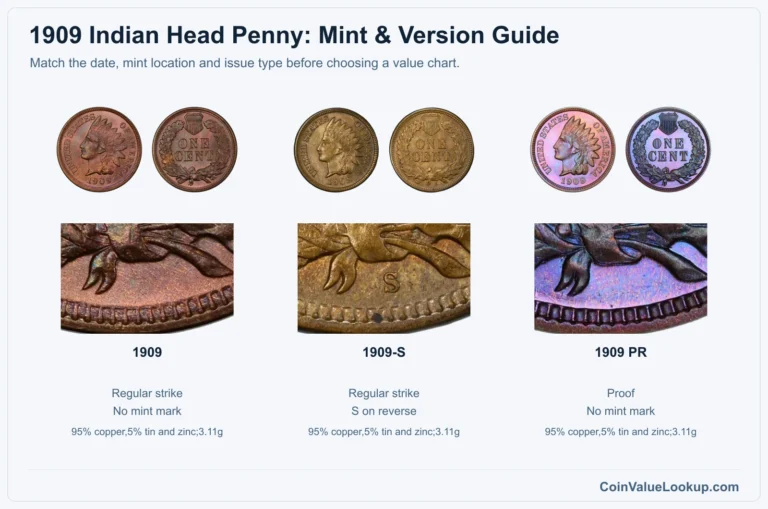
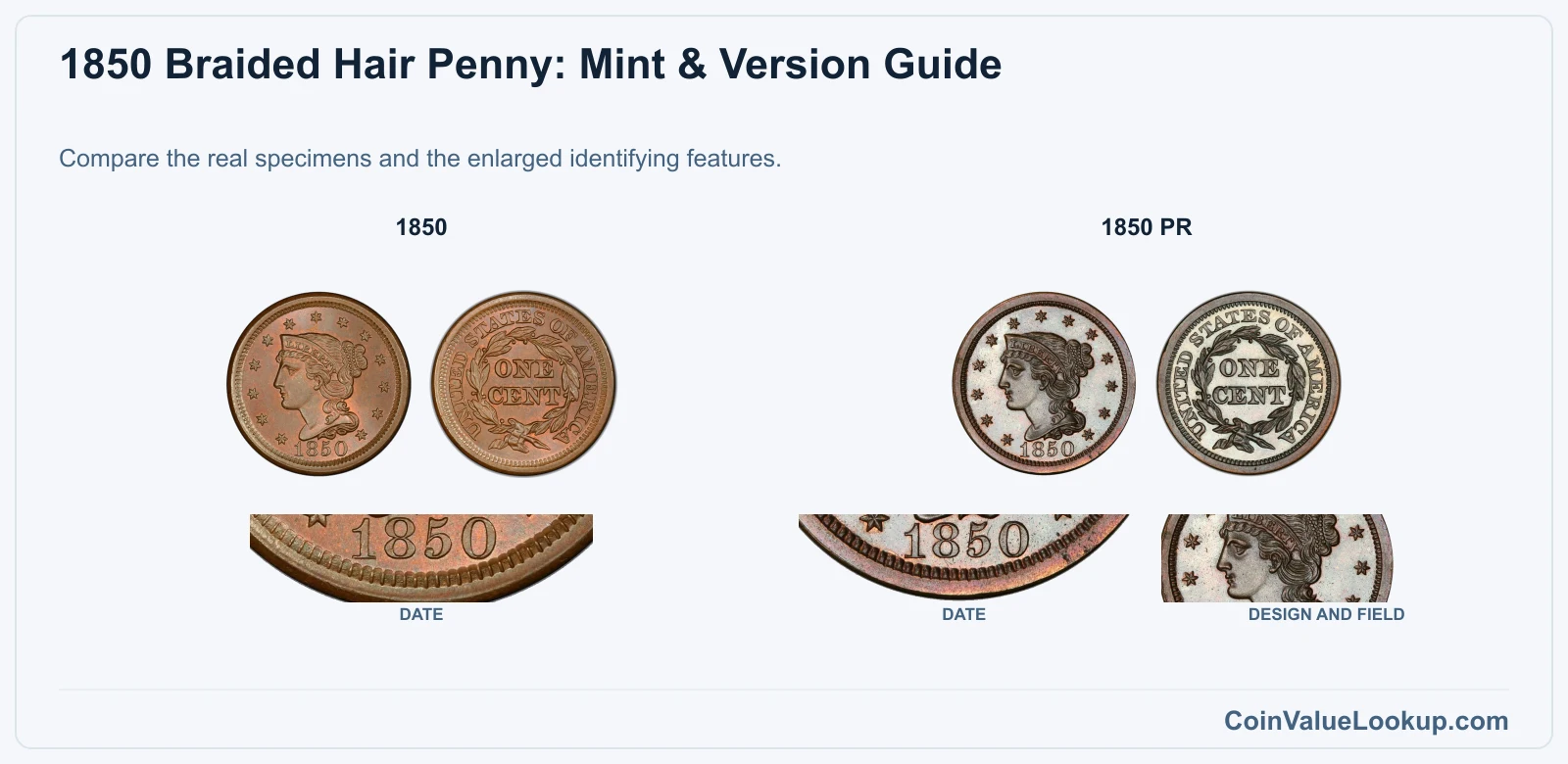
Every 1850 Braided Hair Cent was struck at Philadelphia, so there is no mintmark to hunt for. Do not let anyone convince you a branch-mint version exists for this date.
On the obverse, look for the classic Liberty portrait facing left with hair braided and tied in a bun, encircled by thirteen stars and the date below. The reverse shows the denomination "ONE CENT" inside a laurel wreath.
Match both sides to confirmed Braided Hair examples before assuming you have the right series.
The coin is copper, with a nominal weight around 10.89 grams. Weight alone will not prove authenticity because wear, corrosion and normal production tolerances shift the number.
Use weight as supporting evidence alongside design details, edge appearance and overall feel.
Separate business strikes from proofs carefully. A shiny, polished-looking surface does not equal a proof.
Genuine proofs show specific die characteristics, squared rims and mirror-like fields that result from the manufacturing process, not from someone buffing a circulated coin on a wheel.
Step 2: Check Your 1850 Braided Hair Cent Grade
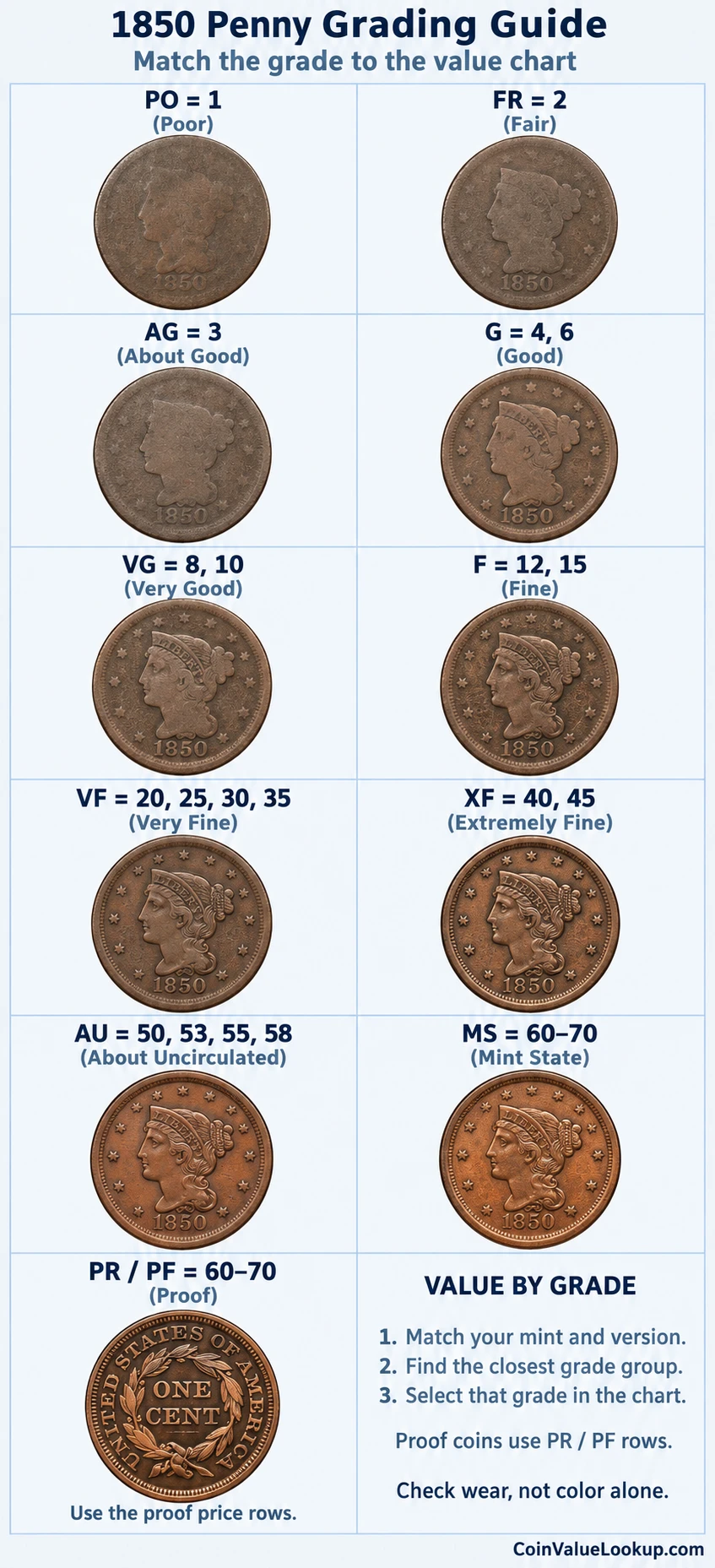
Start with the hair above Liberty's ear and the braid detail near the bun. On a well-worn coin those areas merge into flat spots first.
Check the cheek for smoothness versus original texture, and flip to the reverse to see whether individual leaves in the wreath still show veining.
Use the comparison image to line up your coin against known grade benchmarks of the same type. A G4 coin will have a readable date and enough outline to identify Liberty, but most fine detail is gone.
By MS63 you should see full hair strands, sharp wreath leaves and original luster with only minor contact marks.
Do not confuse a weak strike with wear. Some cents left the press without full detail, and that is a production characteristic, not evidence of circulation.
Likewise, porosity or corrosion eats into the surface differently than honest wear and can drop market value sharply even if the remaining detail looks decent.
Copper coins carry color designations: BN (brown), RB (red-brown) and RD (red). These describe how much original mint color remains, not different metals.
Most survivors from 1850 will be solidly brown.
Step 3: Check 1850 Braided Hair Cent Value by Mint and Version
1850 Braided Hair Cent
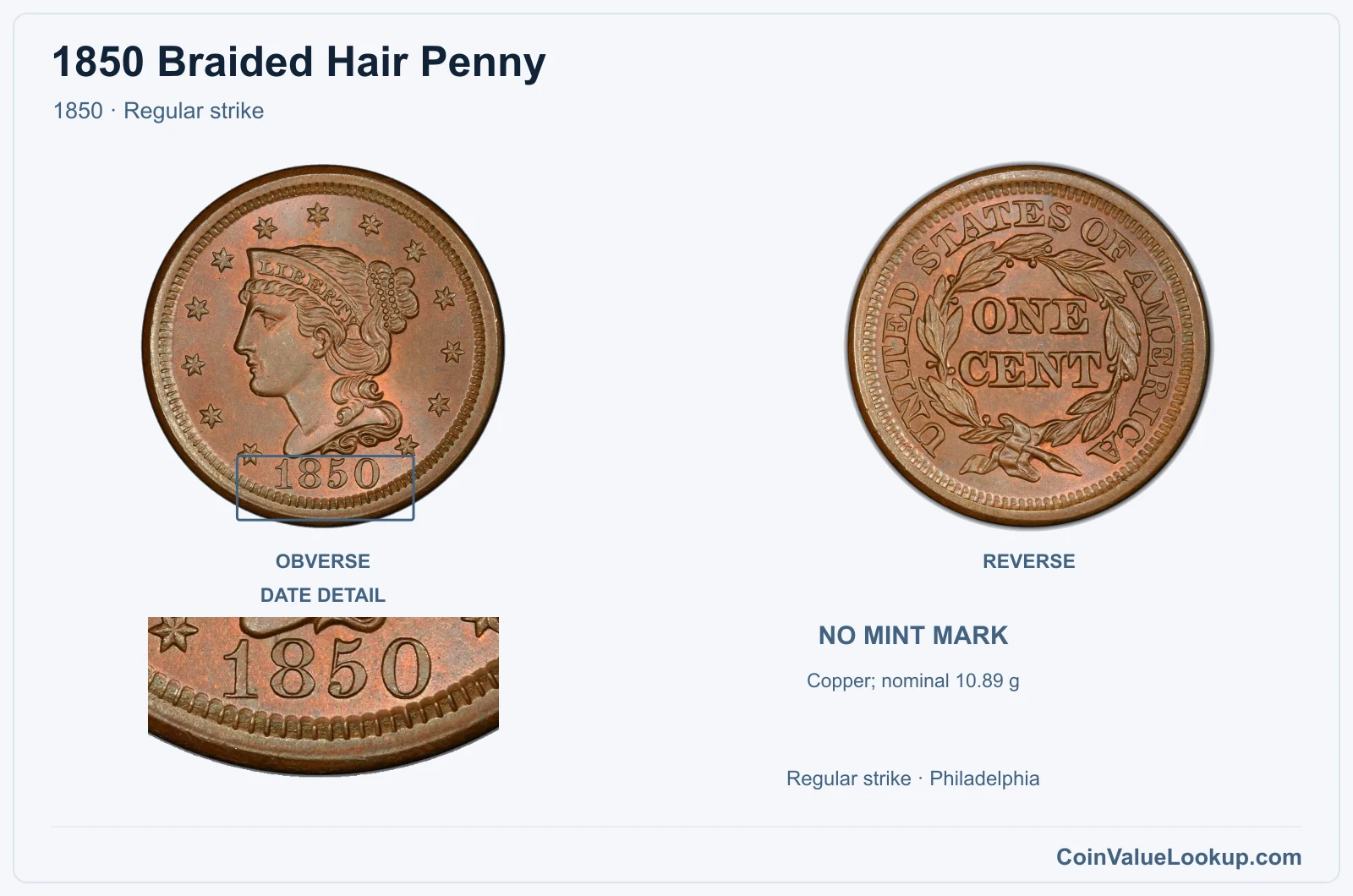
This is the standard 1850 Braided Hair Cent struck for circulation at Philadelphia. No mintmark appears on the coin.
USA Coin Book lists guide estimates from about $30 in G4 up to around $556 in MS63, so condition drives the value dramatically.
Look for the braided Liberty portrait, thirteen stars and date on the obverse, with "ONE CENT" and a wreath on the reverse. Original brown surfaces with no signs of cleaning or tooling will always command stronger interest than a coin that has been scrubbed to look shiny.
Coin Value Lookup is a handy place to compare guide values across different series and dates when you are sorting through a group of old copper cents.
| Range | Grade | Price | Auction Records | Appraisal |
|---|---|---|---|---|
| PO | PO 1 | — | Coin Identifier | |
| FR | FR 2 | — | Coin Identifier | |
| AG | AG 3 | — | Coin Identifier | |
| G | G 4 | — | Coin Identifier | |
| G 6 | — | Coin Identifier | ||
| VG | VG 8 | — | Coin Identifier | |
| VG 10 | — | Coin Identifier | ||
| F | F 12 | — | Coin Identifier | |
| F 15 | — | Coin Identifier | ||
| VF | VF 20 | — | Coin Identifier | |
| VF 25 | — | Coin Identifier | ||
| VF 30 | Coin Identifier | |||
| VF 35 | Coin Identifier | |||
| XF | XF 40 | Coin Identifier | ||
| XF 45 | Coin Identifier | |||
| AU | AU 50 | Coin Identifier | ||
| AU 53 | Coin Identifier | |||
| AU 55 | Coin Identifier | |||
| AU 58 | Coin Identifier | |||
| MS | MS 60 | Coin Identifier | ||
| MS 61 | Coin Identifier | |||
| MS 62 | Coin Identifier | |||
| MS 63 | Coin Identifier | |||
| MS 64 | Coin Identifier | |||
| MS 65 | Coin Identifier | |||
| MS 66 | Coin Identifier | |||
| MS 67 | — | — | — | |
| MS 68 | — | — | — | |
| MS 69 | — | — | — | |
| MS 70 | — | — | — |
1850 Braided Hair Cent — PR
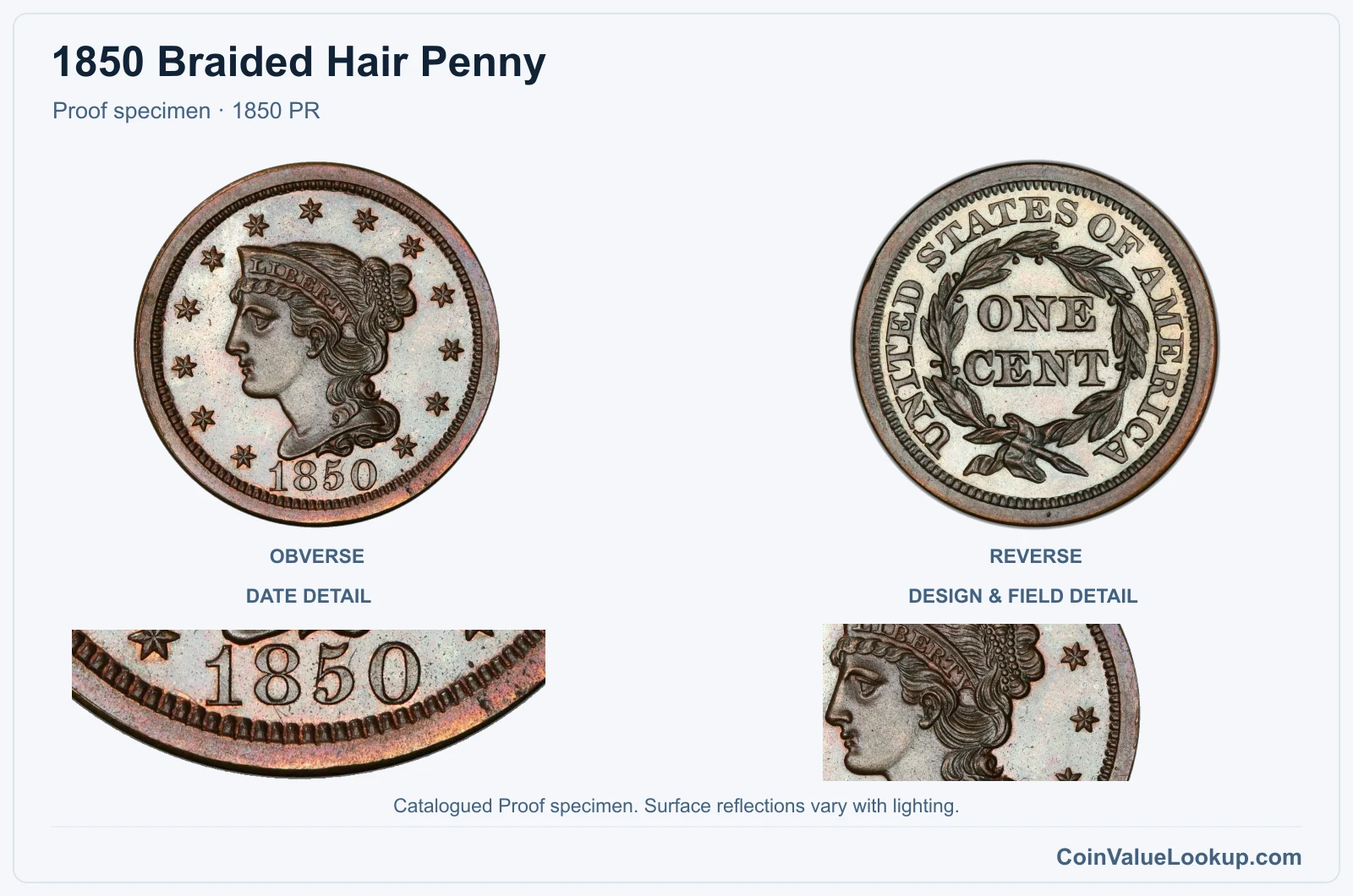
The 1850 Proof Braided Hair Cent is a genuinely rare coin. These were produced in very small numbers at Philadelphia using specially prepared dies and polished planchets, resulting in mirror-like fields and sharp, squared rims that business strikes simply do not have.
No numeric price range has been adopted for this proof because individual assessment matters far more than a generic estimate. Authenticated identity, surface preservation, color and die characteristics all feed into what a specific example is worth.
Be very cautious here. A polished or lightly circulated business strike can mimic proof-like reflectivity to an untrained eye.
True proofs need attribution of their specific die state, rim profile and surface quality by a recognized grading service before you treat one as genuine. If someone offers you an "1850 Proof" without third-party certification, proceed with healthy skepticism.
| Range | Grade | Price | Auction Records | Appraisal |
|---|---|---|---|---|
| PR | PR 1 | — | Coin Identifier | |
| PR 2 | — | Coin Identifier | ||
| PR 3 | — | Coin Identifier | ||
| PR 4 | — | Coin Identifier | ||
| PR 6 | — | Coin Identifier | ||
| PR 8 | — | Coin Identifier | ||
| PR 10 | — | Coin Identifier | ||
| PR 12 | — | Coin Identifier | ||
| PR 15 | — | Coin Identifier | ||
| PR 20 | — | Coin Identifier | ||
| PR 25 | — | Coin Identifier | ||
| PR 30 | — | Coin Identifier | ||
| PR 35 | — | Coin Identifier | ||
| PR 40 | — | Coin Identifier | ||
| PR 45 | — | Coin Identifier | ||
| PR 50 | — | Coin Identifier | ||
| PR 53 | — | Coin Identifier | ||
| PR 55 | — | Coin Identifier | ||
| PR 58 | — | Coin Identifier | ||
| PR 60 | — | Coin Identifier | ||
| PR 61 | — | Coin Identifier | ||
| PR 62 | — | Coin Identifier | ||
| PR 63 | — | Coin Identifier | ||
| PR 64 | Coin Identifier | |||
| PR 65 | Coin Identifier | |||
| PR 66 | — | — | — | |
| PR 67 | — | — | — | |
| PR 68 | — | — | — | |
| PR 69 | — | — | — | |
| PR 70 | — | — | — |
1850 Braided Hair Cent Error List
1. 1850 Braided Hair Cent — Off-Center Strike
An off-center 1850 Braided Hair Cent shows a displaced design with an unstruck crescent along part of the rim, caused by the planchet sitting incorrectly between the dies during striking. The key collecting requirement is that the date remains fully visible; without it, attribution to 1850 becomes very difficult.
Look carefully at the blank crescent area. It should be smooth and correspond geometrically to the shift in design.
A clipped planchet has a curved missing section but the design is still centered. One-sided die misalignment shifts only one face.
Post-mint damage from a vise or hammer can flatten an area but usually leaves tool marks and deformation inconsistent with a genuine off-center strike.
No numeric price range has been adopted for this error on the 1850 date. Value depends on the percentage of off-center shift, date visibility, overall condition and professional authentication.
2. 1850 Braided Hair Cent — Lamination / Split Planchet
A lamination or split planchet error on an 1850 Braided Hair Cent appears as peeling metal, a retained flap or visible separation within the copper itself. These result from impurities or gas trapped in the planchet before striking.
Photograph the edge and the affected face together when documenting this type of error, because edge views reveal the depth and nature of the separation most clearly. The split should follow the metal's internal structure rather than a surface path.
Do not confuse lamination with scraping, environmental corrosion or a deliberately cut coin. Corrosion tends to pit the surface irregularly, and tool marks from cutting or scraping leave directional scratches with sharp, unnatural edges.
A genuine lamination has a layered, flaky quality that looks like the metal itself is coming apart.
No adopted price range exists for this error on the 1850 cent. Each example needs individual evaluation based on severity, eye appeal and authenticated status.
3. 1850 Braided Hair Cent — Die Crack
Die cracks on an 1850 Braided Hair Cent show up as raised lines running across the coin's fields or devices. They are the mirror image of a crack that developed in the steel die during use, so the resulting line on the coin sits above the surrounding surface.
Trace the line in a closeup photo while keeping the full dated coin in frame. Die cracks typically follow a somewhat irregular but continuous path, often radiating from a letter, star or rim toward the center.
The main lookalike is an incuse scratch, which sits below the surface rather than above it. Corrosion channels and tool marks can also mimic cracks, but they lack the consistent raised profile of a genuine die crack.
Run a fingernail or wooden toothpick gently across the line; if it catches going one direction, note whether the line is raised or sunken.
No numeric price has been adopted for die cracks on this date. Severity and location affect desirability.
4. 1850 Braided Hair Cent — Die Break / Cud
A cud is a specific type of die break where a chunk of the die rim has broken away, leaving a raised, featureless blob of metal on the finished coin that connects to the rim. On an 1850 Braided Hair Cent, look for a smooth, raised lump along the edge that interrupts the normal design.
Show the boundary between the cud and the surviving design clearly in photos, because the sharpness of that boundary helps confirm it is a die break rather than damage. The displaced design adjacent to the cud often appears slightly distorted.
Rim dents from post-mint contact are sunken, not raised. Corrosion can build up crusty material near the rim, but it lacks the smooth, metallic continuity of a true cud.
Interior die chips produce small raised spots away from the rim and are a different category entirely.
No adopted price range covers cuds on the 1850 cent. Assessment depends on cud size, location, overall coin condition and third-party verification.
5. 1850 Braided Hair Cent — Clashed Dies
Clashed dies occur when the obverse and reverse dies strike each other without a planchet between them. The result is a faint ghost of the opposite design transferred onto each die, which then prints onto subsequent coins.
On an 1850 Braided Hair Cent, look in the open fields for traces of the wreath on the obverse or hints of the portrait on the reverse. These transferred features should align with where the opposing design would naturally sit during normal die orientation.
Do not mistake random scratches, raised lines from debris in the die, or a brockage for a die clash. Scratches are typically incuse and follow no pattern related to the opposite design.
A brockage involves a previously struck coin acting as a die, producing a much more dramatic and obvious mirror-image impression.
No numeric price has been adopted for clashed-die examples of this date. Value depends on the clarity of the clash, overall coin condition and professional confirmation.