1837 Coronet Head Cent Coin Value: How Much Is It Worth?
The 1837 Coronet Head Cent comes in several distinct varieties, and knowing which one you have matters. Guide estimates from USA Coin Book range from about $30 in G4 to $721 in MS63, depending on the exact variety.
That spread only covers the ordinary business strikes listed below; proofs, restrikes, and major errors fall outside those figures and need individual evaluation.
Fast Way to Identify Your 1837 Coronet Head Cent
The quickest way to start figuring out what you have is to upload clear photos of both sides of your coin. A sharp image of the obverse (front) and reverse (back) lets us run a preliminary identification of the variety, date details, and overall condition.
Edge shots help too, especially if you suspect a planchet problem.
1837 Coronet Head Cent Value
Upload both sides of your 1837 Coronet Head Cent.
Front Obverse
Upload photo
Back Reverse
Upload photo
Which 1837 Coronet Head Cent Versions Are Worth Money?
- The 1837 Plain Cords, Small Letters variety shows the highest listed guide estimate at MS63, reaching about $721 in that grade.
- The 1837 Plain Cords, Medium Letters variety follows closely, with an MS63 guide estimate near $666.
- The 1837 Beaded Cords (Head of 1838) variety carries an MS63 guide estimate around $612.
- Proof examples of the 1837 Coronet Head Cent exist but require individual assessment; no standard guide price is adopted for them.
- Lamination errors on this date are a recognized category worth closer inspection, though pricing depends on the specific coin.
Step 1: Identify Your 1837 Coronet Head Cent Mint Mark and Version
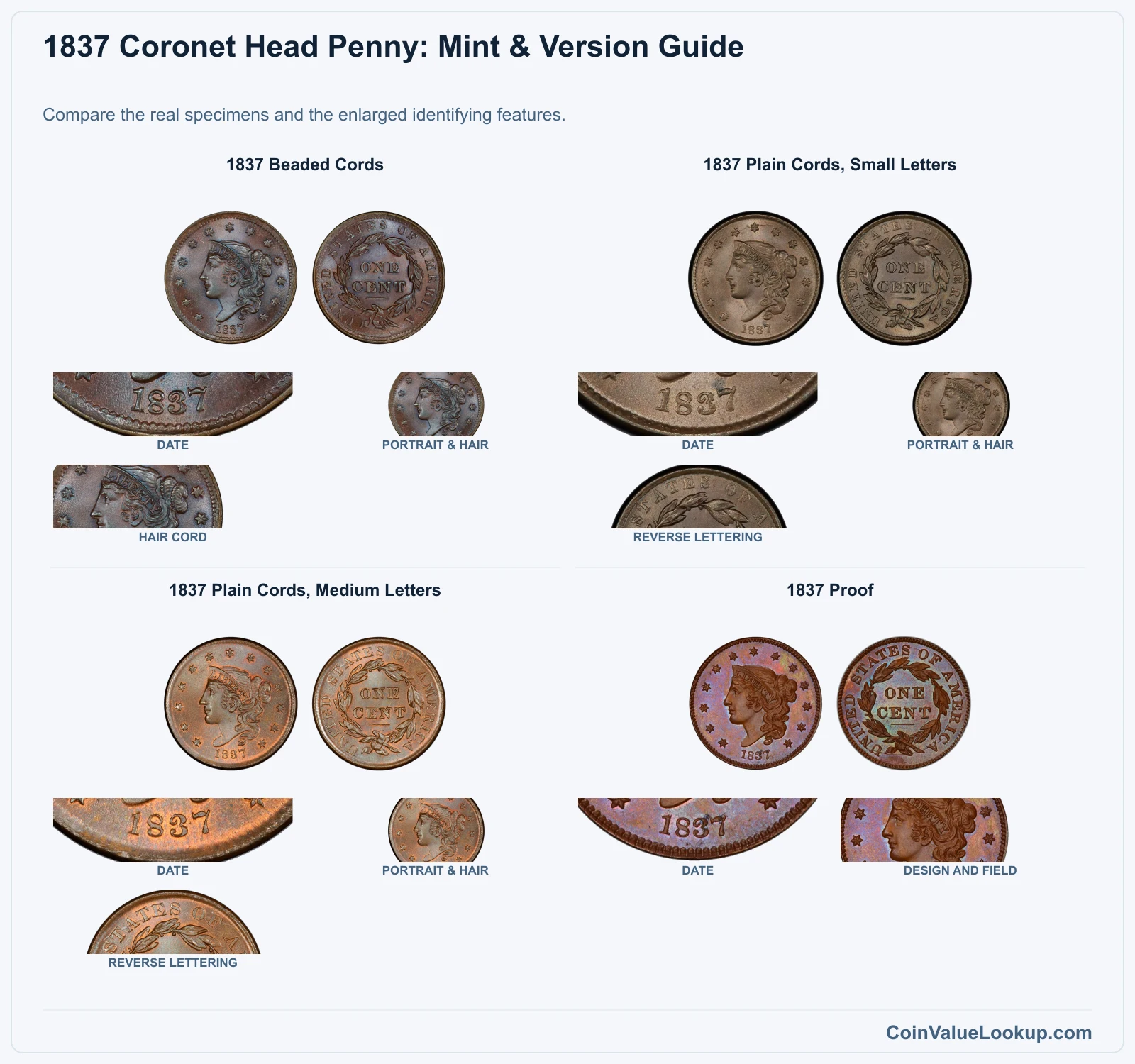
All 1837 Coronet Head Cents were struck at Philadelphia, so there is no mintmark to hunt for. The first thing to check is the hair cord detail on Liberty's portrait: is it beaded (a row of tiny raised dots) or plain (smooth lines)?
If you see beaded cords, you have the "Head of 1838" variety. If the cords are plain, flip the coin over and compare the reverse lettering size.
Small Letters and Medium Letters are two separate die varieties within the Plain Cords group.
Look carefully at both faces and the edge. Date-punch shape, the style of the legend wording, and wreath details all help confirm the correct category.
Weight should be around 10.89 grams in copper, but wear, corrosion, and normal production tolerances mean weight alone cannot prove authenticity. Use it as supporting evidence, not the final word.
Step 2: Check Your 1837 Coronet Head Cent Grade
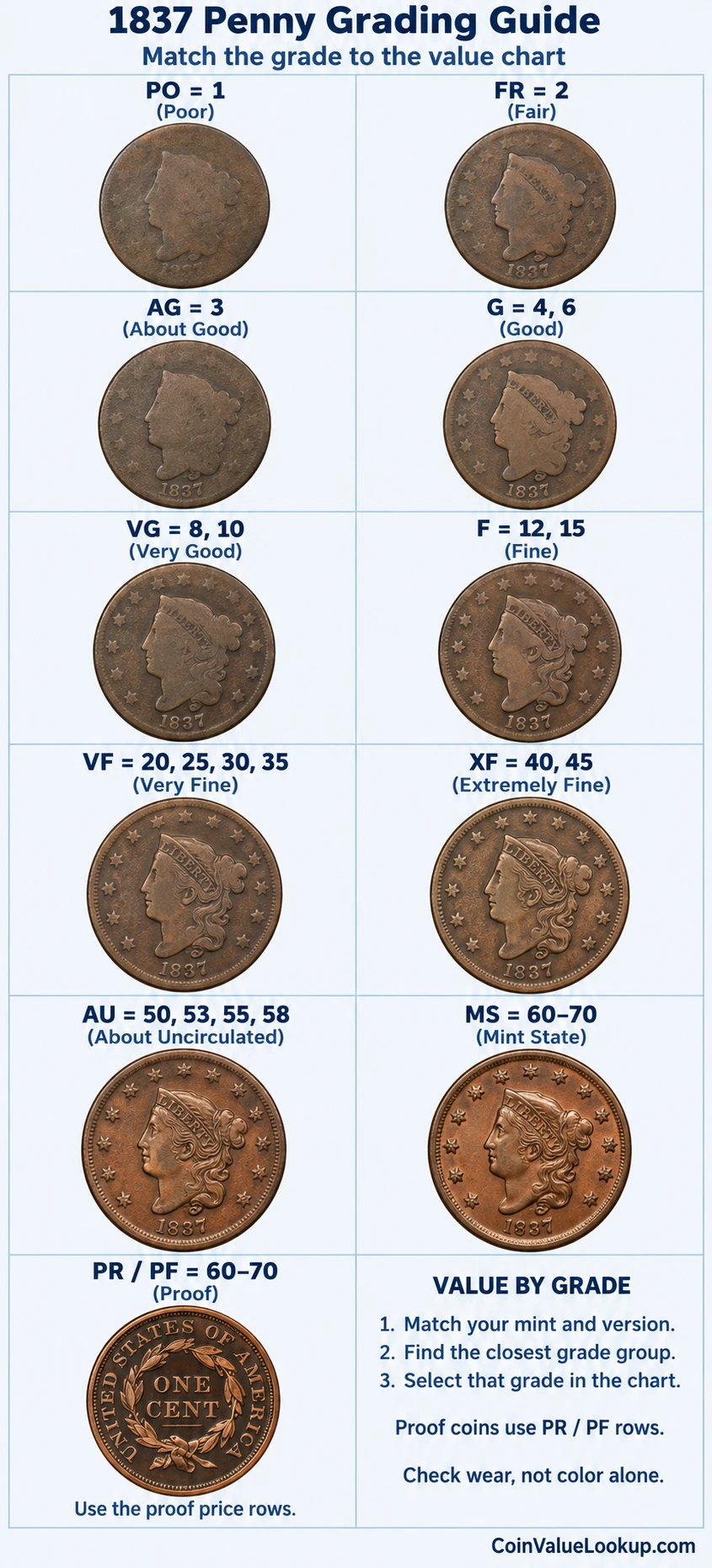
Focus on three areas when judging wear: the hair detail and cheek on Liberty's portrait, the leaf relief on the reverse wreath, and the sharpness of the lettering. Compare your coin side by side with the grade-comparison image for this type.
Do not confuse a weak strike with actual circulation wear. A weakly struck coin may look worn on the high points even though it was never spent.
Corrosion and porosity are separate problems entirely, and they can knock value down hard regardless of how much design detail remains.
Color designations on copper large cents, BN (brown), RB (red-brown), and RD (red), describe the surface color, not different metals. Red survivors command premiums because original copper color oxidizes quickly.
Proof is a method of manufacture, not a grade above Mint State.
Step 3: Check 1837 Coronet Head Cent Value by Mint and Version
1837 Coronet Head Cent — Beaded Cords
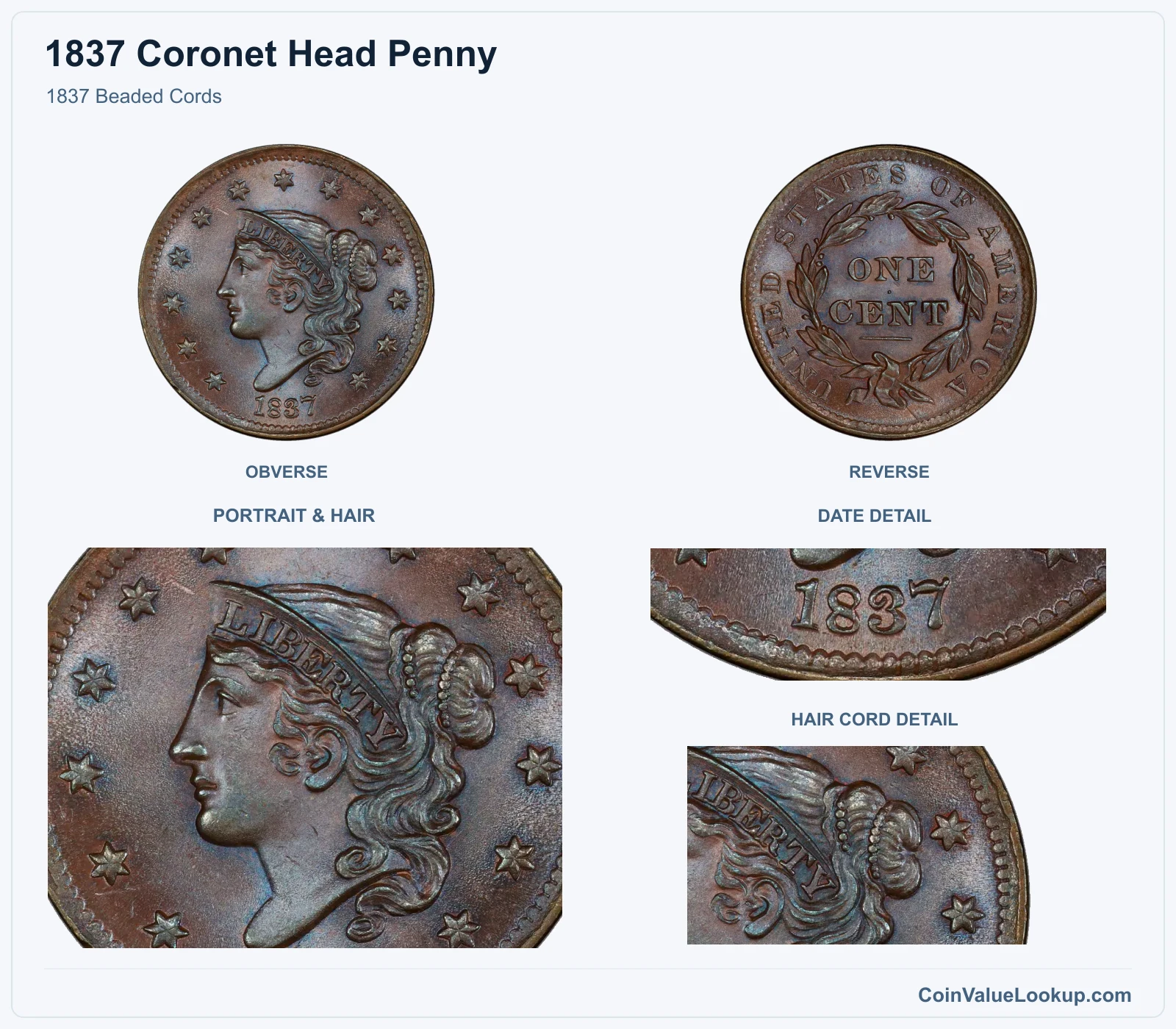
The 1837 Beaded Cords variety is sometimes called the "Head of 1838" because the portrait style was carried into the following year. The identifying feature is a series of small raised beads running along the hair cords behind Liberty's neck.
If those cords look like a string of tiny pearls rather than smooth lines, this is your coin.
USA Coin Book lists guide estimates from roughly $30 in G4 up to about $612 in MS63. Circulated examples are common enough to be affordable, but uncirculated pieces with strong detail and original color are a different story.
All were struck at Philadelphia in copper with a nominal weight of 10.89 grams.
| Range | Grade | Price | Auction Records | Appraisal |
|---|---|---|---|---|
| PO | PO 1 | — | Coin Identifier | |
| FR | FR 2 | — | Coin Identifier | |
| AG | AG 3 | — | Coin Identifier | |
| G | G 4 | — | Coin Identifier | |
| G 6 | — | Coin Identifier | ||
| VG | VG 8 | — | Coin Identifier | |
| VG 10 | — | Coin Identifier | ||
| F | F 12 | Coin Identifier | ||
| F 15 | Coin Identifier | |||
| VF | VF 20 | Coin Identifier | ||
| VF 25 | — | Coin Identifier | ||
| VF 30 | Coin Identifier | |||
| VF 35 | Coin Identifier | |||
| XF | XF 40 | Coin Identifier | ||
| XF 45 | Coin Identifier | |||
| AU | AU 50 | Coin Identifier | ||
| AU 53 | Coin Identifier | |||
| AU 55 | Coin Identifier | |||
| AU 58 | Coin Identifier | |||
| MS | MS 60 | Coin Identifier | ||
| MS 61 | Coin Identifier | |||
| MS 62 | Coin Identifier | |||
| MS 63 | Coin Identifier | |||
| MS 64 | Coin Identifier | |||
| MS 65 | Coin Identifier | |||
| MS 66 | Coin Identifier | |||
| MS 67 | — | — | — | |
| MS 68 | — | — | — | |
| MS 69 | — | — | — | |
| MS 70 | — | — | — |
1837 Coronet Head Cent — Plain Cords, Small Letters
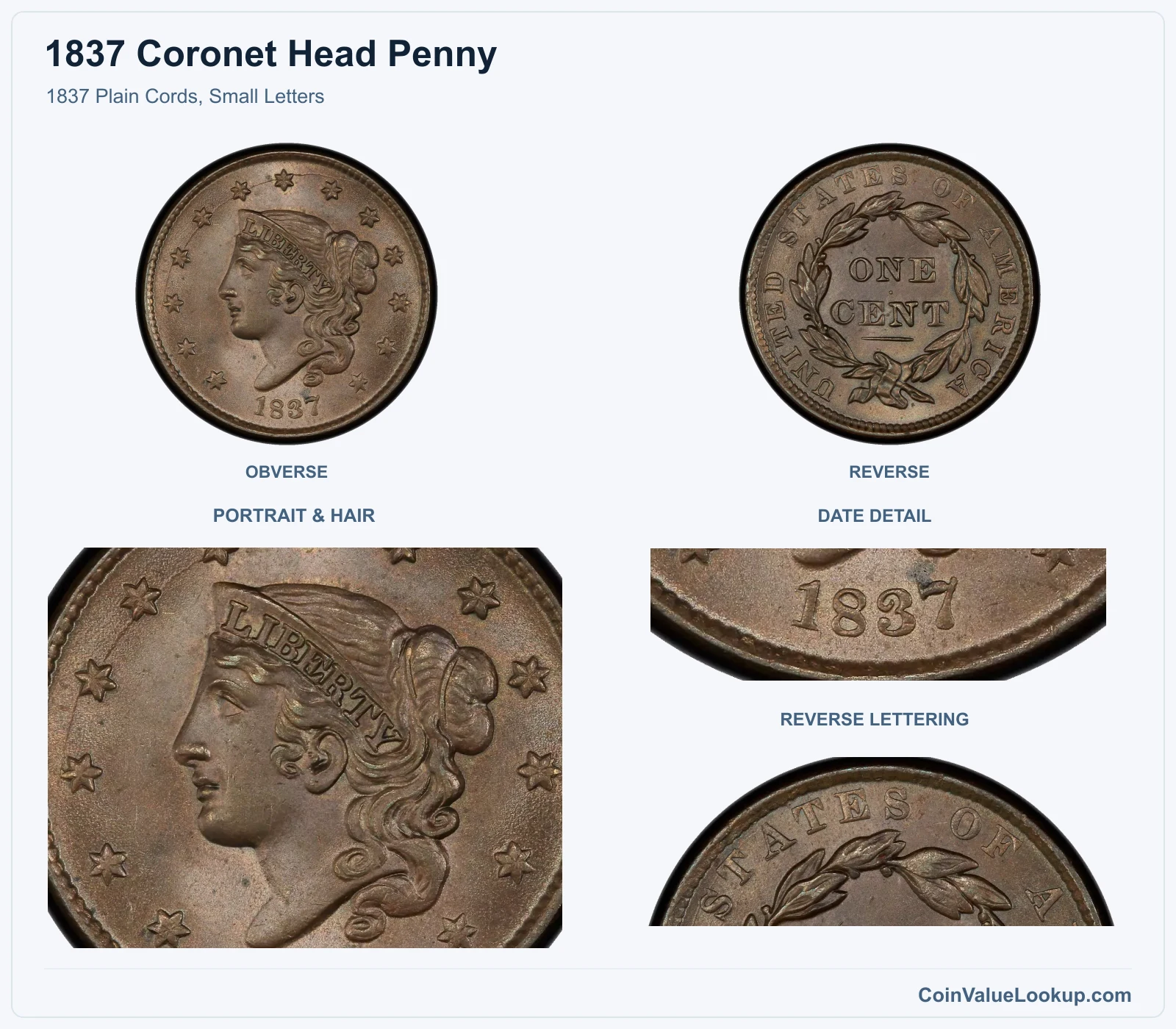
The 1837 Plain Cords, Small Letters variety has smooth, unbeaded hair cords on the obverse and noticeably smaller reverse lettering compared to the Medium Letters die. Flip the coin and hold it next to a known Medium Letters example if you can; the size difference in "ONE CENT" and the wreath legend is the giveaway.
Guide estimates from USA Coin Book run from about $30 in G4 to roughly $721 in MS63, making this the highest-valued ordinary business strike among the 1837 varieties at that grade level. Struck at Philadelphia in copper at the standard 10.89-gram specification.
In lower circulated grades, all three business-strike varieties trade near the same ballpark, so precise variety identification mainly pays off as condition improves.
Coin Value Lookup is a good starting point if you want to look up guide values for other dates and denominations in this series. It covers a wide range of U.S. coin types.
| Range | Grade | Price | Auction Records | Appraisal |
|---|---|---|---|---|
| PO | PO 1 | — | Coin Identifier | |
| FR | FR 2 | — | Coin Identifier | |
| AG | AG 3 | — | Coin Identifier | |
| G | G 4 | — | Coin Identifier | |
| G 6 | — | Coin Identifier | ||
| VG | VG 8 | — | Coin Identifier | |
| VG 10 | — | Coin Identifier | ||
| F | F 12 | — | Coin Identifier | |
| F 15 | — | Coin Identifier | ||
| VF | VF 20 | — | Coin Identifier | |
| VF 25 | — | Coin Identifier | ||
| VF 30 | Coin Identifier | |||
| VF 35 | Coin Identifier | |||
| XF | XF 40 | Coin Identifier | ||
| XF 45 | Coin Identifier | |||
| AU | AU 50 | Coin Identifier | ||
| AU 53 | Coin Identifier | |||
| AU 55 | Coin Identifier | |||
| AU 58 | Coin Identifier | |||
| MS | MS 60 | Coin Identifier | ||
| MS 61 | Coin Identifier | |||
| MS 62 | Coin Identifier | |||
| MS 63 | Coin Identifier | |||
| MS 64 | Coin Identifier | |||
| MS 65 | Coin Identifier | |||
| MS 66 | Coin Identifier | |||
| MS 67 | — | — | — | |
| MS 68 | — | — | — | |
| MS 69 | — | — | — | |
| MS 70 | — | — | — |
1837 Coronet Head Cent — Plain Cords, Medium Letters
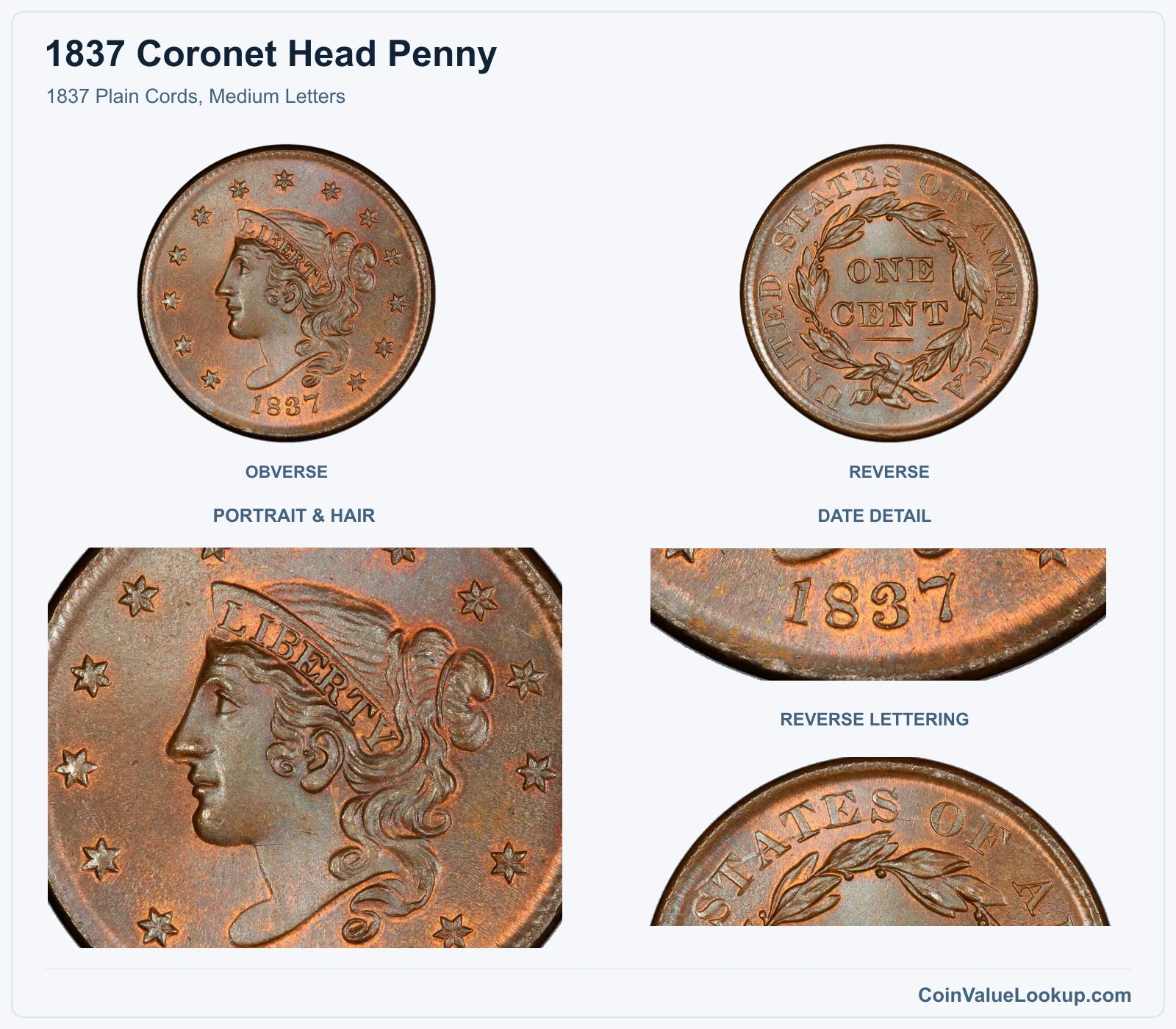
Plain Cords, Medium Letters is the third business-strike variety for 1837. The obverse shares the same smooth hair cord as the Small Letters version, but the reverse lettering is visibly larger.
Side-by-side comparison is the most reliable way to tell them apart; the difference is real but subtle in isolation.
USA Coin Book places guide estimates from around $30 in G4 to approximately $666 in MS63. That slots it between the Beaded Cords and Small Letters varieties at the top grade, though at lower circulated levels the three are nearly interchangeable in value.
Philadelphia mint, copper, nominal 10.89 grams, same as its siblings.
| Range | Grade | Price | Auction Records | Appraisal |
|---|---|---|---|---|
| PO | PO 1 | — | Coin Identifier | |
| FR | FR 2 | — | Coin Identifier | |
| AG | AG 3 | — | Coin Identifier | |
| G | G 4 | — | Coin Identifier | |
| G 6 | — | Coin Identifier | ||
| VG | VG 8 | Coin Identifier | ||
| VG 10 | Coin Identifier | |||
| F | F 12 | Coin Identifier | ||
| F 15 | — | Coin Identifier | ||
| VF | VF 20 | Coin Identifier | ||
| VF 25 | Coin Identifier | |||
| VF 30 | Coin Identifier | |||
| VF 35 | Coin Identifier | |||
| XF | XF 40 | Coin Identifier | ||
| XF 45 | Coin Identifier | |||
| AU | AU 50 | Coin Identifier | ||
| AU 53 | Coin Identifier | |||
| AU 55 | Coin Identifier | |||
| AU 58 | Coin Identifier | |||
| MS | MS 60 | Coin Identifier | ||
| MS 61 | Coin Identifier | |||
| MS 62 | Coin Identifier | |||
| MS 63 | Coin Identifier | |||
| MS 64 | Coin Identifier | |||
| MS 65 | Coin Identifier | |||
| MS 66 | Coin Identifier | |||
| MS 67 | Coin Identifier | |||
| MS 68 | — | — | — | |
| MS 69 | — | — | — | |
| MS 70 | — | — | — |
1837 Coronet Head Cent — Proof
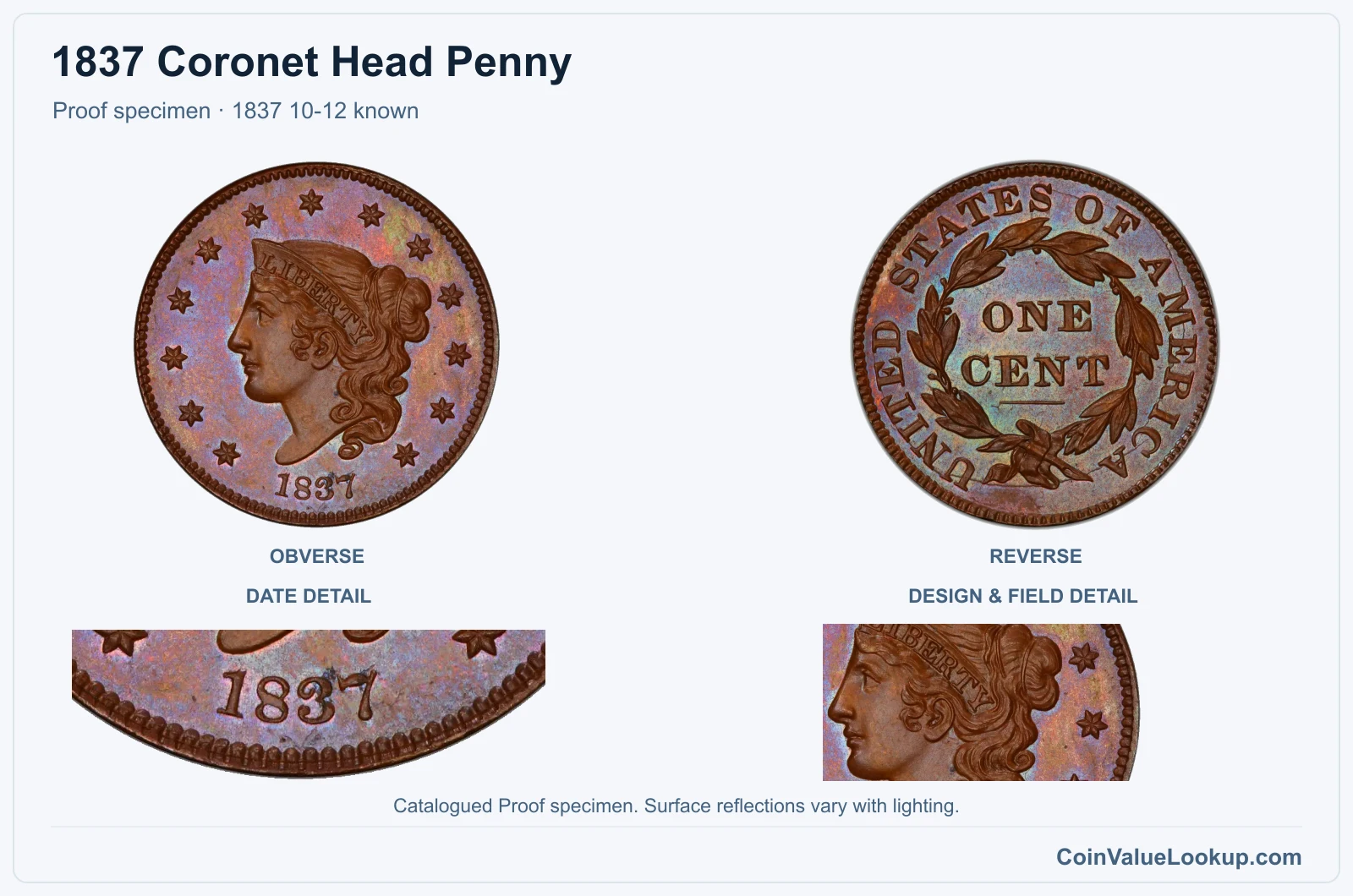
Proof 1837 Coronet Head Cents exist but are genuinely rare early copper proofs. A real proof was struck from specially prepared dies on a carefully selected planchet, producing sharp rims, full detail, and often mirror-like fields.
Polishing a business strike does not create a proof, no matter how shiny it gets.
No standard guide price is adopted for these coins. Each one needs individual assessment based on authenticated identity, surface quality, rim characteristics, and die diagnostics.
PCGS catalogs this issue among the early proof Coronet cents. If you suspect yours is a proof, professional authentication is essential before drawing any value conclusions.
The hair cords, whether beaded or plain, still apply, so variety attribution matters even on proof strikes.
| Range | Grade | Price | Auction Records | Appraisal |
|---|---|---|---|---|
| PR | PR 1 | — | Coin Identifier | |
| PR 2 | — | Coin Identifier | ||
| PR 3 | — | Coin Identifier | ||
| PR 4 | — | Coin Identifier | ||
| PR 6 | — | Coin Identifier | ||
| PR 8 | — | Coin Identifier | ||
| PR 10 | — | Coin Identifier | ||
| PR 12 | — | Coin Identifier | ||
| PR 15 | — | Coin Identifier | ||
| PR 20 | — | Coin Identifier | ||
| PR 25 | — | Coin Identifier | ||
| PR 30 | — | Coin Identifier | ||
| PR 35 | — | Coin Identifier | ||
| PR 40 | — | Coin Identifier | ||
| PR 45 | — | Coin Identifier | ||
| PR 50 | — | Coin Identifier | ||
| PR 53 | — | Coin Identifier | ||
| PR 55 | — | Coin Identifier | ||
| PR 58 | — | Coin Identifier | ||
| PR 60 | — | Coin Identifier | ||
| PR 61 | — | Coin Identifier | ||
| PR 62 | — | Coin Identifier | ||
| PR 63 | Coin Identifier | |||
| PR 64 | Coin Identifier | |||
| PR 65 | Coin Identifier | |||
| PR 66 | — | — | — | |
| PR 67 | — | — | — | |
| PR 68 | — | — | — | |
| PR 69 | — | — | — | |
| PR 70 | — | — | — |
1837 Coronet Head Cent Error List
1. 1837 Coronet Head Cent — Lamination / Split Planchet
Lamination errors on the 1837 Coronet Head Cent show up as peeling metal, a retained flap, or visible separation within the copper planchet. These happen when the original planchet has internal impurities or gas pockets that split apart under striking pressure.
Look at the edge of the coin carefully; a true lamination will often be visible there as a distinct layer pulling away.
The main lookalikes are post-mint damage: scraping from tools, corrosion eating into the surface, or someone deliberately cutting into the coin. A genuine lamination follows the contour of the planchet and does not show fresh bright metal underneath.
Photograph the edge and the affected face together for the clearest documentation.
No specific price range is adopted for this error on the 1837 cent. Value depends on the size and visual drama of the flaw, the underlying variety, and the coin's overall condition.
Cleaning or heavy corrosion elsewhere on the coin will reduce appeal regardless of the error.