1828 Coronet Head Cent Coin Value: How Much Is It Worth?
An 1828 Coronet Head cent is a copper coin struck at Philadelphia, and depending on the exact variety and condition, guide estimates range from about $38 in Good-4 up to $4,751 in MS-63. That spread depends entirely on which date-punch variety you have and how well the coin survived nearly two centuries of handling.
Identifying your specific variety is the first step before putting any value on it.
Fast Way to Identify Your 1828 Coronet Head Cent
The quickest way to start figuring out what you have is to upload clear photos of both the front and back of your coin. Our identifier can give you a preliminary read on the variety, date-punch style, and overall condition.
Good lighting and a steady hand help — try to capture the full date and all legend lettering without glare or shadow.
1828 Coronet Head Cent Value
Upload both sides of your 1828 Coronet Head Cent.
Front Obverse
Upload photo
Back Reverse
Upload photo
Which 1828 Coronet Head Cent Versions Are Worth Money?
- The Small Wide Date variety carries the higher guide estimate at $4,751 in MS-63, compared to $3,377 for the Large Narrow Date in the same grade — so identifying the punch size and spacing matters.
- In lower circulated grades, the two varieties are closer in value: $38 versus $43 at Good-4. Condition drives most of the premium.
- Proof 1828 cents exist but require expert attribution of die characteristics, surfaces, and rims; no standard guide price is adopted for them.
- Listed mint errors such as die cracks, cuds, and rotated dies can add appeal, but each needs individual assessment based on authenticated identity and severity.
Step 1: Identify Your 1828 Coronet Head Cent Mint Mark and Version
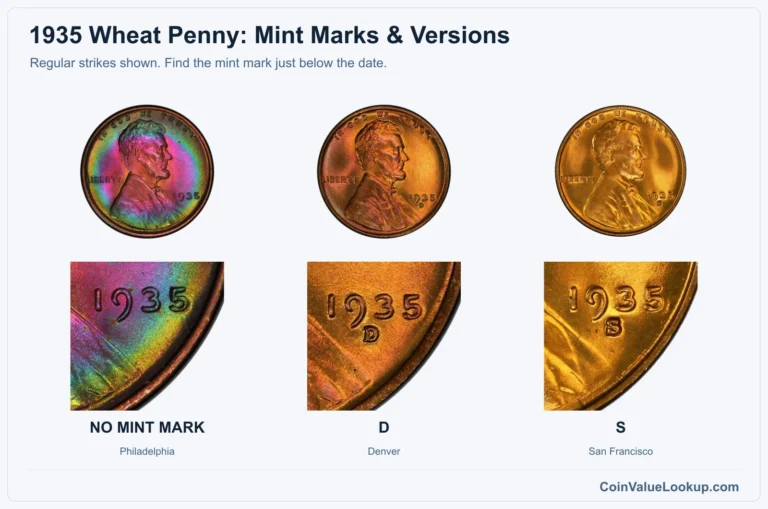
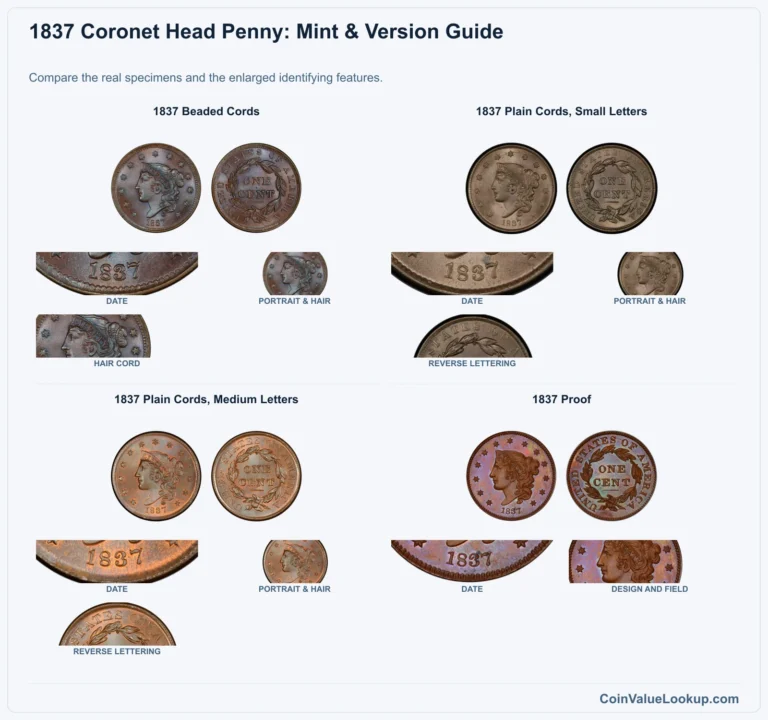
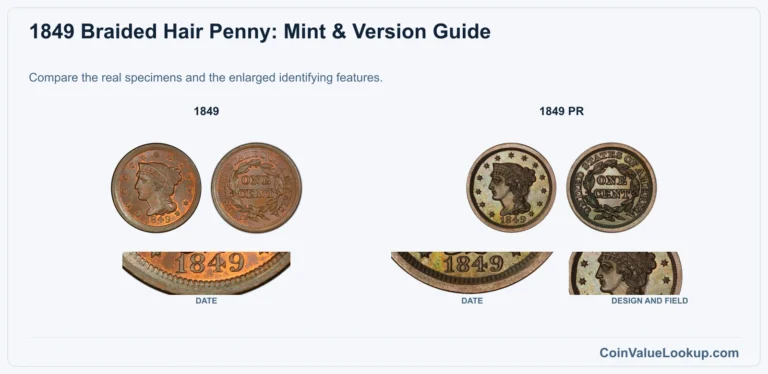
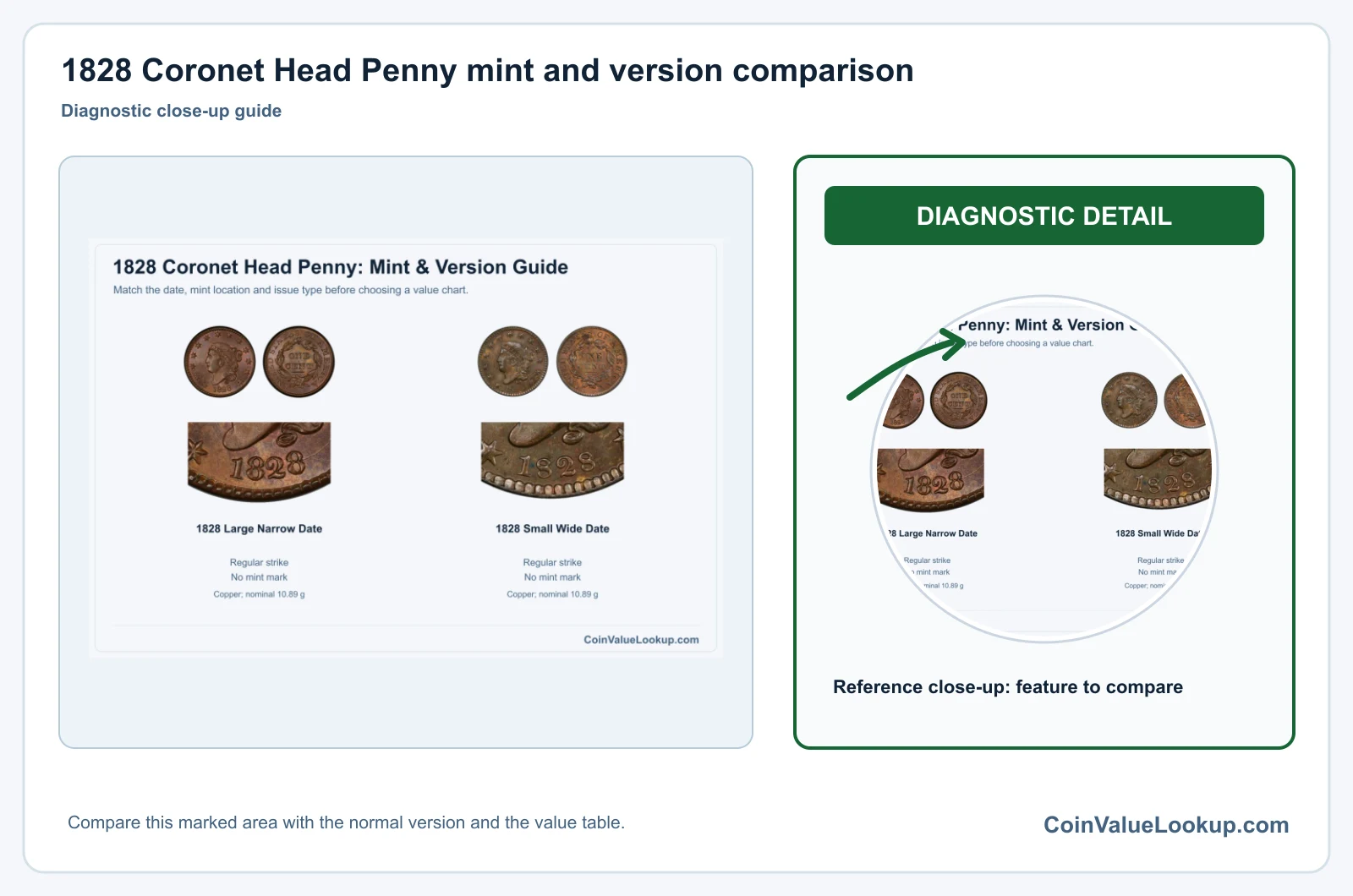
Every 1828 Coronet Head cent was struck at Philadelphia, so there is no mintmark to look for. The key distinction is between two business-strike varieties: the Large Narrow Date and the Small Wide Date.
These names describe two things at once — the size of the digit punches and the spacing between them. On the Large Narrow Date, the individual numerals are taller but sit closer together.
On the Small Wide Date, the digits are shorter but spread farther apart.
To compare, look at the "1" and "8" side by side at the same magnification. The height difference is real but subtle, so having a reference image of each variety open next to your coin helps a lot.
Don't rely on one digit; check all four.
Beyond the date, inspect both faces and the edge. Weight should be roughly 10.89 grams for a genuine copper cent, though wear, corrosion, and normal production tolerances mean weight alone won't prove authenticity.
Surface texture, rim style, and wreath details all matter when confirming your coin falls into the correct category.
Step 2: Check Your 1828 Coronet Head Cent Grade
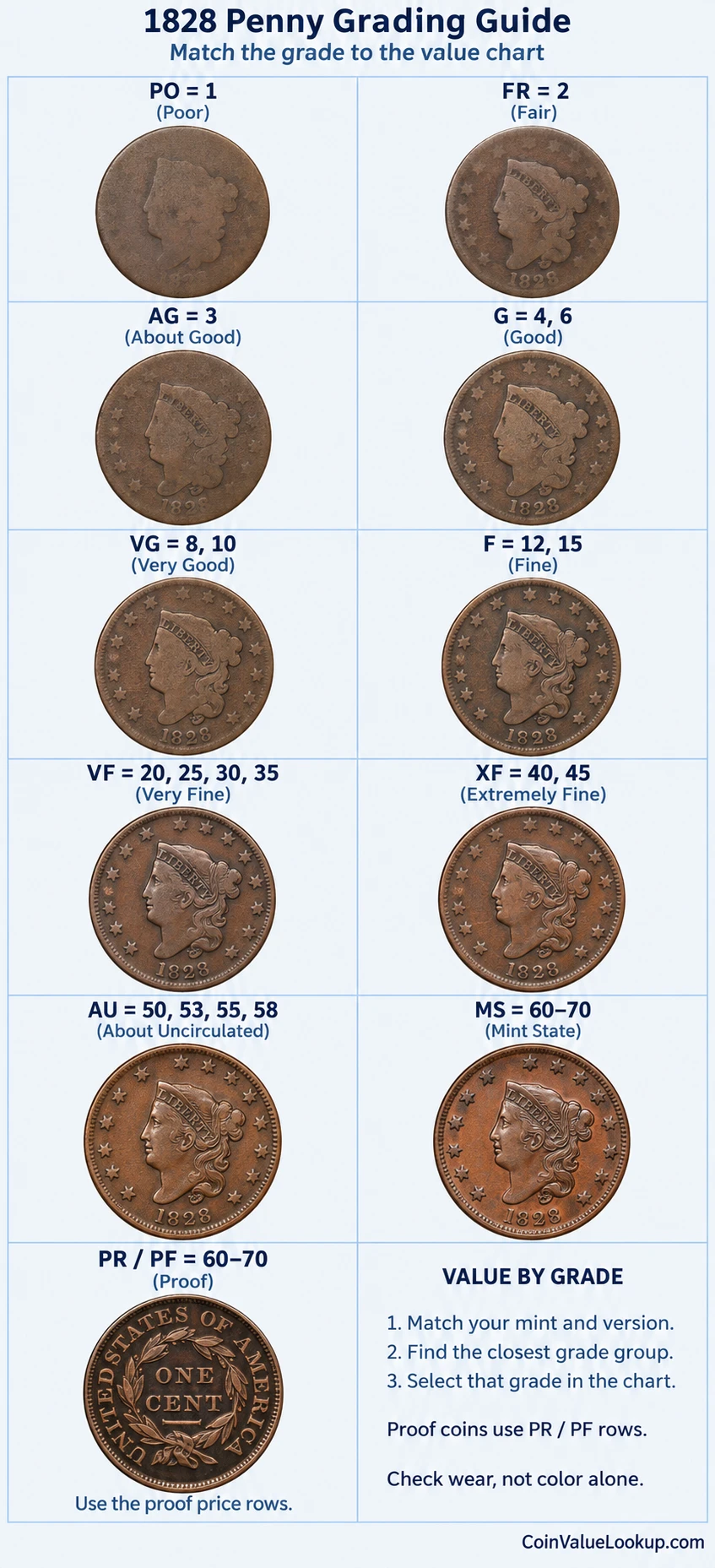
Start with the portrait. On a well-worn coin, Liberty's hair above the forehead goes flat first, then the cheek loses definition.
A coin grading Good-4 will show a clear outline and date but little interior detail.
Flip it over and check the wreath. Leaf veins and berry details fade with circulation, and by About Good most are gone.
Compare your coin's remaining relief against like-type grade examples in the reference image.
Separate honest wear from damage. A weakly struck area can mimic wear, but it usually appears in a localized spot rather than across the whole device.
Corrosion and porosity eat into surfaces differently than friction does — look for pitting versus smooth flatness.
On copper cents, color matters. BN (brown), RB (red-brown), and RD (red) describe how much original copper color remains.
They are color attributes, not different alloys or separate grades. Most survivors this old are full brown.
A proof is a method of manufacture — mirror fields, sharp rims, careful striking — not a grade above Mint State. Cleaning, whizzing, or polishing a business strike does not create a proof.
Surface problems like scratches, corrosion, or old cleaning can lower market value well below what the technical grade might suggest.
Step 3: Check 1828 Coronet Head Cent Value by Mint and Version
1828 Coronet Head Cent — Large Narrow Date
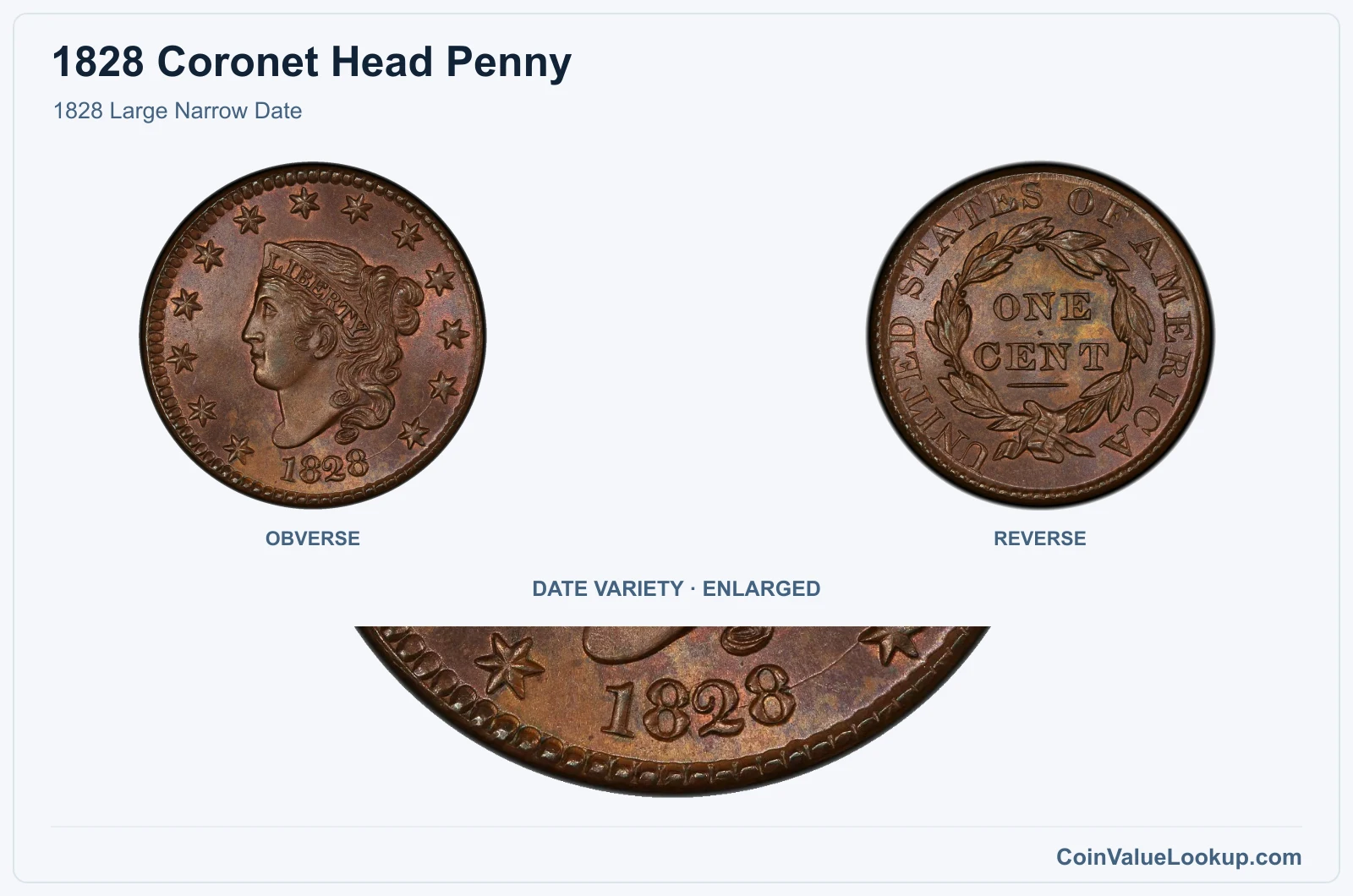
The 1828 Large Narrow Date uses taller digit punches that sit relatively close together. Hold the coin so the date is upright and compare the height of the "8" digits against a known Small Wide Date example — the difference becomes clear at moderate magnification.
Guide estimates from USA Coin Book place this variety at about $38 in Good-4 and around $3,377 in MS-63. Most survivors you encounter will be well-circulated brown copper pieces falling somewhere in the lower end of that range.
Mint-state examples with strong detail and minimal surface problems are genuinely scarce for an early copper cent of this era.
Coin Value Lookup is a good starting point if you want to compare this variety's value against other Coronet Head cent dates. You can look up individual years and denominations to see where your coin fits in the broader series.
| Range | Grade | Price | Auction Records | Appraisal |
|---|---|---|---|---|
| PO | PO 1 | — | Coin Identifier | |
| FR | FR 2 | — | Coin Identifier | |
| AG | AG 3 | — | Coin Identifier | |
| G | G 4 | — | Coin Identifier | |
| G 6 | Coin Identifier | |||
| VG | VG 8 | Coin Identifier | ||
| VG 10 | — | Coin Identifier | ||
| F | F 12 | Coin Identifier | ||
| F 15 | Coin Identifier | |||
| VF | VF 20 | Coin Identifier | ||
| VF 25 | Coin Identifier | |||
| VF 30 | Coin Identifier | |||
| VF 35 | Coin Identifier | |||
| XF | XF 40 | Coin Identifier | ||
| XF 45 | Coin Identifier | |||
| AU | AU 50 | Coin Identifier | ||
| AU 53 | Coin Identifier | |||
| AU 55 | Coin Identifier | |||
| AU 58 | Coin Identifier | |||
| MS | MS 60 | Coin Identifier | ||
| MS 61 | Coin Identifier | |||
| MS 62 | Coin Identifier | |||
| MS 63 | Coin Identifier | |||
| MS 64 | Coin Identifier | |||
| MS 65 | Coin Identifier | |||
| MS 66 | Coin Identifier | |||
| MS 67 | — | — | — | |
| MS 68 | — | — | — | |
| MS 69 | — | — | — | |
| MS 70 | — | — | — |
1828 Coronet Head Cent — Small Wide Date
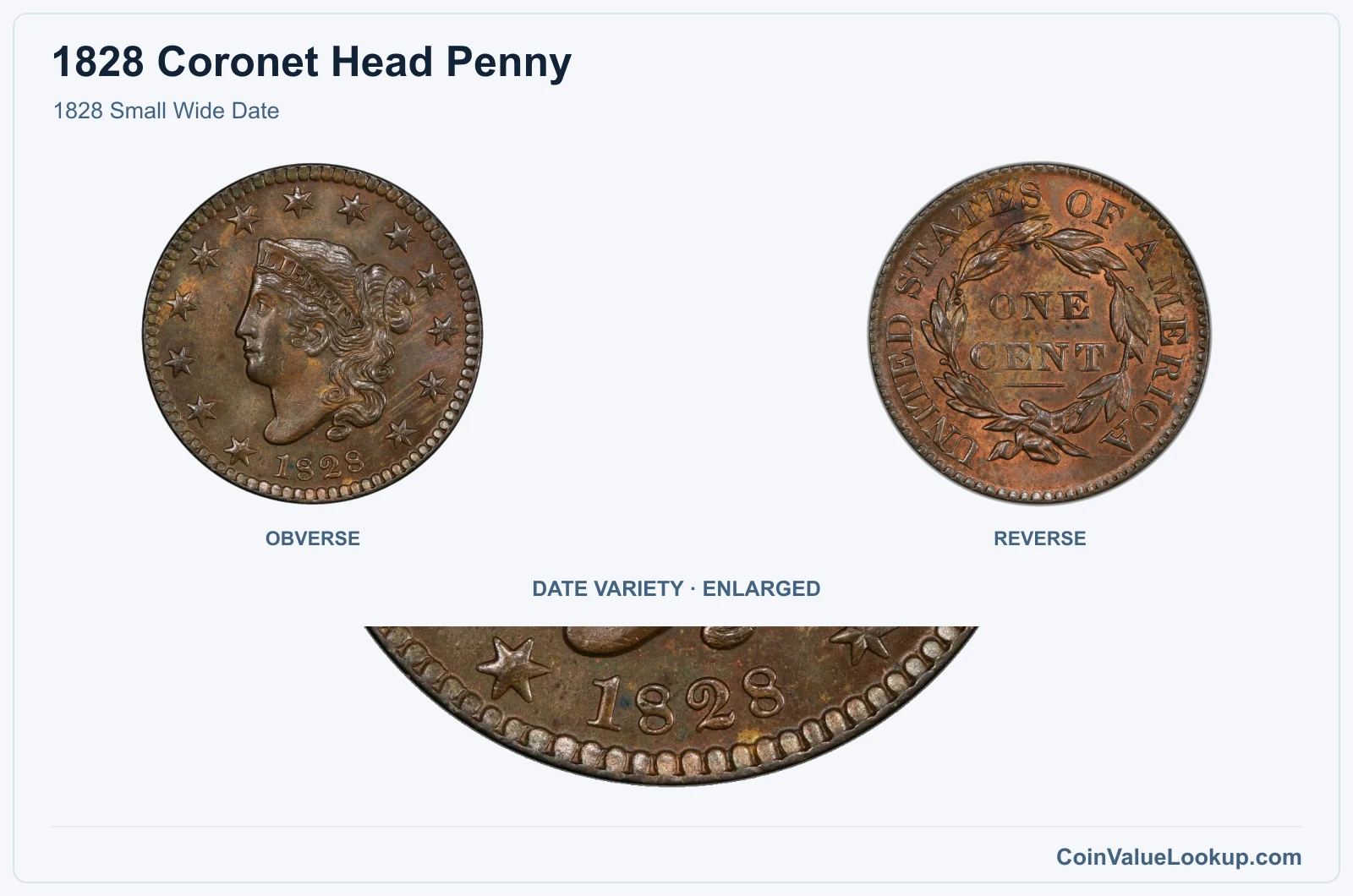
The 1828 Small Wide Date uses noticeably shorter digit punches that are spaced farther apart. The gap between the "1" and the "8" is wider than on the Large Narrow Date, and the overall impression is of a more spread-out, compact date.
USA Coin Book guide estimates put this variety at roughly $43 in Good-4 and about $4,751 in MS-63. That MS-63 figure is higher than the Large Narrow Date in the same grade, which makes correct identification worthwhile.
Still, most examples you run across will be circulated and brown, where the two varieties trade much closer together.
Copper cents from the late 1820s often show porosity, rim bumps, or old cleaning. Any of these conditions can reduce what a buyer is willing to pay, regardless of the technical grade.
| Range | Grade | Price | Auction Records | Appraisal |
|---|---|---|---|---|
| PO | PO 1 | — | Coin Identifier | |
| FR | FR 2 | — | Coin Identifier | |
| AG | AG 3 | — | Coin Identifier | |
| G | G 4 | Coin Identifier | ||
| G 6 | Coin Identifier | |||
| VG | VG 8 | — | Coin Identifier | |
| VG 10 | — | Coin Identifier | ||
| F | F 12 | — | Coin Identifier | |
| F 15 | Coin Identifier | |||
| VF | VF 20 | — | Coin Identifier | |
| VF 25 | — | Coin Identifier | ||
| VF 30 | Coin Identifier | |||
| VF 35 | Coin Identifier | |||
| XF | XF 40 | Coin Identifier | ||
| XF 45 | Coin Identifier | |||
| AU | AU 50 | Coin Identifier | ||
| AU 53 | Coin Identifier | |||
| AU 55 | Coin Identifier | |||
| AU 58 | Coin Identifier | |||
| MS | MS 60 | — | Coin Identifier | |
| MS 61 | — | Coin Identifier | ||
| MS 62 | Coin Identifier | |||
| MS 63 | Coin Identifier | |||
| MS 64 | Coin Identifier | |||
| MS 65 | — | — | — | |
| MS 66 | — | — | — | |
| MS 67 | — | — | — | |
| MS 68 | — | — | — | |
| MS 69 | — | — | — | |
| MS 70 | — | — | — |
1828 Coronet Head Cent — Proof
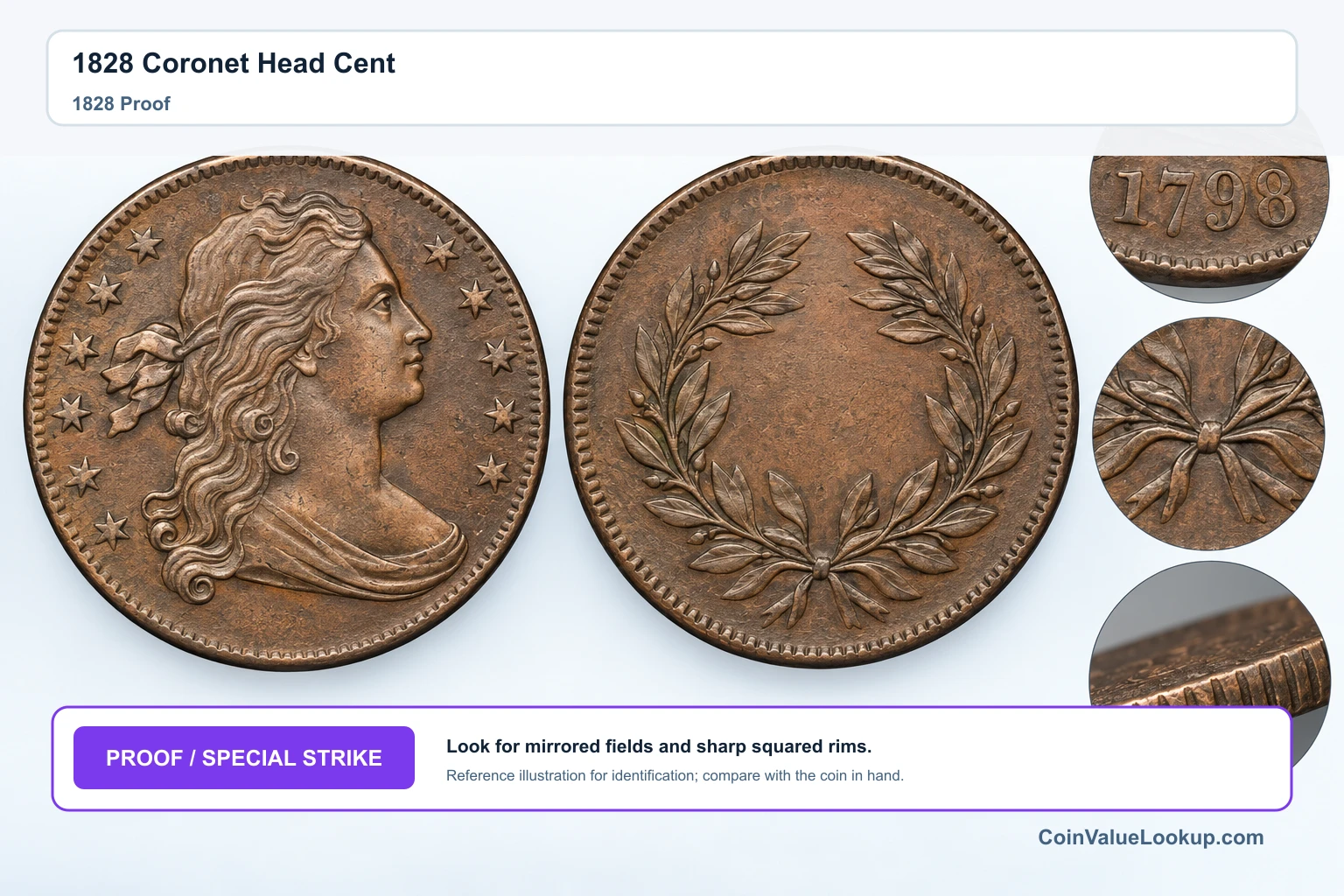
Proof 1828 Coronet Head cents are cataloged but extremely rare. A genuine early proof will show mirror-like fields, squared rims, and sharp die detail that goes well beyond what even a choice business strike displays.
No standard numeric guide price is adopted for this variety. Each proof requires individual assessment based on its authenticated identity, die characteristics, surface preservation, and any impairments.
Polishing a business strike does not produce a proof — the die preparation, striking pressure, and planchet selection are fundamentally different from normal production.
If you believe you have an 1828 proof, authentication by a recognized grading service is essential. Both the Large Narrow Date and Small Wide Date punch styles exist in the series, so even within proofs the exact die marriage matters.
Do not assume a shiny or well-preserved cent is automatically a proof; many early coppers were cleaned at some point in their history, which can mimic reflective surfaces to an untrained eye.
Values by grade are not available for this coin yet.
1828 Coronet Head Cent Error List
1. 1828 Coronet Head Cent — Rotated Dies
On a normally struck U.S. coin, if you hold the obverse upright and flip the coin top-to-bottom, the reverse should also appear upright. A rotated-die error means the reverse is tilted — sometimes just a few degrees, sometimes dramatically.
To check, hold Liberty's portrait right-side-up and rotate the coin along its vertical axis. If the wreath on the back is noticeably off-center from the expected orientation, you may have a die rotation.
The degree of rotation affects collector interest; a slight tilt is far more common than a major one.
Be careful with photos — a picture taken at an angle or a coin casually turned sideways can fake this effect. Always test with the physical coin in hand.
No standard guide price is adopted for this error on the 1828 cent; value depends on the severity of rotation, the coin's authenticated identity, and overall condition.
2. 1828 Coronet Head Cent — Die Crack
Die cracks appear as thin raised lines running across the coin's surface. They form when the steel die develops a fracture during use, and molten metal fills the gap during striking, leaving a ridge on the finished coin.
Look for lines that cross open fields or cut through lettering and devices. They are raised above the surface, which distinguishes them from scratches or tool marks that are incused — pressed into the metal.
Corrosion lines can sometimes mimic a crack, so use magnification and check whether the line follows the coin's contour naturally.
A closeup photo showing the full dated coin alongside the affected area is the best way to document a die crack. No standard guide price is adopted for die cracks on the 1828 cent; value depends on the crack's size, location, and the coin's overall condition and authenticated variety.
3. 1828 Coronet Head Cent — Die Break / Cud
A cud is a specific type of die break where a piece of the die rim breaks away entirely, leaving a raised, featureless blob of metal connected to the coin's rim. It looks like a lump that replaces part of the normal design or legend.
Smaller interior die breaks can also occur away from the rim, producing raised irregular areas within the fields or devices. The key distinction for a true cud is that rim connection — if the raised area floats in the middle of the coin without touching the edge, it is an interior die break rather than a cud.
Don't confuse a cud with a rim dent, which is damage after striking and will be depressed rather than raised. Corrosion blobs can also sit on the surface but lack the sharp boundary where normal design stops and the break begins.
No standard guide price is adopted for this error; each example needs individual assessment based on size, location, and the coin's authenticated identity.