1828 Capped Bust Half Dollar Coin Value: How Much Is It Worth?
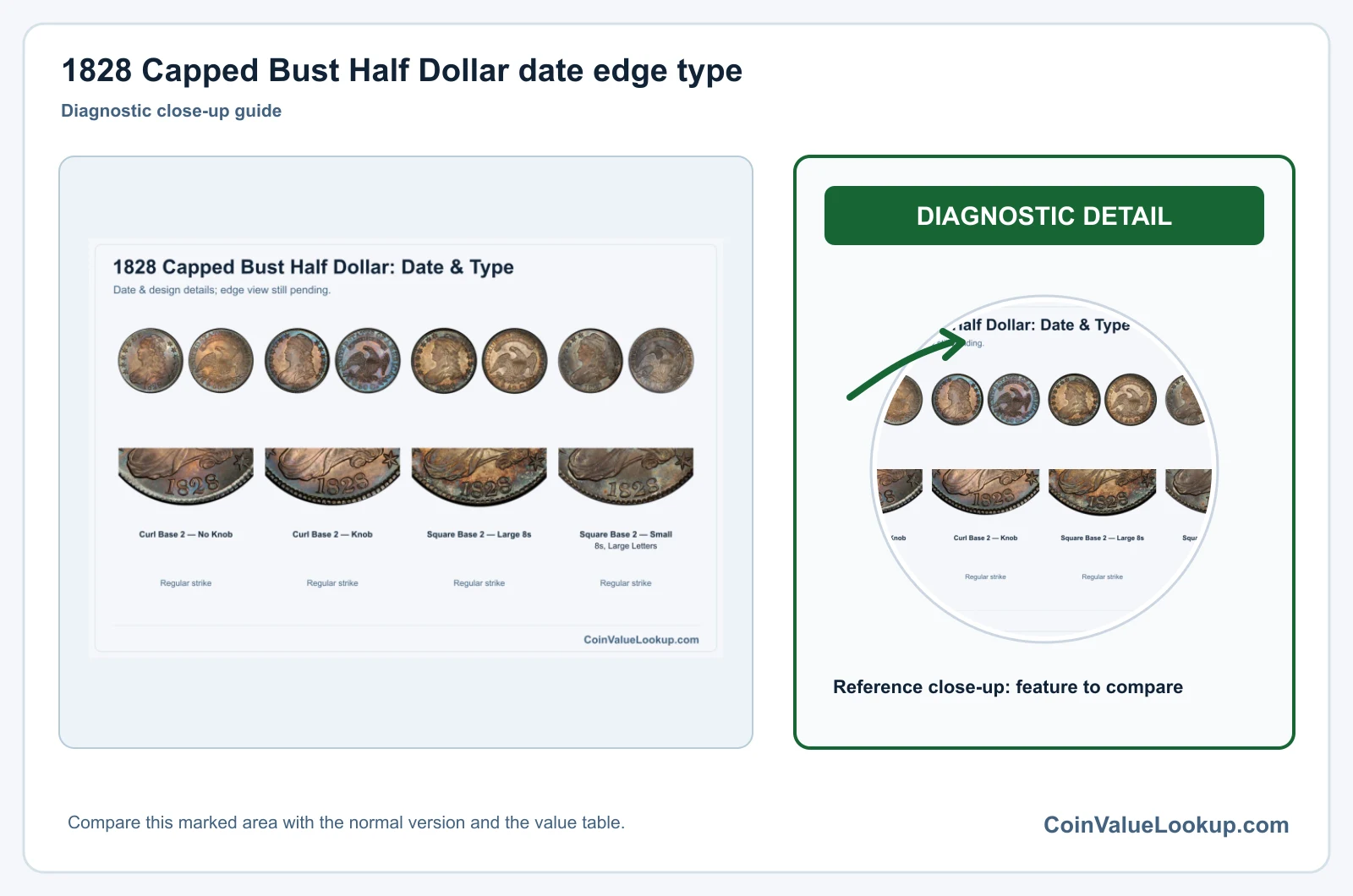
The 1828 Capped Bust Half Dollar carries guide values from roughly $100 at G4 to $879 at AU50, depending on the exact variety. Five distinct circulation strike versions exist for this date, each distinguished by subtle differences in the numeral "2" and the size of the digit "8" and reverse lettering.
A rare Proof also exists. Pinning down which version you hold is the first step toward an accurate value.
Fast Way to Identify Your 1828 Capped Bust Half Dollar
Upload clear photos of the front and back of your 1828 Half Dollar and our identifier will give you a preliminary read on which version you likely have. Edge detail is also helpful if you can photograph it.
This is not a substitute for professional authentication, but it can point you in the right direction before you invest in formal grading.
1828 Capped Bust Half Dollar Value
Upload both sides of your 1828 Capped Bust Half Dollar.
Front Obverse
Upload photo
Back Reverse
Upload photo
Which 1828 Capped Bust Half Dollar Versions Are Worth Money?
- Curl Base 2 — Knob version: guides list up to around $879 at AU50, the highest among the regular strikes for this date.
- Square Base 2 — Small 8s, Small Letters: guide values reach about $740 at AU50, making well-preserved examples worth careful inspection.
- Curl Base 2 — No Knob: a common variety but still valued around $575 at AU50 per guide estimates.
- Square Base 2 — Small 8s, Large Letters: the lowest AU50 guide figure among the five at roughly $457, but still a solid early silver half dollar.
- Proof (Square Base 2, Small 8s, Large Letters): a single PR58 example sold for $192,000 at auction in August 2023 — genuine Proofs of this date are extremely rare specialist coins.
- Doubled Edge Lettering and Die Crack errors have been reported for 1828; condition and visibility drive their individual premiums.
Step 1: Identify Your 1828 Capped Bust Half Dollar Mint Mark and Version
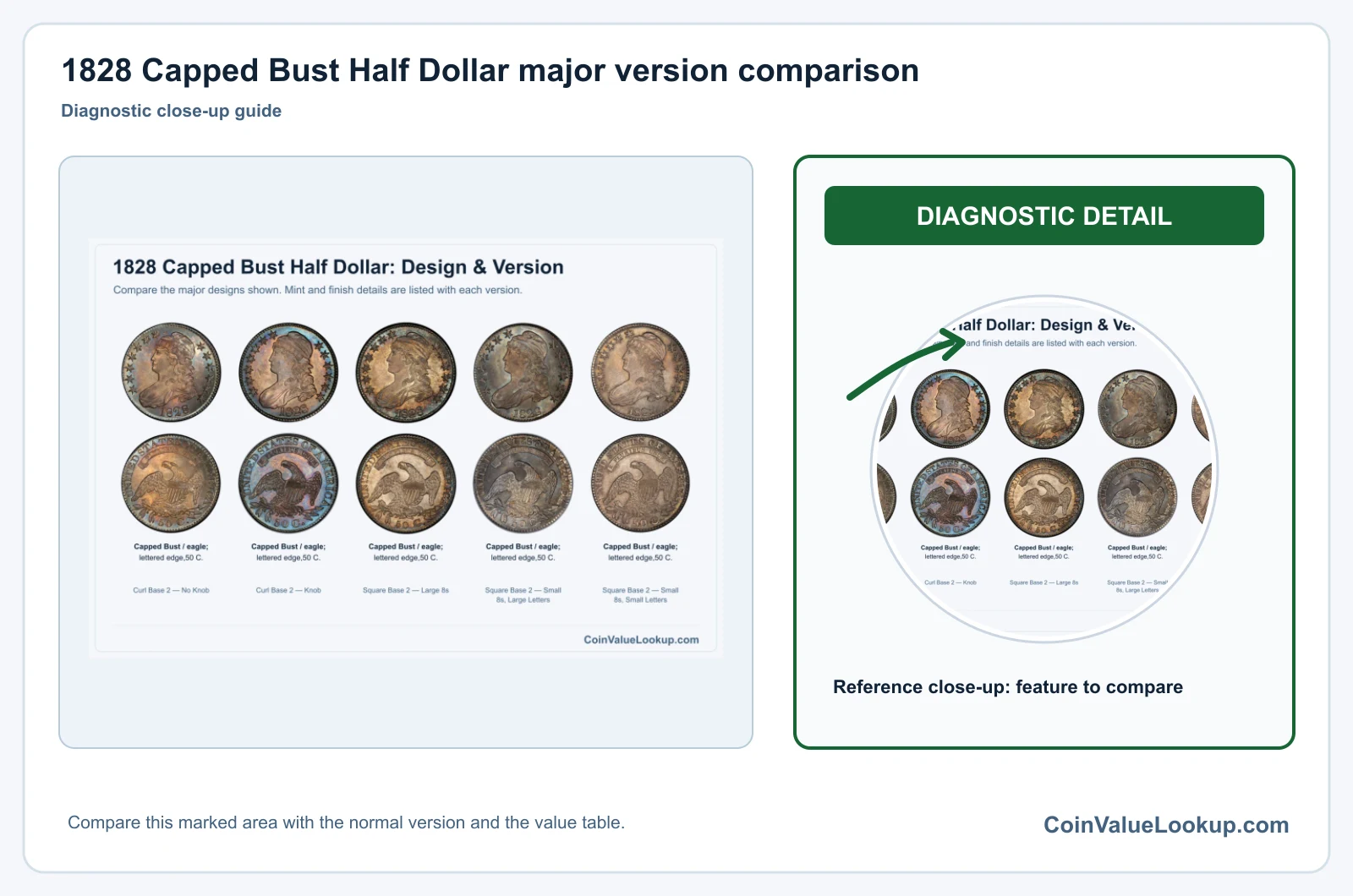
All 1828 Capped Bust Half Dollars were struck at Philadelphia. There is no mintmark to look for.
The coin measures 32.5 mm and weighs a nominal 13.48 grams in a silver-copper alloy of approximately 89.24% silver. The edge is lettered: FIFTY CENTS OR HALF A DOLLAR.
The obverse shows Liberty in a draped cap facing left, with the date below. The reverse displays a heraldic eagle with a shield on its breast and the denomination at the bottom.
To identify your version, start with the "2" in 1828. Does the base of the 2 curve gently, or does it sit flat like a shelf?
A curved base means you have a Curl Base 2 variety. A flat base means Square Base 2.
If you have Curl Base 2, look at the top of the 2 for a small rounded knob at the upper terminal. Present means Knob; absent means No Knob.
If you have Square Base 2, compare both 8s. Are they large or small relative to the other digits?
If large, you have the Large 8s variety. If both 8s are small, flip the coin and compare the reverse legend letters of UNITED STATES OF AMERICA.
Large letters versus small letters separates the final two varieties. Use the full date and full reverse inscription together — do not rely on one isolated numeral.
Proof status requires professional attribution. A shiny or prooflike surface on a regular strike does not make it a Proof.
Step 2: Check Your 1828 Capped Bust Half Dollar Grade
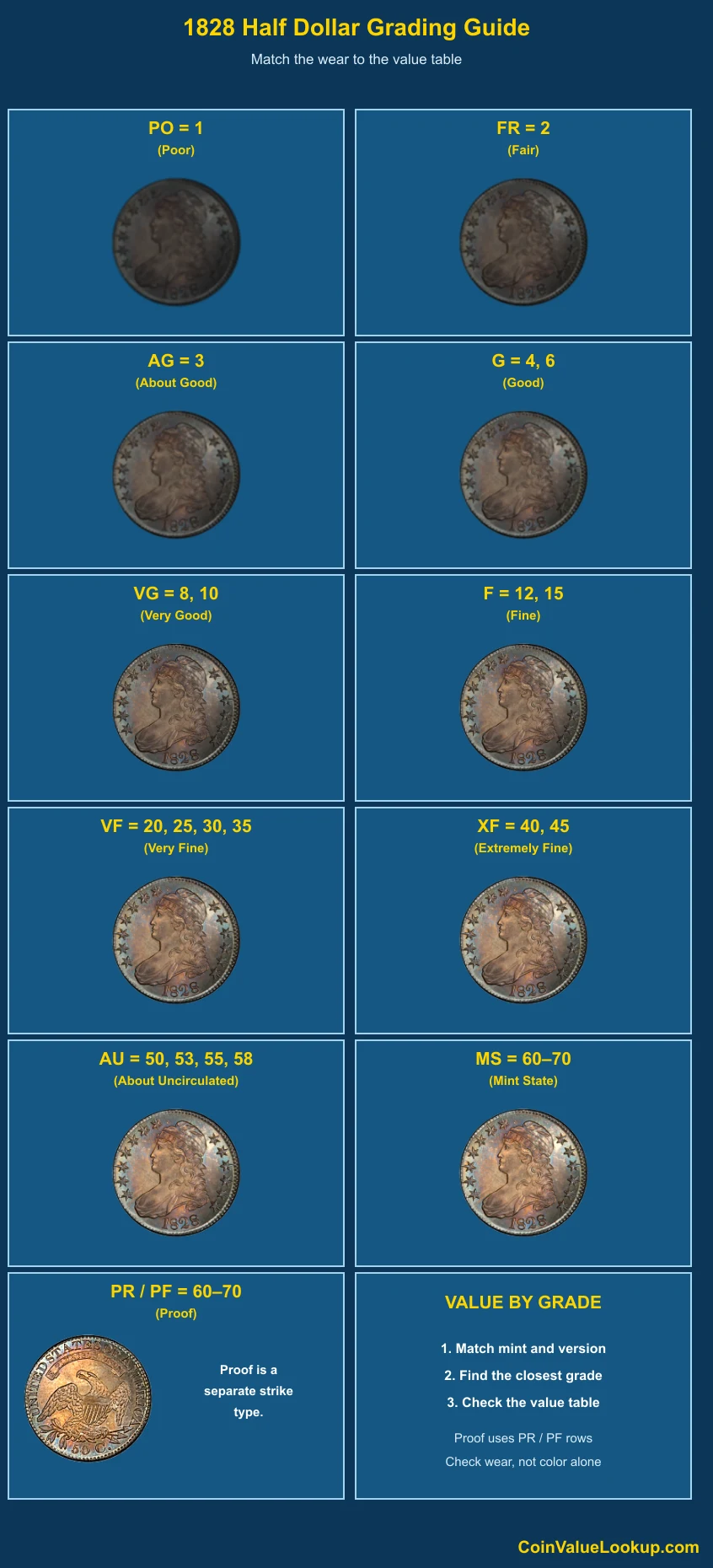
Focus on the high points first. On the obverse, check the hair above Liberty's forehead, the cheek, and the folds of the cap for smoothing.
On the reverse, the eagle's breast feathers and upper wing tips show wear earliest.
A coin in G4 will have the major design outlines visible but most fine detail gone. By VF20 you should see moderate detail in the hair curls and wing feathers with some flatness on the highest points.
An AU50 coin retains most original detail with only light friction on those same peaks.
Separate weak original strike from actual wear. Some 1828 halves left the press with soft detail in spots — that is not the same as a coin that circulated and lost its luster.
Look for unbroken luster in protected areas around the stars and letters as a clue.
Cleaned, scratched, or holed coins grade lower regardless of remaining detail. Use the comparison image to match your coin's wear pattern against known grade examples for this type.
Proof coins are graded on a separate PR scale that reflects surface quality, not circulation wear.
Step 3: Check 1828 Capped Bust Half Dollar Value by Mint and Version
1828 Capped Bust Half Dollar — Curl Base 2 — No Knob
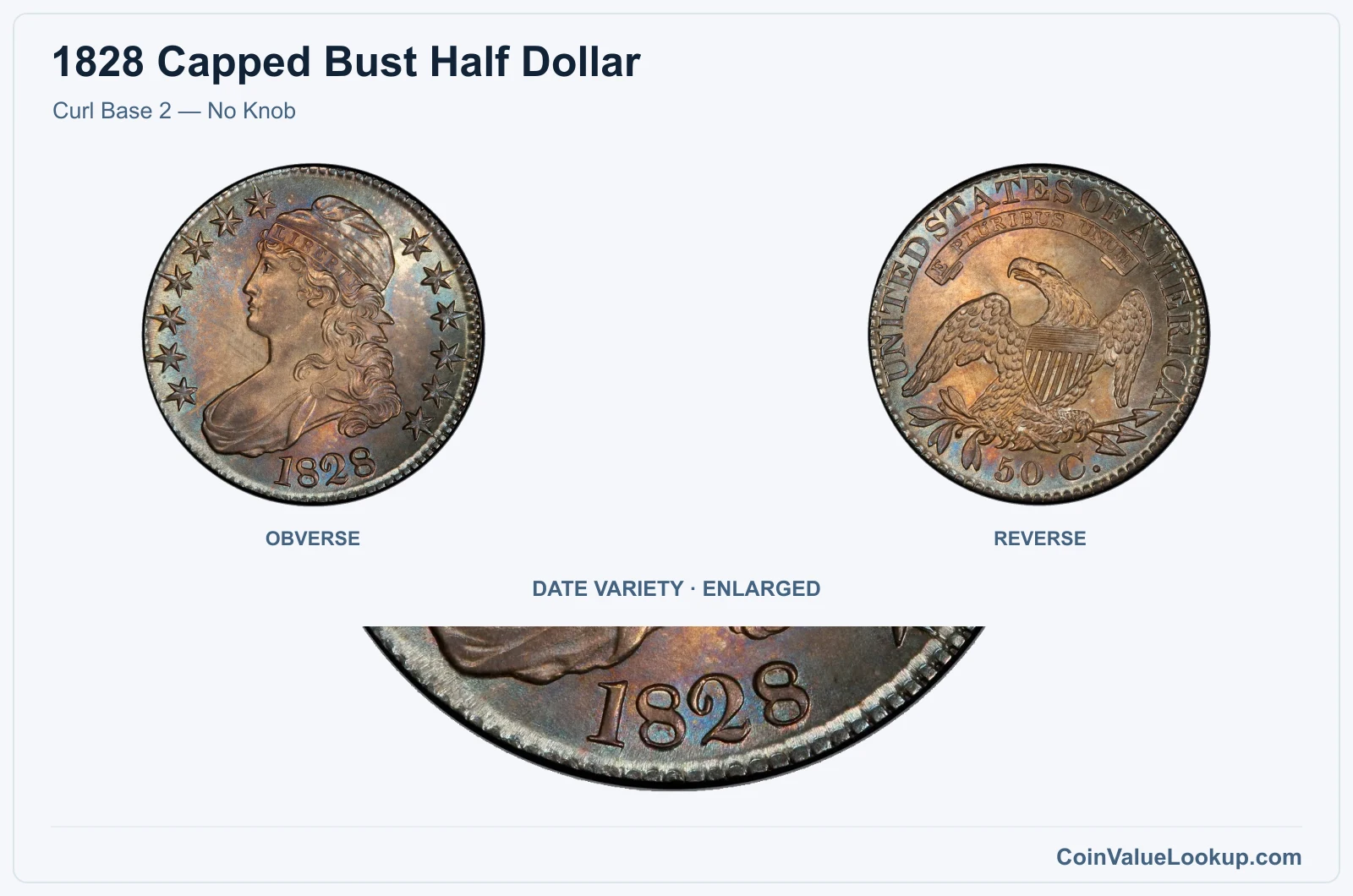
The Curl Base 2 — No Knob variety is identified by the curved, sweeping base of the numeral 2 and the absence of a rounded knob at the top of that same digit. The upper terminal simply tapers off cleanly.
This is a Philadelphia strike in silver-copper alloy (approximately 89.24% silver) with the standard lettered edge reading FIFTY CENTS OR HALF A DOLLAR. Guide estimates from USA Coin Book place this version at about $106 in G4, $182 in VF20, and $575 in AU50.
These are retail guide figures, not guaranteed sale prices.
Compare the top of your 2 carefully against the Knob version before settling on this branch.
Range Grade
Price Auction Records Appraisal PO PO 1
—
Coin Identifier FR FR 2
—
Coin Identifier AG AG 3
—
Coin Identifier G G 4
—
Coin Identifier
G 6
—
Coin Identifier VG VG 8
Coin Identifier
VG 10
Coin Identifier F F 12
—
Coin Identifier
F 15
Coin Identifier VF VF 20
Coin Identifier
VF 25
Coin Identifier
VF 30
Coin Identifier
VF 35
Coin Identifier XF XF 40
Coin Identifier
XF 45
Coin Identifier AU AU 50
Coin Identifier
AU 53
Coin Identifier
AU 55
Coin Identifier
AU 58
Coin Identifier MS MS 60
—
Coin Identifier
MS 61
Coin Identifier
MS 62
Coin Identifier
MS 63
Coin Identifier
MS 64
Coin Identifier
MS 65
Coin Identifier
MS 66
Coin Identifier
MS 67
—
—
—
MS 68
—
—
—
MS 69
—
—
—
MS 70
—
—
—
1828 Capped Bust Half Dollar — Curl Base 2 — Knob
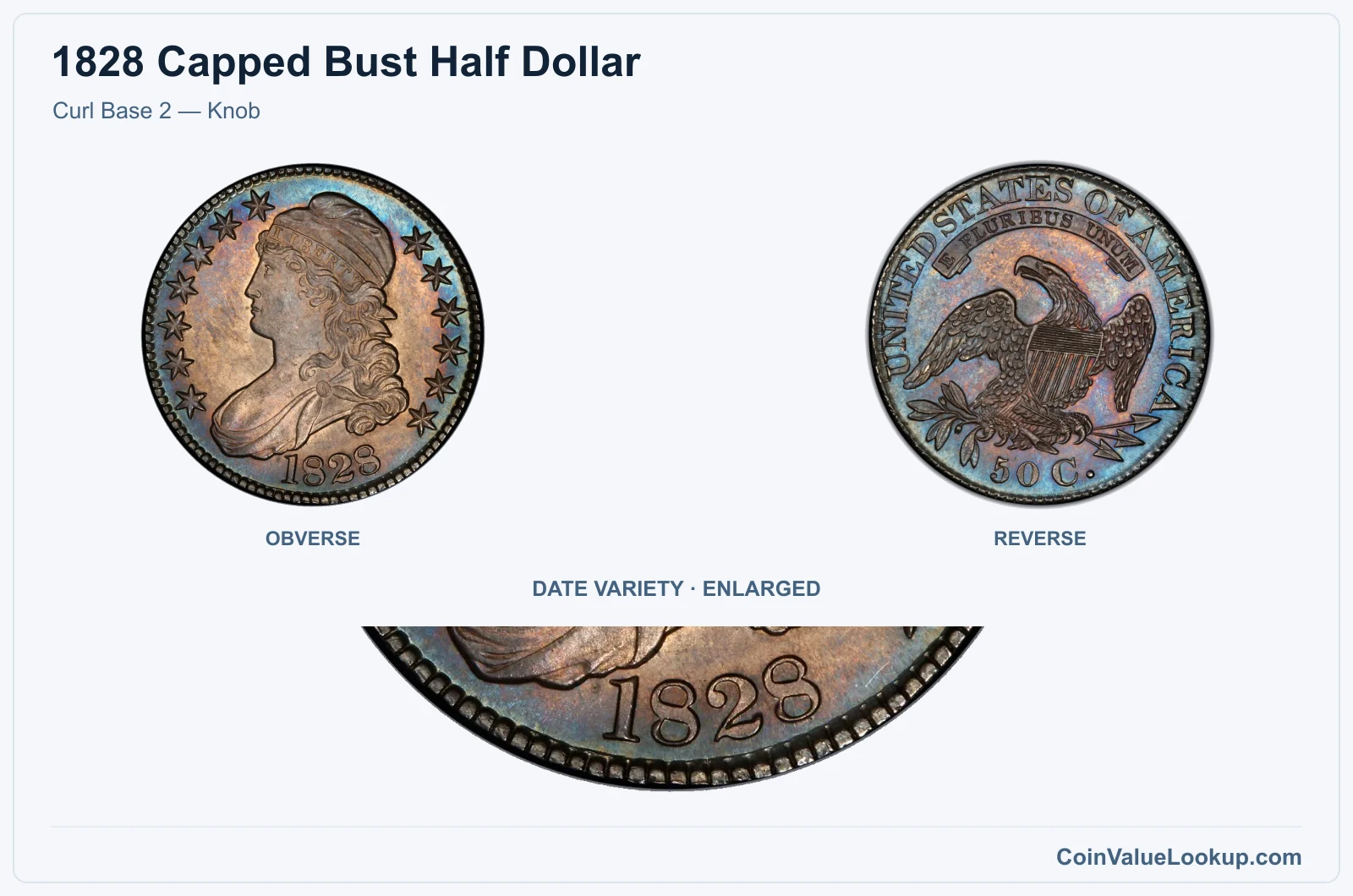
The Curl Base 2 — Knob shares the same curved base on the 2 as its No Knob sibling, but adds a small rounded knob at the upper terminal of the digit. You need decent magnification and good lighting to see this — it is a subtle feature.
This version carries higher guide estimates in the middle and upper grades: about $106 at G4, $205 at VF20, and $879 at AU50 per USA Coin Book. That AU50 figure is the highest among the five regular 1828 varieties, so correct identification matters.
All 1828 halves were struck at Philadelphia with no mintmark. The silver-copper composition and lettered edge are the same across all circulation versions.
Set both Curl Base varieties side by side — in photos or in hand — and the knob difference becomes clear.
Range Grade
Price Auction Records Appraisal PO PO 1
—
Coin Identifier FR FR 2
—
Coin Identifier AG AG 3
—
Coin Identifier G G 4
—
Coin Identifier
G 6
—
Coin Identifier VG VG 8
Coin Identifier
VG 10
—
Coin Identifier F F 12
—
Coin Identifier
F 15
—
Coin Identifier VF VF 20
Coin Identifier
VF 25
Coin Identifier
VF 30
Coin Identifier
VF 35
Coin Identifier XF XF 40
Coin Identifier
XF 45
Coin Identifier AU AU 50
Coin Identifier
AU 53
Coin Identifier
AU 55
Coin Identifier
AU 58
Coin Identifier MS MS 60
—
Coin Identifier
MS 61
Coin Identifier
MS 62
Coin Identifier
MS 63
Coin Identifier
MS 64
—
Coin Identifier
MS 65
Coin Identifier
MS 66
—
—
—
MS 67
—
—
—
MS 68
—
—
—
MS 69
—
—
—
MS 70
—
—
—
1828 Capped Bust Half Dollar — Square Base 2 — Large 8s
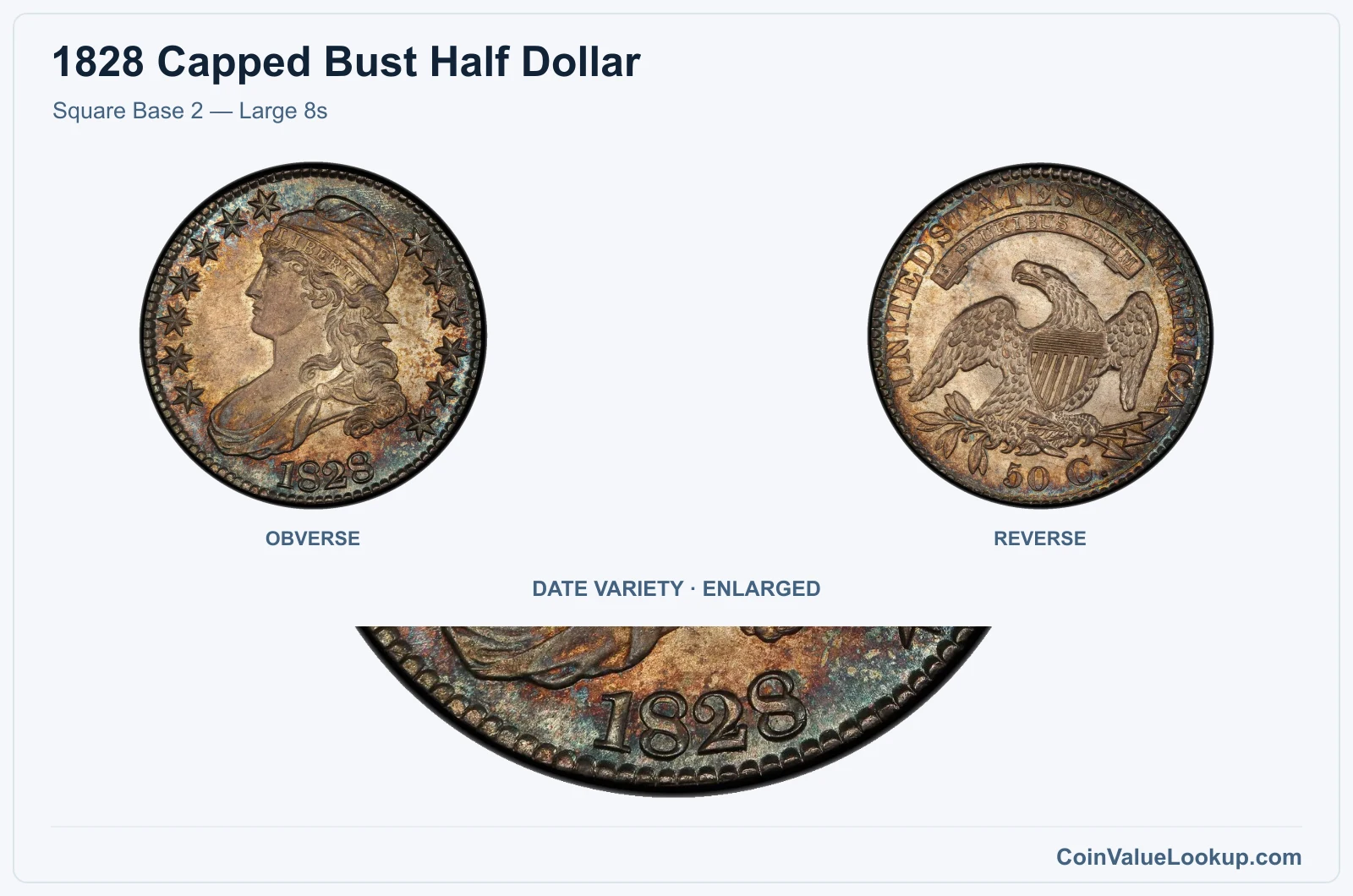
Look for a flat, shelf-like base on the 2. That is your Square Base indicator.
Then compare the two 8s in 1828 to the other digits — on this variety both 8s are noticeably large relative to the 1 and the 2.
Guide values run about $106 at G4, $163 at VF20, and $517 at AU50. This is one of the more affordable varieties of the date in higher grades.
Coin Value Lookup is a useful starting point if you want to look up guide values for other dates in the Capped Bust Half Dollar series or compare across denominations.
Range Grade
Price Auction Records Appraisal PO PO 1
—
Coin Identifier FR FR 2
—
Coin Identifier AG AG 3
—
Coin Identifier G G 4
—
Coin Identifier
G 6
—
Coin Identifier VG VG 8
—
Coin Identifier
VG 10
Coin Identifier F F 12
—
Coin Identifier
F 15
—
Coin Identifier VF VF 20
Coin Identifier
VF 25
Coin Identifier
VF 30
Coin Identifier
VF 35
Coin Identifier XF XF 40
Coin Identifier
XF 45
Coin Identifier AU AU 50
Coin Identifier
AU 53
Coin Identifier
AU 55
Coin Identifier
AU 58
Coin Identifier MS MS 60
—
Coin Identifier
MS 61
—
Coin Identifier
MS 62
Coin Identifier
MS 63
Coin Identifier
MS 64
Coin Identifier
MS 65
Coin Identifier
MS 66
Coin Identifier
MS 67
—
—
—
MS 68
—
—
—
MS 69
—
—
—
MS 70
—
—
—
1828 Capped Bust Half Dollar — Square Base 2 — Small 8s, Large Letters
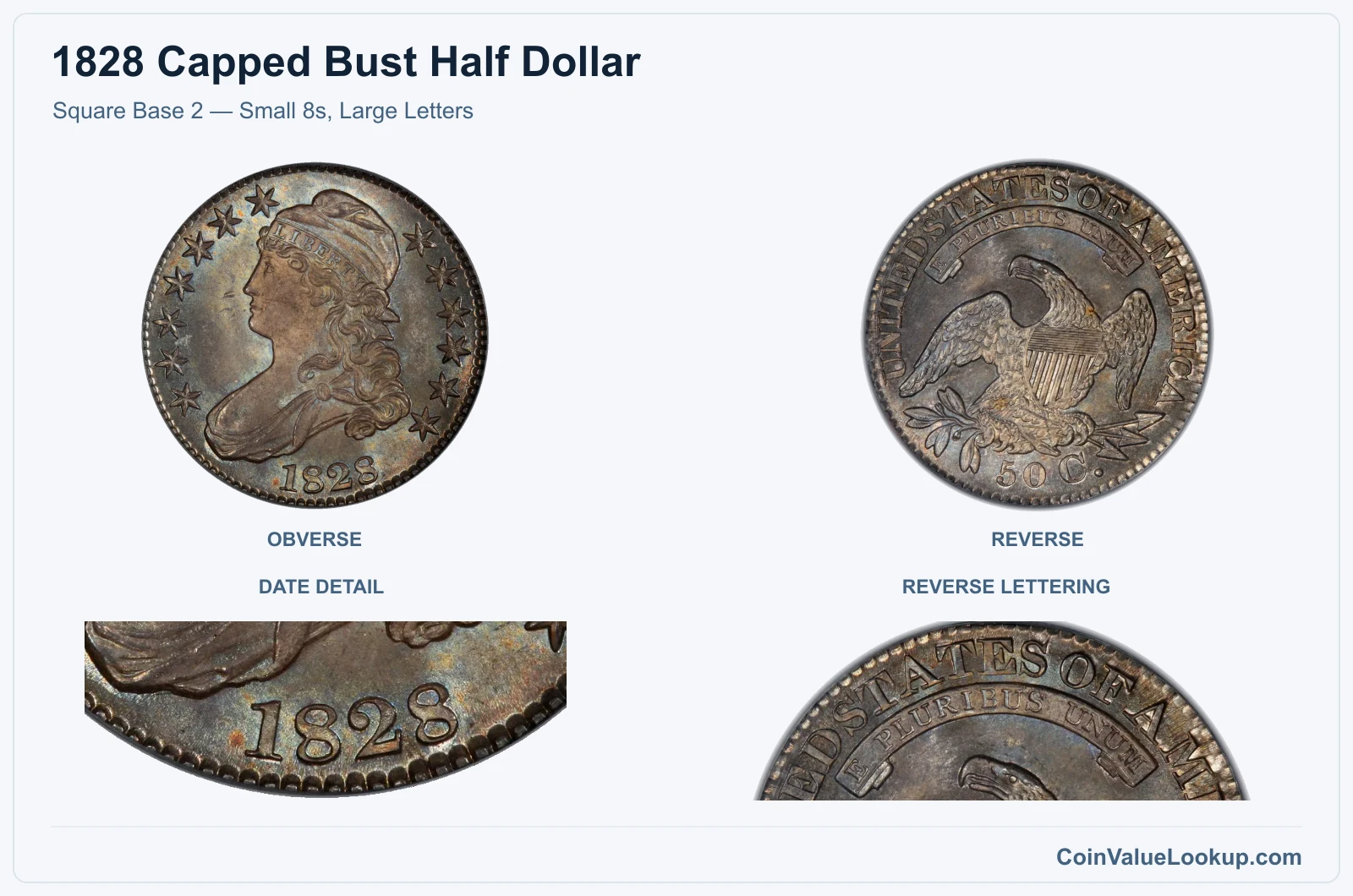
This variety combines three features: a flat (square) base on the 2, two small 8s in the date, and large letters in the reverse legend UNITED STATES OF AMERICA. You need to check both sides of the coin — the date alone will not separate this from the Small Letters version.
USA Coin Book estimates place this at roughly $100 in G4, $163 in VF20, and $457 at AU50. Among the five regular circulation varieties, this one carries the lowest guide figure at AU50.
Philadelphia struck all examples with the standard lettered edge. The silver-copper alloy is approximately 89.24% silver by weight.
Range Grade
Price Auction Records Appraisal PO PO 1
—
Coin Identifier FR FR 2
—
Coin Identifier AG AG 3
—
Coin Identifier G G 4
—
Coin Identifier
G 6
—
Coin Identifier VG VG 8
—
Coin Identifier
VG 10
Coin Identifier F F 12
Coin Identifier
F 15
Coin Identifier VF VF 20
Coin Identifier
VF 25
Coin Identifier
VF 30
Coin Identifier
VF 35
Coin Identifier XF XF 40
Coin Identifier
XF 45
Coin Identifier AU AU 50
Coin Identifier
AU 53
Coin Identifier
AU 55
Coin Identifier
AU 58
Coin Identifier MS MS 60
Coin Identifier
MS 61
Coin Identifier
MS 62
Coin Identifier
MS 63
Coin Identifier
MS 64
Coin Identifier
MS 65
Coin Identifier
MS 66
Coin Identifier
MS 67
—
—
—
MS 68
—
—
—
MS 69
—
—
—
MS 70
—
—
—
1828 Capped Bust Half Dollar — Square Base 2 — Small 8s, Small Letters
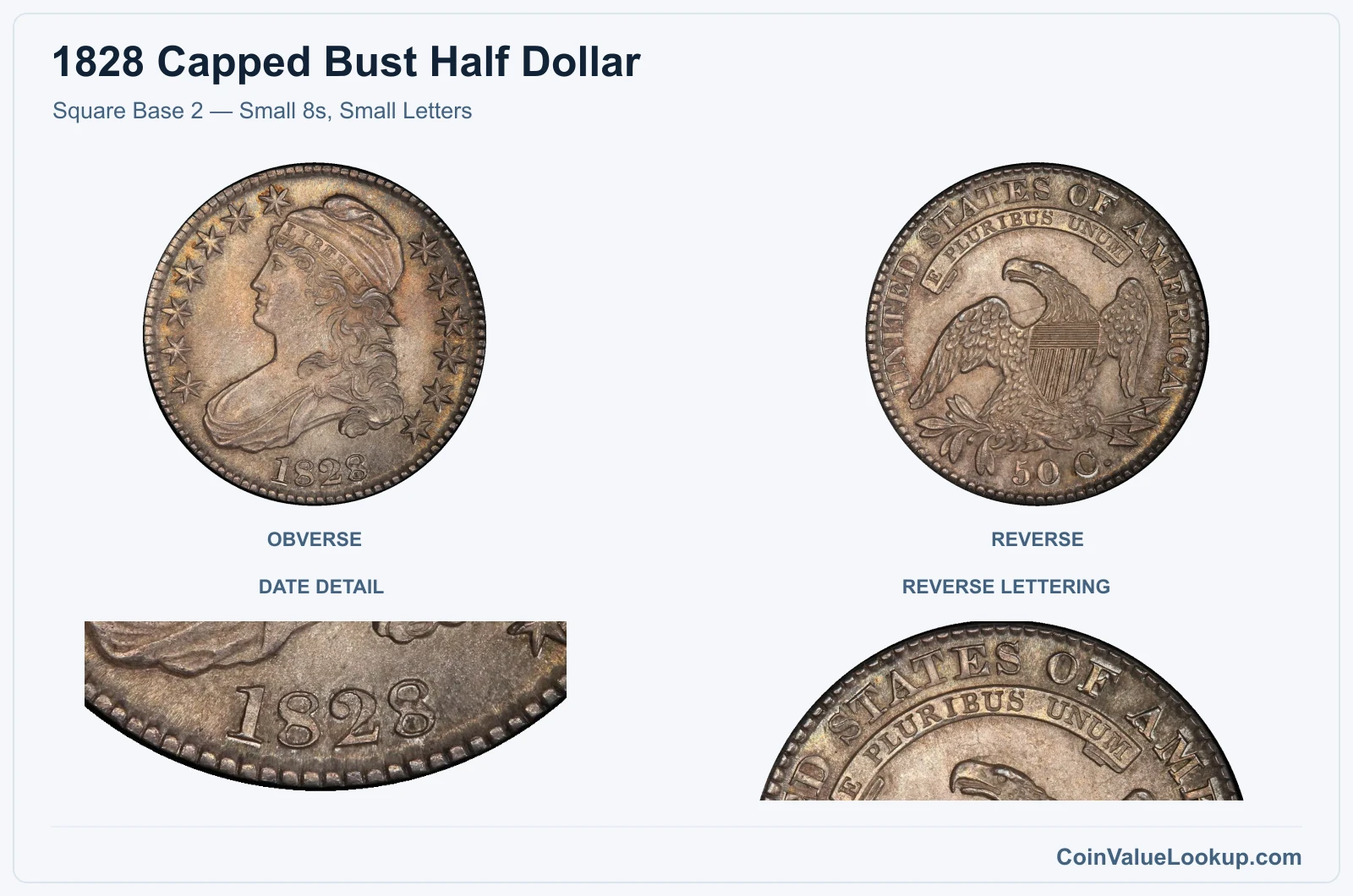
Same flat-base 2. Same small 8s.
The difference is on the reverse: the legend letters of UNITED STATES OF AMERICA are smaller than on the Large Letters variety. You must compare the full reverse inscription, not just a single letter, because the size difference is relative.
Guide estimates from USA Coin Book are about $111 at G4, $205 at VF20, and $740 at AU50. Those upper-grade figures are meaningfully higher than the Large Letters counterpart, making correct attribution worthwhile.
This is still a Philadelphia issue, silver-copper at approximately 89.24% silver, with the standard FIFTY CENTS OR HALF A DOLLAR lettered edge. Take clear photos of both the date and the reverse legend when seeking attribution.
Range Grade
Price Auction Records Appraisal PO PO 1
—
Coin Identifier FR FR 2
—
Coin Identifier AG AG 3
—
Coin Identifier G G 4
—
Coin Identifier
G 6
—
Coin Identifier VG VG 8
—
Coin Identifier
VG 10
Coin Identifier F F 12
Coin Identifier
F 15
—
Coin Identifier VF VF 20
—
Coin Identifier
VF 25
—
Coin Identifier
VF 30
Coin Identifier
VF 35
Coin Identifier XF XF 40
Coin Identifier
XF 45
Coin Identifier AU AU 50
Coin Identifier
AU 53
Coin Identifier
AU 55
Coin Identifier
AU 58
Coin Identifier MS MS 60
—
Coin Identifier
MS 61
Coin Identifier
MS 62
Coin Identifier
MS 63
Coin Identifier
MS 64
Coin Identifier
MS 65
Coin Identifier
MS 66
—
—
—
MS 67
—
—
—
MS 68
—
—
—
MS 69
—
—
—
MS 70
—
—
—
1828 Capped Bust Half Dollar — Lettered Edge Proof — Square Base 2, Small 8s, Large Letters
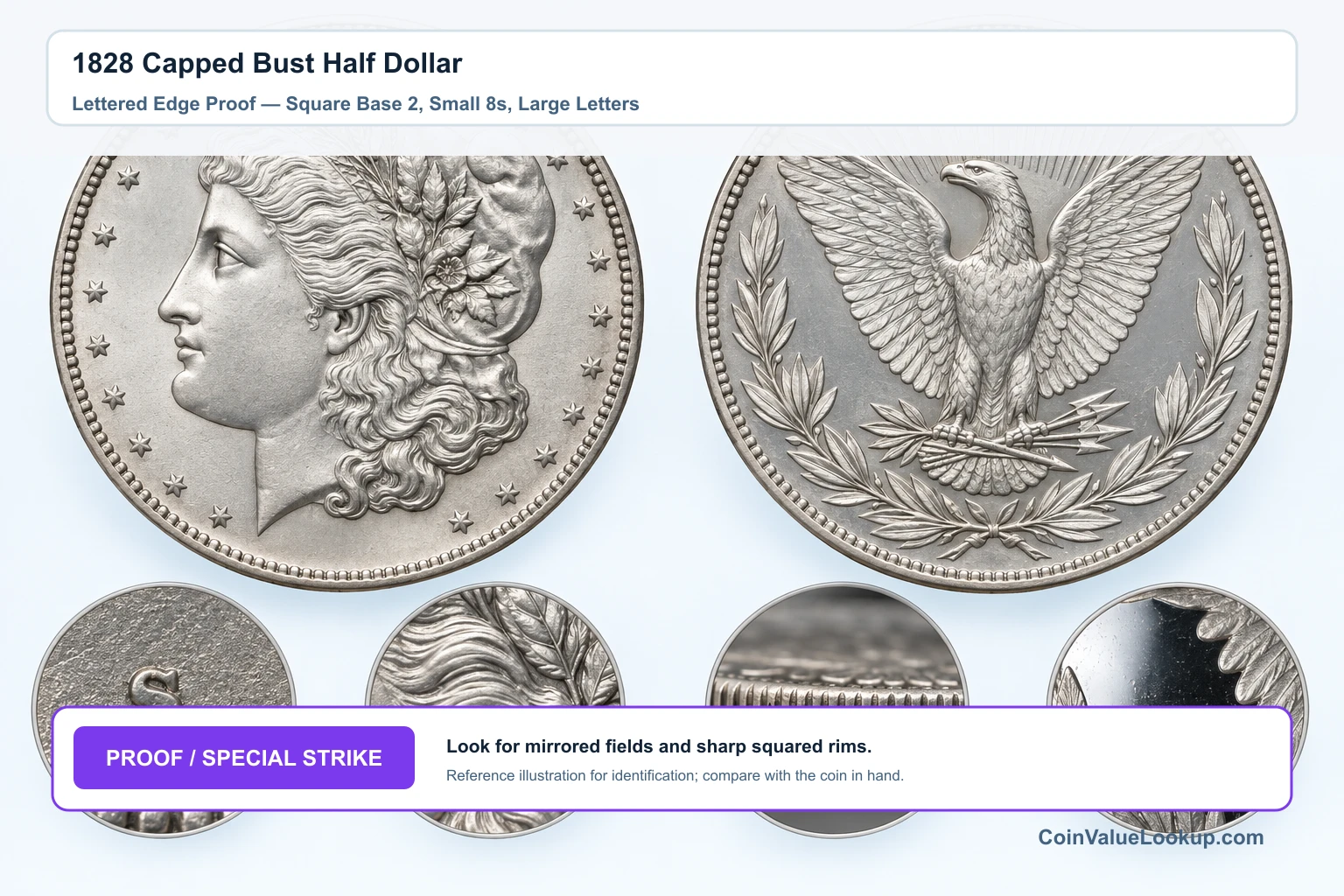
The 1828 Lettered Edge Proof is cataloged as the Square Base 2, Small 8s, Large Letters die marriage struck with a Proof finish. These are exceedingly rare early American Proofs, and ownership tends to stay within advanced specialist collections.
A single example graded PR58 sold through Stack's Bowers in August 2023 for $192,000. That is one historical sale, not a current market range — each Proof trades as an individual event based on its surfaces, eye appeal, and provenance.
Proof status on an 1828 half dollar absolutely requires professional attribution. Polished or prooflike regular strikes can look mirror-bright but are not Proofs.
Look for squared, knife-sharp rims, fully struck devices, and consistent reflective fields — then get it into the hands of a third-party grading service. Do not assign this branch to a coin based on shine alone.
Range Grade
Price Auction Records Appraisal PR PR 1
—
Coin Identifier
PR 2
—
Coin Identifier
PR 3
—
Coin Identifier
PR 4
—
Coin Identifier
PR 6
—
Coin Identifier
PR 8
—
Coin Identifier
PR 10
—
Coin Identifier
PR 12
—
Coin Identifier
PR 15
—
Coin Identifier
PR 20
—
Coin Identifier
PR 25
—
Coin Identifier
PR 30
—
Coin Identifier
PR 35
—
Coin Identifier
PR 40
—
Coin Identifier
PR 45
—
Coin Identifier
PR 50
—
Coin Identifier
PR 53
—
Coin Identifier
PR 55
—
Coin Identifier
PR 58
Coin Identifier
PR 60
—
—
—
PR 61
—
—
—
PR 62
—
—
—
PR 63
—
—
—
PR 64
—
—
—
PR 65
—
—
—
PR 66
—
—
—
PR 67
—
—
—
PR 68
—
—
—
PR 69
—
—
—
PR 70
—
—
—
1828 Capped Bust Half Dollar Error List
1. 1828 Capped Bust Half Dollar — Doubled Edge Lettering
Doubled Edge Lettering has been reported on 1828 Capped Bust Half Dollars. The diagnostic involves repeated or overlapping characters visible along the lettered edge.
Because the edge inscription FIFTY CENTS OR HALF A DOLLAR was applied separately from the obverse and reverse dies, misalignment or double impressions could produce clearly doubled letters.
To check your coin, examine the full edge in a continuous pass — photograph it as a panorama if possible, with the dated face visible in an inset for reference. You are looking for whole characters that appear ghosted or struck twice, not just mushy lettering from heavy wear.
Post-mint damage, general circulation wear, and normal design features can all mimic edge doubling under poor lighting. Compare your coin against an attributed same-year example under equal conditions.
Condition, visibility of the doubling, and the specific error characteristics all affect what a collector will pay, so no single price range applies across the board.
2. 1828 Capped Bust Half Dollar — Die Crack / Die Chip
Die Crack and Die Chip errors have been reported on 1828 Half Dollars. A documented late-state example on the Square Base 2, Small 8s, Large Letters variety shows a raised crack running from below the eagle's left wing along the legend UNITED STATES OF A toward the rim above the letter M.
Die cracks appear as thin raised lines on the coin's surface because metal fills the crack in the die during striking. Die chips are similar but form small raised lumps where a piece of the die broke away.
Both indicate a deteriorating die that was kept in service.
Do not confuse die cracks with incuse scratches, corrosion lines, or foreign material stuck to the surface. Die cracks are raised and follow a path consistent with stress patterns in the die — scratches are incuse and random.
The value of a die crack error depends on its visibility, location, and the overall condition of the coin. No fixed price range applies.