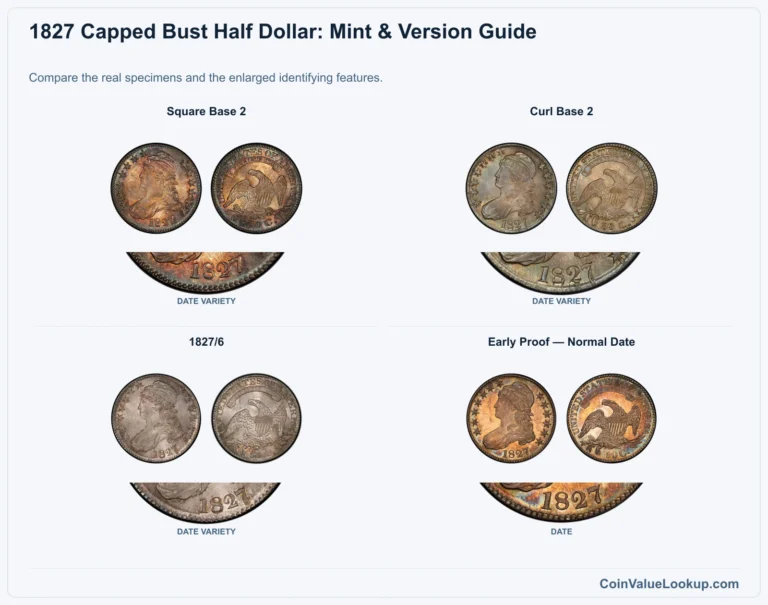
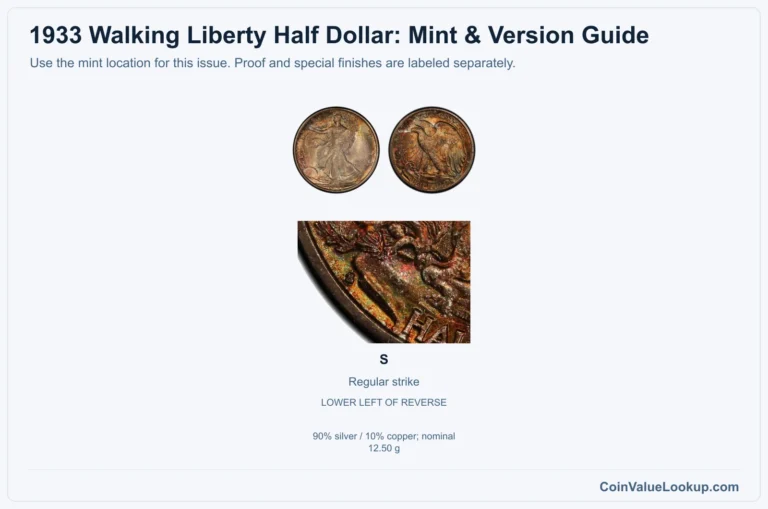
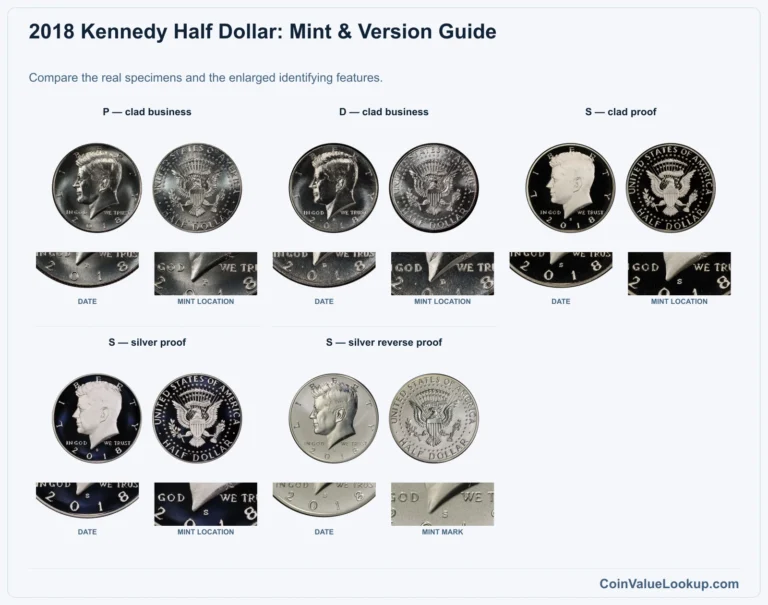
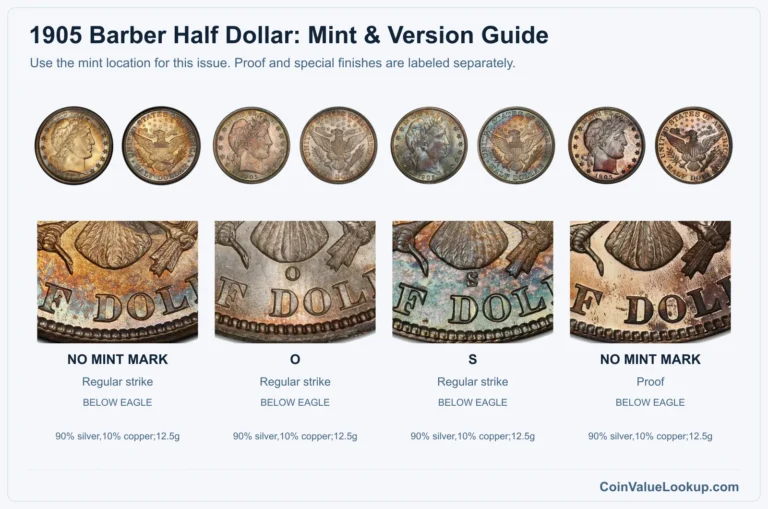
1813 Capped Bust Half Dollar Coin Value: How Much Is It Worth?
A circulated 1813 Capped Bust Half Dollar in Good (G4) condition carries a guide estimate around $111, rising to roughly $268 at VF20 and $948 at AU50 for the normal version. Collector value shifts significantly with the specific variety and surface quality.
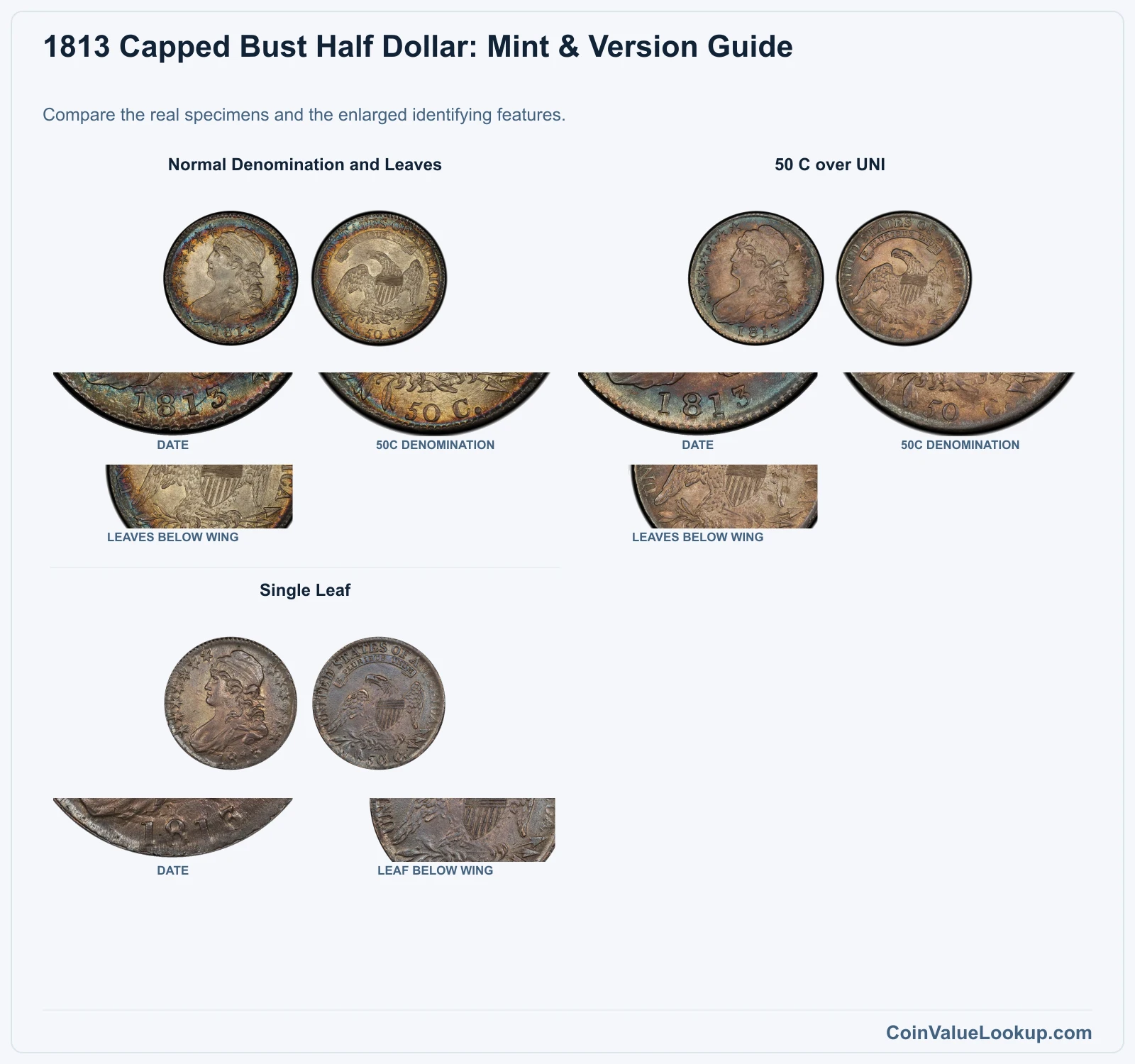
The scarcer 50 C over UNI overdate commands a clear premium, and the Single Leaf variety deserves individual assessment.
Fast Way to Identify Your 1813 Capped Bust Half Dollar
Snap clear photos of both the front and back of your 1813 half dollar and upload them here for a preliminary identification. Good lighting at a slight angle helps capture the lettering and any faint variety markers on the reverse.
This step can narrow down which version you have before diving into closer diagnostics.
1813 Capped Bust Half Dollar Value
Upload both sides of your 1813 Capped Bust Half Dollar.
Front Obverse
Upload photo
Back Reverse
Upload photo
Which 1813 Capped Bust Half Dollar Versions Are Worth Money?
- The 50 C over UNI variety shows remnants of misplaced letters beneath the denomination and carries guide estimates from about $205 at G4 to $1,766 at AU50, well above normal examples.
- The Single Leaf variety, identified by the upper olive-leaf position, requires individual assessment based on authenticated identity and condition rather than a standard price curve.
- Even the normal 1813 issue is a two-century-old silver coin with solid collector demand, estimated around $948 at AU50 in problem-free condition.
Step 1: Identify Your 1813 Capped Bust Half Dollar Mint Mark and Version
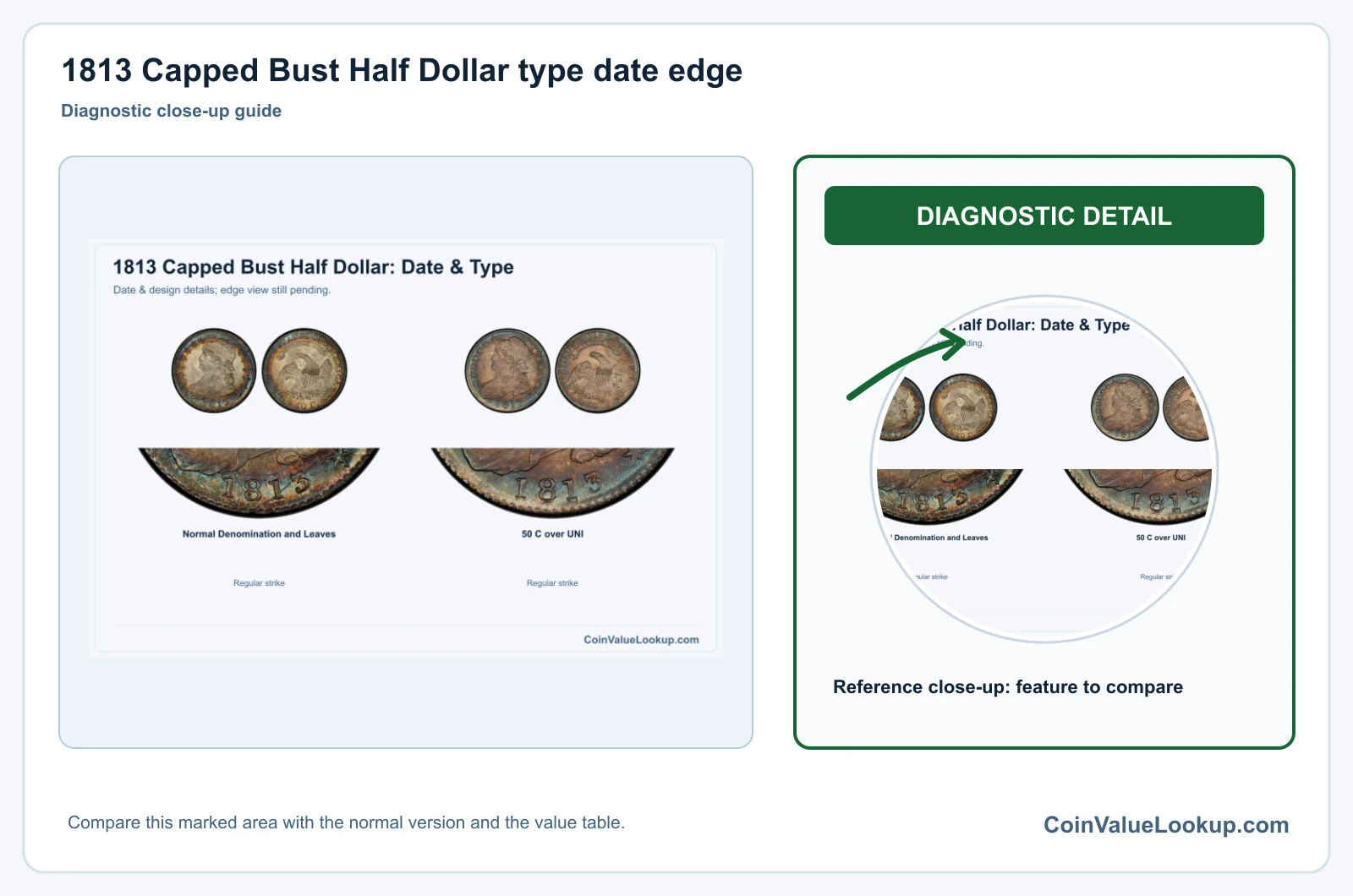
Every 1813 Capped Bust Half Dollar was struck at Philadelphia. There is no mintmark, and the absence of one is completely normal for this issue.
Look for the left-facing Liberty wearing a cap on the obverse, with an eagle and shield on the reverse and "50 C." as the denomination. The lettered edge reads FIFTY CENTS OR HALF A DOLLAR.
If your coin shows a Draped Bust design instead, that belongs to the earlier 1807 type and is covered separately.
The coin is a silver-copper alloy, approximately 89.24% silver, weighing about 13.48 grams and measuring roughly 32.5 mm. Three main branches exist for 1813: Normal Denomination and Leaves, the 50 C over UNI corrected denomination, and the Single Leaf variety.
On the 50 C over UNI, remnants of misplaced letters are visible beneath the denomination on the reverse. The Single Leaf variety involves a specific upper olive-leaf position and typically requires side-by-side comparison with attributed examples to confirm.
Step 2: Check Your 1813 Capped Bust Half Dollar Grade
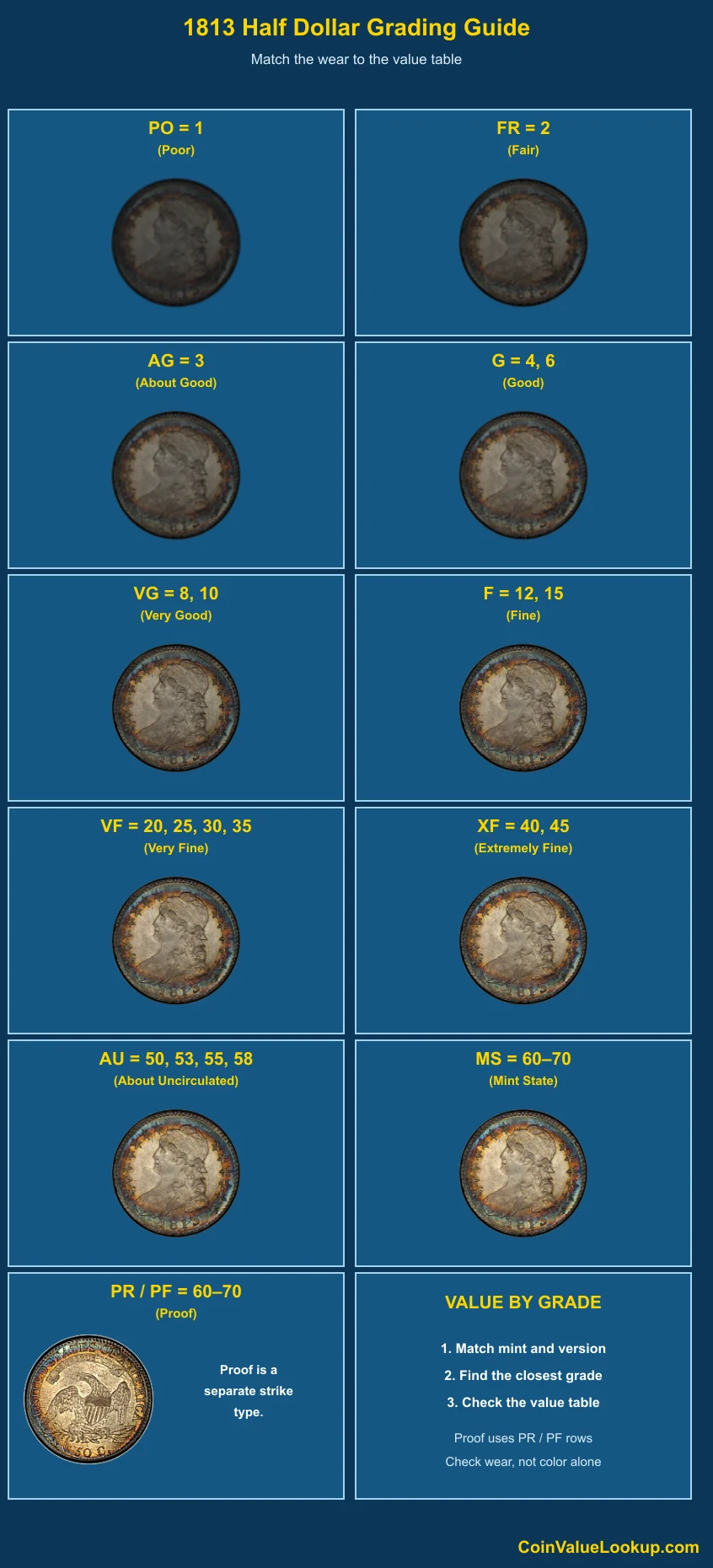
Start with the hair above Liberty's forehead and ear. On a well-worn coin these curls merge into a flat mass, while a lightly circulated piece retains individual strand definition.
Check the cheek, cap, and shoulder clasp for smoothing versus original detail.
Flip the coin over and examine the eagle's breast feathers and wing tips. A weak strike can mimic wear here, so compare luster in the fields around the design.
If the surrounding flat areas still show cartwheel sheen, you are probably looking at strike softness rather than friction.
Use the comparison image to match your coin against known grade benchmarks for the Capped Bust type. Cleaning, tooling, holes, and heavy scratches place a coin in the "Details" category regardless of remaining design sharpness.
A Details coin should not be priced along the same curve as a problem-free example.
Step 3: Check 1813 Capped Bust Half Dollar Value by Mint and Version
1813 Capped Bust Half Dollar — Normal Denomination and Leaves
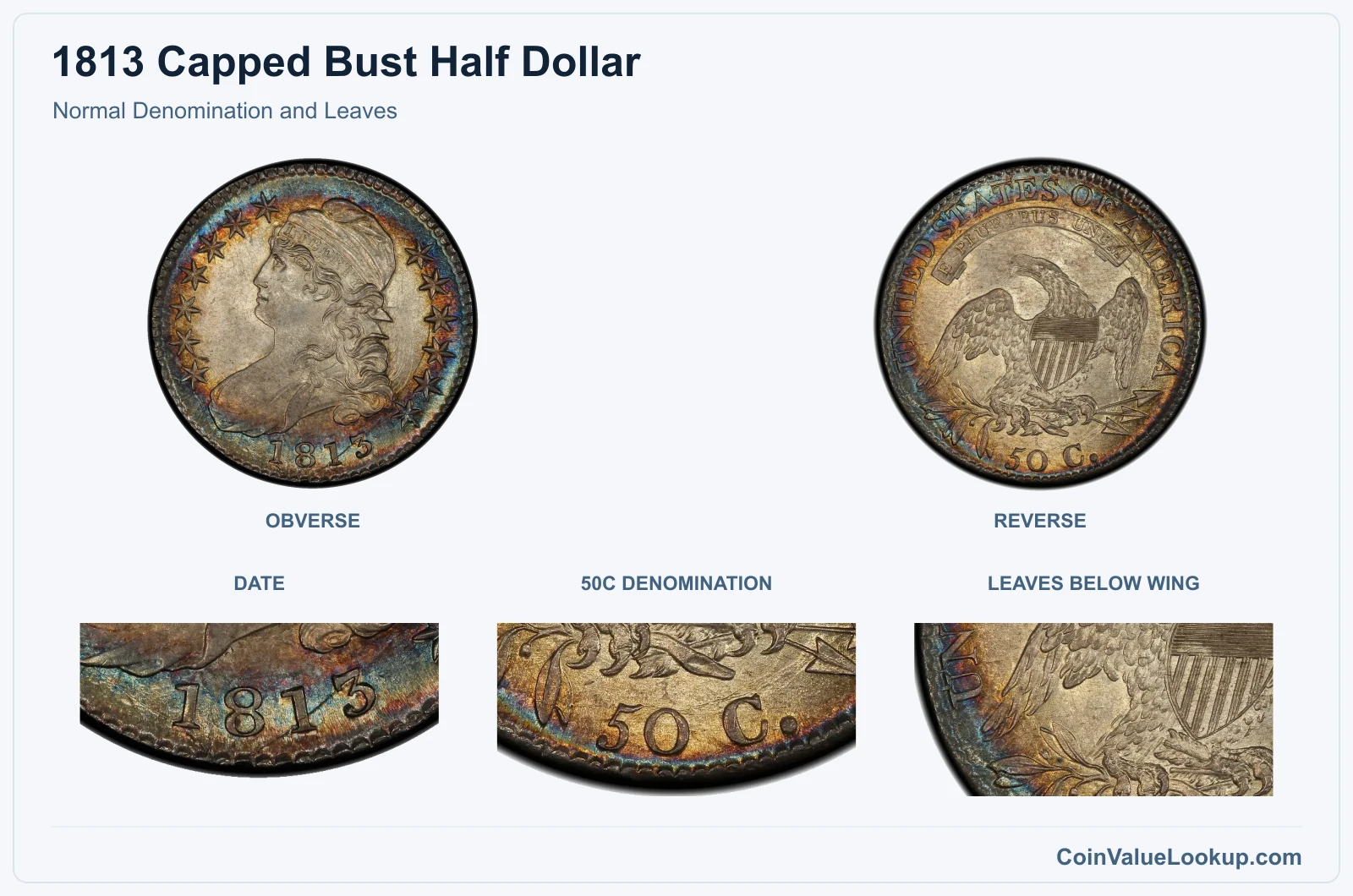
The baseline 1813 Capped Bust Half Dollar has a standard denomination and full olive leaves with no overtype or leaf anomaly. Before assuming you have this version, rule out the corrected 50 C over UNI lettering and the attributed Single Leaf variety.
Guide estimates from USA Coin Book place this version at approximately $111 in G4, $268 in VF20, and $948 in AU50. These are retail guide figures, not guaranteed offers.
Problem-free survivors with original surfaces will track closer to those numbers than cleaned or damaged examples.
Coin Value Lookup is a handy starting point when you want to look up value guides for other dates and denominations in the Capped Bust series or beyond.
Range Grade
Price Auction Records Appraisal PO PO 1
—
Coin Identifier FR FR 2
—
Coin Identifier AG AG 3
—
Coin Identifier G G 4
—
Coin Identifier
G 6
Coin Identifier VG VG 8
—
Coin Identifier
VG 10
Coin Identifier F F 12
Coin Identifier
F 15
Coin Identifier VF VF 20
Coin Identifier
VF 25
Coin Identifier
VF 30
Coin Identifier
VF 35
Coin Identifier XF XF 40
Coin Identifier
XF 45
Coin Identifier AU AU 50
Coin Identifier
AU 53
Coin Identifier
AU 55
Coin Identifier
AU 58
Coin Identifier MS MS 60
Coin Identifier
MS 61
Coin Identifier
MS 62
Coin Identifier
MS 63
Coin Identifier
MS 64
Coin Identifier
MS 65
Coin Identifier
MS 66
Coin Identifier
MS 67
Coin Identifier
MS 68
—
—
—
MS 69
—
—
—
MS 70
—
—
—
1813 Capped Bust Half Dollar — 50 C over UNI
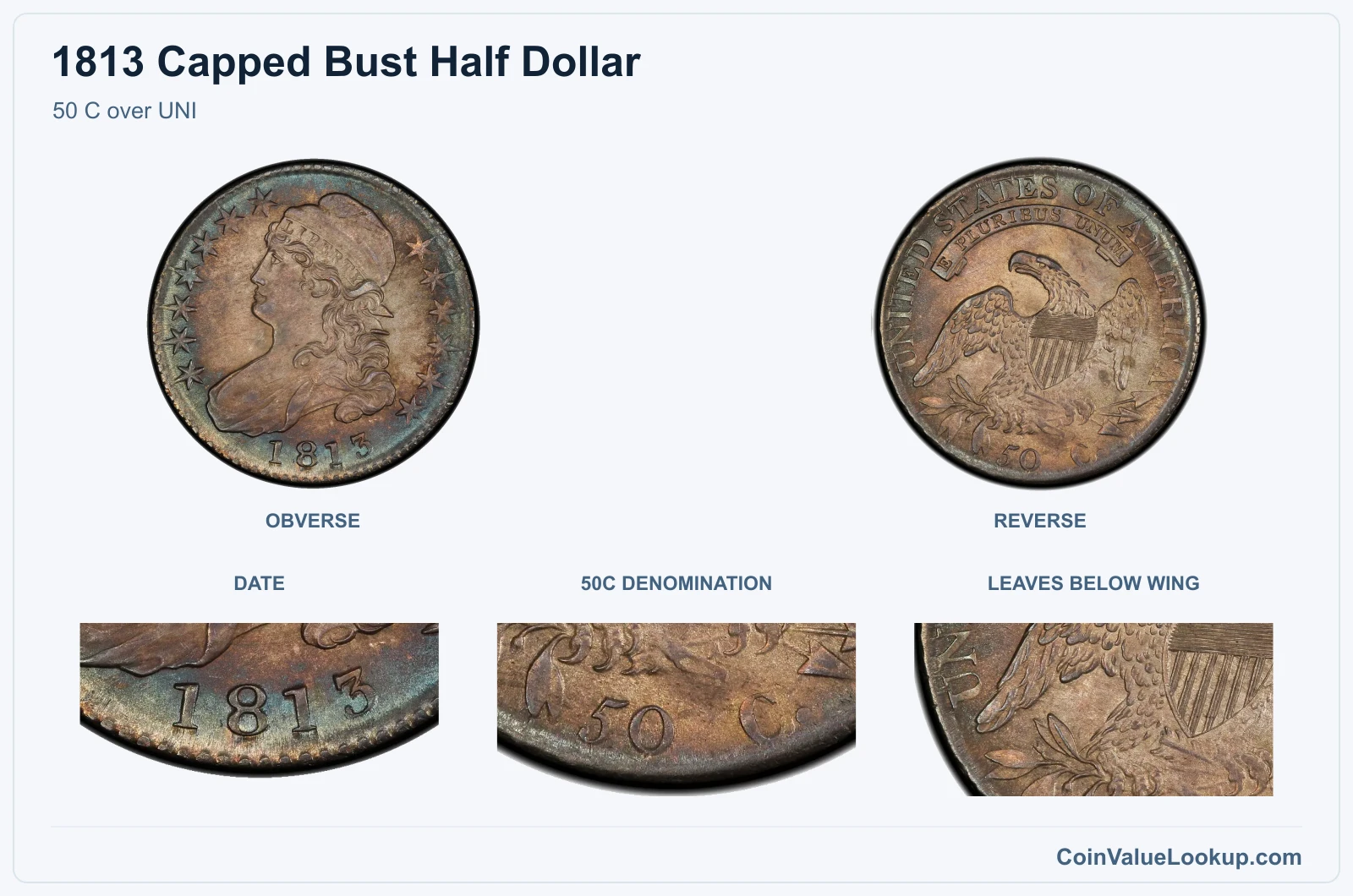
This is the variety collectors watch for. The reverse denomination shows traces of earlier, misplaced lettering beneath the "50 C." marking.
Those remnants were left when the die was corrected, and this is not a standard doubled die. You need magnification and good lighting to spot the ghost letters under the final denomination.
The premium over the normal version is substantial. USA Coin Book guide estimates sit at roughly $205 in G4, $631 in VF20, and $1,766 in AU50.
That is nearly double the normal version at every grade level. Authentication by a major grading service matters here because the letter traces can be subtle, and sellers sometimes misattribute normal die wear as an overtype.
Range Grade
Price Auction Records Appraisal PO PO 1
—
Coin Identifier FR FR 2
—
Coin Identifier AG AG 3
—
Coin Identifier G G 4
—
Coin Identifier
G 6
—
Coin Identifier VG VG 8
Coin Identifier
VG 10
Coin Identifier F F 12
Coin Identifier
F 15
Coin Identifier VF VF 20
Coin Identifier
VF 25
Coin Identifier
VF 30
Coin Identifier
VF 35
Coin Identifier XF XF 40
Coin Identifier
XF 45
Coin Identifier AU AU 50
Coin Identifier
AU 53
Coin Identifier
AU 55
Coin Identifier
AU 58
Coin Identifier MS MS 60
—
Coin Identifier
MS 61
Coin Identifier
MS 62
Coin Identifier
MS 63
Coin Identifier
MS 64
Coin Identifier
MS 65
—
Coin Identifier
MS 66
—
—
—
MS 67
—
—
—
MS 68
—
—
—
MS 69
—
—
—
MS 70
—
—
—
1813 Capped Bust Half Dollar — Single Leaf
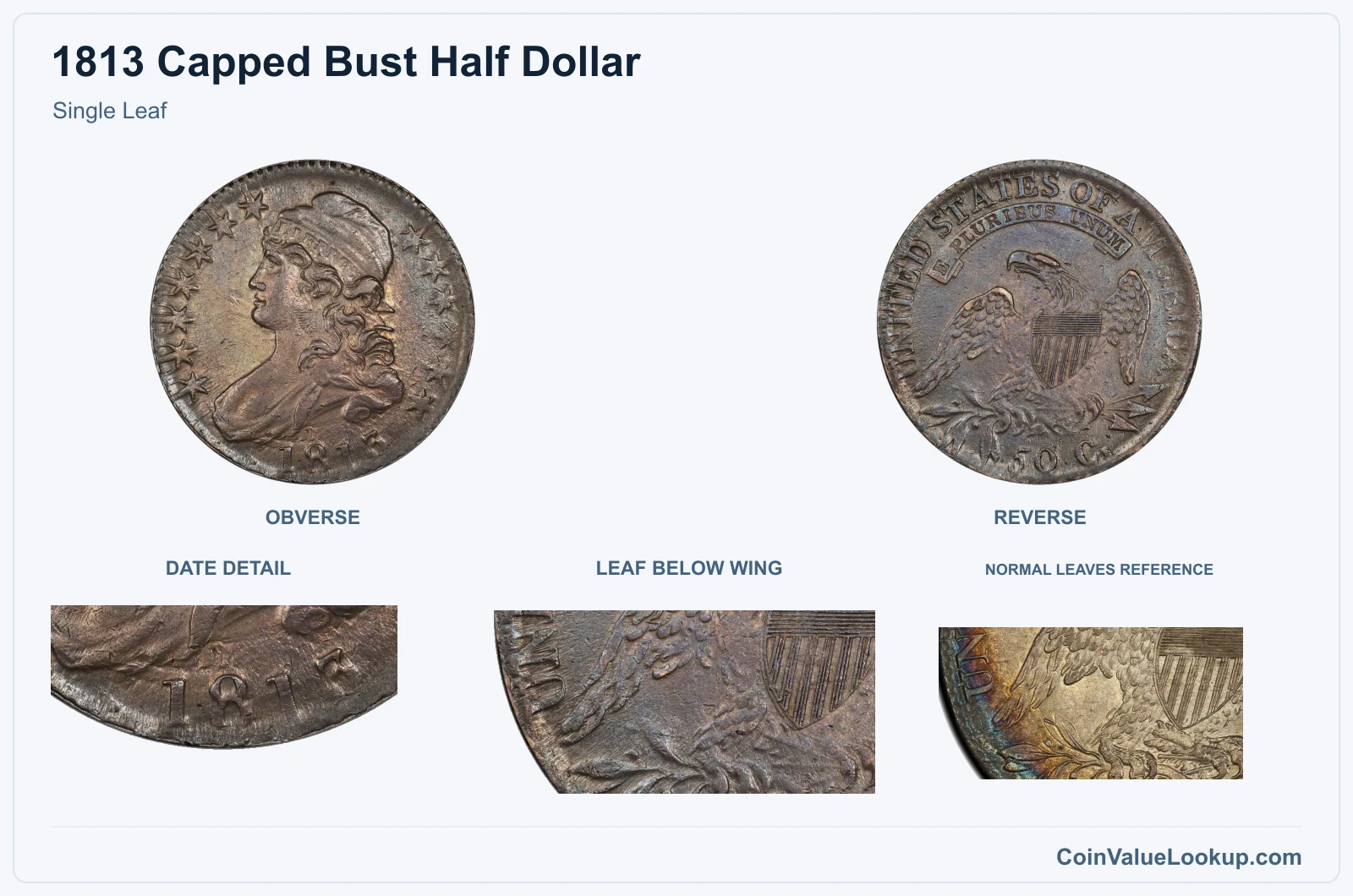
The Single Leaf variety is identified by examining the upper olive-leaf position on the reverse. Attributed examples show a specific leaf configuration that distinguishes them from the normal die state.
Faint traces of the difference may remain even on higher-grade coins, so careful comparison with known attributed specimens is the best approach.
No standard numeric price range has been adopted for this variety. Value depends on authenticated identity, the coin's overall condition, and the specific characteristics present.
If you suspect you have a Single Leaf example, professional attribution through a recognized grading service is worth pursuing, since the variety carries collector interest beyond the normal issue.
Ordinary-issue reference: Ordinary-issue reference only: The table below shows prices for the 1813 Capped Bust Half Dollar (regular strike). It does not represent the value of the specific Single Leaf variety or its variety premium. Year, mint, metal and strike type are matched; the specific variety is not priced by this table.
Range Grade
Price Auction Records Appraisal PO PO 1
—
Coin Identifier FR FR 2
—
Coin Identifier AG AG 3
—
Coin Identifier G G 4
—
Coin Identifier
G 6
Coin Identifier VG VG 8
—
Coin Identifier
VG 10
Coin Identifier F F 12
Coin Identifier
F 15
Coin Identifier VF VF 20
Coin Identifier
VF 25
Coin Identifier
VF 30
Coin Identifier
VF 35
Coin Identifier XF XF 40
Coin Identifier
XF 45
Coin Identifier AU AU 50
Coin Identifier
AU 53
Coin Identifier
AU 55
Coin Identifier
AU 58
Coin Identifier MS MS 60
Coin Identifier
MS 61
Coin Identifier
MS 62
Coin Identifier
MS 63
Coin Identifier
MS 64
Coin Identifier
MS 65
Coin Identifier
MS 66
Coin Identifier
MS 67
Coin Identifier
MS 68
—
—
—
MS 69
—
—
—
MS 70
—
—
—
1813 Capped Bust Half Dollar Error List
1. 1813 Capped Bust Half Dollar — Clashed Dies
A die clash occurs when the obverse and reverse dies strike each other without a planchet between them. The result is a transferred impression of the opposite die's design pressed into each working die, which then shows up as faint extra lines or shapes on subsequent coins.
On an 1813 half dollar, look for ghostly outlines of the eagle on the obverse or traces of Liberty's portrait on the reverse, appearing in areas that normally have no design.
Do not confuse clashed-die impressions with random scratches, raised lines from debris, or the corrected 50 C over UNI denomination, which is a separate variety. No specific price range has been adopted for clashed-die 1813 halves.
Value depends on how visible and dramatic the clash is, the coin's overall condition, and buyer demand for the specific example.
2. 1813 Capped Bust Half Dollar — Defective Planchet
A defective planchet error means the blank metal disk had a flaw before the coin was struck. On an 1813 half dollar, this has been documented as an edge planchet flaw, where part of the blank's rim area shows splitting, lamination, or irregular metal.
Inspect the edge carefully, ideally with magnification, and compare any irregularity against the lettered-edge inscription.
The key distinction is separating an original planchet defect from post-mint damage. Gouges, corrosion, and deliberate metal removal leave different surface textures and patterns than a flaw baked into the blank before striking.
A genuine planchet defect will often show struck-over characteristics where the die impression interacts with the flaw. No specific price range has been adopted for this error on the 1813 issue.
Condition, visibility, and the nature of the defect all influence the coin's value individually.