1807 Capped Bust Half Dollar Coin Value: How Much Is It Worth?
The 1807 Capped Bust Half Dollar marks the debut year of this iconic design, and collectors pay attention. A Small Stars example runs roughly $268 in G4 up to around $4,960 in AU50 based on USA Coin Book guide estimates.
The Bearded Goddess variety, with its dramatic die break, commands a serious premium. Your coin's exact version and surface condition determine where it falls.
Fast Way to Identify Your 1807 Capped Bust Half Dollar
Snap clear photos of both the front and back of your 1807 half dollar and upload them here. Our identifier can offer a preliminary read on which version you might have — Small Stars, Large Stars, the 50 over 20 denomination correction, or the sought-after Bearded Goddess.
Sharp, well-lit images help the most.
1807 Capped Bust Half Dollar Value
Upload both sides of your 1807 Capped Bust Half Dollar.
Front Obverse
Upload photo
Back Reverse
Upload photo
Which 1807 Capped Bust Half Dollar Versions Are Worth Money?
- Bearded Goddess — a raised die break at Liberty's chin creates a distinctive "beard." USA Coin Book estimates range from about $1,541 at G4 to $34,441 at AU50, dwarfing other 1807 varieties at the same grades.
- Small Stars — the smaller star punches distinguish this early subtype, estimated around $268 at G4 to $4,960 at AU50.
- Large Stars — guide estimates run roughly $237 at G4 to $3,651 at AU50; confirm the larger star size and a normal reverse denomination.
- Large Stars 50 over 20 — the corrected denomination on the reverse is a recognized variety, estimated at about $205 at G4 to $2,786 at AU50.
Step 1: Identify Your 1807 Capped Bust Half Dollar Mint Mark and Version
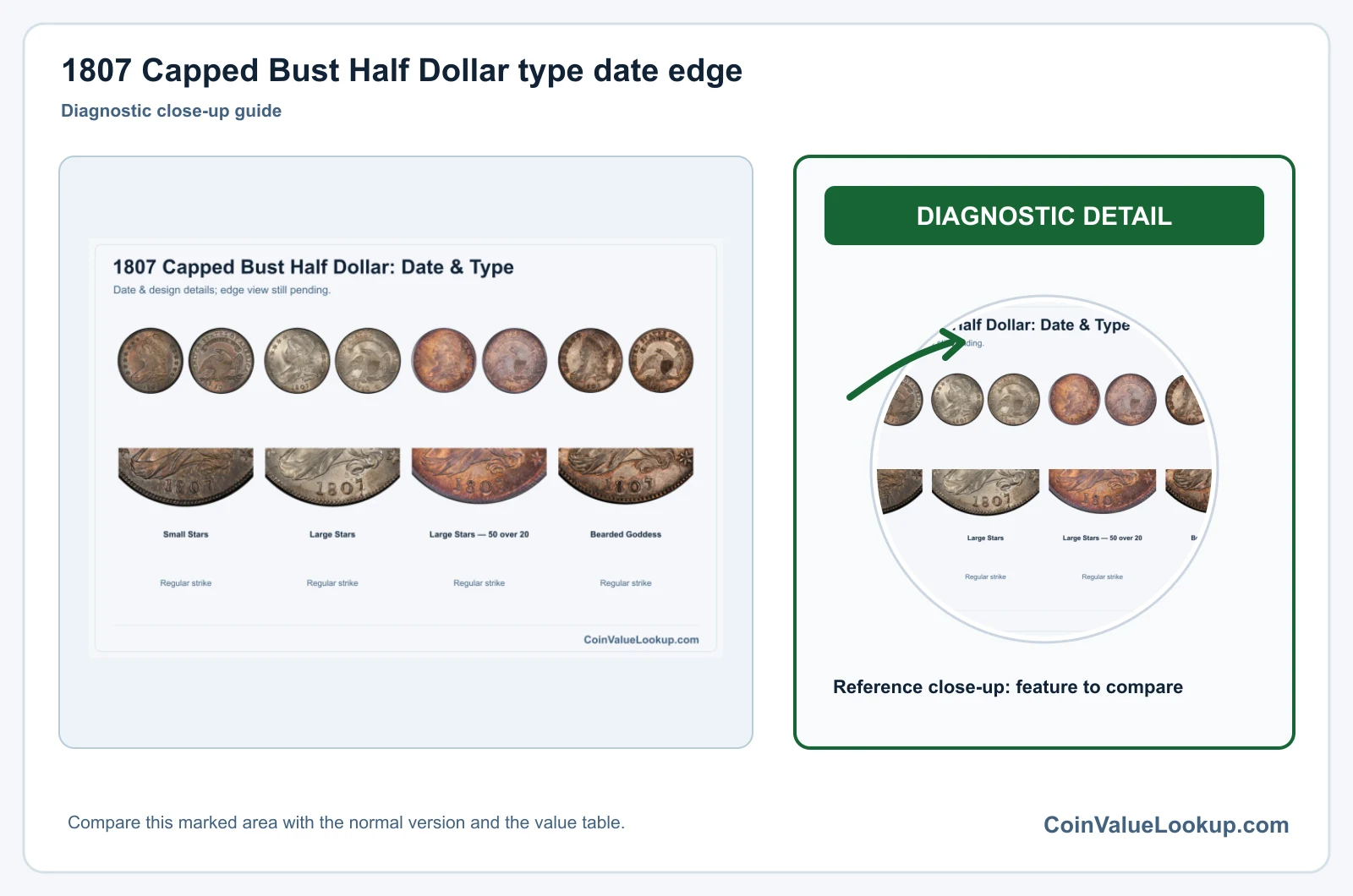
Every 1807 Capped Bust Half Dollar was struck at Philadelphia. There is no mintmark, and that is perfectly normal for this issue.
Look for the left-facing Liberty wearing a cap, with an eagle-and-shield reverse and the denomination 50C. The edge is lettered: FIFTY CENTS OR HALF A DOLLAR.
If your coin shows a right-facing, draped Liberty instead, you have the 1807 Draped Bust Half Dollar, which is a different series entirely.
The coin is a silver-copper alloy, approximately 89.24% silver, weighing about 13.48 grams and roughly 32.5 mm across.
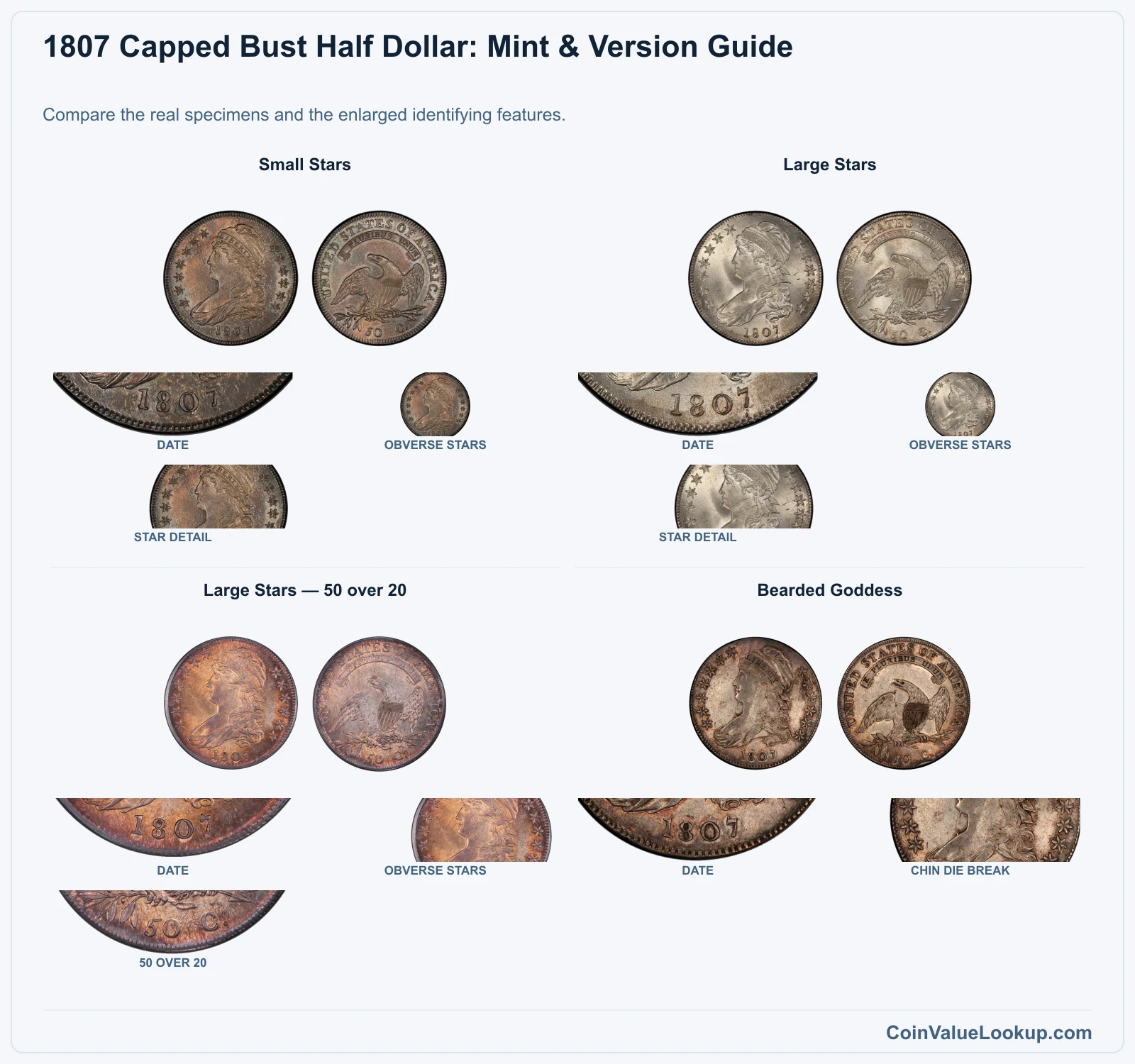
Four collectible branches exist for this year. Small Stars coins have noticeably smaller star punches surrounding Liberty compared to the Large Stars version.
The Large Stars group includes a sub-variety where the reverse denomination reads 50/20 — the engraver corrected the value directly on the die. Finally, the Bearded Goddess shows a raised die break running from Liberty's chin, giving her the appearance of a beard.
Coin Value Lookup is a handy starting point if you need to look up other dates or denominations in the Capped Bust series. Bookmark it and come back whenever a new coin crosses your path.
Step 2: Check Your 1807 Capped Bust Half Dollar Grade
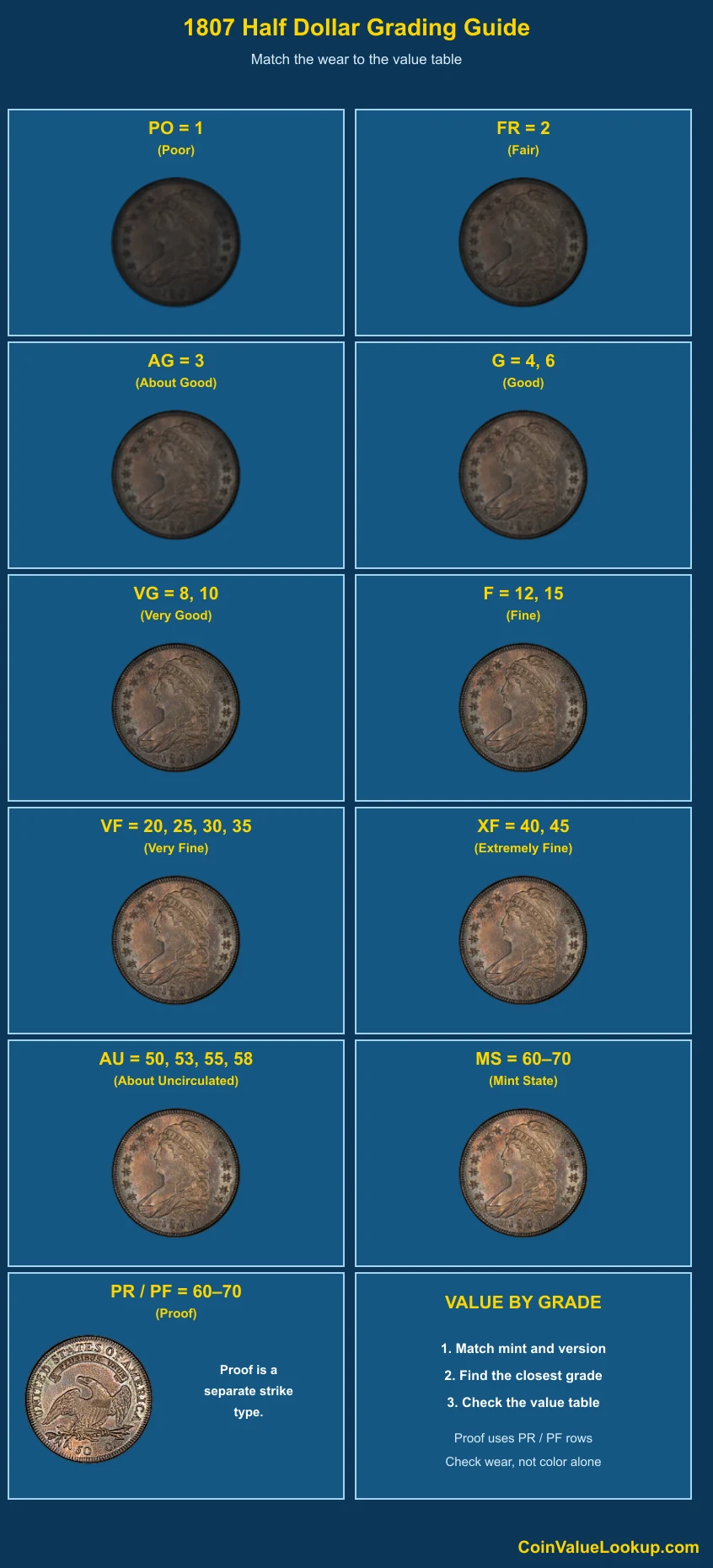
Start at the hair above Liberty's forehead and ear. On a well-worn coin (around G4), these areas blend into flat, featureless zones.
A VF20 shows moderate detail remaining in the hair curls and the cap folds, though high points are softened.
The cheek and shoulder clasp wear next. At AU50, you should still see most original luster in protected areas, with only light friction on the highest points.
Flip it over and check the eagle's breast feathers and wing tips. Weak strikes were common in 1807, so a soft eagle does not always mean heavy wear — compare the obverse wear pattern before downgrading.
Use the comparison image to match your coin against genuine Capped Bust grade examples at each level. Coins with cleaning, holes, tooling or heavy scratches fall into a "Details" category and should not be priced on a straight-grade curve.
Step 3: Check 1807 Capped Bust Half Dollar Value by Mint and Version
1807 Capped Bust Half Dollar — Small Stars
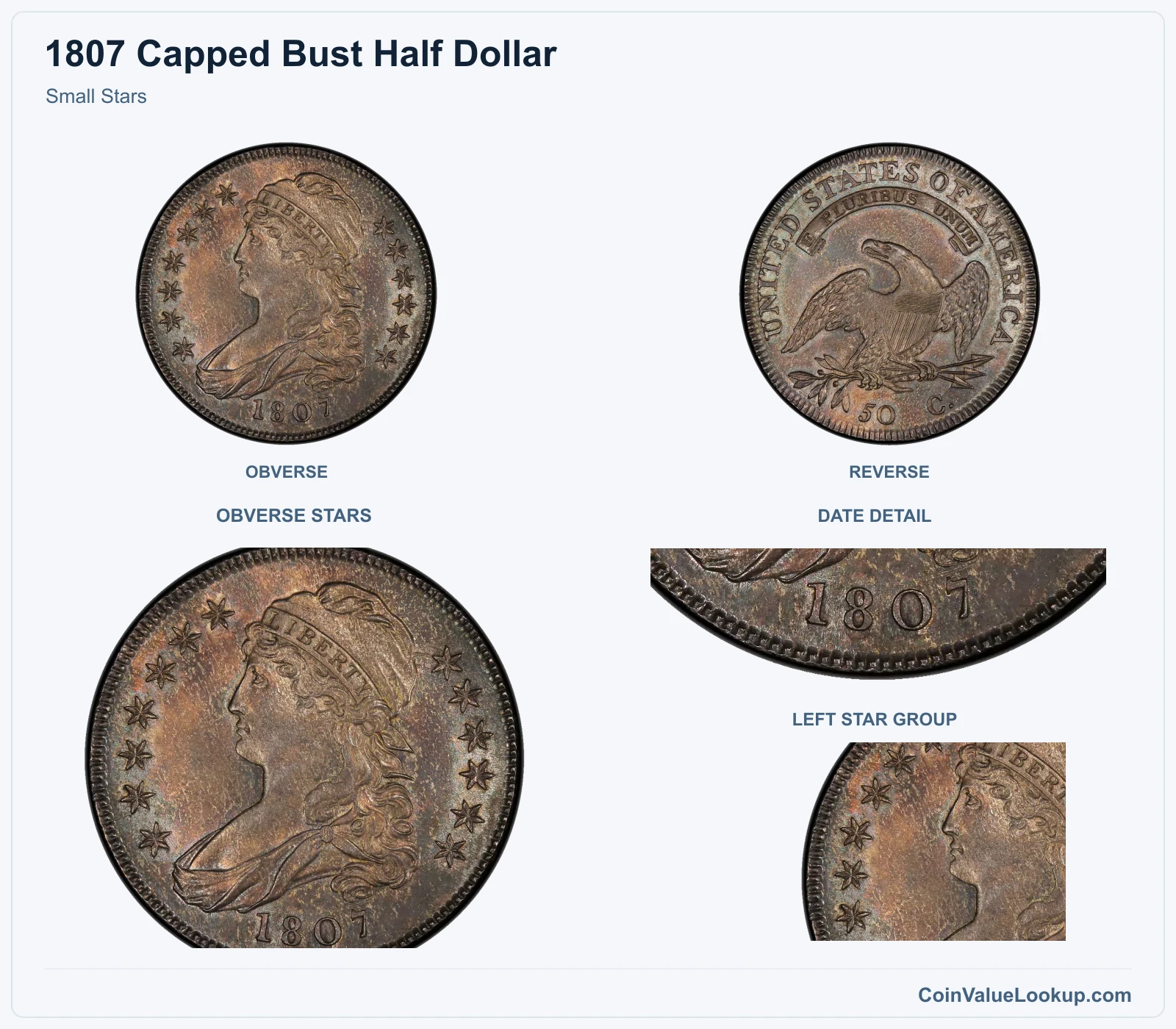
The Small Stars variety is identified by comparing the star punches around Liberty's head. They are visibly smaller and more delicately executed than those on the Large Stars version.
You need both coins side by side — or a reliable reference image — to be sure.
USA Coin Book guide estimates place the Small Stars at roughly $268 in G4, $1,206 in VF20, and $4,960 in AU50. These are retail guide figures, not guaranteed offers.
This variety tends to trade at a modest premium over the Large Stars version, reflecting its status as a distinct early die pairing in the Capped Bust debut year.
Range Grade
Price Auction Records Appraisal PO PO 1
—
Coin Identifier FR FR 2
—
Coin Identifier AG AG 3
—
Coin Identifier G G 4
Coin Identifier
G 6
—
Coin Identifier VG VG 8
Coin Identifier
VG 10
Coin Identifier F F 12
Coin Identifier
F 15
Coin Identifier VF VF 20
Coin Identifier
VF 25
Coin Identifier
VF 30
Coin Identifier
VF 35
Coin Identifier XF XF 40
Coin Identifier
XF 45
Coin Identifier AU AU 50
Coin Identifier
AU 53
Coin Identifier
AU 55
Coin Identifier
AU 58
Coin Identifier MS MS 60
—
Coin Identifier
MS 61
Coin Identifier
MS 62
Coin Identifier
MS 63
Coin Identifier
MS 64
—
Coin Identifier
MS 65
Coin Identifier
MS 66
—
—
—
MS 67
—
—
—
MS 68
—
—
—
MS 69
—
—
—
MS 70
—
—
—
1807 Capped Bust Half Dollar — Large Stars
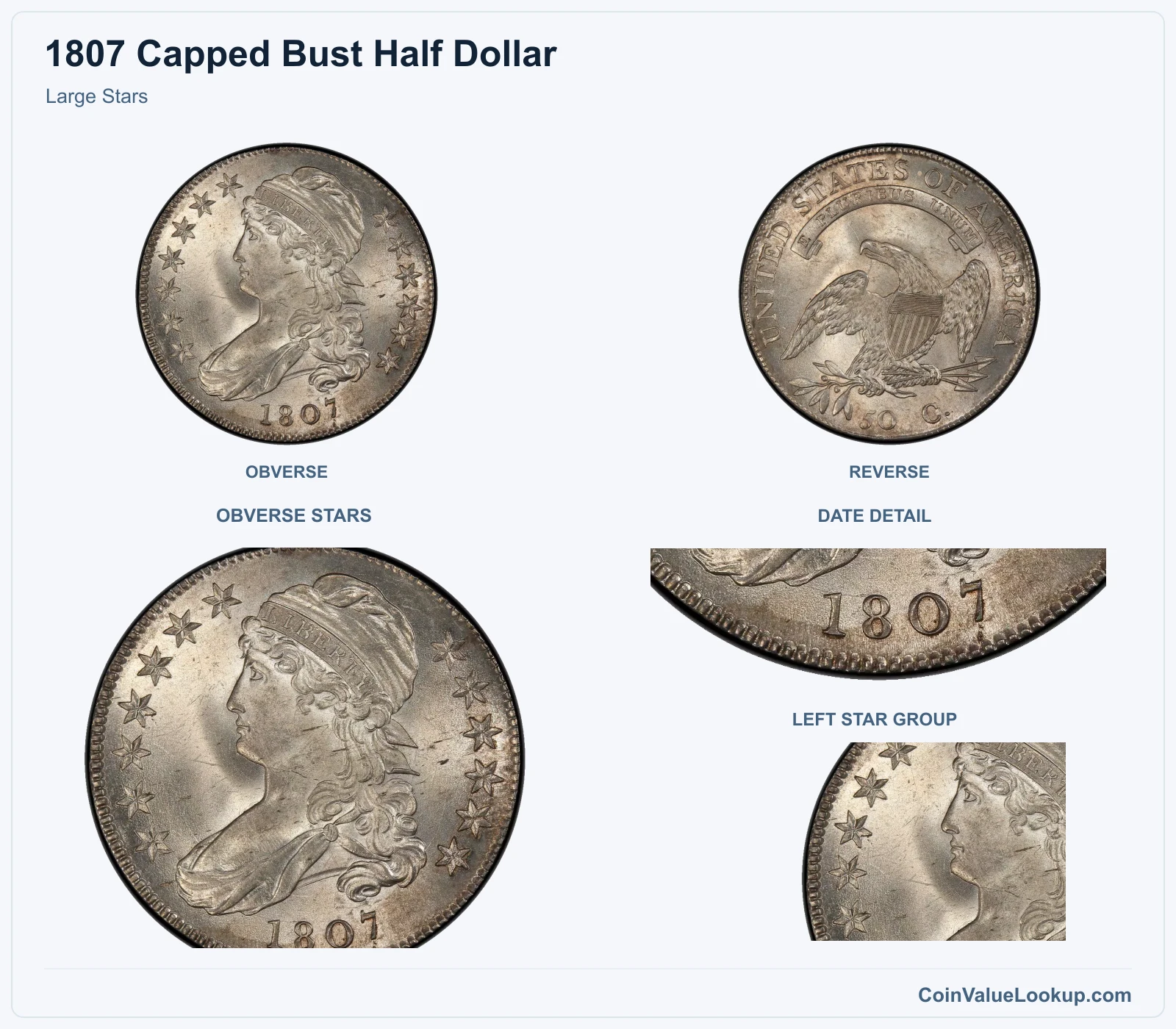
Large Stars coins are the more commonly encountered 1807 Capped Bust variety. The stars surrounding Liberty are punched noticeably larger and bolder than on the Small Stars counterpart.
Before using this price curve, confirm the reverse denomination reads a clean 50C with no traces of an underlying 20. USA Coin Book estimates the Large Stars at about $237 in G4, $1,016 in VF20, and $3,651 in AU50.
These are guide-level retail estimates. Even well-circulated examples in the G4 range carry solid three-figure value thanks to the silver content and first-year appeal of the design.
Range Grade
Price Auction Records Appraisal PO PO 1
—
Coin Identifier FR FR 2
—
Coin Identifier AG AG 3
Coin Identifier G G 4
Coin Identifier
G 6
—
Coin Identifier VG VG 8
—
Coin Identifier
VG 10
Coin Identifier F F 12
Coin Identifier
F 15
Coin Identifier VF VF 20
Coin Identifier
VF 25
Coin Identifier
VF 30
Coin Identifier
VF 35
Coin Identifier XF XF 40
Coin Identifier
XF 45
Coin Identifier AU AU 50
Coin Identifier
AU 53
Coin Identifier
AU 55
Coin Identifier
AU 58
Coin Identifier MS MS 60
—
Coin Identifier
MS 61
—
Coin Identifier
MS 62
Coin Identifier
MS 63
Coin Identifier
MS 64
—
Coin Identifier
MS 65
Coin Identifier
MS 66
—
Coin Identifier
MS 67
—
—
—
MS 68
—
—
—
MS 69
—
—
—
MS 70
—
—
—
1807 Capped Bust Half Dollar — Large Stars — 50 over 20
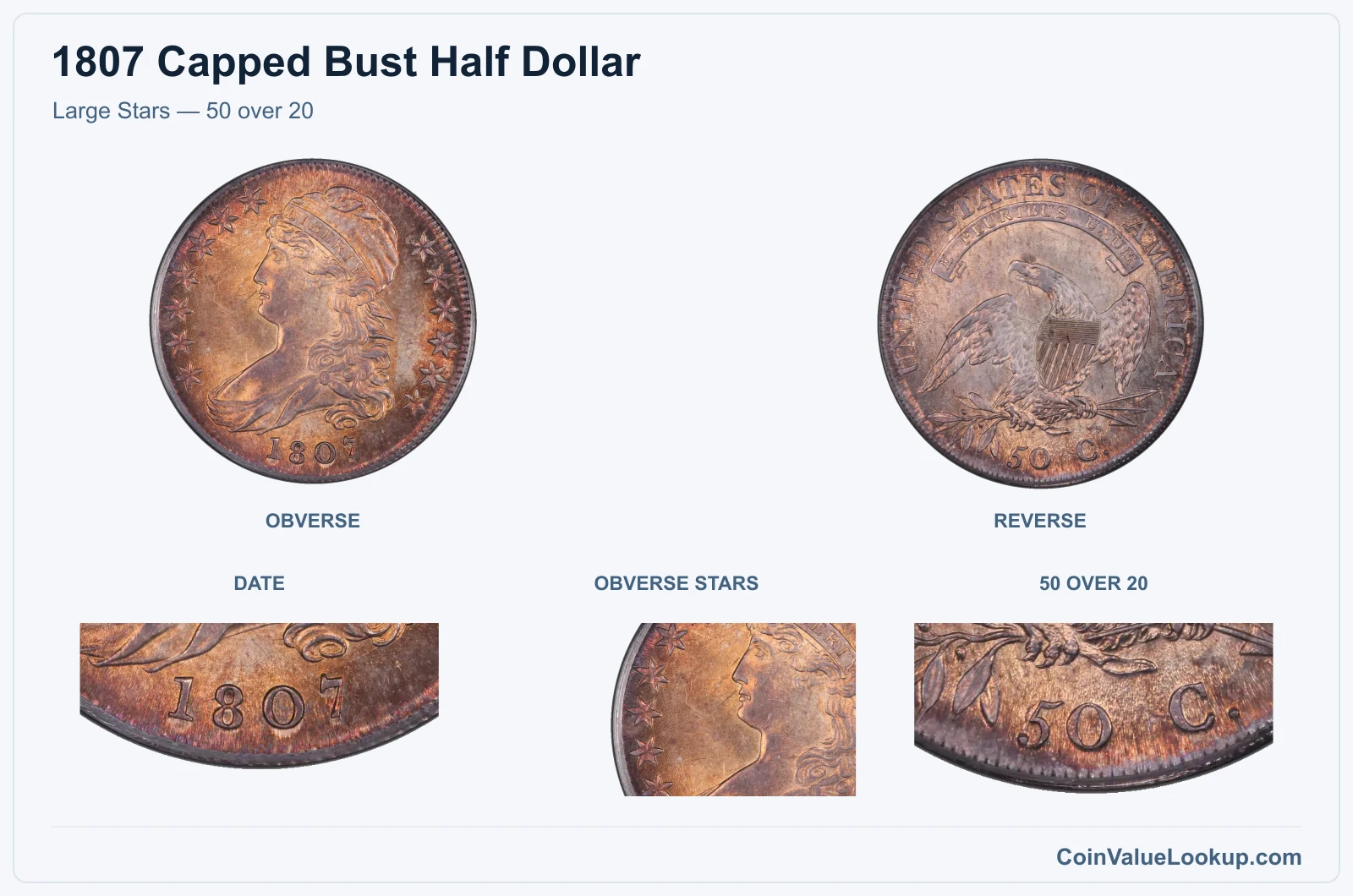
On this variety the reverse die originally showed a denomination of 20 cents, which was corrected to 50 cents directly on the die. Under magnification you can see remnants of the original "20" beneath the "50." This is a die-engraving correction on the reverse, not a date overdate on the obverse — an important distinction.
USA Coin Book guide estimates come in at about $205 in G4, $775 in VF20, and $2,786 in AU50. The 50/20 correction is a recognized catalog label used for database matching.
Despite being a genuine variety, it typically trades below the standard Large Stars because the feature is on the reverse and can be subtle on worn specimens.
Range Grade
Price Auction Records Appraisal PO PO 1
—
Coin Identifier FR FR 2
—
Coin Identifier AG AG 3
Coin Identifier G G 4
Coin Identifier
G 6
—
Coin Identifier VG VG 8
Coin Identifier
VG 10
Coin Identifier F F 12
Coin Identifier
F 15
Coin Identifier VF VF 20
Coin Identifier
VF 25
Coin Identifier
VF 30
Coin Identifier
VF 35
Coin Identifier XF XF 40
Coin Identifier
XF 45
Coin Identifier AU AU 50
Coin Identifier
AU 53
Coin Identifier
AU 55
Coin Identifier
AU 58
Coin Identifier MS MS 60
Coin Identifier
MS 61
Coin Identifier
MS 62
Coin Identifier
MS 63
Coin Identifier
MS 64
Coin Identifier
MS 65
Coin Identifier
MS 66
—
—
—
MS 67
—
—
—
MS 68
—
—
—
MS 69
—
—
—
MS 70
—
—
—
1807 Capped Bust Half Dollar — Bearded Goddess
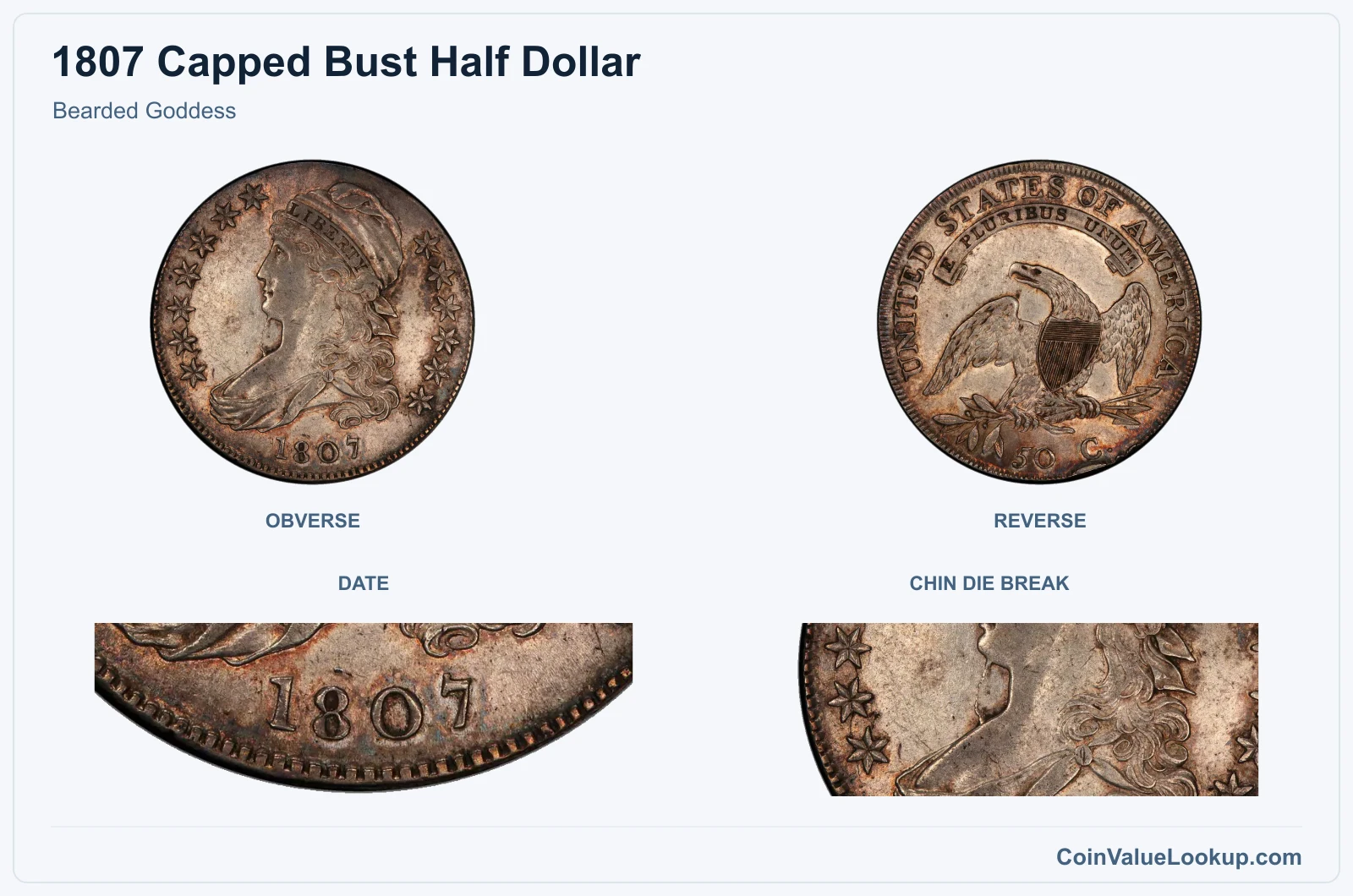
This is the headline variety of 1807. A raised die break extends from Liberty's chin downward, giving her the unmistakable appearance of having a beard.
The break is a manufacturing failure — metal filled a crack in the die and transferred that raised line onto every coin struck from it.
Premiums depend heavily on how bold and complete the break appears. Early die-state coins show a strong, sharp beard; later strikes from the same deteriorating die may show a wider, mushier feature.
Always compare against a positively attributed example before claiming this variety.
USA Coin Book guide estimates are dramatic: roughly $1,541 at G4, $4,960 at VF20, and a striking $34,441 at AU50. These figures reflect the variety's visual appeal and name recognition among early half dollar collectors.
The same die break is discussed in the error section below — it is one event, not two separate collectible categories.
Range Grade
Price Auction Records Appraisal PO PO 1
—
Coin Identifier FR FR 2
—
Coin Identifier AG AG 3
—
Coin Identifier G G 4
—
Coin Identifier
G 6
—
Coin Identifier VG VG 8
—
Coin Identifier
VG 10
—
Coin Identifier F F 12
Coin Identifier
F 15
Coin Identifier VF VF 20
Coin Identifier
VF 25
Coin Identifier
VF 30
Coin Identifier
VF 35
—
Coin Identifier XF XF 40
Coin Identifier
XF 45
Coin Identifier AU AU 50
—
Coin Identifier
AU 53
—
Coin Identifier
AU 55
—
Coin Identifier
AU 58
—
—
— MS MS 60
—
—
—
MS 61
—
—
—
MS 62
—
—
—
MS 63
—
—
—
MS 64
—
—
—
MS 65
—
—
—
MS 66
—
—
—
MS 67
—
—
—
MS 68
—
—
—
MS 69
—
—
—
MS 70
—
—
—
1807 Capped Bust Half Dollar Error List
1. 1807 Capped Bust Half Dollar — Bearded Goddess Die Break
The Bearded Goddess die break is the same feature described in the Bearded Goddess version above — a raised line of metal running from Liberty's chin, caused by a crack that developed in the obverse die during production. It looks like a beard, and the nickname stuck.
When examining your coin, look at the chin area under magnification. A genuine die break will be raised above the field and follow a consistent path across multiple known specimens.
It is not a random scratch or post-mint damage.
Lookalikes include scratches, tooling marks, surface corrosion, or even confusion with the right-facing Draped Bust half dollar struck in the same year, which has an entirely different portrait. A scratch will typically be incuse (pressed into the surface), while the die break is raised.
No separate numerical price range is adopted for this as an error because it is the same feature that defines the Bearded Goddess variety. Individual value depends on the break's visibility, the coin's die state, and overall condition.
Professional attribution is worthwhile here given the premiums involved.