1810 Capped Bust Half Dollar Coin Value: How Much Is It Worth?
An 1810 Capped Bust Half Dollar in well-worn G4 condition carries an estimated guide value around $111, climbing to roughly $332 at VF20 and approximately $1,016 at AU50, per USA Coin Book estimates. Collector value depends heavily on the coin's surfaces, version, and overall condition.
Rare overdates and die marriages can push prices considerably higher.
Fast Way to Identify Your 1810 Capped Bust Half Dollar
Want a quick read on your 1810 half dollar? Upload clear photos of the front and back — and the lettered edge if you can manage it — for a preliminary identification.
That first look can help sort out whether you have a common-date piece or something that warrants a closer examination by a professional grading service.
1810 Capped Bust Half Dollar Value
Upload both sides of your 1810 Capped Bust Half Dollar.
Front Obverse
Upload photo
Back Reverse
Upload photo
Which 1810 Capped Bust Half Dollar Versions Are Worth Money?
- Philadelphia Normal Date — The standard 1810 issue ranges from about $111 in G4 to roughly $1,016 at AU50 per USA Coin Book estimates, making even common-date examples worth well over face value in any collectible grade.
- Rare overdates and die varieties of the 1810 Capped Bust Half Dollar can command significantly higher prices than the normal-date issue, so checking your coin's date closely is worthwhile.
Step 1: Identify Your 1810 Capped Bust Half Dollar Mint Mark and Version
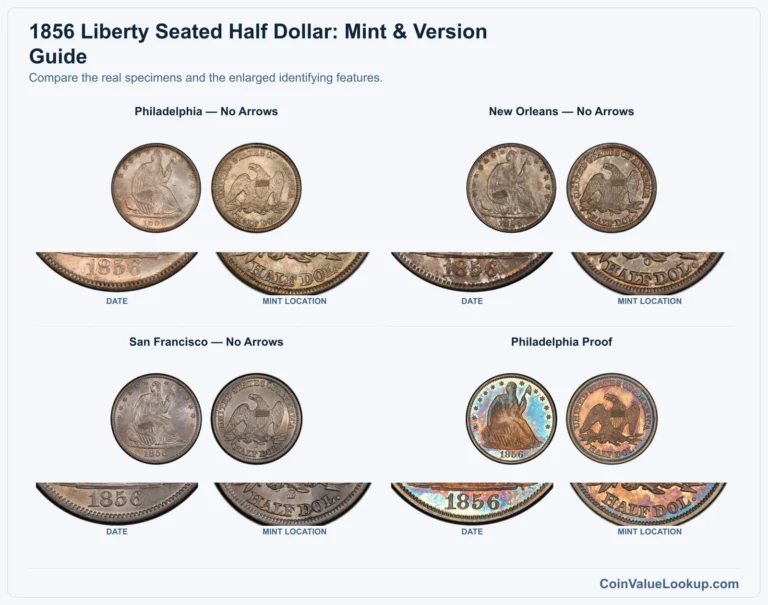
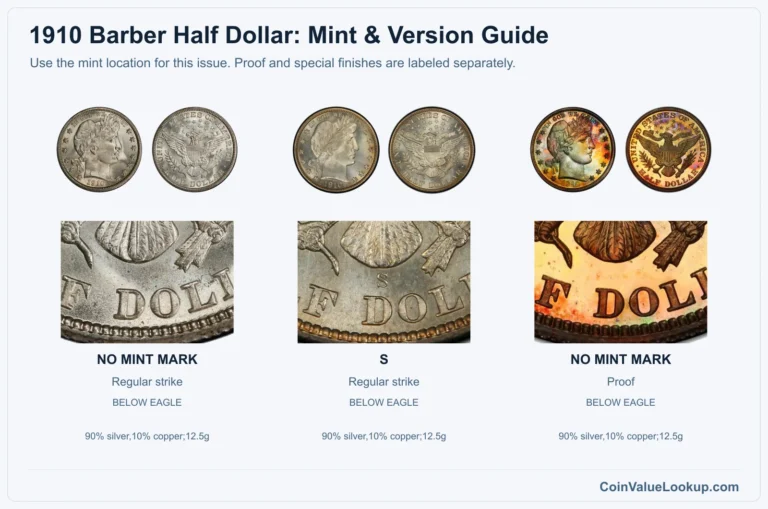
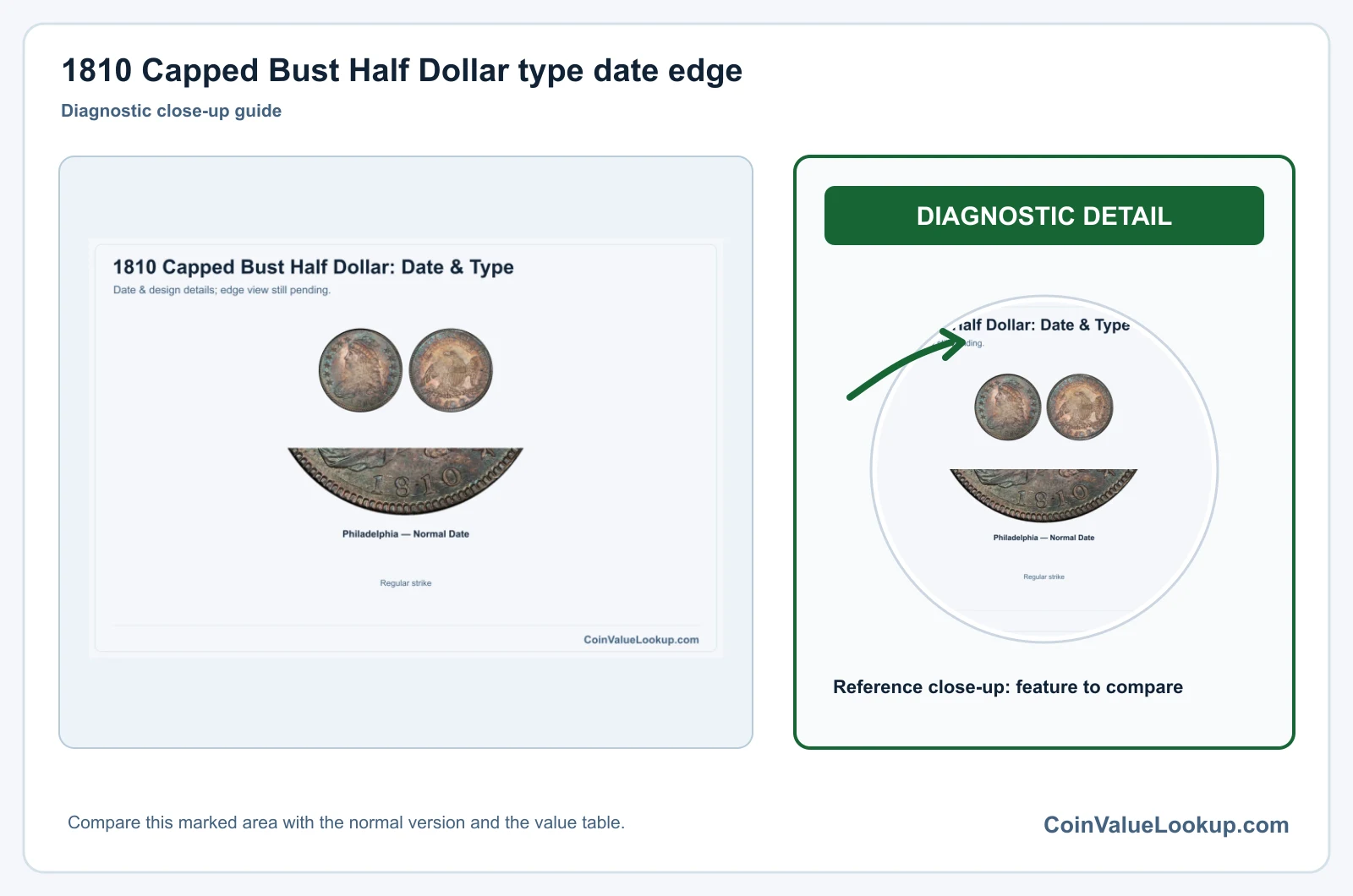
Every 1810 Capped Bust Half Dollar was struck at Philadelphia. There is no mintmark, and the absence of one is completely normal for this issue.
The obverse shows a left-facing Liberty wearing a cloth cap, with stars around the border. The reverse features an eagle holding arrows and an olive branch behind a heraldic shield, with "50 C" at the bottom.
Confirm the lettered edge, which reads FIFTY CENTS OR HALF A DOLLAR. This is a silver-copper alloy coin, approximately 89.24% silver, weighing about 13.48 grams and measuring roughly 32.5 mm in diameter.
Do not confuse this with the 1807 Draped Bust type, which has a distinctly different portrait style. The Capped Bust design by John Reich replaced it, and the two look nothing alike once you see them side by side.
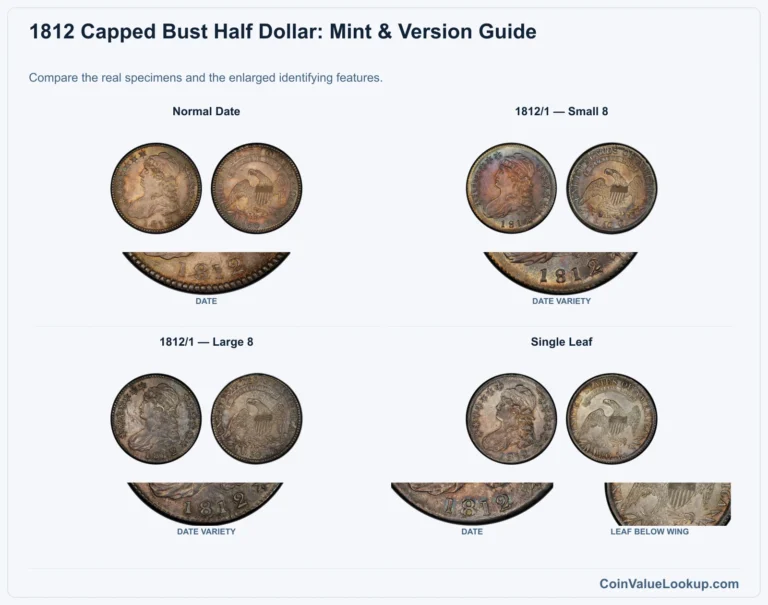
For this year, the primary branch a beginner needs to identify is the Philadelphia Normal Date issue. Specialist die marriages and corrected punches exist but do not automatically create a separate beginner-level valuation category.
Step 2: Check Your 1810 Capped Bust Half Dollar Grade
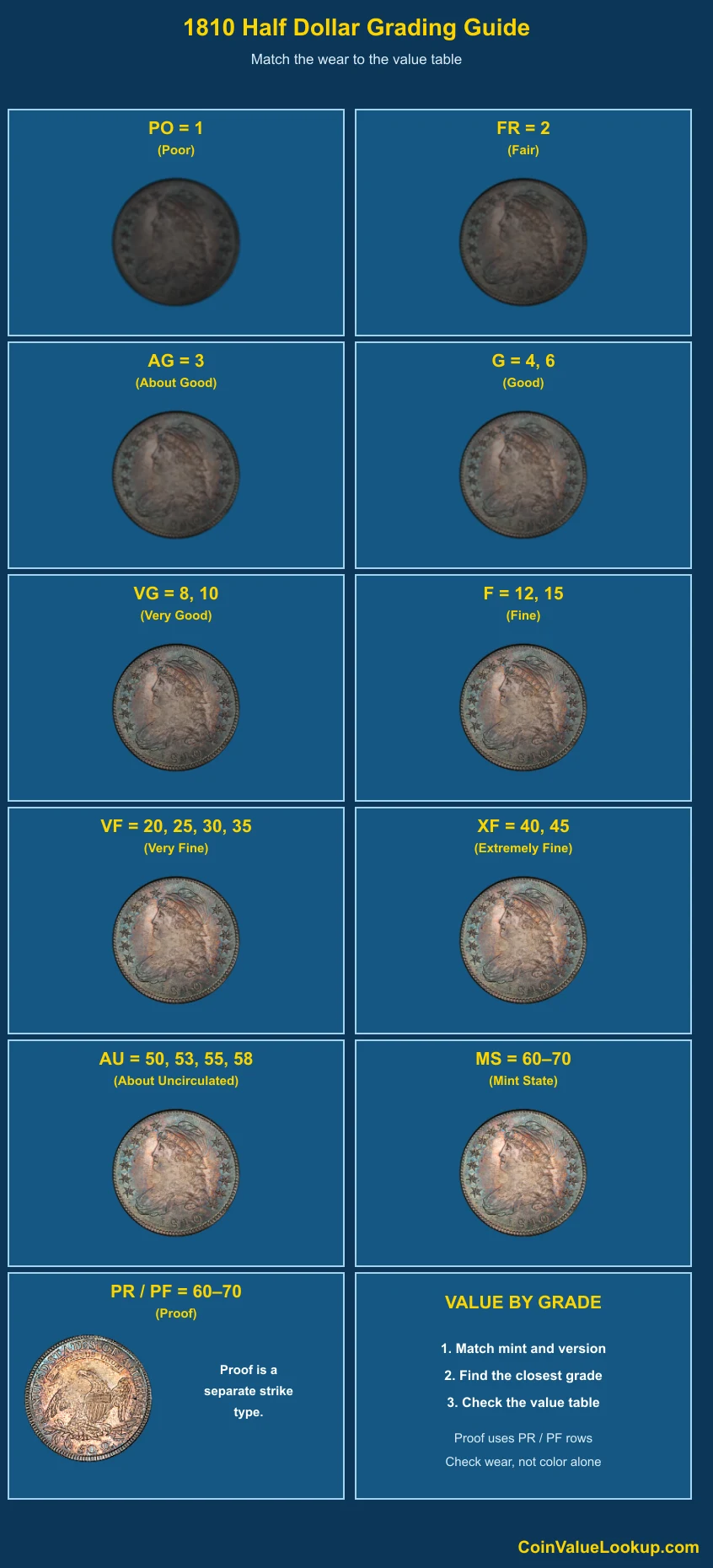
Start with Liberty's hair above the forehead and around the ear. On a well-circulated coin, the individual curls merge into flat areas first.
The cheek, cap folds, and shoulder clasp also lose detail progressively.
Flip the coin over and check the eagle's breast feathers and wing tips. Weak strikes on early 19th-century silver are common, so a mushy breast does not always mean wear — compare the overall luster and high-point friction to tell strike softness from actual circulation.
Use the comparison image to match your coin against known grade benchmarks for the Capped Bust type. Look at the overall sharpness together, not just one spot.
Cleaning, tooling, artificial toning, holes, and heavy scratches must be evaluated separately. A coin with those issues cannot be priced on a straight-grade value curve, even if the remaining detail looks sharp.
Professional grading services label these as "Details" grades for good reason.
Step 3: Check 1810 Capped Bust Half Dollar Value by Mint and Version
1810 Capped Bust Half Dollar — Philadelphia — Normal Date
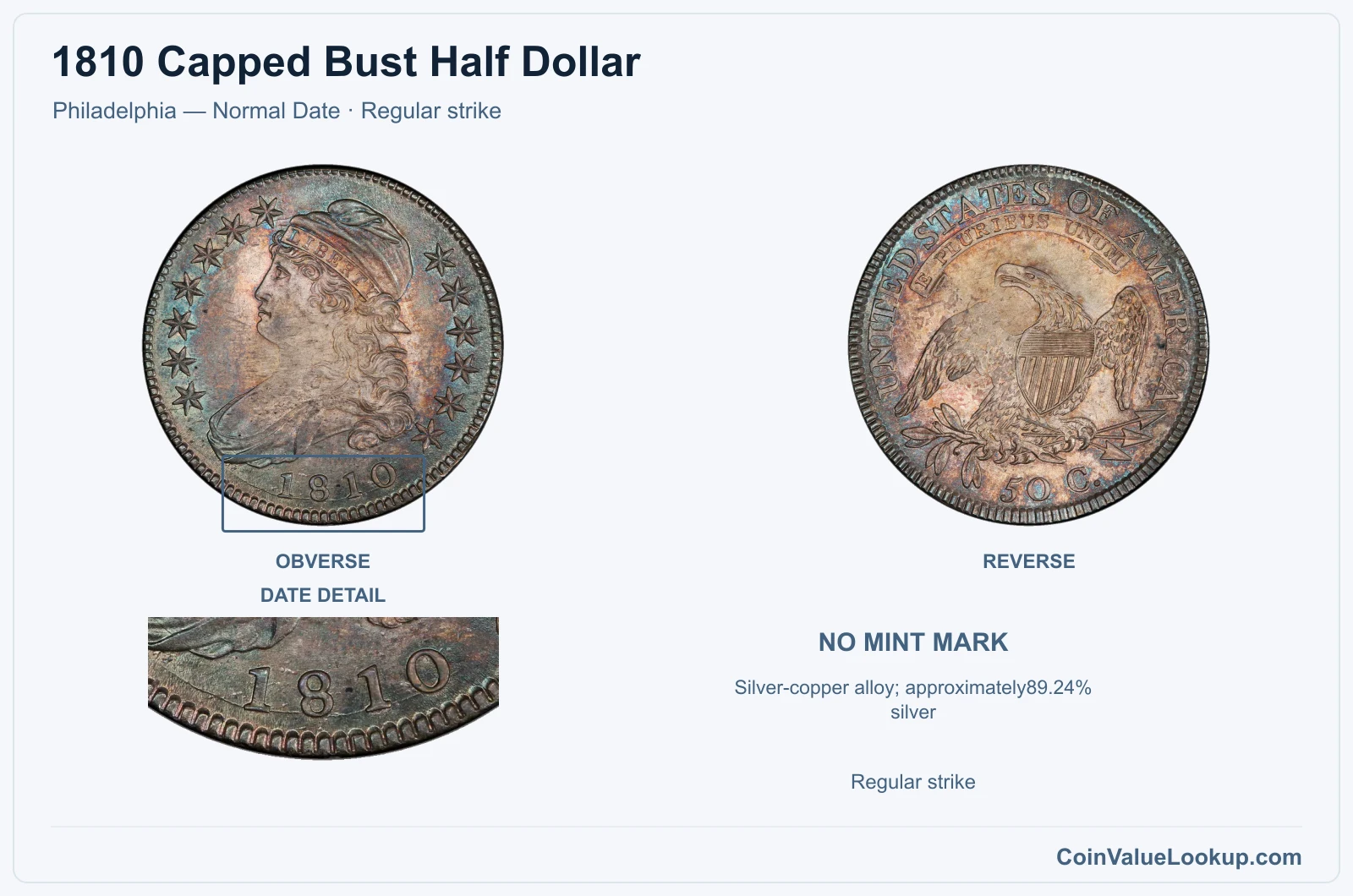
The Philadelphia Normal Date is the standard 1810 Capped Bust Half Dollar — no mintmark, struck in a silver-copper alloy of approximately 89.24% silver. USA Coin Book estimates place it around $111 in G4, about $332 in VF20, and roughly $1,016 in AU50.
These are guide estimates, not guaranteed sale prices.
Specialist collectors catalog numerous die marriages for this date, including corrected punches and minor positional differences. Those varieties matter in advanced Bust Half collecting, but for a beginner evaluating a coin, the normal-date value curve is the right starting point.
A strong original surface with no cleaning will always outperform a higher-detail coin that has been harshly treated.
Coin Value Lookup is a useful starting point if you want to look up other early American coin values alongside this one. You can find guides for other denominations and years in the same series.
Range Grade
Price Auction Records Appraisal PO PO 1
—
Coin Identifier FR FR 2
—
Coin Identifier AG AG 3
—
Coin Identifier G G 4
Coin Identifier
G 6
Coin Identifier VG VG 8
Coin Identifier
VG 10
Coin Identifier F F 12
Coin Identifier
F 15
Coin Identifier VF VF 20
Coin Identifier
VF 25
Coin Identifier
VF 30
Coin Identifier
VF 35
Coin Identifier XF XF 40
Coin Identifier
XF 45
Coin Identifier AU AU 50
Coin Identifier
AU 53
Coin Identifier
AU 55
Coin Identifier
AU 58
Coin Identifier MS MS 60
—
Coin Identifier
MS 61
Coin Identifier
MS 62
Coin Identifier
MS 63
Coin Identifier
MS 64
Coin Identifier
MS 65
Coin Identifier
MS 66
Coin Identifier
MS 67
—
—
—
MS 68
—
—
—
MS 69
—
—
—
MS 70
—
—
—
1810 Capped Bust Half Dollar Error List
1. 1810 Capped Bust Half Dollar — Off-Center Strike
An off-center strike happens when the planchet is not properly seated in the collar before the dies come together, shifting the entire design toward one side. On a reported 1810 Half Dollar example, the displacement was noted at roughly 5%, meaning part of the rim area was left unstruck while the opposite side shows a wider-than-normal border.
Look for the whole design shifting in one direction with a corresponding blank or weak crescent along the opposite edge. Uneven denticles alone do not qualify — the entire image must be displaced.
Do not confuse this with a clipped planchet, which removes metal before striking, or with one-sided die misalignment, which affects only the obverse or reverse independently. Post-mint flattening from a vise or hammer can also mimic the look but lacks the telltale unstruck border.
The value of an off-center piece depends on condition, degree of displacement, and how much of the date and design remain visible.
2. 1810 Capped Bust Half Dollar — Die Crack / Die Chip
Die cracks appear as thin raised lines on the coin's surface, formed when a working die fractures under repeated striking pressure. On a reported 1810 Half Dollar, the crack extends from the neck area toward the bust, creating a visible raised ridge that follows no logical design element.
The key diagnostic is that the line is raised above the field, not incised into it. Run your fingernail across — a genuine die crack will feel like a tiny speed bump.
A scratch or hairline, by contrast, is cut into the metal and feels like a groove.
Do not mistake corrosion trails, foreign material deposits, or incuse tooling marks for die cracks. All of those sit at or below the surface rather than above it.
The value of a die crack piece depends on the crack's prominence, length, and the coin's overall grade and eye appeal. No specific price range is established for this category on the 1810 date.
3. 1810 Capped Bust Half Dollar — Lamination / Split Planchet
A lamination error occurs when impurities or gas pockets trapped inside the planchet cause a layer of metal to peel or split away from the coin's surface. On a silver-copper alloy coin like the 1810 Half Dollar, this defect can appear as a thin flap of metal lifting from the field or a missing patch where the layer has already broken off.
The 1810 Half Dollar has been reported with this type of error. Look for a distinctly layered separation in the metal — not a surface scrape or scratch, which would show directional tool marks.
Corrosion pitting can also look superficially similar, but laminations reveal clean internal metal beneath the separated flap.
Deliberately cut or shaved coins will show sharp, deliberate edges rather than the irregular, natural separation of a lamination. Value depends on condition, visibility, and the extent of the defect; no specific price range is established.
4. 1810 Capped Bust Half Dollar — Clipped Planchet
A clipped planchet error means the blank was incompletely punched from the silver strip before striking, leaving a curved bite out of the coin's edge. On a reported 1810 Half Dollar example, the clip is visible as a missing section along the rim with a characteristic curved profile matching the punch that cut the planchet.
Genuine clips usually show a corresponding area of weakness in the design — called the Blakesley effect — on the opposite side of the coin from the clip. That weakness happens because the planchet had less metal to fill the die in that area.
Do not confuse a clip with an edge that has been filed, cut, or corroded after minting. Post-mint damage tends to show sharp or irregular edges, tool marks, or surface discoloration inconsistent with a manufacturing defect.
Value depends on the size and prominence of the clip and the coin's overall condition; no specific price range is established for this category.