1810 Classic Head Cent Coin Value: How Much Is It Worth?
The 1810 Classic Head Cent is a copper coin struck at the Philadelphia Mint over two centuries ago, and surviving examples carry real value. Guide estimates for the two main varieties range from about $148 in Good-4 condition to around $3,083 in Extremely Fine-40, depending on exact variety and grade.
Identifying which version you hold is the first step toward understanding what your coin is worth.
Fast Way to Identify Your 1810 Classic Head Cent
The quickest way to start figuring out your 1810 cent is to snap clear photos of the front and back, then upload them for a preliminary identification. Good lighting and a close shot of the date area are especially helpful.
This won't replace professional authentication, but it gives you a solid starting point for narrowing down the variety and approximate condition.
1810 Classic Head Cent Value
Upload both sides of your 1810 Classic Head Cent.
Front Obverse
Upload photo
Back Reverse
Upload photo
Which 1810 Classic Head Cent Versions Are Worth Money?
- The 1810/09 overdate variety guides around $162 in G4 and $3,083 in EF40, making it the higher-valued of the two listed branches at those grades.
- The Normal Date 1810 guides at roughly $148 in G4 and $2,728 in EF40, still a substantial coin in any collectible grade.
- Several mint error categories are reported for this date, and authenticated examples with strong visual impact could carry additional value beyond ordinary date pricing.
Step 1: Identify Your 1810 Classic Head Cent Mint Mark and Version
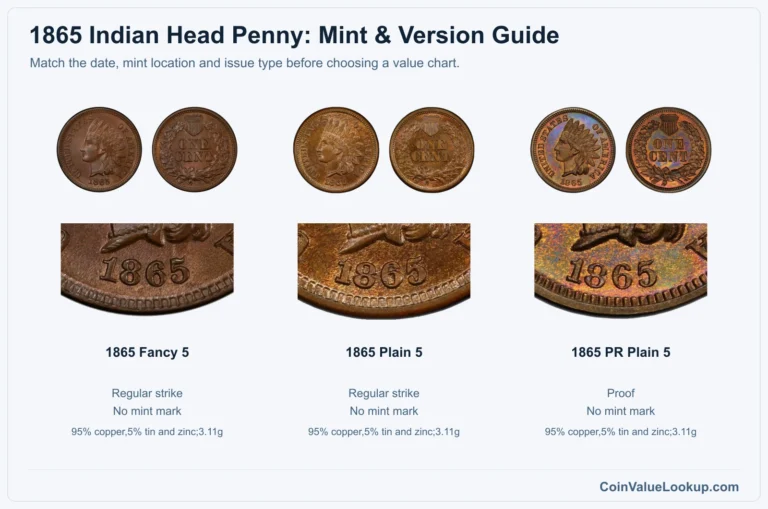
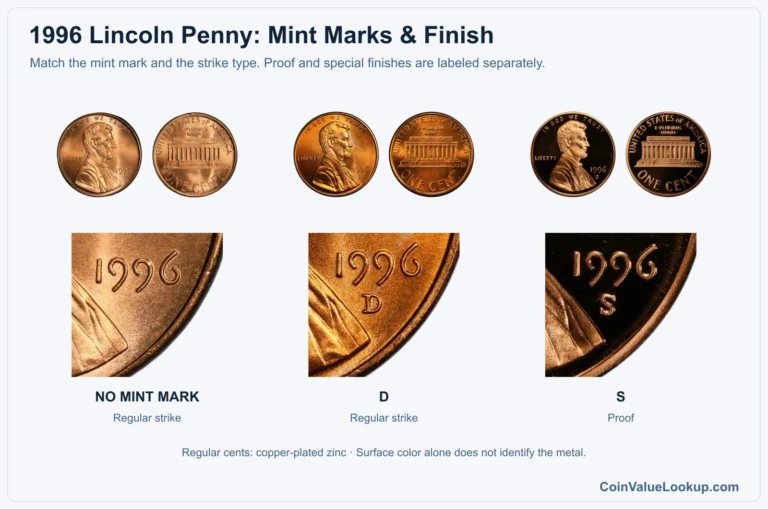
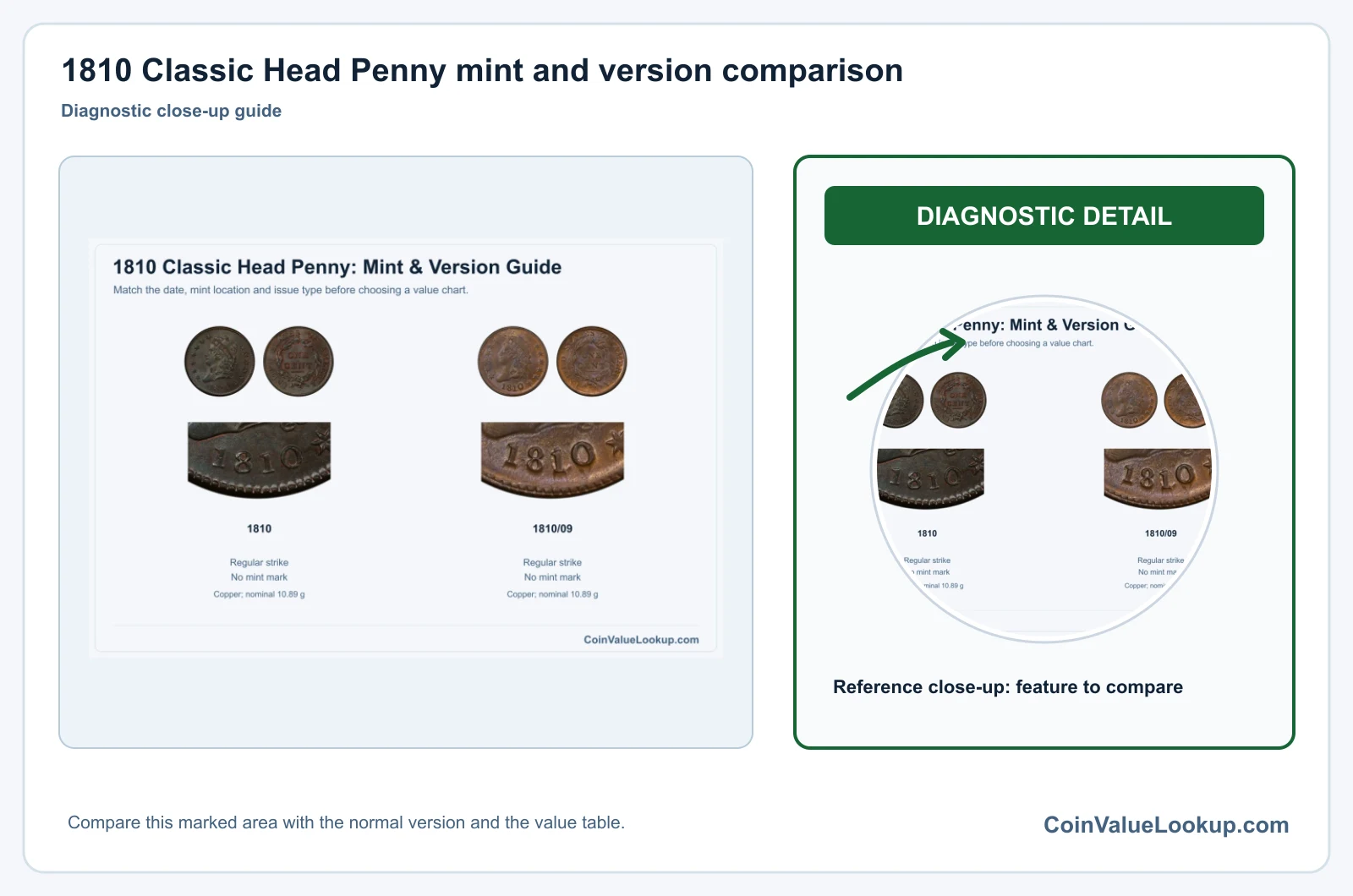
All 1810 Classic Head Cents were struck at the Philadelphia Mint. There is no mintmark on any of them, so don't go hunting for one.
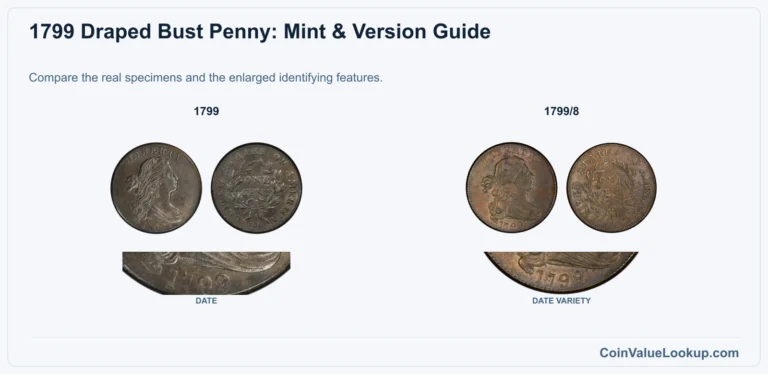
The two main varieties are the Normal Date 1810 and the 1810/09 overdate. These are not the same thing.
On the overdate, you can see remnants of the underlying "09" beneath the final "10" in the date. Not all funky-looking date punches qualify as an overdate, so look specifically for traces of a 0 and 9 beneath the last two digits.
Examine the obverse portrait of Liberty wearing a fillet headband, and the reverse wreath surrounding the denomination. Check the edge as well.
Date-punch shape, legend wording, and wreath details can all help place your coin in the correct category.
Weight can be supporting evidence. These copper cents have a nominal weight of 10.89 grams.
But wear, corrosion, and normal production tolerances from 1810 mean weight alone cannot prove authenticity.
Step 2: Check Your 1810 Classic Head Cent Grade
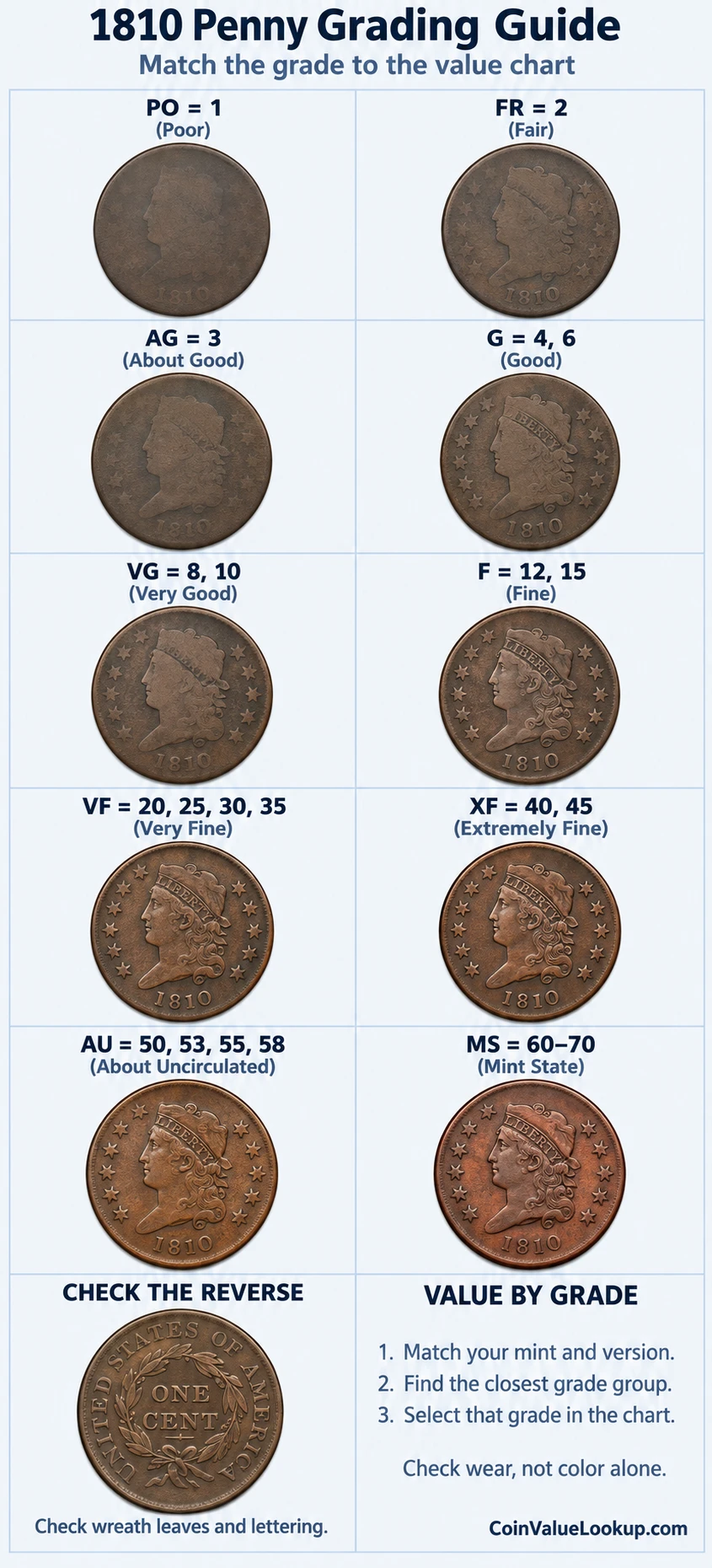
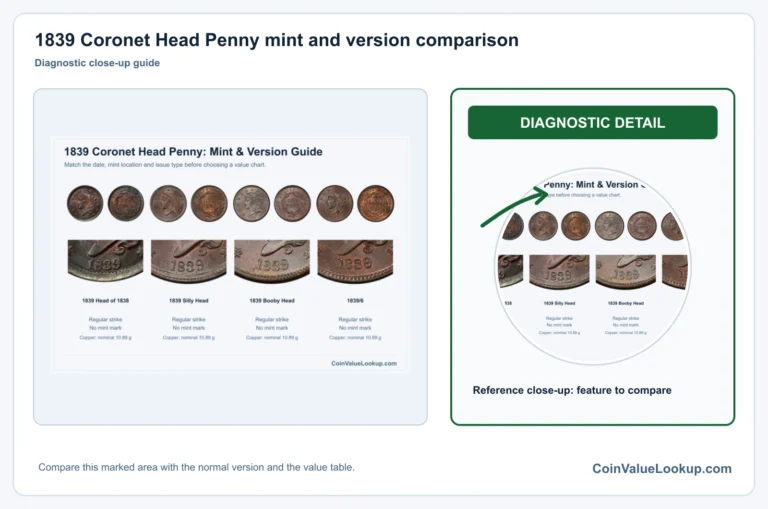
Compare your coin's portrait to the comparison image, paying close attention to the hair detail above and behind Liberty's ear, the cheek, and the headband lettering. On the reverse, look at the leaf relief in the wreath and the sharpness of the lettering around the denomination.
A coin grading Good-4 will show a visible outline of the portrait with most fine detail worn smooth. By Extremely Fine-40, you should see clear individual hair strands and sharp wreath leaves with only light wear on the highest points.
Don't confuse a weak original strike with heavy circulation wear. Early copper large cents were sometimes struck unevenly, leaving soft spots that aren't from handling.
Surface problems matter a lot on early copper. Cleaning, corrosion, and porosity can reduce market value well below what a guide estimate suggests for a given grade.
BN, RB, and RD refer to color on copper surfaces, not different metals. Most surviving 1810 cents are brown.
Step 3: Check 1810 Classic Head Cent Value by Mint and Version
1810 Classic Head Cent
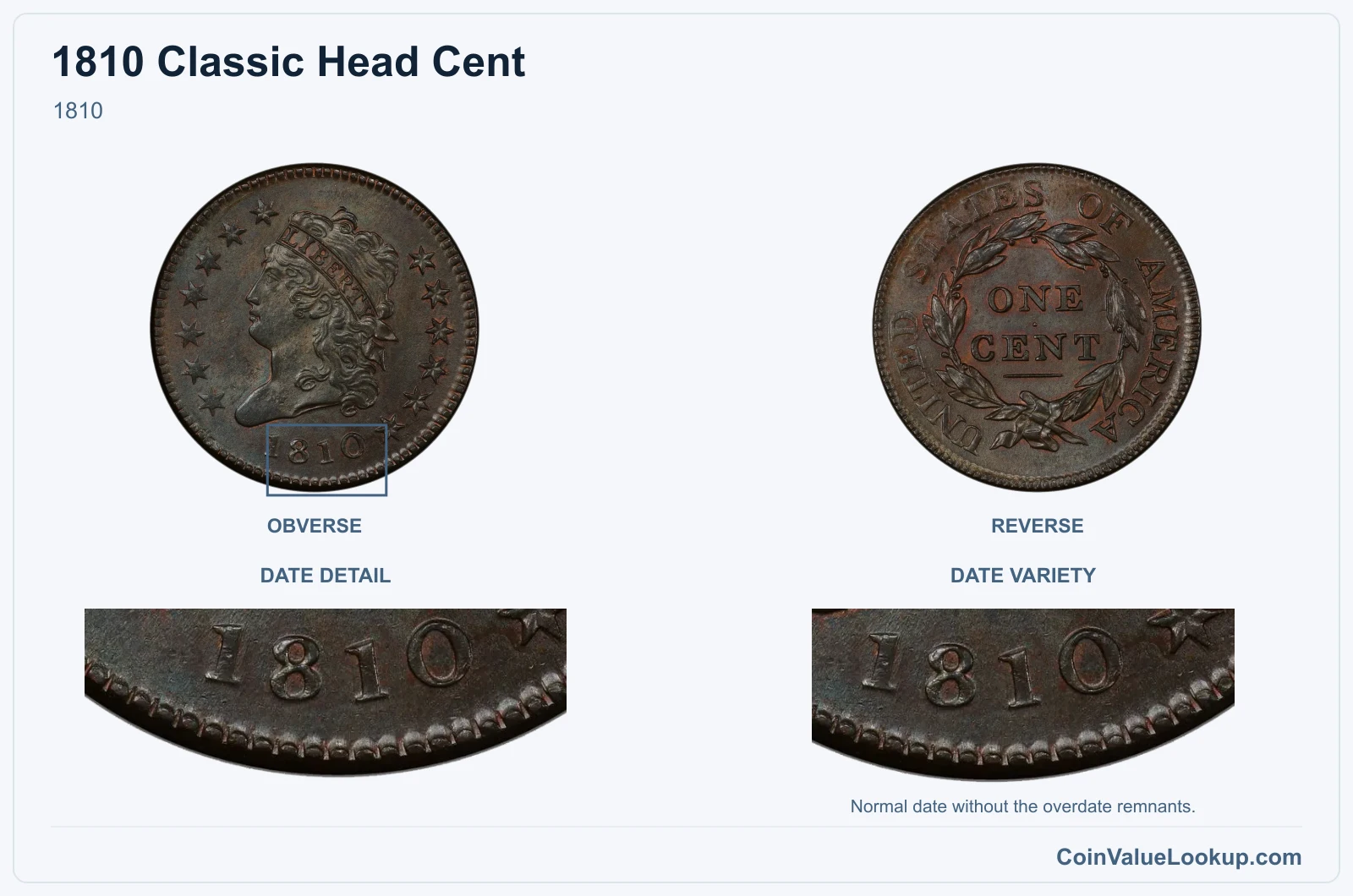
The Normal Date 1810 Classic Head Cent is the straightforward issue for this year. It was struck at Philadelphia on a copper planchet weighing about 10.89 grams, with no mintmark.
The obverse features Liberty wearing a headband, and the reverse shows the denomination inside a wreath.
Guide estimates place this variety at roughly $148 in Good-4 and around $2,728 in Extremely Fine-40. That is a wide spread, and condition drives value dramatically.
Make sure the date reads a clean "1810" without traces of an underlying "09" before classifying a coin as this variety.
Coin Value Lookup is a useful place to look up value guides for early copper cents and many other U.S. coins. If you are comparing several dates or denominations, it can save you time.
| Range | Grade | Price | Auction Records | Appraisal |
|---|---|---|---|---|
| PO | PO 1 | — | Coin Identifier | |
| FR | FR 2 | Coin Identifier | ||
| AG | AG 3 | Coin Identifier | ||
| G | G 4 | Coin Identifier | ||
| G 6 | Coin Identifier | |||
| VG | VG 8 | Coin Identifier | ||
| VG 10 | Coin Identifier | |||
| F | F 12 | Coin Identifier | ||
| F 15 | Coin Identifier | |||
| VF | VF 20 | Coin Identifier | ||
| VF 25 | Coin Identifier | |||
| VF 30 | Coin Identifier | |||
| VF 35 | Coin Identifier | |||
| XF | XF 40 | Coin Identifier | ||
| XF 45 | Coin Identifier | |||
| AU | AU 50 | Coin Identifier | ||
| AU 53 | Coin Identifier | |||
| AU 55 | Coin Identifier | |||
| AU 58 | Coin Identifier | |||
| MS | MS 60 | — | Coin Identifier | |
| MS 61 | — | Coin Identifier | ||
| MS 62 | Coin Identifier | |||
| MS 63 | Coin Identifier | |||
| MS 64 | Coin Identifier | |||
| MS 65 | Coin Identifier | |||
| MS 66 | Coin Identifier | |||
| MS 67 | — | — | — | |
| MS 68 | — | — | — | |
| MS 69 | — | — | — | |
| MS 70 | — | — | — |
1810 Classic Head Cent — /09
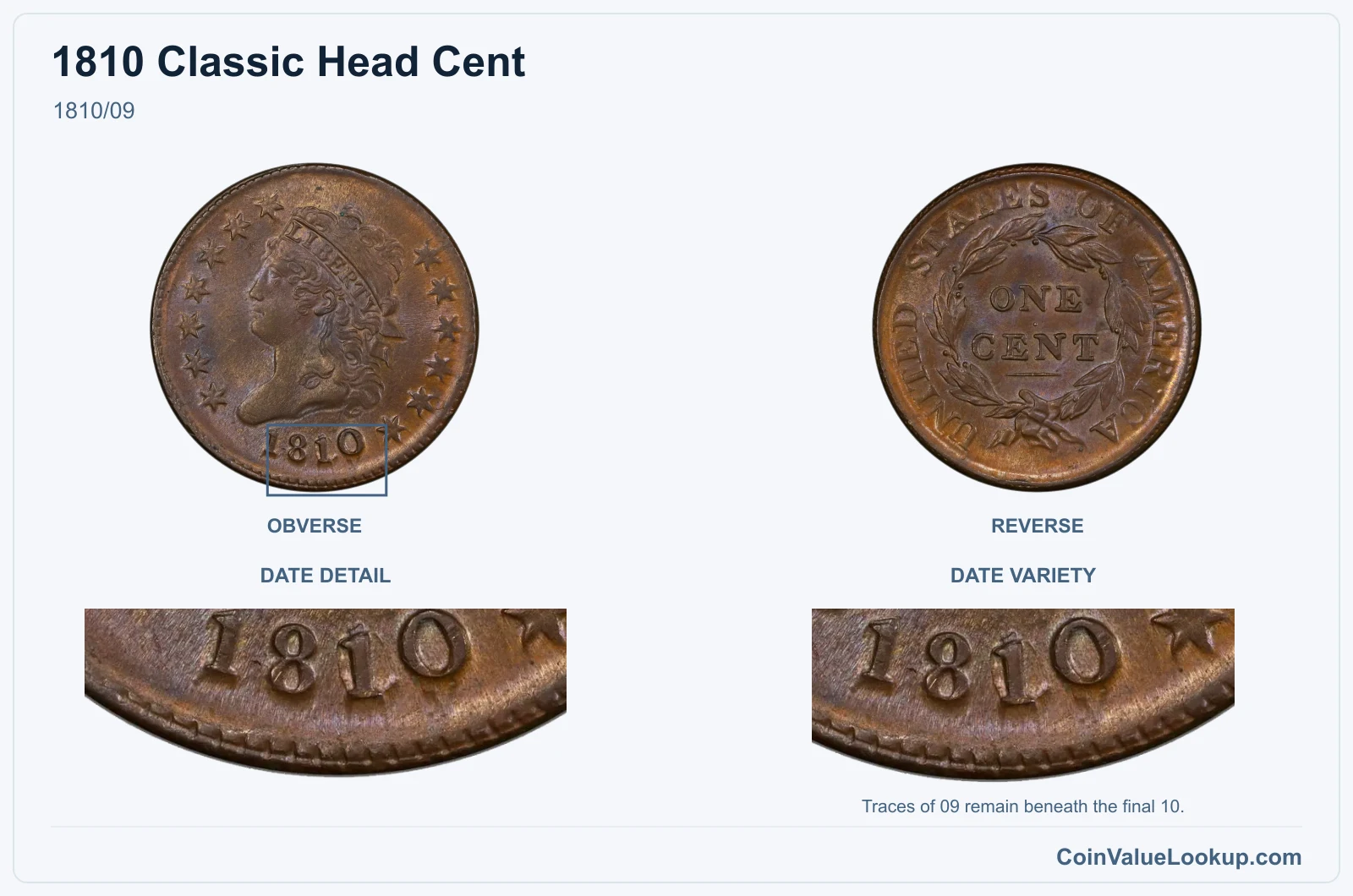
The 1810/09 overdate is a die variety created when a Philadelphia Mint die originally punched with an 1809 date was re-engraved with 1810 numerals. The giveaway is visible remnants of the earlier "09" lurking beneath the "10" at the end of the date.
You need decent magnification to confirm this, especially on worn examples where surface detail is already compromised.
Guide estimates from USA Coin Book place the 1810/09 at about $162 in Good-4 and approximately $3,083 in Extremely Fine-40. Those figures sit above the Normal Date at the same grades, reflecting collector demand for the overdate variety.
Not every irregularity in the date qualifies. Ordinary die wear, machine doubling, or damage can mimic an overdate to the untrained eye.
Look specifically for the curved remnant of a "9" beneath the final "0" in the date.
| Range | Grade | Price | Auction Records | Appraisal |
|---|---|---|---|---|
| PO | PO 1 | — | Coin Identifier | |
| FR | FR 2 | — | Coin Identifier | |
| AG | AG 3 | — | Coin Identifier | |
| G | G 4 | — | Coin Identifier | |
| G 6 | Coin Identifier | |||
| VG | VG 8 | Coin Identifier | ||
| VG 10 | Coin Identifier | |||
| F | F 12 | Coin Identifier | ||
| F 15 | Coin Identifier | |||
| VF | VF 20 | Coin Identifier | ||
| VF 25 | Coin Identifier | |||
| VF 30 | Coin Identifier | |||
| VF 35 | Coin Identifier | |||
| XF | XF 40 | Coin Identifier | ||
| XF 45 | Coin Identifier | |||
| AU | AU 50 | Coin Identifier | ||
| AU 53 | Coin Identifier | |||
| AU 55 | Coin Identifier | |||
| AU 58 | Coin Identifier | |||
| MS | MS 60 | — | Coin Identifier | |
| MS 61 | Coin Identifier | |||
| MS 62 | Coin Identifier | |||
| MS 63 | Coin Identifier | |||
| MS 64 | Coin Identifier | |||
| MS 65 | — | — | — | |
| MS 66 | — | — | — | |
| MS 67 | — | — | — | |
| MS 68 | — | — | — | |
| MS 69 | — | — | — | |
| MS 70 | — | — | — |
1810 Classic Head Cent Error List
1. 1810 Classic Head Cent — Lamination / Split Planchet
A lamination error on a 1810 Classic Head Cent shows as peeling metal, a retained flap, or visible separation within the copper planchet. The flaw originates from impurities or gas trapped in the metal before striking.
When photographing a suspected lamination, capture the edge and the affected face together so the depth of the split is visible.
Don't confuse this with scraping, corrosion pitting, or a coin that has been deliberately cut or gouged after leaving the mint. Genuine laminations tend to follow the contour of the planchet rather than showing sharp tool marks.
No specific price range is adopted for this error on 1810 cents. Value depends on the authenticated identity of the coin, the severity of the lamination, and overall condition.
2. 1810 Classic Head Cent — Die Crack
Die cracks appear as raised lines running across the surface of the coin, crossing fields or devices. They formed when the steel die fractured during use, and the crack transferred as a raised ridge onto every coin struck afterward.
On a 1810 cent, look for thin raised lines that follow no logical design element.
A genuine die crack is raised above the surrounding surface. That distinguishes it from an incuse scratch, which is pressed into the metal, and from corrosion tracks or tool marks left after minting.
Photograph the full coin alongside a closeup tracing the affected area, keeping the date visible.
No adopted price range exists for die-crack errors on this date. Individual value depends on the crack's prominence, location, and the coin's authenticated grade and condition.
3. 1810 Classic Head Cent — Die Break / Cud
A cud is a specific type of die break where a chunk of the die broke away at the rim, leaving a raised blob of metal on the finished coin that connects to the rim edge. On a 1810 Classic Head Cent, this shows up as a featureless raised lump replacing part of the normal design near the border.
The key diagnostic is that a true cud is connected to the rim. Interior die chips and rim dents from post-mint damage are common lookalikes.
Corrosion buildup can also mimic the appearance of a small cud, so examine the texture carefully. A cud will have the same metal quality as the rest of the coin.
No specific price range is adopted here. Authenticated cuds on early copper cents are evaluated individually based on size, location, and the coin's overall condition.
4. 1810 Classic Head Cent — Off-Center Strike
An off-center strike occurs when the planchet is not properly seated between the dies, resulting in a displaced design and an unstruck crescent of blank metal. On a 1810 cent, the percentage of off-center shift and whether the date remains visible are the two biggest factors collectors care about.
A date-visible off-center early copper cent is genuinely scarce.
Be careful not to confuse a clipped planchet, one-sided die misalignment, or post-mint flattening with a true off-center strike. A real off-center coin shows the entire design shifted in one direction with a corresponding blank area on the opposite side.
No adopted price range exists for this error category on the 1810 cent. Each piece needs individual assessment based on the degree of offset, date visibility, and authenticated condition.
5. 1810 Classic Head Cent — Clipped Planchet
A clipped planchet error means the coin blank was incompletely punched from the copper strip before striking, leaving a missing curved, straight, or ragged section. On a 1810 Classic Head Cent, look for a portion of the rim and adjacent design that simply is not there, combined with metal-flow weakness on the opposite side of the coin.
That opposite weakness, called the Blakesley effect, is a useful confirmation.
Filed notches, deliberate edge cuts, and corrosion along the rim can all mimic a clip. Genuine clips have a smooth, natural edge profile consistent with the original blank-cutting process, not sharp or jagged tool marks.
No specific prices are adopted for clipped 1810 cents. Value would be assessed individually based on clip type, size, and the coin's authenticated identity and grade.
6. 1810 Classic Head Cent — Brockage
A brockage happens when a previously struck coin sticks to a die and impresses its design, in mirror image and incuse, onto the next coin fed into the press. On a 1810 Classic Head Cent, one side would show the normal design while the other displays a sunken, reversed version of either the obverse or the reverse.
This is different from a die clash, where the dies simply kiss without a coin between them and leave faint ghost impressions. It is also different from two coins pressed together after minting.
A true brockage shows a complete or partial incuse mirror-image design with proper depth and metal flow from the striking process.
No adopted price range exists for brockage errors on this date. Authentic early-copper brockages are quite rare and are assessed individually by a grading service.
7. 1810 Classic Head Cent — Indented Strike
An indented strike occurs when a second planchet or foreign object overlaps the coin blank during striking, pressing a bounded depressed area into the surface. The result on a 1810 cent would be a distinct depression where the normal design is either missing or distorted, with the rest of the coin struck normally.
The critical distinction from a post-mint dent is that a genuine indent affects the design uniformly within its boundary and was created under full striking pressure. It also differs from a brockage, which transfers an actual mirrored design rather than just a plain depression.
No numeric price range is adopted. Value depends on the size and location of the indent, visibility of the remaining date and design, and the coin's authenticated condition.
8. 1810 Classic Head Cent — Double / Multiple Strike
A double or multiple strike means the coin received two or more separate blows from the dies, with the planchet shifting or rotating between impacts. On a 1810 Classic Head Cent, this produces overlapping but distinctly separate design impressions, sometimes dramatically displaced.
Do not confuse this with a doubled die, which is a different category entirely. A doubled die shows the doubling consistently on every coin from that die, while a double strike is unique to the individual coin.
Also watch out for impressions added after minting by squeezing a coin in a vise, which will lack the sharp definition of a genuine strike.
No adopted prices exist for double-struck 1810 cents. Each example is assessed individually based on the number of strikes, degree of displacement, and authenticated grade.
9. 1810 Classic Head Cent — Overdate
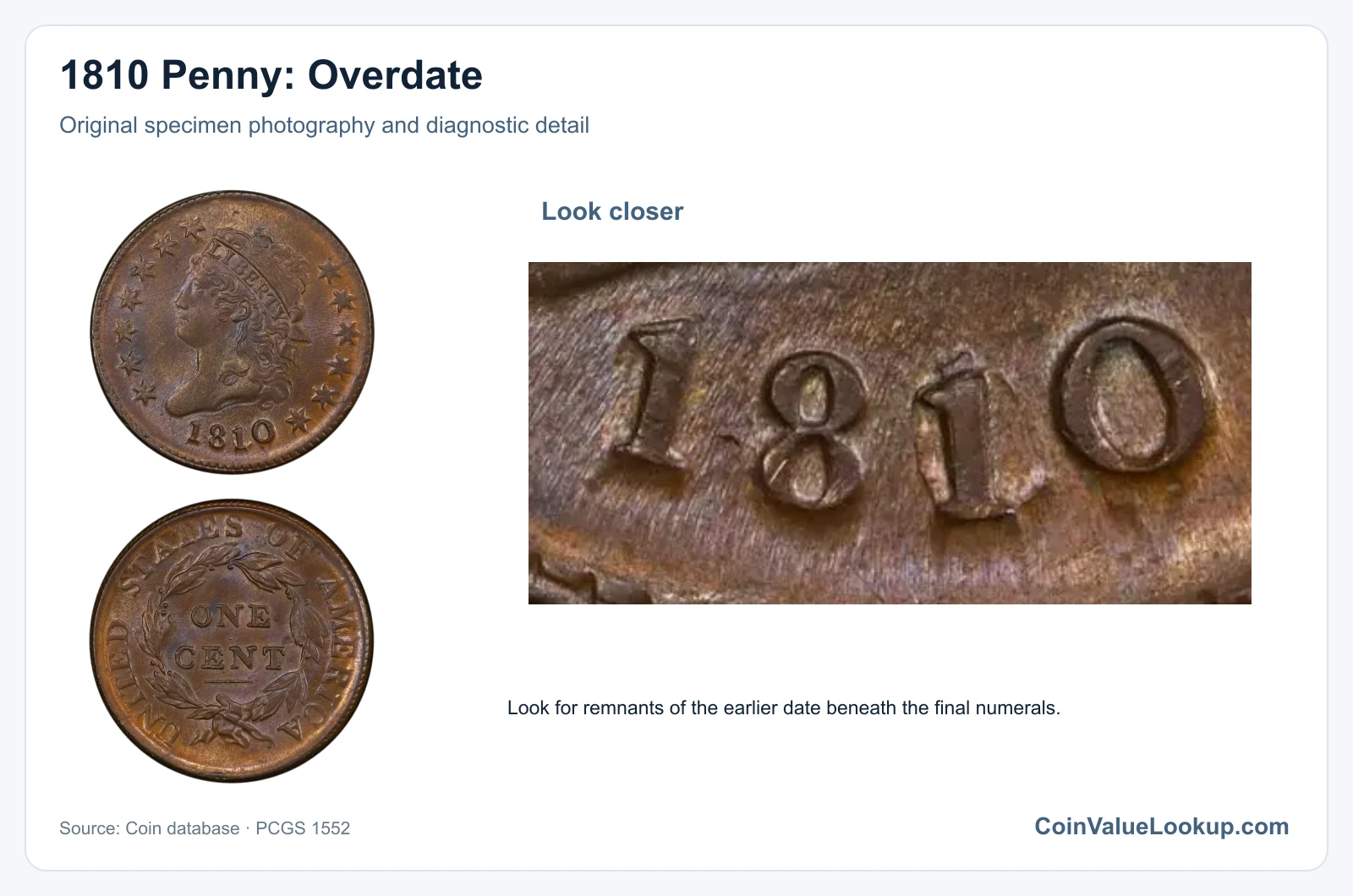
The overdate category on the 1810 Classic Head Cent primarily refers to the well-known 1810/09 variety, where the die was originally engraved with an 1809 date and then re-punched with 1810 digits. This is a die variety, not a random error on a single coin.
Every cent struck from that particular die shows the same underlying traces.
Look for surviving contours of the earlier "09" beneath the final "10" in the date. The curves of the original 9 are the clearest diagnostic, usually visible at the base and top of the final 0.
Ordinary date-punch irregularities, a damaged date, or machine doubling from die bounce should not be classified as an overdate.
The 1810/09 is listed separately in the version section with its own guide values. If you suspect an overdate, compare your coin carefully to confirmed examples before drawing conclusions.