1811 Classic Head Cent Coin Value: How Much Is It Worth?
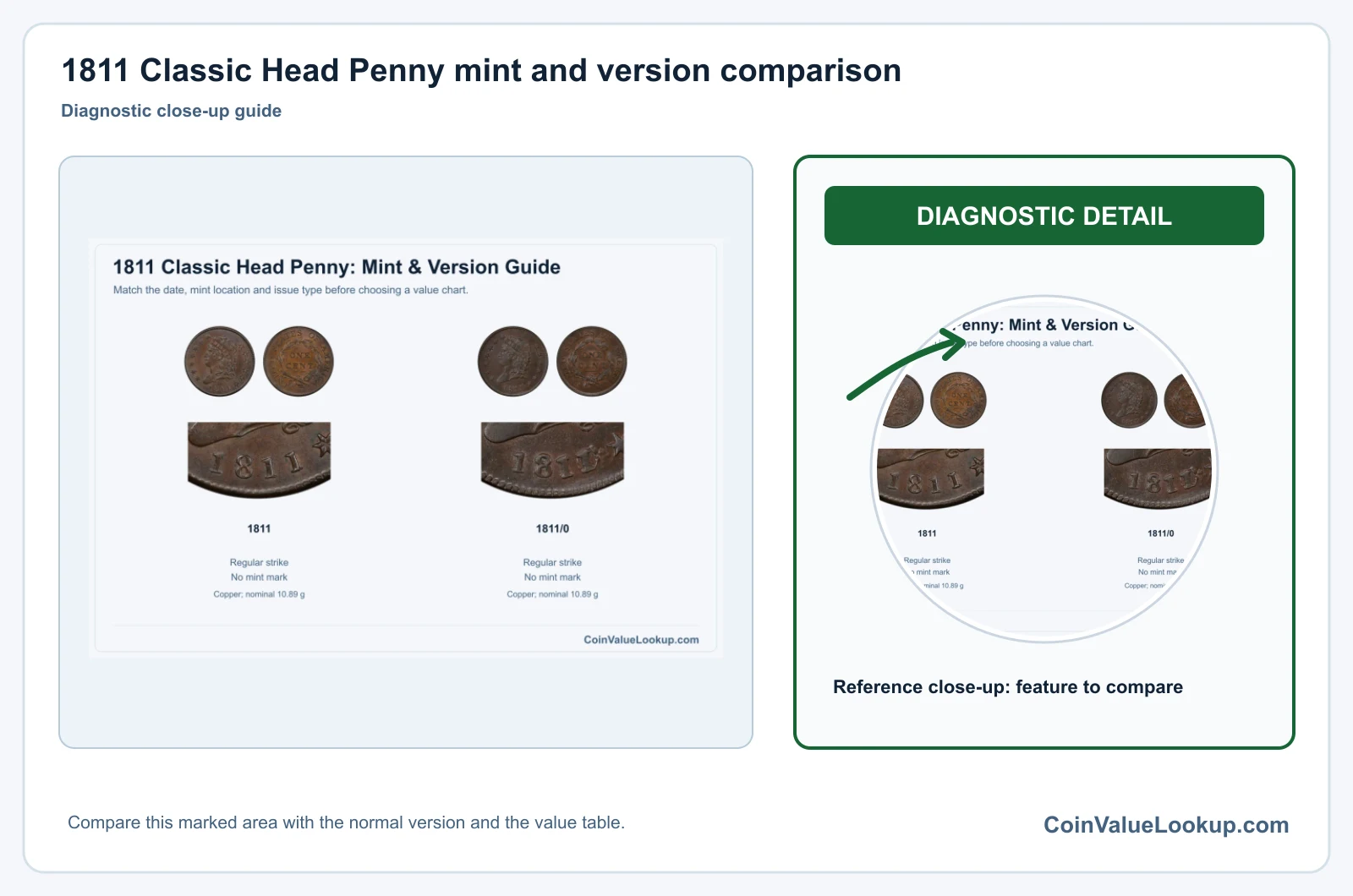
The 1811 Classic Head Cent is a scarce early copper coin struck only at Philadelphia. Guide estimates for ordinary circulated examples range from around $344 in G4 to $4,941 in EF40, while the 1811/0 overdate variety runs from about $407 in G4 up to $10,014 in EF40 according to USA Coin Book.
These are guide figures, not guaranteed offers. Identifying your exact variety matters a great deal before estimating value.
Fast Way to Identify Your 1811 Classic Head Cent
The quickest way to start figuring out what you have is to upload clear photos of the front and back of your coin. Our identifier can provide a preliminary identification of your 1811 Classic Head Cent, helping you determine whether it is the normal date or the overdate variety.
Sharp, well-lit images of both sides give the best results.
1811 Classic Head Cent Value
Upload both sides of your 1811 Classic Head Cent.
Front Obverse
Upload photo
Back Reverse
Upload photo
Which 1811 Classic Head Cent Versions Are Worth Money?
- The 1811/0 overdate variety shows remnants of a 0 beneath the final 1 in the date and carries higher guide values than the normal date across all listed grades.
- Even the normal-date 1811 is a scarce coin, with guide estimates starting around $344 in G4, reflecting low surviving populations for this early copper issue.
- Mint errors such as double strikes and brockages on this date are reported categories that can carry significant premiums, though each piece requires individual assessment.
Step 1: Identify Your 1811 Classic Head Cent Mint Mark and Version
Every 1811 Classic Head Cent was struck at Philadelphia, so there is no mintmark to look for. The key identification task is deciding whether your coin is a normal-date 1811 or the 1811/0 overdate.
For the overdate, look closely at the last digit of the date. You should see traces of a 0 lurking beneath the final 1.
Under magnification, the curved bottom of the underlying 0 is usually visible, especially when the coin retains enough detail in the date area.
Do not assume a blurry or corroded date equals an overdate. Genuine remnants have specific contours that match a 0 punch, not random wear patterns.
If the date is too worn to distinguish, you may need professional examination.
The design shows Liberty facing left wearing a headband inscribed LIBERTY, with stars flanking the portrait. The reverse displays ONE CENT within a wreath.
Weight should be near 10.89 grams in copper, though wear and corrosion shift that number. Weight alone does not prove authenticity or variety.
Step 2: Check Your 1811 Classic Head Cent Grade
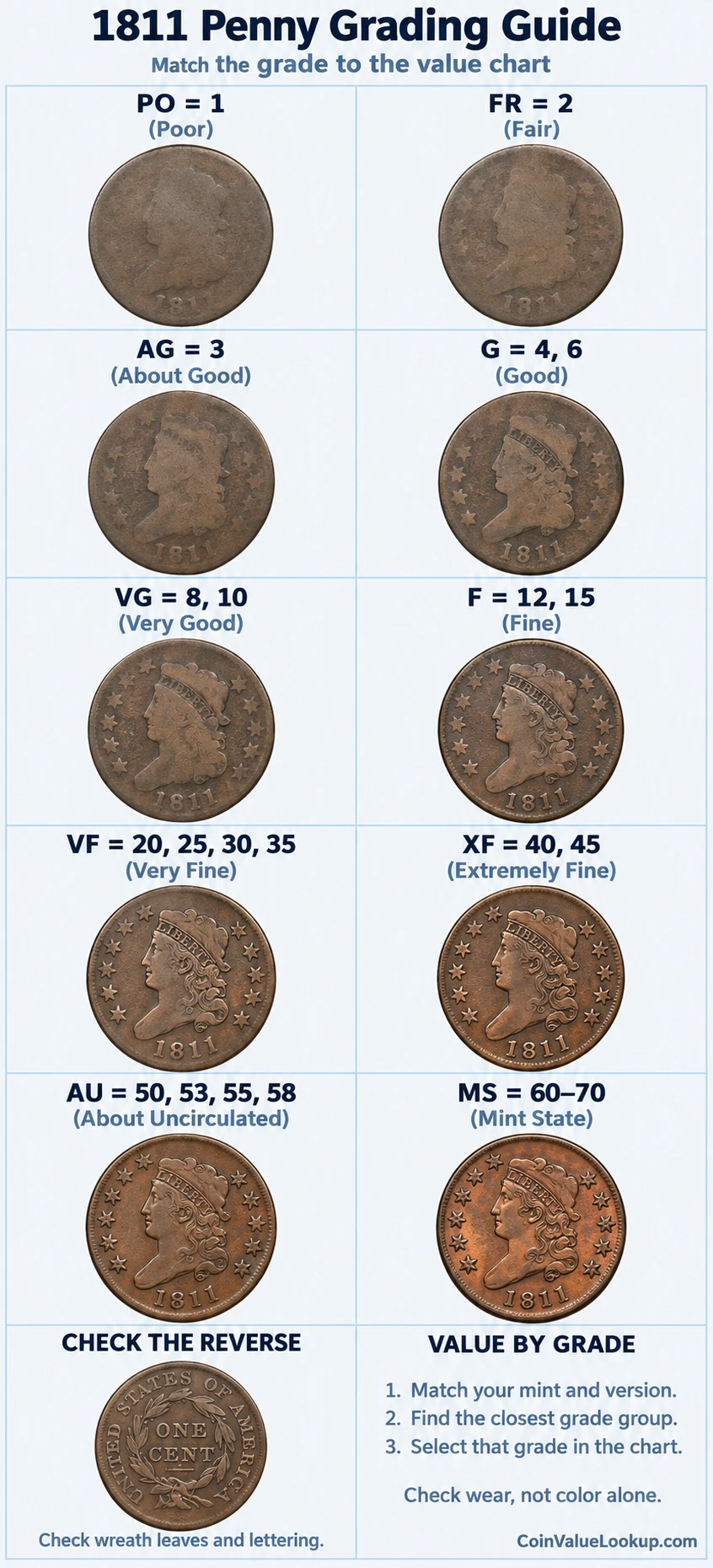
Start with the portrait. On a well-worn example around Good (G4), Liberty's outline and headband will be visible but most hair detail is flat.
The date and legends should still be readable.
As you move up in grade, look for hair strands above and behind the ear, definition in the headband lettering, and relief in the cheek. A Fine coin shows moderate wear on the high points but clear hair separation.
An EF40 coin retains nearly full detail with light friction only on the highest areas of hair and the cheek.
Use the comparison image to match your coin's wear pattern against known grade examples of the same type. Pay attention to whether detail loss comes from actual circulation or from something else entirely.
Corrosion, porosity, and old cleaning are common on early copper. These surface problems can substantially reduce a coin's market appeal and value compared to a problem-free example at the same wear level.
BN, RB, and RD refer to color on copper surfaces, not different metals.
Step 3: Check 1811 Classic Head Cent Value by Mint and Version
1811 Classic Head Cent
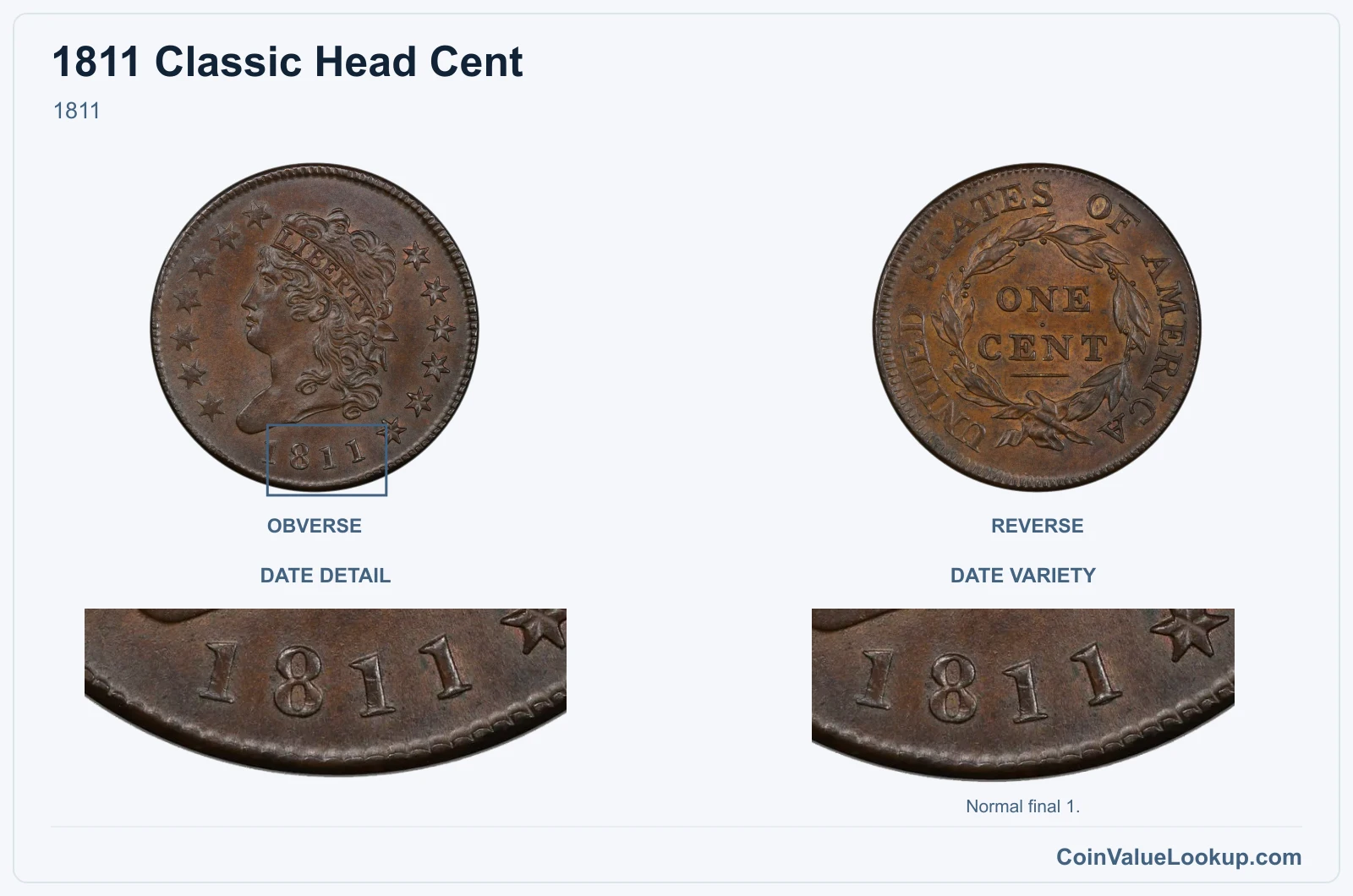
The normal-date 1811 Classic Head Cent is the standard issue for the year, struck in copper at Philadelphia with no mintmark. It features the Classic Head portrait of Liberty on the obverse and ONE CENT within a wreath on the reverse.
USA Coin Book guide estimates place this variety at roughly $344 in G4 and $4,941 in EF40. These are reference points, not buy prices.
Most surviving examples show significant wear, and problem-free pieces in any grade tend to bring stronger results than corroded or cleaned ones.
Coin Value Lookup is a useful starting point if you want to look up guides for this and other early copper series. You can compare your coin's details against the information available for different years and denominations.
| Range | Grade | Price | Auction Records | Appraisal |
|---|---|---|---|---|
| PO | PO 1 | — | Coin Identifier | |
| FR | FR 2 | Coin Identifier | ||
| AG | AG 3 | Coin Identifier | ||
| G | G 4 | Coin Identifier | ||
| G 6 | Coin Identifier | |||
| VG | VG 8 | Coin Identifier | ||
| VG 10 | Coin Identifier | |||
| F | F 12 | Coin Identifier | ||
| F 15 | Coin Identifier | |||
| VF | VF 20 | Coin Identifier | ||
| VF 25 | Coin Identifier | |||
| VF 30 | Coin Identifier | |||
| VF 35 | Coin Identifier | |||
| XF | XF 40 | Coin Identifier | ||
| XF 45 | Coin Identifier | |||
| AU | AU 50 | Coin Identifier | ||
| AU 53 | Coin Identifier | |||
| AU 55 | Coin Identifier | |||
| AU 58 | Coin Identifier | |||
| MS | MS 60 | — | Coin Identifier | |
| MS 61 | Coin Identifier | |||
| MS 62 | — | Coin Identifier | ||
| MS 63 | Coin Identifier | |||
| MS 64 | Coin Identifier | |||
| MS 65 | — | Coin Identifier | ||
| MS 66 | — | — | — | |
| MS 67 | — | — | — | |
| MS 68 | — | — | — | |
| MS 69 | — | — | — | |
| MS 70 | — | — | — |
1811 Classic Head Cent — /0
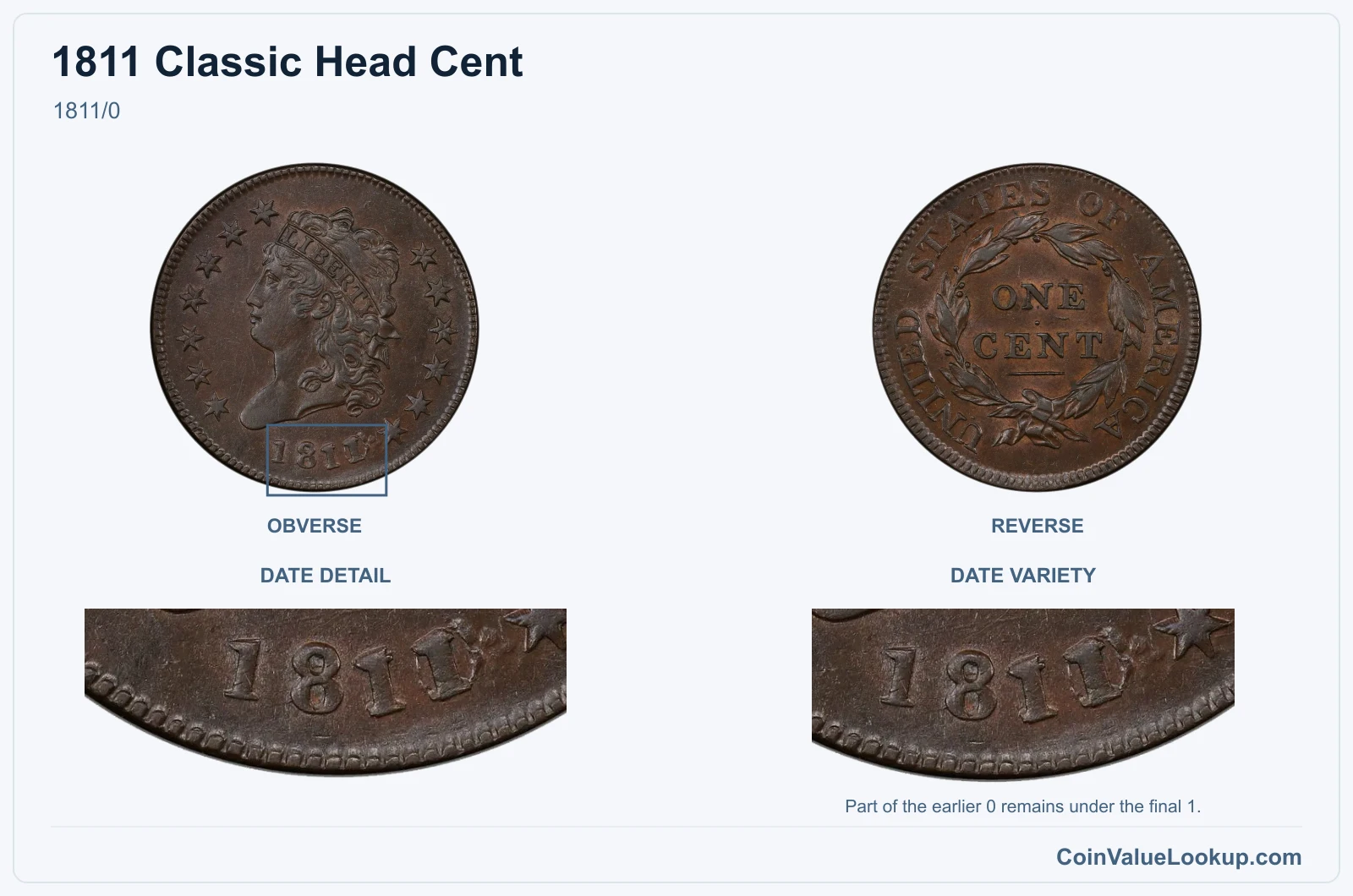
The 1811/0 overdate is the headline variety for this date. The Mint reused a die originally punched with an 1810 date, re-engraving the final digit as a 1 over the existing 0.
Under magnification, you can see the curved remnants of the 0 beneath and around the base of the last 1.
This variety carries a meaningful premium. USA Coin Book estimates about $407 in G4 and $10,014 in EF40.
That EF40 figure is roughly double what the normal date commands in the same grade, so correct identification makes a real difference.
The overdate is not especially rare in lower grades, but finding one with a clearly visible underdigit and clean surfaces takes patience. Heavy corrosion in the date area can obscure the diagnostic, making attribution difficult without professional tools.
| Range | Grade | Price | Auction Records | Appraisal |
|---|---|---|---|---|
| PO | PO 1 | — | Coin Identifier | |
| FR | FR 2 | — | Coin Identifier | |
| AG | AG 3 | Coin Identifier | ||
| G | G 4 | Coin Identifier | ||
| G 6 | Coin Identifier | |||
| VG | VG 8 | Coin Identifier | ||
| VG 10 | Coin Identifier | |||
| F | F 12 | Coin Identifier | ||
| F 15 | Coin Identifier | |||
| VF | VF 20 | Coin Identifier | ||
| VF 25 | — | Coin Identifier | ||
| VF 30 | Coin Identifier | |||
| VF 35 | Coin Identifier | |||
| XF | XF 40 | Coin Identifier | ||
| XF 45 | Coin Identifier | |||
| AU | AU 50 | Coin Identifier | ||
| AU 53 | Coin Identifier | |||
| AU 55 | Coin Identifier | |||
| AU 58 | — | Coin Identifier | ||
| MS | MS 60 | — | Coin Identifier | |
| MS 61 | Coin Identifier | |||
| MS 62 | — | Coin Identifier | ||
| MS 63 | Coin Identifier | |||
| MS 64 | — | — | — | |
| MS 65 | — | — | — | |
| MS 66 | — | — | — | |
| MS 67 | — | — | — | |
| MS 68 | — | — | — | |
| MS 69 | — | — | — | |
| MS 70 | — | — | — |
1811 Classic Head Cent Error List
1. 1811 Classic Head Cent — Double / Multiple Strike
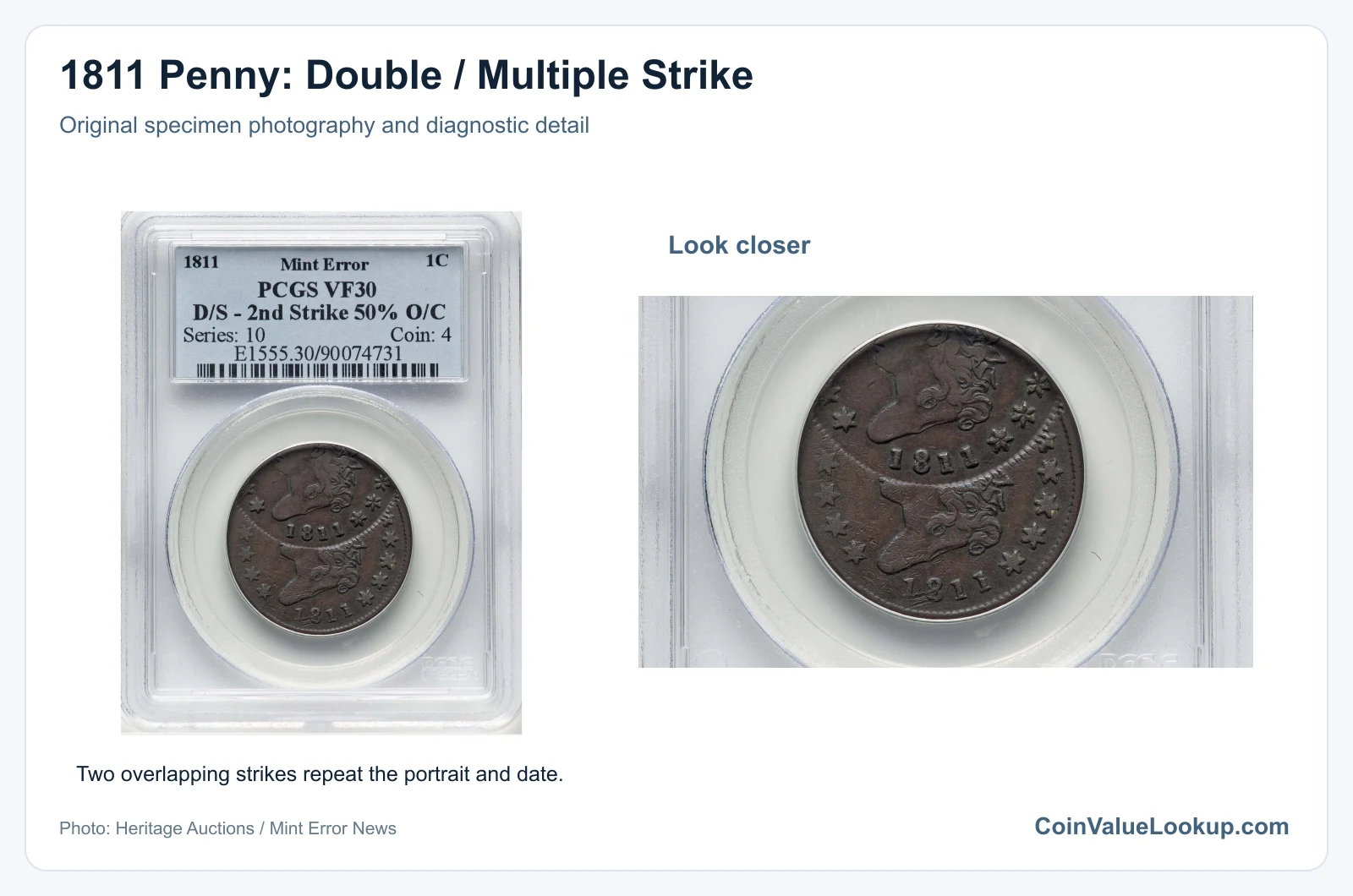
A double or multiple strike on an 1811 Classic Head Cent means the coin received more than one impression from the dies, typically with some displacement or rotation between strikes. The result is two or more overlapping but offset design images on the same planchet.
Look for a clearly separate, shifted impression of the portrait or wreath rather than just slightly thickened lettering. The displacement should be visible to the naked eye on a genuine multiple strike.
Do not confuse this with a doubled die, which is a die-making variety that produces uniform doubling across many coins. Also rule out post-mint damage where a coin was pressed against another object outside the coining press.
No specific price range is adopted for this category; value depends on the severity of the error, the coin's authenticated identity, and its overall condition.
2. 1811 Classic Head Cent — Lamination / Split Planchet
A lamination or split planchet error occurs when the copper stock separates into layers, creating a peeling flap, a missing chunk, or a visible crack within the metal itself. On an 1811 cent, this would appear as a raised or detached sliver of copper, sometimes revealing a rougher subsurface underneath.
Photograph the edge alongside the affected face. Genuine laminations show a natural separation plane within the metal, often with slightly irregular but smooth interior surfaces.
The main lookalikes are scraping damage, deep corrosion pitting, and deliberately cut or shaved coins. Corrosion tends to eat inward with a rough, porous texture, while a lamination splits along a plane.
No adopted price range exists for this error on the 1811 cent. Each example would need individual assessment based on the size and visual impact of the flaw, the coin's grade, and whether it has been authenticated.
3. 1811 Classic Head Cent — Brockage
A brockage happens when a previously struck coin sticks to one die and acts as a secondary die for the next blank fed into the press. The result is one normal side and one side bearing an incuse, mirror-image impression of the same or opposite design.
On an 1811 Classic Head Cent, a brockage would show a sunken, reversed version of either the Liberty portrait or the wreath transferred onto one face. The mirror-image quality is the key diagnostic.
It should read backward and be pressed into the surface rather than raised.
Do not confuse a brockage with a die clash, which leaves faint ghost outlines but no full incuse image. Also watch for post-mint alterations where someone intentionally pressed two coins together.
No numeric price range is adopted for brockages on this date. Value hinges on the clarity and completeness of the brockage impression, authenticated identity, and the coin's overall condition.
4. 1811 Classic Head Cent — Overdate
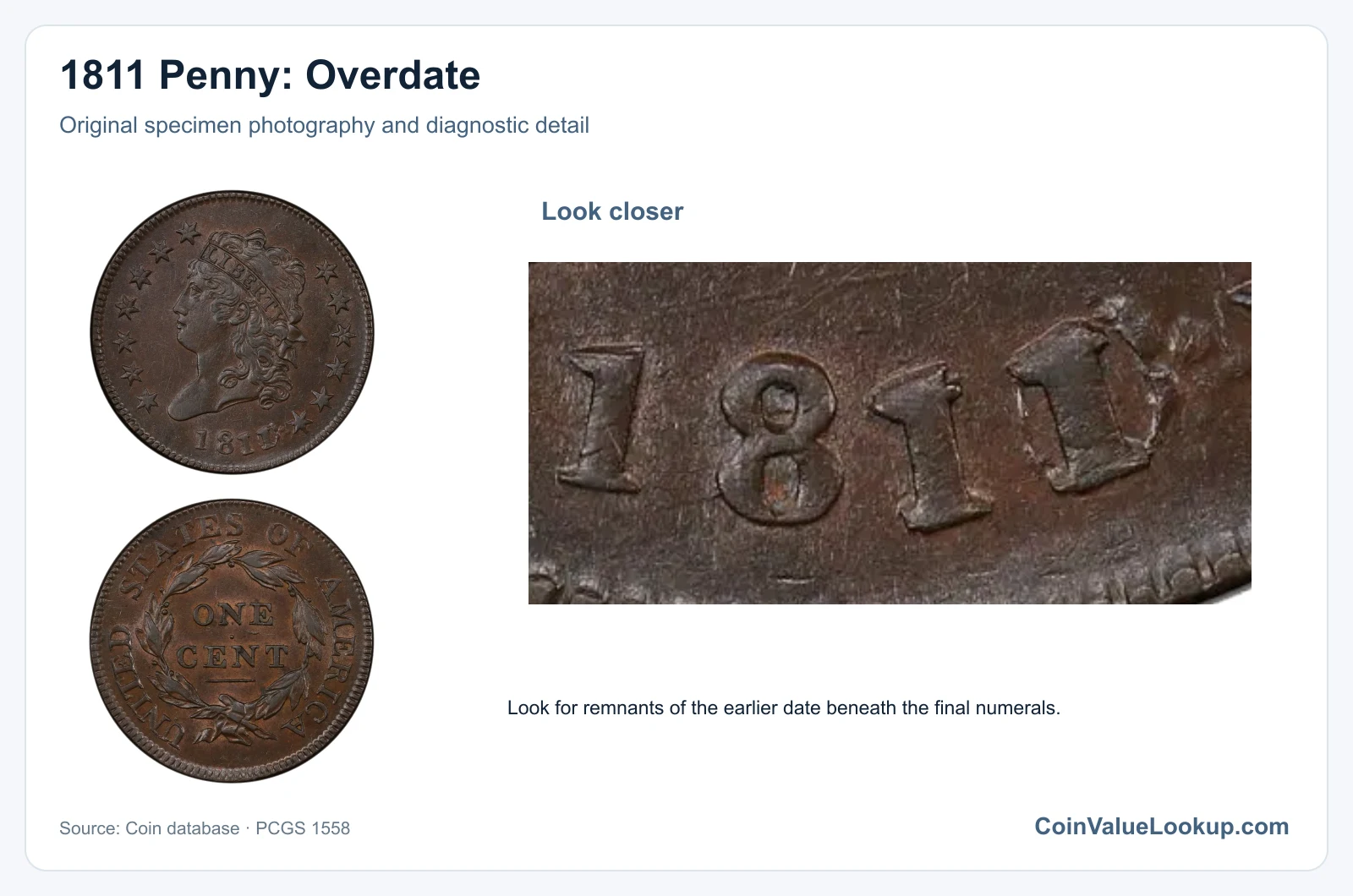
The overdate error on the 1811 Classic Head Cent refers specifically to the 1811/0 variety, where the final 1 in the date was punched over an existing 0 in the die. This is a die variety, not random damage.
The diagnostic is the surviving contour of the 0 beneath the upright stroke of the final 1. Look at the base of that digit under magnification.
You should see a curved remnant that does not belong to a normal 1 punch. Compare what you see against the specific overdate branch listed above.
Do not mistake a damaged or corroded date for an overdate. Wear can sometimes create rounded shapes near the base of digits that mimic an underlying numeral.
Machine doubling, which produces flat shelf-like outlines, is another common lookalike. No separate error price is adopted here; the overdate variety is priced as its own branch in the version guide above, with individual assessment recommended for pieces that are ambiguous or have surface issues.