1811 Capped Bust Half Dollar Coin Value: How Much Is It Worth?
An 1811 Capped Bust Half Dollar in well-worn G4 condition carries a guide estimate around $111, climbing to roughly $1,363 at AU50 for the common Large 8 variety. Collector value shifts meaningfully depending on which date-punch version you have and the coin's surfaces.
The scarcer 1811/10 overdate commands a clear premium across every grade level.
Fast Way to Identify Your 1811 Capped Bust Half Dollar
Snap clear photos of both sides of your coin and upload them for a preliminary identification. This helps narrow down whether you have the Large 8, Small 8, or the more valuable 1811/10 overdate.
Good lighting at a slight angle brings out date details that matter for sorting these apart.
1811 Capped Bust Half Dollar Value
Upload both sides of your 1811 Capped Bust Half Dollar.
Front Obverse
Upload photo
Back Reverse
Upload photo
Which 1811 Capped Bust Half Dollar Versions Are Worth Money?
- Large 8 — The more common variety, with guide estimates from about $111 at G4 to $1,363 at AU50. Check the size of the 8 in the date against a Small 8 reference image.
- Small 8 — Similar value range but slightly lower at higher grades, around $1,206 at AU50. The smaller date punch and tighter digit spacing set it apart.
- 1811/10 Punctuated Date — The overdate variety, with guide values starting near $205 at G4 and reaching approximately $1,765 at AU50. Look for the underlying 0 and the telltale period between 18 and 11.
Step 1: Identify Your 1811 Capped Bust Half Dollar Mint Mark and Version
Every 1811 half dollar was struck at Philadelphia, so the absence of a mintmark is completely normal. Look for the left-facing Capped Bust Liberty on the obverse and the heraldic eagle with shield on the reverse, with "50C" below.
The lettered edge reads FIFTY CENTS OR HALF A DOLLAR, which distinguishes the earlier lettered-edge subtype from the later reeded-edge Capped Bust halves.
The coin is a silver-copper alloy, approximately 89.24% silver, weighing about 13.48 grams and measuring roughly 32.5 mm across. If your coin shows a Draped Bust design instead of the capped variety, that belongs to the earlier 1807 and prior series.
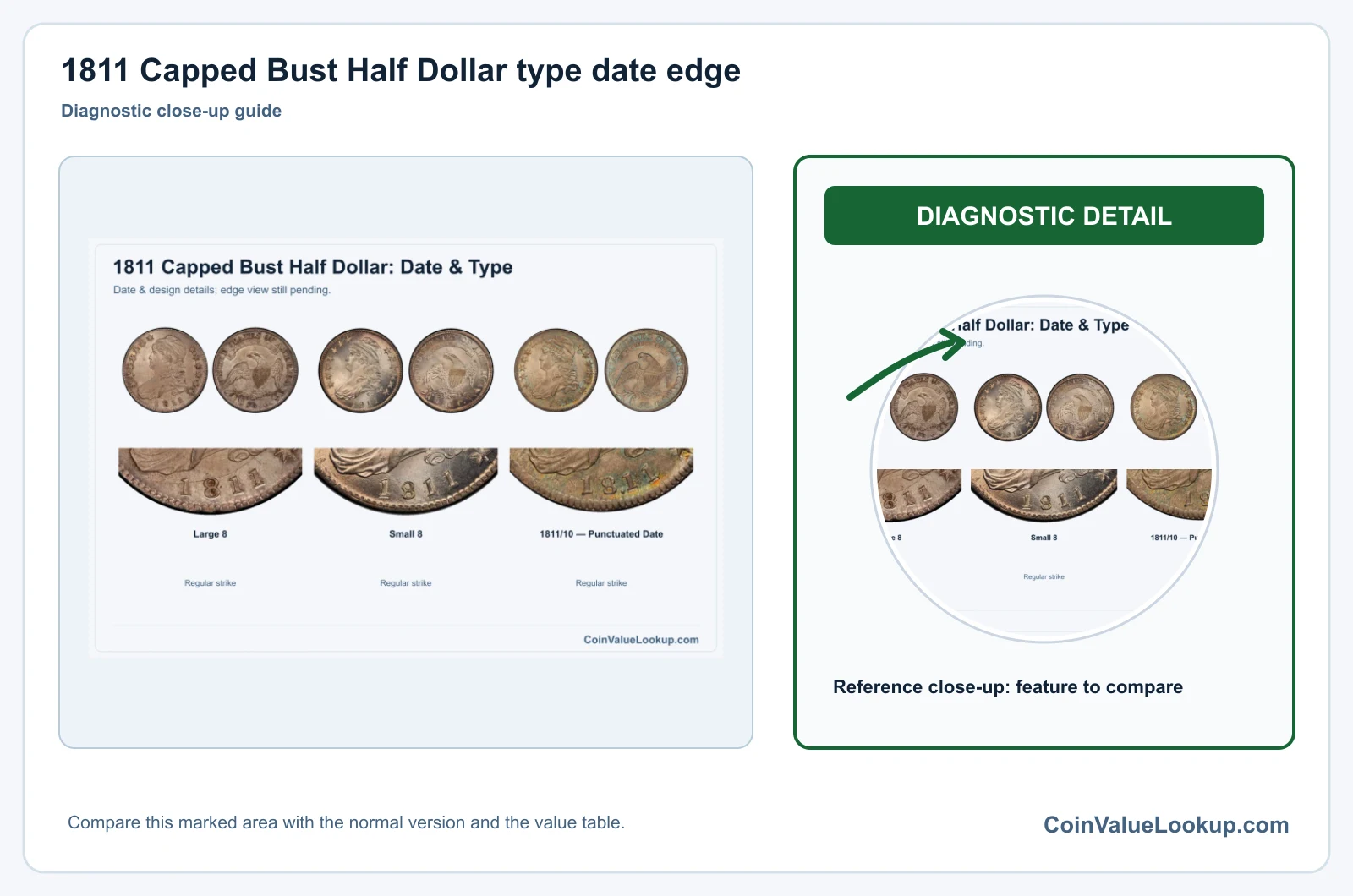
Three major varieties exist for 1811. The Large 8 and Small 8 refer to the size of the digit 8 in the date.
Compare them side by side at the same scale to see the difference in both the numeral itself and the spacing between date digits. The 1811/10 overdate is a separate animal entirely, identifiable by traces of an underlying 0 beneath the second 1, often accompanied by a small period or dot between 18 and 11.
Step 2: Check Your 1811 Capped Bust Half Dollar Grade
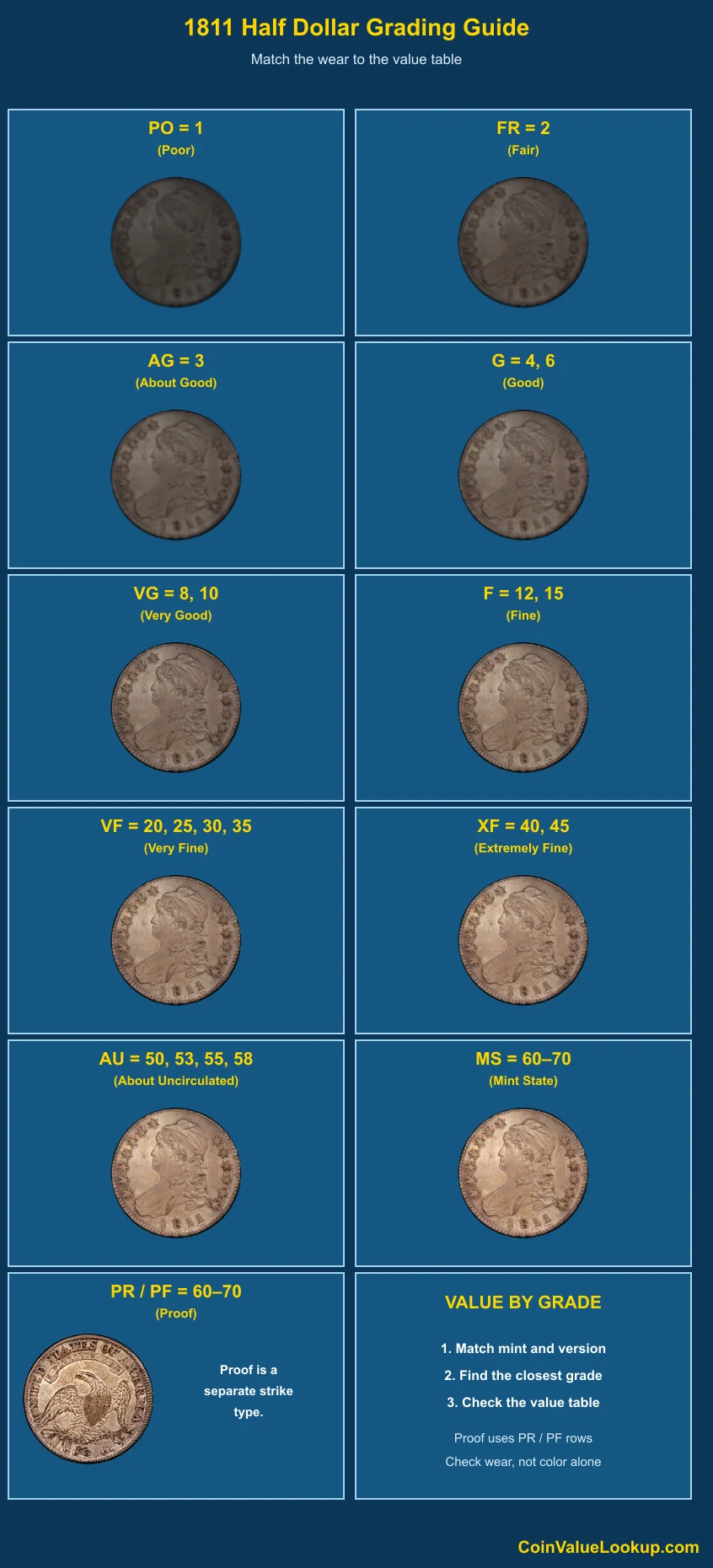
Start by examining the hair above Liberty's forehead and ear. On a well-circulated coin, these strands merge into a flat area first.
The cheek, cap, and shoulder drapery lose definition progressively as wear increases. Use the comparison image to match your coin against known grade benchmarks for this exact type.
On the reverse, check the eagle's breast feathers and wing tips. Weak detail here can come from a soft strike rather than actual wear, so look at the surrounding luster to tell the difference.
A coin that still has cartwheel luster in the protected areas but mushy breast feathers was probably just weakly struck.
Cleaning, tooling, filled holes, and heavy scratches put a coin into "Details" territory. These pieces should not be priced along the same curve as problem-free examples, because the market treats them very differently regardless of how much design detail remains.
Step 3: Check 1811 Capped Bust Half Dollar Value by Mint and Version
1811 Capped Bust Half Dollar — Large 8
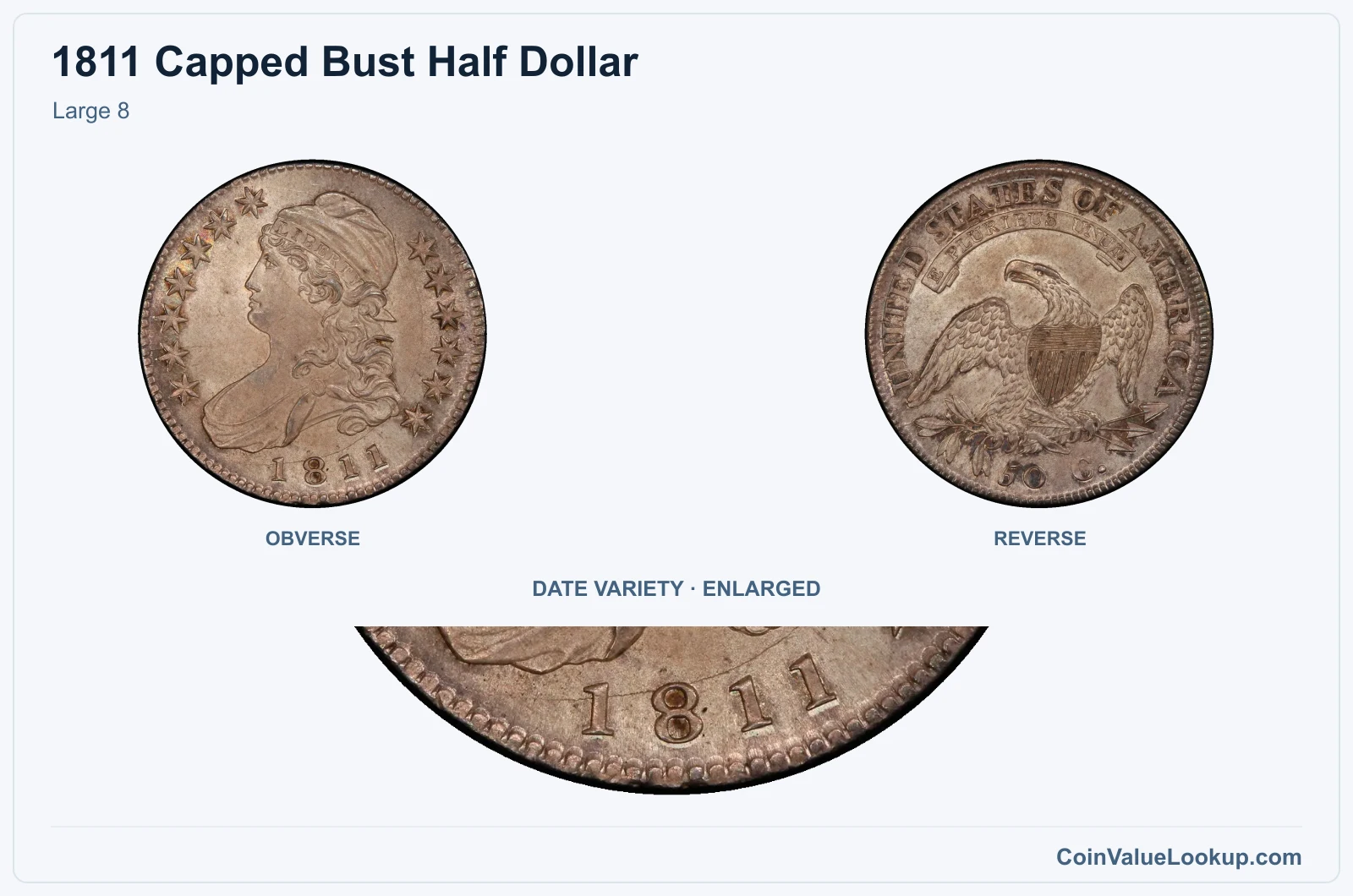
The Large 8 variety uses a noticeably bigger digit 8 in the date, with wider spacing between the numerals. Place your coin next to a confirmed Small 8 image at the same magnification and the difference becomes obvious.
This is the more commonly encountered of the two standard date-punch varieties.
Guide estimates from USA Coin Book place the Large 8 at about $111 in G4, roughly $300 in VF20, and around $1,363 in AU50. These are retail estimates, not guaranteed sale prices.
The coin is a regular Philadelphia circulation strike in silver-copper alloy with the standard lettered edge.
Range Grade
Price Auction Records Appraisal PO PO 1
—
Coin Identifier FR FR 2
—
Coin Identifier AG AG 3
—
Coin Identifier G G 4
—
Coin Identifier
G 6
—
Coin Identifier VG VG 8
Coin Identifier
VG 10
Coin Identifier F F 12
Coin Identifier
F 15
Coin Identifier VF VF 20
Coin Identifier
VF 25
Coin Identifier
VF 30
Coin Identifier
VF 35
Coin Identifier XF XF 40
Coin Identifier
XF 45
Coin Identifier AU AU 50
Coin Identifier
AU 53
Coin Identifier
AU 55
Coin Identifier
AU 58
Coin Identifier MS MS 60
—
Coin Identifier
MS 61
Coin Identifier
MS 62
Coin Identifier
MS 63
Coin Identifier
MS 64
Coin Identifier
MS 65
Coin Identifier
MS 66
Coin Identifier
MS 67
—
—
—
MS 68
—
—
—
MS 69
—
—
—
MS 70
—
—
—
1811 Capped Bust Half Dollar — Small 8
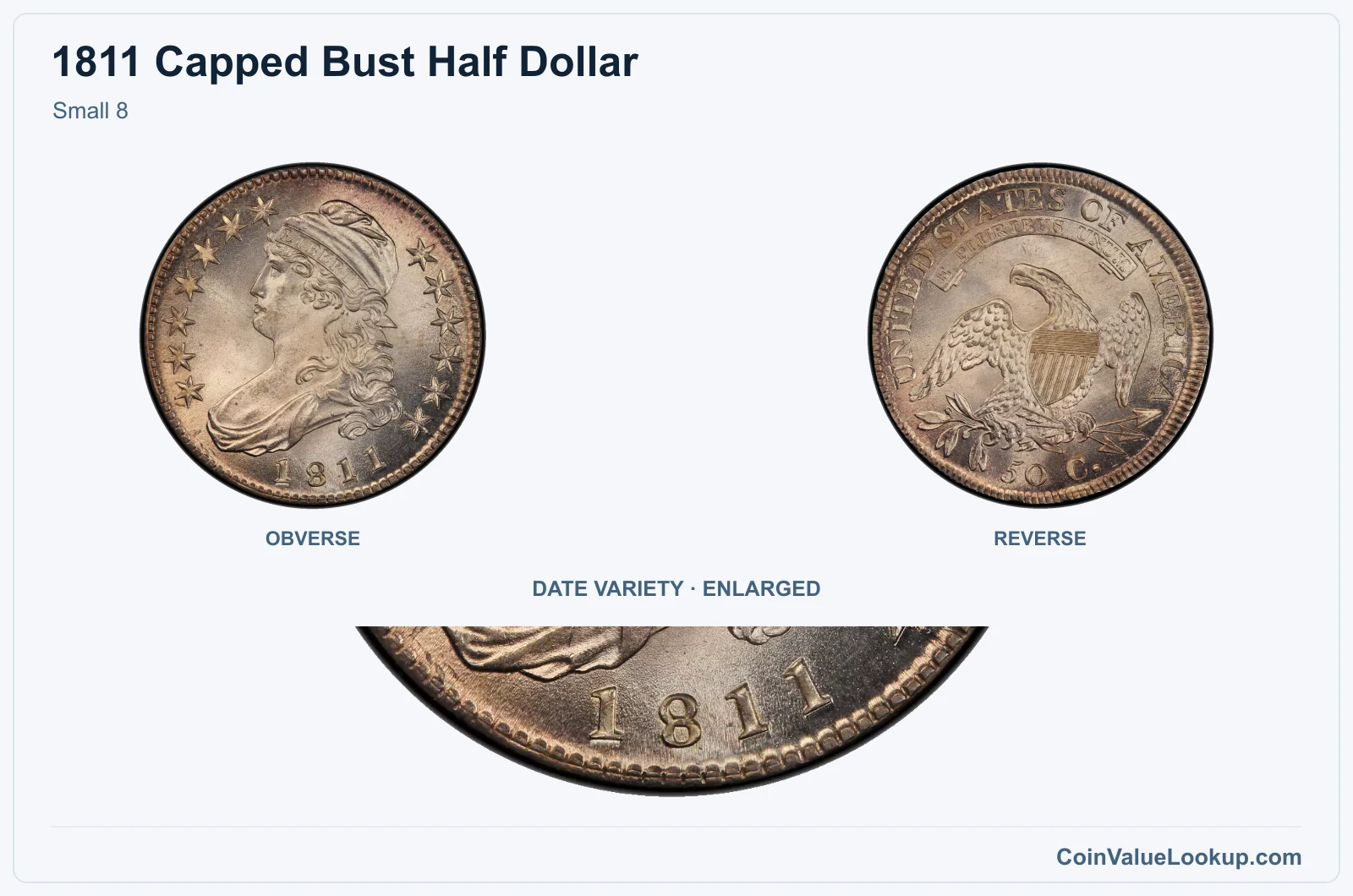
The Small 8 uses a more compact date punch, producing a visually tighter date with a smaller 8. Side-by-side comparison is the simplest way to confirm which punch your coin received.
Do not confuse a worn Large 8 for a Small 8; the overall digit proportions differ even on heavily circulated pieces.
USA Coin Book guide estimates put the Small 8 at about $111 in G4, around $268 in VF20, and approximately $1,206 at AU50. Values run slightly below the Large 8 at mid and upper grades.
Like all 1811 halves, this is a Philadelphia-only silver-copper alloy strike with a lettered edge.
Coin Value Lookup is a useful starting point if you want to look up guides for other dates and denominations in this series. It can save you time when sorting through a mixed group of early half dollars.
Range Grade
Price Auction Records Appraisal PO PO 1
—
Coin Identifier FR FR 2
—
Coin Identifier AG AG 3
—
Coin Identifier G G 4
—
Coin Identifier
G 6
—
Coin Identifier VG VG 8
—
Coin Identifier
VG 10
Coin Identifier F F 12
Coin Identifier
F 15
Coin Identifier VF VF 20
Coin Identifier
VF 25
Coin Identifier
VF 30
Coin Identifier
VF 35
Coin Identifier XF XF 40
Coin Identifier
XF 45
Coin Identifier AU AU 50
Coin Identifier
AU 53
Coin Identifier
AU 55
Coin Identifier
AU 58
Coin Identifier MS MS 60
Coin Identifier
MS 61
Coin Identifier
MS 62
Coin Identifier
MS 63
Coin Identifier
MS 64
Coin Identifier
MS 65
Coin Identifier
MS 66
Coin Identifier
MS 67
Coin Identifier
MS 68
Coin Identifier
MS 69
—
—
—
MS 70
—
—
—
1811 Capped Bust Half Dollar — /10 — Punctuated Date
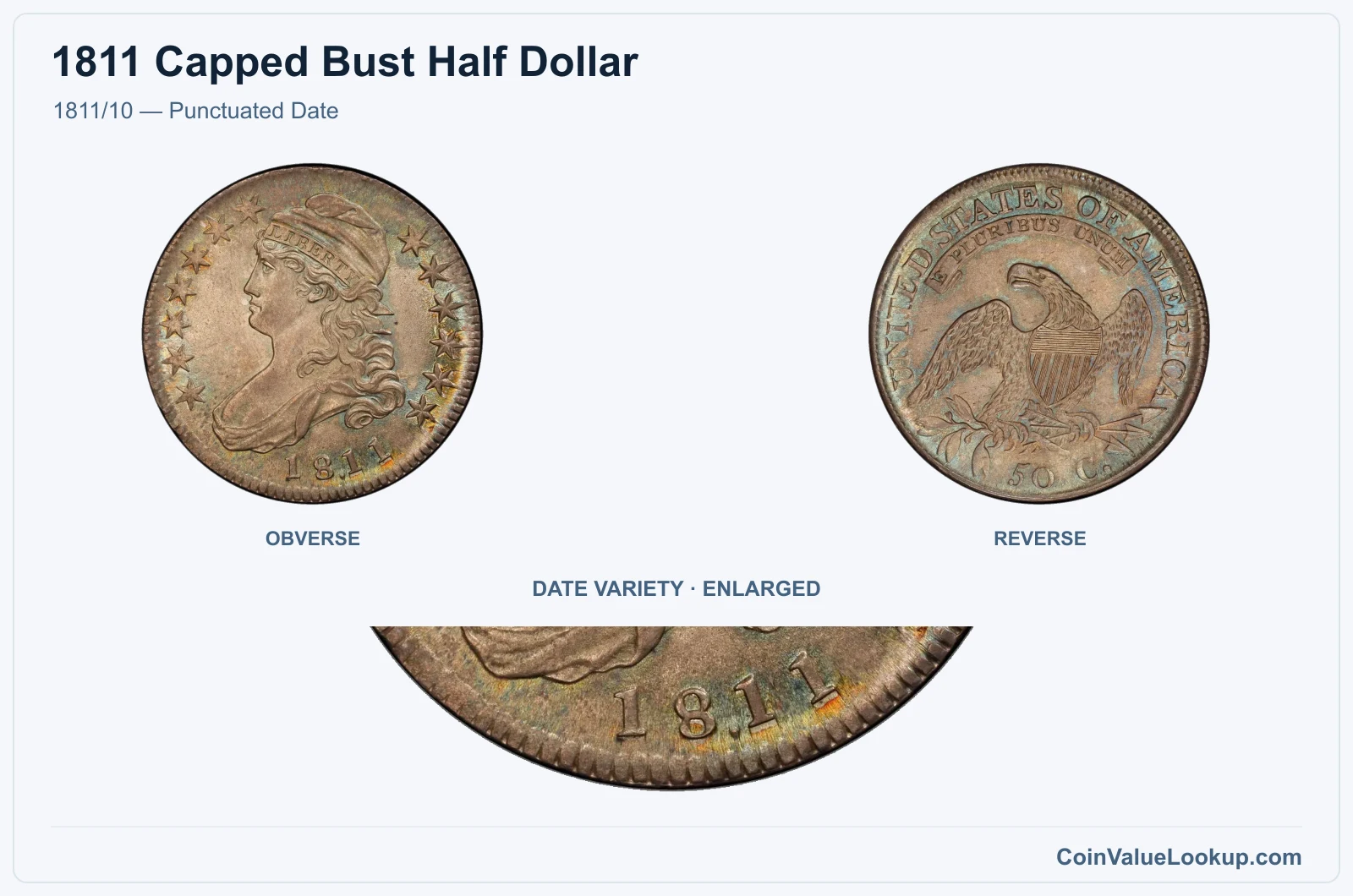
This is the variety that gets collectors excited. The 1811/10 overdate was created when an 1810-dated die was re-entered with an 1811 date punch, leaving traces of the original 0 beneath the final 1.
On well-worn examples, that underlying 0 may be extremely faint or nearly invisible.
A helpful secondary diagnostic is a small period or dot visible between the 18 and 11 portions of the date. This punctuated date feature is closely associated with the overdate and serves as a useful confirmation marker.
A random contact mark or bag hit in the same area does not establish the attribution; the period should appear in a consistent position.
USA Coin Book guide estimates are approximately $205 at G4, about $575 at VF20, and around $1,765 at AU50. That premium over the standard varieties reflects genuine collector demand for overdates in the Capped Bust series.
Careful examination under magnification is worth your time on any 1811 half dollar.
Range Grade
Price Auction Records Appraisal PO PO 1
—
Coin Identifier FR FR 2
—
Coin Identifier AG AG 3
—
Coin Identifier G G 4
Coin Identifier
G 6
—
Coin Identifier VG VG 8
Coin Identifier
VG 10
Coin Identifier F F 12
Coin Identifier
F 15
Coin Identifier VF VF 20
Coin Identifier
VF 25
Coin Identifier
VF 30
Coin Identifier
VF 35
Coin Identifier XF XF 40
Coin Identifier
XF 45
Coin Identifier AU AU 50
Coin Identifier
AU 53
Coin Identifier
AU 55
Coin Identifier
AU 58
Coin Identifier MS MS 60
—
Coin Identifier
MS 61
Coin Identifier
MS 62
Coin Identifier
MS 63
Coin Identifier
MS 64
Coin Identifier
MS 65
Coin Identifier
MS 66
—
Coin Identifier
MS 67
—
—
—
MS 68
—
—
—
MS 69
—
—
—
MS 70
—
—
—
1811 Capped Bust Half Dollar Error List
1. 1811 Capped Bust Half Dollar — Off-Center Strike
An off-center strike occurs when the planchet is not properly seated between the dies at the moment of striking, producing a coin with the design shifted to one side and a corresponding blank crescent on the opposite edge. One reported example of an 1811 half dollar shows roughly 25 percent off-center displacement, with clearly shifted designs and a visible unstruck area.
This is a genuinely dramatic error on an early silver denomination. No specific price range has been adopted for this category, because the value depends heavily on the degree of displacement, how much of the date and design remain visible, and the coin's overall condition.
Do not confuse an off-center strike with a clipped planchet, one-sided die misalignment, or post-mint damage such as a coin that was flattened unevenly after leaving the mint. An authentic off-center piece will show the full-depth strike on the portion of the design that did receive the impression, just in the wrong position relative to the rim.