1979 Kennedy Half Dollar Coin Value: How Much Is It Worth?
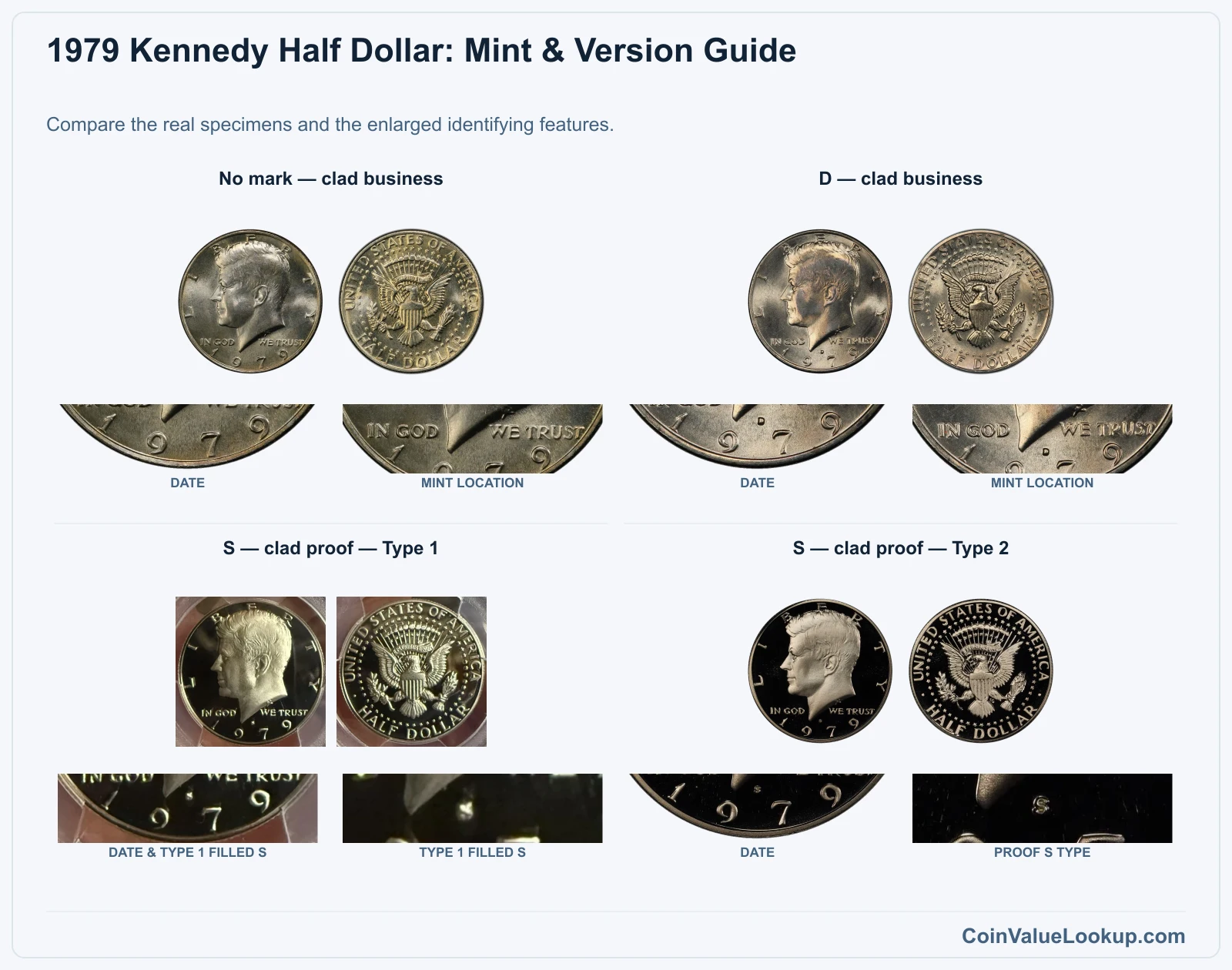
The 1979 Kennedy half dollar carries a face value of fifty cents, and most circulated clad examples are worth exactly that. Collector guide estimates for higher-grade and proof versions range from roughly $3.62 to $30.00 depending on mint, finish and condition.
Before you check a price chart, you need to know whether your coin is a business strike, a proof, and which mintmark it carries.
Fast Way to Identify Your 1979 Kennedy Half Dollar
The quickest way to start is to upload clear photos of both the front and back of your 1979 half dollar. A preliminary identification from those images can help you figure out the mint, finish and approximate condition so you know which price column applies.
Good lighting at a slight angle works best for capturing surface detail.
1979 Kennedy Half Dollar Value
Upload both sides of your 1979 Kennedy Half Dollar.
Front Obverse
Upload photo
Back Reverse
Upload photo
Which 1979 Kennedy Half Dollar Versions Are Worth Money?
- The 1979-S Type 2 (Clear S) clad proof is the key date branch — a USA Coin Book guide estimate places it around $30.00 at PR65, roughly eight times the Type 1 proof.
- Business strikes from Philadelphia and Denver in MS65 condition carry guide estimates near $3.62, well above face value but modest compared to the Type 2 proof.
- Mint-made errors such as double strikes, wrong-planchet strikes and brockages have been reported for this year and can carry individual premiums based on visibility and condition.
Step 1: Identify Your 1979 Kennedy Half Dollar Mint Mark and Version
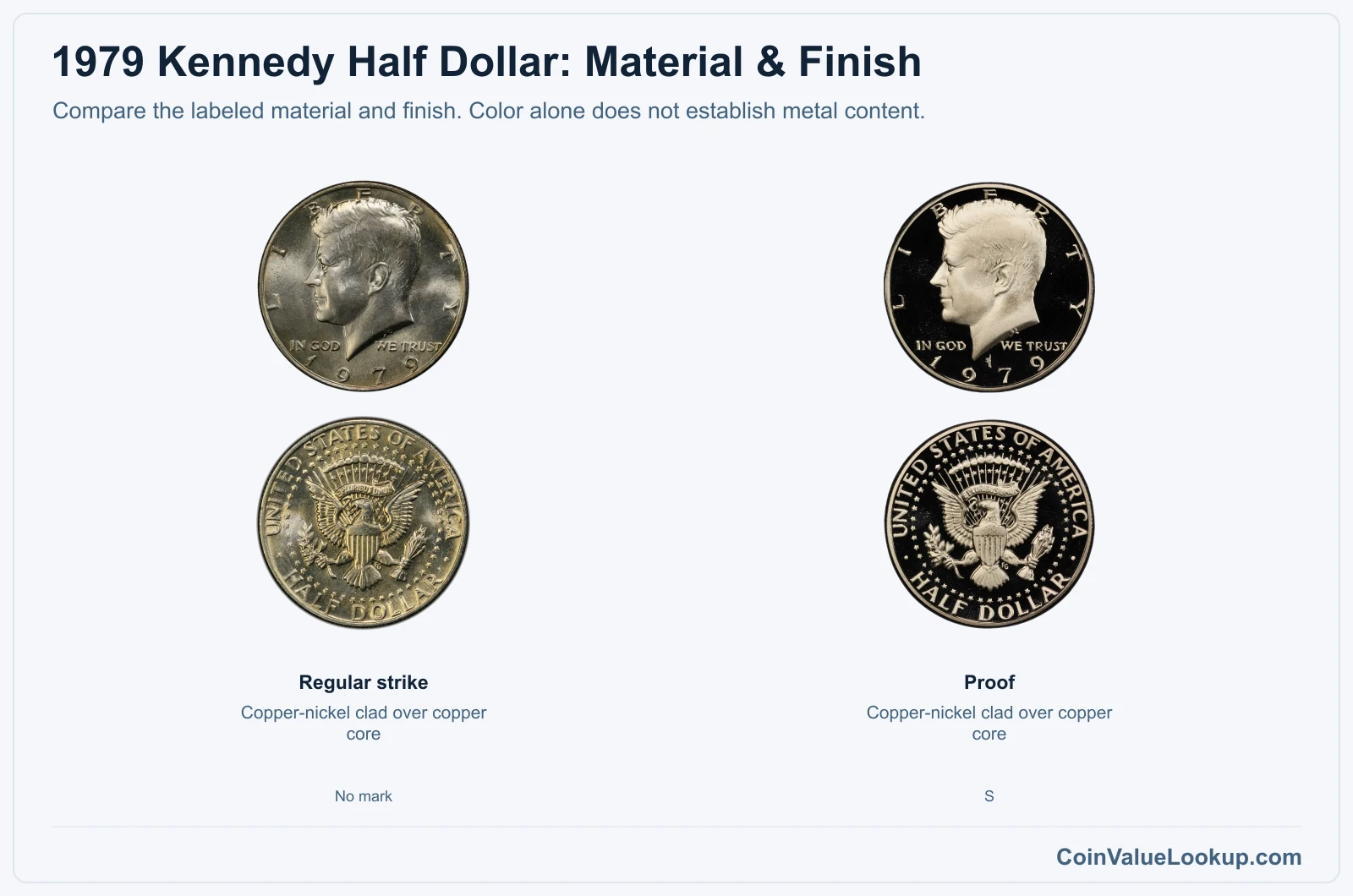
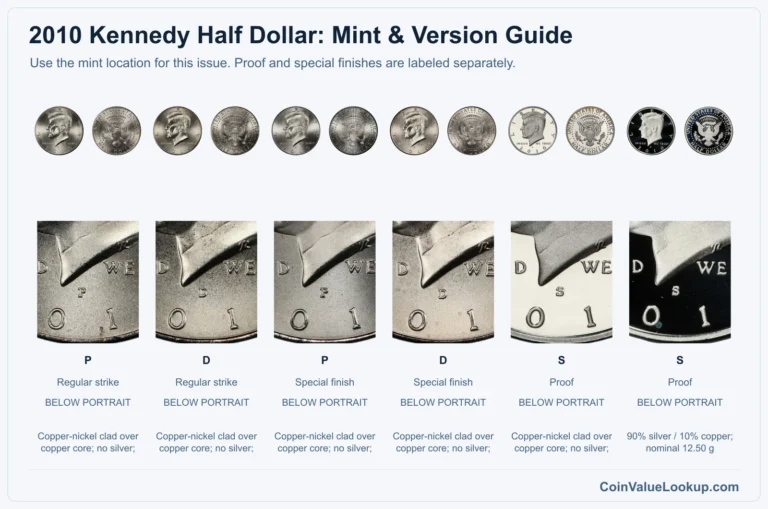
Look beneath Kennedy's portrait on the obverse, just above the date. That is where the mintmark sits.
No mark means Philadelphia, a D means Denver, and an S means San Francisco. Philadelphia coins carried no mintmark in 1979; the P mark was not added until 1980.
All 1979 Kennedy halves are copper-nickel clad over a copper core. None contain silver.
Do not assume a half dollar is silver just because it looks shiny or has unusual toning — lighting and surface oxidation can fool you.
If you have an S-mint proof, the next step is distinguishing Type 1 from Type 2. The Type 1 S mintmark looks filled in and blobby, almost like a lump.
The Type 2 S is clearly defined with open loops. Compare yours against a dated reference image for 1979 specifically, because the 1981 Type 2 punch has different characteristics and should not be used as your comparison.
Coin Value Lookup is a good starting point if you want to look up guides for other Kennedy half dollar years or different denominations entirely. It can save you time when you are sorting through a jar of mixed coins.
Step 2: Check Your 1979 Kennedy Half Dollar Grade
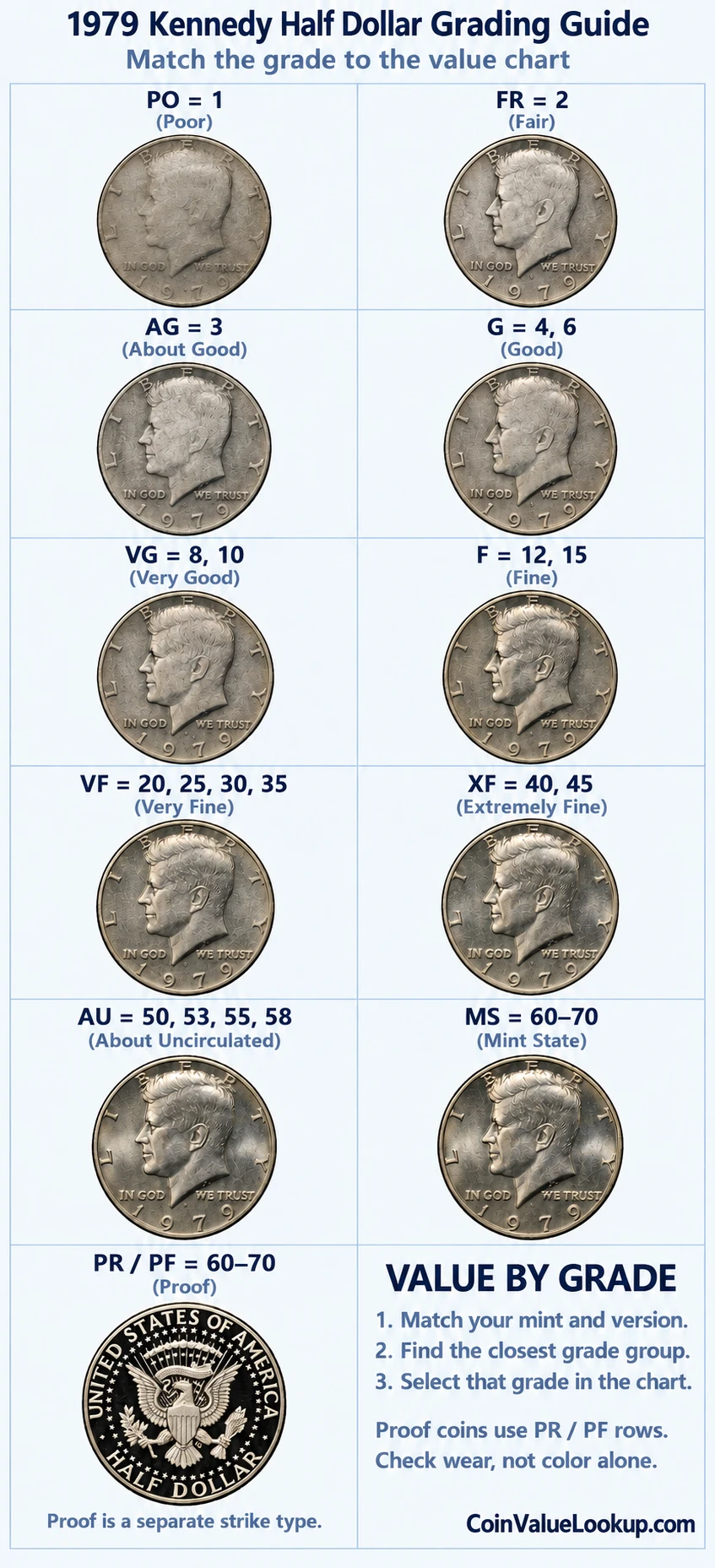
Start with Kennedy's cheek and jawline on the obverse. On a freshly minted coin these areas show fine detail and texture.
As wear sets in, the cheek flattens first, then the hair above the ear goes smooth.
On the reverse, check the eagle's breast feathers and the tops of the wings. These high points lose detail quickly in circulation.
Bag marks are different from wear. A coin can be technically uncirculated but covered in small nicks from bouncing around in a mint bag.
These contact marks lower the grade without being the same thing as circulation wear. Use the comparison image to see how your coin stacks up against examples at different grade levels.
Proofs get graded separately. Look for hairlines from cleaning or mishandling, haze across the mirror fields, and contact marks.
A proof with heavy hairlines can grade lower than a clean business strike, so do not assume proof means top grade.
Step 3: Check 1979 Kennedy Half Dollar Value by Mint and Version
1979 Kennedy Half Dollar — No mark — clad business
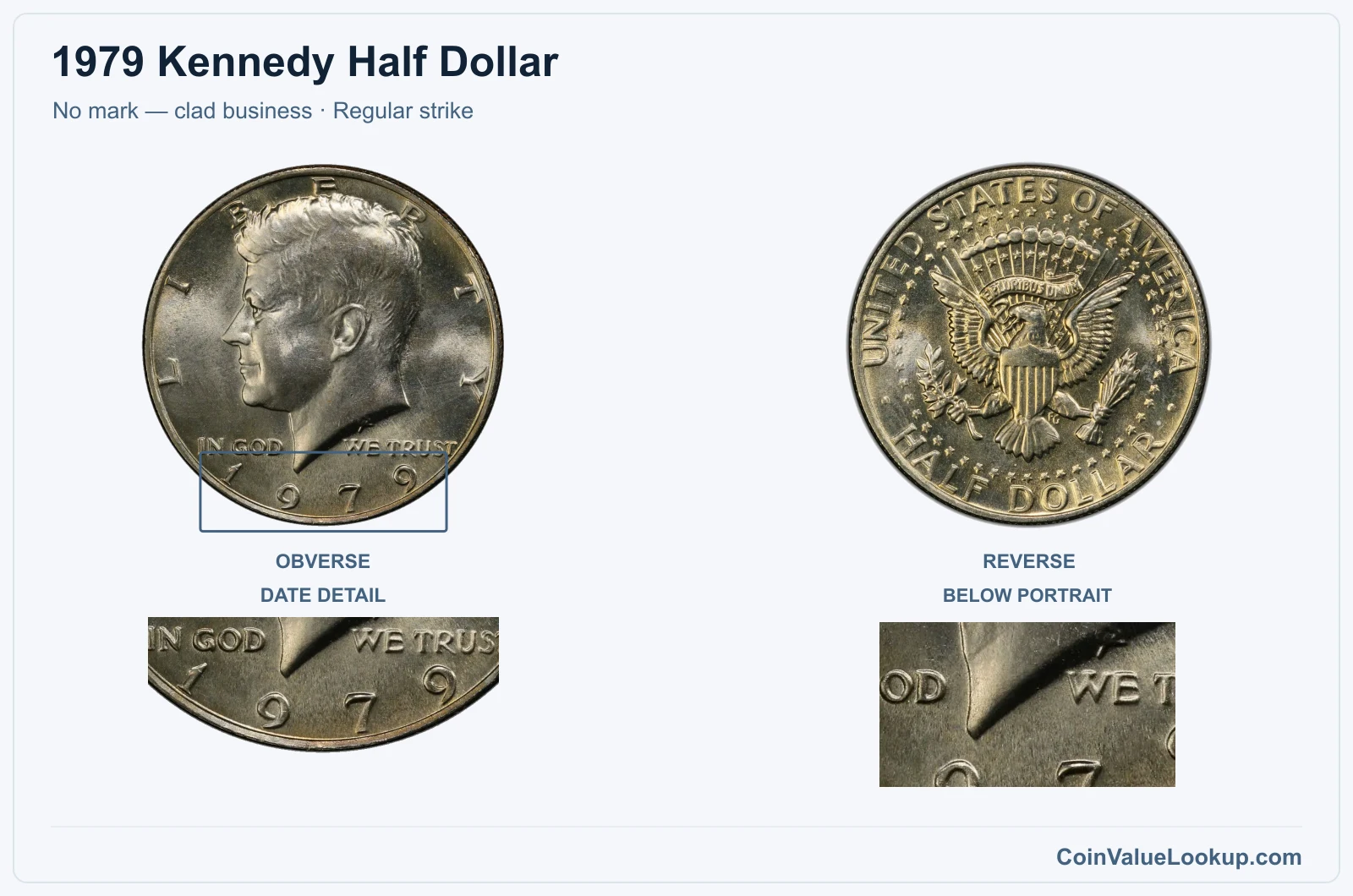
The 1979 Philadelphia half dollar has no mintmark — that blank space below Kennedy's neck is normal for this era. It is a copper-nickel clad coin weighing about 11.34 grams.
Circulated examples are face-value coins. You would need a nice original piece in the MS65 range to see a collector premium; a USA Coin Book guide estimate puts that around $3.62.
Still not retirement money, but it is worth pulling from a roll if the surfaces are clean and mark-free.
Range Grade
Price Auction Records Appraisal PO PO 1
—
Coin Identifier FR FR 2
—
Coin Identifier AG AG 3
—
Coin Identifier G G 4
—
Coin Identifier
G 6
—
Coin Identifier VG VG 8
—
Coin Identifier
VG 10
—
Coin Identifier F F 12
—
Coin Identifier
F 15
—
Coin Identifier VF VF 20
—
Coin Identifier
VF 25
—
Coin Identifier
VF 30
—
Coin Identifier
VF 35
—
Coin Identifier XF XF 40
—
Coin Identifier
XF 45
—
Coin Identifier AU AU 50
—
Coin Identifier
AU 53
—
Coin Identifier
AU 55
Coin Identifier
AU 58
Coin Identifier MS MS 60
—
Coin Identifier
MS 61
Coin Identifier
MS 62
—
Coin Identifier
MS 63
—
Coin Identifier
MS 64
Coin Identifier
MS 65
Coin Identifier
MS 66
Coin Identifier
MS 67
Coin Identifier
MS 68
—
Coin Identifier
MS 69
—
—
—
MS 70
—
—
—
1979 Kennedy Half Dollar — D — clad business
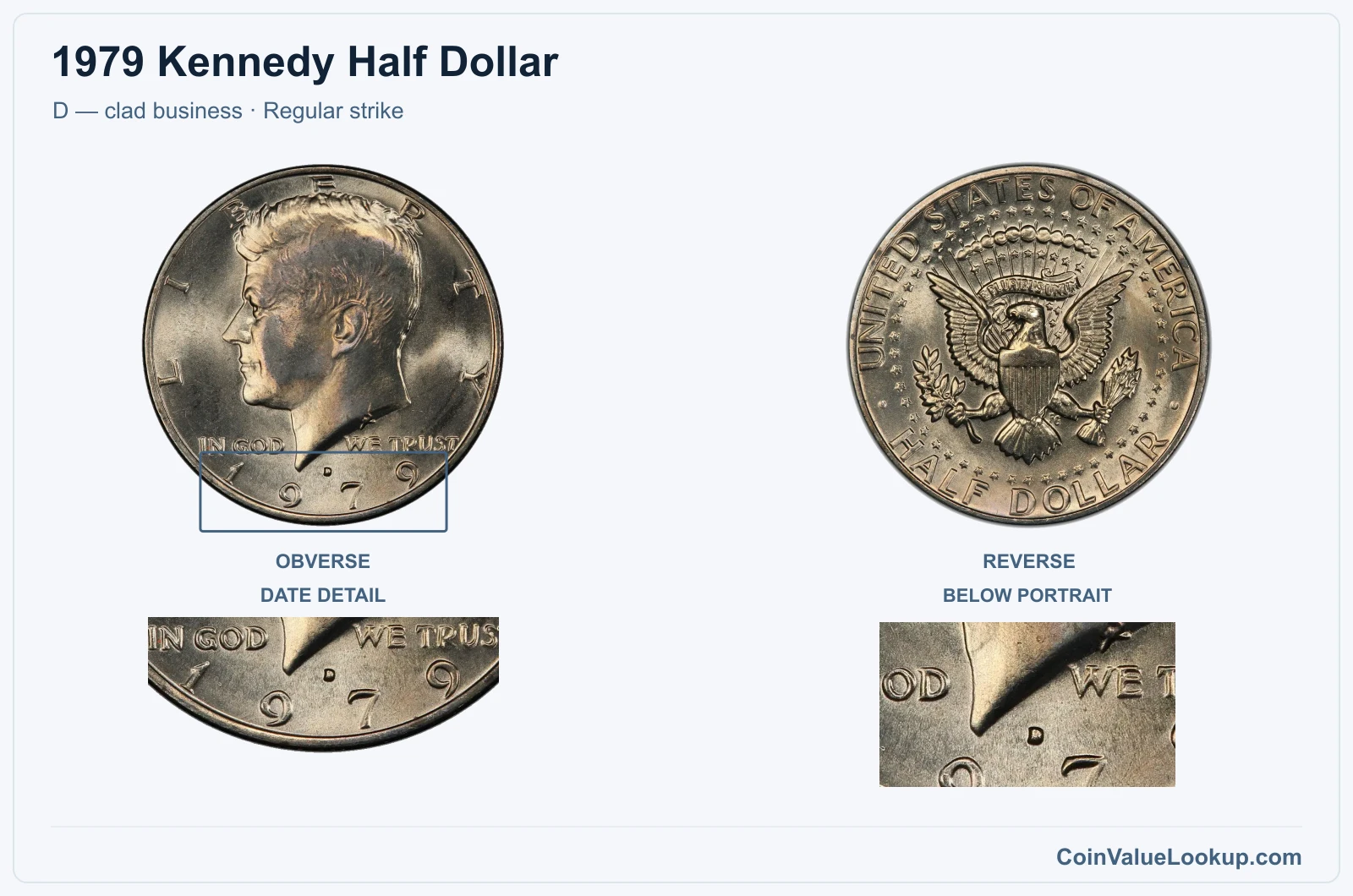
The 1979-D Kennedy half carries a small D mintmark beneath Kennedy's portrait. Like its Philadelphia sibling, it is copper-nickel clad over a copper core at a nominal 11.34 grams.
Worn examples trade at face value. In MS65 condition the USA Coin Book guide estimate is about $3.62.
Denver struck plenty of these, so finding one in high grade is the challenge, not the mintage itself. Look for clean fields and sharp hair detail above the ear.
Range Grade
Price Auction Records Appraisal PO PO 1
—
Coin Identifier FR FR 2
—
Coin Identifier AG AG 3
—
Coin Identifier G G 4
—
Coin Identifier
G 6
—
Coin Identifier VG VG 8
—
Coin Identifier
VG 10
—
Coin Identifier F F 12
—
Coin Identifier
F 15
—
Coin Identifier VF VF 20
—
Coin Identifier
VF 25
—
Coin Identifier
VF 30
—
Coin Identifier
VF 35
—
Coin Identifier XF XF 40
—
Coin Identifier
XF 45
—
Coin Identifier AU AU 50
—
Coin Identifier
AU 53
—
Coin Identifier
AU 55
—
Coin Identifier
AU 58
—
Coin Identifier MS MS 60
—
Coin Identifier
MS 61
—
Coin Identifier
MS 62
—
Coin Identifier
MS 63
—
Coin Identifier
MS 64
Coin Identifier
MS 65
Coin Identifier
MS 66
Coin Identifier
MS 67
Coin Identifier
MS 68
—
—
—
MS 69
—
—
—
MS 70
—
—
—
1979 Kennedy Half Dollar — S — clad proof — Type 1
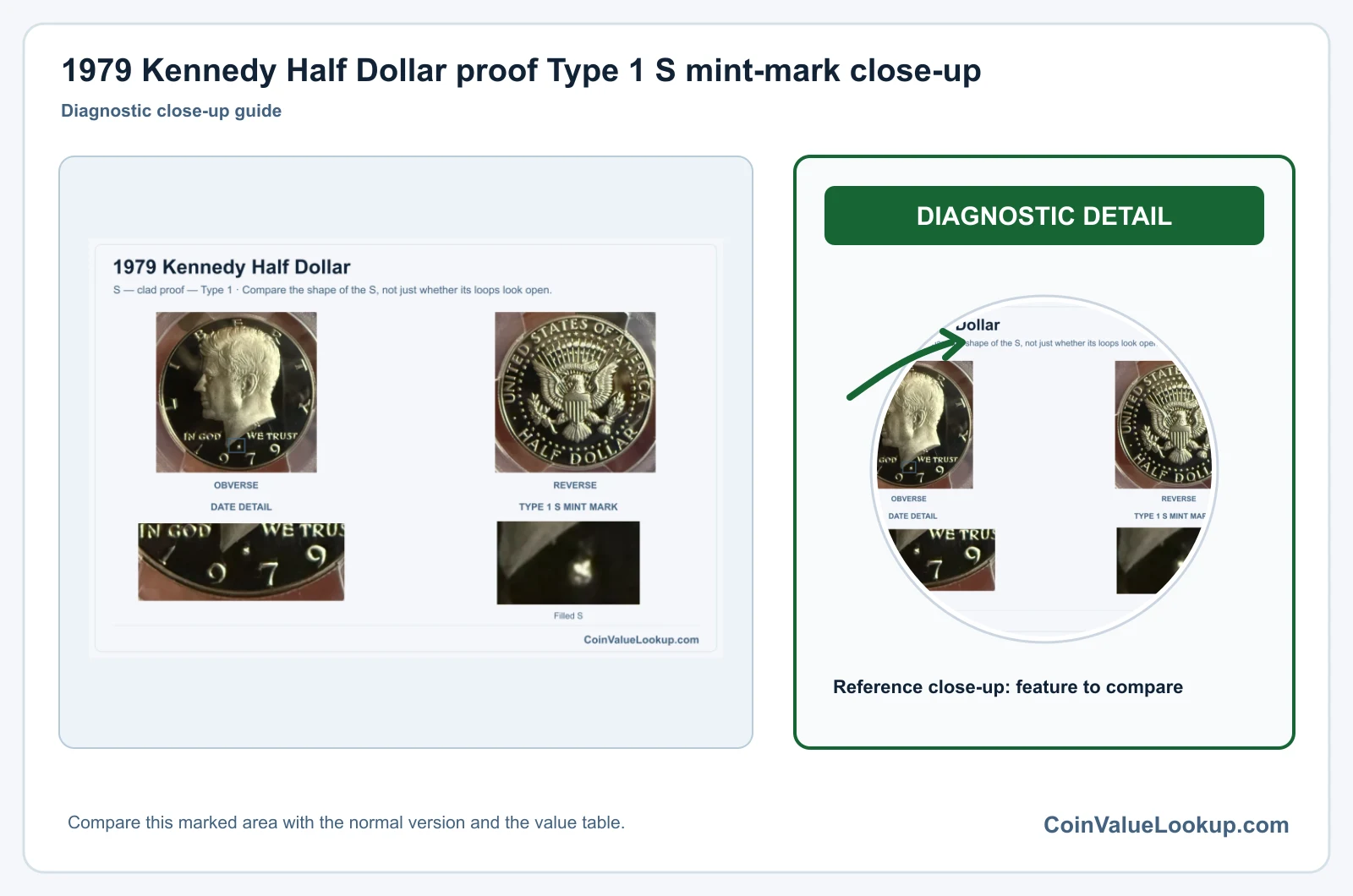
The 1979-S Type 1 proof is the common San Francisco proof, struck on a copper-nickel clad planchet with mirror fields and frosted devices. It weighs about 11.34 grams — no silver here despite the proof finish.
The Type 1 designation refers to the mintmark. On these coins the S looks filled in and blobby, with the loops of the letter nearly closed.
This is the version that came in most 1979 proof sets. A USA Coin Book guide estimate at PR65 is approximately $3.62.
The key is distinguishing it from the much scarcer Type 2, so grab a loupe and compare that S carefully.
Range Grade
Price Auction Records Appraisal PR PR 1
—
Coin Identifier
PR 2
—
Coin Identifier
PR 3
—
Coin Identifier
PR 4
—
Coin Identifier
PR 6
—
Coin Identifier
PR 8
—
Coin Identifier
PR 10
—
Coin Identifier
PR 12
—
Coin Identifier
PR 15
—
Coin Identifier
PR 20
—
Coin Identifier
PR 25
—
Coin Identifier
PR 30
—
Coin Identifier
PR 35
—
Coin Identifier
PR 40
—
Coin Identifier
PR 45
—
Coin Identifier
PR 50
—
Coin Identifier
PR 53
—
Coin Identifier
PR 55
—
Coin Identifier
PR 58
—
Coin Identifier
PR 60
—
Coin Identifier
PR 61
—
Coin Identifier
PR 62
—
Coin Identifier
PR 63
—
Coin Identifier
PR 64
—
Coin Identifier
PR 65
—
Coin Identifier
PR 66
Coin Identifier
PR 67
Coin Identifier
PR 68
Coin Identifier
PR 69
Coin Identifier
PR 70
Coin Identifier
1979 Kennedy Half Dollar — S — clad proof — Type 2
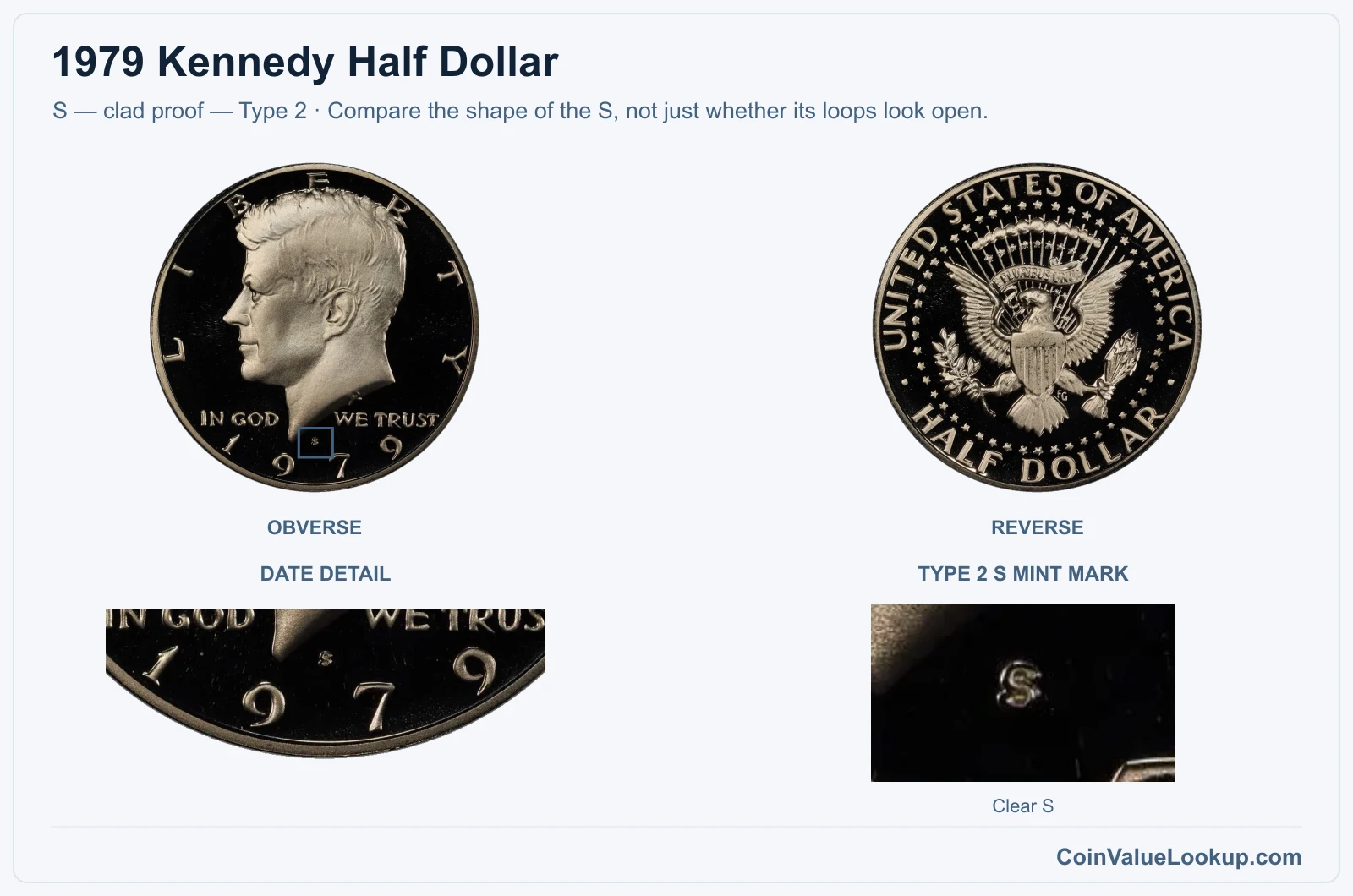
The 1979-S Type 2 proof is the coin to look for. Same copper-nickel clad composition and weight as the Type 1, but the S mintmark is sharply defined with clearly open loops — no blobby fill.
This variety is considerably scarcer than the Type 1. The USA Coin Book guide estimate at PR65 is around $30.00, a significant jump from the $3.62 estimate for the filled-S version.
That price difference makes accurate identification essential. Do not use a 1981 Type 2 as your comparison reference, because that punch has different terminal shapes.
Find a verified 1979 Type 2 image and compare side by side under magnification.
Range Grade
Price Auction Records Appraisal PR PR 1
—
Coin Identifier
PR 2
—
Coin Identifier
PR 3
—
Coin Identifier
PR 4
—
Coin Identifier
PR 6
—
Coin Identifier
PR 8
—
Coin Identifier
PR 10
—
Coin Identifier
PR 12
—
Coin Identifier
PR 15
—
Coin Identifier
PR 20
—
Coin Identifier
PR 25
—
Coin Identifier
PR 30
—
Coin Identifier
PR 35
—
Coin Identifier
PR 40
—
Coin Identifier
PR 45
—
Coin Identifier
PR 50
—
Coin Identifier
PR 53
—
Coin Identifier
PR 55
—
Coin Identifier
PR 58
—
Coin Identifier
PR 60
—
Coin Identifier
PR 61
—
Coin Identifier
PR 62
—
Coin Identifier
PR 63
Coin Identifier
PR 64
—
Coin Identifier
PR 65
—
Coin Identifier
PR 66
Coin Identifier
PR 67
Coin Identifier
PR 68
Coin Identifier
PR 69
Coin Identifier
PR 70
Coin Identifier
1979 Kennedy Half Dollar Error List
1. 1979 Kennedy Half Dollar — Lamination / Split Planchet
A lamination error shows as peeling, flaking or splitting within the metal layers. On a 1979 Kennedy half you might see a thin flap of metal lifting away from the surface, or a visible crack where the alloy has separated.
Photograph the edge alongside the affected face so the depth and extent of the separation are clear. This matters because the value of a lamination depends on size, visibility and overall coin condition.
Do not confuse lamination with surface scraping, corrosion pitting or coins that have been deliberately cut. Genuine laminations follow the metal's natural structure rather than showing tool marks or irregular corrosion patterns.
2. 1979 Kennedy Half Dollar — Clipped Planchet
A clipped planchet means the blank was incompletely punched from the metal strip before striking. The result is a missing curved, straight or ragged section along the edge.
On a genuine clip, you may notice design weakness on the opposite side of the coin from the missing area. The edge at the clip boundary should show the natural metal flow from the blanking process, not sharp tool marks.
Filed notches, deliberate cuts and corrosion damage can mimic a clip. Compare the edge texture carefully — a real clip has a smooth, even boundary consistent with the original blanking operation.
Value depends on the size of the missing portion, visibility and the coin's overall condition.
3. 1979 Kennedy Half Dollar — Broadstrike
A broadstrike occurs when a coin is struck without the normal retaining collar that forms the edge. The result is a coin that spreads outward, appearing wider than normal with a smooth or irregular rim instead of the usual reeded edge.
The full design is still present on a broadstrike — it just expands toward the edges. That is different from an off-center strike, where part of the design is missing entirely.
Be careful not to confuse a broadstrike with a coin that was flattened by machinery or a heavy object after leaving the mint. Post-mint damage tends to distort the design unevenly, while a genuine broadstrike shows symmetrical outward spread.
The value of any broadstrike depends on how dramatic the spread is and the coin's condition.
4. 1979 Kennedy Half Dollar — Double / Multiple Strike
A double or multiple strike happens when a coin receives more than one impression from the dies. You will see two or more overlapping but displaced versions of the design, sometimes rotated relative to each other.
The 1979 half dollar has been reported as a double-struck mated pair, meaning two coins struck together in a linked sequence. These are dramatic errors and quite distinct from a doubled die, which shows doubling within a single strike from a defective die.
Look for clearly separate design impressions rather than merely thickened or spread lettering. Post-mint pressing of two coins together can imitate this, so the relationship between the impressions matters.
Value varies with the degree of displacement, visibility and condition.
5. 1979 Kennedy Half Dollar — Off-Center Strike
An off-center strike happens when the planchet is not properly seated between the dies. Part of the design ends up missing, replaced by a blank crescent of unstruck metal.
The percentage off center and whether the date remains visible are the two biggest factors collectors care about. A coin that is 5% off center is mildly interesting; one that is 50% off center with a readable date is far more desirable.
Do not confuse an off-center strike with a clipped planchet or post-mint flattening. Off-center coins have a complete blank edge on the unstruck side, while clips show the original planchet boundary.
Condition and visual drama drive individual value.
6. 1979 Kennedy Half Dollar — Wrong Planchet / Off-Metal Strike
A wrong-planchet error means the half dollar dies struck a blank intended for a different denomination. The 1979 half dollar has been reported struck on a Susan B.
Anthony dollar planchet.
To check, compare your coin's weight, diameter and edge to a normal 1979 Kennedy half. A coin struck on the wrong blank will show incomplete design coverage or unusual proportions because the planchet does not match the die cavity.
Plating, corrosion, acid treatments and deliberate alterations can all change a coin's appearance enough to fool someone into thinking it is on the wrong metal. Weigh the coin on a precision scale and measure the diameter before jumping to conclusions.
Value depends on the specific wrong planchet, completeness of the design and condition.
7. 1979 Kennedy Half Dollar — Brockage
A brockage occurs when a previously struck coin sticks to a die and impresses its design onto the next coin. The result is one normal side and one side showing an incuse, mirror-image version of the same or opposite design.
The 1979 half dollar has been reported as a first-strike brockage described as double-headed, meaning Kennedy's portrait appears on both sides — one raised normally and one sunken in reverse. That is a visually striking error.
Die clashes can leave faint ghost impressions but do not produce a full incuse mirror image. Coins pressed together after minting also lack the depth and detail of a genuine brockage.
Check the relief and directionality carefully. Value depends on the clarity of the transferred image and overall condition.
8. 1979 Kennedy Half Dollar — Missing Clad Layer
A missing clad layer error means one of the outer copper-nickel layers was absent from the planchet before striking. The exposed side may show a distinctly different color from the copper core material, and the coin will weigh less than the standard 11.34 grams.
Compare the affected face, the edge profile and the weight against a normal clad half dollar. The edge of a missing-clad coin should show an asymmetric layer structure rather than the normal sandwich appearance.
Toning, environmental corrosion, plating and deliberate surface stripping can all change a coin's color and mimic this error. A precise weight measurement is your best screening tool.
The value of a missing clad layer depends on which side is affected, how much of the layer is gone and the coin's condition.
9. 1979 Kennedy Half Dollar — Improper Annealing
Improper annealing refers to a problem in the heat treatment of the planchet before striking. The reported result on a 1979 half dollar is unusual surface discoloration or texture that differs from a normally prepared coin.
This is one of those errors where appearance is a screening clue, not definitive proof. You might see streaky discoloration, a woodgrain-like surface texture or mottled toning that does not match typical environmental damage patterns.
The tricky part is distinguishing genuine annealing issues from environmental toning, corrosion or heat applied after the coin left the mint. Compare your coin's surface and edge to a normal example under consistent lighting.
Value varies with the severity and visual distinctiveness of the error, as well as overall condition.