1972 Kennedy Half Dollar Coin Value: How Much Is It Worth?
A typical 1972 Kennedy half dollar in circulated condition is worth face value — fifty cents. In uncirculated condition around MS63, a USA Coin Book guide estimate puts it at roughly $3.62.
Collector proofs, the recognized 1972-D No FG variety, and authenticated error coins carry separate, sometimes much higher values depending on condition and attribution.
Fast Way to Identify Your 1972 Kennedy Half Dollar
The quickest way to start figuring out what you have is to upload clear photos of both the front and back of your coin. Our identifier can give you a preliminary read on which version you're holding, whether it's a Philadelphia, Denver, or San Francisco issue, and flag anything that looks unusual enough to investigate further.
1972 Kennedy Half Dollar Value
Upload both sides of your 1972 Kennedy Half Dollar.
Front Obverse
Upload photo
Back Reverse
Upload photo
Which 1972 Kennedy Half Dollar Versions Are Worth Money?
- The 1972-D No FG variety, with designer initials completely absent, sold for $2,485.13 in MS63 at a 2016 sale reported by PCGS.
- A 1972-D half struck on a cent planchet brought $3,720 in NGC MS65 Red and Brown at Heritage in August 2024.
- A 1972-D half indented by a cent planchet sold for $4,320 in NGC MS64 at Heritage in June 2023.
- The 1972 Philadelphia Doubled Die Obverse is a recognized hub-doubling variety whose value depends on authenticated identity, condition and severity.
- The 1972-S Proof in high grade, around PR65, carries a guide estimate of about $4.96 — modest, but still well above face value.
Step 1: Identify Your 1972 Kennedy Half Dollar Mint Mark and Version
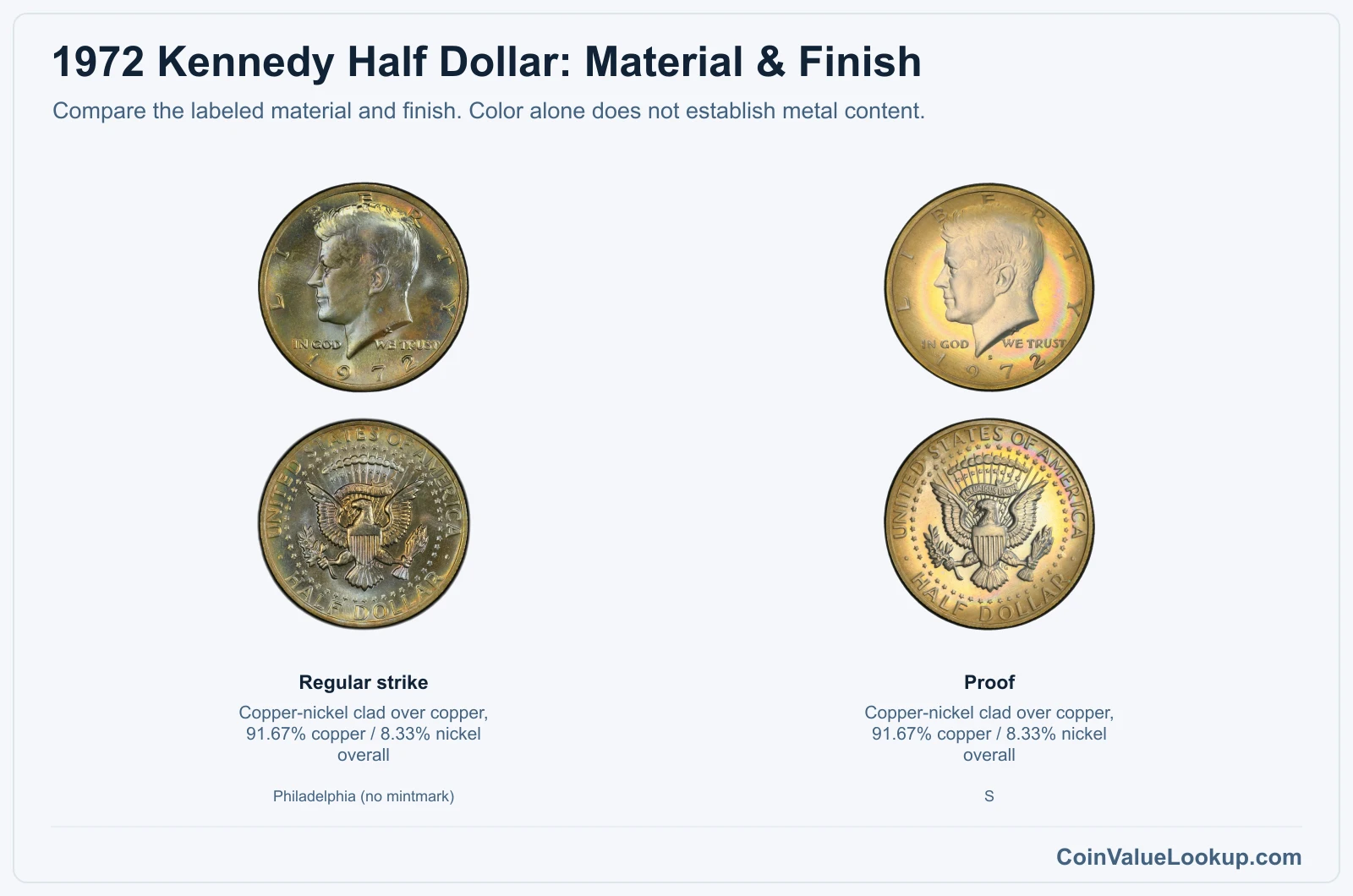
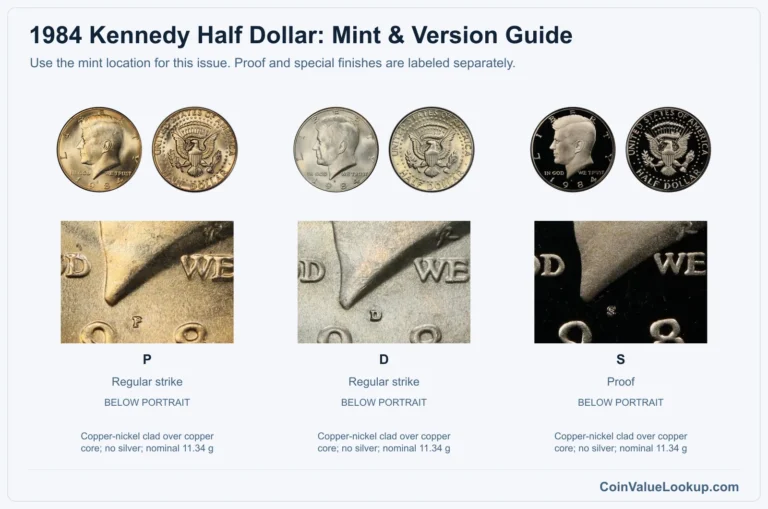
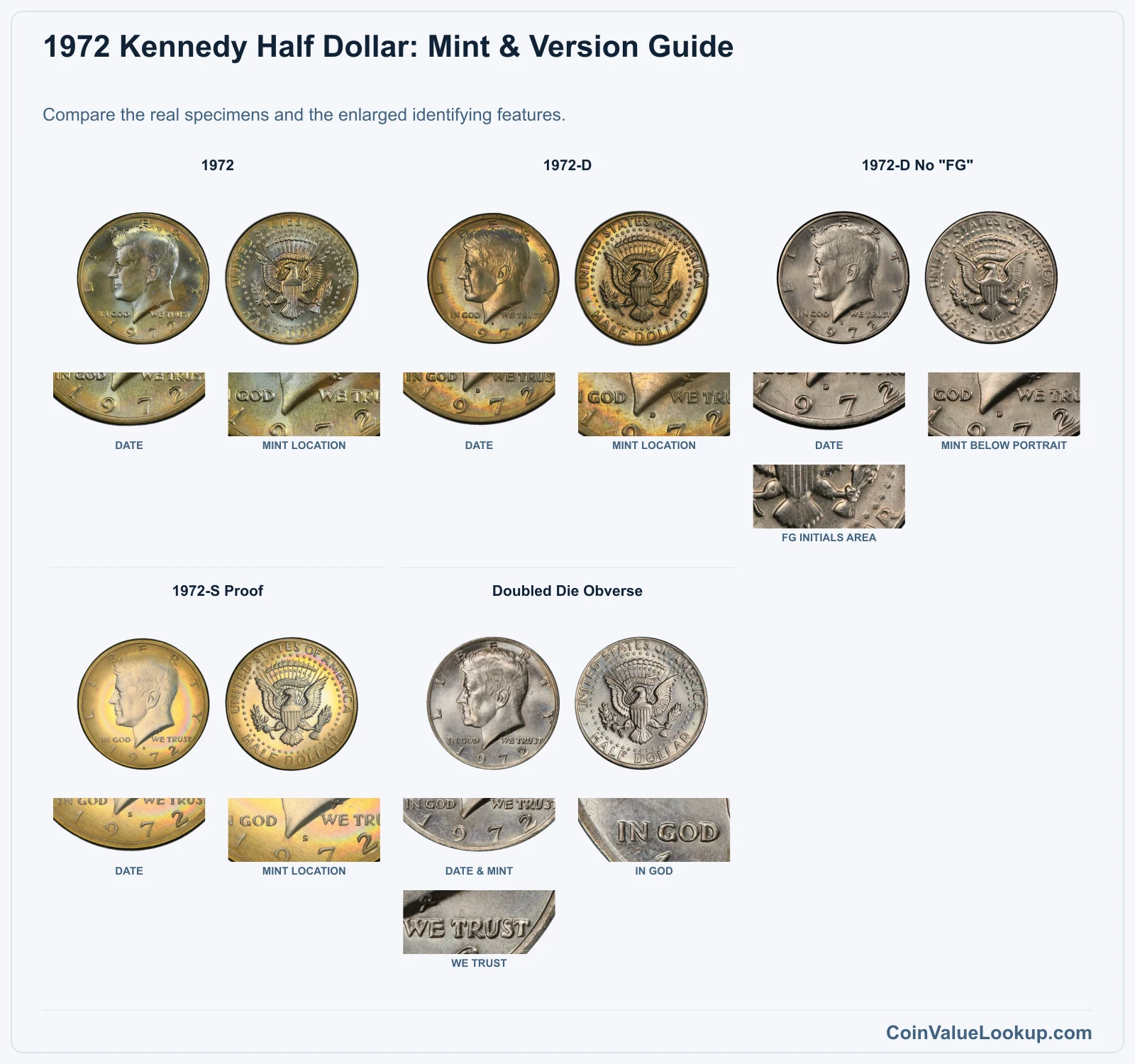
Three main versions exist for 1972: the unmarked Philadelphia business strike, the 1972-D from Denver, and the 1972-S clad proof from San Francisco. No silver was used for any of them — all are copper-nickel clad, weighing about 11.34 grams at roughly 30.61 mm in diameter.
To find the mintmark, look on the obverse just below Kennedy's neck, above the date. Philadelphia coins have no mintmark at all.
A small "D" means Denver, and an "S" means San Francisco.
The 1972-D No FG variety is a separate recognized coin — the designer's initials (Frank Gasparro's "FG") must be completely absent on the reverse at 5x magnification, not just weak or partially visible. Weak initials happen often on early-1970s halves due to soft strikes and die wear, so don't jump to conclusions.
Weight and edge color can help screen for wrong-planchet errors, but they can't confirm a rare alloy on their own. Inspect both faces carefully.
Step 2: Check Your 1972 Kennedy Half Dollar Grade
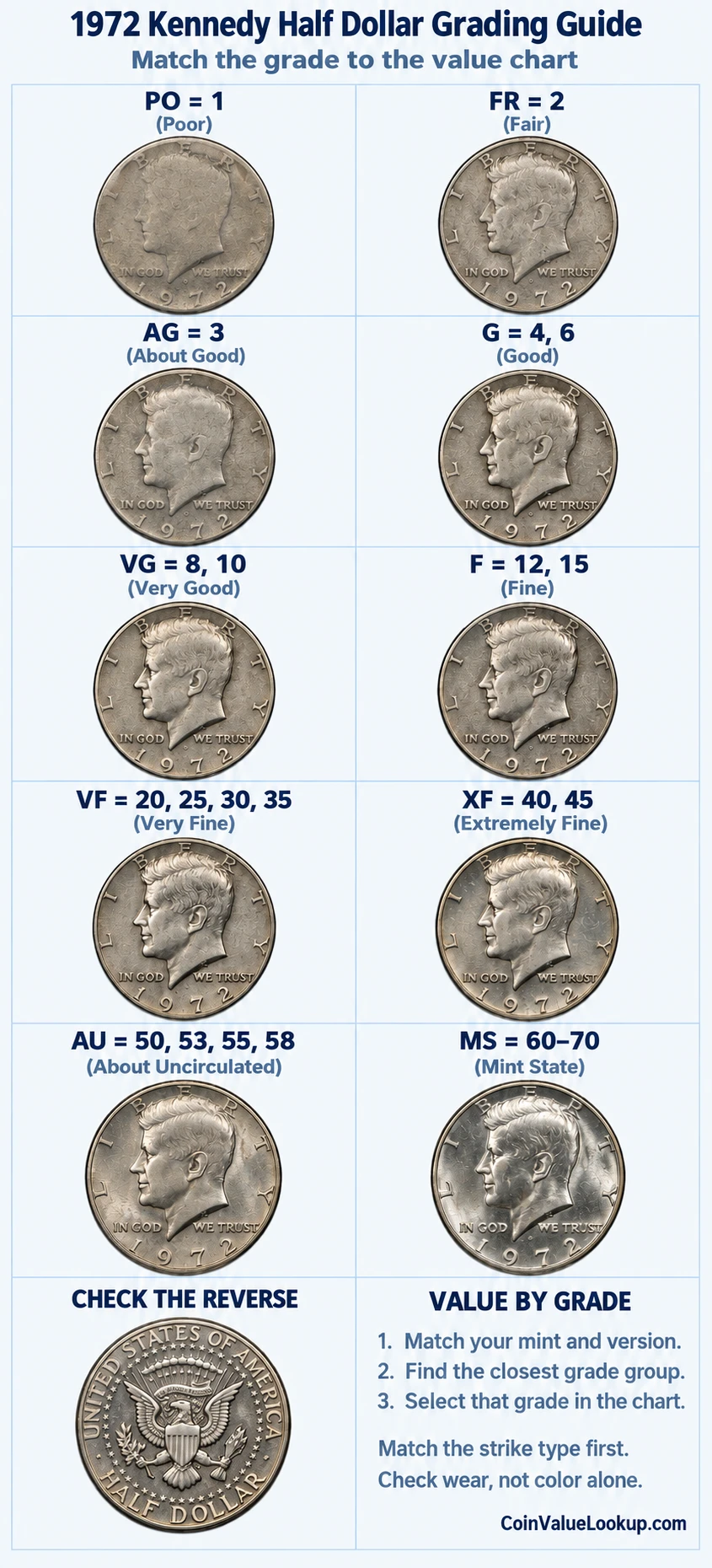
Start on the obverse. Check the hair above Kennedy's ear, the cheekbone, and the jawline — these are the first places to lose detail from circulation.
A coin with full luster and no rub in those spots is a candidate for Mint State grades.
On the reverse, look at the eagle's breast feathers, tail feathers, and the shield lines. But here's the catch: many 1971-and-later Kennedy halves came weakly struck in those shield details right from the mint.
Don't mistake a soft strike for wear.
Separate contact marks and hairlines from actual circulation wear. Bag marks are normal on business strikes; deep scratches are not.
Use the comparison image to match your coin against same-type examples at various grades.
Proof coins are a manufacturing finish, not a grade above Mint State. A proof can still have hairlines, haze, or handling marks that lower its assigned grade.
Cameo contrast on a proof is a surface characteristic — it tells you nothing about silver content.
Step 3: Check 1972 Kennedy Half Dollar Value by Mint and Version
1972 Kennedy Half Dollar
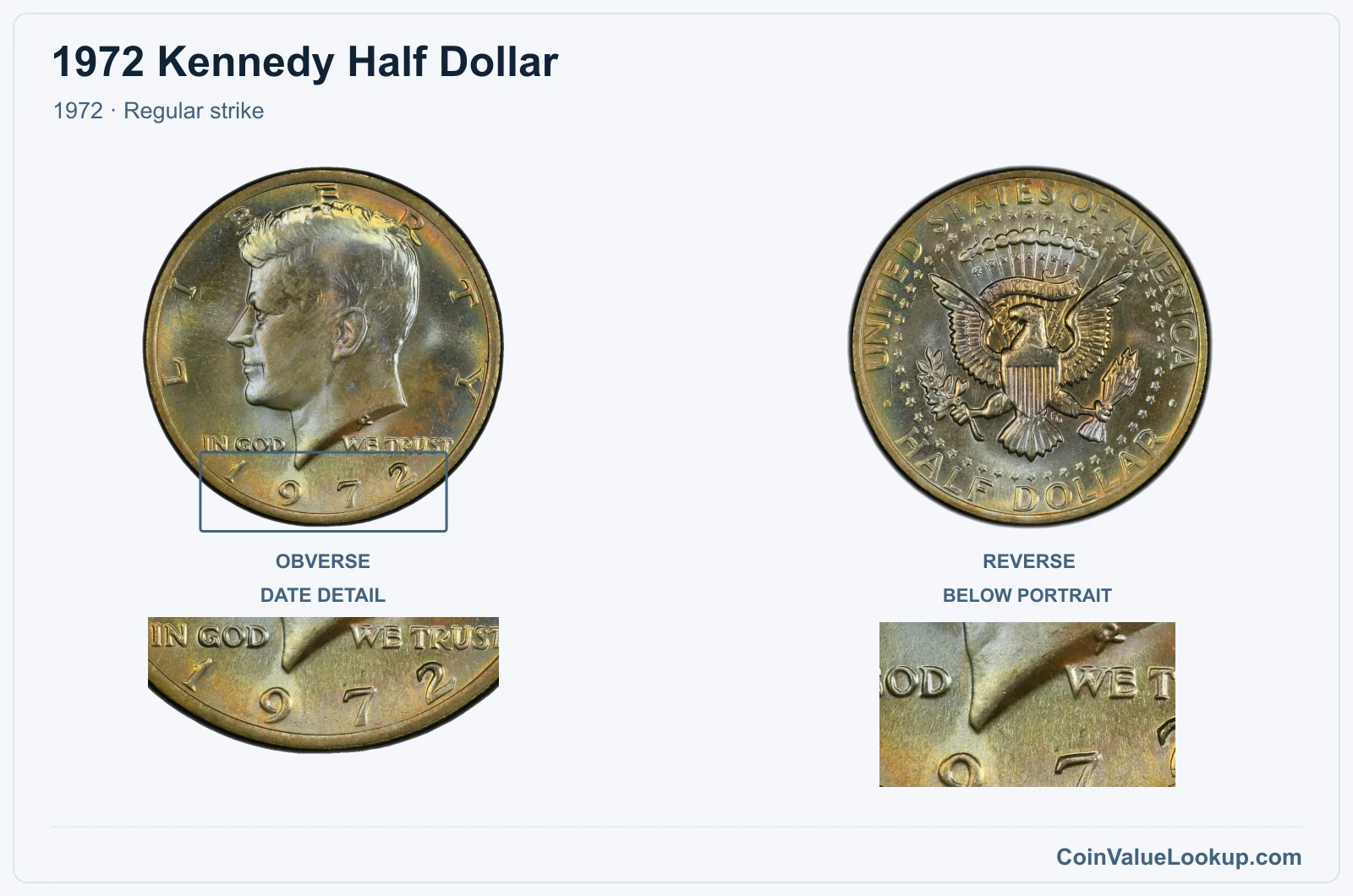
The 1972 Philadelphia Kennedy half has no mintmark — the space below Kennedy's neck is blank. It's a copper-nickel clad coin, no silver involved.
A USA Coin Book guide estimate puts the MS63 value at about $3.62.
In average circulated condition, you're looking at face value. Most of these were spent and pocketed without a second thought.
An uncirculated example with clean surfaces and good luster is worth setting aside, but don't expect a windfall unless a recognized variety or error is present.
| Range | Grade | Price | Auction Records | Appraisal |
|---|---|---|---|---|
| PO | PO 1 | — | Coin Identifier | |
| FR | FR 2 | — | Coin Identifier | |
| AG | AG 3 | — | Coin Identifier | |
| G | G 4 | — | Coin Identifier | |
| G 6 | — | Coin Identifier | ||
| VG | VG 8 | — | Coin Identifier | |
| VG 10 | — | Coin Identifier | ||
| F | F 12 | — | Coin Identifier | |
| F 15 | — | Coin Identifier | ||
| VF | VF 20 | — | Coin Identifier | |
| VF 25 | — | Coin Identifier | ||
| VF 30 | — | Coin Identifier | ||
| VF 35 | — | Coin Identifier | ||
| XF | XF 40 | — | Coin Identifier | |
| XF 45 | — | Coin Identifier | ||
| AU | AU 50 | — | Coin Identifier | |
| AU 53 | — | Coin Identifier | ||
| AU 55 | — | Coin Identifier | ||
| AU 58 | Coin Identifier | |||
| MS | MS 60 | — | Coin Identifier | |
| MS 61 | — | Coin Identifier | ||
| MS 62 | Coin Identifier | |||
| MS 63 | — | Coin Identifier | ||
| MS 64 | — | Coin Identifier | ||
| MS 65 | Coin Identifier | |||
| MS 66 | Coin Identifier | |||
| MS 67 | Coin Identifier | |||
| MS 68 | — | — | — | |
| MS 69 | — | — | — | |
| MS 70 | — | — | — |
1972 Kennedy Half Dollar — D
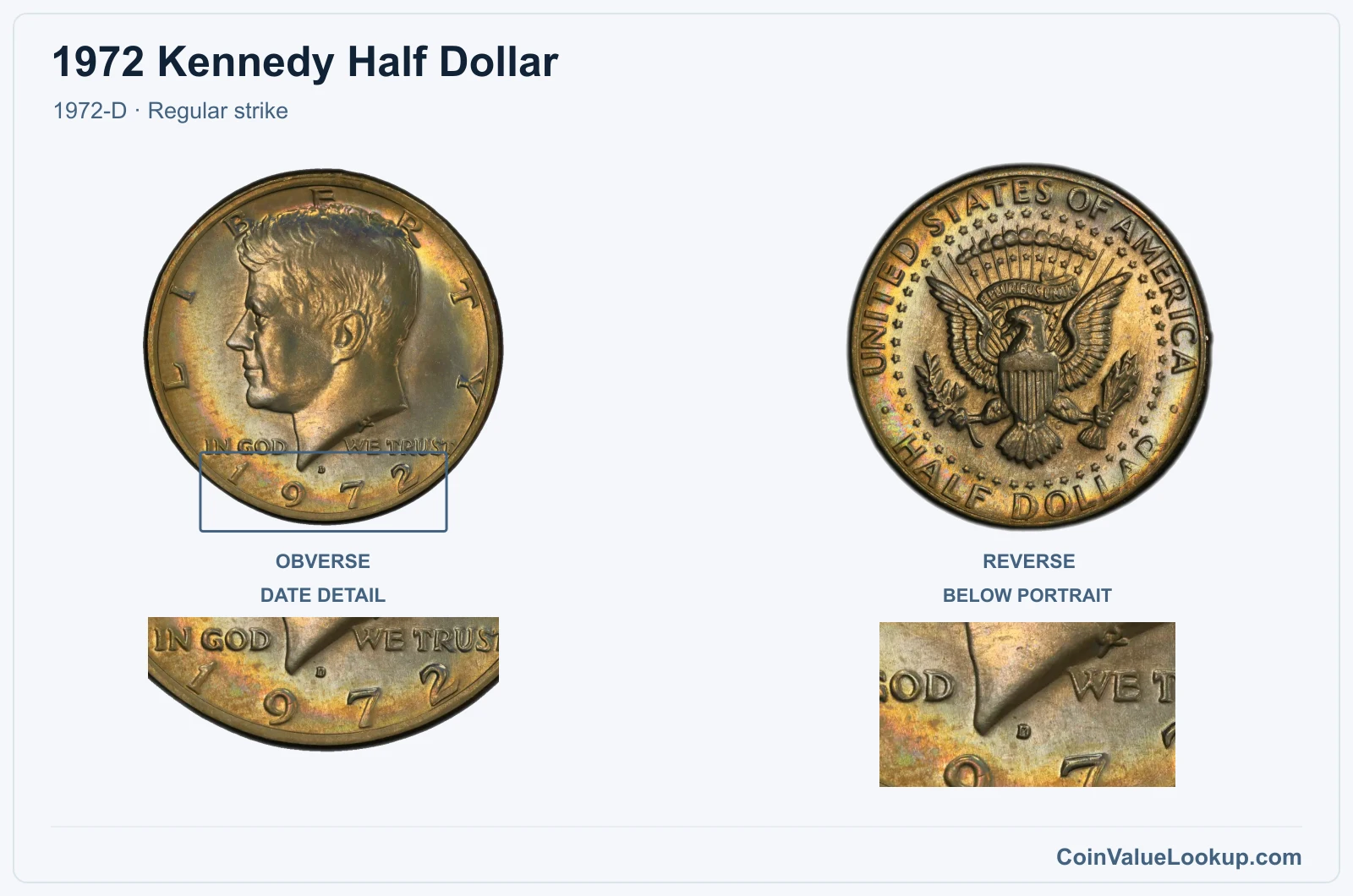
The 1972-D carries a small "D" mintmark on the obverse beneath Kennedy's neck. Same copper-nickel clad composition, same 11.34-gram weight as the Philadelphia issue.
The MS63 guide estimate is also $3.62.
Denver struck plenty of these, so circulated pieces are face-value coins. What makes the 1972-D interesting is the No FG variety and the documented wrong-planchet errors that have turned up from this mint — those are separate entries below.
Check your reverse carefully before tossing this one back in the jar.
| Range | Grade | Price | Auction Records | Appraisal |
|---|---|---|---|---|
| PO | PO 1 | — | Coin Identifier | |
| FR | FR 2 | — | Coin Identifier | |
| AG | AG 3 | — | Coin Identifier | |
| G | G 4 | — | Coin Identifier | |
| G 6 | — | Coin Identifier | ||
| VG | VG 8 | — | Coin Identifier | |
| VG 10 | — | Coin Identifier | ||
| F | F 12 | — | Coin Identifier | |
| F 15 | — | Coin Identifier | ||
| VF | VF 20 | — | Coin Identifier | |
| VF 25 | — | Coin Identifier | ||
| VF 30 | — | Coin Identifier | ||
| VF 35 | — | Coin Identifier | ||
| XF | XF 40 | — | Coin Identifier | |
| XF 45 | — | Coin Identifier | ||
| AU | AU 50 | — | Coin Identifier | |
| AU 53 | — | Coin Identifier | ||
| AU 55 | Coin Identifier | |||
| AU 58 | — | Coin Identifier | ||
| MS | MS 60 | — | Coin Identifier | |
| MS 61 | — | Coin Identifier | ||
| MS 62 | Coin Identifier | |||
| MS 63 | Coin Identifier | |||
| MS 64 | Coin Identifier | |||
| MS 65 | Coin Identifier | |||
| MS 66 | Coin Identifier | |||
| MS 67 | Coin Identifier | |||
| MS 68 | — | Coin Identifier | ||
| MS 69 | — | — | — | |
| MS 70 | — | — | — |
1972 Kennedy Half Dollar — D No "FG"
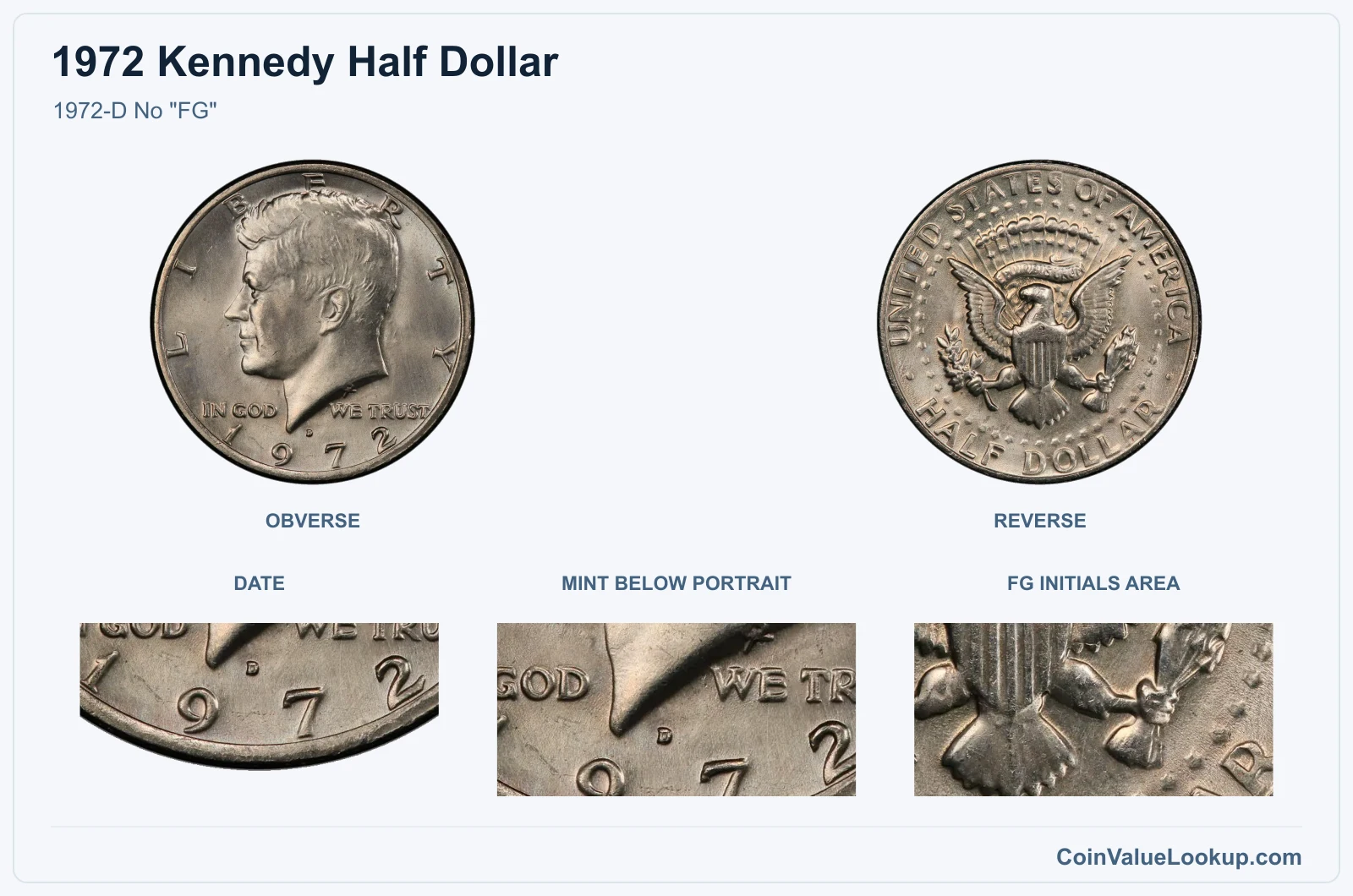
This is the one people actually hunt for. On a normal Kennedy reverse, Frank Gasparro's "FG" initials appear between the eagle's left leg (your right when looking at it) and the tail-feather and arrow bundle.
On the 1972-D No FG, heavy die polishing wiped those initials off the die entirely.
The standard is strict: at 5x magnification, there should be zero trace of the letters. Faintly visible or partially readable initials don't qualify.
Compare your coin's reverse side-by-side with a normal 1972-D — the difference on a genuine No FG is obvious under modest magnification.
A PCGS-reported sale from 2016 saw an MS63 example bring $2,485.13. That's a single historical transaction, not a guaranteed price for every example, but it shows the recognized variety commands serious attention from collectors when properly attributed.
| Range | Grade | Price | Auction Records | Appraisal |
|---|---|---|---|---|
| PO | PO 1 | — | Coin Identifier | |
| FR | FR 2 | — | Coin Identifier | |
| AG | AG 3 | — | Coin Identifier | |
| G | G 4 | — | Coin Identifier | |
| G 6 | — | Coin Identifier | ||
| VG | VG 8 | — | Coin Identifier | |
| VG 10 | — | Coin Identifier | ||
| F | F 12 | — | Coin Identifier | |
| F 15 | — | Coin Identifier | ||
| VF | VF 20 | — | Coin Identifier | |
| VF 25 | — | Coin Identifier | ||
| VF 30 | — | Coin Identifier | ||
| VF 35 | — | Coin Identifier | ||
| XF | XF 40 | — | Coin Identifier | |
| XF 45 | — | Coin Identifier | ||
| AU | AU 50 | — | Coin Identifier | |
| AU 53 | — | Coin Identifier | ||
| AU 55 | — | Coin Identifier | ||
| AU 58 | — | Coin Identifier | ||
| MS | MS 60 | — | Coin Identifier | |
| MS 61 | — | Coin Identifier | ||
| MS 62 | — | Coin Identifier | ||
| MS 63 | — | Coin Identifier | ||
| MS 64 | — | Coin Identifier | ||
| MS 65 | — | Coin Identifier | ||
| MS 66 | — | Coin Identifier | ||
| MS 67 | — | — | — | |
| MS 68 | — | — | — | |
| MS 69 | — | — | — | |
| MS 70 | — | — | — |
1972 Kennedy Half Dollar — S Proof
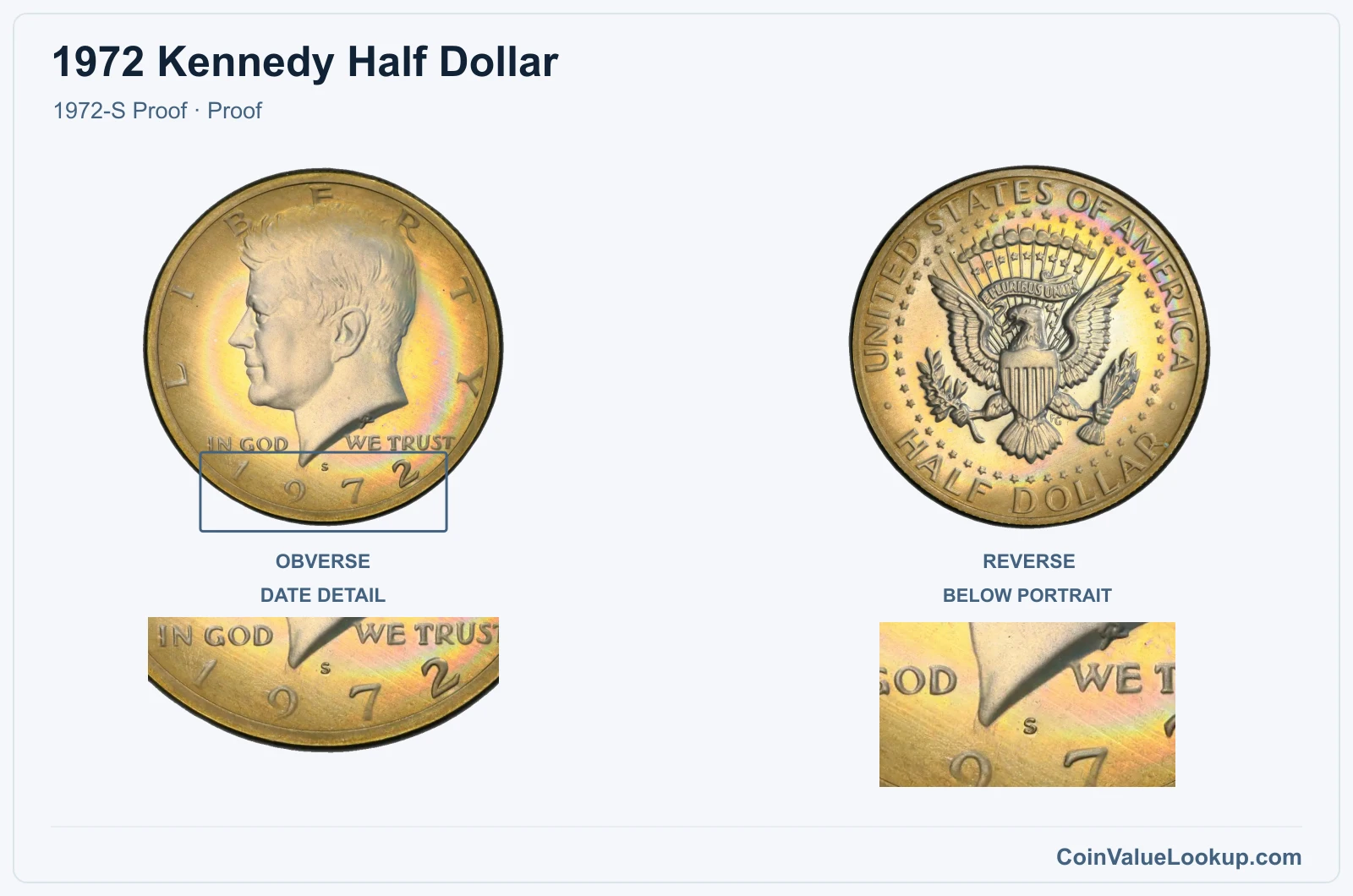
The 1972-S Proof was struck at San Francisco for collector sets and carries an "S" mintmark. It's still copper-nickel clad — no silver.
The mirrored fields and sharp details are a product of the proof manufacturing process, not a higher grade.
Coin Value Lookup is a handy starting point if you want to look up guides for other Kennedy half dollar years or denominations while you're sorting through a collection.
A PR65 guide estimate sits around $4.96 per USA Coin Book. That's modest, but clean high-grade proofs with strong cameo contrast can attract more interest.
Check for hairlines and haze before assuming yours is gem quality.
| Range | Grade | Price | Auction Records | Appraisal |
|---|---|---|---|---|
| PR | PR 1 | — | Coin Identifier | |
| PR 2 | — | Coin Identifier | ||
| PR 3 | — | Coin Identifier | ||
| PR 4 | — | Coin Identifier | ||
| PR 6 | — | Coin Identifier | ||
| PR 8 | — | Coin Identifier | ||
| PR 10 | — | Coin Identifier | ||
| PR 12 | — | Coin Identifier | ||
| PR 15 | — | Coin Identifier | ||
| PR 20 | — | Coin Identifier | ||
| PR 25 | — | Coin Identifier | ||
| PR 30 | — | Coin Identifier | ||
| PR 35 | — | Coin Identifier | ||
| PR 40 | — | Coin Identifier | ||
| PR 45 | — | Coin Identifier | ||
| PR 50 | — | Coin Identifier | ||
| PR 53 | — | Coin Identifier | ||
| PR 55 | — | Coin Identifier | ||
| PR 58 | — | Coin Identifier | ||
| PR 60 | — | Coin Identifier | ||
| PR 61 | — | Coin Identifier | ||
| PR 62 | — | Coin Identifier | ||
| PR 63 | — | Coin Identifier | ||
| PR 64 | — | Coin Identifier | ||
| PR 65 | — | Coin Identifier | ||
| PR 66 | Coin Identifier | |||
| PR 67 | Coin Identifier | |||
| PR 68 | Coin Identifier | |||
| PR 69 | Coin Identifier | |||
| PR 70 | — | — | — |
1972 Kennedy Half Dollar — Doubled Die Obverse
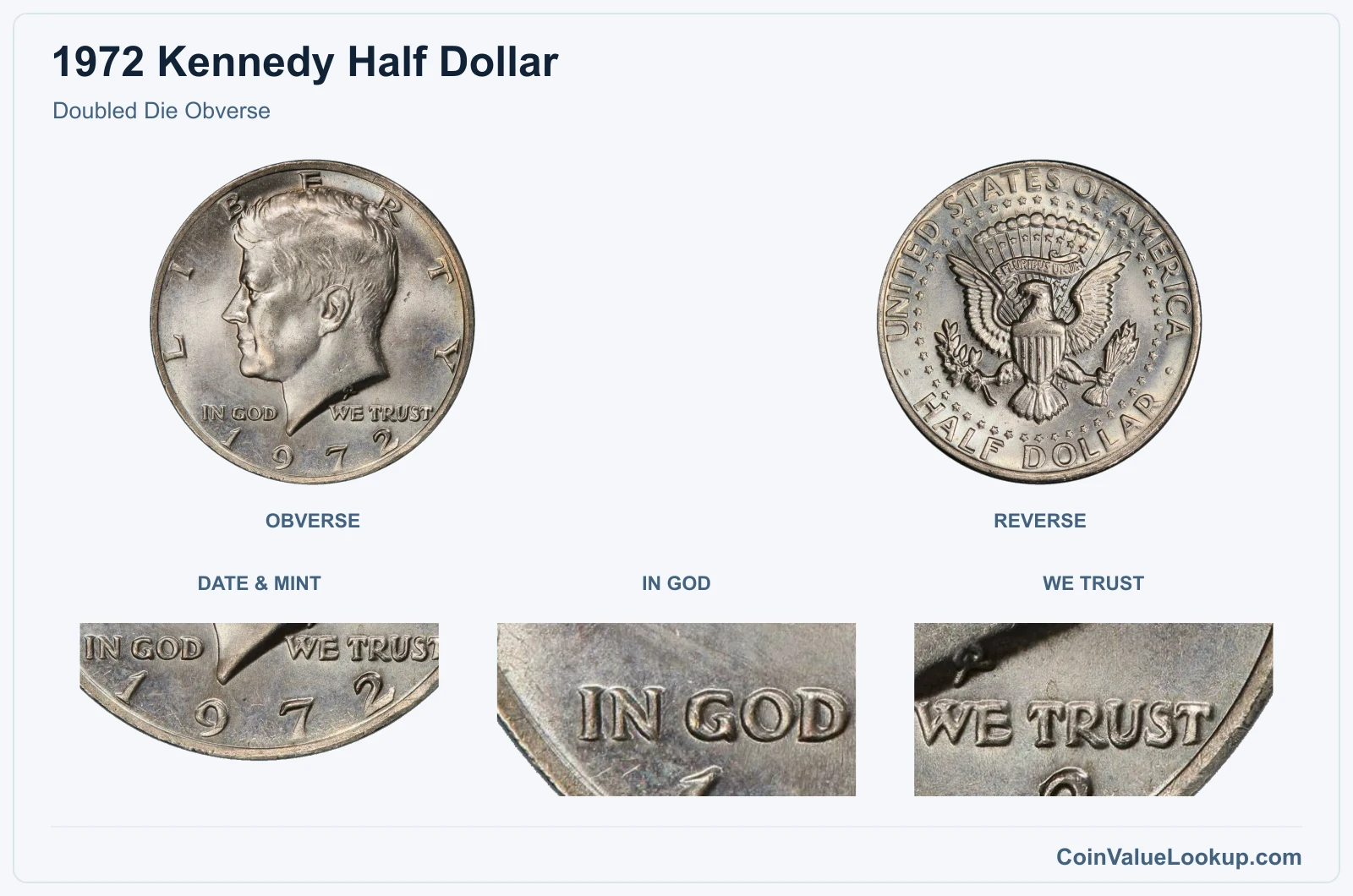
The 1972 Doubled Die Obverse is a Philadelphia (no mintmark) variety caused by hub doubling during die production. The doubling shows as raised, shelf-like extra thickness on the TRUST lettering and LIBERTY — it's visible with a loupe and distinct from the flat, shelf-less look of machine doubling.
This is not the same thing as the 1972-D No FG, which is a Denver reverse variety. The DDO is an obverse-only Philadelphia coin.
Confirm there's no mintmark before attributing it.
No specific price range is supported here. Value depends on the authenticated identity of the exact die variety, the coin's condition, and the severity of the doubling.
Professional attribution from a grading service is the path to confirming what you have and establishing its market standing.
Range Grade
Price Auction Records Appraisal PO PO 1
—
Coin Identifier FR FR 2
—
Coin Identifier AG AG 3
—
Coin Identifier G G 4
—
Coin Identifier
G 6
—
Coin Identifier VG VG 8
—
Coin Identifier
VG 10
—
Coin Identifier F F 12
—
Coin Identifier
F 15
—
Coin Identifier VF VF 20
—
Coin Identifier
VF 25
—
Coin Identifier
VF 30
—
Coin Identifier
VF 35
—
Coin Identifier XF XF 40
—
Coin Identifier
XF 45
—
Coin Identifier AU AU 50
—
Coin Identifier
AU 53
—
Coin Identifier
AU 55
—
Coin Identifier
AU 58
Coin Identifier MS MS 60
—
Coin Identifier
MS 61
—
Coin Identifier
MS 62
Coin Identifier
MS 63
—
Coin Identifier
MS 64
—
Coin Identifier
MS 65
—
Coin Identifier
MS 66
—
—
—
MS 67
—
—
—
MS 68
—
—
—
MS 69
—
—
—
MS 70
—
—
—
1972 Kennedy Half Dollar Error List
1. 1972 Kennedy Half Dollar — Doubled Die Obverse
The 1972 Philadelphia Doubled Die Obverse shows raised doubling on the TRUST lettering and LIBERTY inscription. Under magnification, the extra thickness appears as a clear secondary image slightly offset from the primary letters.
This affects the obverse only, on coins without a mintmark.
Don't confuse this with machine doubling, which produces flat, shelf-like distortion without the raised profile of true hub doubling. Glare under certain lighting, post-mint scratches, and separately double-struck coins can also mimic the look.
The exact spread pattern must match the attributed variety.
No supported price range is available for this variety. Value depends on authenticated identity, the coin's condition, and how pronounced the doubling is.
If you suspect you have one, professional attribution is the way to go.
2. 1972 Kennedy Half Dollar — Missing FG Initials
On the 1972-D Kennedy half, the No FG variety resulted from heavy die polishing that completely removed Frank Gasparro's initials from the reverse die. Look at the space between the eagle's left leg (viewer's right side), above and to the right of the tail feathers, and to the left of the arrows.
On a genuine No FG, there is absolutely no trace of the letters at 5x magnification.
Weakly struck initials, normal wear, grease-filled letters, and deliberate post-mint removal can all make the FG look faint or absent in photos. A blurry image showing no initials is not evidence.
Compare directly against a normal 1972-D reverse.
A PCGS-reported sale from 2016 recorded an MS63 example at $2,485.13. That's an individual historical result, not a blanket market price, but it illustrates serious collector demand for properly attributed specimens.
3. 1972 Kennedy Half Dollar — Struck on a Cent Planchet
A 1972-D Kennedy half dollar struck on a one-cent planchet is a dramatic wrong-planchet error. The coin is drastically undersized — a cent blank is far smaller and lighter than a half-dollar blank — so most of the peripheral legends are missing.
The date and D mintmark are typically still readable, though distorted by the mismatch.
Authentic examples show genuine strike flow and metal displacement consistent with a half-dollar die impacting a much smaller copper-alloy blank. Post-mint alterations like cutting, filing, or plating can mimic the small size but won't replicate the correct die-struck surfaces and missing-legend pattern.
An NGC MS65 Red and Brown example sold for $3,720 at Heritage Auctions in August 2024. Color alone doesn't confirm a cent planchet — authenticated surfaces and correct date/mint identification are essential.
4. 1972 Kennedy Half Dollar — Obverse Indented by a Cent Planchet
This error is a full-sized 1972-D half dollar that was indented by a stray cent blank sitting on top of the planchet during striking. The result is a normal half dollar with a noticeable circular depression on the obverse, roughly the size of a Lincoln cent, where the blank blocked the die.
This is not the same as the struck-on-cent-planchet error above. Here, the half dollar is full diameter and weight — it just has an indent.
The border of the depression should show clean metal-flow characteristics, and the rest of the coin's detail should be normal.
Post-mint damage from impacts or deliberate pressing can create round marks, but they lack the characteristic struck-in appearance and sharp depression border. An NGC MS64 example sold for $4,320 at Heritage Auctions in June 2023.
5. 1972 Kennedy Half Dollar — Off-Center Strike
An off-center strike happens when the planchet isn't seated properly between the dies, so the design is displaced to one side and an unstruck crescent of blank metal appears on the opposite edge. The more dramatic the shift, the more eye-catching the coin.
The date needs to remain visible for the coin to be readily attributable to 1972, which is important for collector interest. A coin struck so far off-center that the date is gone is difficult to attribute and much harder to sell.
Don't confuse off-center strikes with clipped planchets, one-sided die misalignment, or post-mint flattening that may push metal to one side. Genuine off-center errors show a clean unstruck area with no design impression.
Condition, percentage of off-center shift, and date visibility all affect value — no specific price range is available here.
6. 1972 Kennedy Half Dollar — Missing Clad Layer
A missing clad layer error means one of the outer copper-nickel layers was absent from the planchet before striking. The affected face may show an exposed copper-colored surface, and the coin's weight will be noticeably below normal.
Check the edge — a normal Kennedy half shows a visible sandwich of layers, while a missing-clad coin will look off.
Toning, environmental corrosion, or someone stripping the surface after minting can produce a similar copper-toned appearance. The key distinction is that a genuine missing-clad error will weigh less and show proper die detail on the affected face, not a damaged or chemically altered surface.
No specific price range is supported for this error. Value depends on condition, which face is affected, and the extent of the missing layer.
Professional authentication helps separate the real thing from post-mint surface problems.
7. 1972 Kennedy Half Dollar — Die Crack / Die Chip
Die cracks and die chips appear as raised lines or small raised blobs on the coin's surface, transferred from fractures in the steel die during striking. On a 1972 half dollar, look for thin raised lines running across the obverse design or small lumps of extra metal, especially near high-stress areas of the die.
A die crack that extends from an interior point to the rim is sometimes called a cud when a piece of the die actually breaks away, leaving a larger raised blob at the edge. Interior cracks and small chips are more common and generally less dramatic.
Incuse scratches, corrosion lines, or bits of foreign material stuck to the surface can look similar but will be depressed or sit on top of the coin rather than being struck into it. No supported price range exists — the error's size, location, and the coin's condition all factor in.
8. 1972 Kennedy Half Dollar — Clipped Planchet
A clipped planchet error occurs when the blank is punched incorrectly from the metal strip, leaving a missing curved, straight, or ragged section along the edge. On a 1972 half dollar, this shows up as an incomplete rim with a characteristic bite taken out.
Look for the Blakesley effect — a zone of weakness on the rim directly opposite the clip caused by reduced metal flow during striking. The edge texture in the clipped area should differ from a normal reeded or plain edge, and the missing section should have smooth, as-punched characteristics.
Post-mint damage such as filing, cutting, or corrosion along the edge can fake the look of a clip. Genuine clips show consistent metal flow and design weakness near the affected area.
No specific price is available; value depends on clip size, type, and overall condition.
9. 1972 Kennedy Half Dollar — Struck-Through Error
A struck-through error happens when something — grease, a fragment of metal, thread, or other debris — gets between the die and the planchet during striking. The result is a localized depression or incomplete design area where the obstruction blocked the die's impression.
Grease-filled dies tend to produce soft, rounded missing areas, while a retained foreign object can leave a sharper, more defined impression. These are different subcategories and collectors value them differently.
Ordinary weak detail from a worn die, light scratches, cleaning damage, or normal circulation wear can all look vaguely like a struck-through area to the untrained eye. The key difference is that a genuine struck-through will have a defined boundary and consistent depth in the affected zone.
No specific price range applies — the size, location, and nature of the obstruction all matter.
10. 1972 Kennedy Half Dollar — Doubled Die Reverse
A Doubled Die Reverse shows hub doubling on the reverse design elements — the lettering, eagle details, or other design contours will display a secondary, slightly offset image. Compare your coin's reverse to a normal 1972 Kennedy half under magnification, paying close attention to legends like UNITED STATES OF AMERICA and E PLURIBUS UNUM.
Machine doubling is the most common lookalike: it produces flat, shelf-like distortion rather than the raised, rounded secondary image of a true doubled die. Reflections under certain lighting and random post-mint damage can also mislead.
No specific price range is supported for this variety. Value depends on condition, the strength and location of the doubling, and whether the coin has been professionally attributed.
If the doubling is only visible in photos taken at a specific angle, be skeptical.