1959 Franklin Half Dollar Coin Value: How Much Is It Worth?
The 1959 Franklin Half Dollar is a 90% silver coin that remains popular with collectors for both its metal content and its classic mid-century design. Guide estimates for this year range from about $32.00 in well-worn grades up to $109.00 for top mint-state examples, depending on the mint, condition and any special designations.
These are guide anchors from USA Coin Book, not guaranteed sale prices or current silver-melt quotes. Mint origin, surface quality, and strike sharpness all play a role in where a particular coin falls within that spread.
Fast Way to Identify Your 1959 Franklin Half Dollar
Want a quick read on your 1959 Franklin half? Upload clear photos of both the front and back of your coin, and our identifier can offer a preliminary take on which version you have.
This is not a certified authentication or exact grade assignment, but it can point you in the right direction before you invest in a professional opinion.
1959 Franklin Half Dollar Value
Upload both sides of your 1959 Franklin Half Dollar.
Front Obverse
Upload photo
Back Reverse
Upload photo
Which 1959 Franklin Half Dollar Versions Are Worth Money?
- The 1959-D in MS65 grade carries the highest guide estimate of the three branches at $109.00, reflecting collector demand for top-condition Denver strikes.
- The 1959 Philadelphia business strike is listed at $91.00 in MS65, still a strong value well above its lower-grade baseline of $32.00 in G4.
- The 1959 proof (PR65) is guided at $48.00 and appeals to collectors seeking the mirror-finish Philadelphia issue from this year.
- Full Bell Lines designation on either business-strike version can command an additional premium beyond the standard grade price, so check those lower bell lines carefully.
Step 1: Identify Your 1959 Franklin Half Dollar Mint Mark and Version
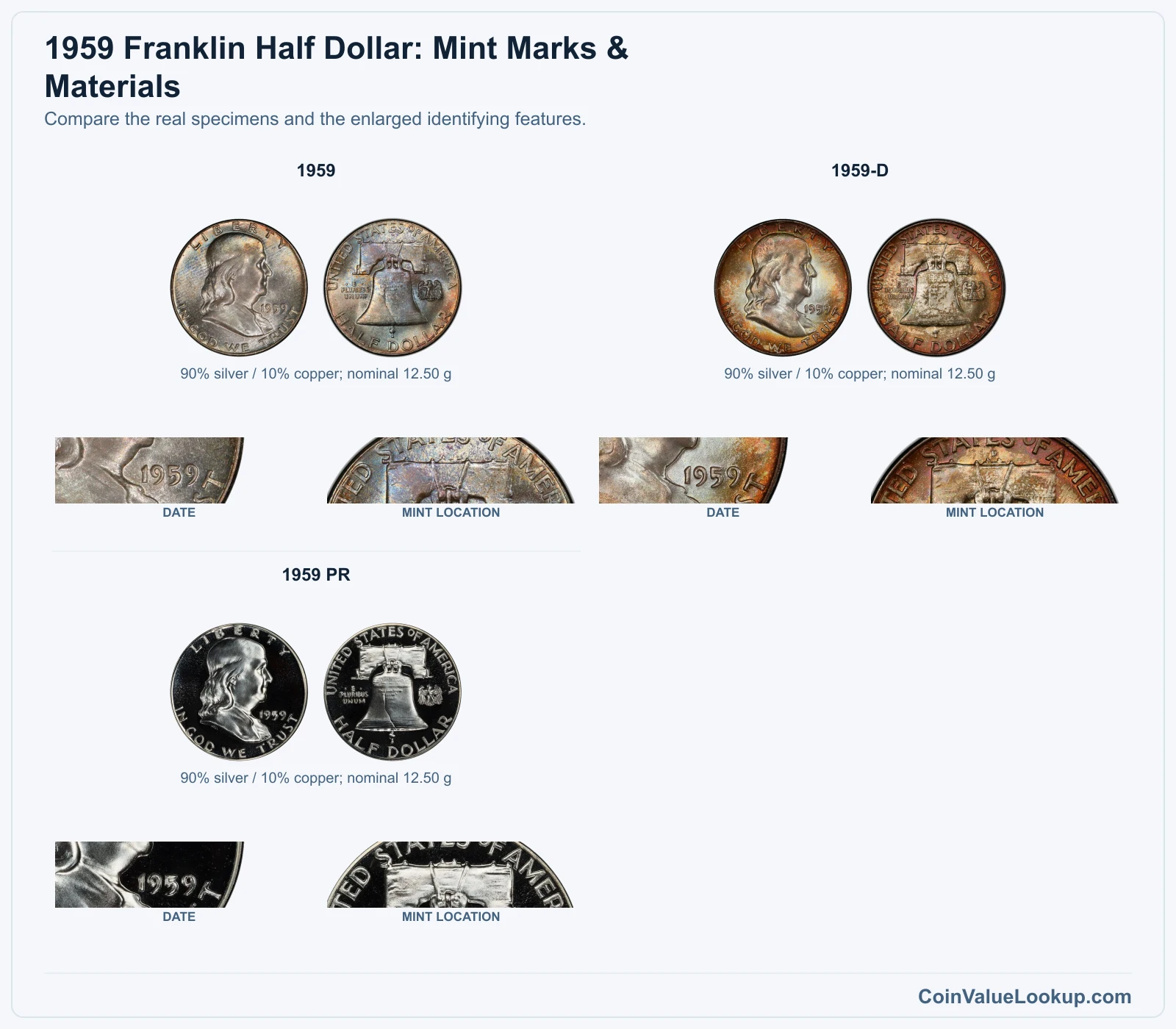
The 1959 Franklin Half Dollar was struck at two mints, and Philadelphia also produced proof editions. All versions share the same composition: 90% silver and 10% copper at a nominal weight of 12.50 grams.
To figure out which version you hold, flip the coin over and look above the Liberty Bell, just below the words E PLURIBUS UNUM. If there is no mintmark, your coin was made in Philadelphia.
A small "D" means Denver.
Philadelphia proof coins also carry no mintmark, so you need to look at the surfaces. A proof will have deeply mirrored fields and exceptionally sharp design details.
If your coin just looks shiny because someone polished it, that is not a proof — that is a cleaned coin, and the two are worlds apart in value.
Toning or light color changes do not affect the underlying alloy. Your coin is still 90% silver regardless of whether it is brilliant white or has rainbow patina.
However, cleaning or heavy damage will lower its collector premium significantly compared to a problem-free example.
Step 2: Check Your 1959 Franklin Half Dollar Grade
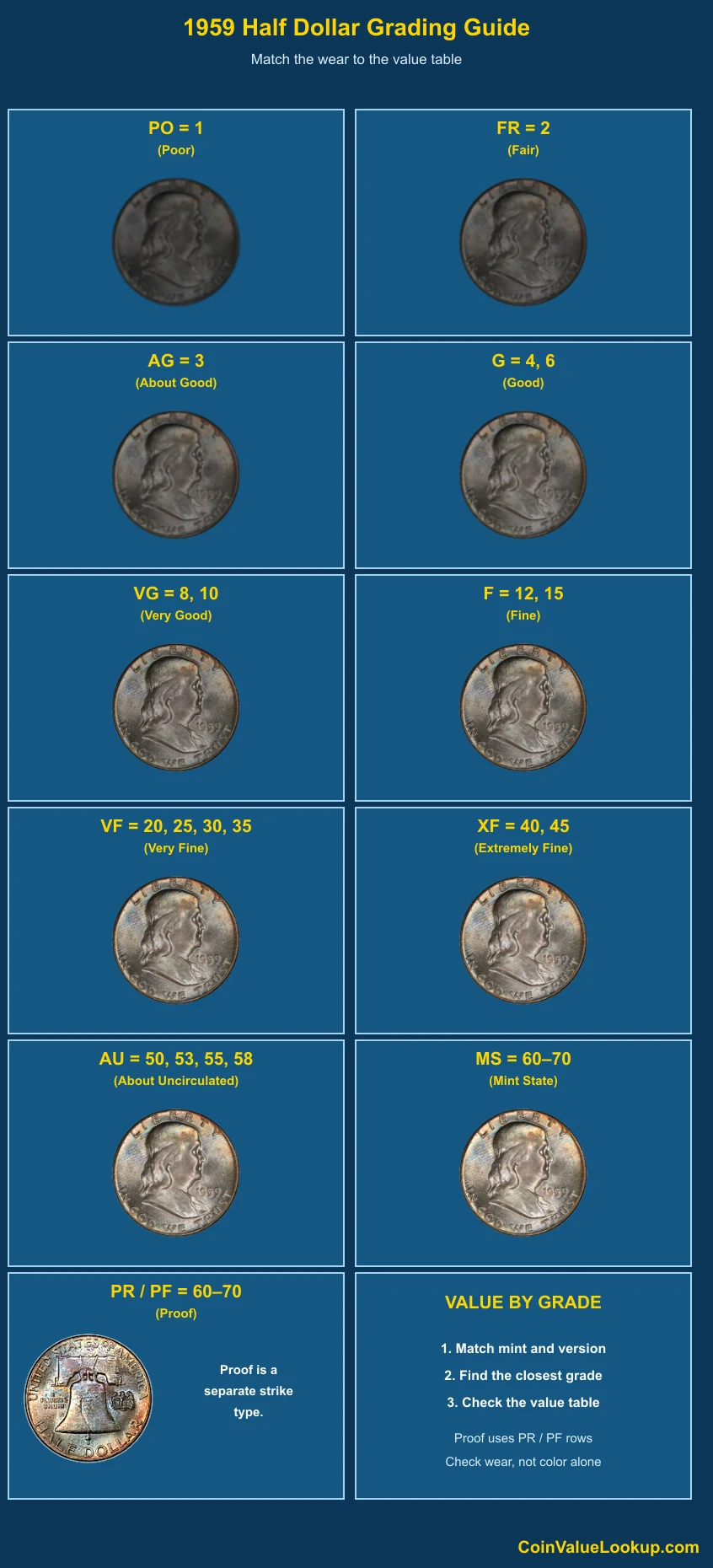
Start with Franklin's cheek and the hair behind his ear. On a coin that saw real circulation, these high points lose detail first, progressing from minor softness to flat, featureless patches as wear increases.
The shoulder area flattens next.
On the reverse, check the lettering around the Liberty Bell and the condition of the rim. Lower bell lines are another key area — they wear quickly in commerce.
Use the comparison image to match your coin's wear pattern against known grade examples.
Do not confuse bag marks (small nicks from coins banging together in mint bags) with actual circulation smoothing. A coin can be uncirculated and still show contact marks.
Full Bell Lines is a strike-detail designation indicating the lower lines on the bell remain complete and unbroken; it is not a separate grade, but it can meaningfully raise the premium on an otherwise high-grade coin.
Proof coins get graded on a different scale. Look for hairlines from mishandling, haze, and whether the fields retain their original mirror finish.
Cameo contrast — frosted devices against mirrored fields — is a plus but not present on every proof.
Step 3: Check 1959 Franklin Half Dollar Value by Mint and Version
1959 Franklin Half Dollar
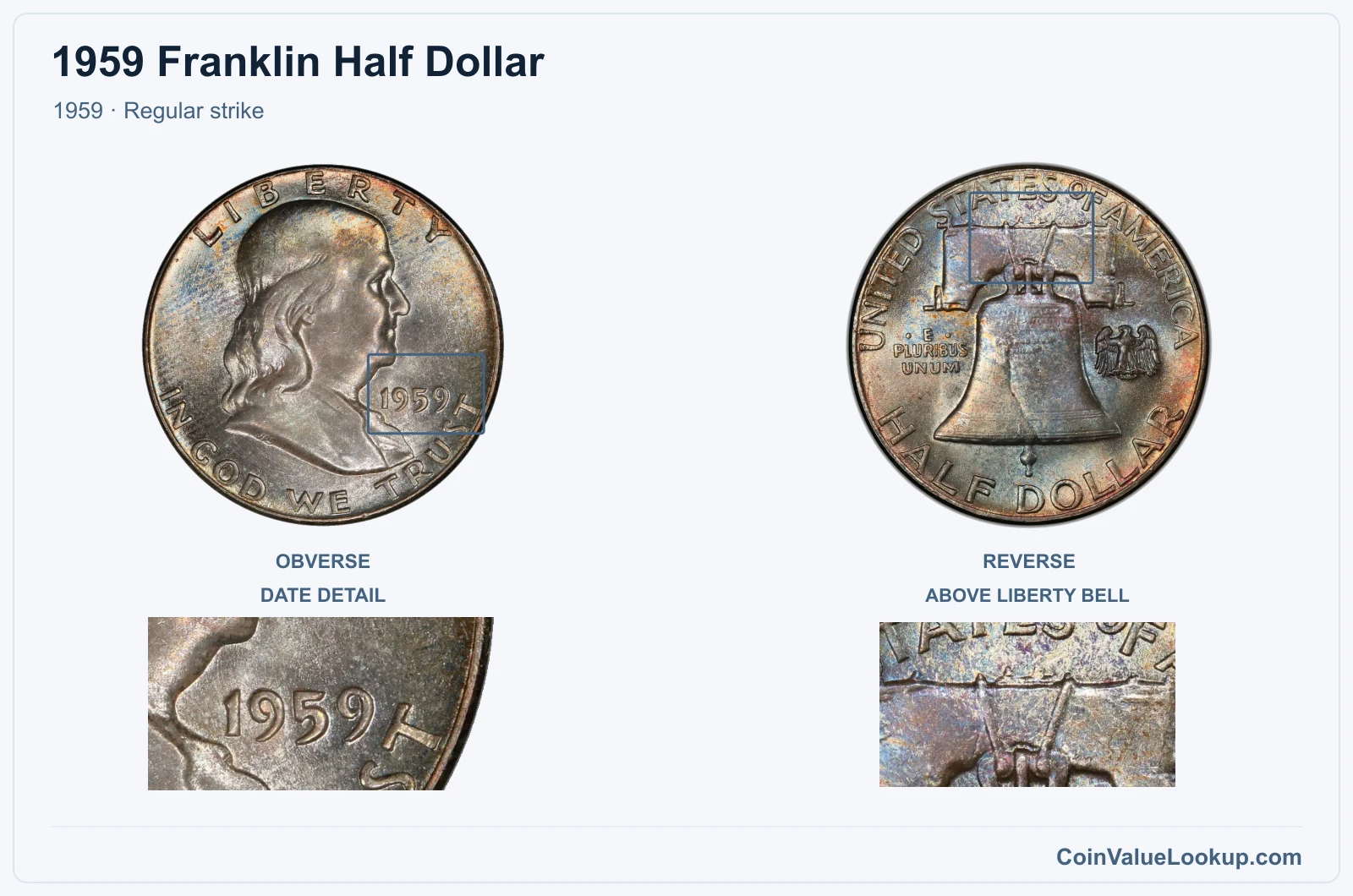
The 1959 Philadelphia business strike has no mintmark on the reverse. In heavily worn condition (G4), a guide estimate from USA Coin Book places it around $32.00.
A gem-quality MS65 example jumps to about $91.00.
Silver content provides a floor, but collector value above melt depends on original, problem-free surfaces. A coin that has been cleaned, whizzed, or damaged will not command the same premium as one with natural toning or original luster.
Before referencing any price chart, confirm the absence of a mintmark and honestly assess the wear level. Full Bell Lines is a strike-quality designation indicating the lower horizontal lines on the Liberty Bell are fully intact — it does not change the mint or metal, but it can affect the coin's desirability at higher grades.
Range Grade
Price Auction Records Appraisal PO PO 1
—
Coin Identifier FR FR 2
—
Coin Identifier AG AG 3
—
Coin Identifier G G 4
—
Coin Identifier
G 6
—
Coin Identifier VG VG 8
—
Coin Identifier
VG 10
—
Coin Identifier F F 12
—
Coin Identifier
F 15
—
Coin Identifier VF VF 20
—
Coin Identifier
VF 25
—
Coin Identifier
VF 30
—
Coin Identifier
VF 35
—
Coin Identifier XF XF 40
—
Coin Identifier
XF 45
Coin Identifier AU AU 50
—
Coin Identifier
AU 53
—
Coin Identifier
AU 55
—
Coin Identifier
AU 58
Coin Identifier MS MS 60
—
Coin Identifier
MS 61
—
Coin Identifier
MS 62
Coin Identifier
MS 63
Coin Identifier
MS 64
Coin Identifier
MS 65
Coin Identifier
MS 66
Coin Identifier
MS 67
Coin Identifier
MS 68
—
—
—
MS 69
—
—
—
MS 70
—
—
—
1959 Franklin Half Dollar — D
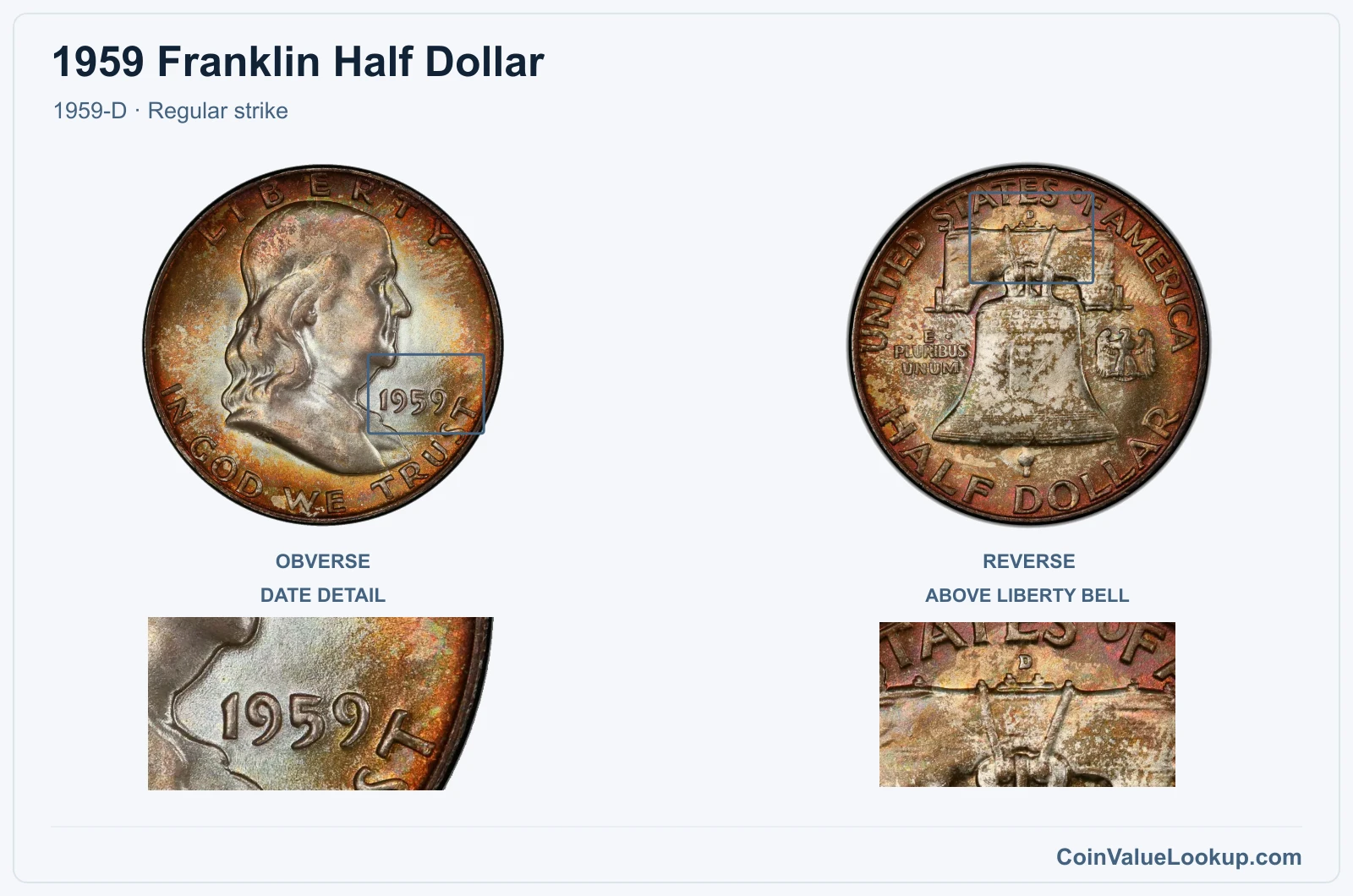
The 1959-D was struck in Denver and carries a small "D" mintmark on the reverse, above the Liberty Bell. Its guide estimates match the Philadelphia issue at the low end — $32.00 in G4 — but the MS65 value is higher at $109.00 per USA Coin Book.
That gap at the top end means condition matters a great deal. A well-preserved Denver half with full luster and minimal bag marks is more sought after than a Philadelphia example in the same grade, at least by current guide figures.
As always, cleaned or damaged coins trade at a discount regardless of mintmark. Check for Full Bell Lines if your coin grades in the mint-state range; intact lower bell lines on a 1959-D can add real value.
Coin Value Lookup is a handy starting point if you want to look up guide values for other dates and denominations in the Franklin series or beyond.
Range Grade
Price Auction Records Appraisal PO PO 1
—
Coin Identifier FR FR 2
—
Coin Identifier AG AG 3
—
Coin Identifier G G 4
—
Coin Identifier
G 6
—
Coin Identifier VG VG 8
—
Coin Identifier
VG 10
—
Coin Identifier F F 12
—
Coin Identifier
F 15
—
Coin Identifier VF VF 20
—
Coin Identifier
VF 25
—
Coin Identifier
VF 30
—
Coin Identifier
VF 35
—
Coin Identifier XF XF 40
—
Coin Identifier
XF 45
—
Coin Identifier AU AU 50
—
Coin Identifier
AU 53
—
Coin Identifier
AU 55
—
Coin Identifier
AU 58
Coin Identifier MS MS 60
—
Coin Identifier
MS 61
—
Coin Identifier
MS 62
—
Coin Identifier
MS 63
Coin Identifier
MS 64
Coin Identifier
MS 65
Coin Identifier
MS 66
Coin Identifier
MS 67
Coin Identifier
MS 68
—
—
—
MS 69
—
—
—
MS 70
—
—
—
1959 Franklin Half Dollar — PR
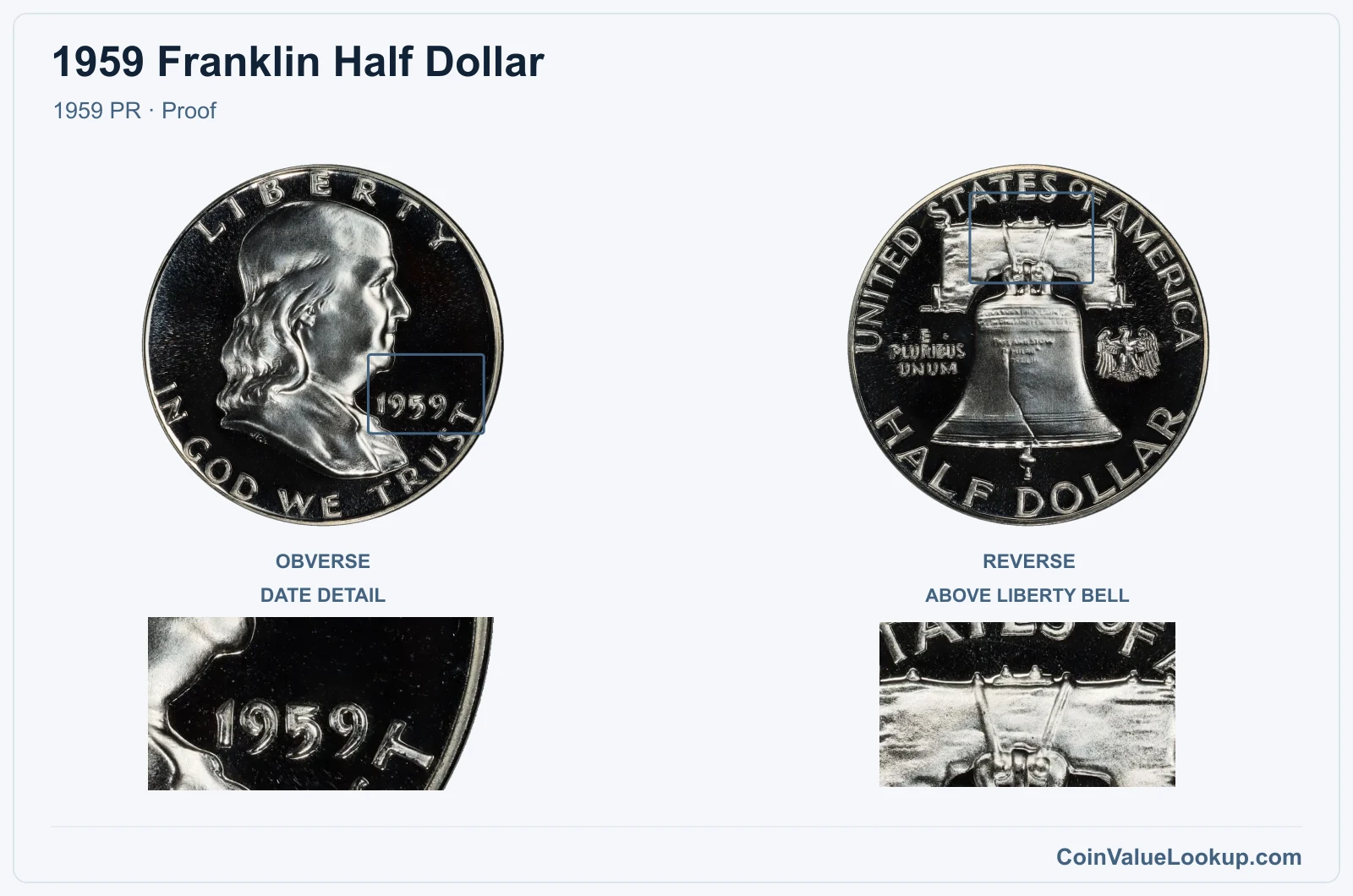
The 1959 proof was made at Philadelphia and carries no mintmark, just like its business-strike counterpart. The difference is in how it was made: proof coins are struck with specially prepared dies on polished planchets, producing mirror-like fields and crisp design edges.
A PR65 example is guided at $48.00 by USA Coin Book. That is below the MS65 business strikes, which can seem counterintuitive, but proof Franklins from this era were saved in large numbers.
To confirm you have a genuine proof, look for deeply reflective fields — not just a shiny coin. Hairlines from improper storage or handling are the main enemy of proof grades.
Cameo contrast, where the devices appear frosted against the mirrored field, is possible but not universal on 1959 proofs. A polished circulation strike is emphatically not a proof, no matter how much it sparkles.
Range Grade
Price Auction Records Appraisal PR PR 1
—
Coin Identifier
PR 2
—
Coin Identifier
PR 3
—
Coin Identifier
PR 4
—
Coin Identifier
PR 6
—
Coin Identifier
PR 8
—
Coin Identifier
PR 10
—
Coin Identifier
PR 12
—
Coin Identifier
PR 15
—
Coin Identifier
PR 20
—
Coin Identifier
PR 25
—
Coin Identifier
PR 30
—
Coin Identifier
PR 35
—
Coin Identifier
PR 40
—
Coin Identifier
PR 45
—
Coin Identifier
PR 50
—
Coin Identifier
PR 53
—
Coin Identifier
PR 55
—
Coin Identifier
PR 58
—
Coin Identifier
PR 60
—
Coin Identifier
PR 61
—
Coin Identifier
PR 62
—
Coin Identifier
PR 63
—
Coin Identifier
PR 64
—
Coin Identifier
PR 65
—
Coin Identifier
PR 66
—
Coin Identifier
PR 67
—
Coin Identifier
PR 68
—
Coin Identifier
PR 69
—
Coin Identifier
PR 70
—
—
—
1959 Franklin Half Dollar Error List
1. 1959 Franklin Half Dollar — Bugs Bunny Die Clash
The "Bugs Bunny" die clash is one of the more entertaining errors in the Franklin series. It occurs when obverse and reverse dies strike each other without a planchet between them, transferring design elements to the wrong die.
On the 1959 half dollar, this clash left raised, tooth-like marks near Franklin's mouth and lip area, giving him a passing resemblance to a certain cartoon rabbit.
To check, use magnification and compare your coin's portrait to a normal 1959 Franklin. The clash marks are subtle raised lines that follow a pattern, not random scratches or dings.
Scratches, stray metal flow, or post-mint damage can mimic the look at a glance, so compare carefully.
No specific price range is available for this variety. Value depends on how visible the clash marks are, the coin's overall condition, and collector demand at the time of sale.
2. 1959 Franklin Half Dollar — Doubled Die Reverse
A doubled die reverse (DDR) has been reported for the 1959 Franklin Half Dollar. This type of error occurs during die production when a misaligned second impression creates doubled design elements on the reverse side of the coin.
To look for it, compare the reverse legends and design contours on your coin against a normal 1959 half dollar under magnification. Genuine die doubling will show consistent, directional separation of the affected design elements — letters, numbers, or parts of the bell may appear slightly split or shadowed in a repeating pattern.
Do not confuse this with machine doubling, which tends to produce flat, shelf-like displacement rather than the rounded secondary image of a true doubled die. Reflections under certain lighting or random post-mint damage can also fool you.
No adopted price range is available for this variety. The coin's value would depend on the strength and visibility of the doubling, as well as overall condition.
3. 1959 Franklin Half Dollar — Die Break / Cud
Die break and cud errors have been reported on the 1959 Franklin Half Dollar. These happen when a piece of the die cracks or breaks away entirely.
A die crack shows as a thin raised line across the coin's surface. A full cud — where the break reaches the rim — leaves a raised, blobby area of unstruck metal connected to the edge.
Look for an irregular raised feature that disrupts the normal design. A true cud will connect to the rim and show a clear boundary where the die broke.
The displaced area will lack normal design detail.
Do not confuse a rim dent or damage from being dropped with a die break. Corrosion can also create rough, raised patches, and small interior die chips are a different (usually less valuable) category from a full rim cud.
No specific price range is available. Value depends on the size and location of the break and the coin's overall condition.