1939 Walking Liberty Half Dollar Coin Value: How Much Is It Worth?
The 1939 Walking Liberty Half Dollar is a 90% silver coin that remains popular with collectors for its bold Adolph Weinman design and accessible price points. Guide estimates for this date range from about $34.00 in well-worn condition up to $878.00 for a gem proof, depending on mint, condition, and whether the coin is a regular business strike or a collector proof.
These are guide anchors from published references, not guaranteed selling prices or current silver-melt quotes.
Fast Way to Identify Your 1939 Walking Liberty Half Dollar
The quickest way to start figuring out what your 1939 half dollar is worth is to upload clear photos of both the front and back. Our identifier can give you a preliminary read on which mint and version you have.
That alone narrows your price range significantly. Grab a well-lit shot and avoid glare on the coin's surface.
1939 Walking Liberty Half Dollar Value
Upload both sides of your 1939 Walking Liberty Half Dollar.
Front Obverse
Upload photo
Back Reverse
Upload photo
Which 1939 Walking Liberty Half Dollar Versions Are Worth Money?
- The 1939 PR proof carries the highest single guide anchor at $878.00 in PR65, reflecting its low original mintage as a collector-only issue.
- The 1939-S business strike reaches $235.00 at MS63, well above the Philadelphia and Denver mints at the same grade, making uncirculated examples worth checking carefully.
- The 1939-D has a reported Doubled Die Obverse variety; condition and clarity of the doubling affect its premium, so inspect obverse lettering closely.
- A 1939-D Repunched Mintmark (D/D) has been reported by PCGS, adding another variety worth examining under magnification on Denver-minted coins.
Step 1: Identify Your 1939 Walking Liberty Half Dollar Mint Mark and Version
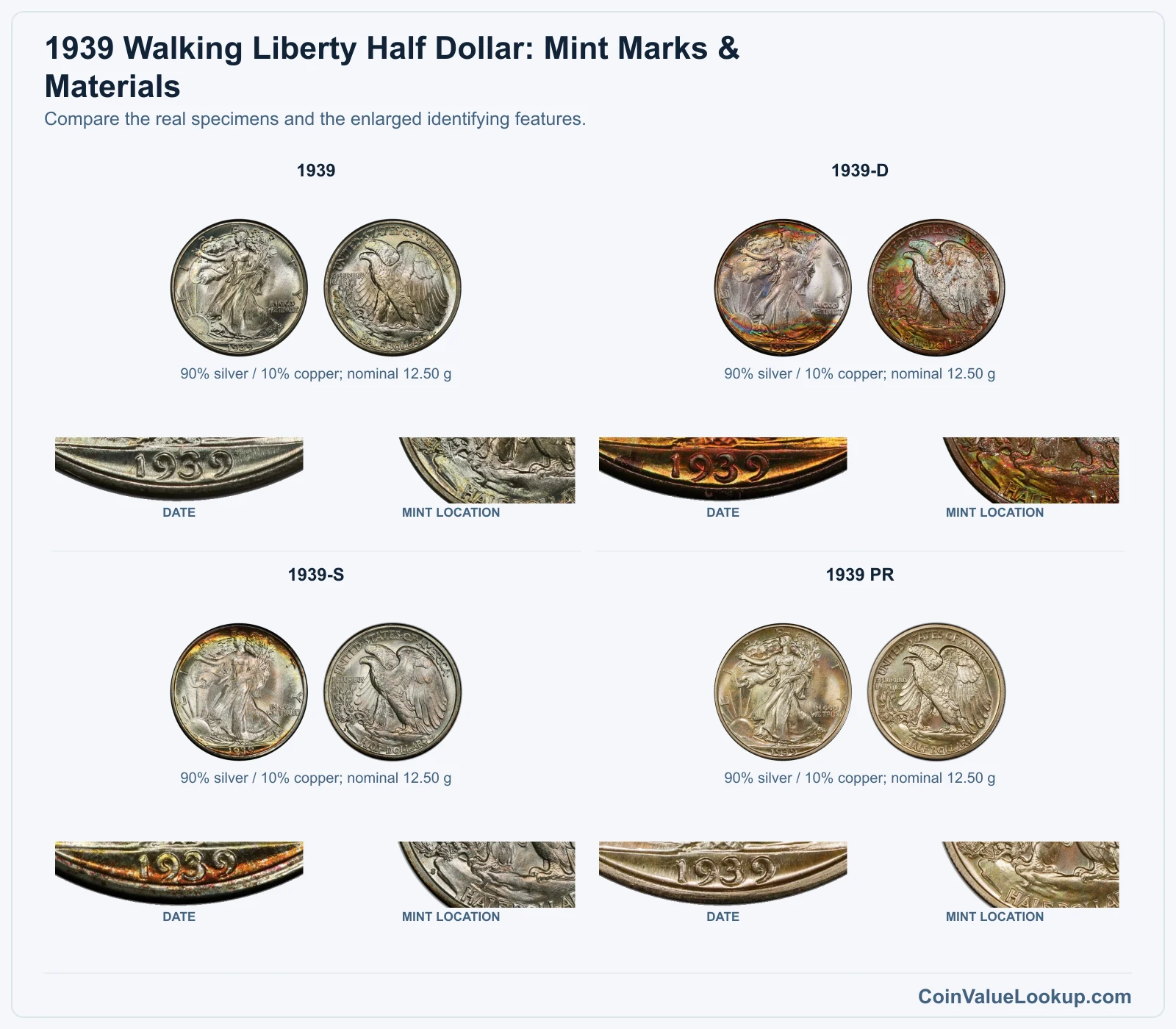
Every 1939 Walking Liberty Half Dollar is struck in 90% silver and 10% copper, weighing a nominal 12.50 grams. Toning or discoloration does not change that alloy.
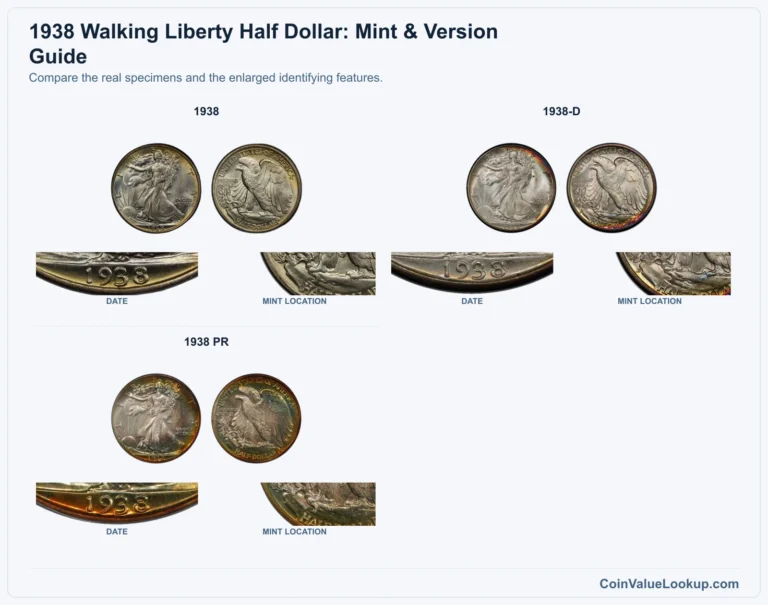
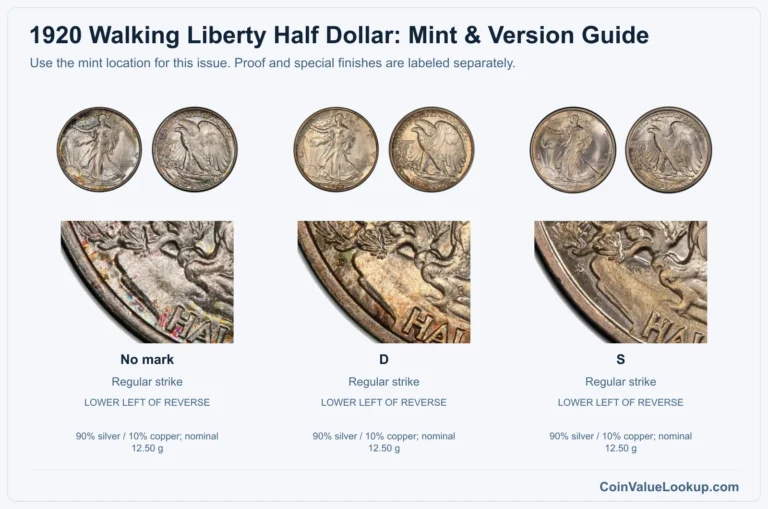
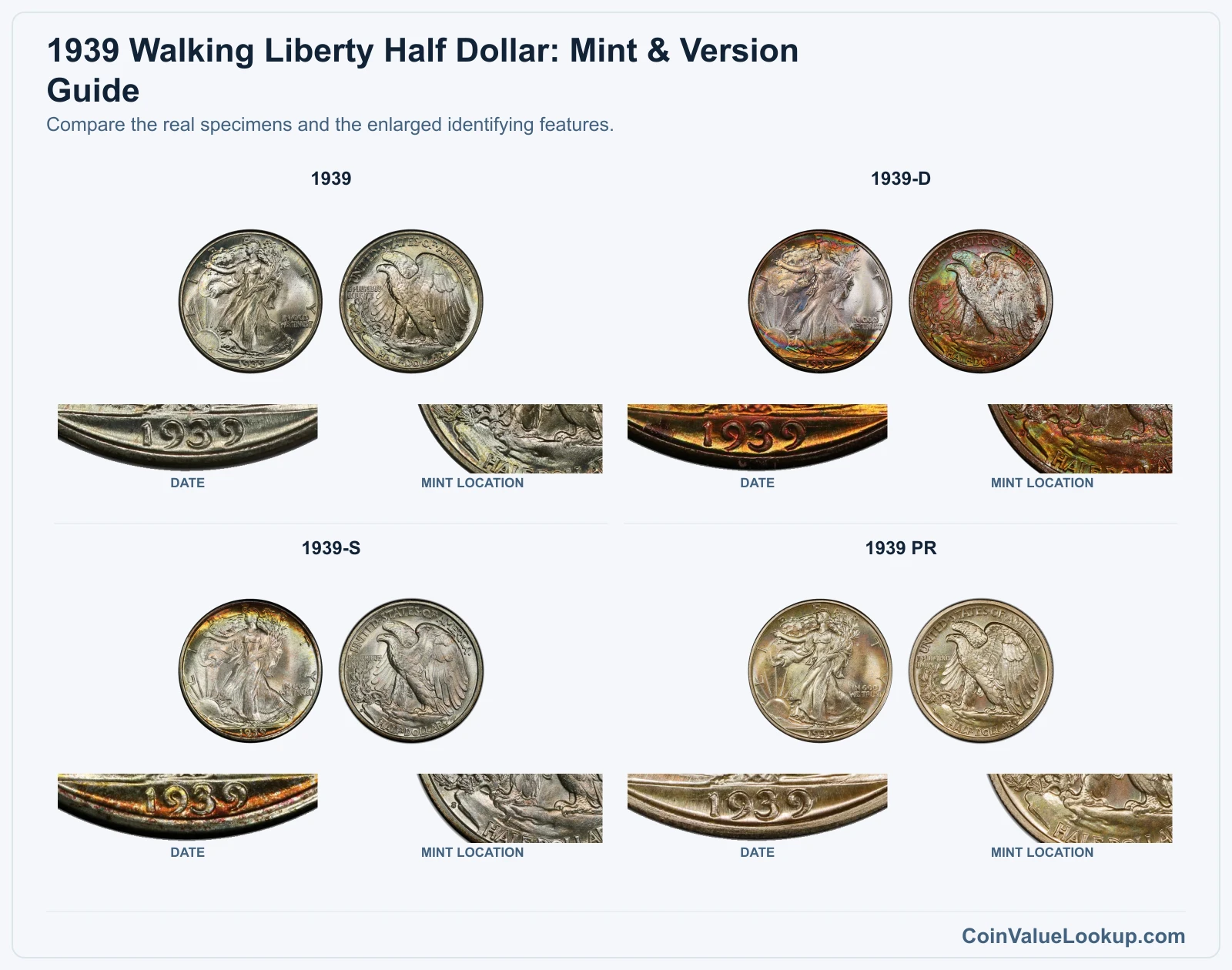
For 1939 issues, the mintmark sits on the reverse, lower left, near the 8 o'clock position behind the eagle's tail feathers. A "D" means Denver, an "S" means San Francisco, and no mintmark at all means Philadelphia.
This placement applies to all late-date Walkers; the obverse mintmark location was only used in 1916 and early 1917.
You have four possible branches this year: 1939 (Philadelphia business strike), 1939-D (Denver business strike), 1939-S (San Francisco business strike), and 1939 PR (Philadelphia proof). The proof is a specially manufactured collector coin with mirrored fields and crisp device edges.
A polished circulated coin is not a proof, no matter how shiny it looks.
Step 2: Check Your 1939 Walking Liberty Half Dollar Grade
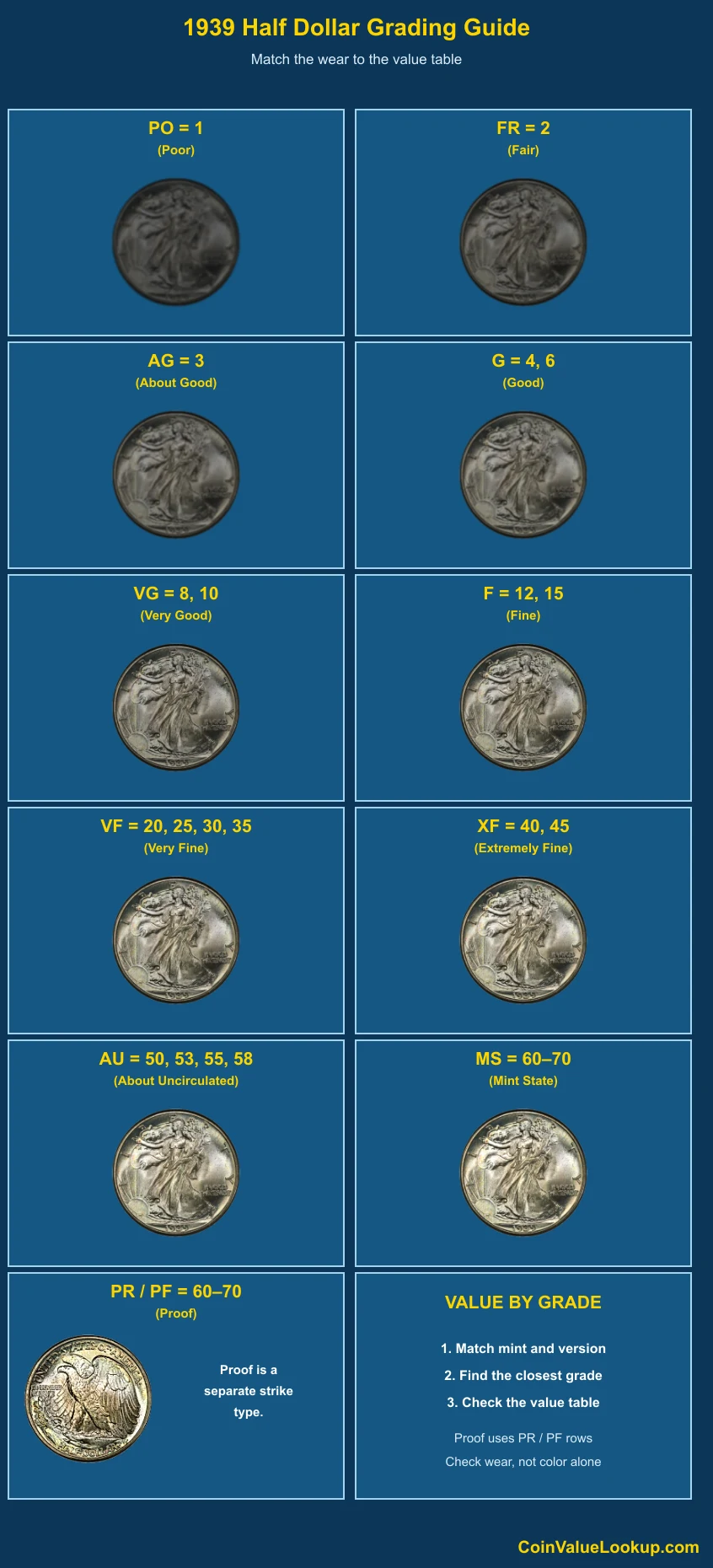
Start with Liberty's head, her left hand, and the area around her breast and knee on the obverse. These are the first places to lose detail from wear.
On the reverse, check the eagle's breast feathers, leg, and the tops of the wing feathers.
Here is the catch with Walkers: weak central strikes exist even on coins that never circulated. A soft hand or fuzzy head detail does not automatically mean the coin is worn.
Look at the surrounding fields for original mint luster. If the luster is full and unbroken but the hand is mushy, that is a strike issue, not wear.
Actual wear creates smooth, flat spots and kills the luster in those areas first. Compare your coin to the grading image to see how a same-type half dollar looks at various stages.
Problem-free surfaces matter too. Cleaned, scratched, or corroded coins trade well below guide values for the same technical grade.
Coin Value Lookup is a good starting point for looking up guides across different coin series and dates. If you are working through a collection or a bag of inherited coins, it can save you a lot of flipping between references.
Step 3: Check 1939 Walking Liberty Half Dollar Value by Mint and Version
1939 Walking Liberty Half Dollar
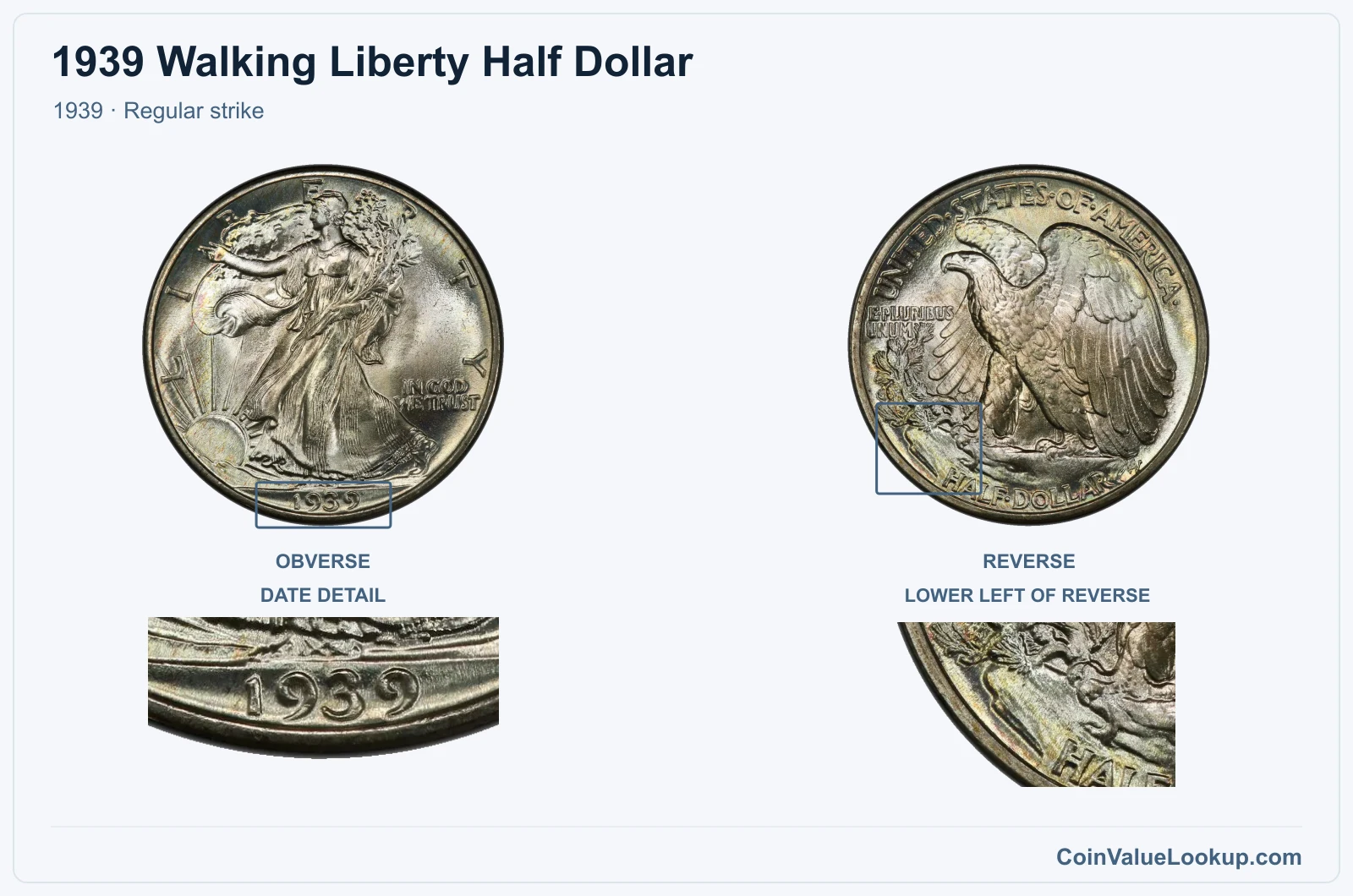
The 1939 Philadelphia issue has no mintmark on the reverse. In well-worn Good-4 condition, guide estimates sit around $34.00; a clean MS63 example jumps to roughly $99.00.
Silver content provides a floor, but problem-free original surfaces are what push a coin toward those higher estimates.
Before comparing to any chart, confirm the absence of a mintmark and assess the coin honestly for cleaning or damage. A dipped or polished Walker is not the same coin to a buyer as one with natural toning and full original luster.
Range Grade
Price Auction Records Appraisal PO PO 1
—
Coin Identifier FR FR 2
—
Coin Identifier AG AG 3
—
Coin Identifier G G 4
—
Coin Identifier
G 6
—
Coin Identifier VG VG 8
—
Coin Identifier
VG 10
—
Coin Identifier F F 12
—
Coin Identifier
F 15
—
Coin Identifier VF VF 20
—
Coin Identifier
VF 25
Coin Identifier
VF 30
—
Coin Identifier
VF 35
—
Coin Identifier XF XF 40
—
Coin Identifier
XF 45
—
Coin Identifier AU AU 50
—
Coin Identifier
AU 53
—
Coin Identifier
AU 55
Coin Identifier
AU 58
Coin Identifier MS MS 60
Coin Identifier
MS 61
Coin Identifier
MS 62
Coin Identifier
MS 63
Coin Identifier
MS 64
Coin Identifier
MS 65
Coin Identifier
MS 66
Coin Identifier
MS 67
Coin Identifier
MS 68
Coin Identifier
MS 69
—
—
—
MS 70
—
—
—
1939 Walking Liberty Half Dollar — D
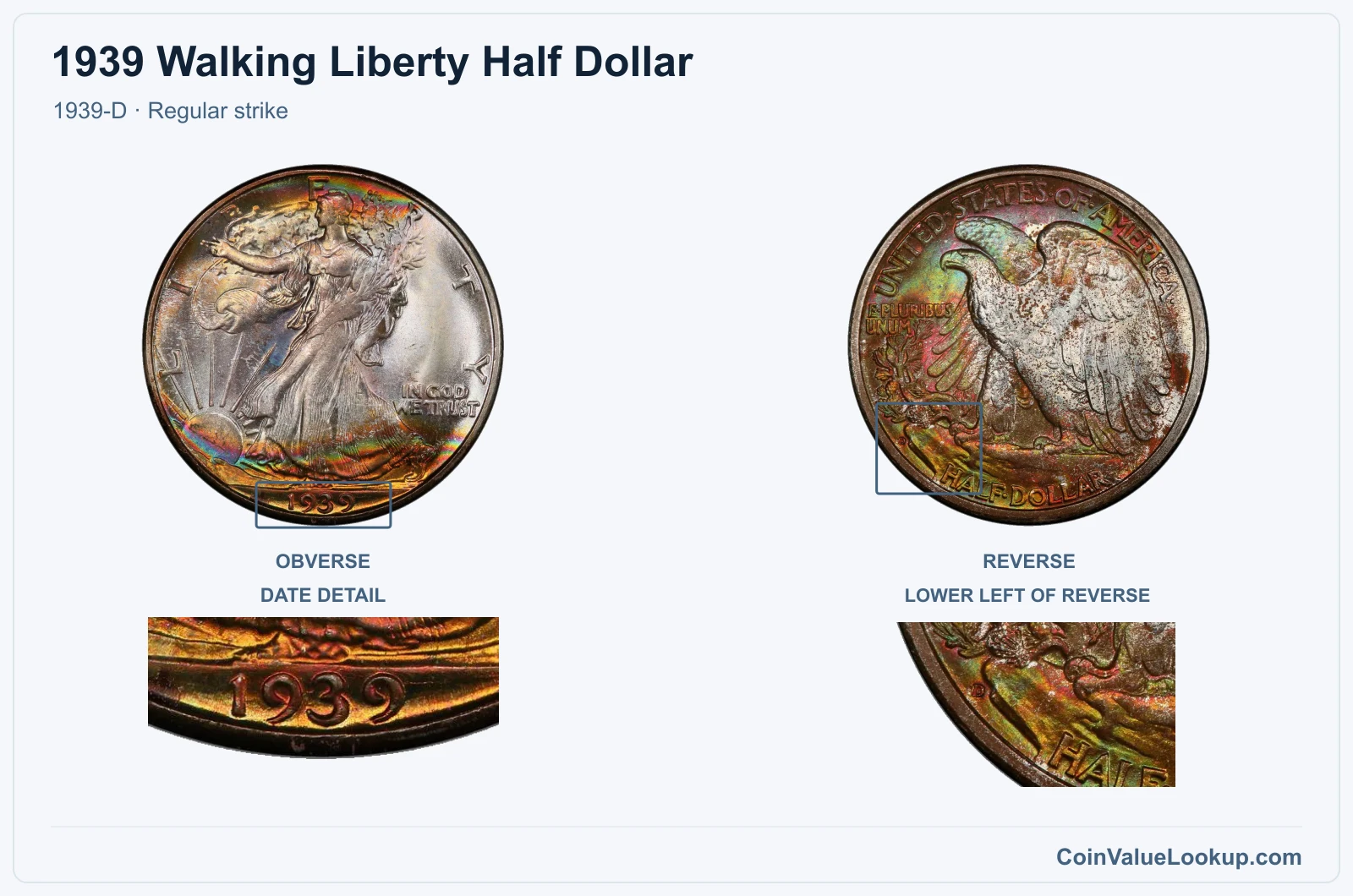
The 1939-D carries a small "D" mintmark on the reverse lower left. Guide estimates run about $34.00 at Good-4 and around $110.00 at MS63.
That is modestly above the Philadelphia issue in uncirculated grades.
Denver strikes from this era can show weaker central detail, so do not confuse a soft strike for heavy wear. Check the luster first.
Original, untampered surfaces matter more to collectors than a slightly sharper strike on a cleaned coin.
Range Grade
Price Auction Records Appraisal PO PO 1
—
Coin Identifier FR FR 2
—
Coin Identifier AG AG 3
—
Coin Identifier G G 4
—
Coin Identifier
G 6
—
Coin Identifier VG VG 8
—
Coin Identifier
VG 10
—
Coin Identifier F F 12
—
Coin Identifier
F 15
—
Coin Identifier VF VF 20
—
Coin Identifier
VF 25
—
Coin Identifier
VF 30
Coin Identifier
VF 35
—
Coin Identifier XF XF 40
—
Coin Identifier
XF 45
—
Coin Identifier AU AU 50
—
Coin Identifier
AU 53
—
Coin Identifier
AU 55
Coin Identifier
AU 58
Coin Identifier MS MS 60
Coin Identifier
MS 61
—
Coin Identifier
MS 62
Coin Identifier
MS 63
Coin Identifier
MS 64
Coin Identifier
MS 65
Coin Identifier
MS 66
Coin Identifier
MS 67
Coin Identifier
MS 68
Coin Identifier
MS 69
—
—
—
MS 70
—
—
—
1939 Walking Liberty Half Dollar — S
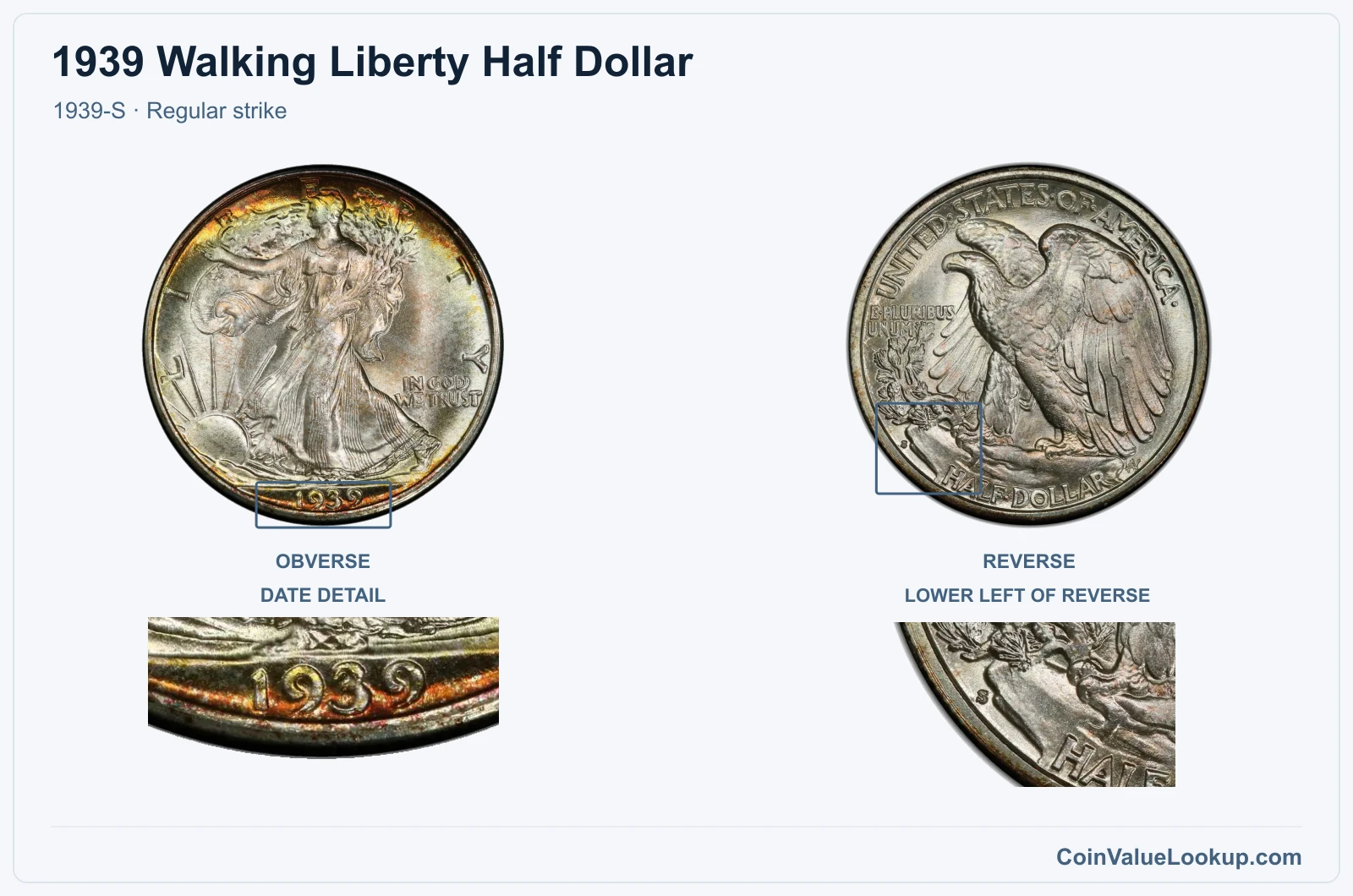
San Francisco's 1939-S is the one to watch in this date group for business strikes. Guide estimates put Good-4 at $34.00, same as the others, but MS63 climbs to about $235.00.
That gap tells you that high-grade survivors with original surfaces are noticeably scarcer from San Francisco this year.
Look for the "S" mintmark on the reverse lower left. Full luster and strong central detail on a 1939-S Walker will command a real premium over the same coin from Philadelphia or Denver.
Range Grade
Price Auction Records Appraisal PO PO 1
—
Coin Identifier FR FR 2
—
Coin Identifier AG AG 3
—
Coin Identifier G G 4
—
Coin Identifier
G 6
—
Coin Identifier VG VG 8
—
Coin Identifier
VG 10
—
Coin Identifier F F 12
—
Coin Identifier
F 15
—
Coin Identifier VF VF 20
—
Coin Identifier
VF 25
—
Coin Identifier
VF 30
—
Coin Identifier
VF 35
—
Coin Identifier XF XF 40
—
Coin Identifier
XF 45
Coin Identifier AU AU 50
Coin Identifier
AU 53
Coin Identifier
AU 55
Coin Identifier
AU 58
Coin Identifier MS MS 60
Coin Identifier
MS 61
Coin Identifier
MS 62
Coin Identifier
MS 63
Coin Identifier
MS 64
Coin Identifier
MS 65
Coin Identifier
MS 66
Coin Identifier
MS 67
Coin Identifier
MS 68
Coin Identifier
MS 69
—
—
—
MS 70
—
—
—
1939 Walking Liberty Half Dollar — PR
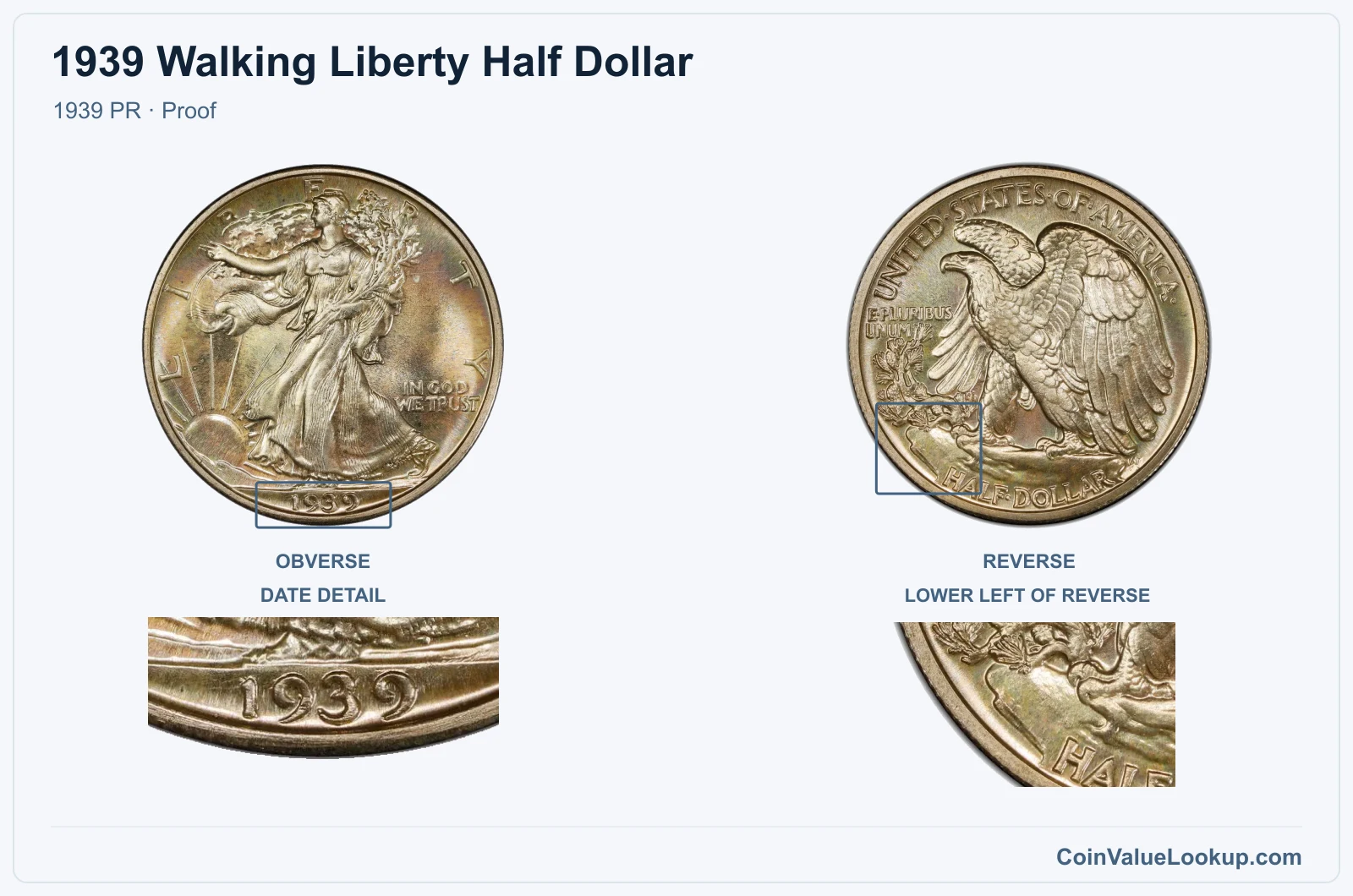
The 1939 PR is a proof issue struck at Philadelphia with specially prepared dies. Genuine proofs show deeply mirrored fields and razor-sharp design edges that no amount of polishing can replicate on a business strike.
The guide estimate for a PR65 example is $878.00.
When evaluating a proof, look for hairlines from past cleaning or mishandling, any haze across the mirrors, and whether the devices show frosted cameo contrast against the fields. These factors all affect value.
No mintmark is present, same as the regular Philadelphia coin, so the proof identity comes entirely from the finish quality and provenance.
Range Grade
Price Auction Records Appraisal PR PR 1
—
Coin Identifier
PR 2
—
Coin Identifier
PR 3
—
Coin Identifier
PR 4
—
Coin Identifier
PR 6
—
Coin Identifier
PR 8
—
Coin Identifier
PR 10
—
Coin Identifier
PR 12
—
Coin Identifier
PR 15
—
Coin Identifier
PR 20
—
Coin Identifier
PR 25
—
Coin Identifier
PR 30
—
Coin Identifier
PR 35
—
Coin Identifier
PR 40
—
Coin Identifier
PR 45
—
Coin Identifier
PR 50
—
Coin Identifier
PR 53
—
Coin Identifier
PR 55
Coin Identifier
PR 58
—
Coin Identifier
PR 60
Coin Identifier
PR 61
Coin Identifier
PR 62
Coin Identifier
PR 63
Coin Identifier
PR 64
Coin Identifier
PR 65
Coin Identifier
PR 66
Coin Identifier
PR 67
Coin Identifier
PR 68
Coin Identifier
PR 69
—
—
—
PR 70
—
—
—
1939 Walking Liberty Half Dollar Error List
1. 1939 Walking Liberty Half Dollar — Doubled Die Obverse
A Doubled Die Obverse has been reported on the 1939-D Walking Liberty Half Dollar specifically. This variety shows consistent doubling on obverse design elements such as lettering or portions of the date.
Under good light, compare the suspect coin's obverse inscriptions to a normal 1939-D; look for uniform separation or notching on the letter edges rather than a flat, shelf-like distortion.
The key distinction is between true hub doubling and machine doubling. Machine doubling produces a flat, shelf-like displacement that lacks the rounded, raised character of a genuine doubled die.
Reflections or worn die contours can also mimic the effect under certain angles. No specific price has been established in the supplied references, but value depends on the visibility of the doubling and the coin's overall condition.
A bold, clearly visible example will always attract more interest than a faint one.
2. 1939 Walking Liberty Half Dollar — Repunched Mintmark
A Repunched Mintmark variety has been reported on the 1939-D Walking Liberty Half Dollar, cataloged as a 1939-D/D. This means the "D" mintmark was punched into the working die more than once, leaving traces of an earlier, slightly offset impression beneath or beside the final mintmark position.
To check for this, examine the reverse mintmark area under at least 5x magnification. You are looking for remnants of a second "D" that do not align with the primary punch.
Compare your coin's mintmark to a known normal 1939-D at matching magnification and lighting.
Do not confuse a die chip, corrosion around the mintmark, or flat machine-doubling displacement for a true repunched mintmark. No specific price is available in the supplied references, but the coin's grade, surface quality, and clarity of the repunching all influence what a collector would pay.