1843 Liberty Seated Half Dollar Coin Value: How Much Is It Worth?
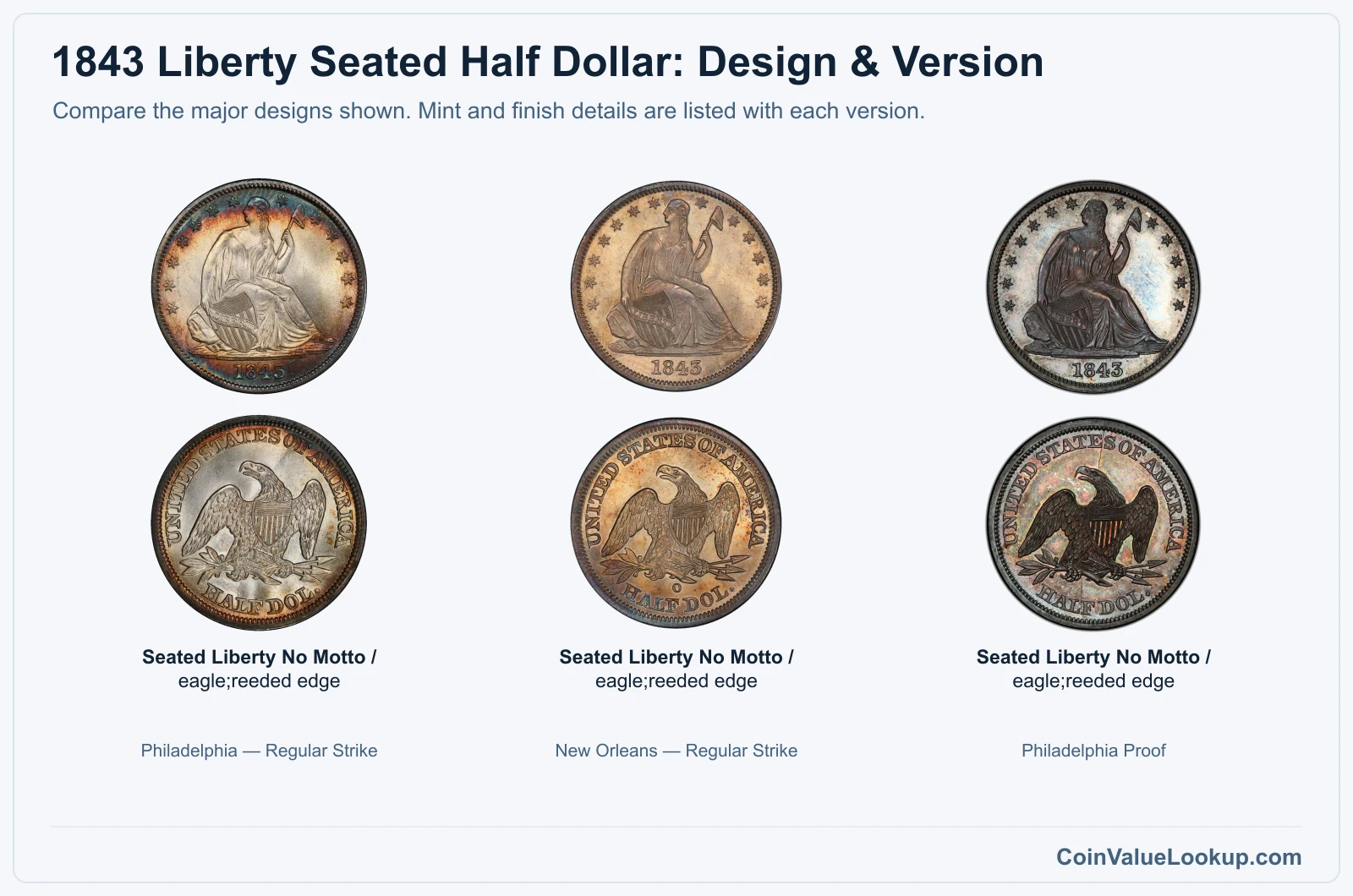
The 1843 Liberty Seated Half Dollar was struck at Philadelphia and New Orleans in 90% silver. What yours is worth depends on the mint, grade, and whether it carries any die variety.
Guide estimates for regular circulation strikes run from about $80 at G4 up to $576 at AU50, while a rare Proof sold individually for over $44,000 at auction. Identifying your specific coin matters.
Fast Way to Identify Your 1843 Liberty Seated Half Dollar
Want a quick read on what you have? Snap clear photos of both the front and back of your coin and upload them here.
That gives us enough to make a preliminary identification of the mint, general condition, and version. It is not a substitute for professional certification, but it is a solid first step before you dig deeper.
1843 Liberty Seated Half Dollar Value
Upload both sides of your 1843 Liberty Seated Half Dollar.
Front Obverse
Upload photo
Back Reverse
Upload photo
Which 1843 Liberty Seated Half Dollar Versions Are Worth Money?
- Philadelphia regular strikes in AU50 condition reach around $576 according to guide estimates, making high-grade survivors the ones to watch for from this mint.
- New Orleans (O mintmark) regular strikes share similar guide values but the mintmark adds collectibility for type collectors building a mint set.
- A Philadelphia Proof sold at Heritage in October 2014 for $44,063 in PR64 — genuine Proofs are extreme rarities requiring professional confirmation.
- Die cracks, repunched dates, and clashed dies have been reported for 1843 halves and can add a premium depending on visibility and condition.
Step 1: Identify Your 1843 Liberty Seated Half Dollar Mint Mark and Version
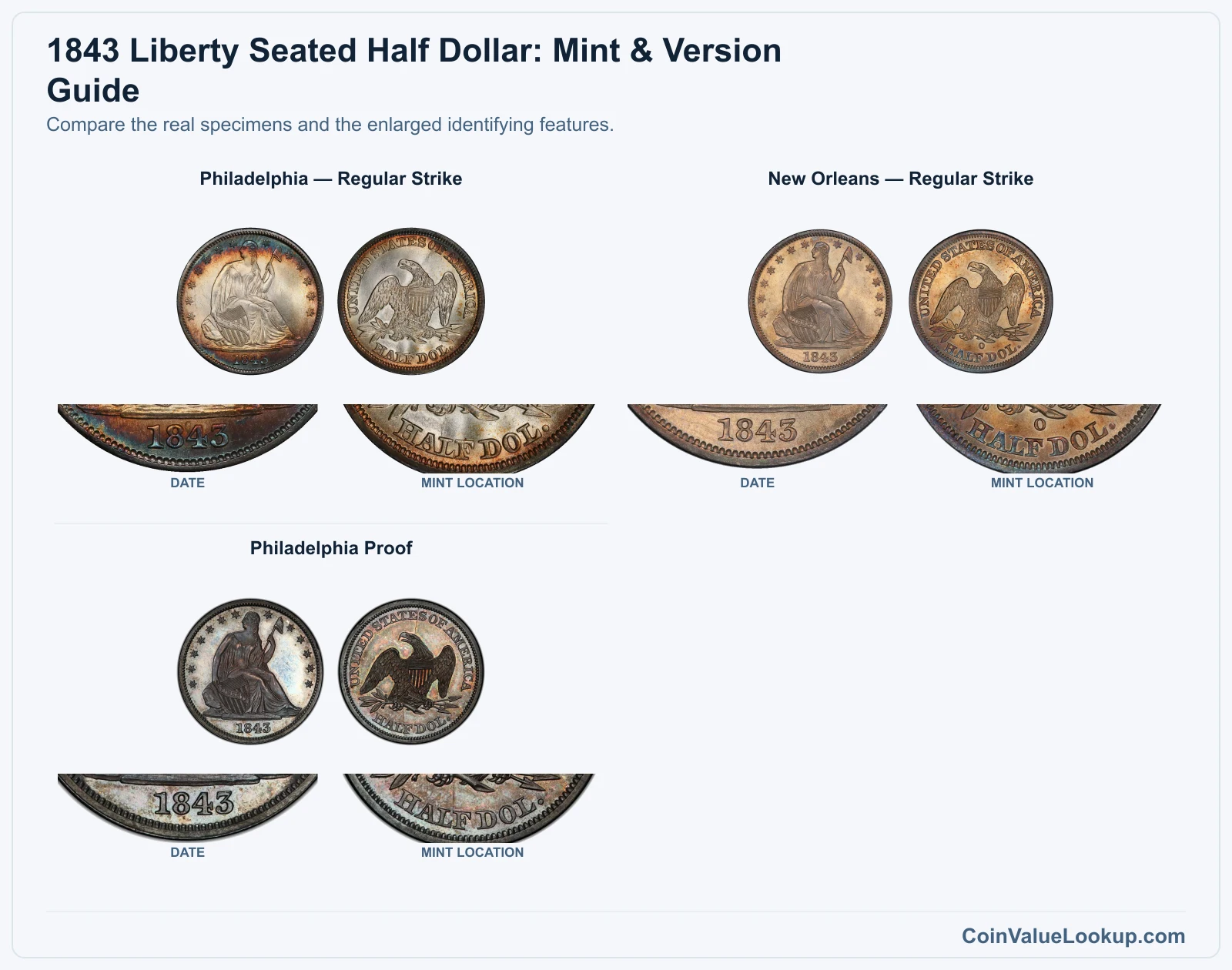
The 1843 half dollar uses the Seated Liberty obverse — Miss Liberty seated on a rock holding a pole and cap — paired with an eagle reverse inscribed HALF DOL. There is no IN GOD WE TRUST motto on this type.
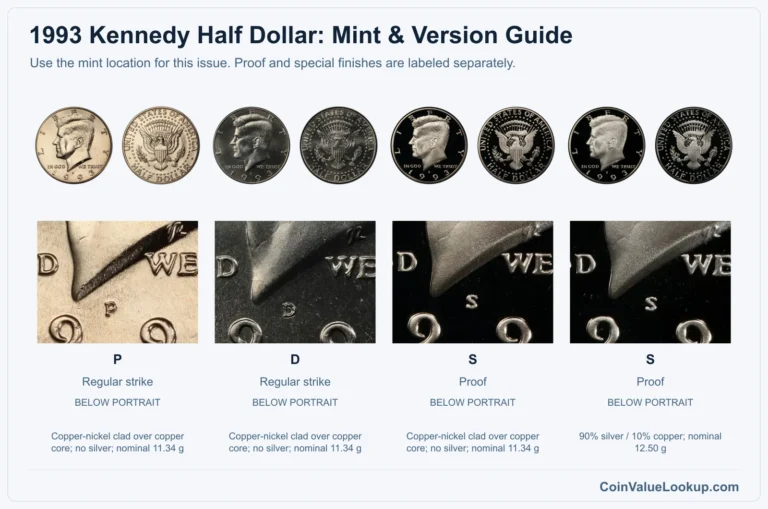
The coin is 90% silver, 10% copper, with a reeded edge and a nominal weight of 13.36 grams.
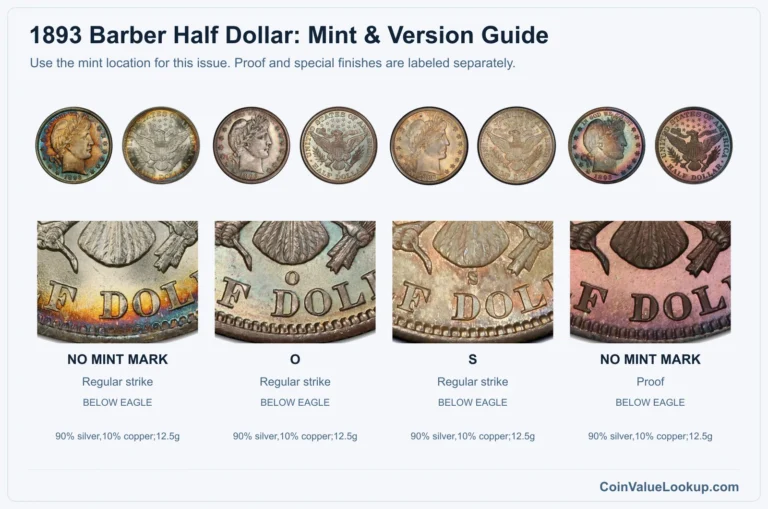
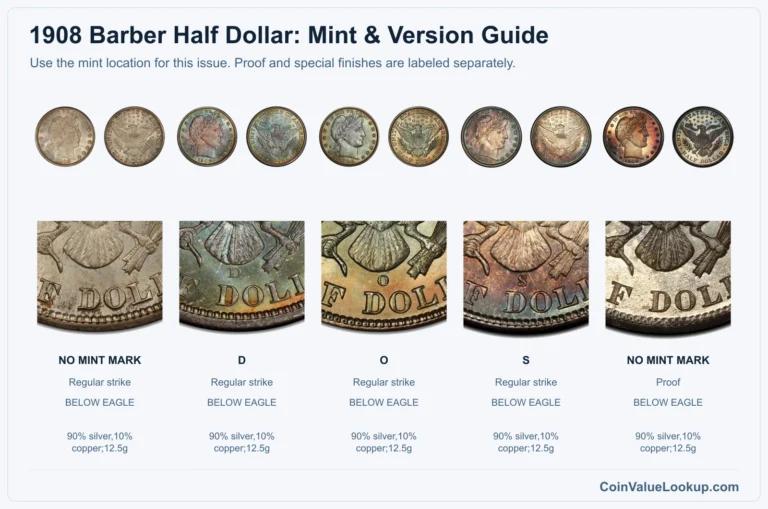
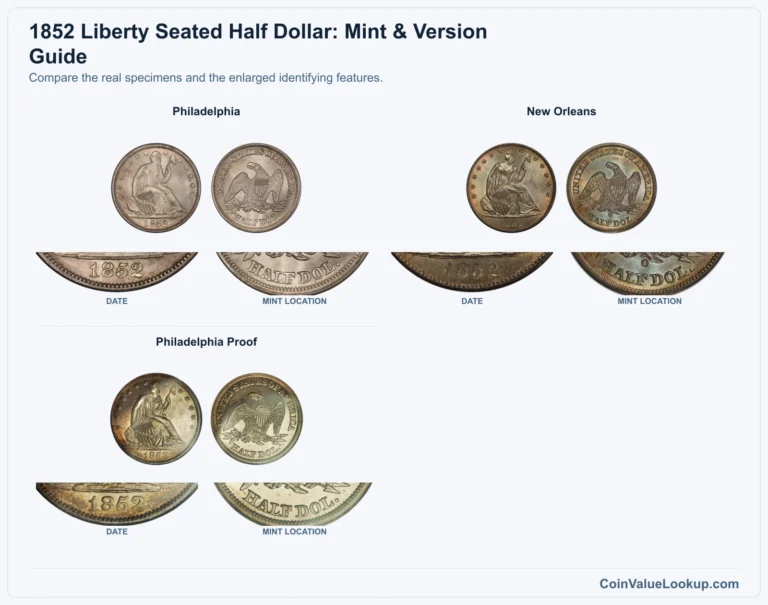
Philadelphia strikes carry no mintmark at all. New Orleans pieces have a small "O" on the reverse below the eagle.
Do not confuse a worn or damaged area near the eagle for a mintmark; look carefully under magnification.
The flat-top "3" in the date is standard for this year, not a separate variety or error. If the top of the 3 looks flat rather than rounded, that is simply how the date was punched.
Proof or presentation strikes exist but are extremely rare. A bright, flashy coin is not automatically a Proof — cleaning or light circulation can mimic reflectivity.
Professional attribution is required to confirm Proof manufacture.
Step 2: Check Your 1843 Liberty Seated Half Dollar Grade
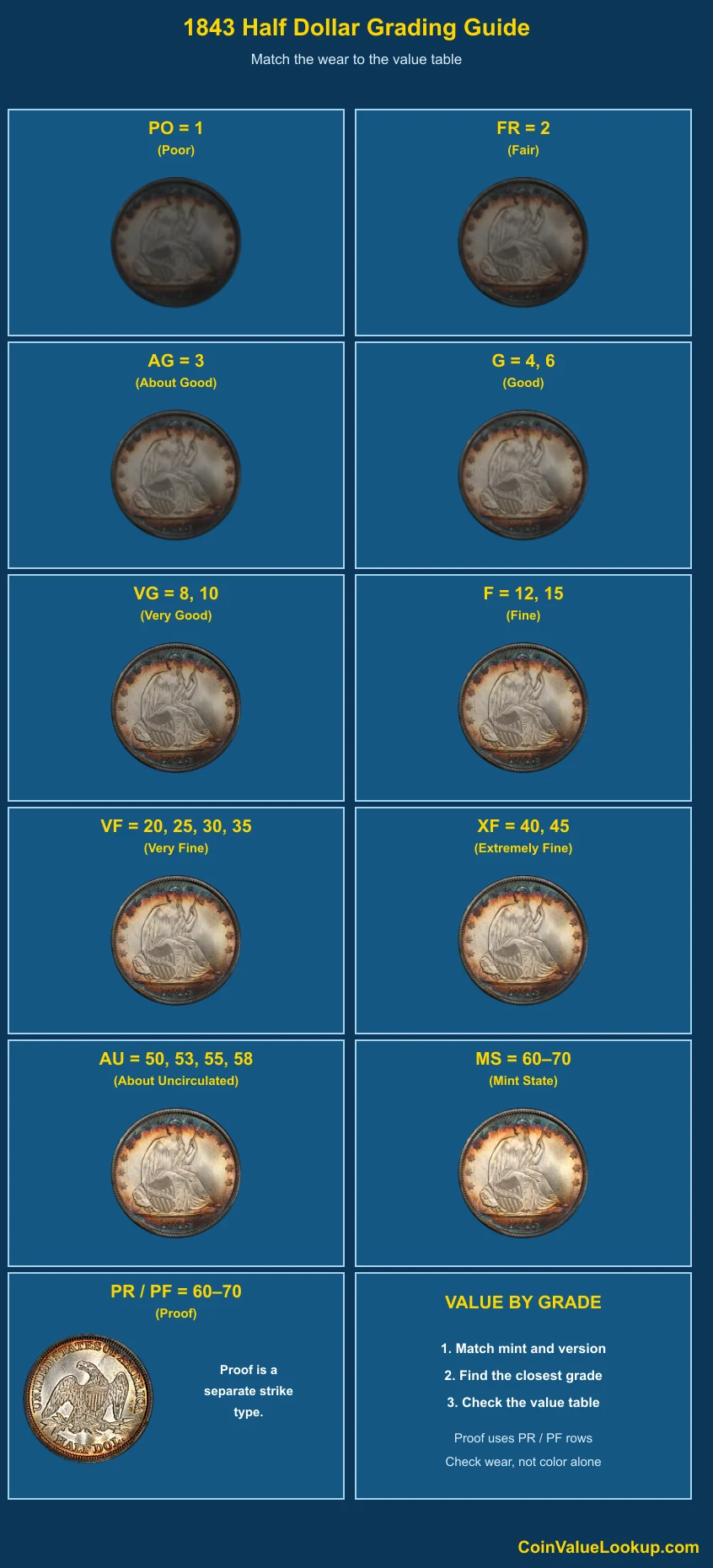
Start with the obverse. On a well-worn coin (around Good), Liberty's outline is visible but the head, breast, and knee details are flat.
At VF, the head shows clear definition, the knee has some roundness, and the horizontal shield lines begin to separate. By AU, only the highest points — Liberty's knee and breast — show slight friction, and most original luster remains in the fields.
Flip to the reverse. Check the eagle's breast feathers, wing tips, and claws.
In lower grades these merge into smooth lumps; in VF and above they sharpen progressively. Compare your coin side-by-side with the type-matched grading photographs to gauge where it falls.
One trap with Seated halves is weak original strikes. Some coins left the press with soft detail on Liberty's head or the eagle's feathers, which can look like wear but is actually a striking issue.
Broken, cartwheel luster in the fields usually confirms a coin has not circulated much, even if the high points look soft.
Cleaning, holes, scratches, and rim damage all reduce value significantly. Never clean an old silver coin — even a gentle wipe can leave hairlines visible under magnification.
Step 3: Check 1843 Liberty Seated Half Dollar Value by Mint and Version
1843 Liberty Seated Half Dollar — Philadelphia — Regular Strike
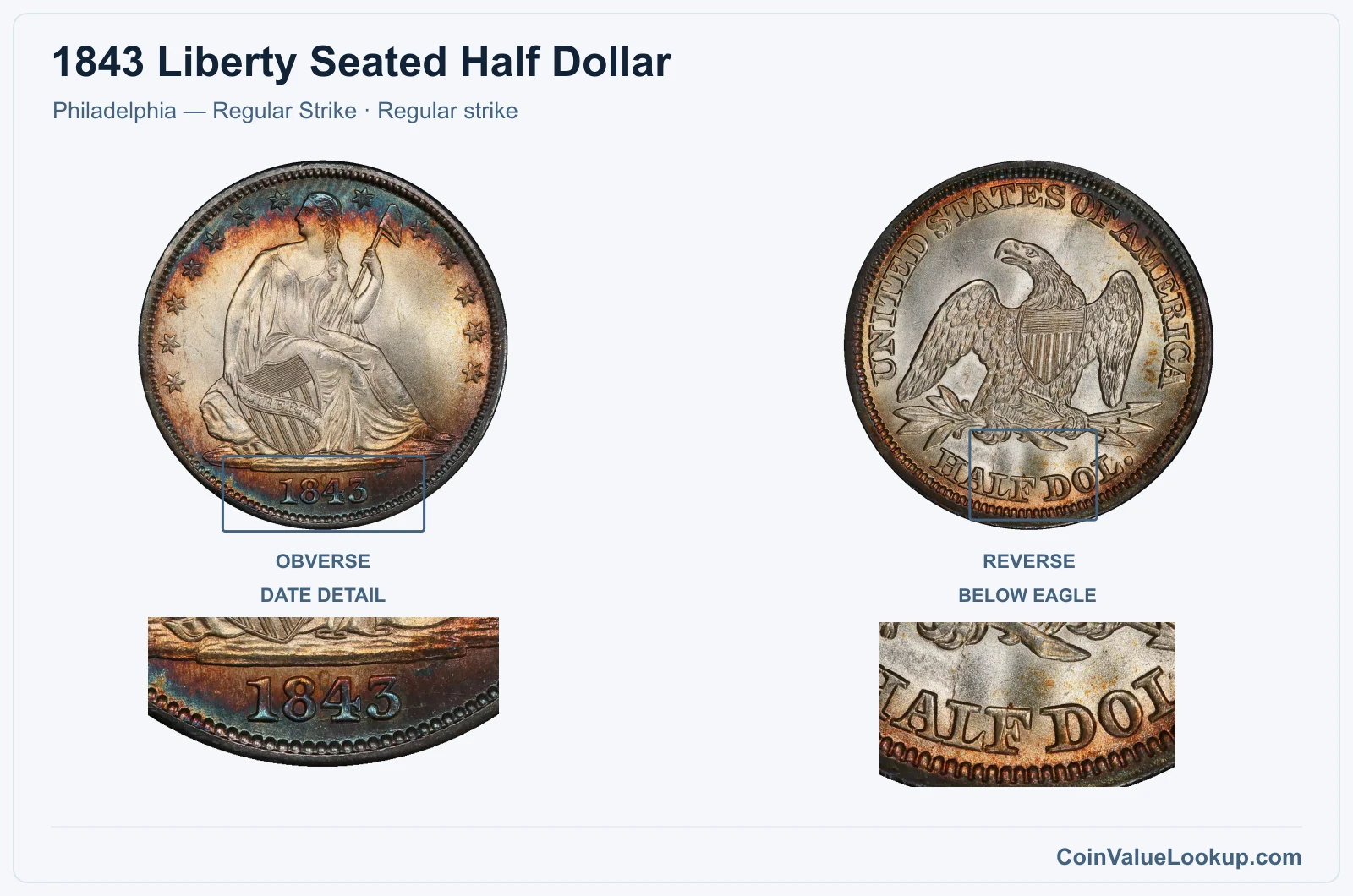
The Philadelphia regular strike is the baseline 1843 half dollar. It carries no mintmark.
Guide estimates place it around $80 in G4, $269 in VF20, and $576 in AU50. The flat-topped "3" in the date is completely normal for this issue — do not pay extra for it as though it were a variety.
Heavy reverse die cracking has been documented on Philadelphia dies this year (covered in the errors section). That cracking is a separate collectible feature, not a defect that lowers value.
When evaluating a Philadelphia piece, check the reverse fields carefully for raised irregular lines that could indicate a cracked die.
Range Grade
Price Auction Records Appraisal PO PO 1
—
Coin Identifier FR FR 2
—
Coin Identifier AG AG 3
—
Coin Identifier G G 4
—
Coin Identifier
G 6
—
Coin Identifier VG VG 8
Coin Identifier
VG 10
Coin Identifier F F 12
—
Coin Identifier
F 15
Coin Identifier VF VF 20
Coin Identifier
VF 25
Coin Identifier
VF 30
Coin Identifier
VF 35
Coin Identifier XF XF 40
Coin Identifier
XF 45
Coin Identifier AU AU 50
Coin Identifier
AU 53
Coin Identifier
AU 55
Coin Identifier
AU 58
Coin Identifier MS MS 60
Coin Identifier
MS 61
Coin Identifier
MS 62
Coin Identifier
MS 63
Coin Identifier
MS 64
Coin Identifier
MS 65
Coin Identifier
MS 66
—
Coin Identifier
MS 67
Coin Identifier
MS 68
—
—
—
MS 69
—
—
—
MS 70
—
—
—
1843 Liberty Seated Half Dollar — New Orleans — Regular Strike
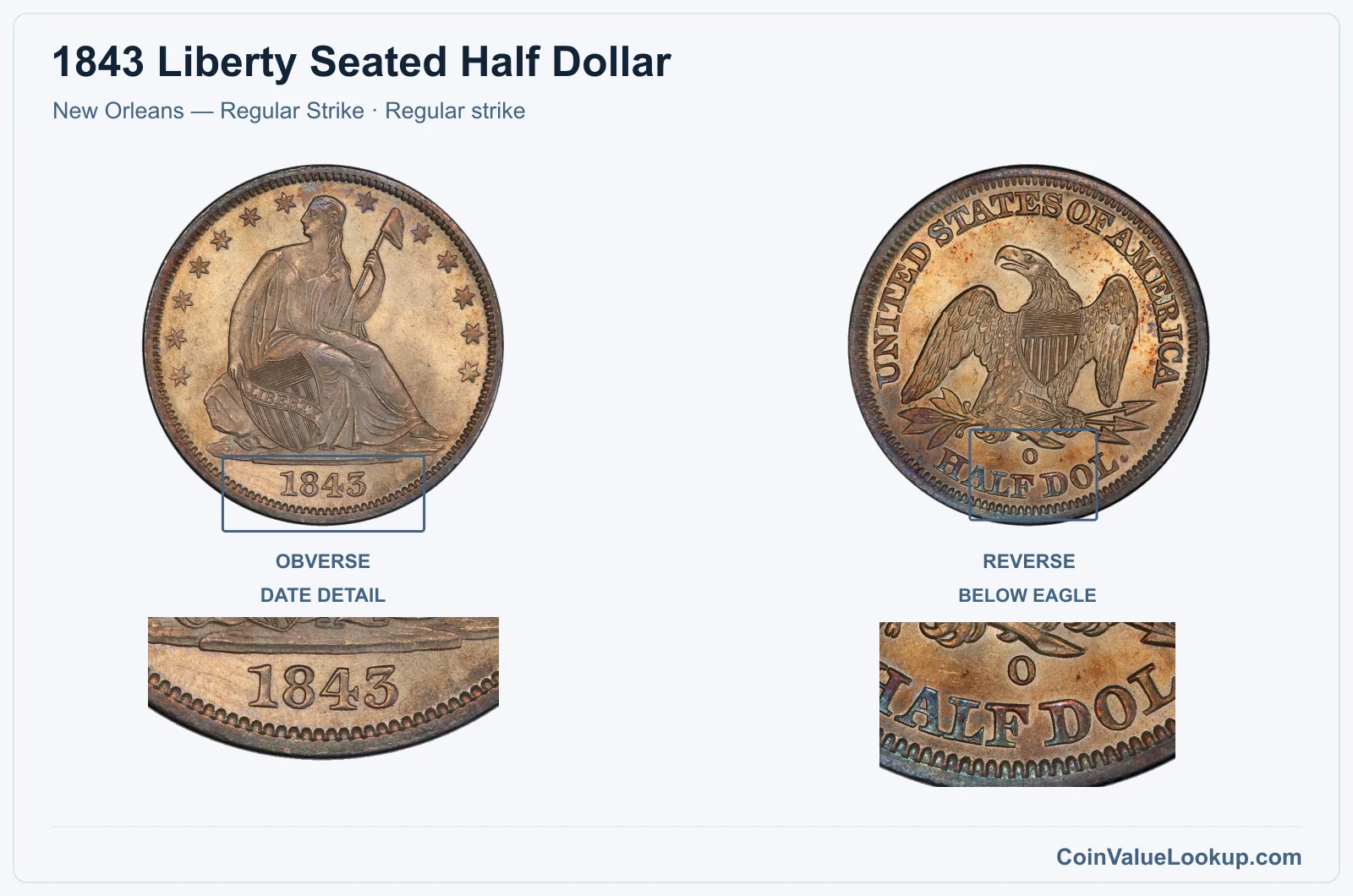
The New Orleans issue is identified by a small "O" mintmark on the reverse, positioned below the eagle. Guide estimates are comparable to Philadelphia: roughly $80 at G4, $269 at VF20, and $576 at AU50.
The reverse lettering style changed around 1842, so if the letters on your 1843-O look different from an earlier New Orleans half, that is part of the normal design progression, not a separate variety. When confirming the mintmark, use magnification — on well-circulated coins, the O can be faint and easy to miss.
Coin Value Lookup is a good starting point if you want to look up guides for other dates and denominations in the Seated Liberty series.
Range Grade
Price Auction Records Appraisal PO PO 1
—
Coin Identifier FR FR 2
—
Coin Identifier AG AG 3
—
Coin Identifier G G 4
—
Coin Identifier
G 6
—
Coin Identifier VG VG 8
—
Coin Identifier
VG 10
—
Coin Identifier F F 12
Coin Identifier
F 15
Coin Identifier VF VF 20
Coin Identifier
VF 25
Coin Identifier
VF 30
Coin Identifier
VF 35
Coin Identifier XF XF 40
Coin Identifier
XF 45
Coin Identifier AU AU 50
Coin Identifier
AU 53
Coin Identifier
AU 55
Coin Identifier
AU 58
Coin Identifier MS MS 60
Coin Identifier
MS 61
Coin Identifier
MS 62
Coin Identifier
MS 63
Coin Identifier
MS 64
Coin Identifier
MS 65
Coin Identifier
MS 66
—
—
—
MS 67
—
—
—
MS 68
—
—
—
MS 69
—
—
—
MS 70
—
—
—
1843 Liberty Seated Half Dollar — Philadelphia Proof
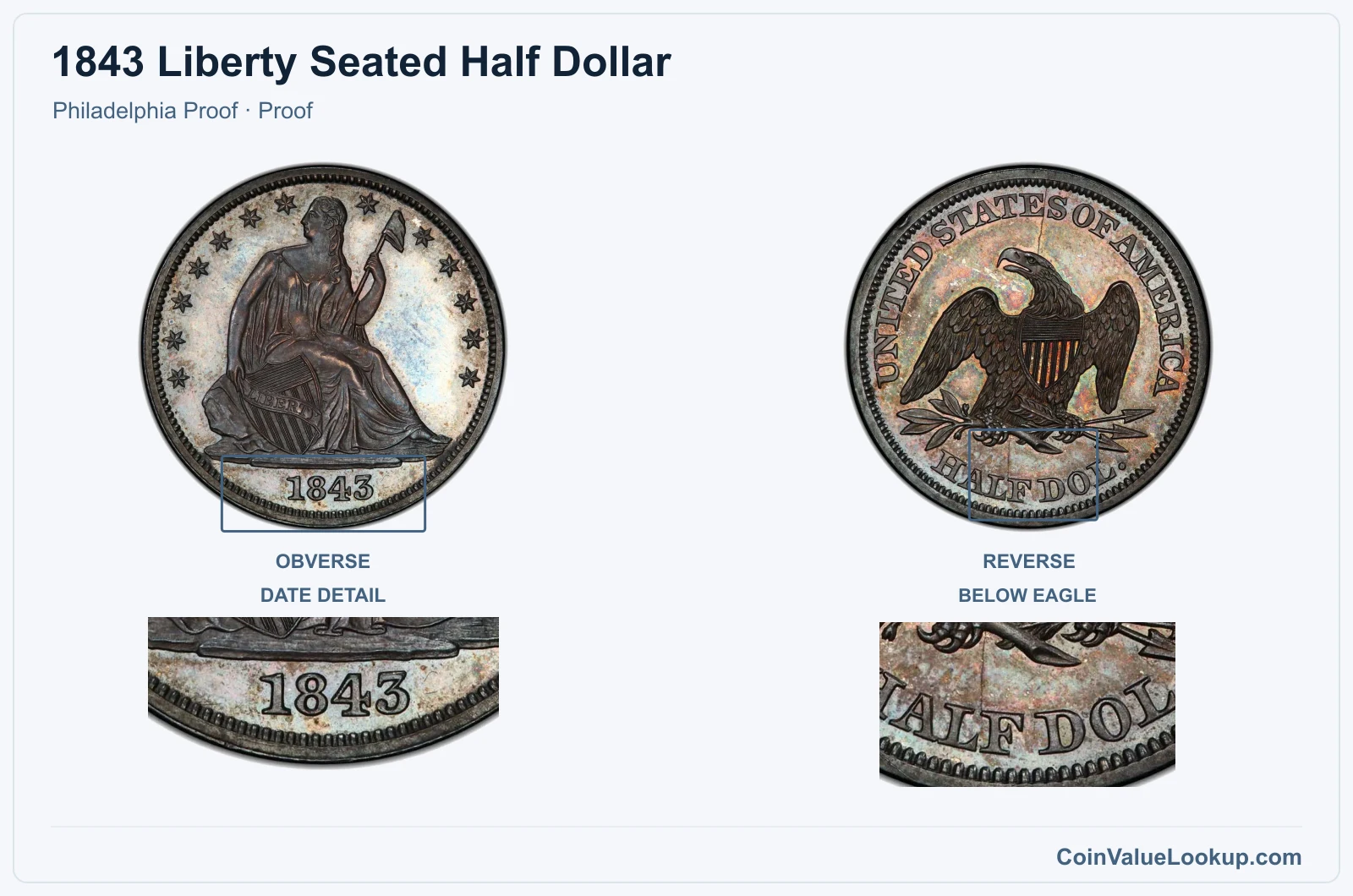
A Philadelphia Proof 1843 half dollar is an exceptionally rare coin. One graded PR64 sold through Heritage Auctions in October 2014 for $44,063.
That is a single historical sale, not a current market range, so do not assume every bright 1843 half is worth five figures.
Proof Seated halves have deeply mirrored fields and sharply struck devices produced by specially prepared dies and planchets. A regular strike that has been cleaned or lightly circulated can look shiny, but it will lack the consistent mirror depth and die polish lines of a genuine Proof.
Professional certification from a major grading service is essential before treating any coin as a Proof issue.
Range Grade
Price Auction Records Appraisal PR PR 1
—
Coin Identifier
PR 2
—
Coin Identifier
PR 3
—
Coin Identifier
PR 4
—
Coin Identifier
PR 6
—
Coin Identifier
PR 8
—
Coin Identifier
PR 10
—
Coin Identifier
PR 12
—
Coin Identifier
PR 15
—
Coin Identifier
PR 20
—
Coin Identifier
PR 25
—
Coin Identifier
PR 30
—
Coin Identifier
PR 35
—
Coin Identifier
PR 40
—
Coin Identifier
PR 45
—
Coin Identifier
PR 50
—
Coin Identifier
PR 53
—
Coin Identifier
PR 55
—
Coin Identifier
PR 58
—
Coin Identifier
PR 60
—
Coin Identifier
PR 61
—
Coin Identifier
PR 62
—
Coin Identifier
PR 63
—
Coin Identifier
PR 64
Coin Identifier
PR 65
—
Coin Identifier
PR 66
—
—
—
PR 67
—
—
—
PR 68
—
—
—
PR 69
—
—
—
PR 70
—
—
—
1843 Liberty Seated Half Dollar Error List
1. 1843 Liberty Seated Half Dollar — Die Crack / Die Chip
Die cracks show up as thin, raised, irregular lines on the coin's surface — they are ridges, not grooves. On 1843 Philadelphia pieces, a documented example shows a near-vertical crack bisecting the reverse.
The 1843-O has also been recorded with cracks running through the HALF DOL legend.
These cracks formed as the steel dies fatigued during production. A small crack adds modest collector interest; a dramatic one that spans the entire reverse is more desirable.
The value depends on the crack's size, location, and the coin's overall condition — no fixed price range applies.
Do not confuse die cracks with incuse scratches, corrosion lines, or foreign material stuck to the surface. Scratches are recessed into the metal, while die cracks are raised above the surrounding field.
Tilt the coin under a light and check whether the line casts a shadow upward or sits in a groove.
2. 1843 Liberty Seated Half Dollar — Repunched Date
A repunched date occurs when the date numerals were punched into the working die more than once, with slight misalignment between impressions. On the 1843-O, a double-punched date has been documented — you may see traces of a second set of digits slightly offset from the primary date under magnification.
Look at the bases and tops of each numeral. Extra thickness, notching, or a shadow image next to any digit suggests repunching.
The value of a repunched date depends on how visible the doubling is and the coin's grade; no specific price range is established for this variety.
Be careful not to mistake a damaged date for a repunched one. Post-strike contact can flatten or shift the appearance of digits, and machine doubling — a flat, shelf-like distortion — looks superficially similar but carries little premium.
Genuine repunching shows rounded, die-struck secondary impressions.
3. 1843 Liberty Seated Half Dollar — Clashed Dies
Clashed dies result when the obverse and reverse dies strike each other without a planchet between them, transferring part of each design onto the opposing die. On subsequent coins, ghost-like impressions of the opposite design appear in the fields.
The 1843 Philadelphia half dollar falls within a documented range of years (1842–1844) identified as affected by die clashing and fractured reverse dies.
On an 1843 piece, look in the open fields of both sides for faint outlines that do not belong — traces of Liberty's head on the reverse field, or parts of the eagle on the obverse. These impressions are raised and follow the contour of the transferred design element.
Do not confuse clash marks with random scratches, raised lines from a damaged planchet, or brockage errors. Clash impressions mirror an identifiable portion of the opposite die's design.
Value depends on how strong the clash is and the coin's overall condition; no fixed price range is established.