1843 Liberty Seated Dime Coin Value: How Much Is It Worth?
The 1843 Liberty Seated Dime spans a wide value range depending on mint and condition. A Philadelphia issue in well-worn Good-4 grade starts around $29 in the USA Coin Book guide, while a New Orleans coin in Mint State 63 reaches a guide estimate of about $120,121.
Proof examples and error varieties carry their own separate pricing. Understanding which branch you hold is the first step to a realistic assessment.
Fast Way to Identify Your 1843 Liberty Seated Dime
The quickest way to start figuring out what your 1843 dime is worth is to upload clear photos of both the front and back. Our identifier can give you a preliminary read on the mint, design type, and general condition from those images alone.
It is not a substitute for professional grading or authentication, but it points you in the right direction fast.
1843 Liberty Seated Dime Value
Upload both sides of your 1843 Liberty Seated Dime.
Front Obverse
Upload photo
Back Reverse
Upload photo
Which 1843 Liberty Seated Dime Versions Are Worth Money?
- The New Orleans (O mintmark) regular issue is scarce and commands a steep premium, with a USA Coin Book guide estimate reaching about $120,121 at MS63.
- Philadelphia Proof examples are rare early collector pieces, with a guide estimate around $12,500 at PR63.
- A repunched date variety (1843/1843) can add value depending on visibility and condition, though no standard price range is established.
Step 1: Identify Your 1843 Liberty Seated Dime Mint Mark and Version
First, confirm you actually have a dime and not a half dime. Both feature a seated Liberty, but the dime reverse reads ONE DIME inside a small wreath, while the half dime says HALF DIME.
Size helps too: the dime is 17.9 mm with a reeded edge.
Next, read the date. You want a clear 1843.
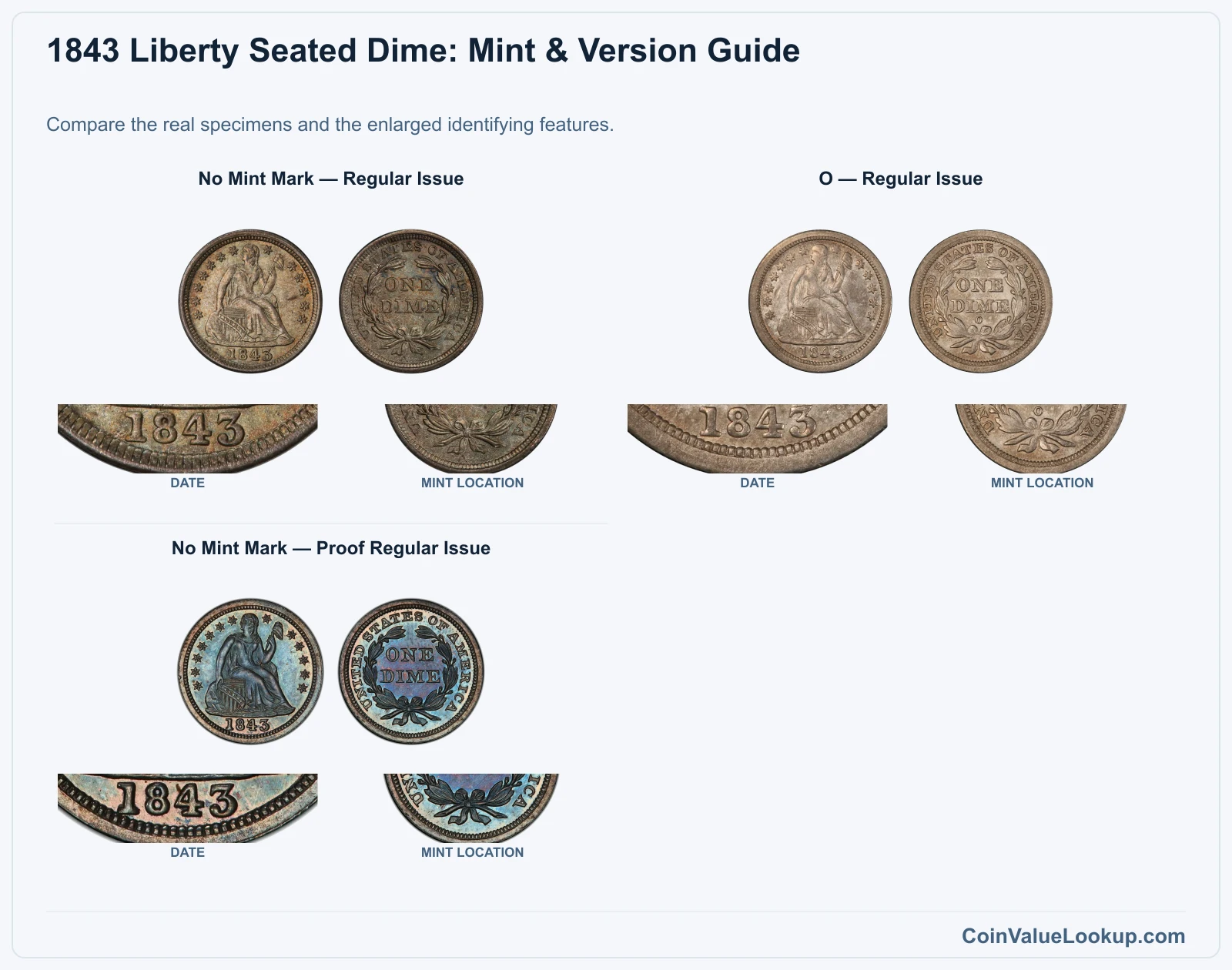
Then flip the coin over and look below the wreath for a mintmark. Philadelphia coins carry no letter at all.
A small "O" means New Orleans.
The 1843 dime uses the Stars Obverse with Drapery subtype. Look for a fold of drapery at Liberty's elbow on the obverse.
The alloy is 90% silver and 10% copper, with a nominal weight of 2.67 grams. If it feels too light or the edge is smooth, you may have a worn or altered piece.
One important note: a so-called "1843/1843" is a repunched date, meaning the date was punched more than once in slightly different positions. That is not an overdate involving a different year.
The distinction matters for both identification and value.
Step 2: Check Your 1843 Liberty Seated Dime Grade
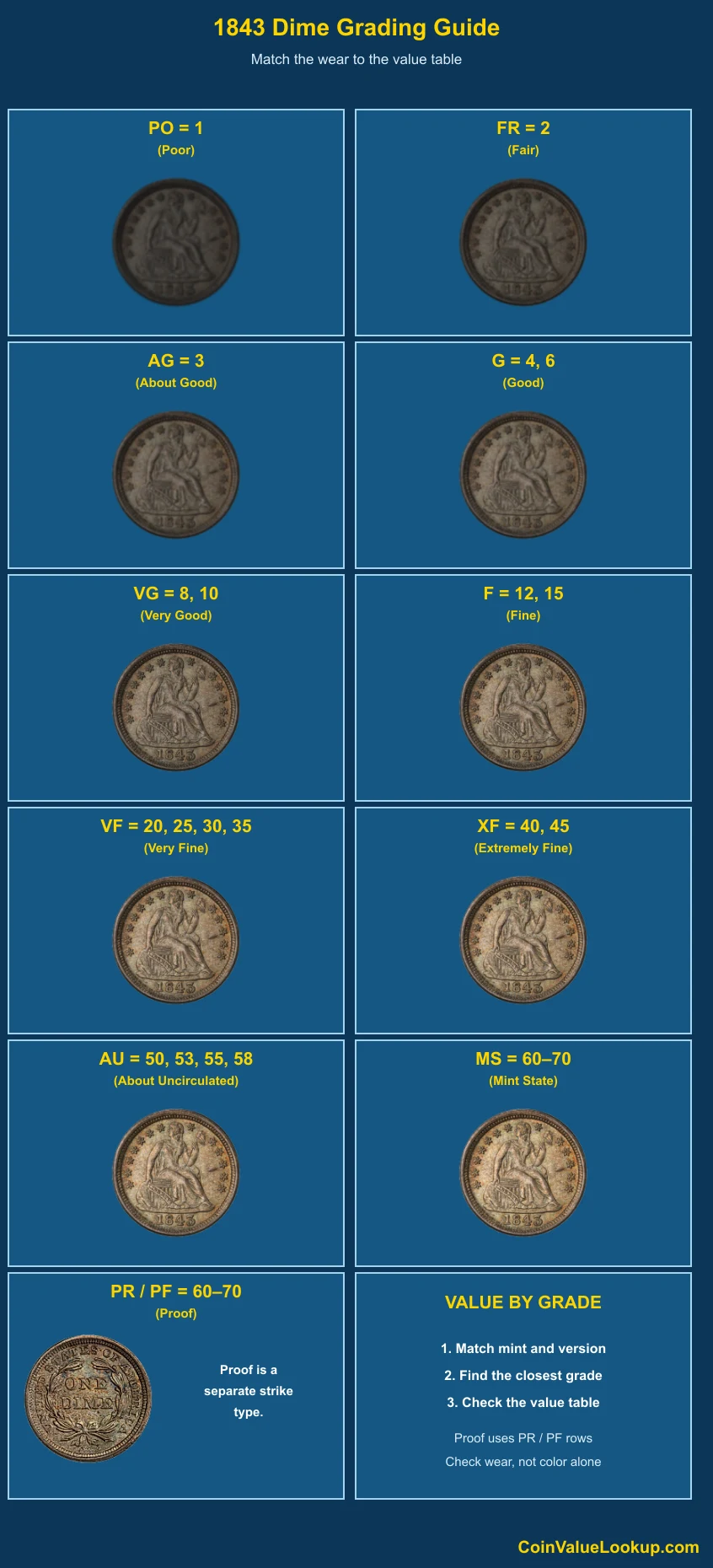
Compare your coin's wear against a grading image set matched to the Stars With Drapery subtype. Different subtypes have different weak points from the factory, so using the wrong reference will mislead you.
On the obverse, check Liberty's head, the shield on her arm, and her feet. These are the first areas to lose detail from circulation.
On the reverse, inspect the wreath, especially near its base.
Original luster is a big deal. A coin can look shiny because someone polished it, but that actually hurts the grade and value.
Genuine mint luster has a cartwheel effect when you tilt the coin under a light. Cleaning leaves hairlines visible under magnification.
Strike weakness from worn dies is not the same as circulation wear. A weakly struck coin may lack detail on the head or feet even in high grade.
Judge luster and surface preservation together to avoid confusing the two.
Proof coins are identified by mirrored fields and a specific manufacturing process, not by being in better condition than a Mint State coin. A polished circulated dime is not a Proof, no matter how reflective it appears.
Step 3: Check 1843 Liberty Seated Dime Value by Mint and Version
1843 Liberty Seated Dime — No Mint Mark — Regular Issue
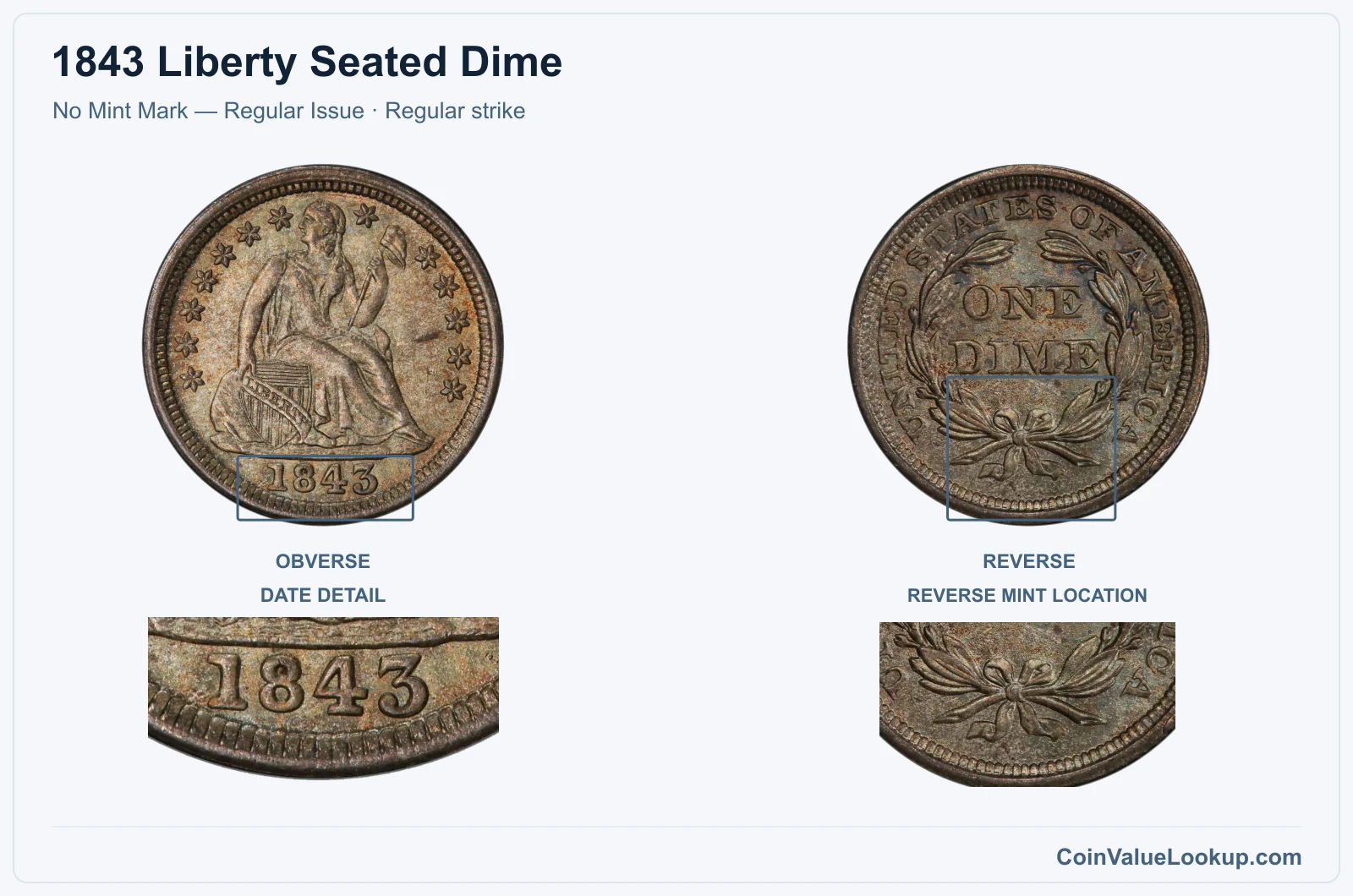
The Philadelphia regular issue has no mintmark anywhere on the coin. It uses the Stars Obverse with Drapery design and a small wreath reverse with the ONE DIME legend.
The alloy is 90% silver and 10% copper at a nominal 2.67 grams.
USA Coin Book guide estimates place this coin at about $29 in Good-4 and roughly $1,001 in MS63. That is a big spread, so condition matters enormously.
Check for drapery detail at Liberty's elbow and overall sharpness before assuming a grade.
Coin Value Lookup is a good starting point if you want to look up guides for other dates and denominations in this series. You can compare your coin across years to see where relative values sit.
Range Grade
Price Auction Records Appraisal PO PO 1
—
Coin Identifier FR FR 2
—
Coin Identifier AG AG 3
—
Coin Identifier G G 4
—
Coin Identifier
G 6
—
Coin Identifier VG VG 8
—
Coin Identifier
VG 10
—
Coin Identifier F F 12
Coin Identifier
F 15
—
Coin Identifier VF VF 20
—
Coin Identifier
VF 25
Coin Identifier
VF 30
—
Coin Identifier
VF 35
—
Coin Identifier XF XF 40
—
Coin Identifier
XF 45
Coin Identifier AU AU 50
—
Coin Identifier
AU 53
Coin Identifier
AU 55
Coin Identifier
AU 58
Coin Identifier MS MS 60
Coin Identifier
MS 61
Coin Identifier
MS 62
Coin Identifier
MS 63
Coin Identifier
MS 64
Coin Identifier
MS 65
Coin Identifier
MS 66
Coin Identifier
MS 67
—
—
—
MS 68
—
—
—
MS 69
—
—
—
MS 70
—
—
—
1843 Liberty Seated Dime — O — Regular Issue
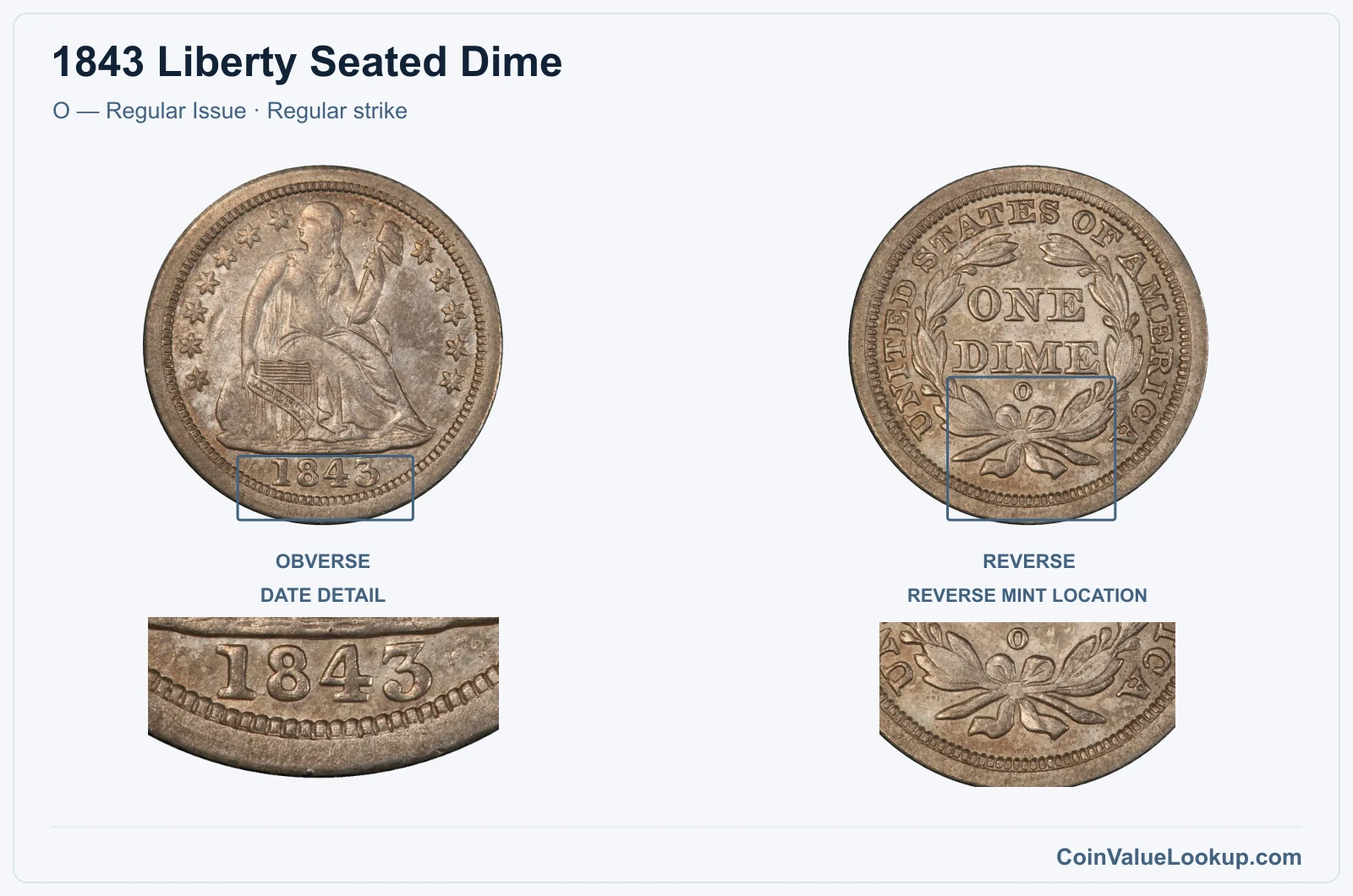
Look for a small "O" mintmark on the reverse, positioned below the wreath. This is the New Orleans issue, and it is genuinely scarce, especially in unworn condition.
Same alloy and weight as the Philadelphia version: 90% silver, 10% copper, 2.67 grams.
The value gap between grades here is dramatic. A USA Coin Book guide estimate puts Good-4 around $228, already nearly eight times the Philadelphia version in the same grade.
At MS63, the guide jumps to approximately $120,121. Survivors in high grade are rare enough that individual coin quality and eye appeal can drive results well beyond or below any single guide figure.
If you think you have an uncirculated O-mint 1843 dime, professional grading and authentication are worth the investment. Original surfaces and correct attribution matter far more than a shiny appearance.
Range Grade
Price Auction Records Appraisal PO PO 1
—
Coin Identifier FR FR 2
—
Coin Identifier AG AG 3
Coin Identifier G G 4
Coin Identifier
G 6
Coin Identifier VG VG 8
Coin Identifier
VG 10
Coin Identifier F F 12
Coin Identifier
F 15
Coin Identifier VF VF 20
Coin Identifier
VF 25
Coin Identifier
VF 30
Coin Identifier
VF 35
Coin Identifier XF XF 40
Coin Identifier
XF 45
Coin Identifier AU AU 50
Coin Identifier
AU 53
Coin Identifier
AU 55
—
Coin Identifier
AU 58
Coin Identifier MS MS 60
—
Coin Identifier
MS 61
—
Coin Identifier
MS 62
—
Coin Identifier
MS 63
—
Coin Identifier
MS 64
—
Coin Identifier
MS 65
—
Coin Identifier
MS 66
—
—
—
MS 67
—
—
—
MS 68
—
—
—
MS 69
—
—
—
MS 70
—
—
—
1843 Liberty Seated Dime — No Mint Mark — Proof Regular Issue
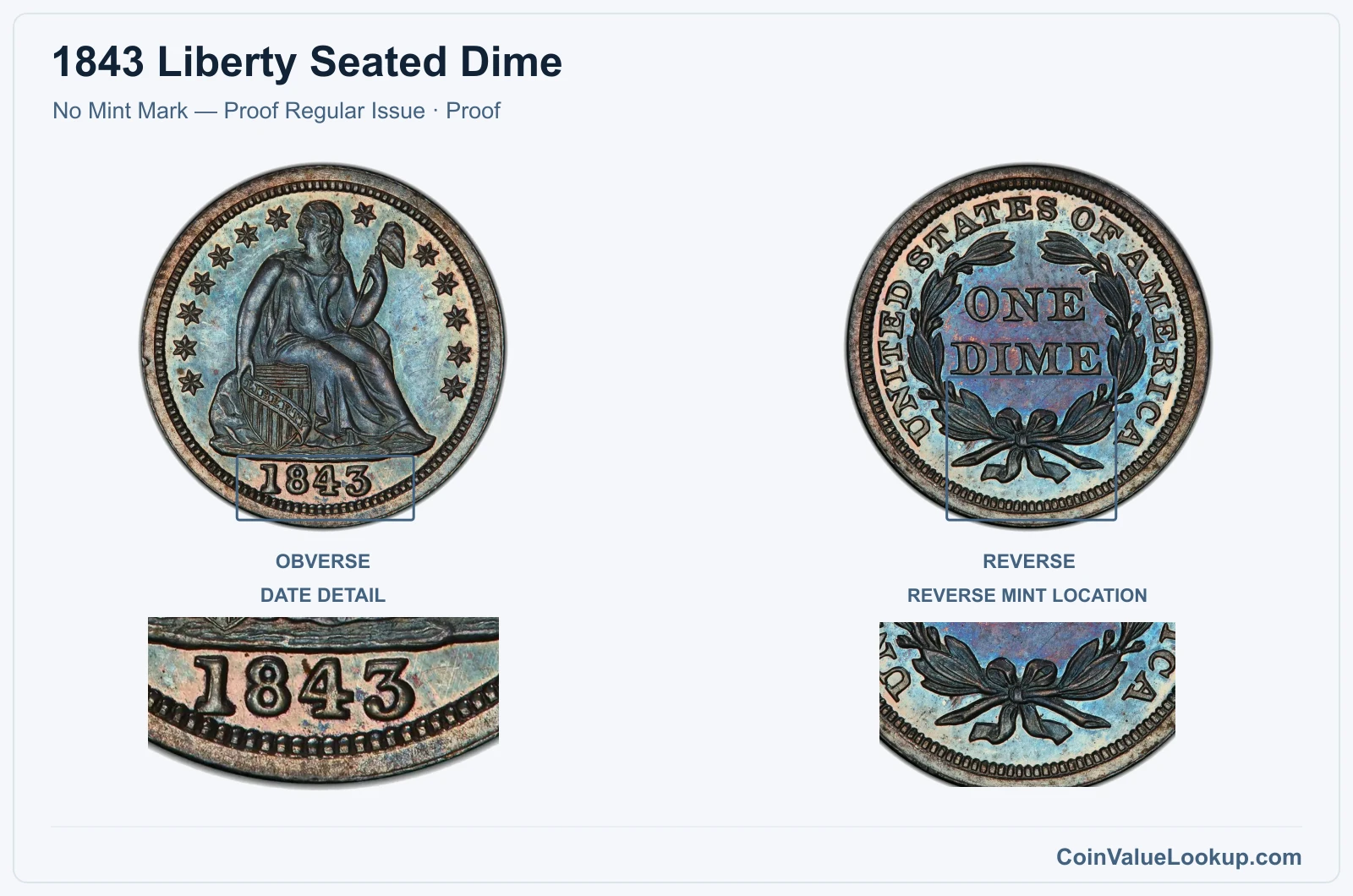
Proof 1843 dimes were struck at Philadelphia with polished dies and planchets, producing mirrored fields. These are rare early-date Proofs, not part of a routine annual collector program like later 19th-century issues.
Very few survive.
A PCGS guide estimate places the PR63 grade at about $12,500. That is a single anchor point, not a guaranteed sale price.
Individual auction results can vary based on eye appeal, toning, and hairline severity.
Do not confuse a polished or cleaned circulation coin with a Proof. Genuine Proofs have a distinctive mirror finish created during manufacturing, visible as deep reflectivity across the flat fields.
Hairlines from mishandling reduce the grade but do not disqualify the Proof designation. Cameo contrast, where devices appear frosty against mirrored fields, is a descriptive characteristic and not a separate mint or variety.
Range Grade
Price Auction Records Appraisal PR PR 1
—
Coin Identifier
PR 2
—
Coin Identifier
PR 3
—
Coin Identifier
PR 4
—
Coin Identifier
PR 6
—
Coin Identifier
PR 8
—
Coin Identifier
PR 10
—
Coin Identifier
PR 12
—
Coin Identifier
PR 15
—
Coin Identifier
PR 20
—
Coin Identifier
PR 25
—
Coin Identifier
PR 30
—
Coin Identifier
PR 35
—
Coin Identifier
PR 40
—
Coin Identifier
PR 45
—
Coin Identifier
PR 50
—
Coin Identifier
PR 53
—
Coin Identifier
PR 55
—
Coin Identifier
PR 58
—
Coin Identifier
PR 60
—
Coin Identifier
PR 61
—
Coin Identifier
PR 62
—
Coin Identifier
PR 63
—
Coin Identifier
PR 64
Coin Identifier
PR 65
Coin Identifier
PR 66
Coin Identifier
PR 67
—
—
—
PR 68
—
—
—
PR 69
—
—
—
PR 70
—
—
—
1843 Liberty Seated Dime Error List
1. 1843 Liberty Seated Dime — Repunched Date
A repunched date on the 1843 dime shows remnants of an earlier punch position next to the final date numerals. Under magnification, you may see traces of a slightly shifted "1," "8," "4," or "3" adjacent to the accepted digits.
This happened when a Mint worker struck the date punch into the working die more than once, with the second impression not perfectly aligned over the first.
This is different from machine doubling, which produces flat, shelf-like distortions across the entire design, not just the date. It is also not damage from a hit or scratch on the coin after it left the press.
Genuine repunched dates show raised remnants that match the style of the original numerals.
No standard numerical price has been established for this variety. Value depends on how visible the repunching is, the overall condition of the coin, and collector demand for the specific die pairing.
If you suspect you have one, clear close-up photos of the date area are essential for any meaningful assessment.