1947 Roosevelt Dime Coin Value: How Much Is It Worth?
The 1947 Roosevelt Dime is a 90% silver coin struck across three mints, and every example carries real precious-metal content. Guide estimates for ordinary business strikes range from about $5.81 in Good-4 condition to around $18 for a Mint State 65 example, depending on the mint.
These are grade-specific retail reference points from USA Coin Book, not guaranteed buy prices, and silver spot prices shift the floor. No proofs were produced this year.
Coins grading high with Full Bands designation occupy their own tier and deserve separate comparison.
Fast Way to Identify Your 1947 Roosevelt Dime
Want a quick read on your 1947 dime? Upload clear photos of the front and back, and our identifier can offer a preliminary identification of your coin's mint version and approximate condition.
This is not a substitute for professional authentication or certified grading, but it gives you a solid starting point before you dig deeper.
1947 Roosevelt Dime Value
Upload both sides of your 1947 Roosevelt Dime.
Front Obverse
Upload photo
Back Reverse
Upload photo
Which 1947 Roosevelt Dime Versions Are Worth Money?
- Uncirculated 1947 dimes with strong, fully separated torch bands and original luster can trade well above typical Mint State prices.
- A Curved Clipped Planchet error on a 1947-S dime is known in high grade — confirm the smooth curved absence and opposite-rim weakness before assuming a premium.
- Doubled Die Obverse varieties exist on 1947 Philadelphia strikes — check IN GOD WE TRUST and the date under magnification.
- Doubled Die Reverse varieties are reported on 1947-S strikes — inspect the torch and reverse lettering for rounded doubling.
- Off-Center Strikes on 1947-S dimes with the date visible are collectible error coins worth individual assessment.
- A 1947-S/D Over-Mintmark variety shows remnants of a different letter beneath the final S — visibility and condition drive value.
Step 1: Identify Your 1947 Roosevelt Dime Mint Mark and Version
Start by confirming the date reads 1947 and that you see the Roosevelt portrait on the obverse with the torch, olive branch, and oak branch on the reverse. That much is easy.
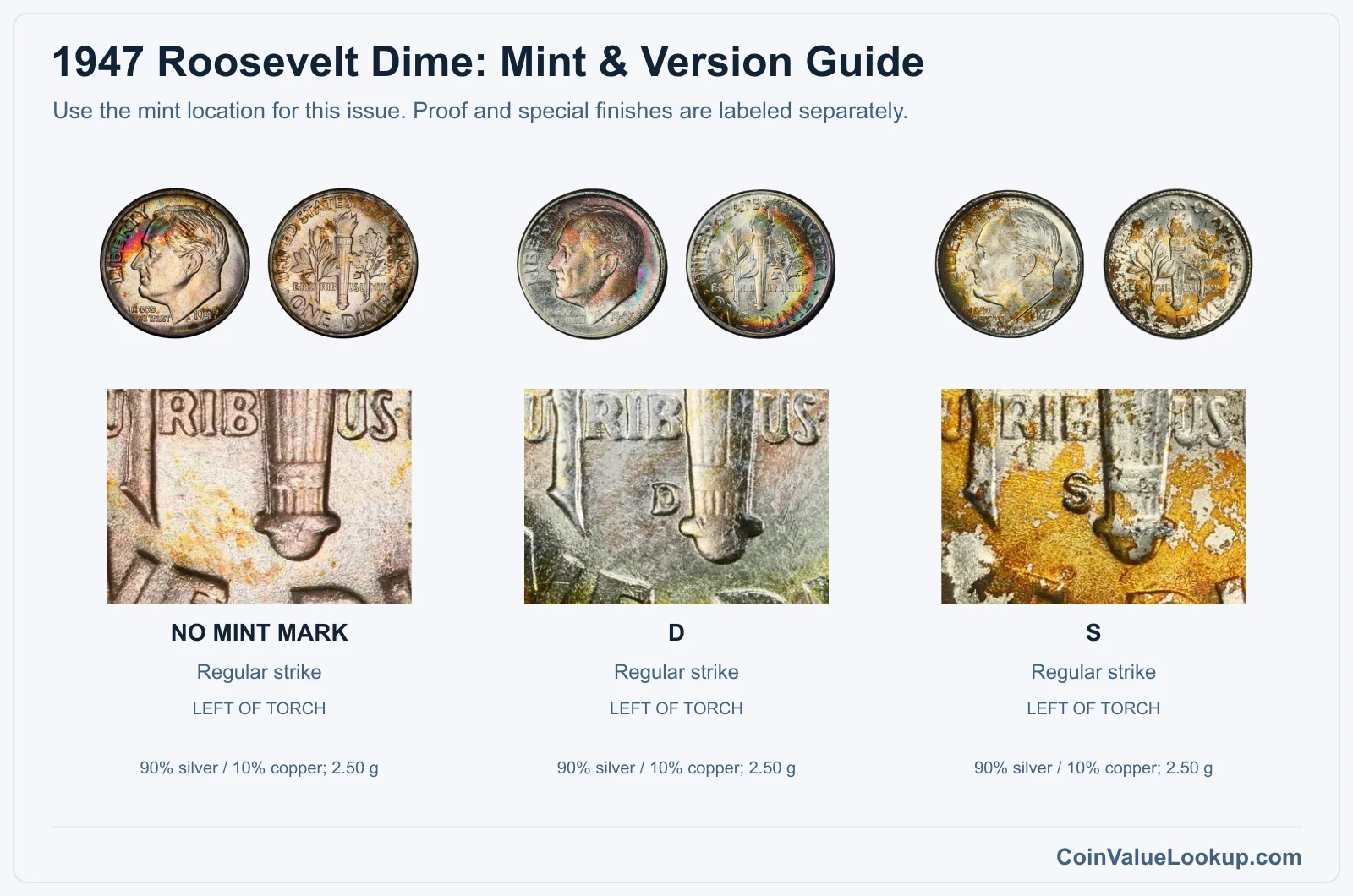
Next, flip to the reverse and look near the base of the torch for a small mintmark letter. A "D" means Denver.
An "S" means San Francisco. If there is no letter at all, your coin was struck in Philadelphia.
The absence of a mintmark is perfectly normal and not an error.
All three versions are composed of 90% silver and 10% copper, weigh approximately 2.50 grams, and measure about 17.9 mm in diameter. There is no clad version of this date.
Proofs were not issued until 1950, so any 1947 dime you encounter is a business strike.
Step 2: Check Your 1947 Roosevelt Dime Grade
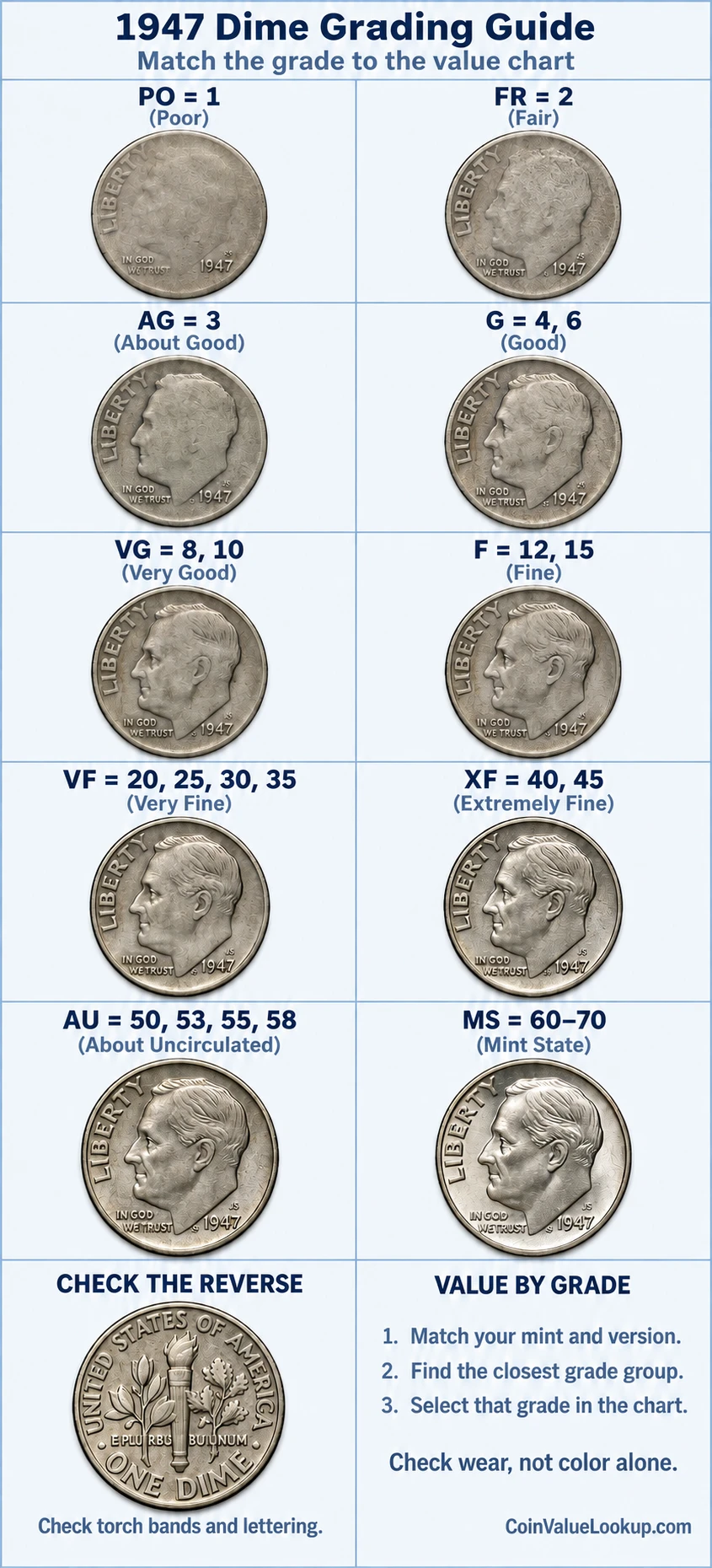
Focus first on Roosevelt's cheekbone, the hair detail above his ear, and the jawline. These are the highest points on the obverse and the first places to show smoothing from circulation.
On the reverse, check the upper torch bands and the leaf tips.
A common mistake is confusing a weak strike with actual wear. Some 1947 dimes left the press with soft torch bands, especially from certain mints, so a mushy band pair alone does not prove the coin circulated.
Look for the overall luster pattern and any contact marks across the fields.
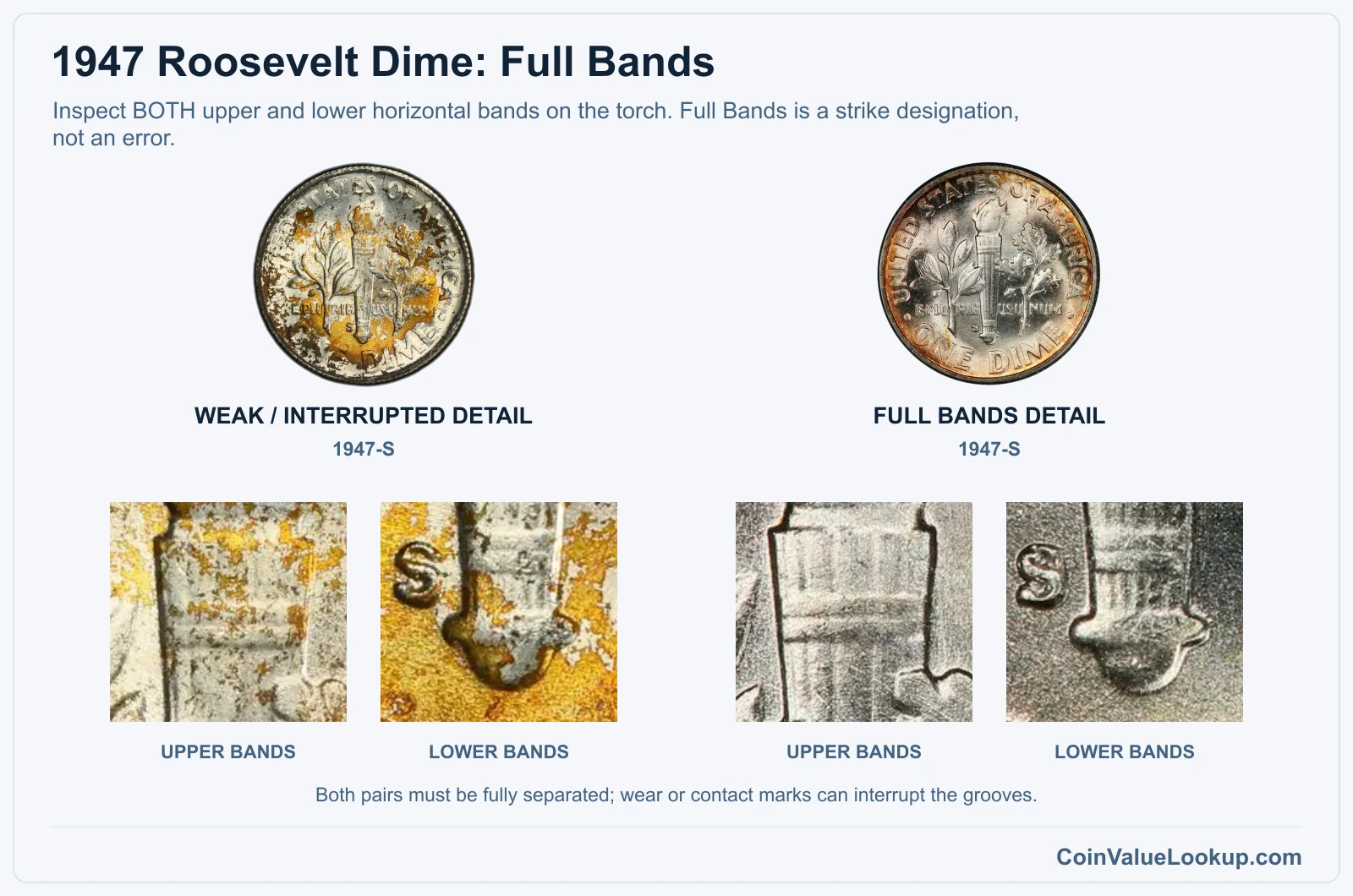
Full Bands is a strike designation referring to complete separation of both horizontal pairs of bands on the torch. It is not a grade and not a proof finish.
Compare your coin to the grading image provided, and keep Full Bands comparisons within the same mint and same numerical grade for an honest assessment.
Original surfaces matter more than raw brightness. A coin that has been cleaned or dipped will typically show hairline scratches under magnification and an unnatural shine.
Preservation and luster quality factor into the grade alongside wear.
Step 3: Check 1947 Roosevelt Dime Value by Mint and Version
1947 Roosevelt Dime — No Mintmark / Philadelphia
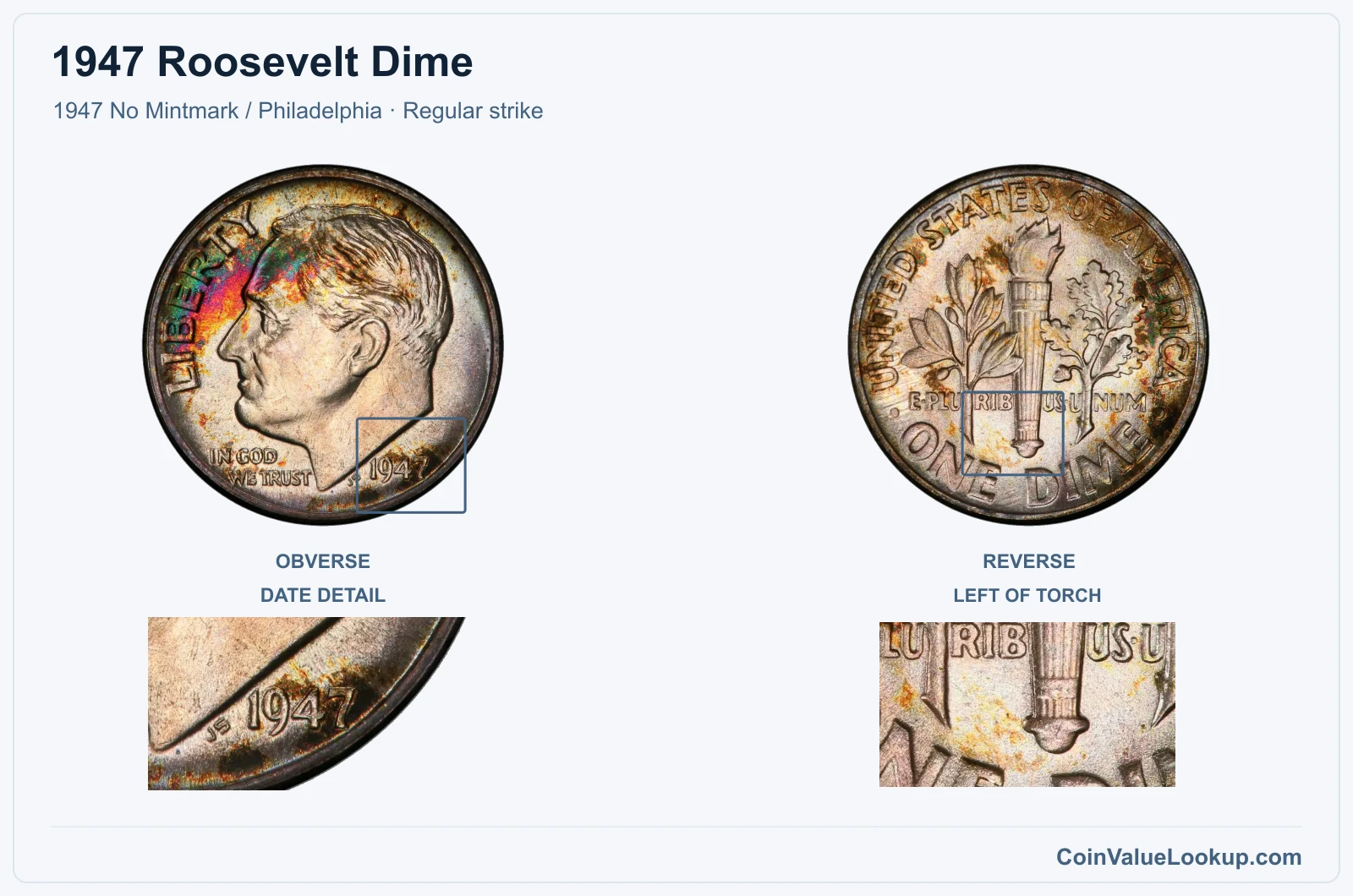
The 1947 Philadelphia dime carries no mintmark on the reverse. It is the most commonly encountered version of this date.
Guide estimates place it at roughly $5.81 in Good-4 and about $18 in MS65, per USA Coin Book.
Look for original silver luster in the fields and sharp detail on the torch bands if you suspect an uncirculated coin. Full Bands examples — where both horizontal band pairs on the torch are distinctly separated — deserve comparison against other Full Bands Philadelphia coins of the same numerical grade, not against generic circulated pieces.
Avoid cleaning your coin; even a gentle wipe can damage the surfaces and reduce its appeal to collectors.
Range Grade
Price Auction Records Appraisal PO PO 1
—
Coin Identifier FR FR 2
—
Coin Identifier AG AG 3
—
Coin Identifier G G 4
—
Coin Identifier
G 6
—
Coin Identifier VG VG 8
—
Coin Identifier
VG 10
—
Coin Identifier F F 12
—
Coin Identifier
F 15
—
Coin Identifier VF VF 20
—
Coin Identifier
VF 25
—
Coin Identifier
VF 30
Coin Identifier
VF 35
—
Coin Identifier XF XF 40
—
Coin Identifier
XF 45
—
Coin Identifier AU AU 50
—
Coin Identifier
AU 53
—
Coin Identifier
AU 55
—
Coin Identifier
AU 58
—
Coin Identifier MS MS 60
—
Coin Identifier
MS 61
—
Coin Identifier
MS 62
Coin Identifier
MS 63
—
Coin Identifier
MS 64
—
Coin Identifier
MS 65
Coin Identifier
MS 66
Coin Identifier
MS 67
Coin Identifier
MS 68
Coin Identifier
MS 69
—
—
—
MS 70
—
—
—
1947 Roosevelt Dime — D / Denver
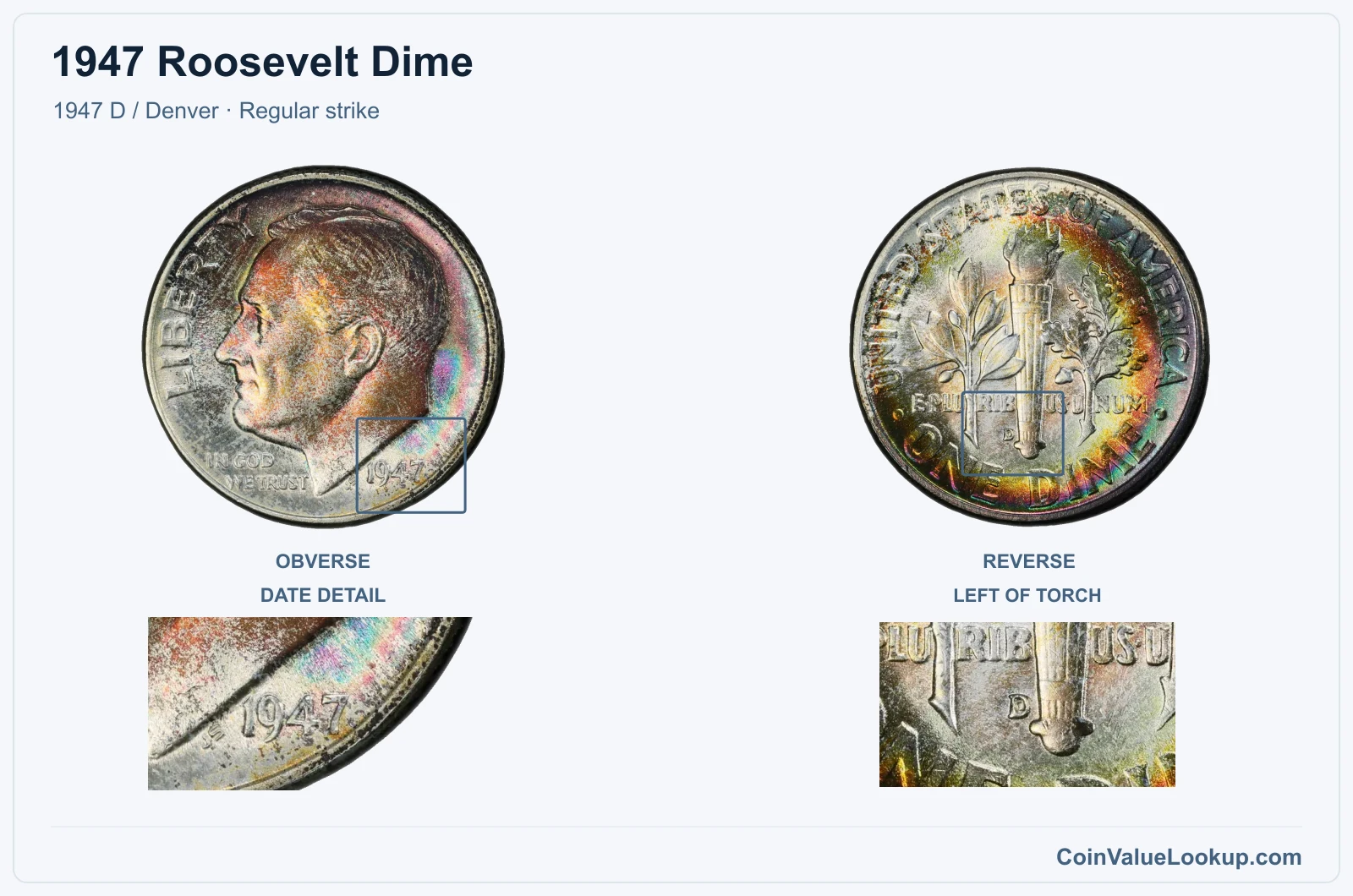
The Denver issue shows a small "D" mintmark near the base of the torch on the reverse. Guide estimates are about $5.81 in Good-4 and roughly $18 in MS65.
Denver strikes can vary in sharpness, so check the torch bands carefully before concluding a coin saw heavy use. A weakly struck example may look worn but still retain full luster in the protected fields.
If the bands separate cleanly under magnification, you may have a Full Bands coin, which carries its own premium tier. As always, original surfaces without cleaning or environmental damage are what collectors prefer.
Coin Value Lookup is a handy place to look up value guides for Roosevelt Dimes and other U.S. series when you want a quick reference organized by year and mint.
Range Grade
Price Auction Records Appraisal PO PO 1
—
Coin Identifier FR FR 2
—
Coin Identifier AG AG 3
—
Coin Identifier G G 4
—
Coin Identifier
G 6
—
Coin Identifier VG VG 8
—
Coin Identifier
VG 10
—
Coin Identifier F F 12
—
Coin Identifier
F 15
—
Coin Identifier VF VF 20
—
Coin Identifier
VF 25
—
Coin Identifier
VF 30
—
Coin Identifier
VF 35
—
Coin Identifier XF XF 40
—
Coin Identifier
XF 45
—
Coin Identifier AU AU 50
—
Coin Identifier
AU 53
—
Coin Identifier
AU 55
—
Coin Identifier
AU 58
—
Coin Identifier MS MS 60
—
Coin Identifier
MS 61
—
Coin Identifier
MS 62
—
Coin Identifier
MS 63
—
Coin Identifier
MS 64
Coin Identifier
MS 65
Coin Identifier
MS 66
Coin Identifier
MS 67
Coin Identifier
MS 68
Coin Identifier
MS 69
—
—
—
MS 70
—
—
—
1947 Roosevelt Dime — S / San Francisco
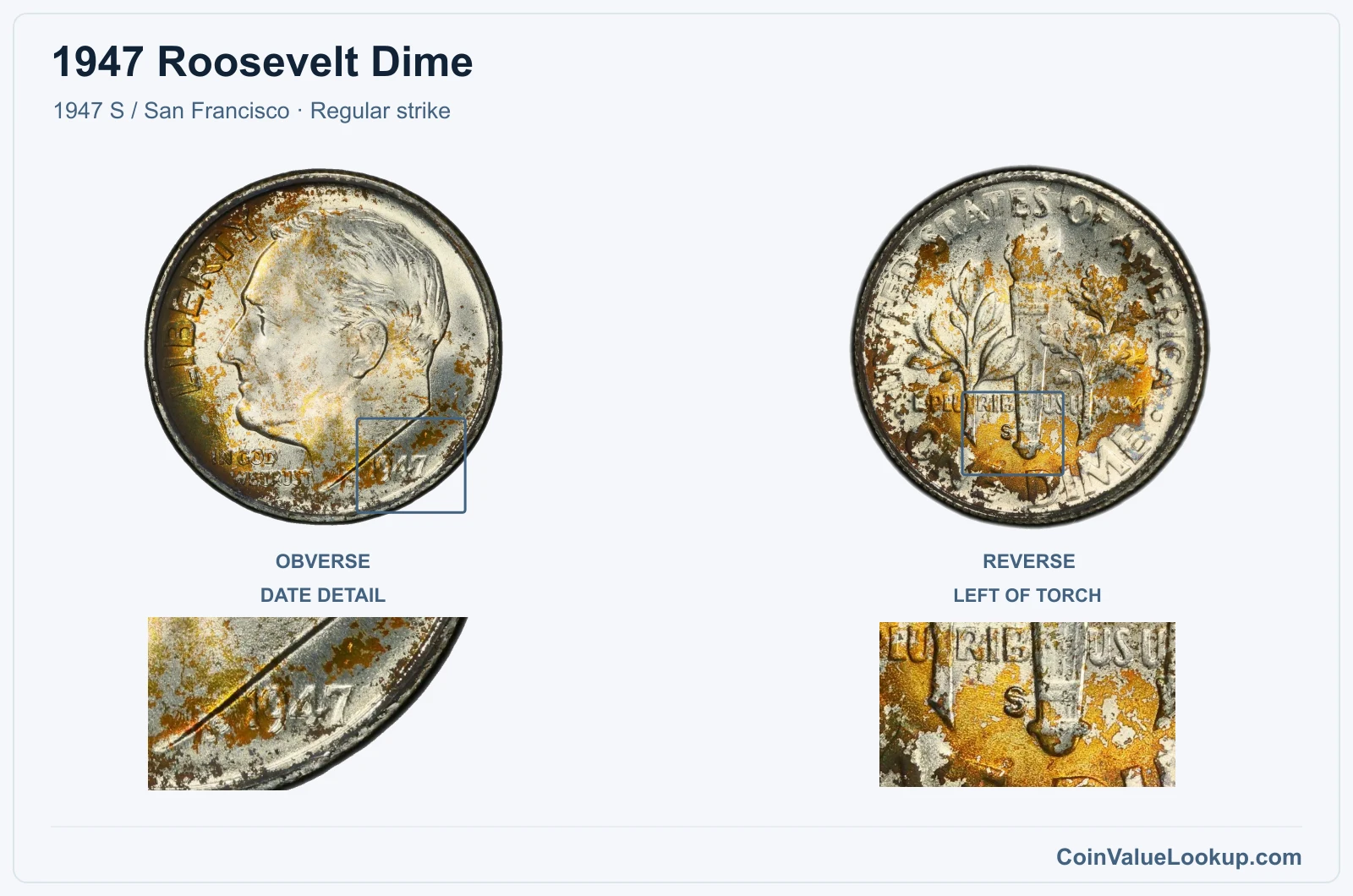
San Francisco's contribution carries an "S" mintmark beside the torch base. Guide values run about $5.81 at Good-4 through roughly $18 at MS65, matching the other mints in the USA Coin Book estimates for this date.
The 1947-S is also the mint associated with several known error varieties, including curved clips, doubled die reverses, and off-center strikes. That does not mean every 1947-S dime is special, but it does mean this mintmark is worth a closer look under magnification.
Full Bands coins from San Francisco should be compared against other 1947-S Full Bands examples at the same grade, since strike quality can differ from what Philadelphia or Denver produced.
Range Grade
Price Auction Records Appraisal PO PO 1
—
Coin Identifier FR FR 2
—
Coin Identifier AG AG 3
—
Coin Identifier G G 4
—
Coin Identifier
G 6
—
Coin Identifier VG VG 8
—
Coin Identifier
VG 10
—
Coin Identifier F F 12
—
Coin Identifier
F 15
—
Coin Identifier VF VF 20
—
Coin Identifier
VF 25
—
Coin Identifier
VF 30
Coin Identifier
VF 35
—
Coin Identifier XF XF 40
—
Coin Identifier
XF 45
—
Coin Identifier AU AU 50
—
Coin Identifier
AU 53
—
Coin Identifier
AU 55
—
Coin Identifier
AU 58
—
Coin Identifier MS MS 60
—
Coin Identifier
MS 61
—
Coin Identifier
MS 62
—
Coin Identifier
MS 63
—
Coin Identifier
MS 64
Coin Identifier
MS 65
Coin Identifier
MS 66
Coin Identifier
MS 67
Coin Identifier
MS 68
Coin Identifier
MS 69
—
—
—
MS 70
—
—
—
1947 Roosevelt Dime Error List
1. 1947 Roosevelt Dime — Curved Clipped Planchet
A curved clipped planchet error occurs when the blanking press overlaps a previously punched hole in the metal strip, leaving a smooth, crescent-shaped bite missing from the coin's edge. On a 1947-S dime, look for this smooth curved absence along the rim, then check both faces for the characteristic metal-flow distortion at the ends of the clip and a subtle area of weakness on the rim directly opposite the missing section.
A Heritage Auctions lot documents a 1947-S example with roughly 10% curved clip, certified NGC MS66. Genuine clips will not show fresh tool marks, file lines, or sharp edges.
If the missing area looks cut, bitten with pliers, or filed down, it is post-mint damage. Value depends on the authenticated identity, the coin's condition, and the severity of the clip, so individual assessment applies.
2. 1947 Roosevelt Dime — Doubled Die Obverse
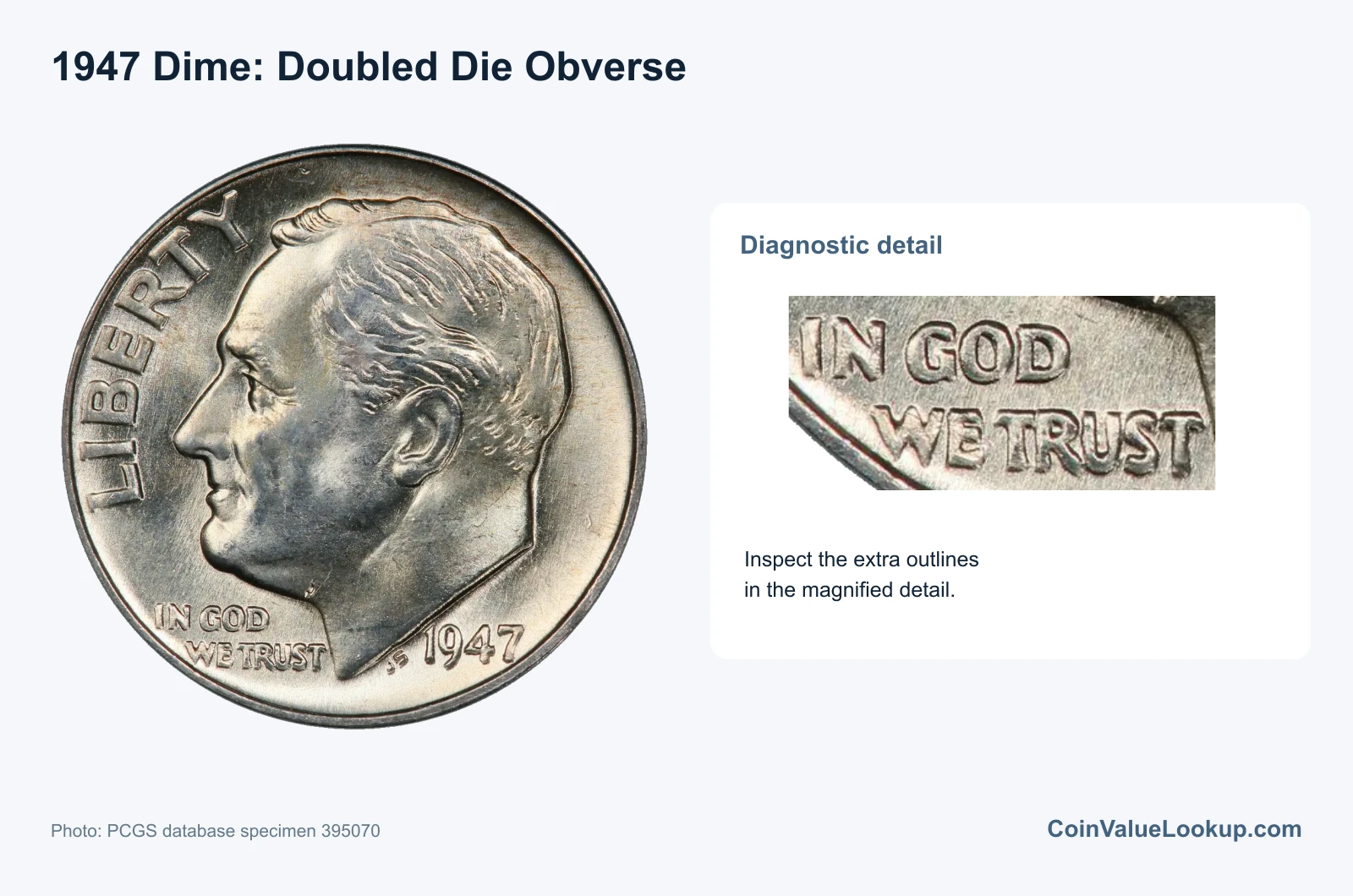
Doubled Die Obverse varieties on the 1947 Philadelphia dime show raised, separated doubling that was created in the die itself before any coins were struck. Under magnification, examine IN GOD WE TRUST, the first letters of LIBERTY, the date digits, and especially the JS designer initials near the truncation of Roosevelt's neck.
The doubling will appear as a distinct secondary image with rounded, raised edges rather than a flat shelf.
Do not confuse this with flat mechanical doubling, which produces shelf-like smearing without the rounded profile. Ordinary wear can also blur letters in ways that mimic doubling at first glance.
A certified MS65 example with documented obverse doubling has appeared at auction. Pricing is individual, driven by the coin's condition, the strength and visibility of the doubling, and third-party authentication.
3. 1947 Roosevelt Dime — Doubled Die Reverse
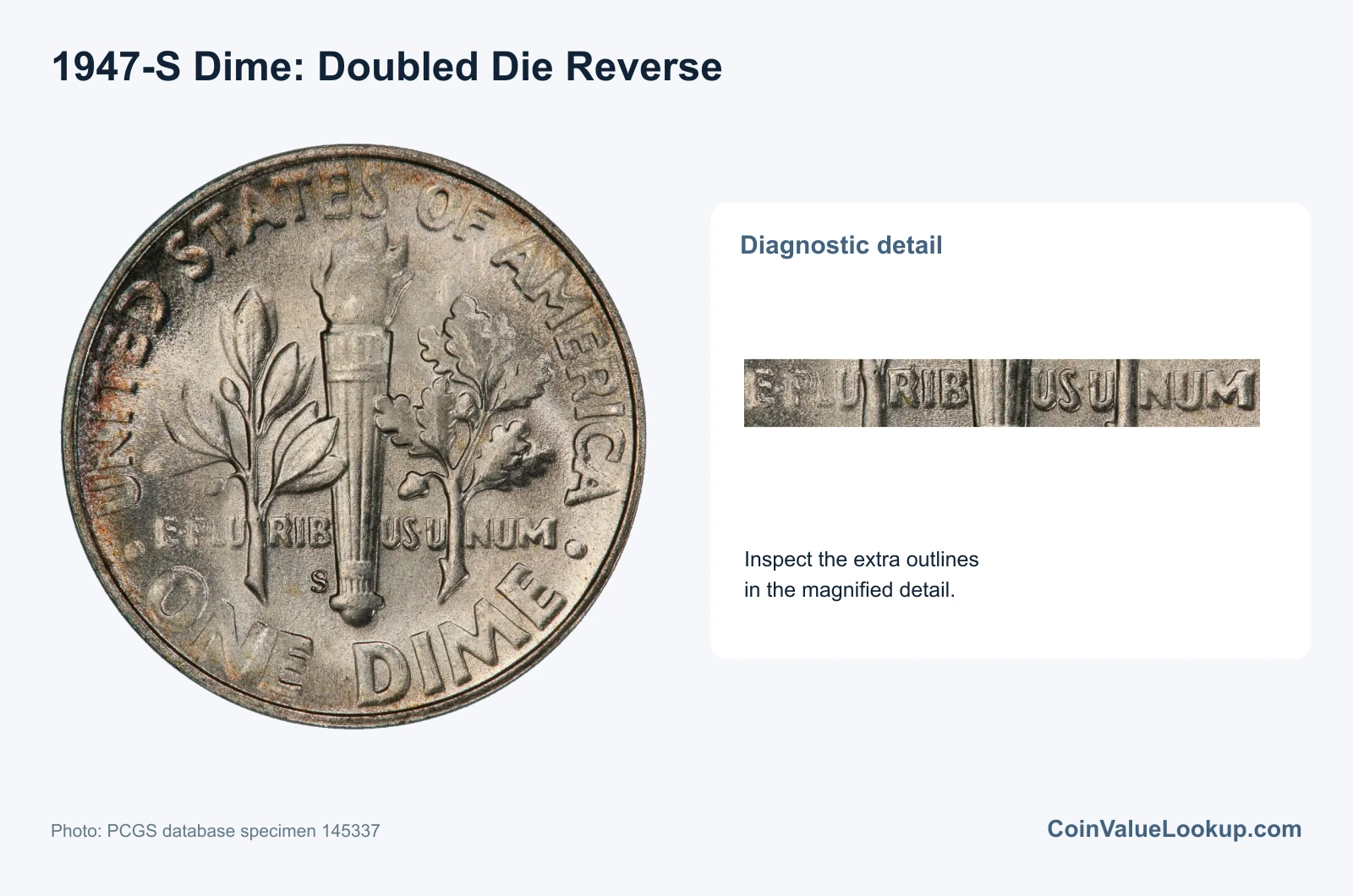
A Doubled Die Reverse on the 1947-S dime displays rounded, duplicated detail on the torch structure and reverse lettering. Under magnification, look for a secondary outline on the torch flames, the horizontal bands, or the inscription UNITED STATES OF AMERICA.
The doubling should appear raised and rounded, matching documented examples of this variety.
A repunched "S" mintmark is a completely different feature and should not be confused with a doubled die. Flat mechanical doubling — a common byproduct of loose die components — lacks the rounded separation profile of a true doubled die.
Certified specimens have been offered through specialist auction venues. Value hinges on the specific die marriage, the clarity of doubling, and the coin's overall grade, so each piece warrants individual assessment.
4. 1947 Roosevelt Dime — Off-Center Strike
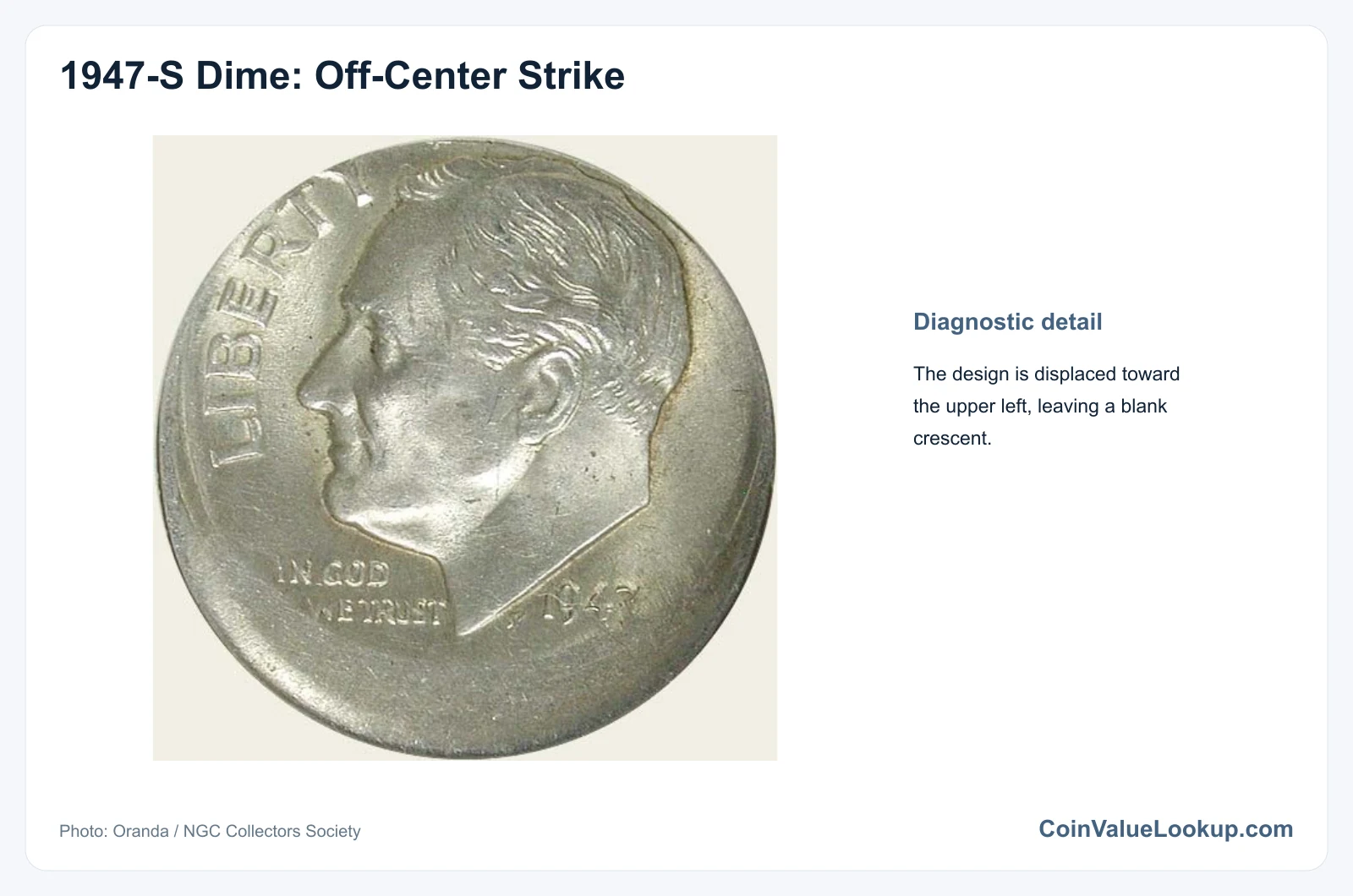
An off-center strike happens when the planchet is not seated properly between the dies, shifting the entire design toward one side and leaving a blank crescent on the opposite edge. On the 1947-S, a certified example graded NGC MS62 with Full Torch designation shows approximately 15% off-center displacement, with the date still fully visible on both sides of the coin.
The date being readable is critical to collectibility and value. A broadstrike, which retains the full design but lacks a raised rim, is a different error.
One-sided die misalignment or post-strike rim damage should also be ruled out. Each off-center coin is assessed individually based on the percentage of displacement, whether the date and mintmark survive, and overall condition.
5. 1947 Roosevelt Dime — Ragged Clipped Planchet
A ragged clipped planchet differs from the smooth curved clip. It results from a strip-end blank rather than an overlapping circular punch, so the missing portion has an irregular, jagged profile instead of a neat crescent.
A documented 1947 Philadelphia dime shows this irregular original edge running from approximately the 5 o'clock to the 6:30 position, attributed by a specialist dealer.
The key diagnostic is the edge character. A genuine ragged clip will show original metal flow consistent with the blank's formation, not fresh breaks or saw marks.
A broken or cut silver dime can mimic this at a glance, so examine the edge carefully under magnification. The absence of a smooth curved bite does not automatically mean damage.
Value depends on authentication, the coin's preservation, and the extent of the clip.
6. 1947 Roosevelt Dime — Over-Mintmark
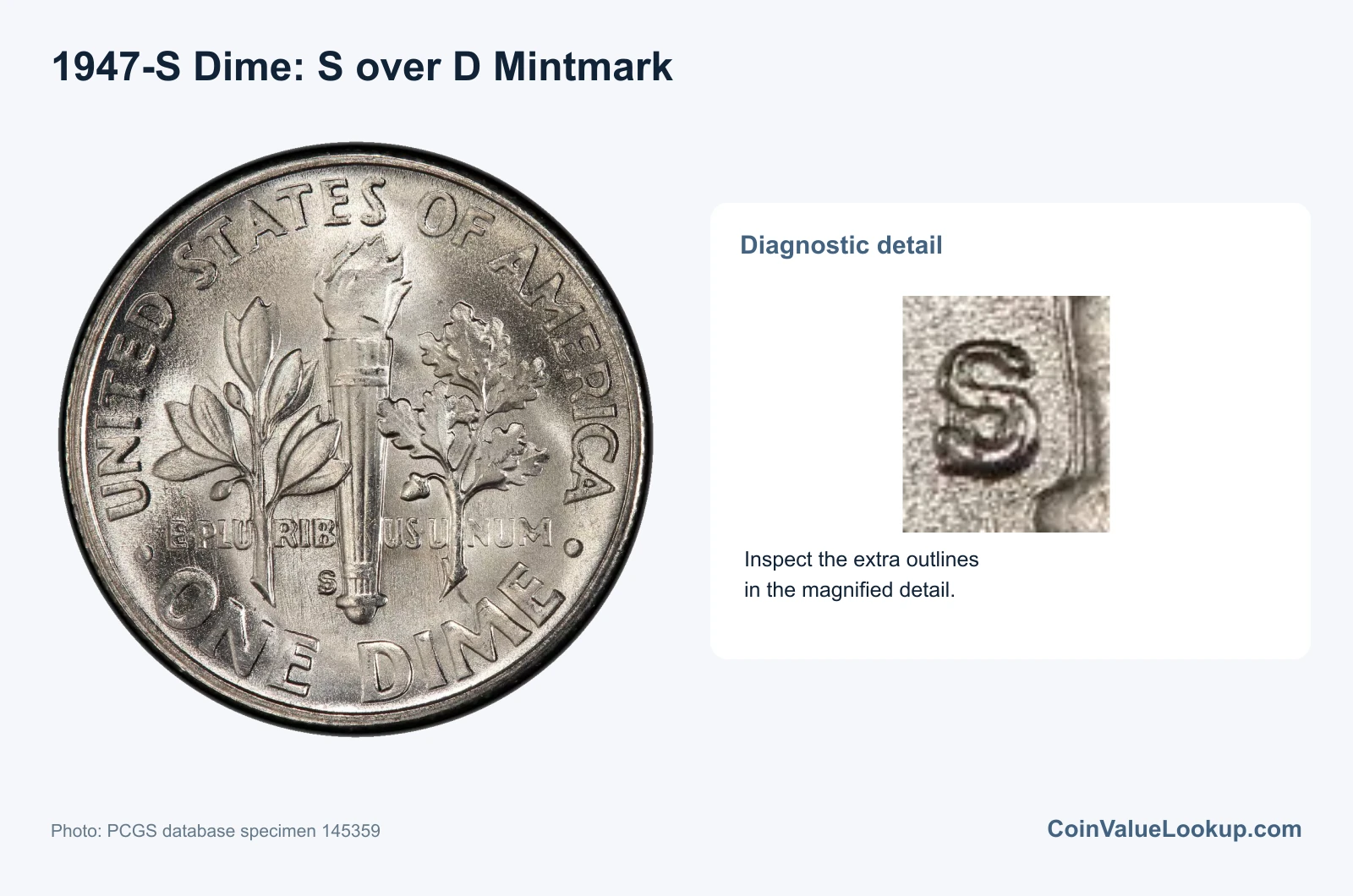
The 1947-S/D Over-Mintmark variety shows traces of a D mintmark beneath the final S punch on the reverse. This happened at the Mint when a die initially prepared with one mintmark was re-punched with the correct letter for a different facility.
Look under magnification for remnants of the D's curved outline peeking from behind or beside the S.
This is not the same as a repunched mintmark, where the same letter was simply re-entered at a slight offset. Nor is it a die chip or contact damage near the mintmark.
Visibility of the underlying letter and the coin's overall condition both affect value, so individual assessment is appropriate. No specific price range is adopted for this variety.
7. 1947 Roosevelt Dime — Struck-Through Error
A struck-through error occurs when foreign material — grease, cloth fiber, a metal fragment, or another obstruction — sits between the die and the planchet during striking. The result is a localized depression or incomplete design element where the material blocked the die's impression.
Grease fill-ins tend to produce soft, filled areas in the lettering or design, while a retained foreign object can leave a sharper, more defined impression.
Do not confuse struck-through areas with ordinary wear, scratches from circulation, cleaning damage, or a weakly struck region of the die. The depression should correspond to both the coin's surface and the surrounding design flow.
Value depends on the type and size of the obstruction, the coin's condition, and the visual drama of the error.