1979 Roosevelt Dime Coin Value: How Much Is It Worth?
Most 1979 Roosevelt dimes you find in pocket change are worth face value — ten cents. In higher uncirculated grades the numbers climb a bit: a guide estimate puts an MS 65 Philadelphia or Denver piece at about $2.79, while an ordinary PR 65 proof starts around $3.08.
The real upside comes from correctly identified proof varieties and genuine mint errors, so keep reading before you assume yours is ordinary.
Fast Way to Identify Your 1979 Roosevelt Dime
The quickest way to start figuring out what you have is to upload clear photos of both the front and back of your coin. Our identification tool can give you a preliminary read on the mint mark, general condition, and whether your dime might be one of the more collectible varieties.
It is not a substitute for professional authentication, but it is a solid first step.
1979 Roosevelt Dime Value
Upload both sides of your 1979 Roosevelt Dime.
Front Obverse
Upload photo
Back Reverse
Upload photo
Which 1979 Roosevelt Dime Versions Are Worth Money?
- Well-preserved business strikes with clear, fully separated torch bands can command a premium over typical uncirculated examples.
- S-proof Type 2 dimes carry a higher guide estimate than Type 1 proofs — look for the open, rounded S mint mark.
- Off-center strikes on confirmed 1979-D dimes have documented auction activity; one MS 63 example sold for $92.
- Clipped planchet errors with substantial missing metal and original curved edges are collected as mint errors.
- Broadstrike-with-multiple-clips combinations are scarce and grade as a single error category.
- Multiple-strike and wrong-planchet errors have been reported for 1979 dimes; individual value depends on authentication and severity.
Step 1: Identify Your 1979 Roosevelt Dime Mint Mark and Version
Start by confirming the date reads 1979 and the design shows Franklin Roosevelt's portrait on the obverse with a torch flanked by branches on the reverse. The coin should weigh about 2.27 grams and measure roughly 17.9 mm across — standard copper-nickel clad over a copper core, no silver.
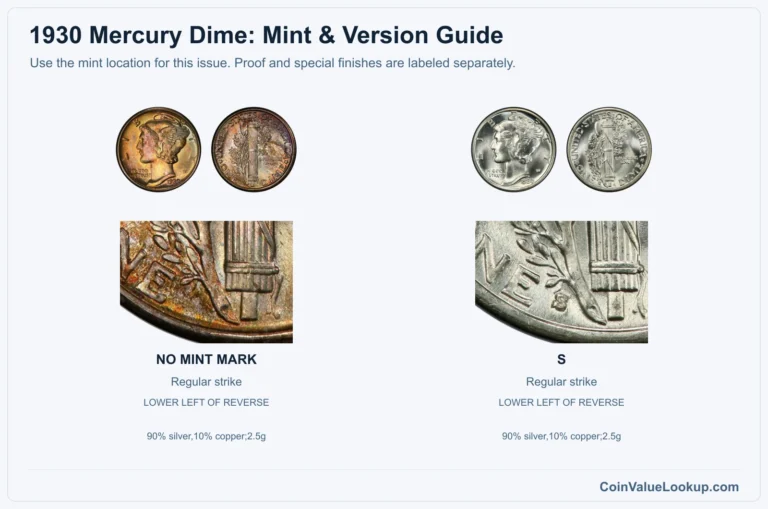
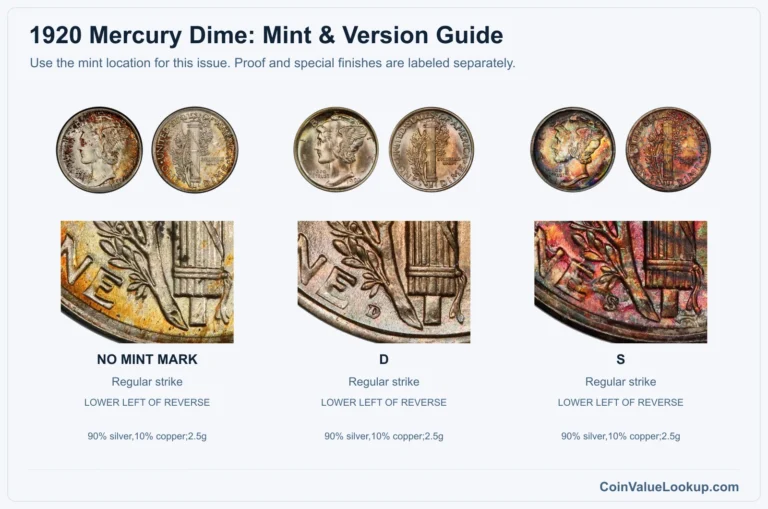
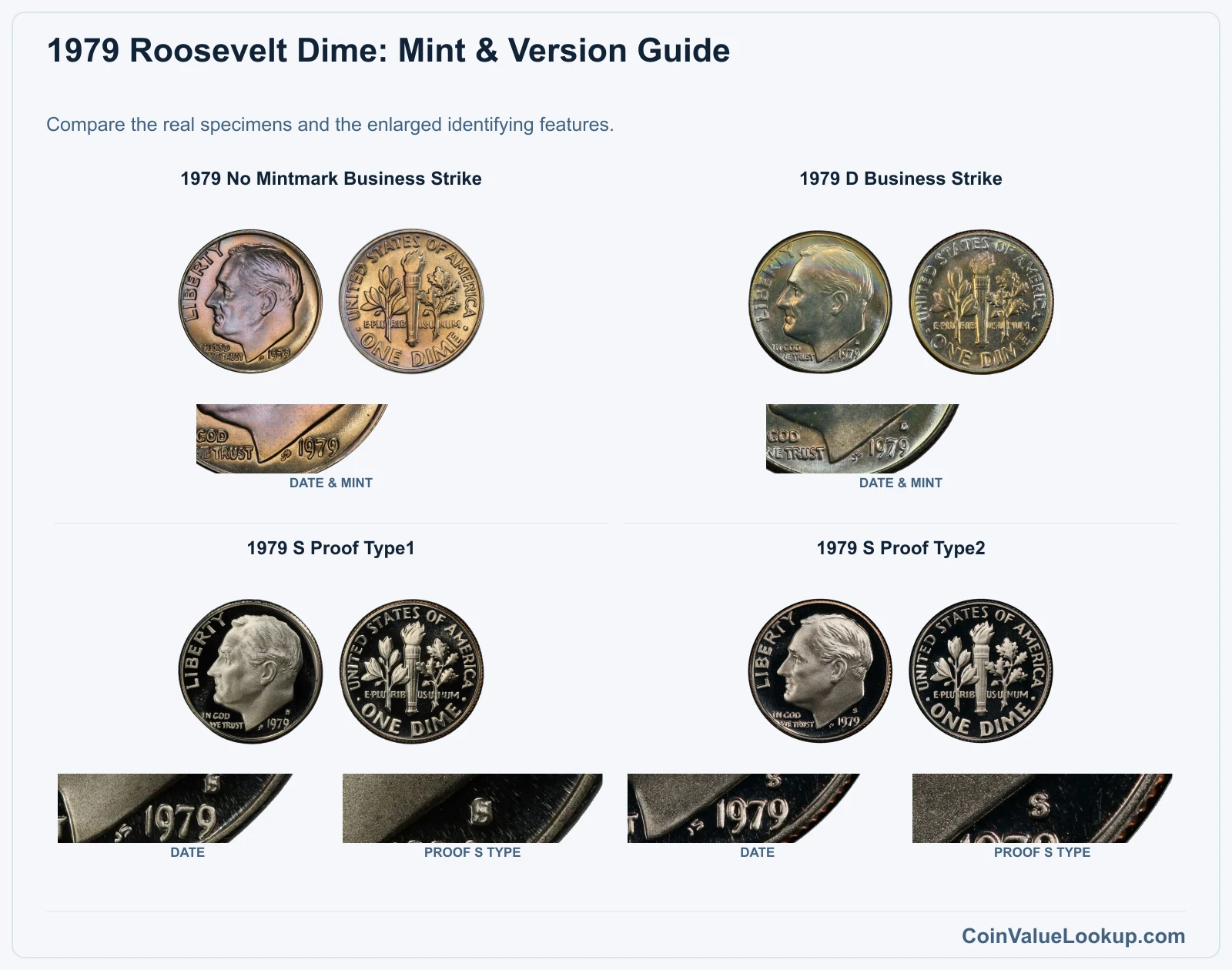
Next, check for a mint mark near the date on the obverse. No mint mark means Philadelphia.
A "D" means Denver. An "S" means a San Francisco proof.
If you have an S proof, look closely at the letter itself. The Type 1 "S" looks compact with filled-in counters — the loops of the letter appear blobby or closed.
The Type 2 "S" is rounder and more open, with clearly visible counters. Both are normal mint-mark styles for 1979 proofs, not errors.
Telling them apart matters because they carry different guide values.
Step 2: Check Your 1979 Roosevelt Dime Grade
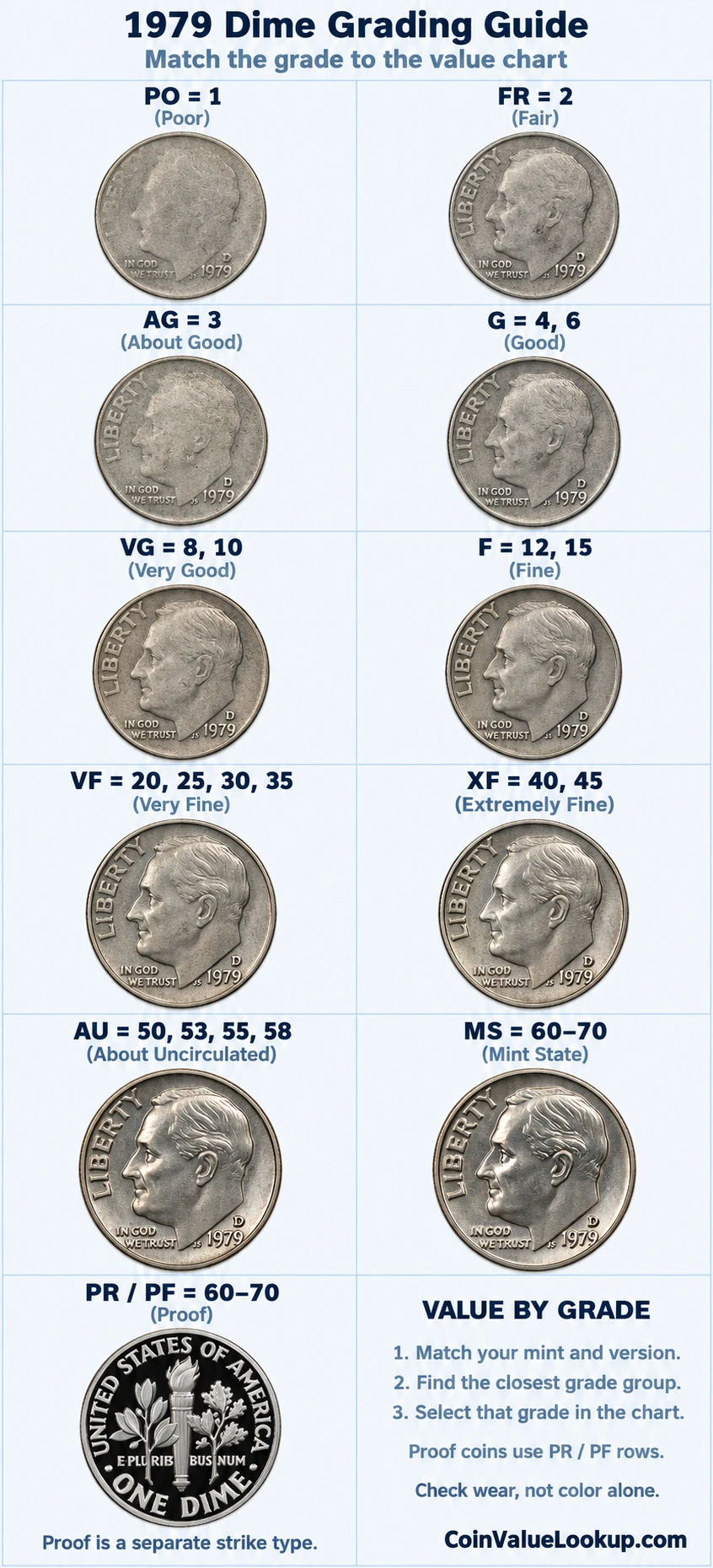
Hold your dime under good light and check Roosevelt's cheekbone, jawline, and the hair detail above his ear. These are the first areas to show wear.
On the reverse, examine the torch lines and leaf veins.
A coin with full original luster and no contact marks lands in the Mint State range. Once you see smoothing on the cheek or flattened hair strands, you are in circulated territory.
Cleaning, polishing, or heavy scratches drag the grade down regardless of remaining detail — brightness alone does not equal a high grade.
Use the comparison image nearby to match your coin's wear level against known grade examples. For proofs, remember that the mirror finish and any contrast between fields and devices describe the manufacturing method, not a grade above Mint State.
"Full Bands" — where both horizontal torch-band pairs show clear separation — is a strike designation that can add a premium, but it is not an error.
Step 3: Check 1979 Roosevelt Dime Value by Mint and Version
1979 Roosevelt Dime — No Mintmark Business Strike
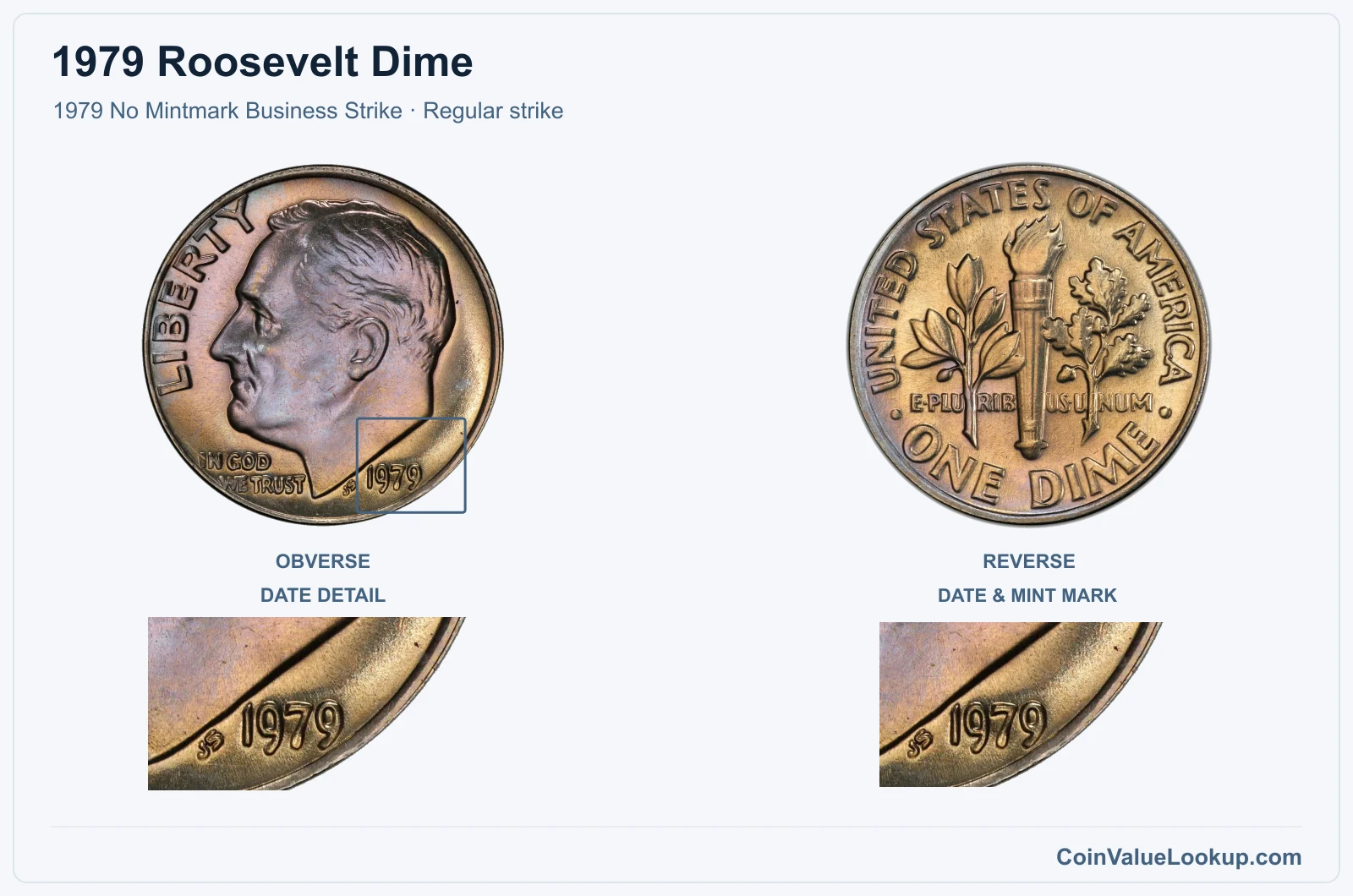
The 1979 Philadelphia dime carries no mint mark — that is completely normal for this year. Philadelphia did not add a "P" to dimes until 1980.
A USA Coin Book guide estimate places the MS 65 value at about $2.79.
In circulated grades, expect face value. The jump comes when a coin retains full original luster with minimal bag marks, and especially when the torch bands show complete separation.
Check the area just to the left of the date to confirm no tiny letter is hiding there; if it is blank, you have the Philly issue.
Range Grade
Price Auction Records Appraisal PO PO 1
—
Coin Identifier FR FR 2
—
Coin Identifier AG AG 3
—
Coin Identifier G G 4
—
Coin Identifier
G 6
—
Coin Identifier VG VG 8
—
Coin Identifier
VG 10
—
Coin Identifier F F 12
—
Coin Identifier
F 15
—
Coin Identifier VF VF 20
—
Coin Identifier
VF 25
—
Coin Identifier
VF 30
—
Coin Identifier
VF 35
—
Coin Identifier XF XF 40
—
Coin Identifier
XF 45
—
Coin Identifier AU AU 50
—
Coin Identifier
AU 53
—
Coin Identifier
AU 55
—
Coin Identifier
AU 58
—
Coin Identifier MS MS 60
—
Coin Identifier
MS 61
—
Coin Identifier
MS 62
Coin Identifier
MS 63
—
Coin Identifier
MS 64
—
Coin Identifier
MS 65
—
Coin Identifier
MS 66
Coin Identifier
MS 67
Coin Identifier
MS 68
—
—
—
MS 69
—
—
—
MS 70
—
—
—
1979 Roosevelt Dime — D Business Strike
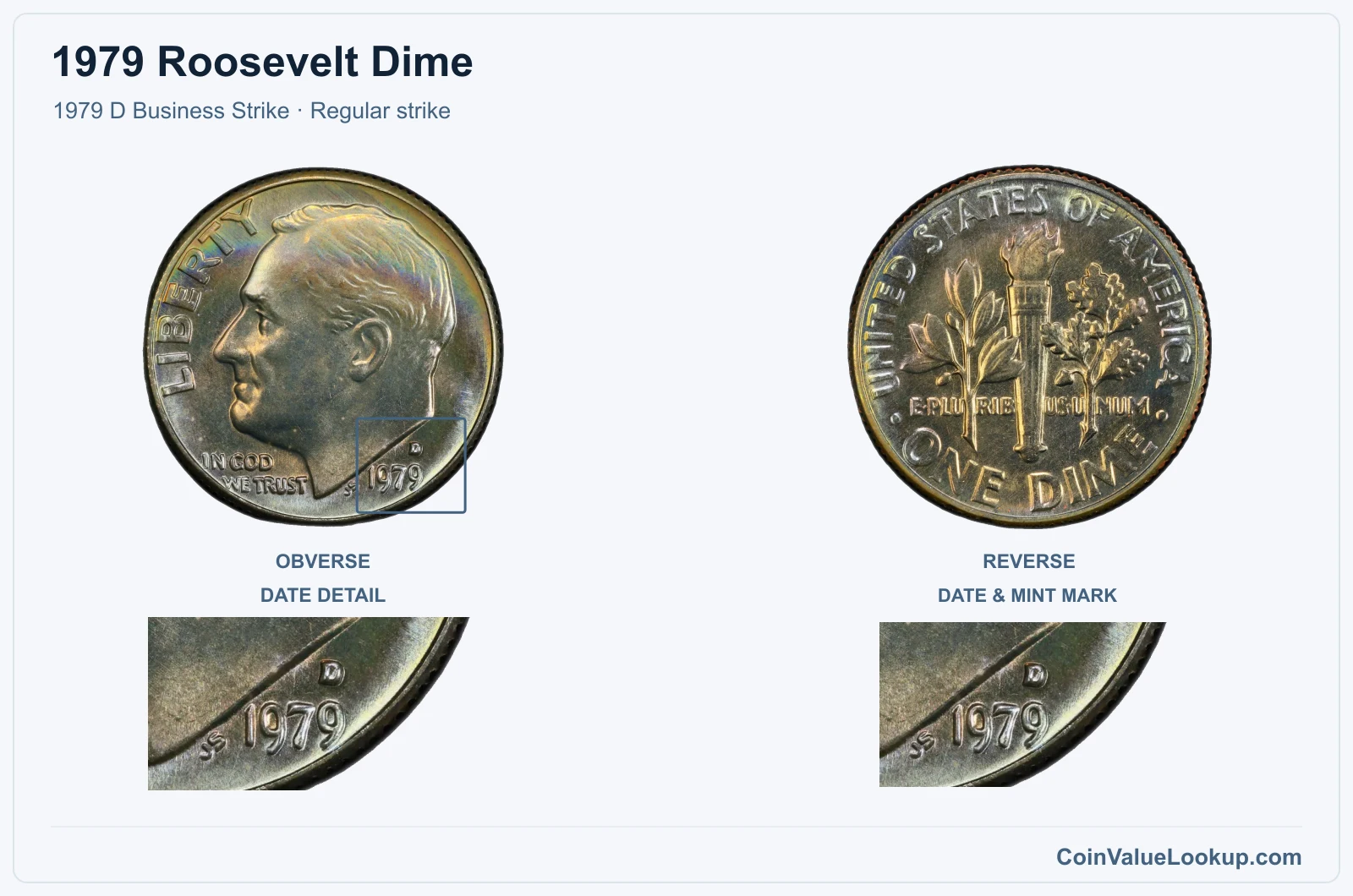
Denver's 1979 dime is identified by a small "D" near the date on the obverse. It is also copper-nickel clad over a copper core, weighing 2.27 grams.
The MS 65 guide estimate matches Philadelphia at $2.79.
Circulated examples are worth ten cents. For uncirculated coins, surface preservation and luster matter most.
Full separation of both horizontal torch-band pairs on the reverse — the Full Bands designation — can push value above the generic MS 65 point, so flip the coin over and look carefully.
Coin Value Lookup is a handy place to look up value guides for Roosevelt dimes and other U.S. coins if you want to compare across years and mints.
Range Grade
Price Auction Records Appraisal PO PO 1
—
Coin Identifier FR FR 2
—
Coin Identifier AG AG 3
—
Coin Identifier G G 4
—
Coin Identifier
G 6
—
Coin Identifier VG VG 8
—
Coin Identifier
VG 10
—
Coin Identifier F F 12
—
Coin Identifier
F 15
—
Coin Identifier VF VF 20
—
Coin Identifier
VF 25
—
Coin Identifier
VF 30
—
Coin Identifier
VF 35
—
Coin Identifier XF XF 40
—
Coin Identifier
XF 45
—
Coin Identifier AU AU 50
—
Coin Identifier
AU 53
—
Coin Identifier
AU 55
—
Coin Identifier
AU 58
—
Coin Identifier MS MS 60
—
Coin Identifier
MS 61
—
Coin Identifier
MS 62
—
Coin Identifier
MS 63
Coin Identifier
MS 64
Coin Identifier
MS 65
Coin Identifier
MS 66
Coin Identifier
MS 67
Coin Identifier
MS 68
Coin Identifier
MS 69
—
—
—
MS 70
—
—
—
1979 Roosevelt Dime — S Proof Type1
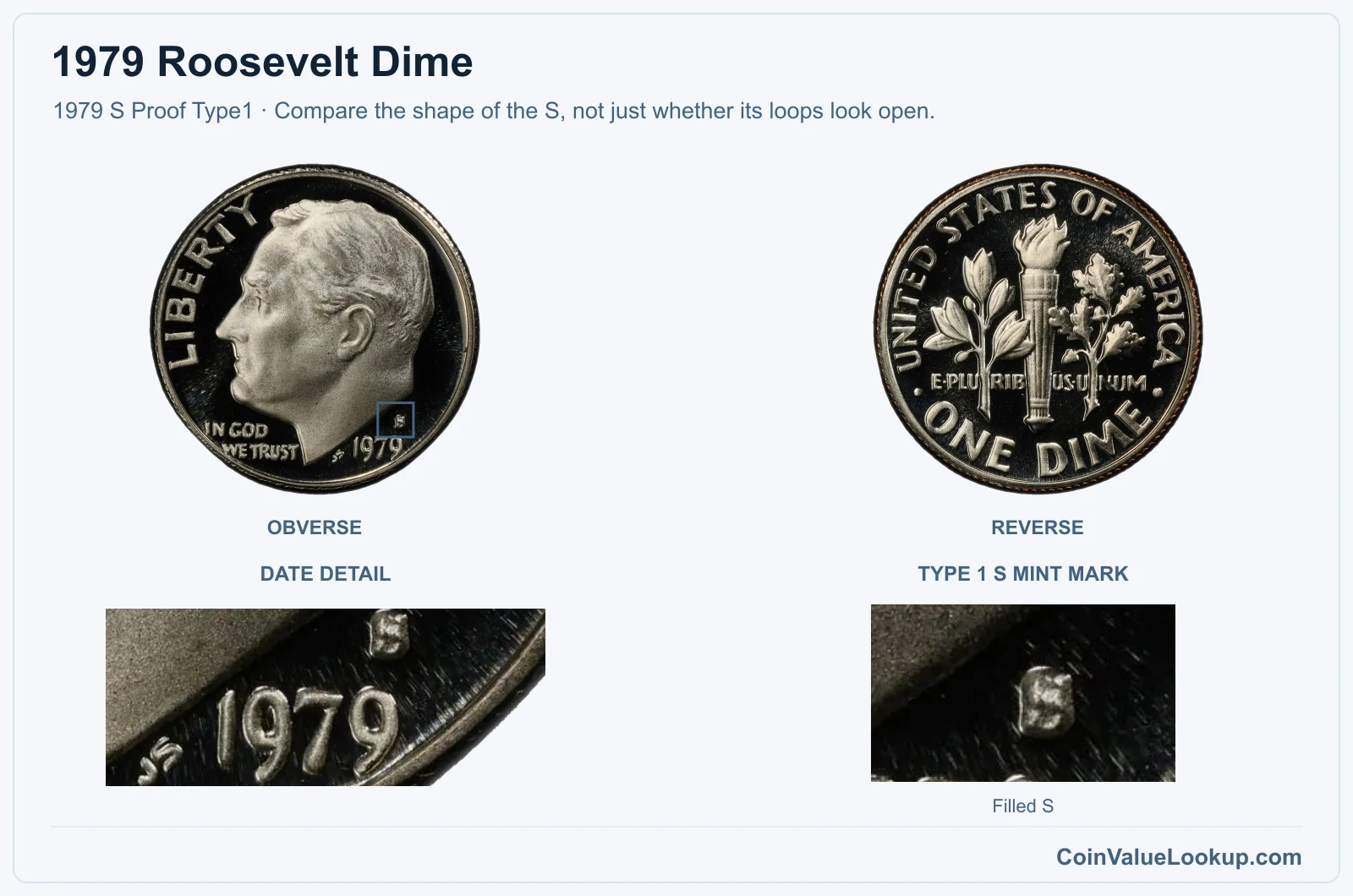
The 1979 S Proof Type 1 is the more common of the two proof styles struck at San Francisco. Look at the "S" mint mark: on a Type 1 it appears compact and somewhat blobby, with the internal loops (counters) filled in or nearly closed.
This is not damage or a filled die — it is simply the punch style used for part of the production run.
A guide estimate from USA Coin Book places the PR 65 value at roughly $3.08. Proofs were sold in sets, so most survivors are in decent shape.
Coins with strong contrast between frosted devices and mirror fields tend to attract more attention from collectors, but that contrast is a manufacturing characteristic, not a separate grade tier.
Range Grade
Price Auction Records Appraisal PR PR 1
—
Coin Identifier
PR 2
—
Coin Identifier
PR 3
—
Coin Identifier
PR 4
—
Coin Identifier
PR 6
—
Coin Identifier
PR 8
—
Coin Identifier
PR 10
—
Coin Identifier
PR 12
—
Coin Identifier
PR 15
—
Coin Identifier
PR 20
—
Coin Identifier
PR 25
—
Coin Identifier
PR 30
—
Coin Identifier
PR 35
—
Coin Identifier
PR 40
—
Coin Identifier
PR 45
—
Coin Identifier
PR 50
—
Coin Identifier
PR 53
—
Coin Identifier
PR 55
—
Coin Identifier
PR 58
—
Coin Identifier
PR 60
—
Coin Identifier
PR 61
—
Coin Identifier
PR 62
—
Coin Identifier
PR 63
—
Coin Identifier
PR 64
—
Coin Identifier
PR 65
—
Coin Identifier
PR 66
—
Coin Identifier
PR 67
—
Coin Identifier
PR 68
—
Coin Identifier
PR 69
Coin Identifier
PR 70
Coin Identifier
1979 Roosevelt Dime — S Proof Type2
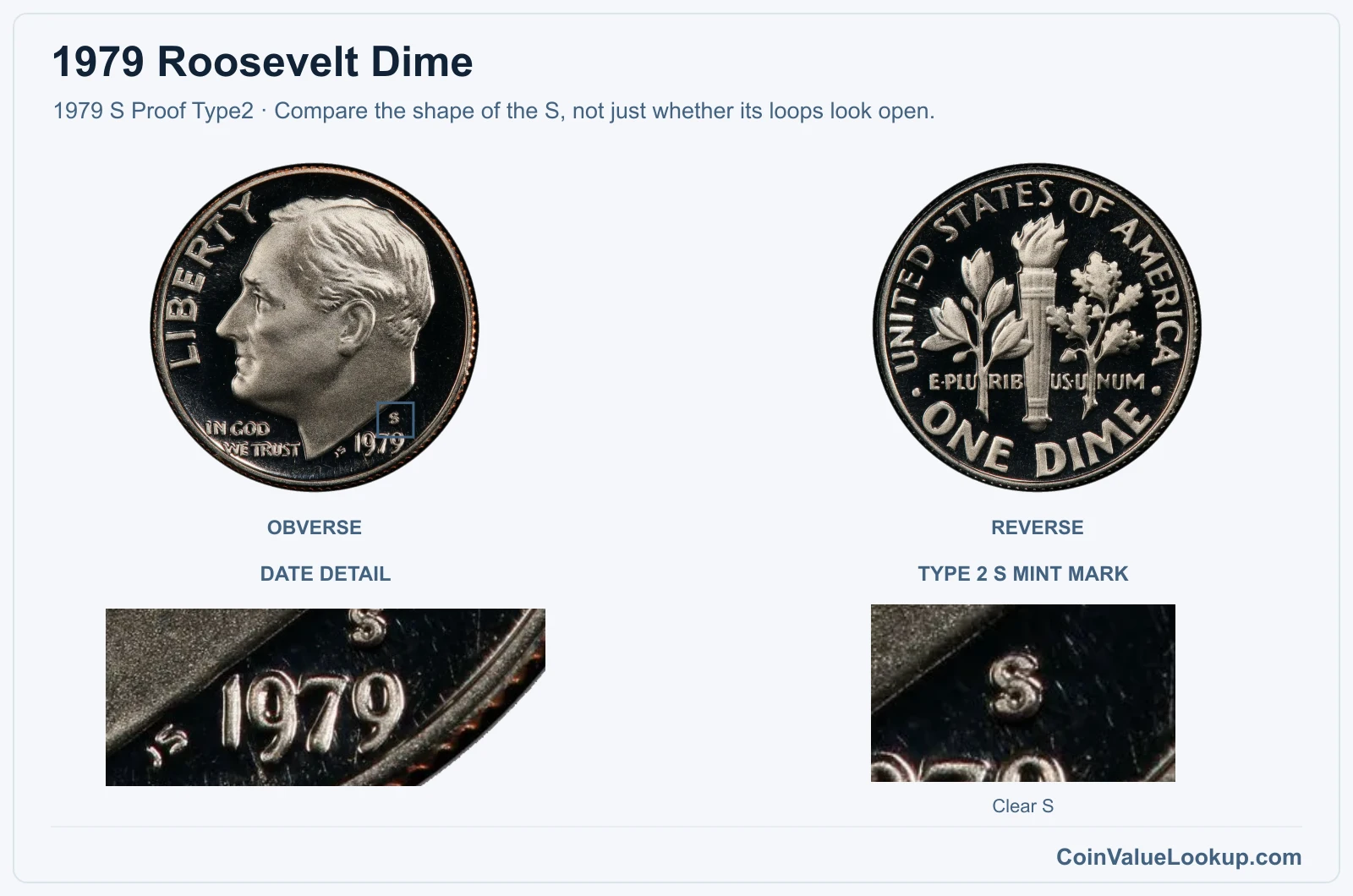
The 1979 S Proof Type 2 is the variety to watch for. Its "S" mint mark is noticeably rounder and more open — you can clearly see through the loops of the letter, unlike the filled-in look of the Type 1.
Compare both under magnification if you are unsure; the difference is consistent, not random.
The PR 65 guide estimate for the Type 2 is about $6.25, roughly double the Type 1 at the same grade level. That premium exists because the Type 2 punch was used for a smaller portion of the 1979 proof run.
Both are normal mint-mark styles, not missing-mint-mark errors. If someone tells you a 1979 proof with an S is a "No S" variety, they are mistaken — that is not a recognized issue for this date.
Range Grade
Price Auction Records Appraisal PR PR 1
—
Coin Identifier
PR 2
—
Coin Identifier
PR 3
—
Coin Identifier
PR 4
—
Coin Identifier
PR 6
—
Coin Identifier
PR 8
—
Coin Identifier
PR 10
—
Coin Identifier
PR 12
—
Coin Identifier
PR 15
—
Coin Identifier
PR 20
—
Coin Identifier
PR 25
—
Coin Identifier
PR 30
—
Coin Identifier
PR 35
—
Coin Identifier
PR 40
—
Coin Identifier
PR 45
—
Coin Identifier
PR 50
—
Coin Identifier
PR 53
—
Coin Identifier
PR 55
—
Coin Identifier
PR 58
—
Coin Identifier
PR 60
—
Coin Identifier
PR 61
—
Coin Identifier
PR 62
—
Coin Identifier
PR 63
—
Coin Identifier
PR 64
—
Coin Identifier
PR 65
—
Coin Identifier
PR 66
—
Coin Identifier
PR 67
Coin Identifier
PR 68
Coin Identifier
PR 69
Coin Identifier
PR 70
Coin Identifier
1979 Roosevelt Dime Error List
1. 1979 Roosevelt Dime — Off-Center Strike
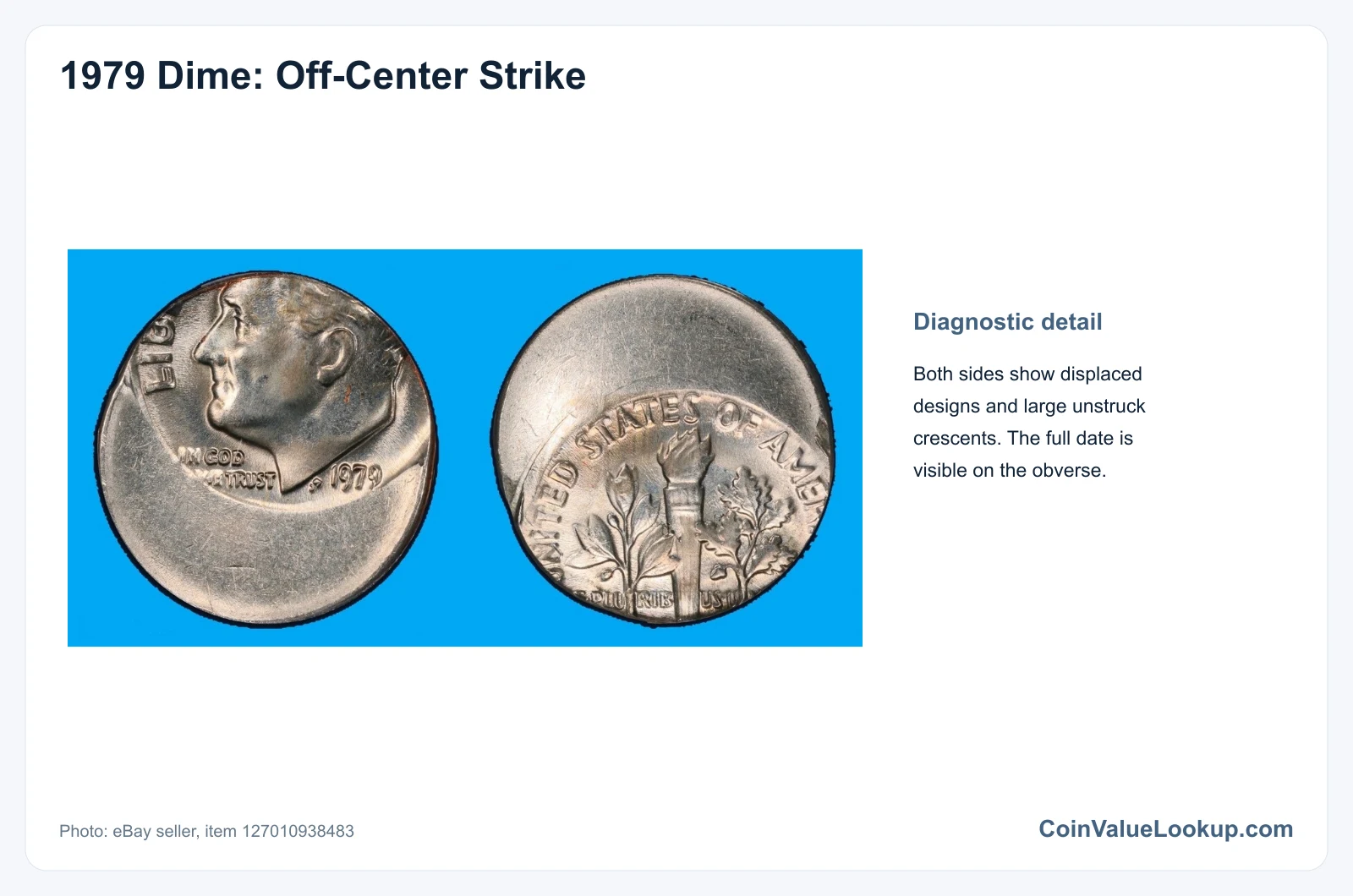
An off-center strike happens when the planchet is not properly seated in the collar before the dies come together, so part of the design is missing and a blank crescent appears. The documented 1979-D example shows roughly 70 percent off center toward the 9 o'clock position, yet retains the date and D mint mark — that retained date is critical to collectibility.
A PCGS MS 63 specimen sold at Heritage Auctions for $92 in May 2005. The distorted date visible on that coin is an as-made feature of the misalignment, not post-mint damage.
Do not confuse a slight misaligned die (where the full design is present but shifted) or a damaged rim with a genuine off-center strike. A real off-center piece will have a smooth, unstruck blank area with no rim on that side.
2. 1979 Roosevelt Dime — Clipped Planchet
A clipped planchet error occurs when the blanking press overlaps a previously punched area of the metal strip, producing a coin blank with a curved bite missing. The documented 1979-D example, certified PCGS MS 64, shows about 30 percent of the planchet missing.
Both clip endpoints and the original curved edge should be visible.
There is no broadly adopted price range for clipped 1979 dimes. Value depends heavily on the size of the clip, whether the date and mint mark survive, overall condition, and third-party certification.
Each piece needs individual assessment.
Watch out for coins that have been cut, filed, or ground down after leaving the mint. Post-mint damage typically produces straight or irregular edges rather than the smooth, concave arc of a genuine clip, and the Blakesley effect — a weakness opposite the clip — will be absent on fakes.
3. 1979 Roosevelt Dime — Broadstrike with Multiple Clips
This is a combination error: the coin was struck outside the retaining collar (broadstrike), causing it to spread wider than normal, and the planchet itself had multiple clips from blanking-press overlap. The two problems coexist on a single piece, and they are treated as one combined error rather than separately.
The documented 1979-D example was certified by ANACS as MS 60 Details with notations for corrosion and damage — those surface issues are not part of the mint error and reduce the coin's appeal. No adopted price range exists for this combination, so value comes down to individual assessment of error severity, visibility, and surface condition.
To tell a genuine broadstrike-with-clips from post-mint abuse, look for the expanded diameter, absent collar marks, and the characteristic curved clip edges. Corrosion or tooling marks are separate from the error itself.
4. 1979 Roosevelt Dime — Double / Multiple Strike
A multiple-strike error means the coin received more than one blow from the dies, with at least one impression displaced or rotated from the others. The result is overlapping or separated design elements — you might see a second partial portrait shifted from the first, not just thicker lettering.
This category has been reported for 1979 dimes. No specific price range is adopted here; the value of any individual example depends on how many strikes occurred, how dramatically they are displaced, and the coin's overall condition.
Third-party authentication matters because the visual effect can superficially resemble a doubled die or post-mint impressions made outside the minting process.
Look for distinct, separate design impressions rather than the flat shelf or spread typical of machine doubling. If the extra image looks stamped in rather than mechanically pushed, that is a better sign.
5. 1979 Roosevelt Dime — Wrong Planchet / Off-Metal Strike
A wrong-planchet strike means a blank intended for a different denomination or purpose ended up in the dime press. The coin will show the full Roosevelt dime design but on a planchet that differs in weight, diameter, edge characteristics, or some combination of these from a normal dime blank.
This category has been reported for 1979 dimes. No specific price is adopted, because value hinges on which planchet was used, how completely the design transferred, and the coin's authenticated condition.
Each example must be evaluated individually.
To check, weigh your coin on a precise scale (a normal 1979 dime is about 2.27 grams) and measure the diameter (roughly 17.9 mm). If either measurement is clearly off, look at the edge — a reeded edge versus a plain edge, or a different thickness, can confirm a wrong blank.
Rule out plating loss, acid-treated coins, and deliberate alterations first; those are far more common than genuine off-metal strikes.
6. 1979 Roosevelt Dime — Doubled Die Obverse
A doubled die obverse is a die variety where the hub impression was slightly misaligned during die manufacture, producing consistent doubling on every coin struck from that die. For 1979 dimes, a minor doubled die obverse has been reported.
Look at the obverse lettering — especially LIBERTY and IN GOD WE TRUST — under magnification with steady, angled light. Genuine doubled die doubling shows as a consistent separation or notching on one side of the letters, and it will appear in the same direction on every affected element.
No specific price is adopted for this variety. Its value depends on the strength and visibility of the doubling plus the coin's condition.
The key distinction is separating it from machine doubling, which produces a flat, shelf-like spread usually toward the rim. Worn die contours and lighting reflections can also mimic doubling to the untrained eye, so compare carefully against a known normal example.