1979 Susan B. Anthony Dollar Coin Value: How Much Is It Worth?
The 1979 Susan B. Anthony Dollar was the first small-size dollar coin of the modern era, and most examples are still worth close to face value.
Guide estimates for explicitly listed grades and versions range from about $6.25 to $69.00, depending on mint, finish and variety. That does not mean every coin falls in that window — ordinary circulated pieces trade for much less.
Before you assign any value, figure out which mint struck your coin, whether it is a business strike or proof, and whether it belongs to one of the premium varieties described below.
Fast Way to Identify Your 1979 Susan B. Anthony Dollar
The quickest way to start is to snap clear photos of both sides of your coin and upload them here for a preliminary identification. Good lighting and a steady hand help — get the mintmark area near the shoulder in focus.
This tool can help sort out mint, finish and general variety from your images, though it is not a substitute for professional certification.
1979 Susan B. Anthony Dollar Value
Upload both sides of your 1979 Susan B. Anthony Dollar.
Front Obverse
Upload photo
Back Reverse
Upload photo
Which 1979 Susan B. Anthony Dollar Versions Are Worth Money?
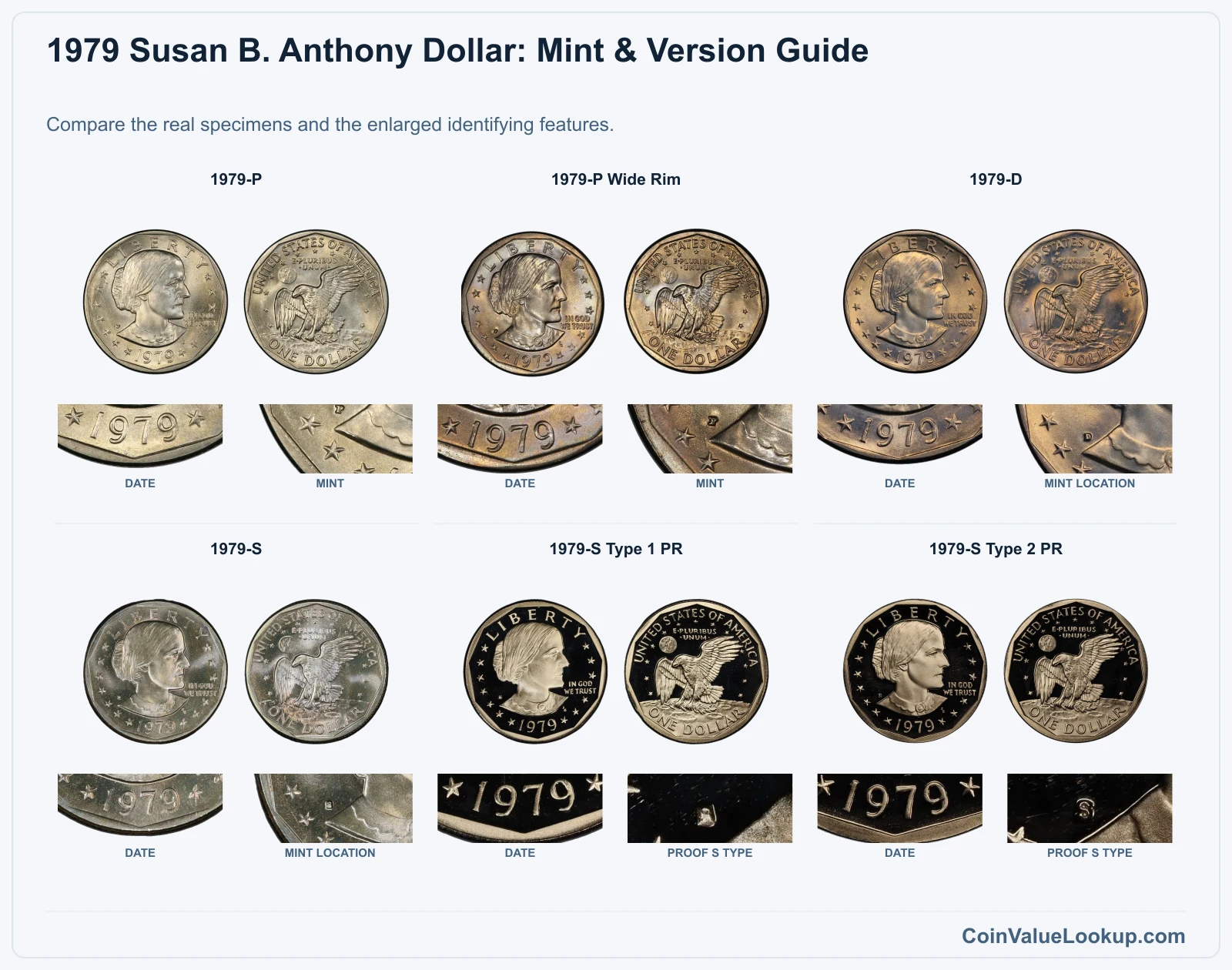
- 1979-P Wide Rim (Near Date) — the date sits closer to the rim than normal Philadelphia strikes, and a guide estimate of about $26.00 in MS63 makes it worth pulling from pocket change.
- 1979-S Type 2 Proof (Clear S) — the sharply defined S mintmark is scarcer than the common filled-S Type 1; a guide estimate around $69.00 in PR65 puts it well above ordinary proofs.
- 1979-S Type 1 Proof (Filled S) — still a collectible proof finish, though at roughly $6.25 in PR65 it is the most affordable entry in the proof lineup.
Step 1: Identify Your 1979 Susan B. Anthony Dollar Mint Mark and Version
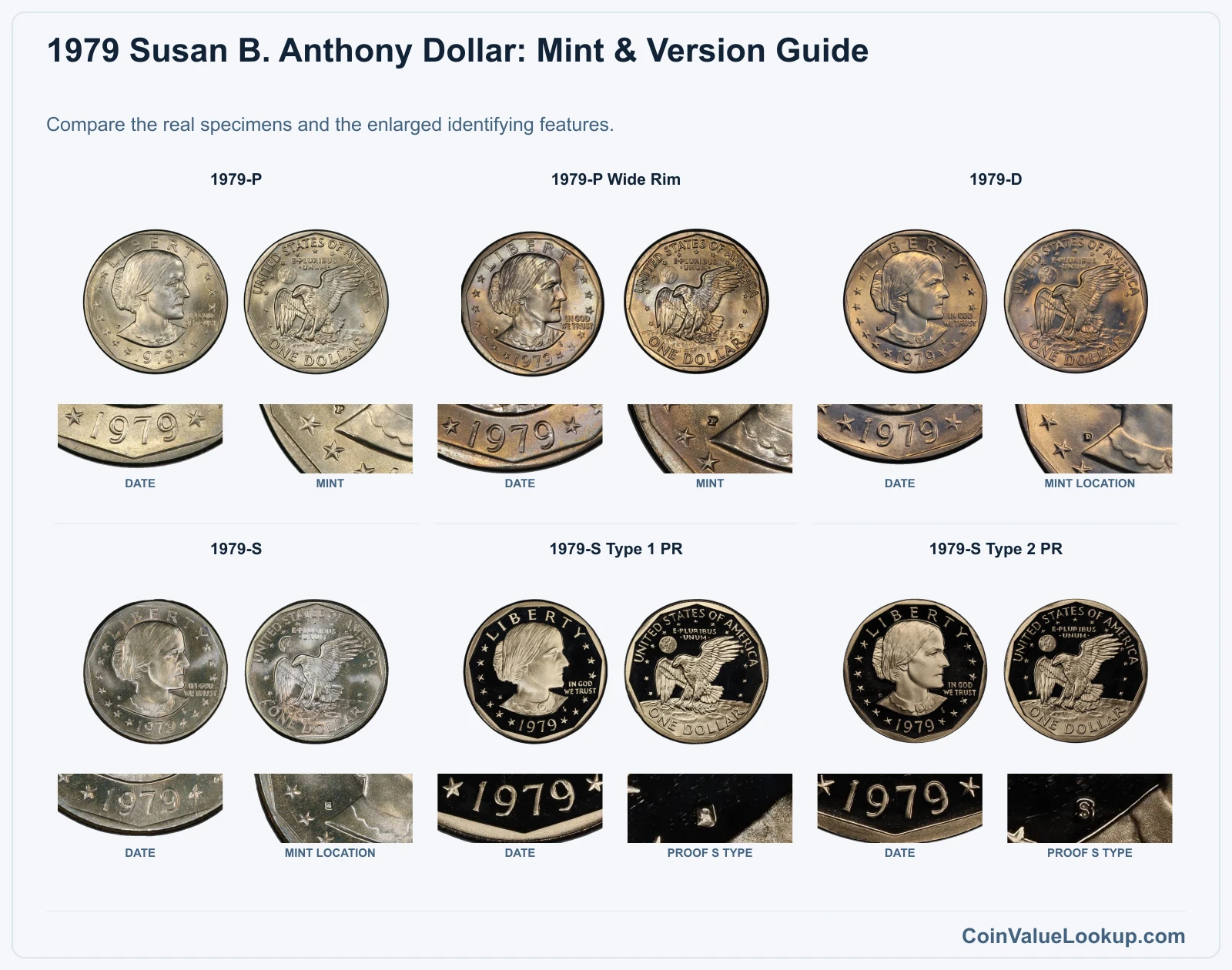
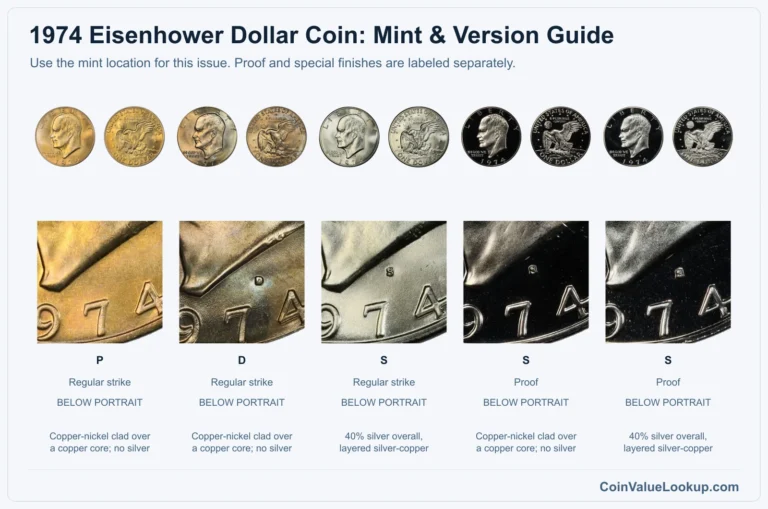
Look on the obverse near Susan B. Anthony's left shoulder for a small letter: P for Philadelphia, D for Denver, or S for San Francisco.
All 1979 SBA dollars are copper-nickel clad over a copper core — none contain silver, so skip the magnet test and silver-acid kits.
Business strikes from all three mints exist. San Francisco also produced proof coins in two distinct mintmark styles: Type 1 (filled, blobby S) and Type 2 (clear, sharply cut S).
Do not confuse these with the 1981 Type 2, which has a different punch shape.
Philadelphia coins split into two rim varieties. The common Narrow Rim (Far Date) has a visible gap between the bottom of the date and the rim.
The scarcer Wide Rim (Near Date) pushes the date noticeably closer to the rim edge. Hold two examples side by side and the difference is obvious.
The coin weighs 8.10 grams and measures 26.50 mm with a reeded edge. If yours deviates significantly from those specs, you may have an error or an altered coin.
Step 2: Check Your 1979 Susan B. Anthony Dollar Grade
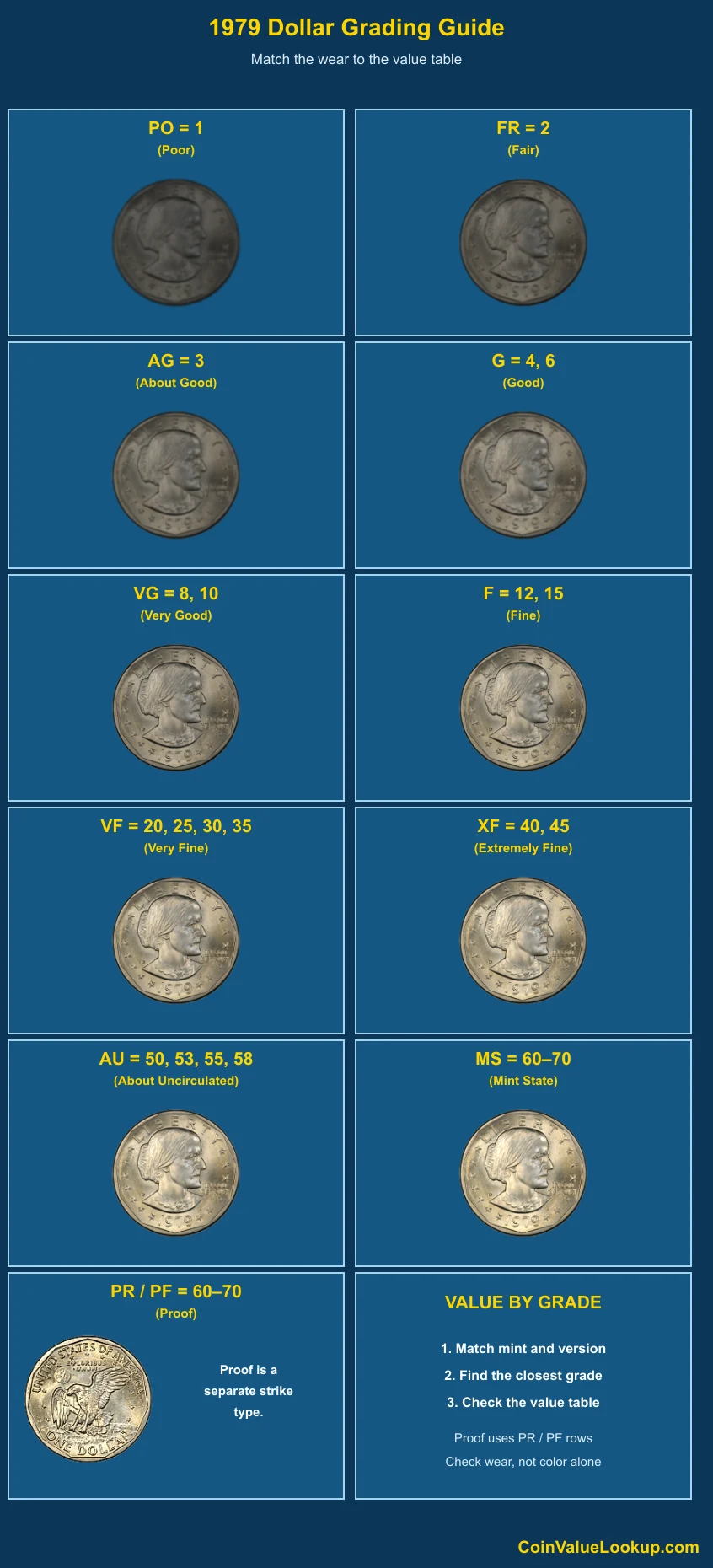
Focus on three wear points. On the obverse, check the cheek and the hair detail above the ear — these are the highest relief areas and show friction first.
On the reverse, the eagle's breast feathers lose definition early.
A coin with full hair strands, sharp cheek contour and complete eagle breast detail is likely Mint State. Once you see slight smoothing on the cheek or the hair above the ear, you are looking at About Uncirculated or below.
Heavy flatness across both high points drops the coin into lower circulated grades.
For proofs, grading works differently. Ignore the mirror finish as a sign of grade — proof is a manufacturing method, not a condition above Mint State.
Instead, examine the fields for hairlines from handling, haze from improper storage, and contact marks from other coins. Compare your coin against the reference comparison image to see how wear, luster loss and surface quality correspond to specific grade levels.
Coin Value Lookup is a handy starting point if you are checking values for other dates or denominations in this series. You can browse guides organized by coin type without needing to know catalog numbers.
Step 3: Check 1979 Susan B. Anthony Dollar Value by Mint and Version
1979 Susan B. Anthony Dollar — P
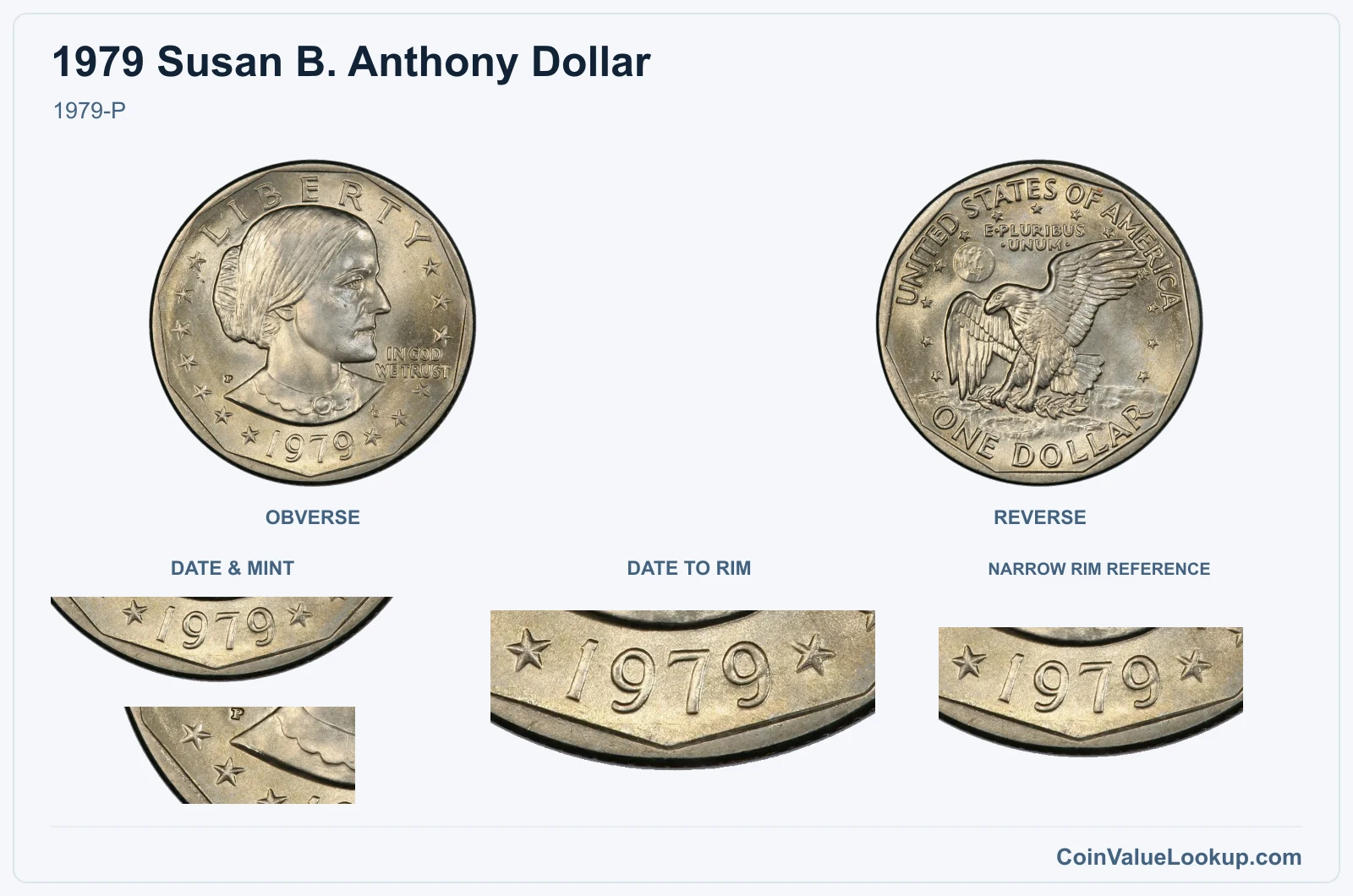
The 1979-P with the standard Narrow Rim is the most common Susan B. Anthony Dollar you will encounter.
Hundreds of millions were struck. The date sits noticeably away from the rim — sometimes called the "Far Date" variety.
A USA Coin Book guide estimate places this version at about $7.29 in MS63. Circulated examples are essentially worth face value.
Original, uncleaned surfaces matter for any premium; polished or cleaned coins lose collector appeal quickly.
Range Grade
Price Auction Records Appraisal PO PO 1
—
Coin Identifier FR FR 2
—
Coin Identifier AG AG 3
—
Coin Identifier G G 4
—
Coin Identifier
G 6
—
Coin Identifier VG VG 8
—
Coin Identifier
VG 10
—
Coin Identifier F F 12
—
Coin Identifier
F 15
—
Coin Identifier VF VF 20
—
Coin Identifier
VF 25
—
Coin Identifier
VF 30
—
Coin Identifier
VF 35
—
Coin Identifier XF XF 40
—
Coin Identifier
XF 45
—
Coin Identifier AU AU 50
—
Coin Identifier
AU 53
—
Coin Identifier
AU 55
Coin Identifier
AU 58
Coin Identifier MS MS 60
—
Coin Identifier
MS 61
—
Coin Identifier
MS 62
Coin Identifier
MS 63
Coin Identifier
MS 64
Coin Identifier
MS 65
Coin Identifier
MS 66
Coin Identifier
MS 67
Coin Identifier
MS 68
Coin Identifier
MS 69
—
—
—
MS 70
—
—
—
1979 Susan B. Anthony Dollar — P Wide Rim
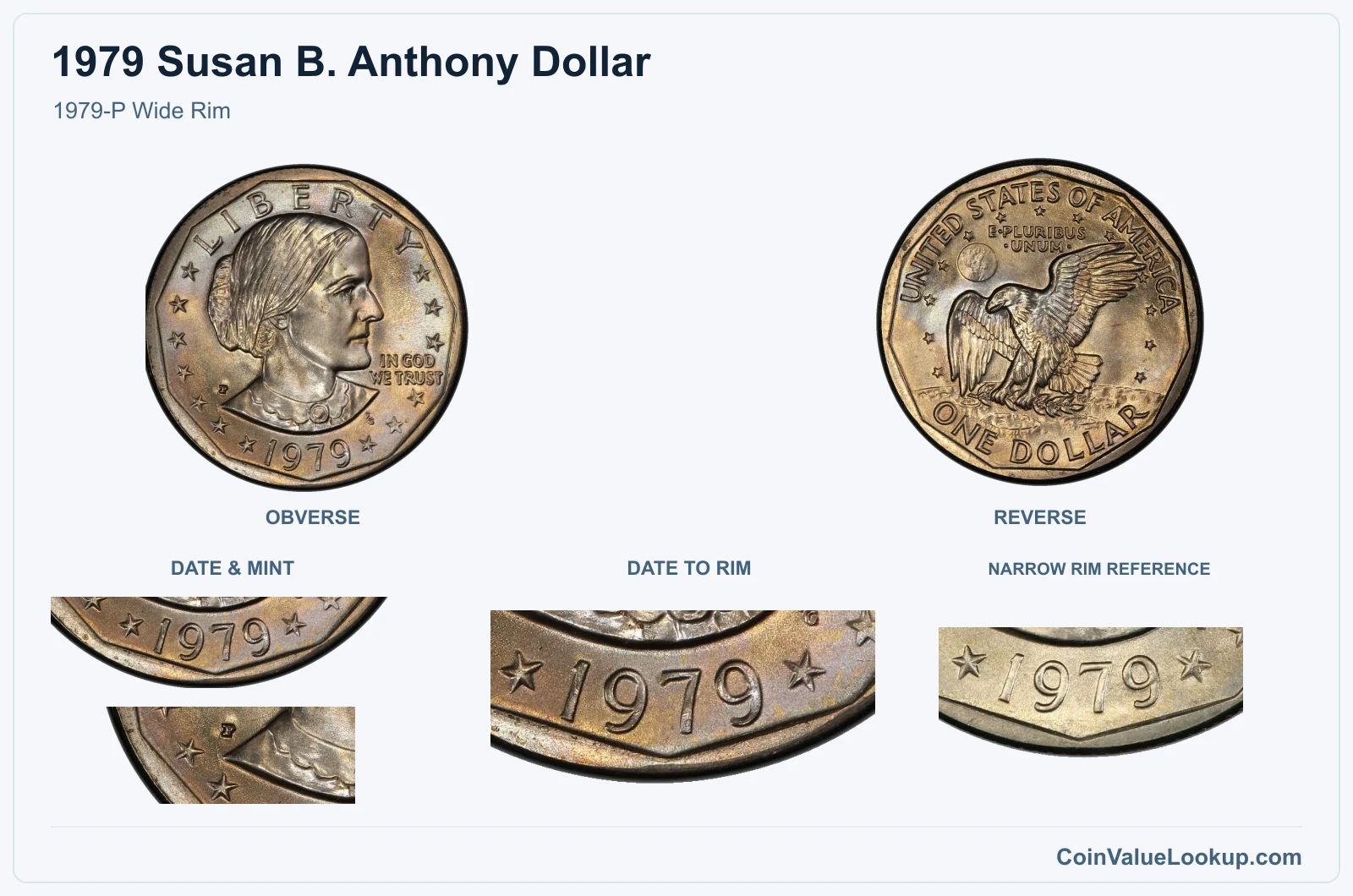
The 1979-P Wide Rim is the one Philadelphia variety worth hunting. On this coin the date is positioned closer to the rim than on the standard issue, earning it the alternate name "Near Date." The difference is easy to spot once you compare both side by side — the gap between the bottom of the 9 in 1979 and the inner rim virtually disappears on the Wide Rim.
A USA Coin Book guide estimate lists this variety at about $26.00 in MS63, more than three times the standard P-mint coin in the same grade. Original surfaces and accurate variety identification are critical.
Later SBA dollar years used a wide rim as the standard design, so this diagnostic applies only to the 1979 Philadelphia issue.
Range Grade
Price Auction Records Appraisal PO PO 1
—
Coin Identifier FR FR 2
—
Coin Identifier AG AG 3
—
Coin Identifier G G 4
—
Coin Identifier
G 6
—
Coin Identifier VG VG 8
—
Coin Identifier
VG 10
—
Coin Identifier F F 12
—
Coin Identifier
F 15
—
Coin Identifier VF VF 20
—
Coin Identifier
VF 25
—
Coin Identifier
VF 30
—
Coin Identifier
VF 35
—
Coin Identifier XF XF 40
—
Coin Identifier
XF 45
—
Coin Identifier AU AU 50
—
Coin Identifier
AU 53
—
Coin Identifier
AU 55
Coin Identifier
AU 58
Coin Identifier MS MS 60
Coin Identifier
MS 61
—
Coin Identifier
MS 62
Coin Identifier
MS 63
Coin Identifier
MS 64
Coin Identifier
MS 65
Coin Identifier
MS 66
Coin Identifier
MS 67
Coin Identifier
MS 68
—
—
—
MS 69
—
—
—
MS 70
—
—
—
1979 Susan B. Anthony Dollar — D
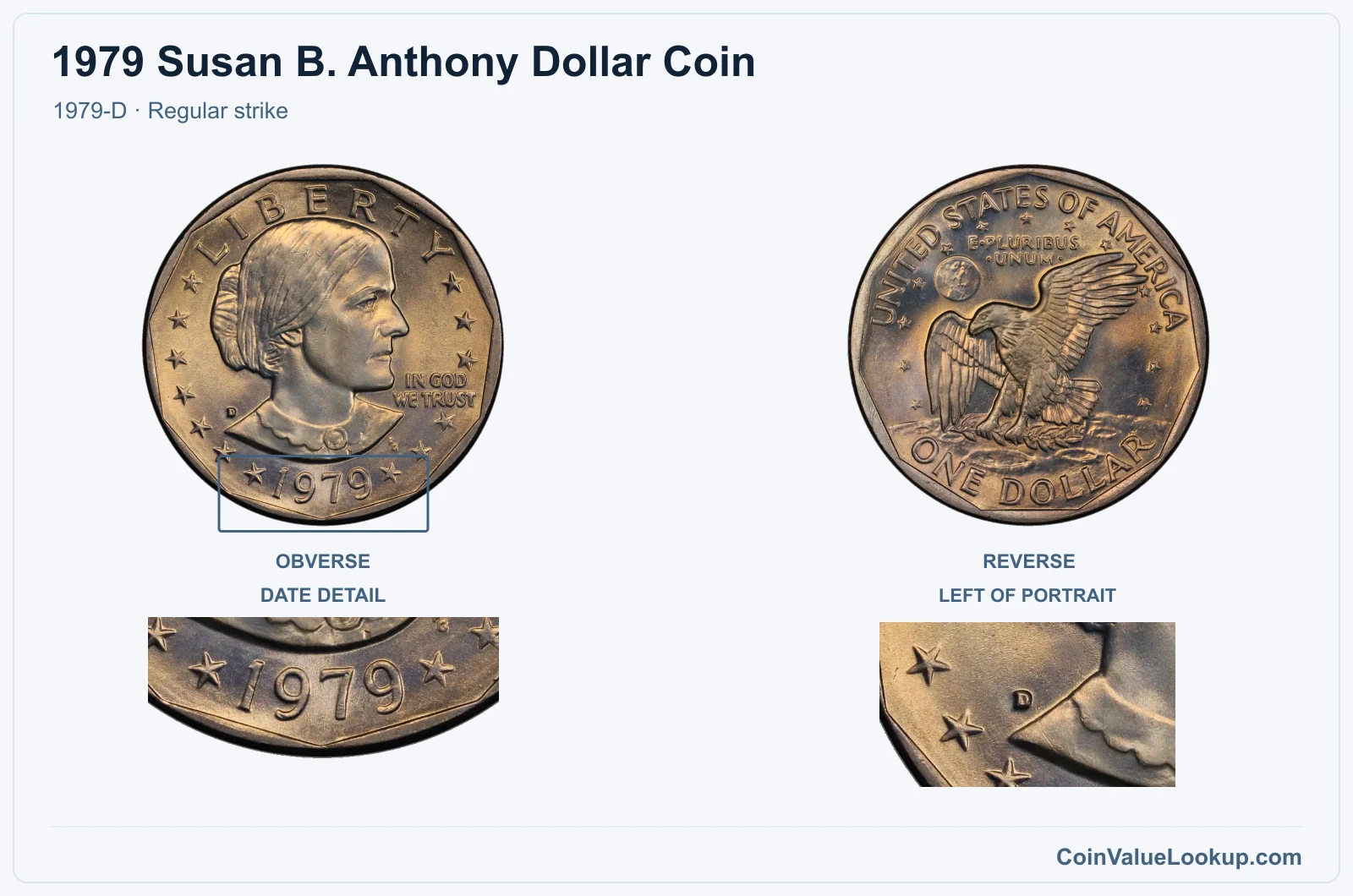
The 1979-D was struck at the Denver Mint and carries a D mintmark on the obverse near the shoulder. It is a common business-strike issue with no known major sub-varieties for this date.
USA Coin Book estimates about $7.29 in MS63. Like its Philadelphia counterpart, circulated pieces are worth a dollar.
Look for original luster and minimal contact marks if you are trying to find an example worth grading.
Range Grade
Price Auction Records Appraisal PO PO 1
—
Coin Identifier FR FR 2
—
Coin Identifier AG AG 3
—
Coin Identifier G G 4
—
Coin Identifier
G 6
—
Coin Identifier VG VG 8
—
Coin Identifier
VG 10
—
Coin Identifier F F 12
—
Coin Identifier
F 15
—
Coin Identifier VF VF 20
—
Coin Identifier
VF 25
—
Coin Identifier
VF 30
—
Coin Identifier
VF 35
—
Coin Identifier XF XF 40
—
Coin Identifier
XF 45
—
Coin Identifier AU AU 50
—
Coin Identifier
AU 53
—
Coin Identifier
AU 55
—
Coin Identifier
AU 58
Coin Identifier MS MS 60
—
Coin Identifier
MS 61
Coin Identifier
MS 62
Coin Identifier
MS 63
Coin Identifier
MS 64
Coin Identifier
MS 65
Coin Identifier
MS 66
Coin Identifier
MS 67
Coin Identifier
MS 68
Coin Identifier
MS 69
—
—
—
MS 70
—
—
—
1979 Susan B. Anthony Dollar — S
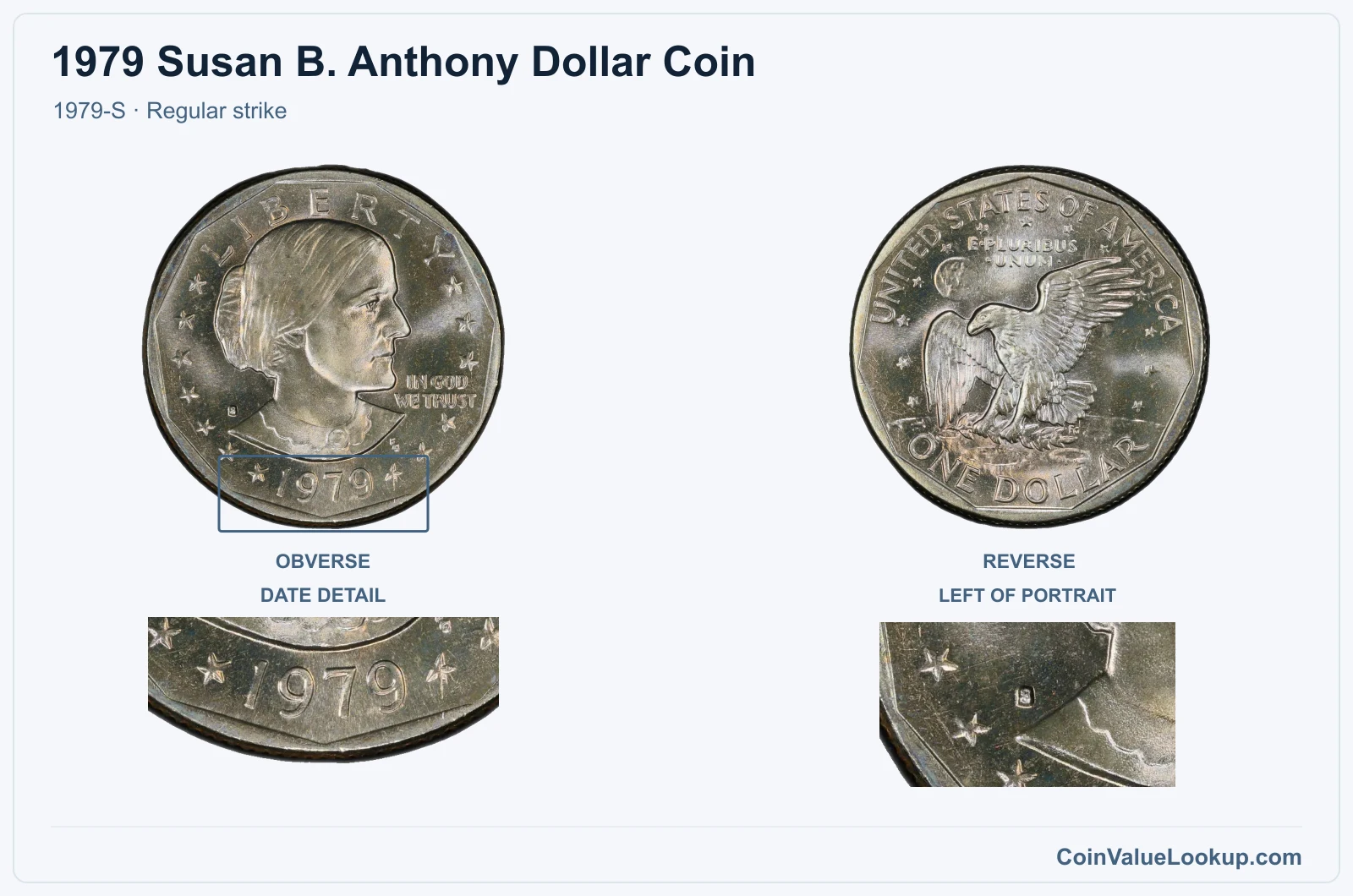
The 1979-S business strike comes from the San Francisco Mint. It carries an S mintmark and was struck for general circulation — do not confuse it with the proof versions also made at San Francisco.
The guide estimate is about $7.29 in MS63 per USA Coin Book. These are not rare, but nice original examples in high Mint State grades are less commonly encountered than the P or D issues simply because fewer collectors saved them raw.
Range Grade
Price Auction Records Appraisal PO PO 1
—
Coin Identifier FR FR 2
—
Coin Identifier AG AG 3
—
Coin Identifier G G 4
—
Coin Identifier
G 6
—
Coin Identifier VG VG 8
—
Coin Identifier
VG 10
—
Coin Identifier F F 12
—
Coin Identifier
F 15
—
Coin Identifier VF VF 20
—
Coin Identifier
VF 25
—
Coin Identifier
VF 30
—
Coin Identifier
VF 35
—
Coin Identifier XF XF 40
—
Coin Identifier
XF 45
—
Coin Identifier AU AU 50
—
Coin Identifier
AU 53
—
Coin Identifier
AU 55
—
Coin Identifier
AU 58
Coin Identifier MS MS 60
—
Coin Identifier
MS 61
—
Coin Identifier
MS 62
Coin Identifier
MS 63
Coin Identifier
MS 64
Coin Identifier
MS 65
Coin Identifier
MS 66
Coin Identifier
MS 67
Coin Identifier
MS 68
Coin Identifier
MS 69
—
—
—
MS 70
—
—
—
1979 Susan B. Anthony Dollar — S Type 1 PR
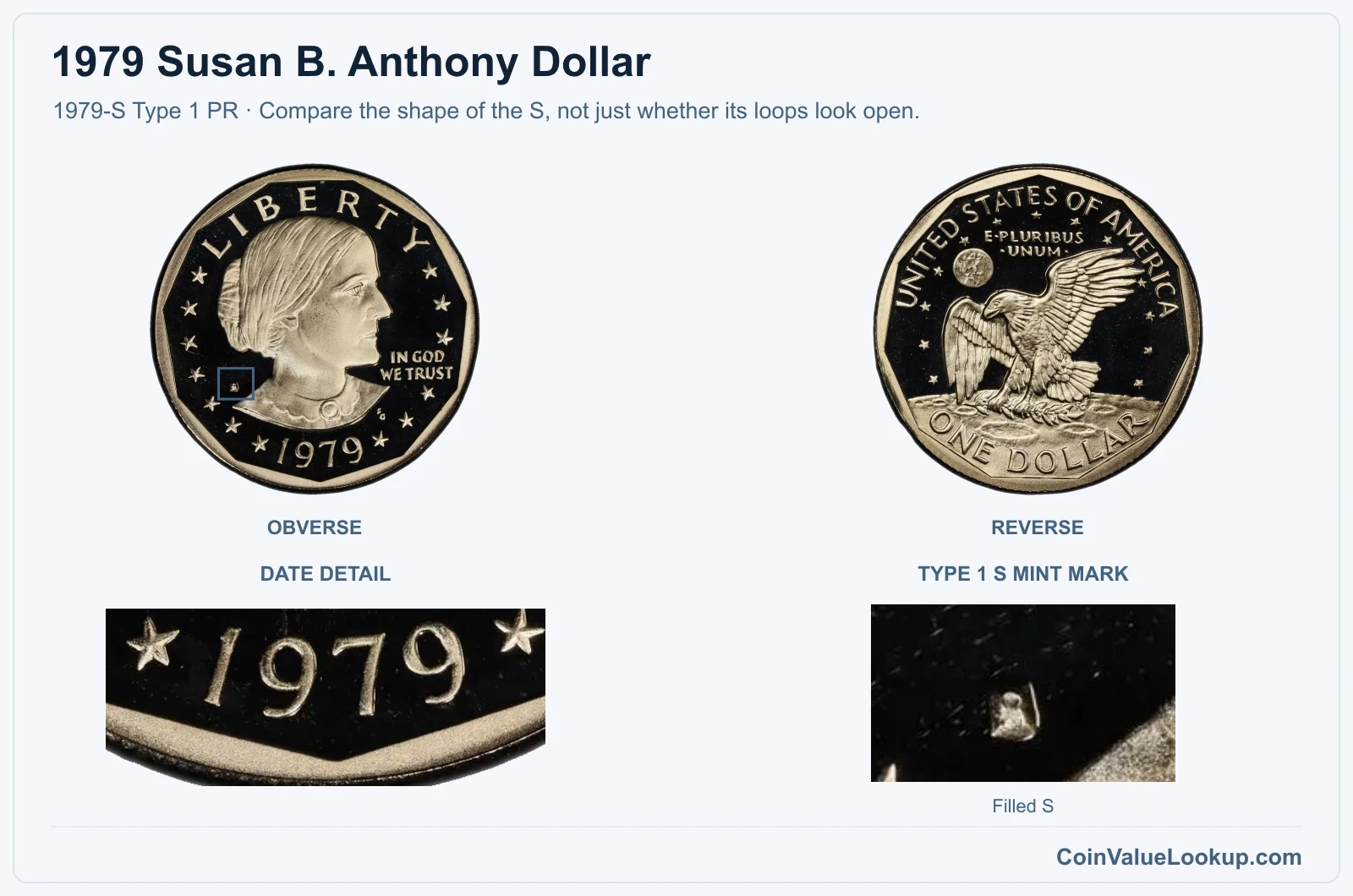
The 1979-S Type 1 Proof is the common proof variety for this year. Its S mintmark looks filled in or blobby — the interior curves of the letter are not fully open.
This is normal for Type 1; it is not damage or a grease-filled die.
A proof is a special manufacturing finish using polished dies and planchets, not simply a shiny coin. The guide estimate from USA Coin Book is about $6.25 in PR65.
That is modest, and most examples survive in collectible condition because they were sold in protective packaging. Check for hairlines and haze before assuming yours is gem quality.
Range Grade
Price Auction Records Appraisal PR PR 1
—
Coin Identifier
PR 2
—
Coin Identifier
PR 3
—
Coin Identifier
PR 4
—
Coin Identifier
PR 6
—
Coin Identifier
PR 8
—
Coin Identifier
PR 10
—
Coin Identifier
PR 12
—
Coin Identifier
PR 15
—
Coin Identifier
PR 20
—
Coin Identifier
PR 25
—
Coin Identifier
PR 30
—
Coin Identifier
PR 35
—
Coin Identifier
PR 40
—
Coin Identifier
PR 45
—
Coin Identifier
PR 50
—
Coin Identifier
PR 53
—
Coin Identifier
PR 55
—
Coin Identifier
PR 58
—
Coin Identifier
PR 60
Coin Identifier
PR 61
—
Coin Identifier
PR 62
—
Coin Identifier
PR 63
—
Coin Identifier
PR 64
—
Coin Identifier
PR 65
—
Coin Identifier
PR 66
—
Coin Identifier
PR 67
Coin Identifier
PR 68
Coin Identifier
PR 69
Coin Identifier
PR 70
Coin Identifier
1979 Susan B. Anthony Dollar — S Type 2 PR
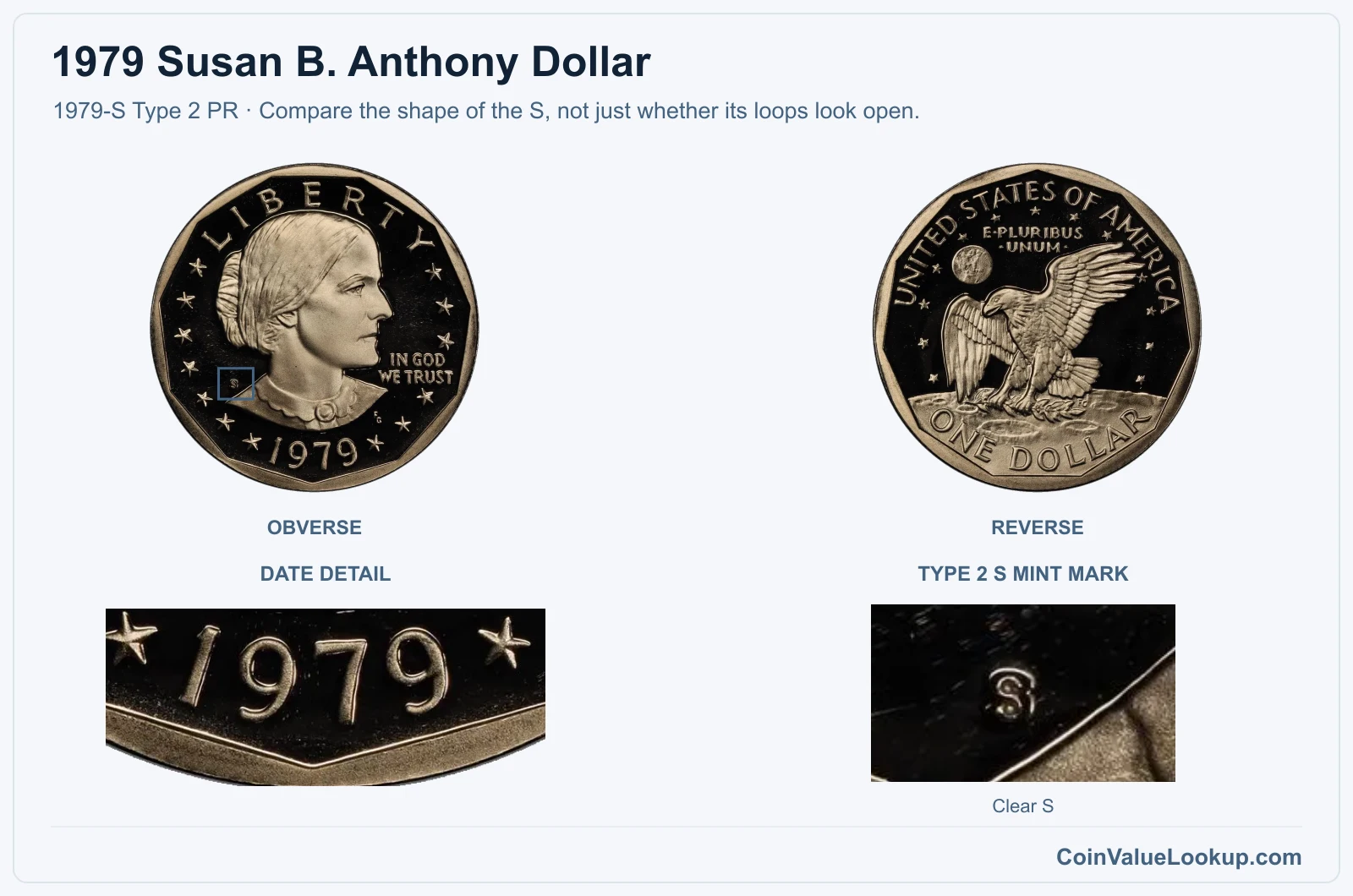
The 1979-S Type 2 Proof is the scarcer and more valuable proof variety. Its S mintmark is clearly defined with open, distinct curves — a sharp contrast to the mushy blob of the Type 1.
You need magnification and ideally a reference image specific to 1979 to confirm the punch shape, because the 1981 Type 2 S looks different again.
USA Coin Book estimates about $69.00 in PR65, making this the highest-valued version in the 1979 SBA lineup at that grade. A proof is a manufacturing finish, not a condition grade, so hairlines, haze and contact marks still affect the coin's actual grade.
Confirming the mintmark style is the key step — get it wrong and you have a $6 coin instead of a $69 one.
Range Grade
Price Auction Records Appraisal PR PR 1
—
Coin Identifier
PR 2
—
Coin Identifier
PR 3
—
Coin Identifier
PR 4
—
Coin Identifier
PR 6
—
Coin Identifier
PR 8
—
Coin Identifier
PR 10
—
Coin Identifier
PR 12
—
Coin Identifier
PR 15
—
Coin Identifier
PR 20
—
Coin Identifier
PR 25
—
Coin Identifier
PR 30
—
Coin Identifier
PR 35
—
Coin Identifier
PR 40
—
Coin Identifier
PR 45
—
Coin Identifier
PR 50
—
Coin Identifier
PR 53
—
Coin Identifier
PR 55
—
Coin Identifier
PR 58
—
Coin Identifier
PR 60
—
Coin Identifier
PR 61
—
Coin Identifier
PR 62
—
Coin Identifier
PR 63
—
Coin Identifier
PR 64
—
Coin Identifier
PR 65
—
Coin Identifier
PR 66
Coin Identifier
PR 67
Coin Identifier
PR 68
Coin Identifier
PR 69
Coin Identifier
PR 70
Coin Identifier
1979 Susan B. Anthony Dollar Error List
1. 1979 Susan B. Anthony Dollar — Wrong Planchet / Off-Metal Strike
A wrong-planchet 1979 Susan B. Anthony Dollar was struck on a blank intended for a different denomination or even a different country's coin.
The result is a dollar design on metal that does not match the normal 8.10-gram, 26.50 mm copper-nickel clad specification.
To check, weigh and measure the coin carefully. Compare the edge, diameter and weight against a normal SBA dollar.
The design may be incomplete or distorted because the blank was the wrong size. Condition, the degree of design completeness, and the identity of the wrong planchet all affect value — no standard price applies.
Watch out for plated coins, acid-treated surfaces, or corroded pieces that merely look like a different metal. These post-mint alterations are not mint errors.
2. 1979 Susan B. Anthony Dollar — Off-Center Strike
An off-center 1979 SBA Dollar shows a shifted design with an unstruck crescent of blank metal on one side. The planchet was not centered between the dies when struck.
Small shifts of a few percent are common and add little value; dramatic shifts — especially those that still show the date — attract collector interest.
Value depends on the percentage of off-center displacement, whether the date is visible, and overall condition. No standard price range applies to every example.
Do not confuse an off-center strike with a clipped planchet, a one-sided die misalignment, or a coin that was flattened or bent after leaving the mint. Genuine off-center coins show proper metal flow and an unstruck area with the original blank texture.
3. 1979 Susan B. Anthony Dollar — Broadstrike
A broadstrike happens when the collar die — the ring that normally confines the planchet and forms the reeded edge — fails to engage. The coin spreads outward under striking pressure, producing a wider-than-normal piece with a smooth or malformed edge instead of the usual reeding.
The full design is generally present but stretched. Compare the diameter to a normal 26.50 mm SBA dollar; a broadstrike will measure larger.
The edge profile is the giveaway — no reeding, no uniform rim.
Value depends on the severity of the spread, surface condition, and whether both sides are fully struck. No adopted price range is available for this error.
Be careful not to confuse a broadstrike with a coin that was flattened on railroad tracks or in a vise after minting — those show distortion without proper die detail.
4. 1979 Susan B. Anthony Dollar — Struck-Through Error
A struck-through error on the 1979-P SBA Dollar (Narrow Rim, Far Date) occurs when foreign material — such as grease, cloth fibers, or a metal fragment — sits between the die and the planchet during striking. The result is a localized depression or area of missing detail on the finished coin.
Grease-filled strikes tend to produce smooth, rounded depressions where design elements should be. Retained foreign objects leave a distinct impression or outline.
Keep these two categories separate when describing what you see.
Value depends on the size, location and visibility of the obstruction area, plus overall coin condition. No standard price applies.
Ordinary wear, cleaning scratches, or weak strikes from tired dies can mimic a struck-through look, so compare carefully against a normal example.
5. 1979 Susan B. Anthony Dollar — Double-Denomination Strike
A double-denomination error is among the rarest mint errors in any series. On a 1979 SBA Dollar, this would mean a previously struck coin of a different denomination was fed back through the press and overstruck with the dollar dies.
You would see traces of the original underlying design — a different size, denomination or portrait — beneath the Susan B. Anthony dollar design.
These are extremely unusual. Value depends on the clarity of both designs, the identity of the underlying denomination, and overall preservation.
No standard price range is available.
Fakes exist. Vise impressions — where someone presses two coins together in a vise — can mimic a double denomination but lack proper metal flow and strike characteristics.
A coin struck on a wrong blank without a prior design is a wrong-planchet error, not a double denomination.
6. 1979 Susan B. Anthony Dollar — Clipped Planchet
A clipped-planchet 1979 SBA Dollar is missing a portion of the original blank because the punch that cut blanks from the metal strip overlapped a previously punched hole. The clip can be curved, straight, or irregularly shaped depending on where the overlap occurred.
Look for a missing section with a smooth, natural edge — not a rough or filed cut. On a genuine clip, the design opposite the missing area often shows slight weakness because metal could not flow evenly during striking.
This weakness pattern helps confirm authenticity.
Value depends on the size and type of clip and the coin's overall condition. No adopted price range is available.
Watch for coins that have been deliberately cut, filed, or corroded along the edge — these are post-mint damage, not mint errors.
7. 1979 Susan B. Anthony Dollar — Partial Collar Strike
A partial-collar strike on a 1979 SBA Dollar produces a distinctive stepped edge. Part of the coin was inside the collar die during striking and received normal reeding, while the rest was outside and spread slightly, creating a smooth or distorted rim on that side.
The result is a coin that looks normal on one portion of its edge and broadstruck on the other, with a visible transition line between the two zones. Tilt the coin under a light and compare the edge profile to a normal example — the step is usually easy to spot.
Value depends on how dramatic the step is and the coin's overall condition. No standard price is available for this error.
Do not confuse a partial collar with ordinary rim damage, a flattened rim from a coin counter, or a full broadstrike where no collar engagement occurred at all.