1888 Morgan Silver Dollar Coin Value: How Much Is It Worth?
The 1888 Morgan Silver Dollar is a coin that rewards careful identification. Guide estimates for the explicitly listed grades and versions range from about $74.00 to $3,285.00, but your coin's actual value depends on its specific mint, condition, surface quality and whether it belongs to a scarce variety.
A worn Philadelphia example and a gem 1888-S occupy very different territory. Certain varieties — like the 1888-O Scarface, the 1888-O Doubled Die Obverse, and the proof issue — deserve special attention before you settle on a number.
Fast Way to Identify Your 1888 Morgan Silver Dollar
The quickest way to start is to upload clear photos of both sides of your 1888 Morgan Dollar. A front and back image lets us provide a preliminary identification of the mint, variety and approximate condition.
That is not a substitute for professional authentication or certified grading, but it points you in the right direction. Snap the photos in even, diffused light and avoid glare on the fields.
1888 Morgan Silver Dollar Value
Upload both sides of your 1888 Morgan Silver Dollar.
Front Obverse
Upload photo
Back Reverse
Upload photo
Which 1888 Morgan Silver Dollar Versions Are Worth Money?
- 1888-S — The San Francisco issue carries the highest guide spread here, from $149.00 in G4 to $3,285.00 in MS65, making grade especially important.
- 1888-O Scarface — A recognized New Orleans die variety; value depends on authenticated identity and condition rather than a standard price table.
- 1888-O DDO (Doubled Die Obverse) — Another O-mint variety worth checking for; pricing depends on the specific die, visibility and grade.
- 1888 Proof — A proof-finish Philadelphia coin that requires authentication; do not confuse a shiny business strike for proof manufacture.
- 1888-O in high Mint State — A guide estimate of $474.00 at MS65 puts a gem O-mint coin well above a typical circulated example.
Step 1: Identify Your 1888 Morgan Silver Dollar Mint Mark and Version
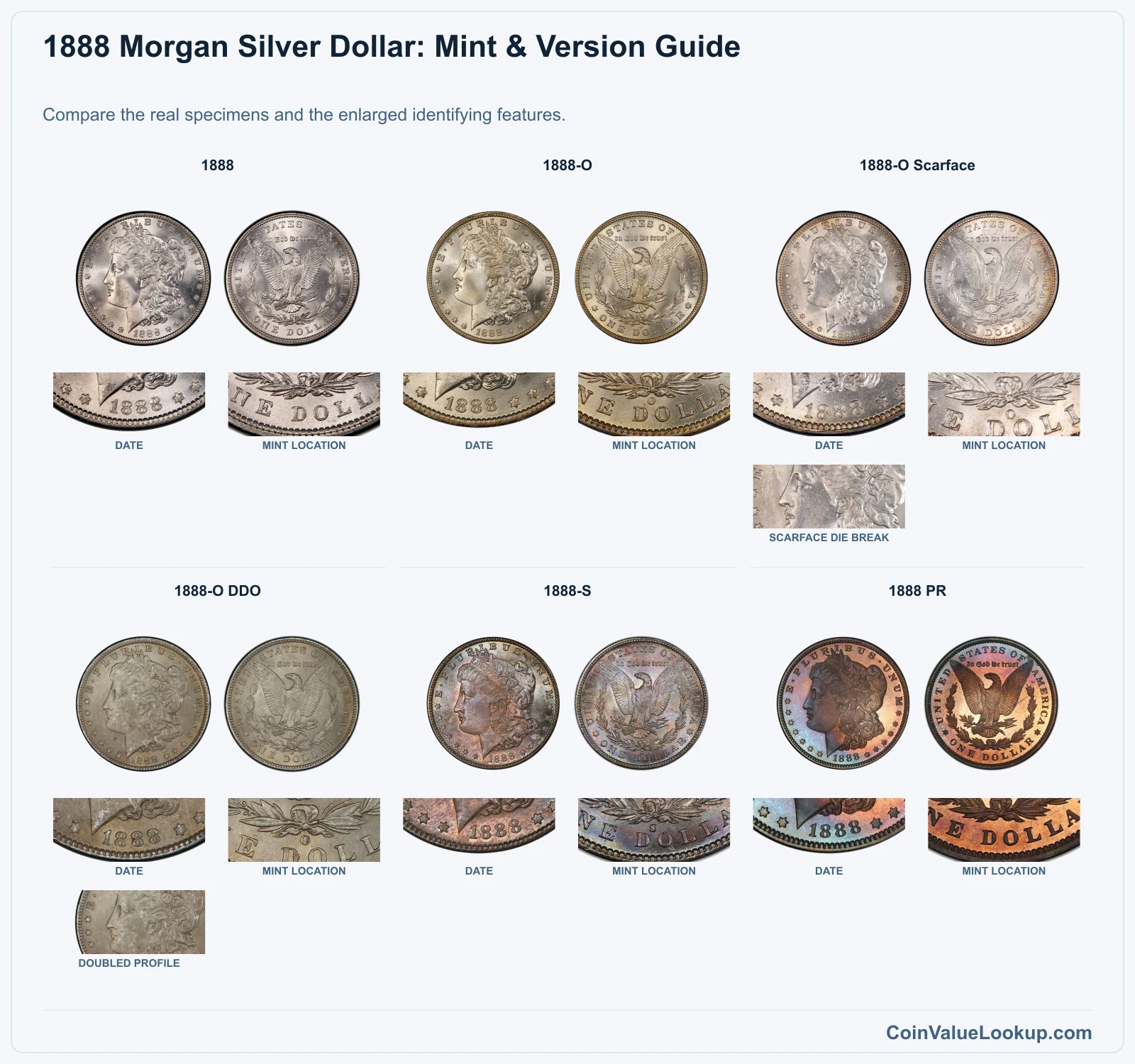
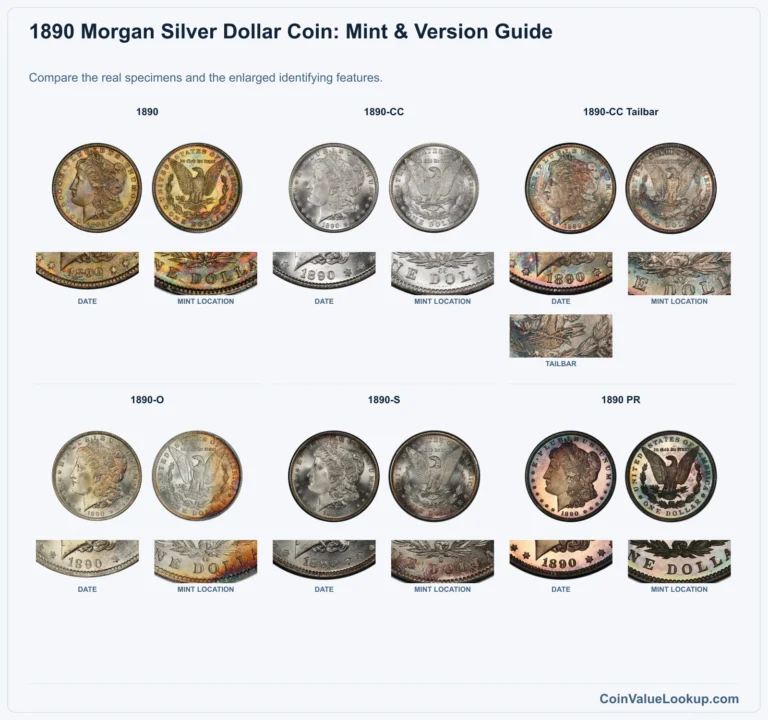
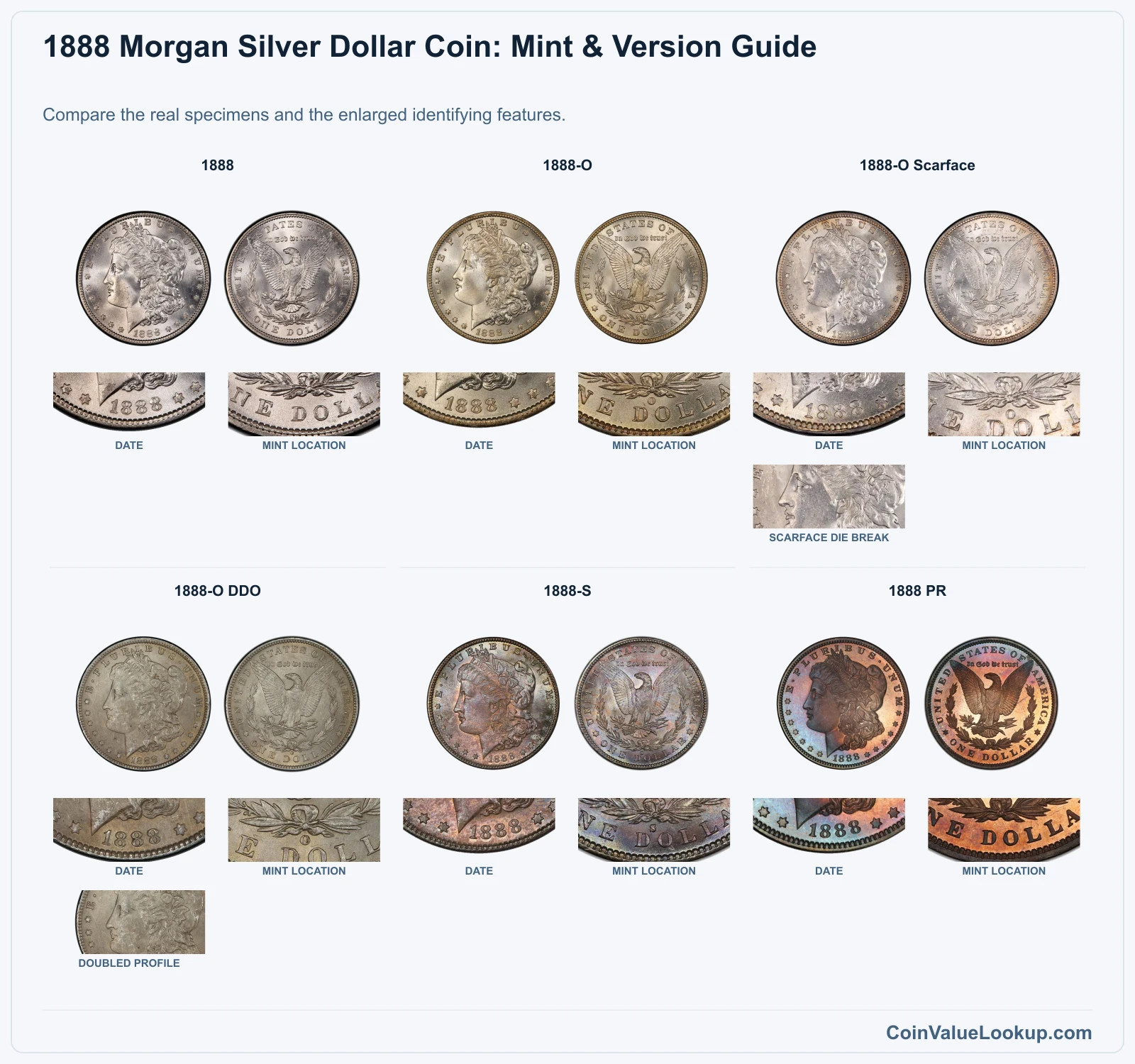
First, flip your coin over and look below the bow of the wreath on the reverse. If there is no mintmark, it is a Philadelphia strike.
An "O" means New Orleans, and an "S" means San Francisco. There is no CC (Carson City) or D (Denver) issue for 1888.
The coin is 90% silver and 10% copper, weighing 26.73 grams. The obverse shows George T.
Morgan's Liberty head in profile; the reverse features an eagle with outstretched wings inside a wreath. The edge is reeded.
Six distinct branches exist for 1888: the Philadelphia business strike (no mintmark), the 1888-O, the 1888-O Scarface variety, the 1888-O Doubled Die Obverse, the 1888-S, and the 1888 Proof (Philadelphia, no mintmark). Distinguishing the O-mint varieties from a regular 1888-O requires close examination under magnification, so do not assume you have a Scarface or DDO just because it came from New Orleans.
A shiny surface does not make a coin prooflike or proof. Prooflike and Deep-Mirror Prooflike are surface designations applied to eligible business strikes — they are not proof manufacture.
True proofs were struck with a different process entirely.
Step 2: Check Your 1888 Morgan Silver Dollar Grade
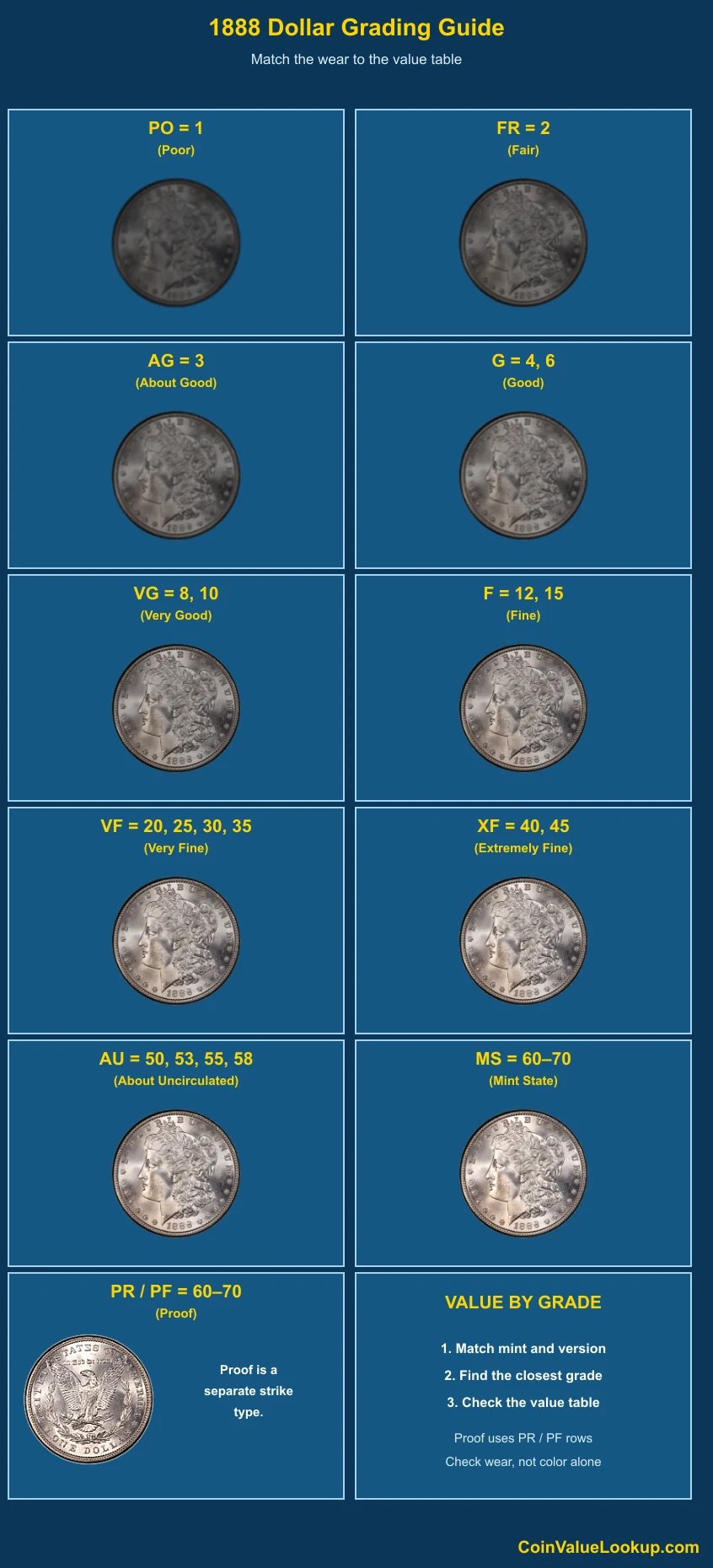
Start with the hair above Liberty's ear and the high point of her cheek. On well-circulated coins, these areas flatten first; in Good-4 territory, the portrait outline is visible but most interior detail is gone.
At About Uncirculated, only faint rub shows on the cheek and the cap's highest folds.
For Mint State coins, luster is everything. A full cartwheel across both sides with no breaks in the fields suggests MS-63 or above, but bag marks — those scattered contact tics from storage — pull the grade back down even without actual wear.
Check the eagle's breast feathers on the reverse for the same kind of contact.
Use the comparison image to see the difference between a circulated piece, an AU coin with light friction, and a full Mint State example side by side. Proof coins should be evaluated separately from business strikes; the manufacturing finish creates a distinctly mirrored field that is not the same as a prooflike business strike.
Cleaned, polished or artificially toned coins generally receive a details grade, which limits their market comparability.
Step 3: Check 1888 Morgan Silver Dollar Value by Mint and Version
1888 Morgan Silver Dollar
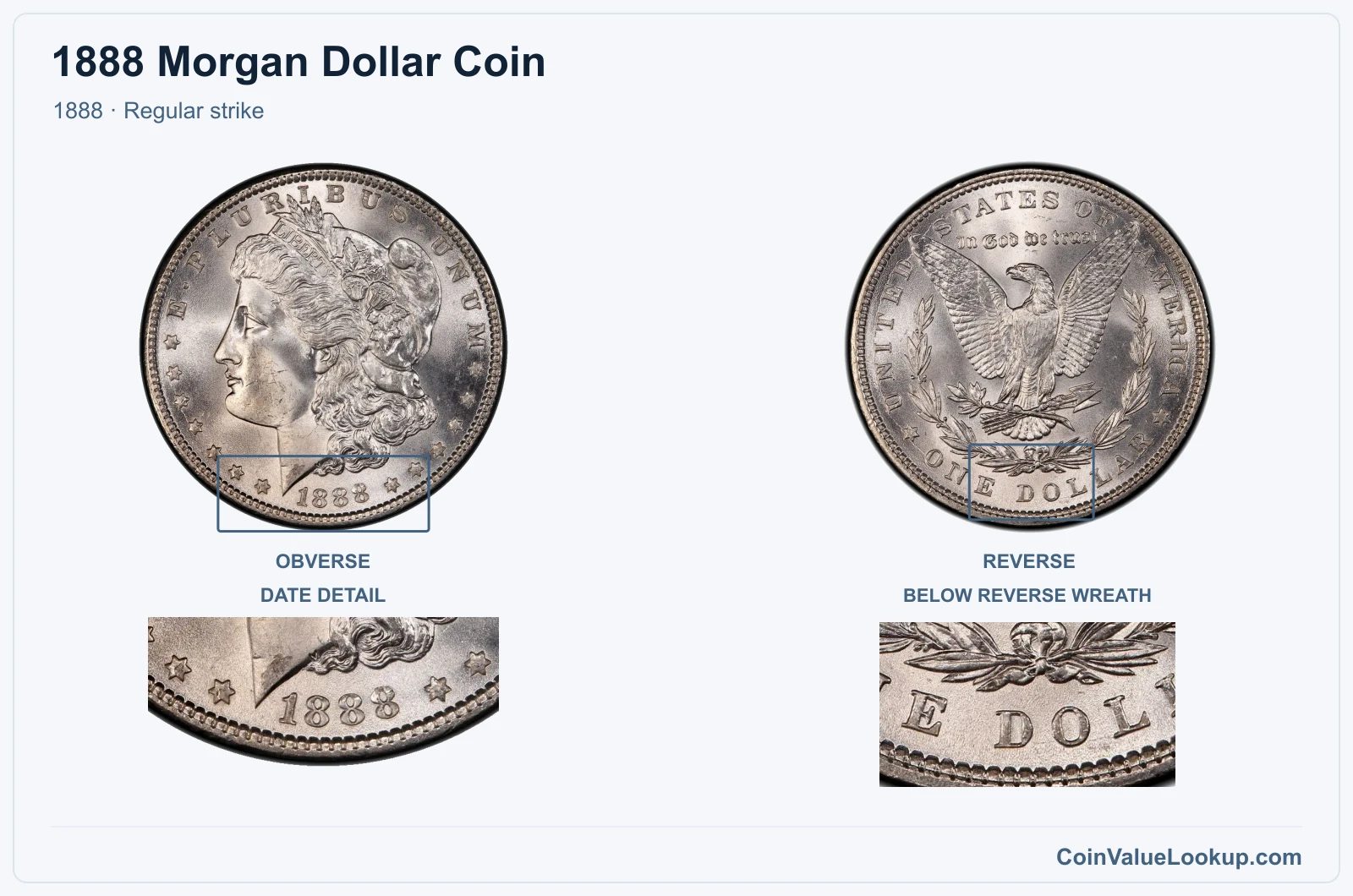
The 1888 Philadelphia Morgan Dollar carries no mintmark. In well-worn Good-4 condition, a USA Coin Book guide estimate places it around $74.00.
Jump to MS65 and the same guide lists roughly $326.00.
Those are guide estimates for specific grades, not guaranteed sale prices. Original surfaces matter — cleaned or polished coins trade at a discount.
If your coin has deeply reflective fields and sharp devices, it might qualify for a Prooflike or Deep-Mirror Prooflike designation, which can shift value further. But that attribution requires proper evaluation, not just a bright look under a desk lamp.
Range Grade
Price Auction Records Appraisal PO PO 1
—
Coin Identifier FR FR 2
—
Coin Identifier AG AG 3
—
Coin Identifier G G 4
—
Coin Identifier
G 6
—
Coin Identifier VG VG 8
—
Coin Identifier
VG 10
—
Coin Identifier F F 12
Coin Identifier
F 15
Coin Identifier VF VF 20
—
Coin Identifier
VF 25
—
Coin Identifier
VF 30
—
Coin Identifier
VF 35
—
Coin Identifier XF XF 40
—
Coin Identifier
XF 45
—
Coin Identifier AU AU 50
Coin Identifier
AU 53
Coin Identifier
AU 55
Coin Identifier
AU 58
Coin Identifier MS MS 60
Coin Identifier
MS 61
Coin Identifier
MS 62
Coin Identifier
MS 63
Coin Identifier
MS 64
Coin Identifier
MS 65
Coin Identifier
MS 66
Coin Identifier
MS 67
Coin Identifier
MS 68
—
—
—
MS 69
—
—
—
MS 70
—
—
—
1888 Morgan Silver Dollar — O
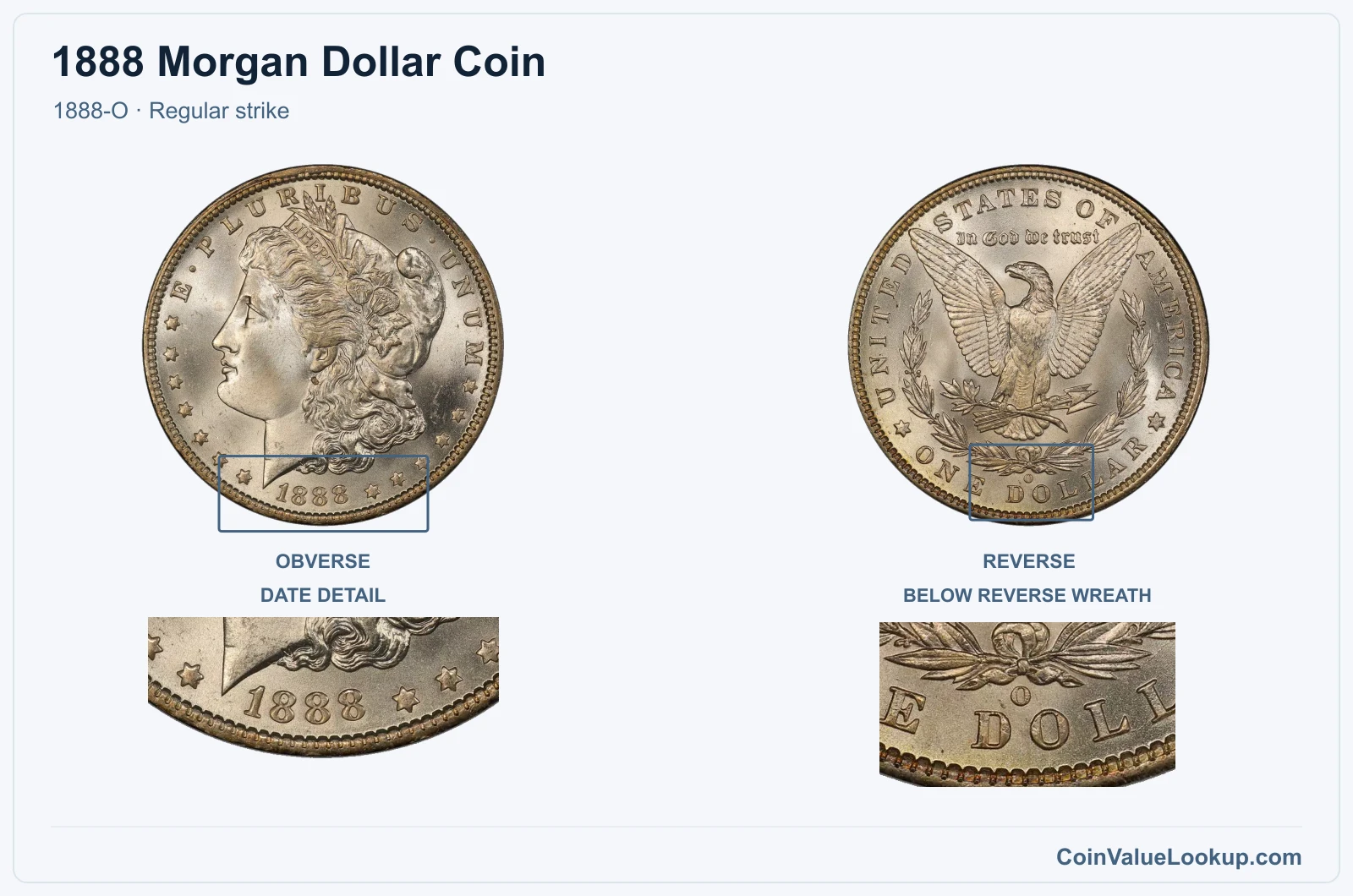
Look for the small "O" mintmark below the wreath on the reverse. The New Orleans Mint produced 1888-O Morgans in large numbers, so circulated pieces are common.
Guide estimates from USA Coin Book put G4 around $74.00 and MS65 around $474.00.
The premium for a gem example reflects how few survived without heavy bag marks. If your 1888-O is lightly circulated, it likely falls closer to the lower anchor.
Cleaning or polishing reduces comparability with these guide figures, so leave the coin alone. PL and DMPL surface designations can apply to eligible business strikes of this mint and may affect pricing.
Range Grade
Price Auction Records Appraisal PO PO 1
—
Coin Identifier FR FR 2
Coin Identifier AG AG 3
Coin Identifier G G 4
Coin Identifier
G 6
—
Coin Identifier VG VG 8
—
Coin Identifier
VG 10
—
Coin Identifier F F 12
—
Coin Identifier
F 15
Coin Identifier VF VF 20
—
Coin Identifier
VF 25
Coin Identifier
VF 30
Coin Identifier
VF 35
—
Coin Identifier XF XF 40
—
Coin Identifier
XF 45
—
Coin Identifier AU AU 50
Coin Identifier
AU 53
Coin Identifier
AU 55
—
Coin Identifier
AU 58
Coin Identifier MS MS 60
—
Coin Identifier
MS 61
Coin Identifier
MS 62
Coin Identifier
MS 63
Coin Identifier
MS 64
Coin Identifier
MS 65
Coin Identifier
MS 66
Coin Identifier
MS 67
Coin Identifier
MS 68
—
—
—
MS 69
—
—
—
MS 70
—
—
—
1888 Morgan Silver Dollar — O Scarface
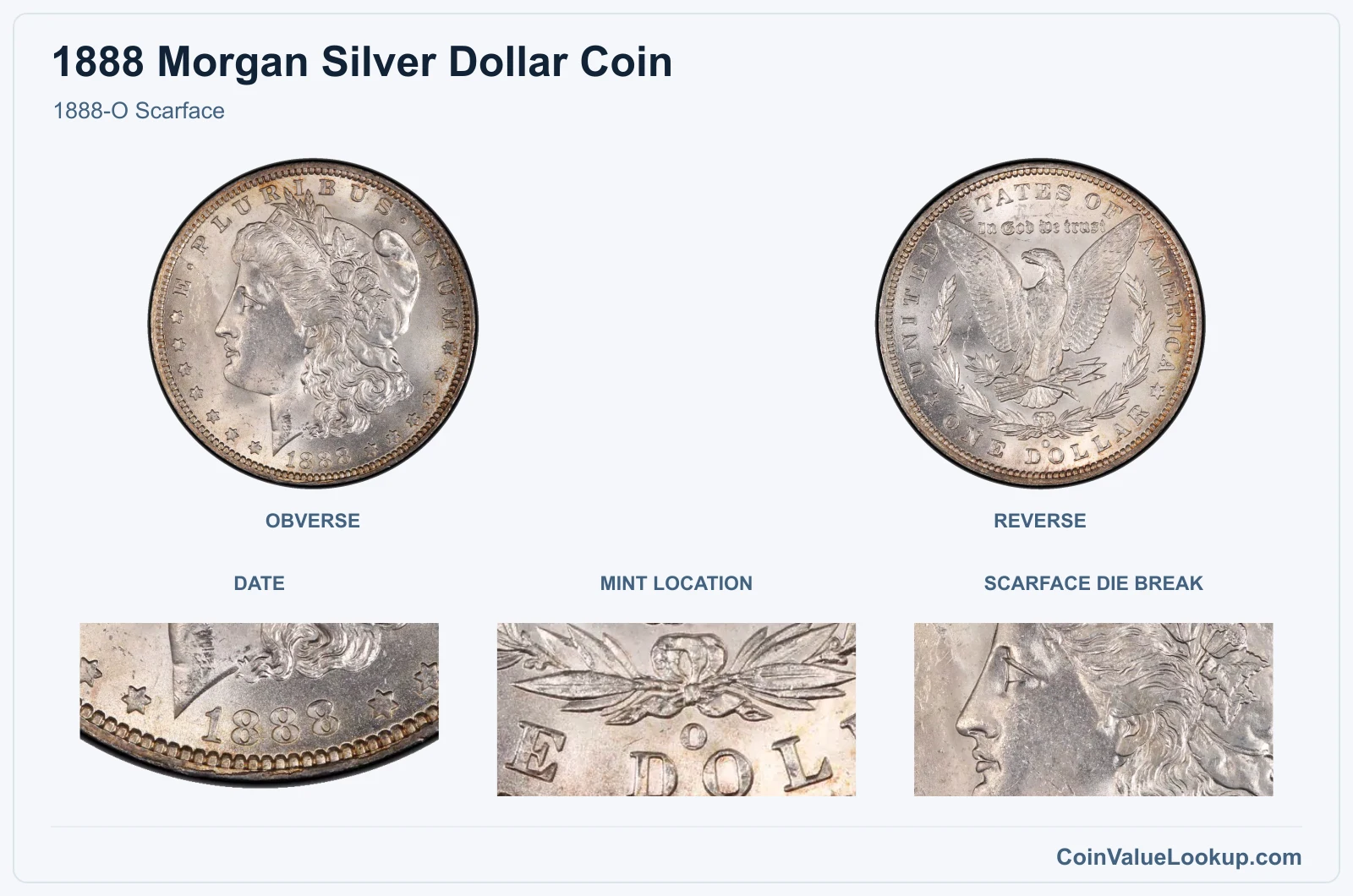
The 1888-O Scarface is a recognized die variety struck at the New Orleans Mint. The name refers to a distinctive die feature visible on Liberty's face — a specific mark or gouge transferred from the die to every coin struck from it.
No standard numeric price range has been adopted for this variety. Value depends on authenticated identity and the coin's condition.
You need to confirm the variety under magnification and ideally through professional attribution, because random scratches or contact marks on any 1888-O could be mistaken for the Scarface diagnostic. A scratch acquired after striking sits in the surface; a die-transferred feature appears consistently raised.
Keep that distinction in mind before paying a variety premium.
Coin Value Lookup is a good starting point if you want to look up guides for other Morgan Dollar dates and mints while researching your coin.
Range Grade
Price Auction Records Appraisal PO PO 1
—
Coin Identifier FR FR 2
—
Coin Identifier AG AG 3
—
Coin Identifier G G 4
—
Coin Identifier
G 6
—
Coin Identifier VG VG 8
—
Coin Identifier
VG 10
—
Coin Identifier F F 12
—
Coin Identifier
F 15
—
Coin Identifier VF VF 20
—
Coin Identifier
VF 25
—
Coin Identifier
VF 30
—
Coin Identifier
VF 35
—
Coin Identifier XF XF 40
—
Coin Identifier
XF 45
—
Coin Identifier AU AU 50
—
Coin Identifier
AU 53
—
Coin Identifier
AU 55
—
Coin Identifier
AU 58
—
Coin Identifier MS MS 60
Coin Identifier
MS 61
Coin Identifier
MS 62
Coin Identifier
MS 63
Coin Identifier
MS 64
Coin Identifier
MS 65
—
—
—
MS 66
—
—
—
MS 67
—
—
—
MS 68
—
—
—
MS 69
—
—
—
MS 70
—
—
—
1888 Morgan Silver Dollar — O DDO
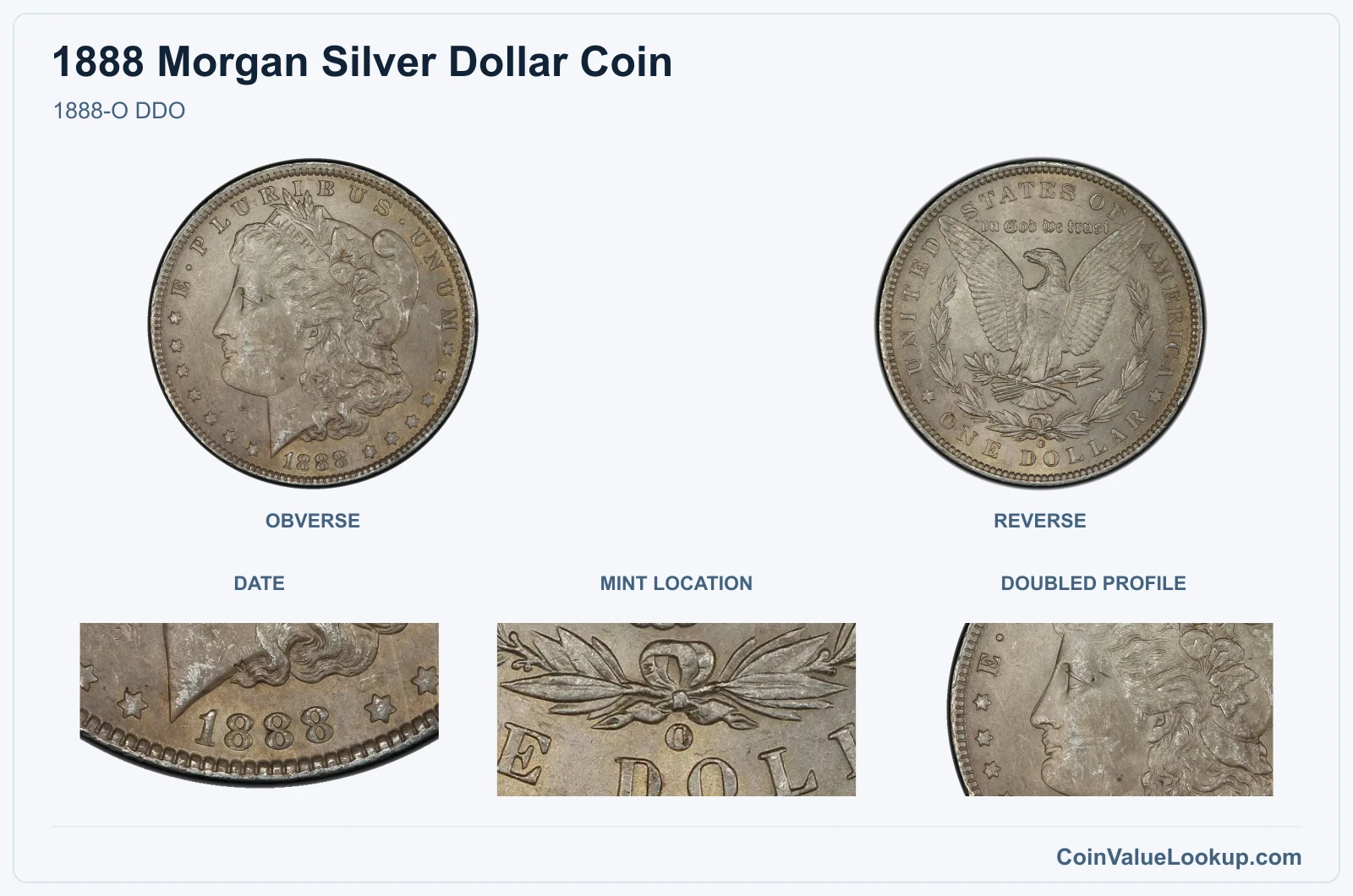
The 1888-O DDO is a Doubled Die Obverse variety from the New Orleans Mint. On this coin, portions of the obverse design were impressed into the die twice at slightly different positions, producing visible doubling on the finished coin.
No standard numeric price range has been adopted for this variety. Pricing depends on the specific doubled die involved, the degree of visible doubling, and the coin's overall grade.
Compare the obverse lettering and design elements to a normal 1888-O under magnification — genuine hub doubling shows consistent separation or notching rather than a flat, shelf-like displacement. Machine doubling, which is a less collectible form of strike anomaly, can mimic the appearance to the untrained eye.
Authentication is strongly recommended before assigning variety value.
Range Grade
Price Auction Records Appraisal PO PO 1
—
Coin Identifier FR FR 2
Coin Identifier AG AG 3
Coin Identifier G G 4
Coin Identifier
G 6
Coin Identifier VG VG 8
Coin Identifier
VG 10
Coin Identifier F F 12
Coin Identifier
F 15
Coin Identifier VF VF 20
Coin Identifier
VF 25
Coin Identifier
VF 30
Coin Identifier
VF 35
Coin Identifier XF XF 40
Coin Identifier
XF 45
Coin Identifier AU AU 50
Coin Identifier
AU 53
Coin Identifier
AU 55
Coin Identifier
AU 58
Coin Identifier MS MS 60
—
Coin Identifier
MS 61
Coin Identifier
MS 62
—
Coin Identifier
MS 63
—
—
—
MS 64
—
—
—
MS 65
—
—
—
MS 66
—
—
—
MS 67
—
—
—
MS 68
—
—
—
MS 69
—
—
—
MS 70
—
—
—
1888 Morgan Silver Dollar — S
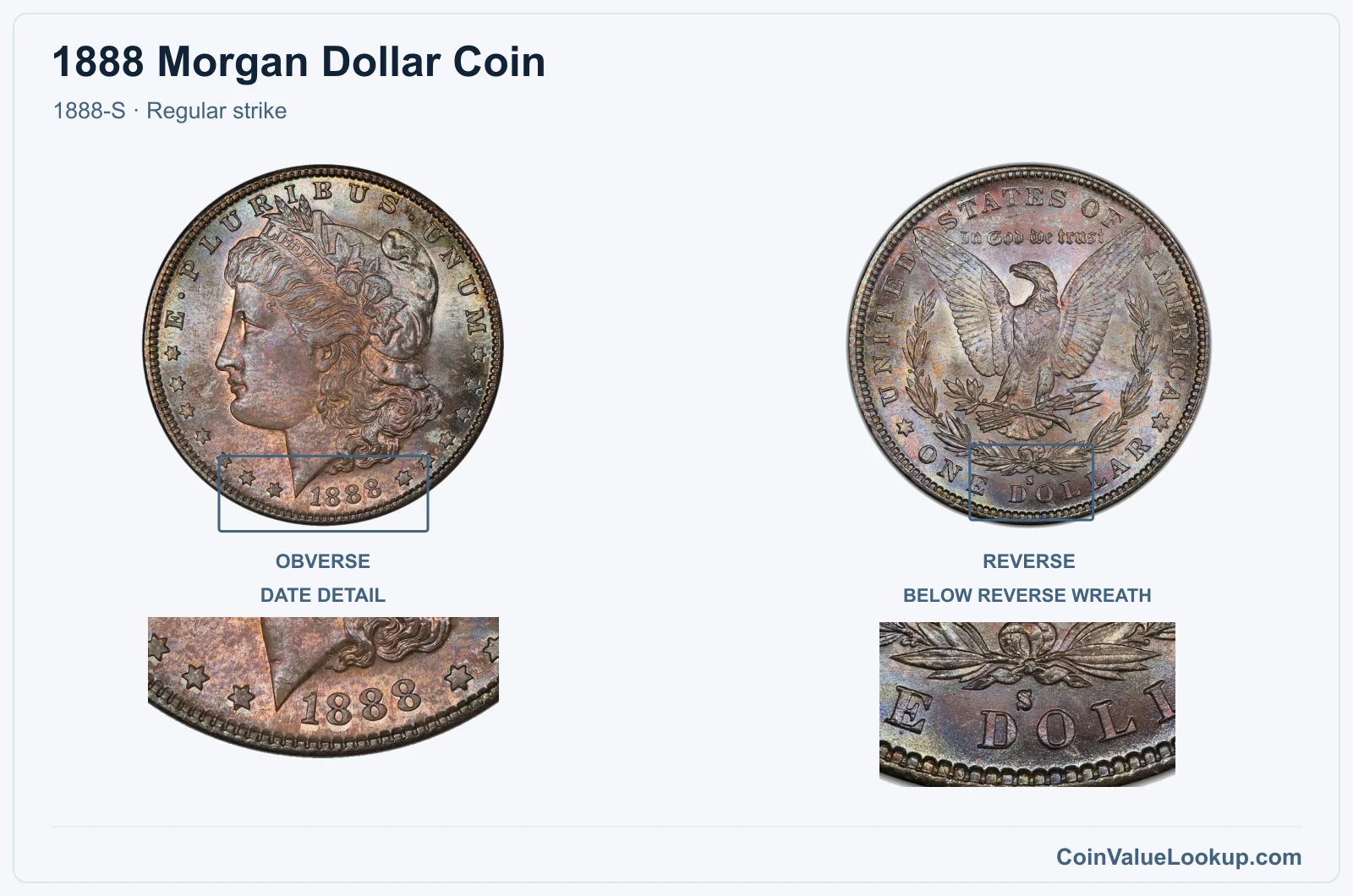
The 1888-S carries the steepest price curve of the regular business strikes. USA Coin Book's guide estimates list G4 at $149.00 and MS65 at $3,285.00.
That gap tells you grade matters enormously for this mint.
Look for the "S" mintmark below the wreath bow. San Francisco strikes from this era are often well-made, but surviving gem examples are scarce enough to drive that high-end figure.
A circulated 1888-S still commands more than its Philadelphia or New Orleans counterparts at the same grade. Original, untampered surfaces are critical — any cleaning or artificial toning will hurt the coin's standing relative to these guide anchors.
Range Grade
Price Auction Records Appraisal PO PO 1
—
Coin Identifier FR FR 2
Coin Identifier AG AG 3
Coin Identifier G G 4
Coin Identifier
G 6
Coin Identifier VG VG 8
Coin Identifier
VG 10
Coin Identifier F F 12
Coin Identifier
F 15
Coin Identifier VF VF 20
Coin Identifier
VF 25
Coin Identifier
VF 30
Coin Identifier
VF 35
Coin Identifier XF XF 40
Coin Identifier
XF 45
Coin Identifier AU AU 50
Coin Identifier
AU 53
Coin Identifier
AU 55
Coin Identifier
AU 58
Coin Identifier MS MS 60
Coin Identifier
MS 61
Coin Identifier
MS 62
Coin Identifier
MS 63
Coin Identifier
MS 64
Coin Identifier
MS 65
Coin Identifier
MS 66
Coin Identifier
MS 67
Coin Identifier
MS 68
—
—
—
MS 69
—
—
—
MS 70
—
—
—
1888 Morgan Silver Dollar — PR
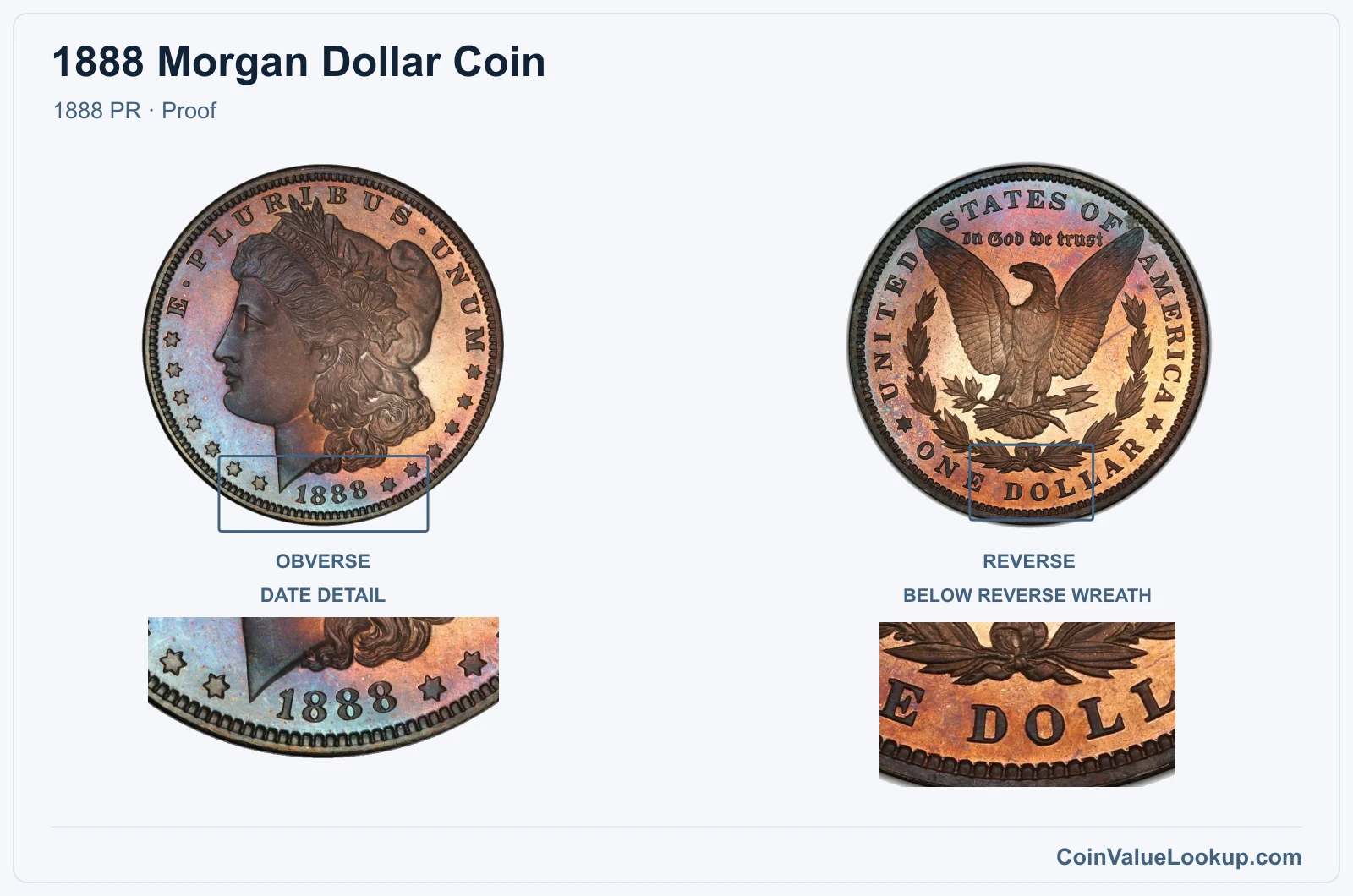
The 1888 Proof Morgan Dollar was struck at Philadelphia using specially prepared dies and planchets. It carries no mintmark.
A proof is a manufacturing finish — not simply a high-grade or especially shiny business strike.
No standard numeric price range has been adopted here. Value depends on the coin's authenticated proof identity and its condition.
Proof Morgans have deeply mirrored fields and sharp, squared-off device edges that differ from even the most lustrous business strike. If you think you have one, professional authentication is essential.
A prooflike business strike can fool you under certain lighting, but the edge detail and field depth are different under magnification. Do not pay a proof premium without third-party confirmation.
Range Grade
Price Auction Records Appraisal PR PR 1
—
Coin Identifier
PR 2
—
Coin Identifier
PR 3
—
Coin Identifier
PR 4
—
Coin Identifier
PR 6
—
Coin Identifier
PR 8
—
Coin Identifier
PR 10
—
Coin Identifier
PR 12
—
Coin Identifier
PR 15
—
Coin Identifier
PR 20
—
Coin Identifier
PR 25
—
Coin Identifier
PR 30
—
Coin Identifier
PR 35
—
Coin Identifier
PR 40
—
Coin Identifier
PR 45
—
Coin Identifier
PR 50
—
Coin Identifier
PR 53
Coin Identifier
PR 55
—
Coin Identifier
PR 58
—
Coin Identifier
PR 60
Coin Identifier
PR 61
Coin Identifier
PR 62
Coin Identifier
PR 63
Coin Identifier
PR 64
Coin Identifier
PR 65
Coin Identifier
PR 66
Coin Identifier
PR 67
Coin Identifier
PR 68
—
—
—
PR 69
—
—
—
PR 70
—
—
—
1888 Morgan Silver Dollar Error List
1. 1888 Morgan Silver Dollar — Doubled Die Reverse
A Doubled Die Reverse on an 1888 Morgan Dollar shows consistent doubling on the reverse design — letters, eagle feathers or wreath elements may appear with a secondary outline. Reported doubled reverse examples exist for this year.
To check, compare your coin's reverse lettering and design contours against a normal 1888 Morgan under the same lighting and magnification. True hub doubling creates separation or notching that is consistent across affected areas.
Machine doubling looks similar at a glance but tends to produce flat, shelf-like displacement without the crisp secondary outline.
No specific price range has been adopted. Value depends on the particular die, how visible the doubling is, and the coin's condition.
Reflections, random damage and worn die contours can mimic doubling, so careful comparison or professional attribution is the safest path.
2. 1888 Morgan Silver Dollar — Doubled Die Obverse
A Doubled Die Obverse on an 1888 Morgan Dollar means the obverse die received multiple impressions from the hub at slightly different angles. This produces visible doubling on letters, the date, or design elements of Liberty's portrait.
Compare the obverse legends and design with a normal coin under matching light. Genuine doubled-die obverse features show consistent separation or notching on multiple elements, not just one spot.
Machine doubling — a less valuable strike anomaly — creates a flat shelf rather than true secondary detail. Worn die contours and reflections can also fool you.
No numerical price range has been adopted. The value of a DDO depends on which specific die is involved, how dramatic the doubling appears, and the coin's overall grade.
Professional authentication is recommended before paying a variety premium.
3. 1888 Morgan Silver Dollar — Partial Collar Strike
A partial collar strike happens when the collar die — the ring that forms the coin's edge — does not fully contain the planchet during striking. On an 1888 Morgan Dollar, this produces a stepped or uneven edge where part of the coin spread beyond the collar while the rest was confined normally.
Check the edge profile by rolling the coin slowly on a flat surface. A normal Morgan has uniform reeding all the way around.
A partial collar coin will show a section where the edge is smooth, expanded or stepped relative to the rest.
Do not confuse edge damage or a flattened rim with a genuine partial collar. Post-strike damage leaves irregular marks, while a partial collar creates a smooth, consistent transition.
No numerical price range has been adopted; value depends on the degree of the misalignment and the coin's condition.
4. 1888 Morgan Silver Dollar — Rotated Dies
A rotated die error on an 1888 Morgan Dollar means the reverse die was not aligned correctly with the obverse die at the time of striking. Normally, if you hold the obverse upright and flip the coin top to bottom, the reverse should also appear upright.
A rotated die coin will show the reverse tilted at some angle.
To test this, hold the obverse so Liberty faces straight up, then rotate the coin on its vertical axis toward you. If the eagle is not centered and upright, you may have a rotation.
Measure the approximate degree of offset.
Be careful with photos — a rotated image is not a rotated die. Confirm the rotation by physically handling the coin.
No numerical price range has been adopted; value depends on the degree of rotation and the coin's overall condition. Slight rotations are less noteworthy than major ones.
5. 1888 Morgan Silver Dollar — Struck-Through Error
A struck-through error on an 1888 Morgan Dollar occurs when foreign material — grease, metal filings, cloth fibers or debris — gets between the die and the planchet during striking. The result is a localized depression or an incomplete area of the design where the obstruction blocked the full impression.
Look for a smooth, recessed area that does not match normal wear. Grease-filled dies tend to obscure entire letters or small design sections uniformly.
A retained foreign object may leave a distinct impression of its shape.
Do not mistake wear, scratches, cleaning marks or ordinary weak strikes for a struck-through error. Wear removes metal gradually from high points; a struck-through impression is recessed into the field or design from the moment of striking.
No numerical price range has been adopted. Value depends on the size, location and nature of the obstruction, plus the coin's grade.
6. 1888 Morgan Silver Dollar — Die Crack / Die Chip
Die cracks and die chips are raised features on an 1888 Morgan Dollar caused by a damaged or deteriorating die. A die crack appears as a thin raised line running across the coin's surface, sometimes connecting a design element to the rim.
A die chip shows up as a small raised blob, often inside a letter or near a design junction.
These features are raised because the crack or chip in the steel die creates a recess, and metal flows into that recess during striking. Compare your coin to a normal example — the extra raised material should be obvious under magnification.
Do not confuse scratches (which are incuse, or cut into the surface) with die cracks (which are raised above it). Corrosion or foreign deposits can also mimic chips.
No numerical price range has been adopted; value depends on the size, location and visual drama of the crack or chip, along with the coin's condition.