1921 Morgan Silver Dollar Coin Value: How Much Is It Worth?
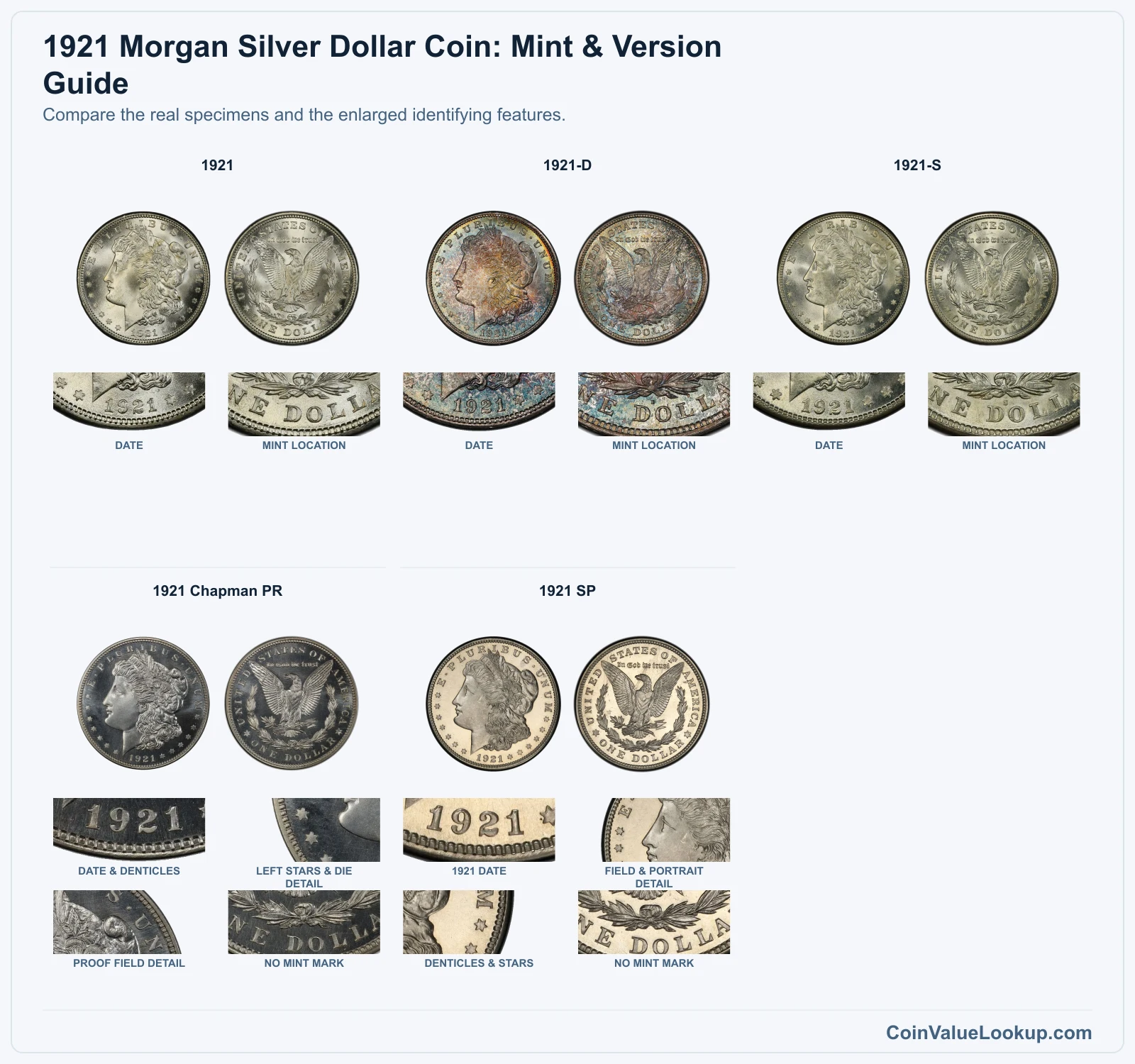
The 1921 Morgan Silver Dollar is the last year of one of America's most iconic coin series. After a long hiatus, the Mint revived the Morgan design for a single massive production run before switching to the Peace Dollar later that year.
Value depends on which mint struck your coin, its condition, surface quality and whether it belongs to a scarce special category like a Chapman Proof or Specimen strike. Identifying the exact version you hold is the essential first step.
Fast Way to Identify Your 1921 Morgan Silver Dollar
The quickest way to start figuring out what you have is to upload clear photos of both the front and back of your coin. Our identifier can give you a preliminary read on the mint, design type and general condition.
It is not a substitute for professional authentication, but it helps you zero in on the right version before you dig deeper into values.
1921 Morgan Silver Dollar Value
Upload both sides of your 1921 Morgan Silver Dollar.
Front Obverse
Upload photo
Back Reverse
Upload photo
Which 1921 Morgan Silver Dollar Versions Are Worth Money?
- The 1921 Chapman Proof is a rare special-finish issue from Philadelphia; professional authentication is required to confirm it.
- The 1921 Specimen (SP) strike is another scarce Philadelphia finish that commands attention from advanced collectors.
- PL and DMPL surface designations on regular business strikes can affect value; a shiny surface alone is not sufficient for attribution.
- The 1921-D and 1921-S carry mintmarks that distinguish them from the Philadelphia issue; check below the wreath bow.
- Condition matters greatly across all versions; original surfaces without cleaning or damage preserve the most value.
Step 1: Identify Your 1921 Morgan Silver Dollar Mint Mark and Version
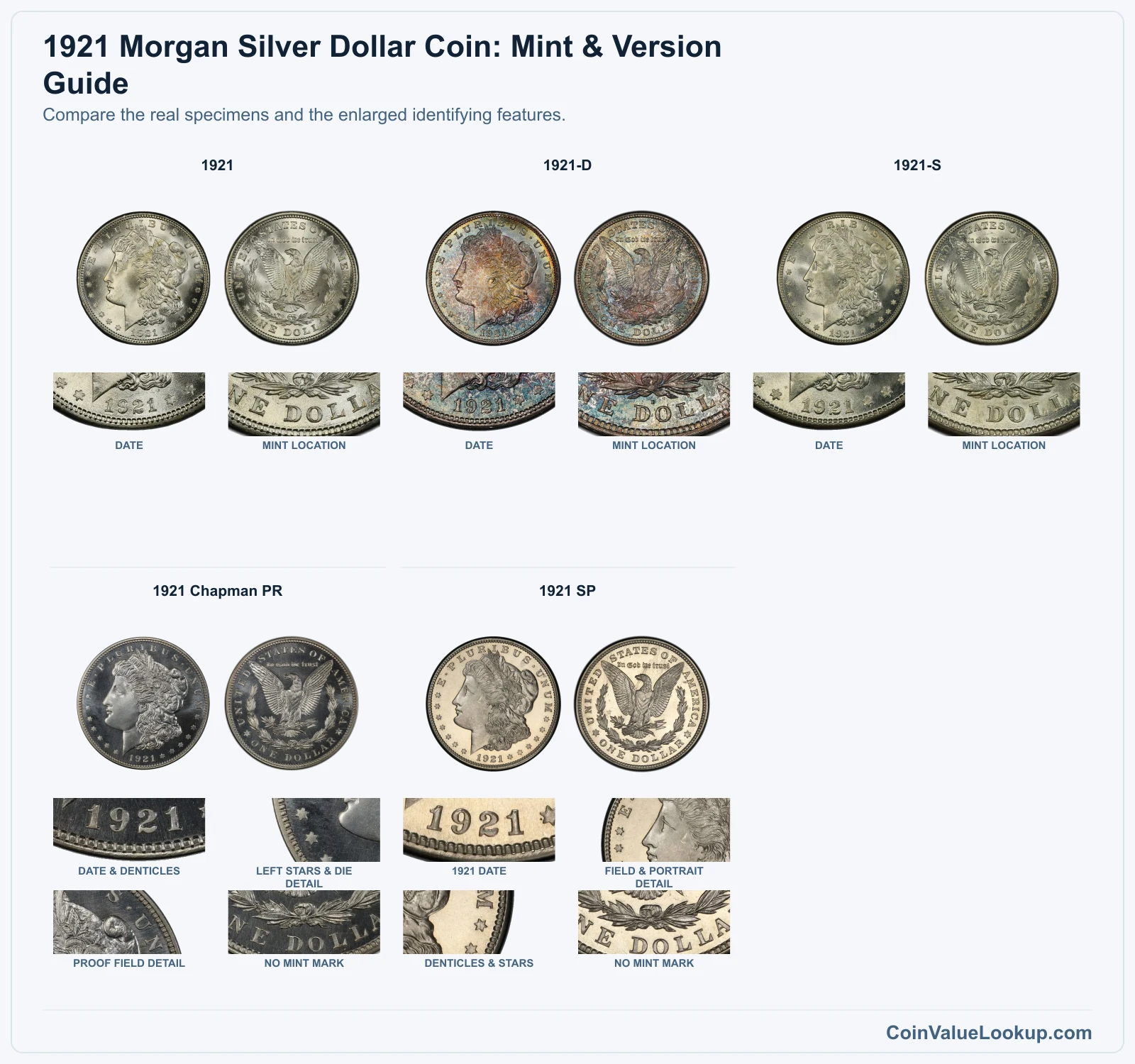
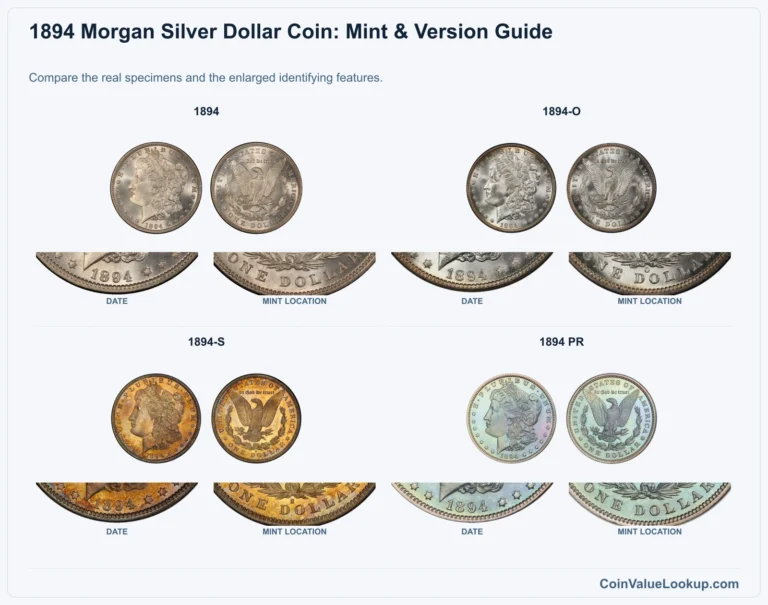
Flip your 1921 Morgan Dollar to the reverse and look below the bow of the wreath. That is where the mintmark sits.
No letter means Philadelphia. A "D" means Denver, and an "S" means San Francisco.
Those are the only three business-strike mints for this year.
The coin is 90% silver and 10% copper, weighing 26.73 grams. The obverse shows Liberty's head with a Phrygian cap, and the reverse features an eagle clutching arrows and an olive branch inside a wreath.
The edge is reeded.
Beyond the three regular-strike versions, two rare special finishes exist for 1921: the Chapman Proof and the Specimen strike. Both were made at Philadelphia and carry no mintmark.
A shiny coin is not automatically one of these. Proof is a specific manufacturing method, not just a high grade, and professional certification is essential to confirm either designation.
Prooflike (PL) and Deep Mirror Prooflike (DMPL) surfaces sometimes appear on regular business strikes. These are surface designations applied during grading, not separate proof manufacture.
A mirror-like field alone does not make your coin a proof.
Step 2: Check Your 1921 Morgan Silver Dollar Grade
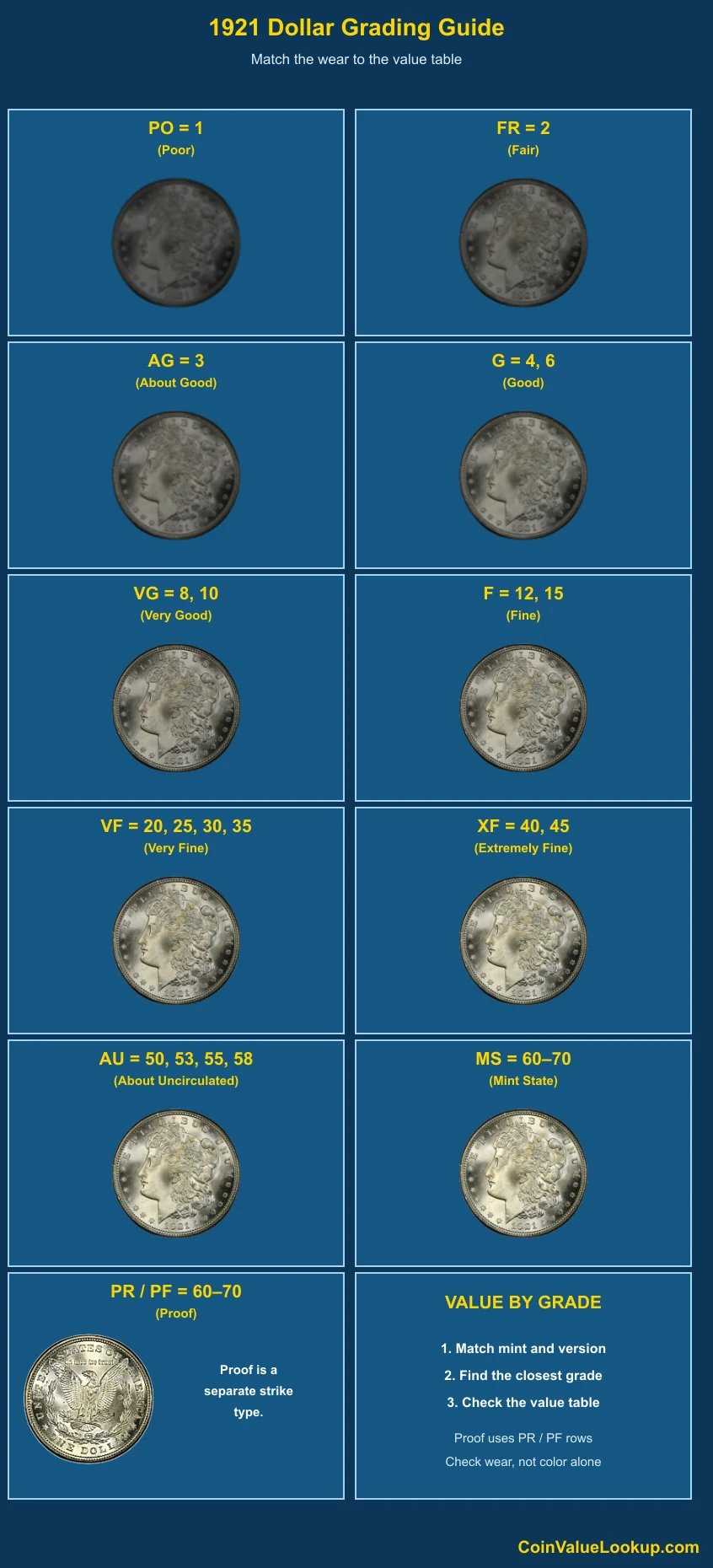
Start with Liberty's hair detail above the ear. On a well-worn coin, those strands merge into a flat area first.
Next check the cheek below the eye and the cap above the forehead. Any softness there tells you the coin has seen circulation.
On the reverse, the eagle's breast feathers lose definition early. Compare yours to the grading image to see how much detail remains.
Mint State coins still have full detail, but that does not mean they are perfect. Bag marks, those little nicks and scrapes from being tossed around with thousands of other heavy silver dollars, pull the grade down even without actual wear.
A coin can look shiny and still grade MS-60 because of heavy contact marks.
Cleaned or polished coins lose their original luster and develop a distinctive washed-out or artificially bright appearance. This reduces both grade and market appeal.
If your coin looks unusually shiny but has fine hairlines under magnification, it may have been cleaned.
Step 3: Check 1921 Morgan Silver Dollar Value by Mint and Version
1921 Morgan Silver Dollar
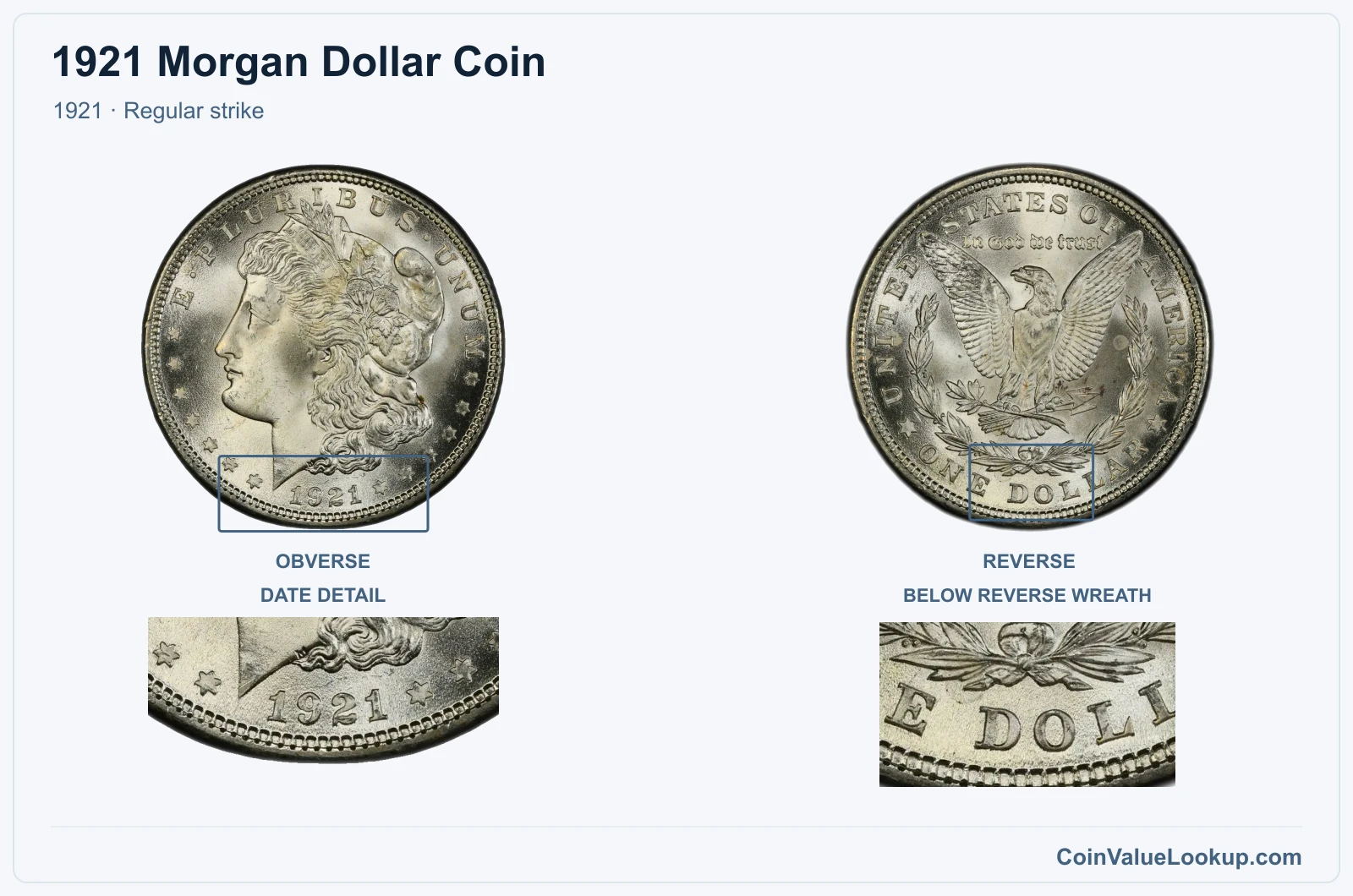
The 1921 Philadelphia Morgan Dollar has no mintmark. This is by far the most common version of the year, as the Philadelphia Mint produced the lion's share of the 1921 run.
Value depends on authenticated grade and whether the coin retains original, uncleaned surfaces.
Some Philadelphia strikes exhibit Prooflike or Deep Mirror Prooflike surfaces. These are grading-service designations for business strikes that happened to receive reflective fields during production.
They are not proof coins. Pricing for a specific grade depends on individual assessment of the coin's authenticated identity and condition.
Range Grade
Price Auction Records Appraisal PO PO 1
Coin Identifier FR FR 2
Coin Identifier AG AG 3
—
Coin Identifier G G 4
—
Coin Identifier
G 6
—
Coin Identifier VG VG 8
—
Coin Identifier
VG 10
—
Coin Identifier F F 12
—
Coin Identifier
F 15
—
Coin Identifier VF VF 20
—
Coin Identifier
VF 25
—
Coin Identifier
VF 30
—
Coin Identifier
VF 35
—
Coin Identifier XF XF 40
—
Coin Identifier
XF 45
—
Coin Identifier AU AU 50
Coin Identifier
AU 53
Coin Identifier
AU 55
Coin Identifier
AU 58
Coin Identifier MS MS 60
Coin Identifier
MS 61
Coin Identifier
MS 62
Coin Identifier
MS 63
Coin Identifier
MS 64
Coin Identifier
MS 65
Coin Identifier
MS 66
Coin Identifier
MS 67
Coin Identifier
MS 68
—
—
—
MS 69
—
—
—
MS 70
—
—
—
1921 Morgan Silver Dollar — D
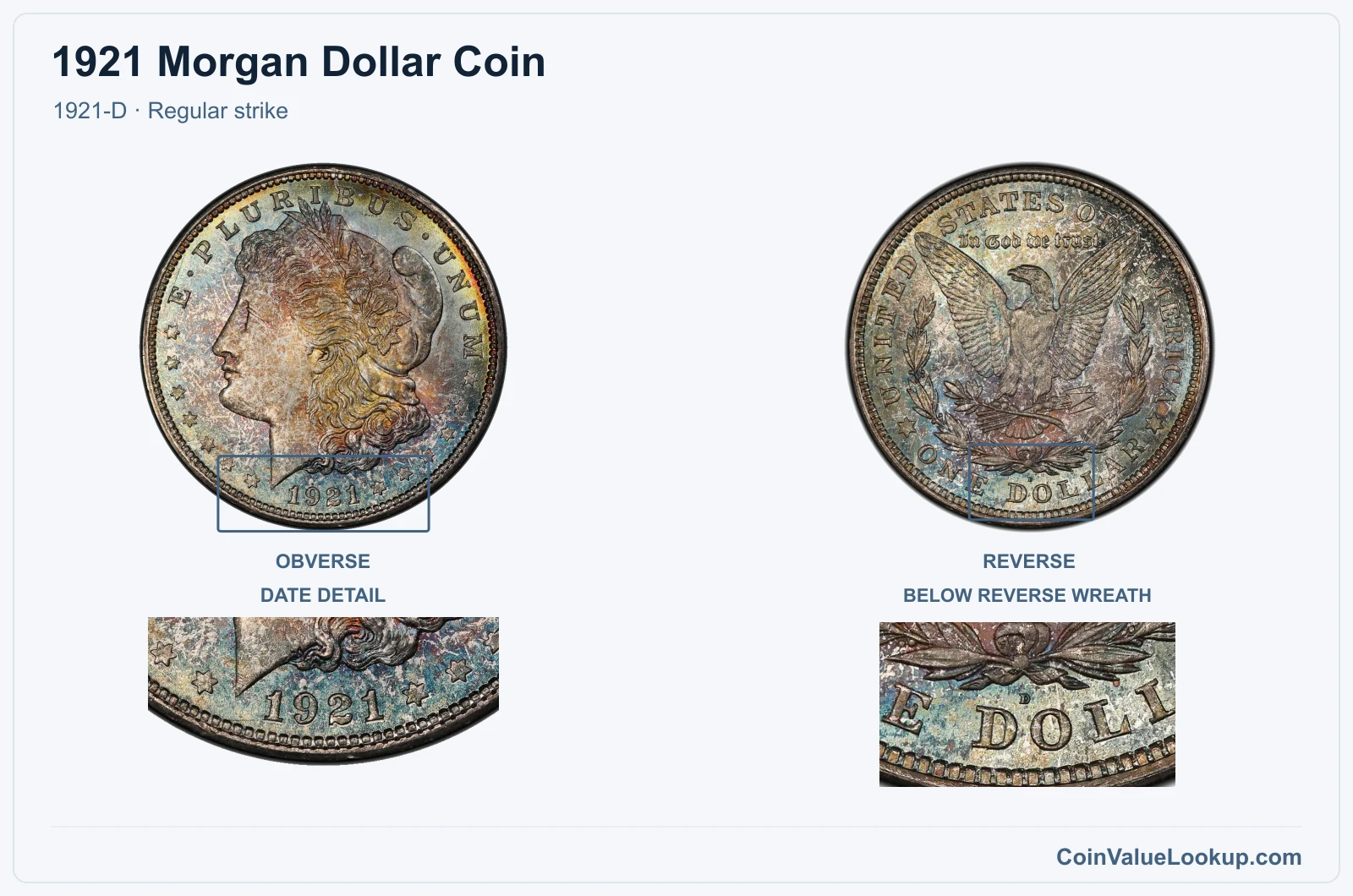
The 1921-D carries a small "D" mintmark below the wreath bow on the reverse. Denver struck a large quantity this year, so the coin is available across many grades.
As with all 1921 Morgans, original surfaces matter. A coin that has been polished, dipped or otherwise cleaned will not compare well to one with natural toning or blast-white original luster.
Value hinges on authenticated grade and surface quality. PL and DMPL designations may apply to eligible business strikes with reflective fields.
Range Grade
Price Auction Records Appraisal PO PO 1
—
Coin Identifier FR FR 2
Coin Identifier AG AG 3
—
Coin Identifier G G 4
—
Coin Identifier
G 6
—
Coin Identifier VG VG 8
—
Coin Identifier
VG 10
—
Coin Identifier F F 12
—
Coin Identifier
F 15
—
Coin Identifier VF VF 20
—
Coin Identifier
VF 25
—
Coin Identifier
VF 30
Coin Identifier
VF 35
—
Coin Identifier XF XF 40
Coin Identifier
XF 45
Coin Identifier AU AU 50
Coin Identifier
AU 53
Coin Identifier
AU 55
Coin Identifier
AU 58
Coin Identifier MS MS 60
Coin Identifier
MS 61
Coin Identifier
MS 62
Coin Identifier
MS 63
Coin Identifier
MS 64
Coin Identifier
MS 65
Coin Identifier
MS 66
Coin Identifier
MS 67
Coin Identifier
MS 68
—
—
—
MS 69
—
—
—
MS 70
—
—
—
1921 Morgan Silver Dollar — S
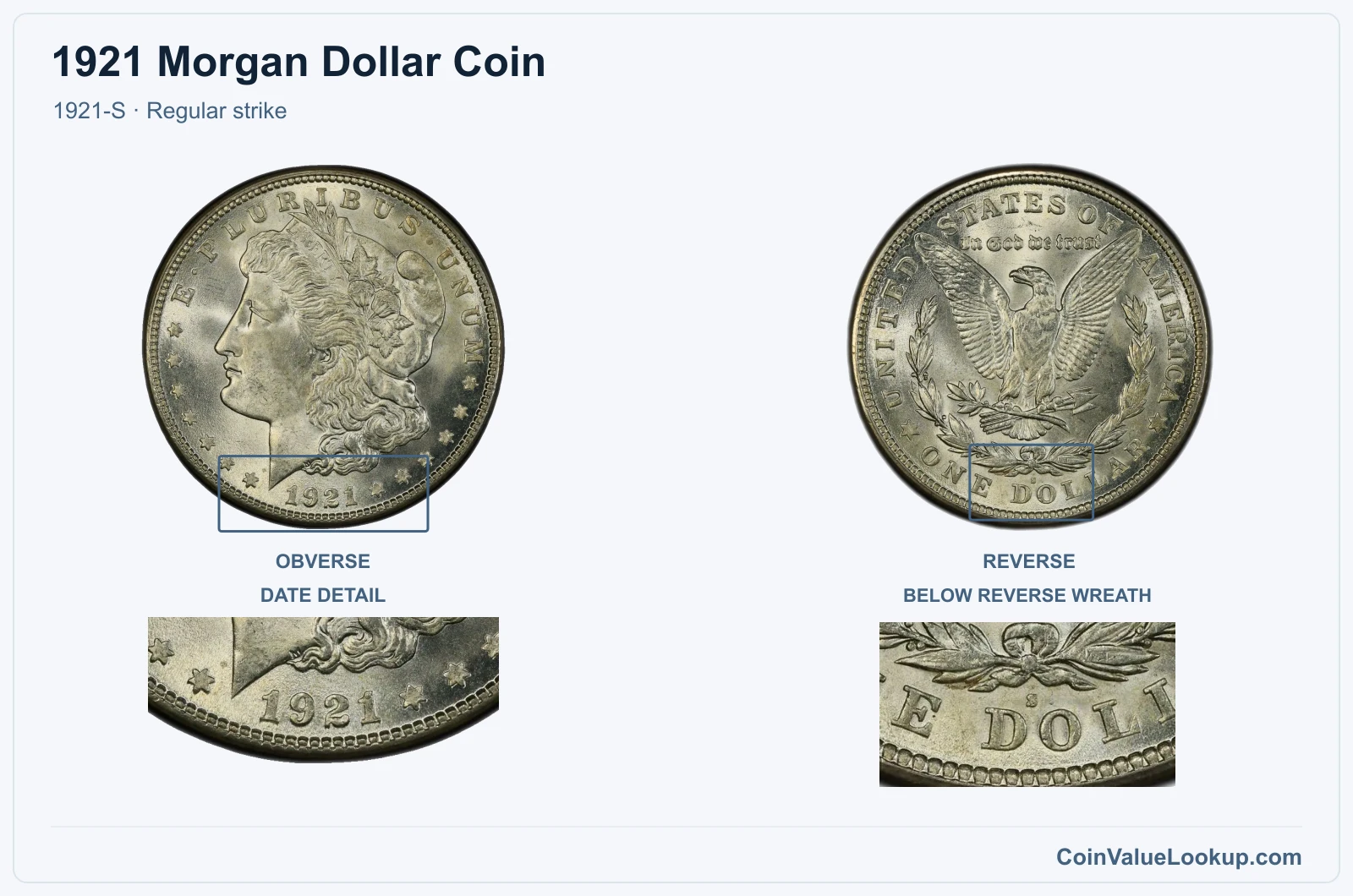
Look for the "S" mintmark below the wreath bow to confirm a San Francisco strike. The 1921-S rounds out the trio of business-strike mints for this final Morgan year.
Coin Value Lookup is a useful starting point when you want to look up guides for different coin series and dates. It can help you narrow down which version and grade range applies to your specific coin.
Value depends on the coin's authenticated grade and whether original surfaces are intact. Cleaning, environmental damage and heavy bag marks all reduce desirability.
PL and DMPL surface designations can apply where eligible.
Range Grade
Price Auction Records Appraisal PO PO 1
Coin Identifier FR FR 2
Coin Identifier AG AG 3
—
Coin Identifier G G 4
—
Coin Identifier
G 6
—
Coin Identifier VG VG 8
—
Coin Identifier
VG 10
—
Coin Identifier F F 12
—
Coin Identifier
F 15
—
Coin Identifier VF VF 20
—
Coin Identifier
VF 25
—
Coin Identifier
VF 30
—
Coin Identifier
VF 35
Coin Identifier XF XF 40
Coin Identifier
XF 45
Coin Identifier AU AU 50
Coin Identifier
AU 53
Coin Identifier
AU 55
Coin Identifier
AU 58
Coin Identifier MS MS 60
Coin Identifier
MS 61
Coin Identifier
MS 62
Coin Identifier
MS 63
Coin Identifier
MS 64
Coin Identifier
MS 65
Coin Identifier
MS 66
Coin Identifier
MS 67
Coin Identifier
MS 68
—
—
—
MS 69
—
—
—
MS 70
—
—
—
1921 Morgan Silver Dollar — Chapman PR
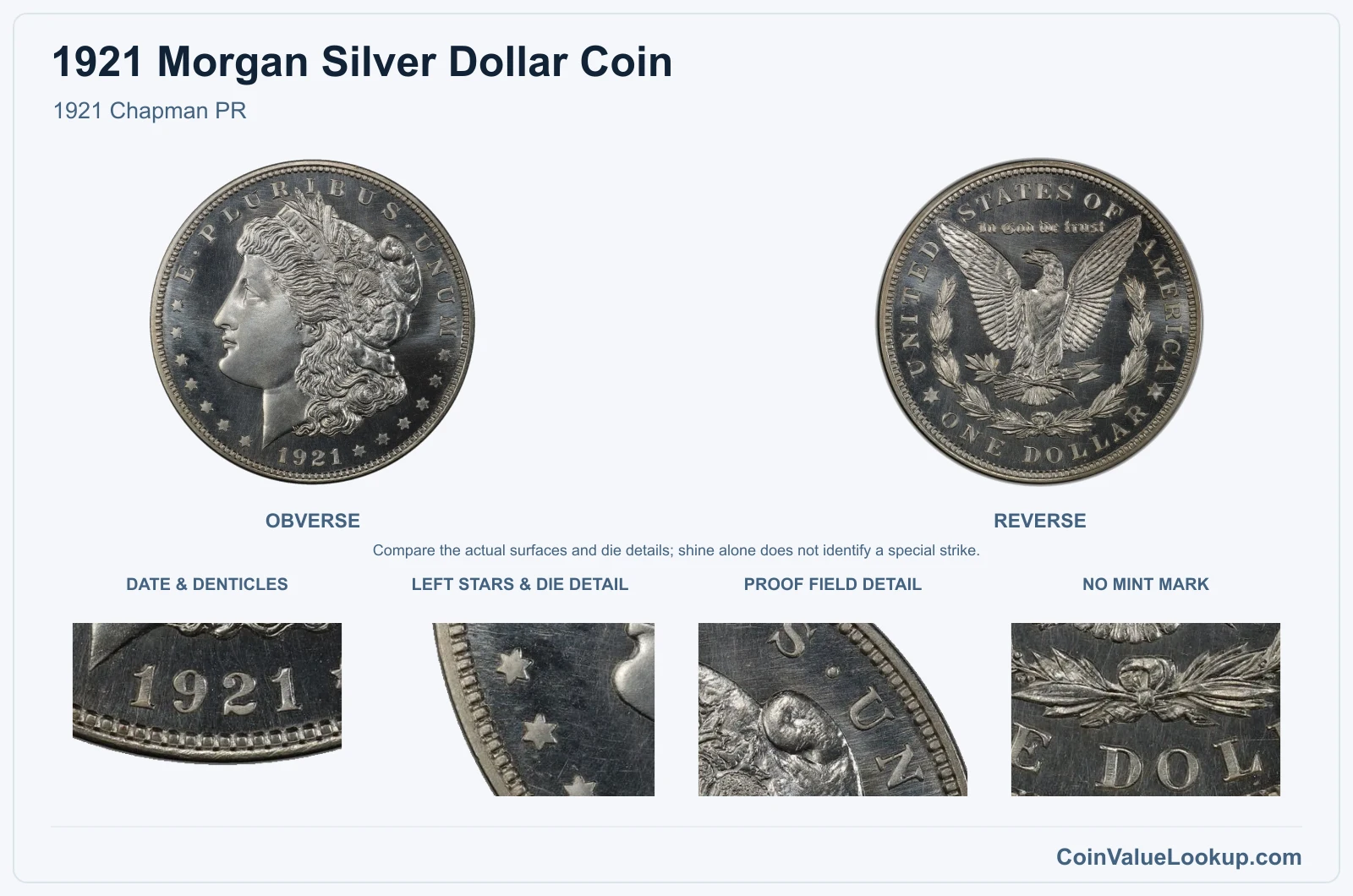
The 1921 Chapman Proof is one of the rarest issues in the entire Morgan Dollar series. It was struck at Philadelphia with specially prepared dies and planchets, producing mirror fields and sharp details that business strikes cannot replicate.
A proof is a manufacturing method, not simply a high grade. Many shiny 1921 Morgans are business strikes with reflective surfaces, not proofs.
Professional third-party certification is the only reliable way to confirm Chapman Proof status. Do not pay a proof premium based on appearance alone.
Because these are so scarce, value depends entirely on authenticated identity, grade and any individual characteristics of the specific coin. Each example is assessed on its own merits.
Range Grade
Price Auction Records Appraisal PR PR 1
—
Coin Identifier
PR 2
—
Coin Identifier
PR 3
—
Coin Identifier
PR 4
—
Coin Identifier
PR 6
—
Coin Identifier
PR 8
—
Coin Identifier
PR 10
—
Coin Identifier
PR 12
—
Coin Identifier
PR 15
—
Coin Identifier
PR 20
—
Coin Identifier
PR 25
—
Coin Identifier
PR 30
—
Coin Identifier
PR 35
—
Coin Identifier
PR 40
—
Coin Identifier
PR 45
—
Coin Identifier
PR 50
—
Coin Identifier
PR 53
—
Coin Identifier
PR 55
—
Coin Identifier
PR 58
—
Coin Identifier
PR 60
Coin Identifier
PR 61
—
Coin Identifier
PR 62
Coin Identifier
PR 63
Coin Identifier
PR 64
Coin Identifier
PR 65
Coin Identifier
PR 66
Coin Identifier
PR 67
Coin Identifier
PR 68
—
—
—
PR 69
—
—
—
PR 70
—
—
—
1921 Morgan Silver Dollar — SP
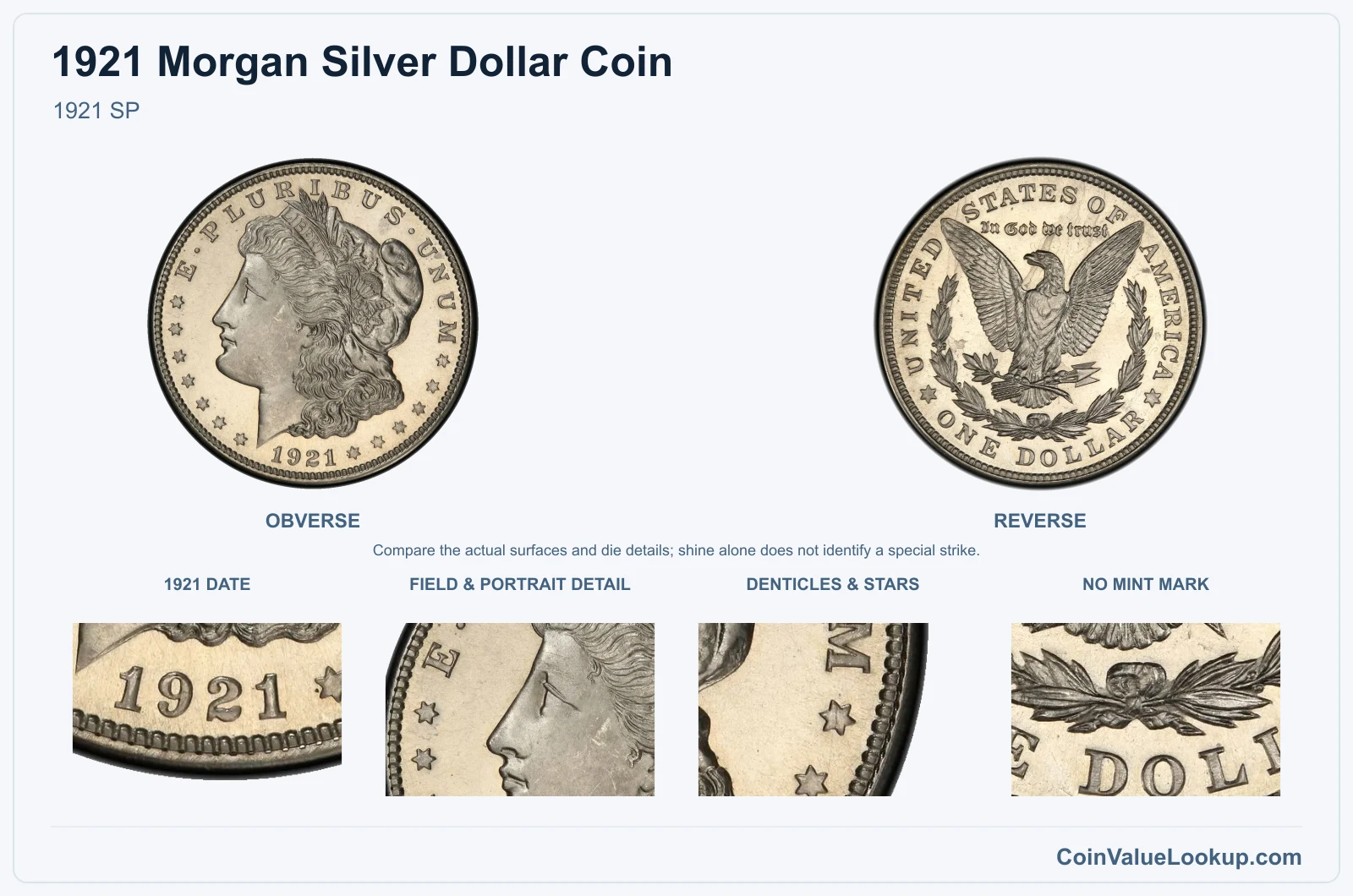
The 1921 Specimen strike is another Philadelphia special-finish issue, designated SP by grading services. Like the Chapman Proof, it is extremely scarce and requires professional authentication to confirm.
Specimen strikes differ from standard business strikes in their preparation and finish, though the visual distinction can be subtle without side-by-side comparison under proper lighting. A coin that simply looks "nicer than average" is not necessarily an SP.
Value is determined by individual assessment of the coin's authenticated identity and condition. The rarity of confirmed examples means each one is evaluated on its own terms rather than against a broad price table.
Range Grade
Price Auction Records Appraisal SP SP 1
—
Coin Identifier
SP 2
—
Coin Identifier
SP 3
—
Coin Identifier
SP 4
—
Coin Identifier
SP 6
—
Coin Identifier
SP 8
—
Coin Identifier
SP 10
—
Coin Identifier
SP 12
—
Coin Identifier
SP 15
—
Coin Identifier
SP 20
—
Coin Identifier
SP 25
—
Coin Identifier
SP 30
—
Coin Identifier
SP 35
—
Coin Identifier
SP 40
—
Coin Identifier
SP 45
—
Coin Identifier
SP 50
—
Coin Identifier
SP 53
—
Coin Identifier
SP 55
—
Coin Identifier
SP 58
—
Coin Identifier
SP 60
—
Coin Identifier
SP 61
Coin Identifier
SP 62
Coin Identifier
SP 63
Coin Identifier
SP 64
Coin Identifier
SP 65
Coin Identifier
SP 66
Coin Identifier
SP 67
—
—
—
SP 68
—
—
—
SP 69
—
—
—
SP 70
—
—
—
1921 Morgan Silver Dollar Error List
1. 1921 Morgan Silver Dollar — Clashed Dies
A clashed die error on the 1921 Morgan Dollar occurs when the obverse and reverse dies strike each other without a planchet between them. The impact transfers traces of one die's design onto the other.
On the finished coin, you may see faint ghost-like impressions of the opposite design in the fields, aligned with where the opposing features would naturally sit.
The specific variety reported for this year is a "Denticle Clash," involving the rim denticles. This is documented for the 1921 Philadelphia Morgan Dollar; other mints are not implied by that listing.
Do not confuse clash marks with random scratches, raised lines from a damaged die, or post-mint contact marks. True clash impressions follow a predictable pattern matching the opposite die.
Condition, visibility of the clash and the specific error type all affect how the coin is valued. Professional authentication is recommended before paying any premium.
2. 1921 Morgan Silver Dollar — Off-Center Strike
An off-center strike happens when the planchet is not properly seated between the dies at the moment of striking. The result is a design that is shifted to one side, leaving an unstruck crescent of blank metal on the opposite edge.
The degree of displacement matters: a 5% shift is subtle, while a 50% shift is dramatic and unmistakable.
This error has been reported for the 1921 Morgan Dollar. A key factor in desirability is whether the date remains fully visible despite the shift.
Do not confuse an off-center strike with a clipped planchet, which removes material before striking, or with one-sided die misalignment that tilts the design without displacing it. Post-mint damage like a flattened rim is also not a strike error.
Value depends on the percentage of displacement, condition and visibility. Authentication by a professional service is strongly recommended.