1885 Morgan Silver Dollar Coin Value: How Much Is It Worth?
The 1885 Morgan Silver Dollar is a coin worth examining closely. Guide estimates for this year range from about $74.00 in well-worn grades to $2,534.00 at the gem Mint State level, depending on mint, variety and condition.
Not every 1885 dollar falls in that window — mint, finish and design variety matter. A common Philadelphia or New Orleans piece in low grade sits near the bottom, while a gem San Francisco coin or a scarce Carson City variety can land much higher.
Fast Way to Identify Your 1885 Morgan Silver Dollar
The quickest way to start figuring out what you have is to upload clear photos of both the front and back of your coin. Our identifier uses those images for a preliminary identification of your coin's mint, design and general condition.
It is not a substitute for professional authentication or precise grading, but it gives you a solid starting point before digging deeper.
1885 Morgan Silver Dollar Value
Upload both sides of your 1885 Morgan Silver Dollar.
Front Obverse
Upload photo
Back Reverse
Upload photo
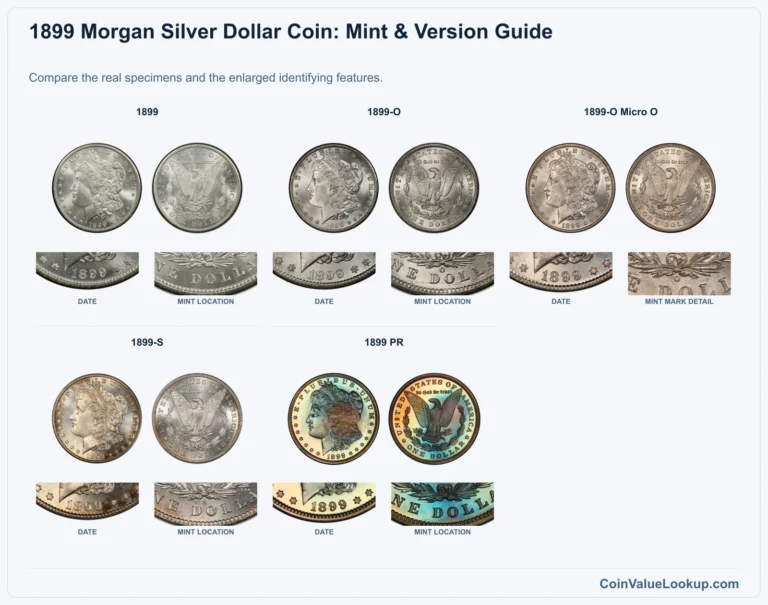
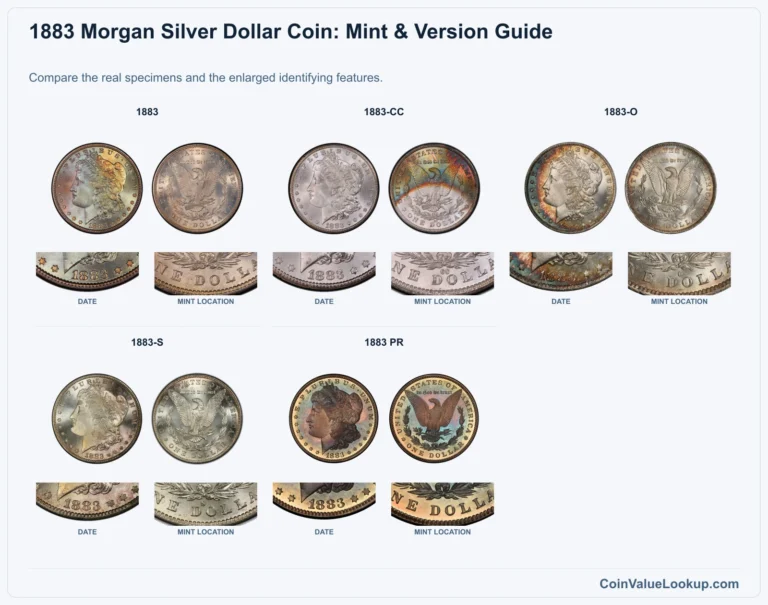
Which 1885 Morgan Silver Dollar Versions Are Worth Money?
- The 1885-CC DDGH is a doubled-die variety from Carson City — confirm both the CC mintmark and the doubling before assuming you have one.
- The 1885 Proof (PR) is a special manufacturing finish struck at Philadelphia; it requires professional authentication, not just a shiny appearance.
- Carson City (CC) regular strikes carry a clear premium over Philadelphia and New Orleans issues in matching grades.
- The 1885-S jumps sharply in value at gem Mint State levels, with a guide estimate around $2,534.00 at MS65 compared to $74.00 in G4.
Step 1: Identify Your 1885 Morgan Silver Dollar Mint Mark and Version
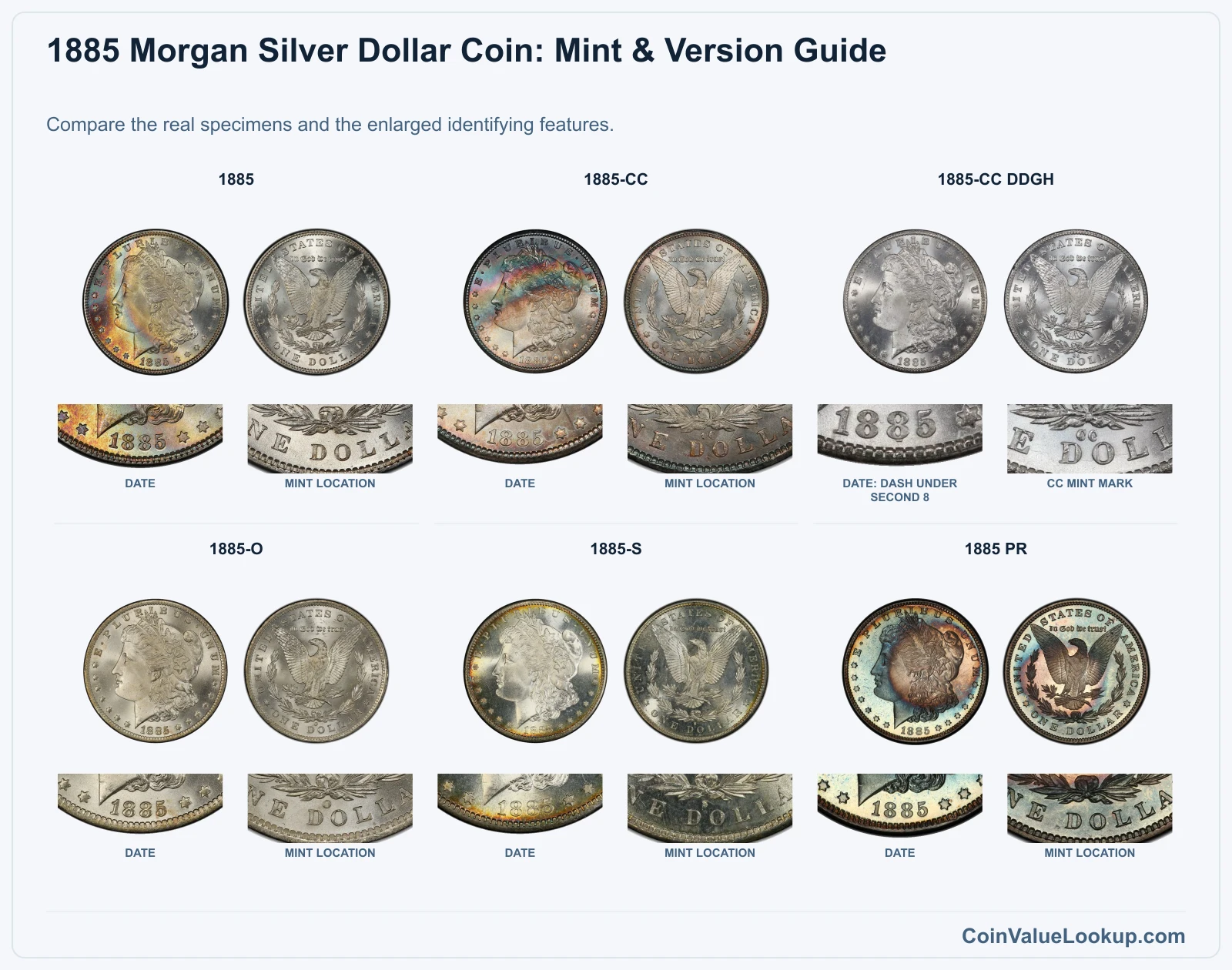
Flip the coin to the reverse and look below the bow that ties the wreath together. That is where the mintmark lives.
No letter means Philadelphia. A "CC" is Carson City, "O" is New Orleans, and "S" is San Francisco.
Only those four mints struck Morgan Dollars in 1885.
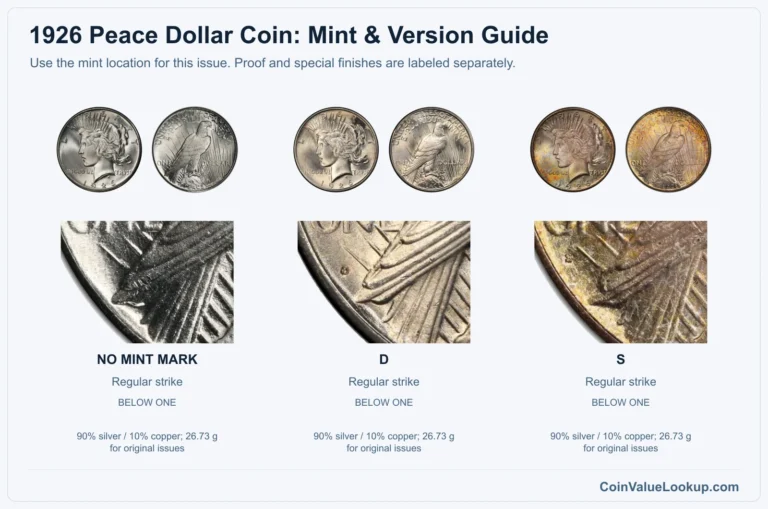
The coin should weigh 26.73 grams and be made of 90% silver and 10% copper with a reeded edge. If yours is noticeably lighter or has a smooth edge, something is off.
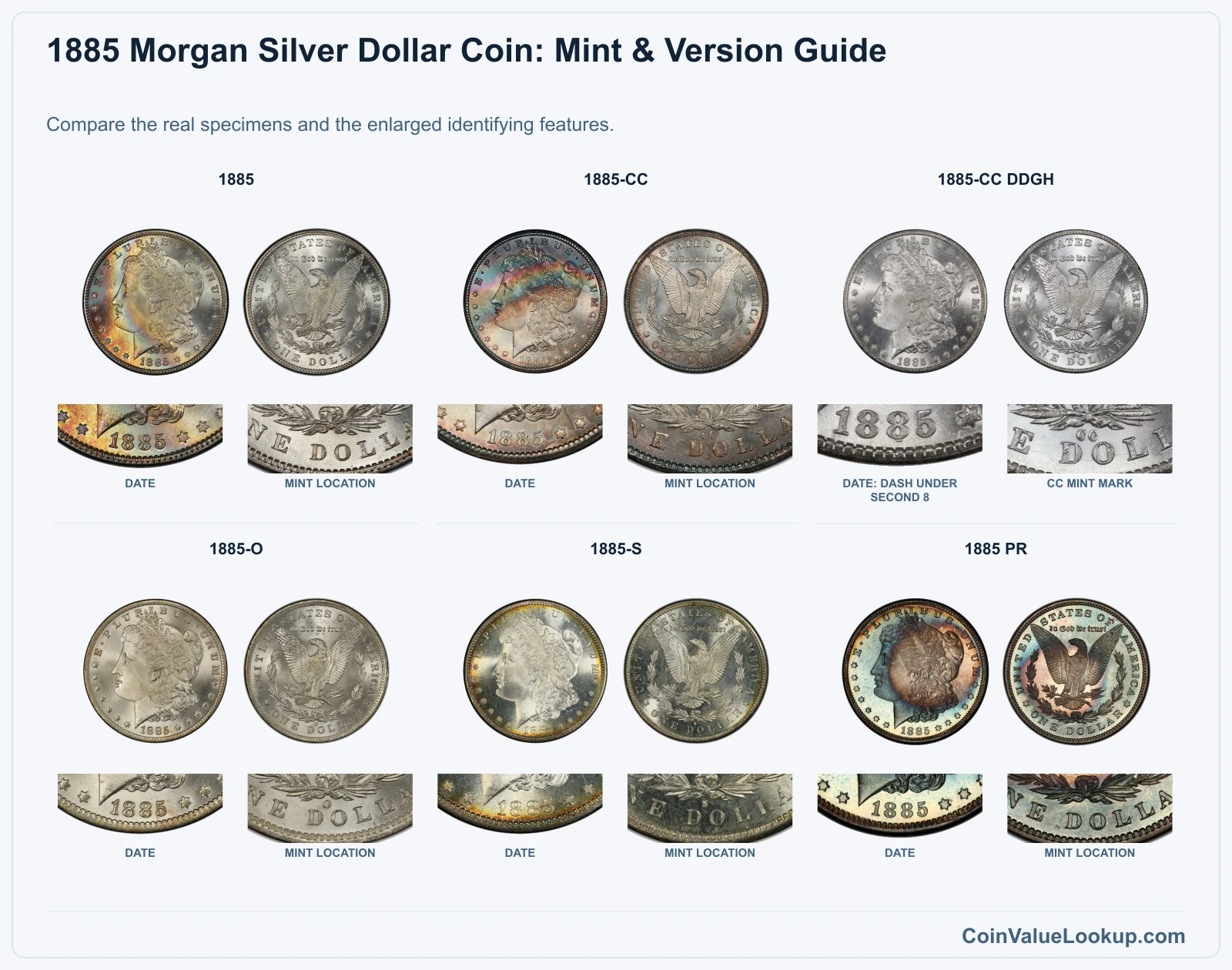
Beyond the basic mint, you need to check for specific varieties. The 1885-CC comes in both a standard version and a doubled-die variety (labeled here as 1885-CC DDGH).
Philadelphia also produced proof strikes this year, which are a special manufacturing finish — not just a shiny coin.
Some business strikes show prooflike or deep-mirror prooflike surfaces, sometimes noted as PL or DMPL. These are surface designations on regular strikes, not proof manufacture.
A shiny surface alone does not make a coin prooflike; that requires authenticated attribution.
Step 2: Check Your 1885 Morgan Silver Dollar Grade
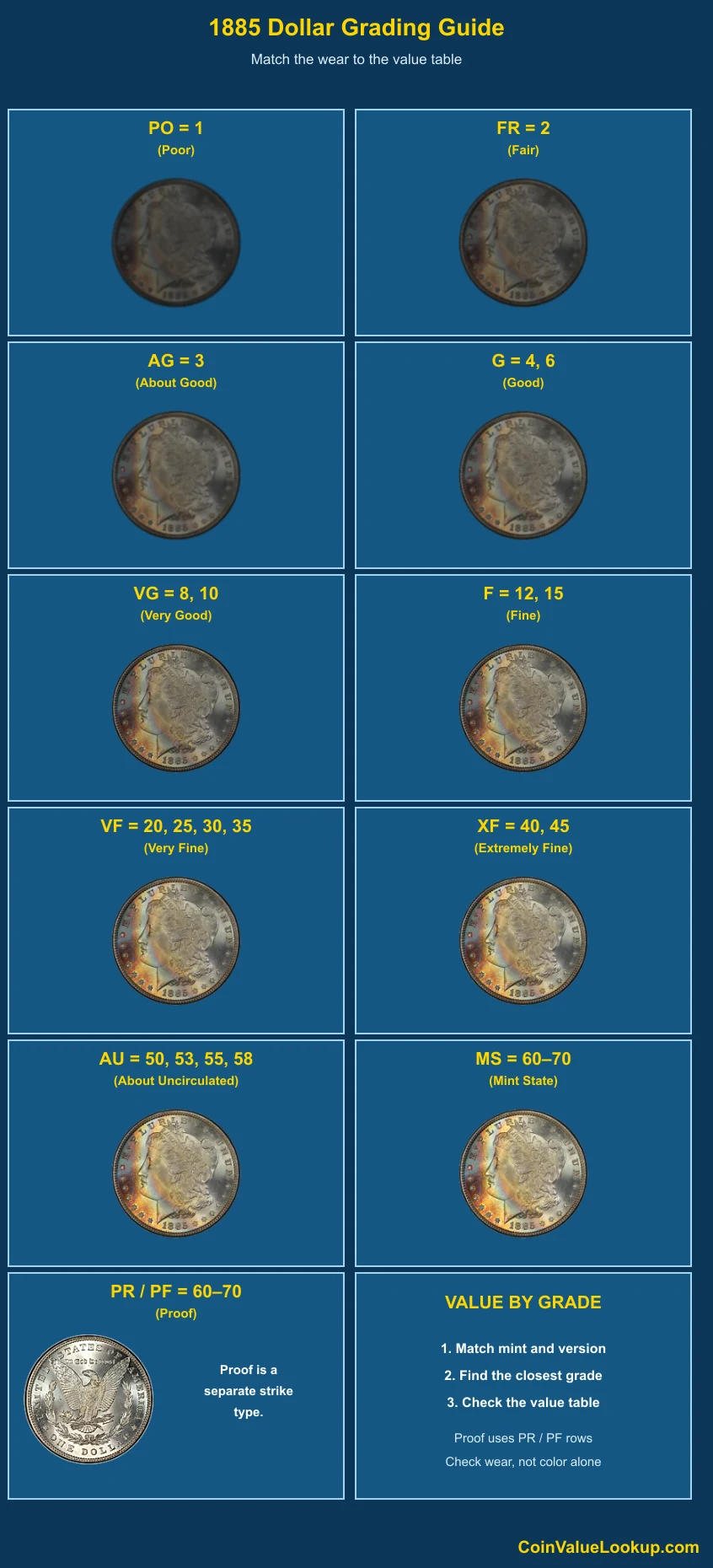
Start by checking the hair above Liberty's ear on the obverse. In a well-circulated coin, those strands are flat and merged together.
An About Uncirculated piece still shows faint wear on the cheek and the cap but retains most of its original luster.
On the reverse, the eagle's breast feathers are the first to go. If every feather is sharp and fully separated, you are likely in Mint State territory.
Bag marks complicate things. Morgan Dollars were stored in heavy canvas bags, so even uncirculated coins often have nicks and contact marks.
Those marks lower the Mint State grade without indicating actual circulation wear. Use the comparison image to see how circulated, AU and Mint State examples differ side by side.
Cleaned or polished coins lose their original surfaces and grade differently from untouched pieces, so look for unnatural shininess or hairline scratches under light.
Step 3: Check 1885 Morgan Silver Dollar Value by Mint and Version
1885 Morgan Silver Dollar
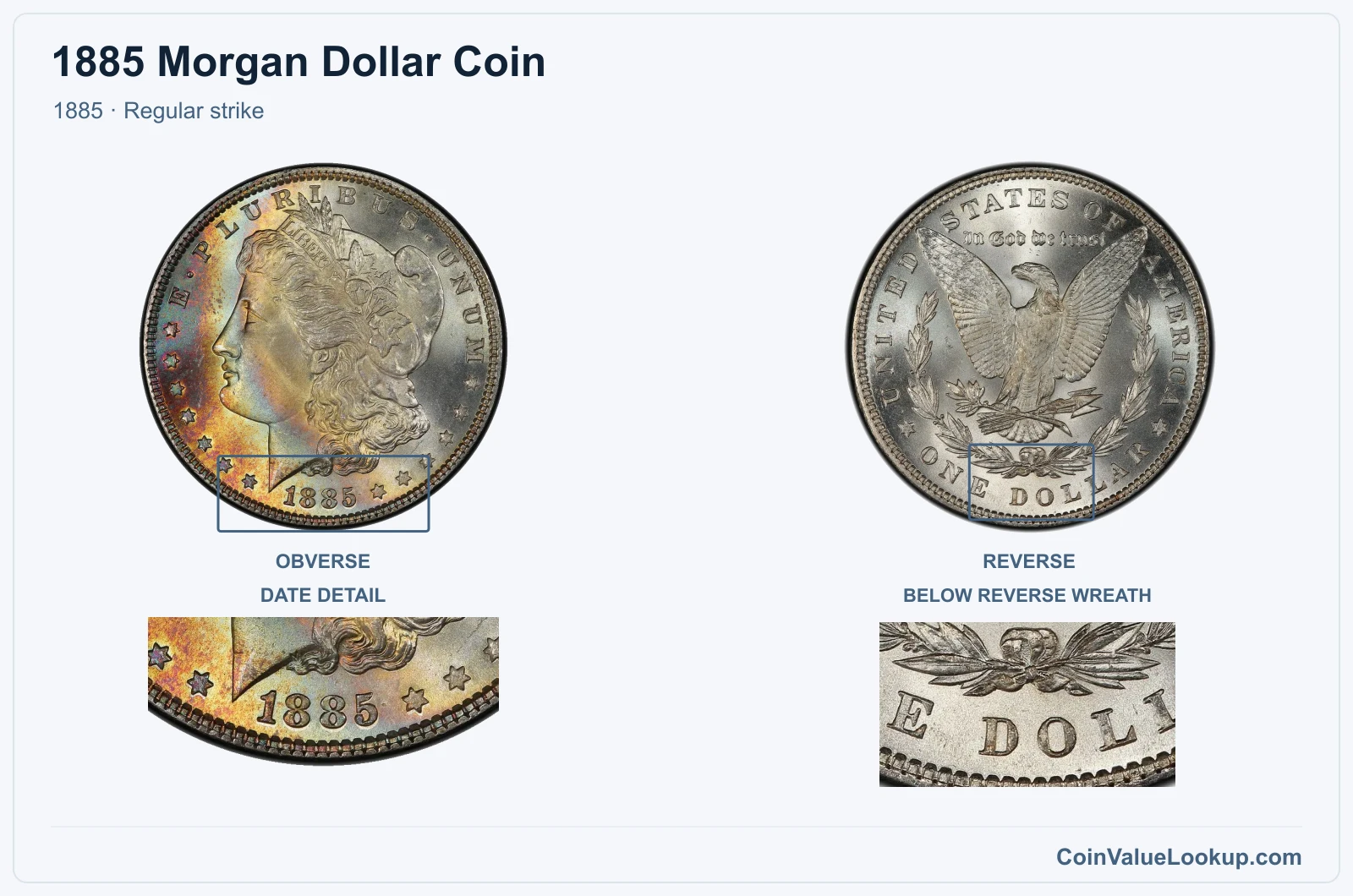
The 1885 Philadelphia issue has no mintmark below the wreath bow. It is the most available version of this date in lower grades.
A USA Coin Book guide estimate places it at about $74.00 in G4 and around $302.00 in MS65. These are guide estimates, not guaranteed sale prices.
Original, uncleaned surfaces matter. A coin that has been polished or dipped will not compare favorably to one with natural toning or full cartwheel luster.
Prooflike and deep-mirror prooflike designations apply to eligible business strikes and can affect pricing, but a merely shiny coin does not automatically qualify.
Range Grade
Price Auction Records Appraisal PO PO 1
—
Coin Identifier FR FR 2
Coin Identifier AG AG 3
—
Coin Identifier G G 4
—
Coin Identifier
G 6
—
Coin Identifier VG VG 8
—
Coin Identifier
VG 10
—
Coin Identifier F F 12
—
Coin Identifier
F 15
—
Coin Identifier VF VF 20
—
Coin Identifier
VF 25
—
Coin Identifier
VF 30
—
Coin Identifier
VF 35
—
Coin Identifier XF XF 40
—
Coin Identifier
XF 45
Coin Identifier AU AU 50
Coin Identifier
AU 53
Coin Identifier
AU 55
Coin Identifier
AU 58
Coin Identifier MS MS 60
Coin Identifier
MS 61
Coin Identifier
MS 62
Coin Identifier
MS 63
Coin Identifier
MS 64
Coin Identifier
MS 65
Coin Identifier
MS 66
Coin Identifier
MS 67
Coin Identifier
MS 68
Coin Identifier
MS 69
—
—
—
MS 70
—
—
—
1885 Morgan Silver Dollar — CC
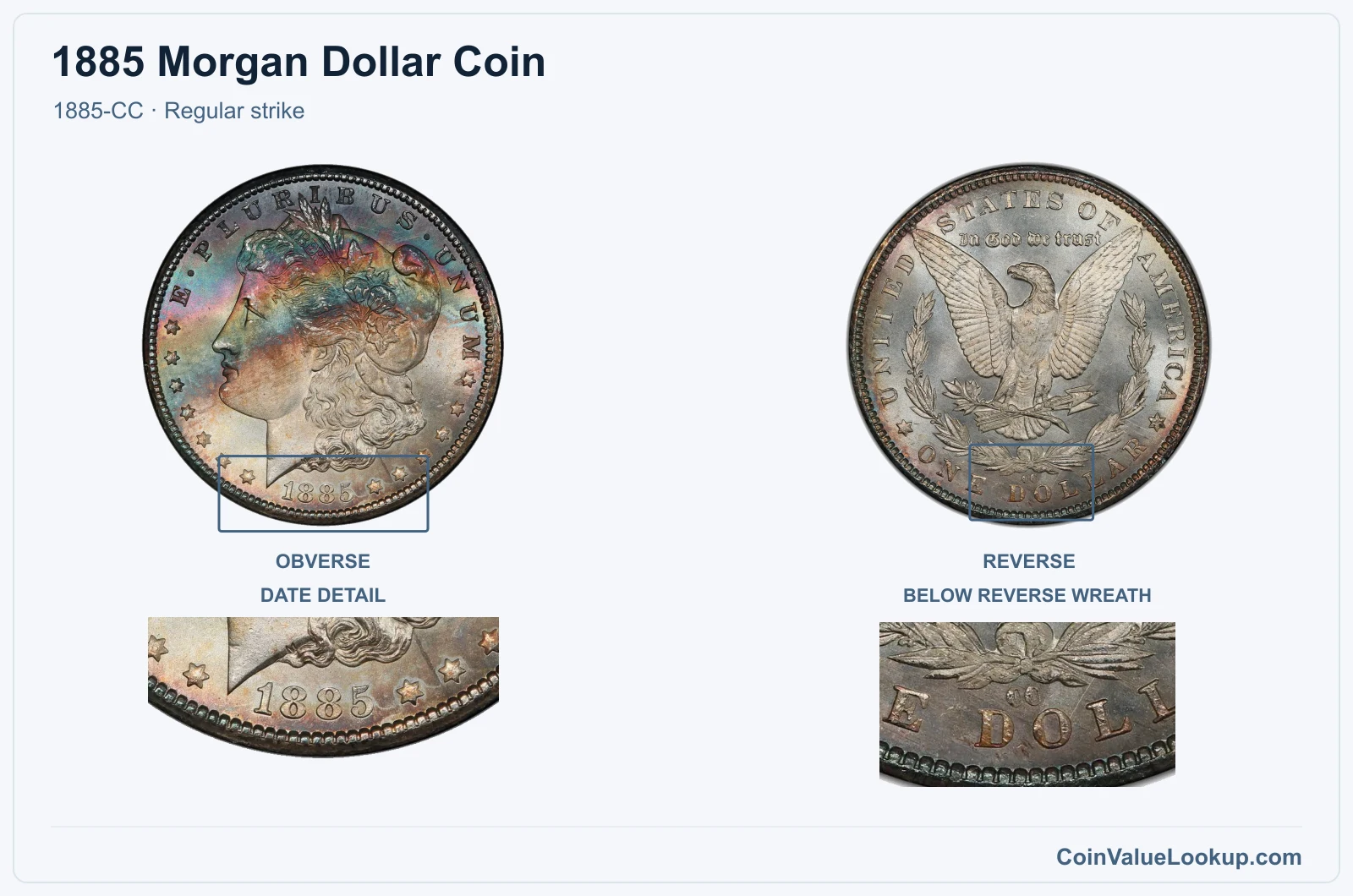
The 1885-CC carries a "CC" mintmark for Carson City, Nevada. Carson City dollars are perennial collector favorites because the mint had a relatively small output.
Guide estimates from USA Coin Book put this one at roughly $564.00 in G4 and $1,559.00 in MS65.
Many surviving 1885-CC dollars came from Treasury hoards released decades later, so uncirculated examples are more available than you might expect for a Carson City coin. Still, even at the lower grades, the CC mintmark commands a significant premium over Philadelphia or New Orleans issues.
Look for original surfaces — cleaning is especially costly on a coin whose premium depends partly on collector appeal.
Range Grade
Price Auction Records Appraisal PO PO 1
Coin Identifier FR FR 2
Coin Identifier AG AG 3
Coin Identifier G G 4
Coin Identifier
G 6
Coin Identifier VG VG 8
Coin Identifier
VG 10
Coin Identifier F F 12
Coin Identifier
F 15
Coin Identifier VF VF 20
Coin Identifier
VF 25
Coin Identifier
VF 30
Coin Identifier
VF 35
Coin Identifier XF XF 40
Coin Identifier
XF 45
Coin Identifier AU AU 50
Coin Identifier
AU 53
Coin Identifier
AU 55
Coin Identifier
AU 58
Coin Identifier MS MS 60
Coin Identifier
MS 61
Coin Identifier
MS 62
Coin Identifier
MS 63
Coin Identifier
MS 64
Coin Identifier
MS 65
Coin Identifier
MS 66
Coin Identifier
MS 67
Coin Identifier
MS 68
Coin Identifier
MS 69
—
—
—
MS 70
—
—
—
1885 Morgan Silver Dollar — CC DDGH
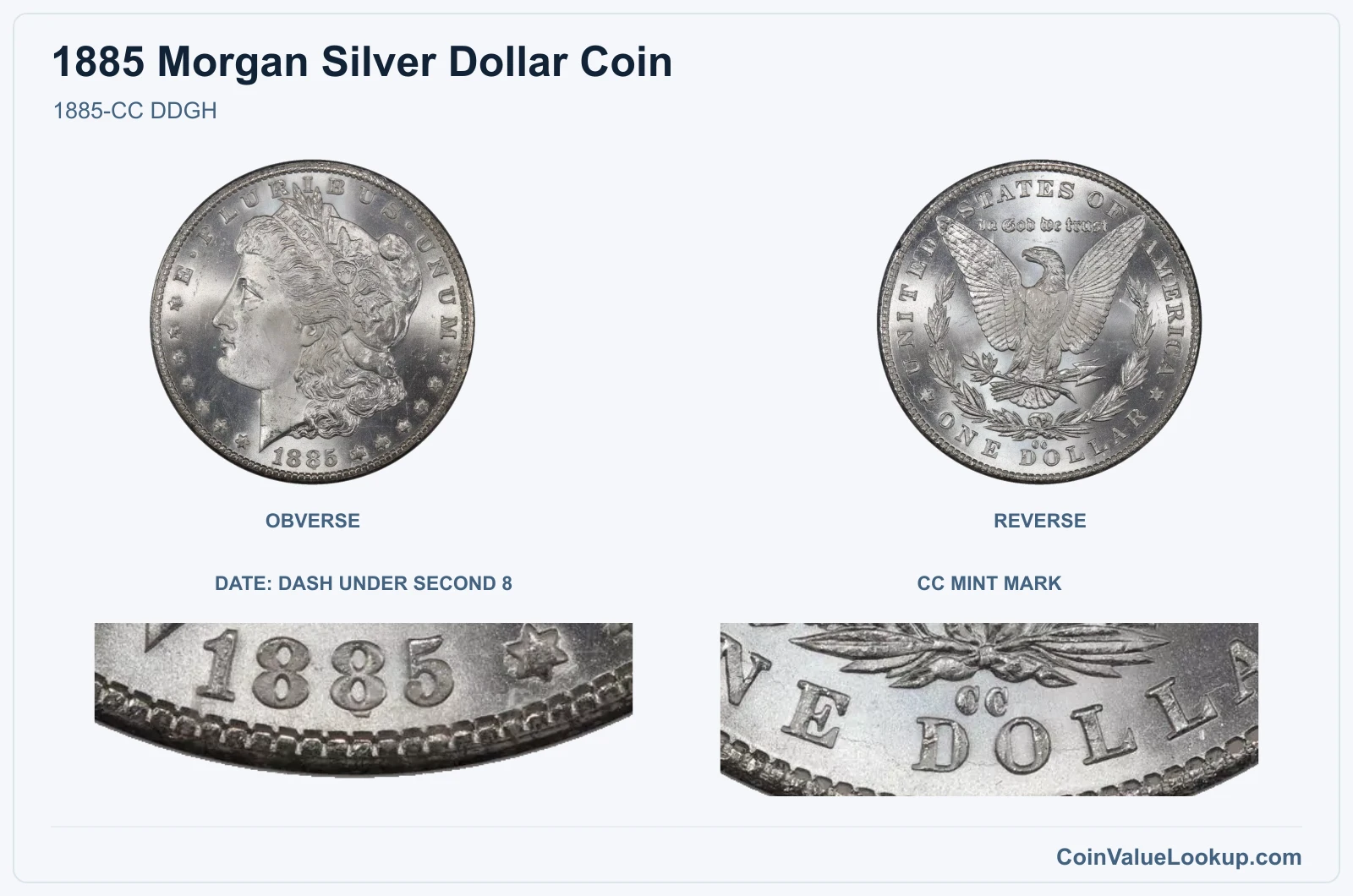
The 1885-CC DDGH is a doubled-die variety struck at Carson City. To confirm it, you need the CC mintmark and visible doubling consistent with the attributed die.
This is not something you can call from across the room; magnification and comparison to known examples are essential.
No adopted guide price is available for this variety. Its value depends on authenticated identity, the degree of visible doubling, and the coin's overall condition.
Because it combines a Carson City strike with a recognized die variety, authenticated examples draw specialized collector interest. Have it examined by a professional grading service before paying or asking a premium.
Range Grade
Price Auction Records Appraisal PO PO 1
—
Coin Identifier FR FR 2
—
Coin Identifier AG AG 3
—
Coin Identifier G G 4
—
Coin Identifier
G 6
—
Coin Identifier VG VG 8
—
Coin Identifier
VG 10
—
Coin Identifier F F 12
—
Coin Identifier
F 15
—
Coin Identifier VF VF 20
—
Coin Identifier
VF 25
—
Coin Identifier
VF 30
—
Coin Identifier
VF 35
—
Coin Identifier XF XF 40
—
Coin Identifier
XF 45
—
Coin Identifier AU AU 50
—
Coin Identifier
AU 53
—
Coin Identifier
AU 55
—
Coin Identifier
AU 58
—
Coin Identifier MS MS 60
—
Coin Identifier
MS 61
—
Coin Identifier
MS 62
—
Coin Identifier
MS 63
—
Coin Identifier
MS 64
Coin Identifier
MS 65
—
Coin Identifier
MS 66
Coin Identifier
MS 67
—
—
—
MS 68
—
—
—
MS 69
—
—
—
MS 70
—
—
—
1885 Morgan Silver Dollar — O
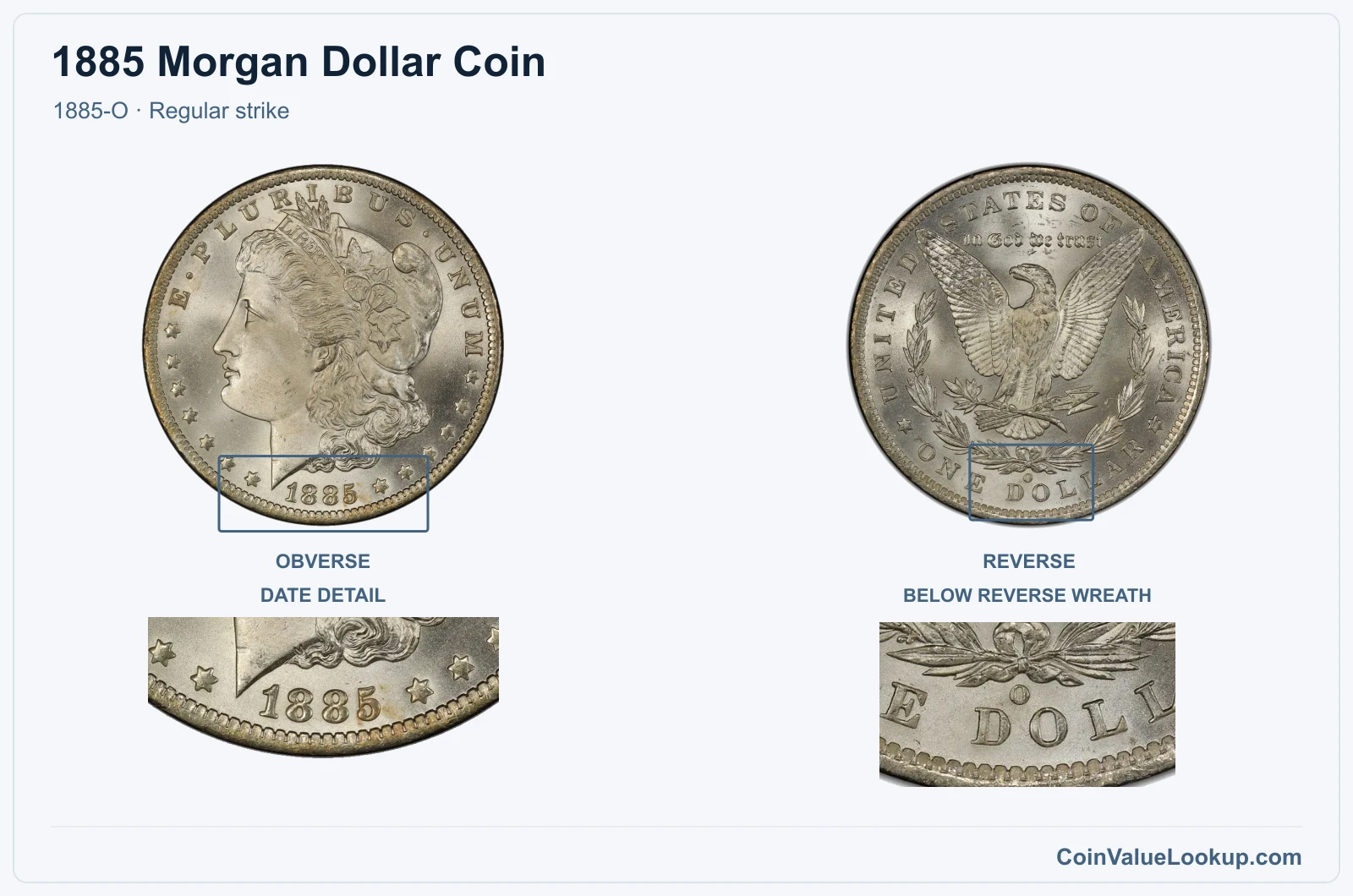
The 1885-O was struck in New Orleans and carries a small "O" mintmark. This is one of the higher-mintage Morgan Dollars of its era, making it easy to find in most grades.
USA Coin Book guide estimates sit at about $74.00 in G4 and $302.00 in MS65.
Coin Value Lookup is a good place to look up guides for other dates and mints in the Morgan series if you are sorting through a collection. It can help you prioritize which coins deserve a closer look.
Original surfaces and the absence of cleaning are important. PL or DMPL surface designations can influence pricing on business strikes, but they require proper attribution.
Range Grade
Price Auction Records Appraisal PO PO 1
Coin Identifier FR FR 2
Coin Identifier AG AG 3
—
Coin Identifier G G 4
—
Coin Identifier
G 6
—
Coin Identifier VG VG 8
—
Coin Identifier
VG 10
—
Coin Identifier F F 12
—
Coin Identifier
F 15
—
Coin Identifier VF VF 20
—
Coin Identifier
VF 25
Coin Identifier
VF 30
—
Coin Identifier
VF 35
—
Coin Identifier XF XF 40
—
Coin Identifier
XF 45
—
Coin Identifier AU AU 50
Coin Identifier
AU 53
—
Coin Identifier
AU 55
Coin Identifier
AU 58
Coin Identifier MS MS 60
Coin Identifier
MS 61
Coin Identifier
MS 62
Coin Identifier
MS 63
Coin Identifier
MS 64
Coin Identifier
MS 65
Coin Identifier
MS 66
Coin Identifier
MS 67
Coin Identifier
MS 68
Coin Identifier
MS 69
—
—
—
MS 70
—
—
—
1885 Morgan Silver Dollar — S
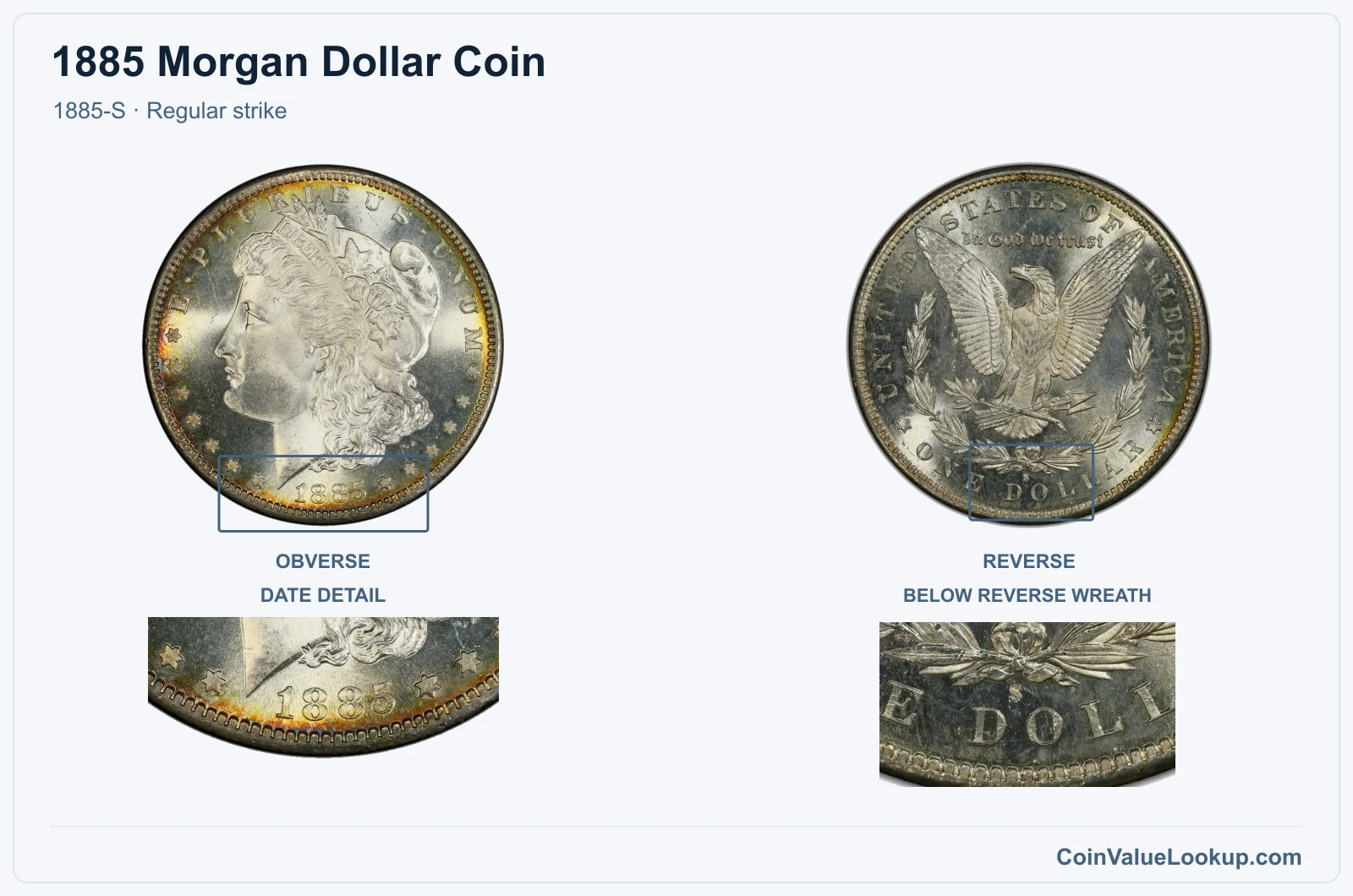
The 1885-S bears an "S" mintmark for San Francisco. In lower grades it tracks with Philadelphia and New Orleans at about $74.00 in G4 per USA Coin Book.
The real jump happens in high Mint State — the MS65 guide estimate is approximately $2,534.00.
That steep climb reflects the relative scarcity of gem-quality survivors. Bag marks, which are common on Morgan Dollars, can keep an otherwise sharp coin out of the MS65 bracket.
If you have an 1885-S that looks fully lustrous with minimal contact marks, it is worth careful evaluation. Cleaning or polishing would undermine that potential, so resist the urge to shine it up.
Range Grade
Price Auction Records Appraisal PO PO 1
—
Coin Identifier FR FR 2
Coin Identifier AG AG 3
—
Coin Identifier G G 4
—
Coin Identifier
G 6
—
Coin Identifier VG VG 8
—
Coin Identifier
VG 10
—
Coin Identifier F F 12
—
Coin Identifier
F 15
—
Coin Identifier VF VF 20
—
Coin Identifier
VF 25
—
Coin Identifier
VF 30
—
Coin Identifier
VF 35
Coin Identifier XF XF 40
Coin Identifier
XF 45
Coin Identifier AU AU 50
Coin Identifier
AU 53
Coin Identifier
AU 55
Coin Identifier
AU 58
Coin Identifier MS MS 60
Coin Identifier
MS 61
Coin Identifier
MS 62
Coin Identifier
MS 63
Coin Identifier
MS 64
Coin Identifier
MS 65
Coin Identifier
MS 66
Coin Identifier
MS 67
Coin Identifier
MS 68
—
—
—
MS 69
—
—
—
MS 70
—
—
—
1885 Morgan Silver Dollar — PR
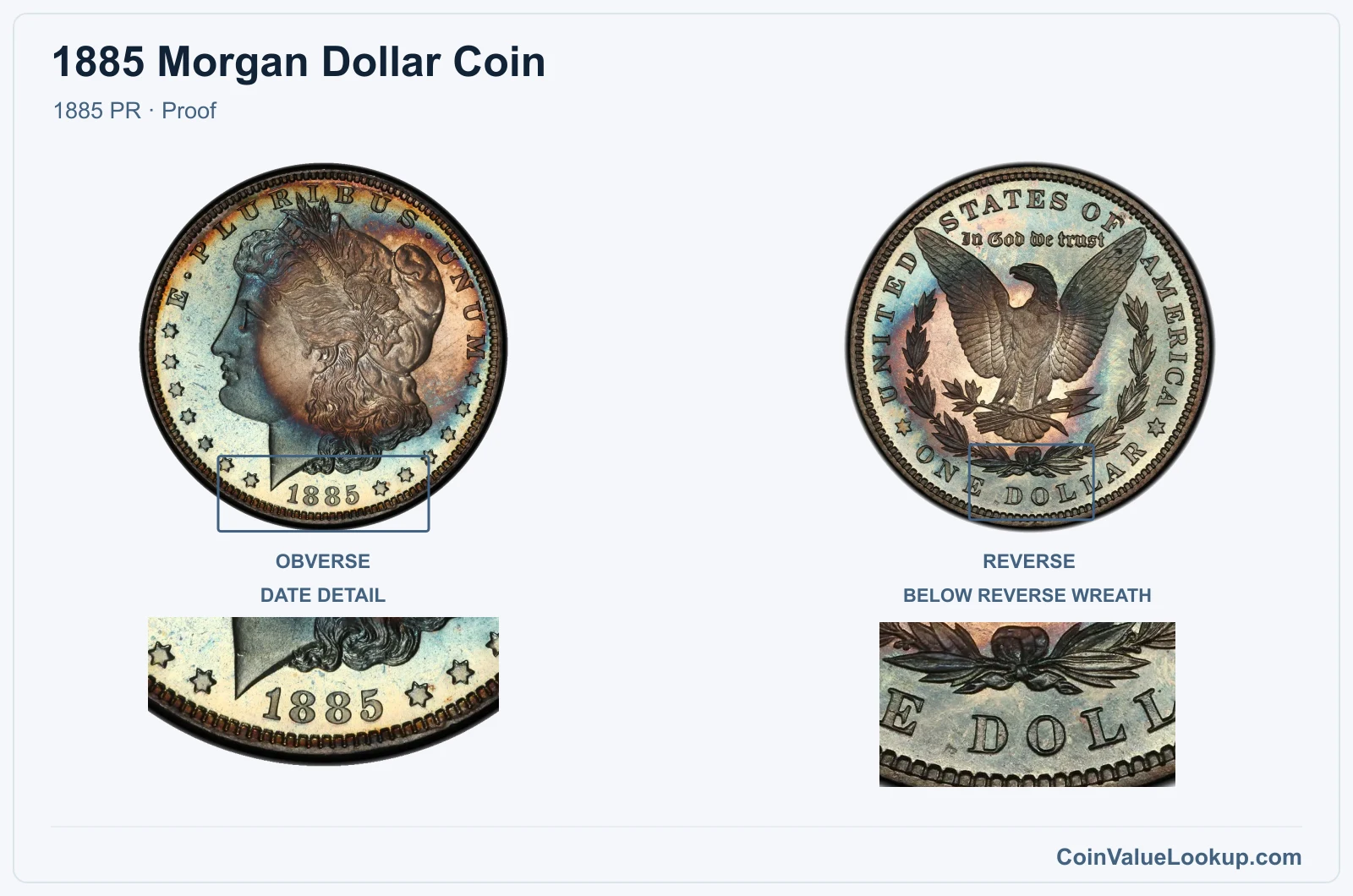
The 1885 Proof was manufactured at Philadelphia using specially prepared dies and planchets. A proof is a manufacturing finish, not simply a high-grade regular coin.
The mirrored fields and sharp detail are by-products of the striking process, not wear or lack thereof.
No adopted guide price is available for this version. Individual value depends on authenticated proof status and condition.
Many coins are mistaken for proofs because they are shiny or well-preserved, so professional authentication is critical before buying or selling one at proof prices. Prooflike business strikes are a different category entirely and should not be confused with true proofs.
Range Grade
Price Auction Records Appraisal PR PR 1
—
Coin Identifier
PR 2
—
Coin Identifier
PR 3
—
Coin Identifier
PR 4
—
Coin Identifier
PR 6
—
Coin Identifier
PR 8
—
Coin Identifier
PR 10
—
Coin Identifier
PR 12
—
Coin Identifier
PR 15
—
Coin Identifier
PR 20
—
Coin Identifier
PR 25
—
Coin Identifier
PR 30
—
Coin Identifier
PR 35
—
Coin Identifier
PR 40
—
Coin Identifier
PR 45
—
Coin Identifier
PR 50
—
Coin Identifier
PR 53
—
Coin Identifier
PR 55
—
Coin Identifier
PR 58
Coin Identifier
PR 60
—
Coin Identifier
PR 61
Coin Identifier
PR 62
Coin Identifier
PR 63
Coin Identifier
PR 64
Coin Identifier
PR 65
Coin Identifier
PR 66
Coin Identifier
PR 67
Coin Identifier
PR 68
Coin Identifier
PR 69
—
—
—
PR 70
—
—
—
1885 Morgan Silver Dollar Error List
1. 1885 Morgan Silver Dollar — Repunched Mintmark
A repunched mintmark (RPM) has been reported for the 1885-S Morgan Dollar, described as an 1885-S/S RPM. This means the S mintmark was punched into the die more than once in slightly different positions, leaving traces of the earlier impression visible under magnification.
To check, examine the mintmark area closely with a loupe. You are looking for a remnant outline or a shadow of a second S near, beneath or overlapping the primary punch.
Compare your coin to a normal 1885-S mintmark at similar magnification so you know what belongs and what does not.
Machine doubling, a die chip or simple corrosion near the mintmark can mimic the look. The value of a confirmed RPM depends on the coin's condition and how clearly the repunching shows, so professional authentication is recommended before assuming a premium.
2. 1885 Morgan Silver Dollar — Off-Center Strike
Off-center strikes have been reported for the 1885 Morgan Dollar. An off-center error happens when the planchet is not properly seated between the dies at the moment of striking, producing a design that is shifted to one side with an unstruck crescent of blank metal on the opposite edge.
The key diagnostic is that displaced crescent — it should be smooth, unstruck metal continuous with the coin's rim area. If the date is still visible on an off-center Morgan Dollar, collector interest increases substantially.
Do not confuse an off-center strike with a clipped planchet, one-sided die misalignment, or post-mint damage such as a coin that was flattened or bent after leaving the mint. Condition, the percentage of off-center shift, and date visibility all affect value, but no specific price range is available for this error.
3. 1885 Morgan Silver Dollar — Lamination / Split Planchet
Lamination errors have been reported for the 1885 Morgan Dollar. These occur when the planchet has an internal flaw — a separation within the alloy — that manifests as peeling metal, a retained flap, or a visible split in the coin's surface.
To spot one, look for a patch of metal that appears to be lifting away from the coin or a thin layer that has partially separated. Photographing the edge alongside the affected face gives the best documentation, since the split is often visible in cross-section.
Scraping, corrosion or a deliberately cut coin can mimic the appearance. Genuine lamination flaws follow the contour of the coin's surface and arise from the metal itself, not from external tools.
Value depends on the size, location and severity of the flaw as well as the coin's overall condition, so have it authenticated rather than relying on a visual guess.