1926 Peace Silver Dollar Coin Value: How Much Is It Worth?
The 1926 Peace Silver Dollar is a 90% silver coin struck at up to three mints, and guide estimates range from about $65.00 to $1,166.00 depending on mint, grade and condition. That spread is not a guaranteed offer for every coin.
Most circulated examples sit near the lower end, while original, high-grade survivors from specific mints command significantly more. Identifying your exact mint version and preserving original surfaces matter before you start comparing values.
Fast Way to Identify Your 1926 Peace Silver Dollar
Snap a clear photo of the front and back of your 1926 Peace Dollar and upload both images for a preliminary identification. This helps pin down the mint mark and general condition so you can narrow which version you have.
It is not a substitute for professional grading or authentication, but it gives you a solid starting point.
1926 Peace Silver Dollar Value
Upload both sides of your 1926 Peace Silver Dollar.
Front Obverse
Upload photo
Back Reverse
Upload photo
Which 1926 Peace Silver Dollar Versions Are Worth Money?
- 1926-D (Denver) in MS65 carries a guide estimate of $1,166.00, the highest listed figure among the three mints at that grade.
- 1926-S (San Francisco) in MS65 is estimated at $1,036.00, close behind Denver and worth checking carefully for original surfaces.
- 1926 Philadelphia in MS65 is guided at $678.00, still well above its circulated value of $65.00 in G4.
- Mint-made errors such as doubled reverse lettering, struck-through impressions or lamination flaws can add value when confirmed by a professional grading service.
Step 1: Identify Your 1926 Peace Silver Dollar Mint Mark and Version
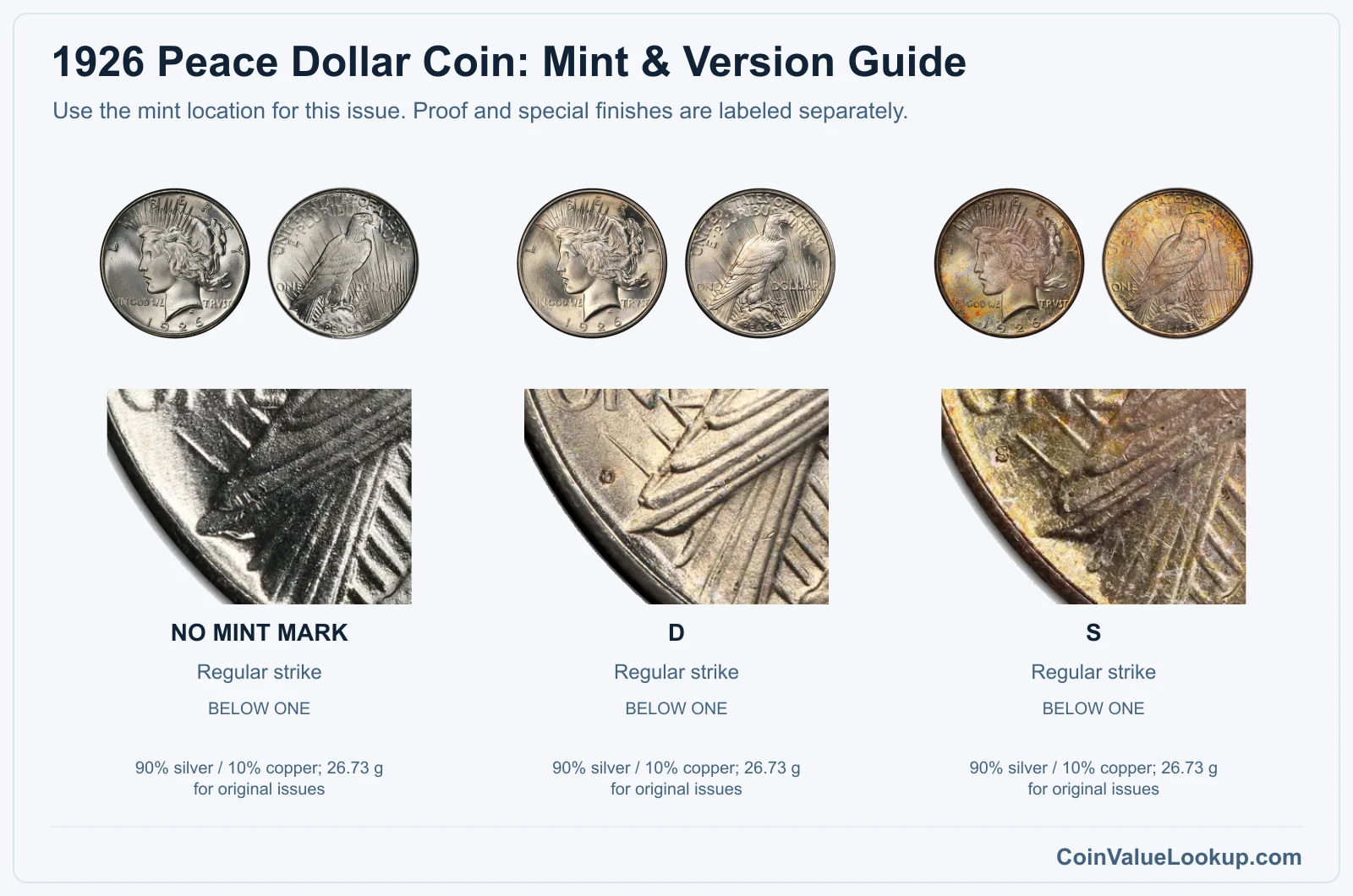
Flip your coin to the reverse and look just below the word ONE, near the eagle's tail feathers. A small "D" means Denver, an "S" means San Francisco, and no letter at all means Philadelphia.
That single detail changes the value path entirely.
The "V" in TRVST on the reverse is part of the original design, not a die error. Every Peace Dollar uses this Latin-style spelling, so do not let anyone charge you a premium for it.
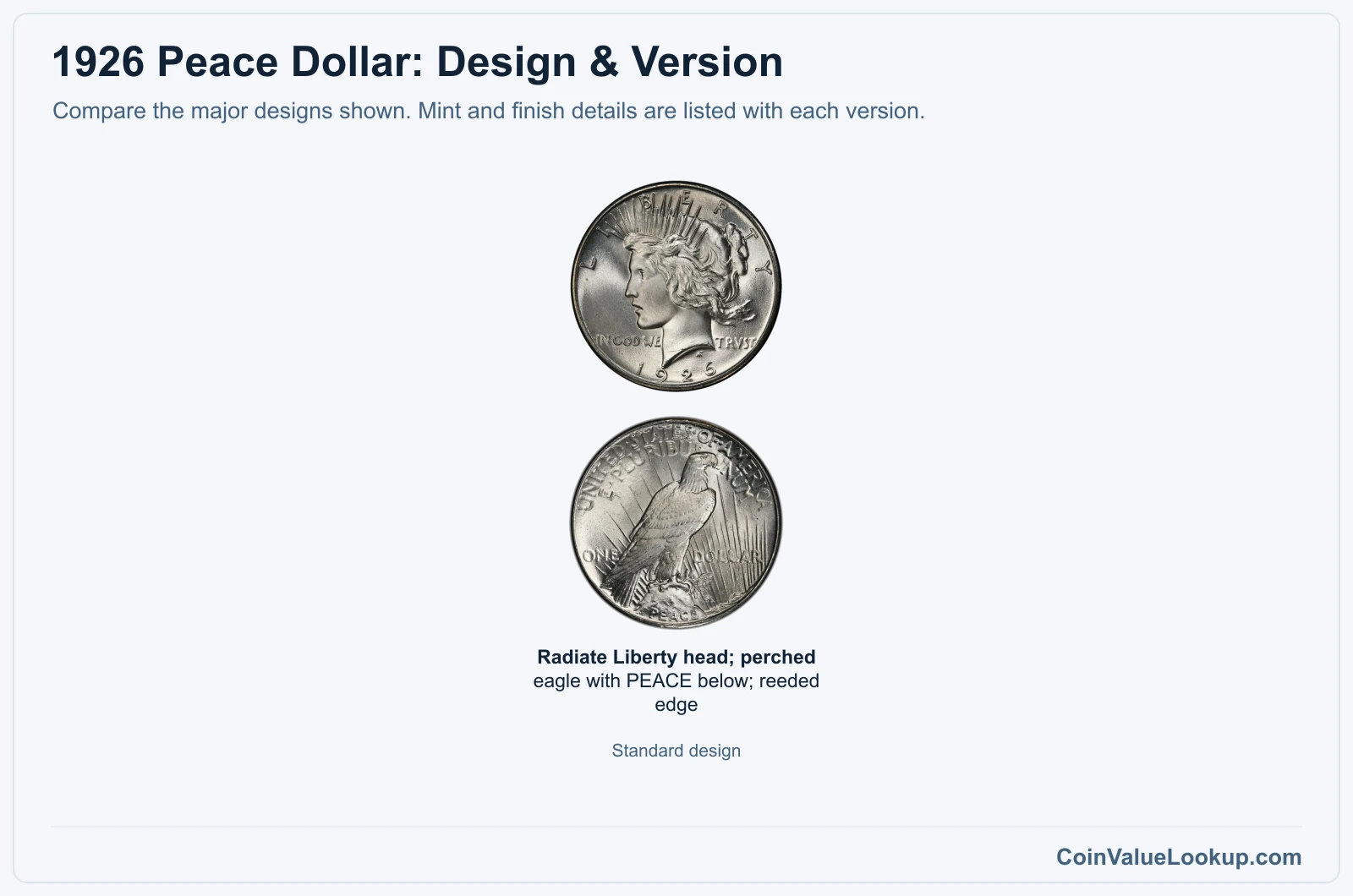
All genuine 1926 Peace Dollars are struck in 90% silver and 10% copper, weighing 26.73 grams. The obverse shows a radiant Liberty head in profile, and the reverse features a perched bald eagle above the word PEACE.
The edge is reeded. If your coin is noticeably lighter or has a smooth edge, it may not be authentic.
Step 2: Check Your 1926 Peace Silver Dollar Grade
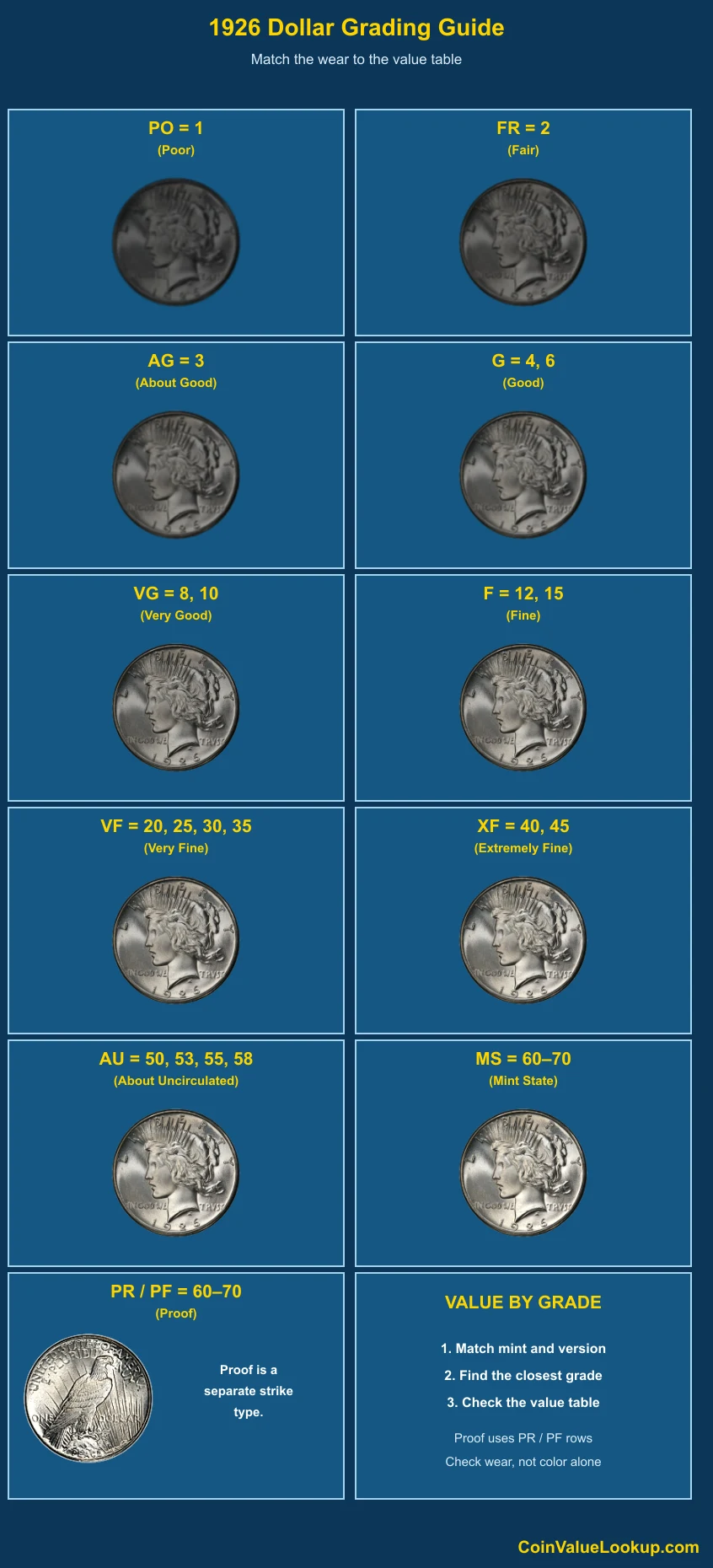
Focus on three key areas when judging wear: the hair above Liberty's ear, her cheek, and the eagle's shoulder and wing feathers on the reverse. In Good condition, those areas are flat and blended.
Around About Uncirculated, you will see only the slightest friction on the highest points with most luster still visible.
Mint State coins retain full original luster and show no wear, though they may have bag marks from storage. Use the comparison image to line up your coin against circulated, AU and Mint State examples side by side.
Cleaned or polished coins look unnaturally bright and lose their original "skin," which reduces their collector value regardless of how little actual wear exists.
Step 3: Check 1926 Peace Silver Dollar Value by Mint and Version
1926 Peace Silver Dollar
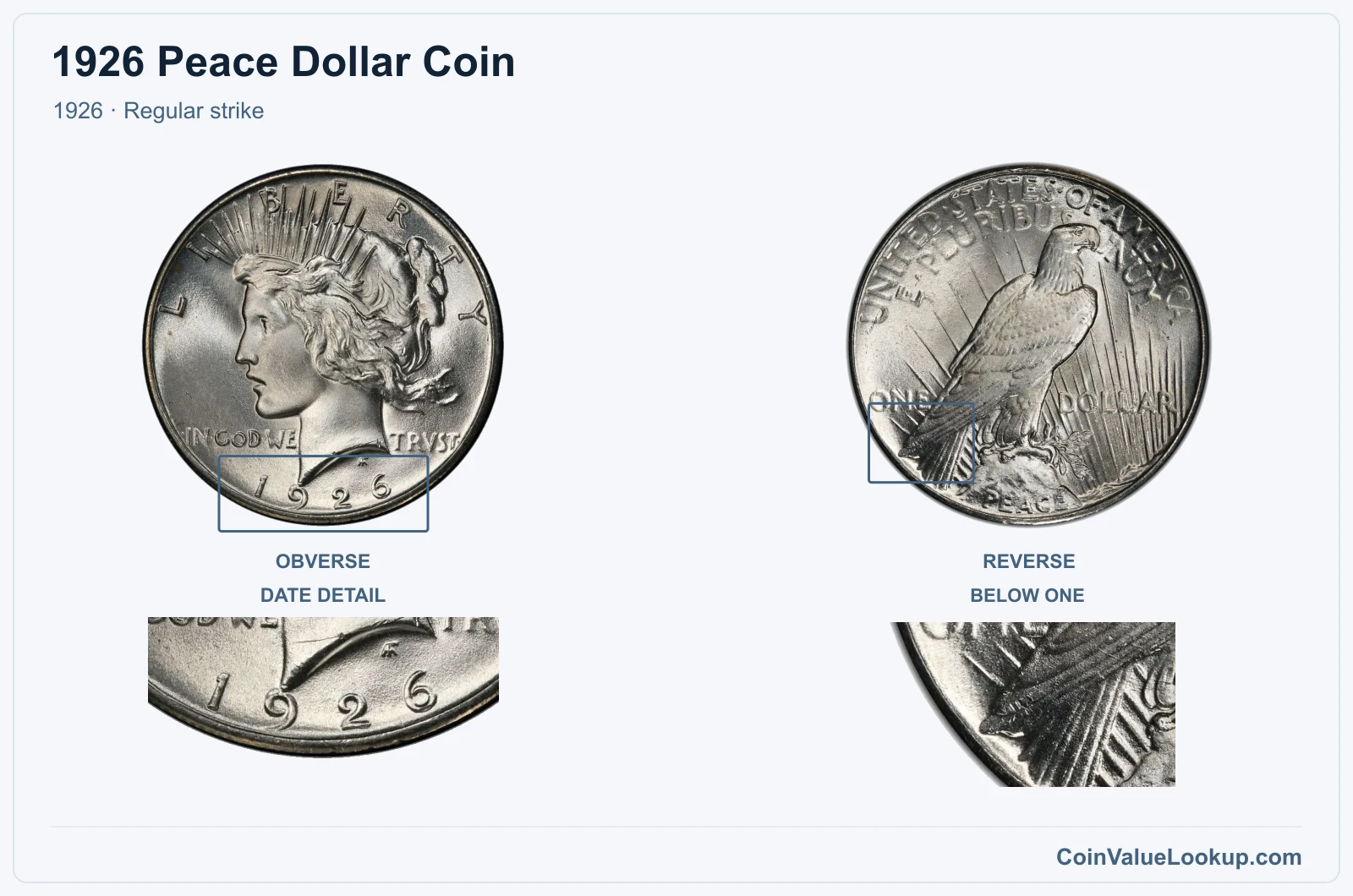
The 1926 Philadelphia issue has no mint mark anywhere on the coin. In well-worn Good-4 condition, guide estimates place it around $65.00.
Jump to MS65 and that figure rises to roughly $678.00, reflecting how few survive with full, original luster and minimal contact marks.
Before comparing prices, confirm the surfaces have not been cleaned or polished. A coin that has been wiped down loses its natural toning and luster pattern, making it difficult to grade accurately and reducing its appeal to collectors.
Original surfaces are the whole game here.
Range Grade
Price Auction Records Appraisal PO PO 1
Coin Identifier FR FR 2
Coin Identifier AG AG 3
—
Coin Identifier G G 4
—
Coin Identifier
G 6
—
Coin Identifier VG VG 8
—
Coin Identifier
VG 10
—
Coin Identifier F F 12
—
Coin Identifier
F 15
—
Coin Identifier VF VF 20
—
Coin Identifier
VF 25
Coin Identifier
VF 30
—
Coin Identifier
VF 35
—
Coin Identifier XF XF 40
—
Coin Identifier
XF 45
Coin Identifier AU AU 50
Coin Identifier
AU 53
—
Coin Identifier
AU 55
Coin Identifier
AU 58
Coin Identifier MS MS 60
—
Coin Identifier
MS 61
Coin Identifier
MS 62
Coin Identifier
MS 63
Coin Identifier
MS 64
Coin Identifier
MS 65
Coin Identifier
MS 66
Coin Identifier
MS 67
Coin Identifier
MS 68
—
—
—
MS 69
—
—
—
MS 70
—
—
—
1926 Peace Silver Dollar — D
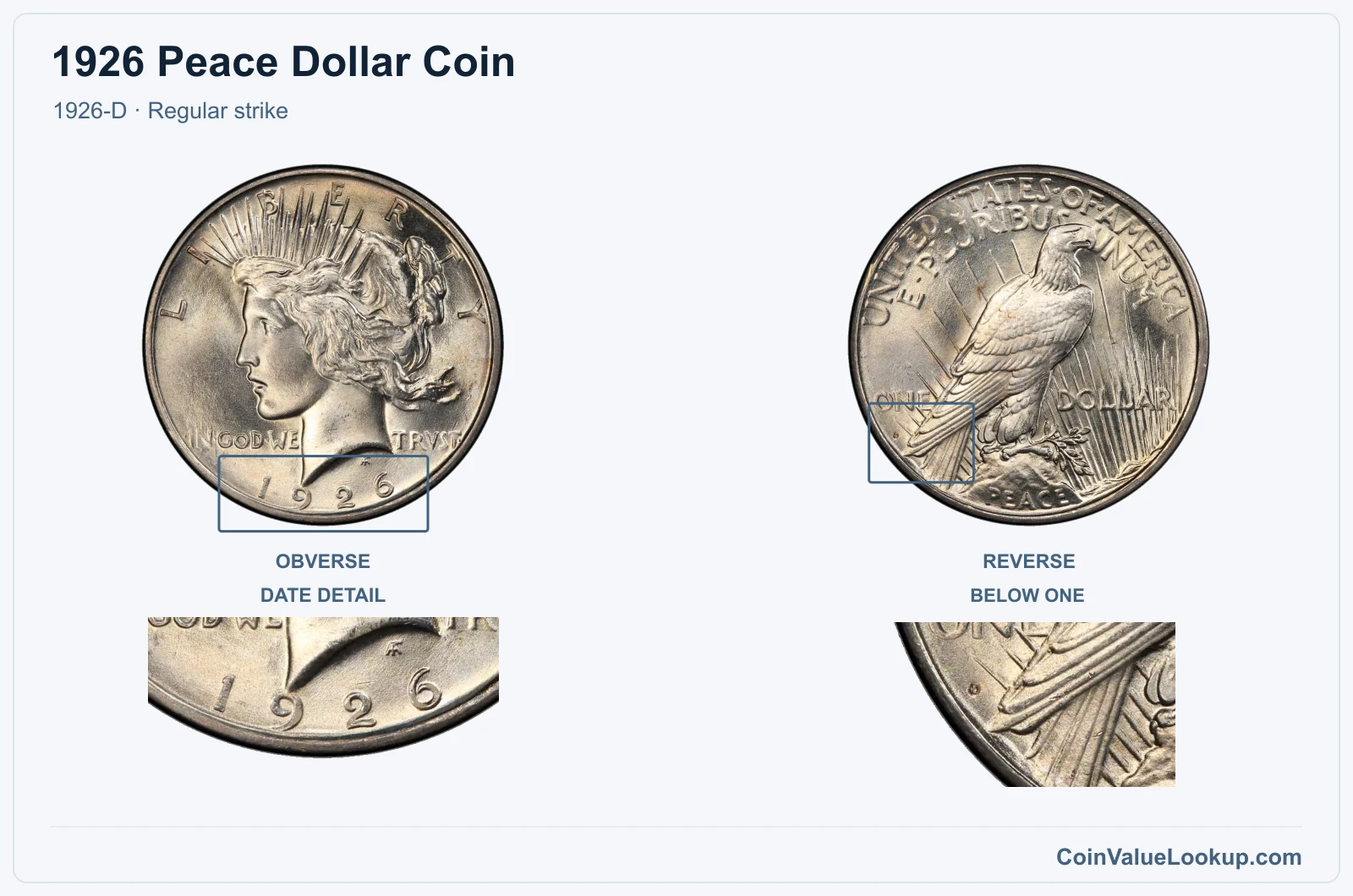
Look for a small "D" mint mark on the reverse, below ONE near the eagle's tail feathers. The 1926-D carries guide estimates of $65.00 in G4 and $1,166.00 in MS65, making the high-grade examples particularly rewarding to find.
Denver strikes from this era can show softer central detail even on uncirculated coins, so do not automatically downgrade for a slightly mushy eagle breast. That said, original luster and freedom from heavy bag marks are what separate a coin worth a few hundred dollars from one approaching four figures.
If you are exploring values for other dates and mints, Coin Value Lookup is a handy place to pull up guides across the full Peace Dollar series.
Range Grade
Price Auction Records Appraisal PO PO 1
—
Coin Identifier FR FR 2
—
Coin Identifier AG AG 3
—
Coin Identifier G G 4
—
Coin Identifier
G 6
—
Coin Identifier VG VG 8
—
Coin Identifier
VG 10
—
Coin Identifier F F 12
—
Coin Identifier
F 15
—
Coin Identifier VF VF 20
—
Coin Identifier
VF 25
—
Coin Identifier
VF 30
—
Coin Identifier
VF 35
—
Coin Identifier XF XF 40
—
Coin Identifier
XF 45
Coin Identifier AU AU 50
Coin Identifier
AU 53
Coin Identifier
AU 55
Coin Identifier
AU 58
Coin Identifier MS MS 60
Coin Identifier
MS 61
Coin Identifier
MS 62
Coin Identifier
MS 63
Coin Identifier
MS 64
Coin Identifier
MS 65
Coin Identifier
MS 66
Coin Identifier
MS 67
Coin Identifier
MS 68
—
—
—
MS 69
—
—
—
MS 70
—
—
—
1926 Peace Silver Dollar — S
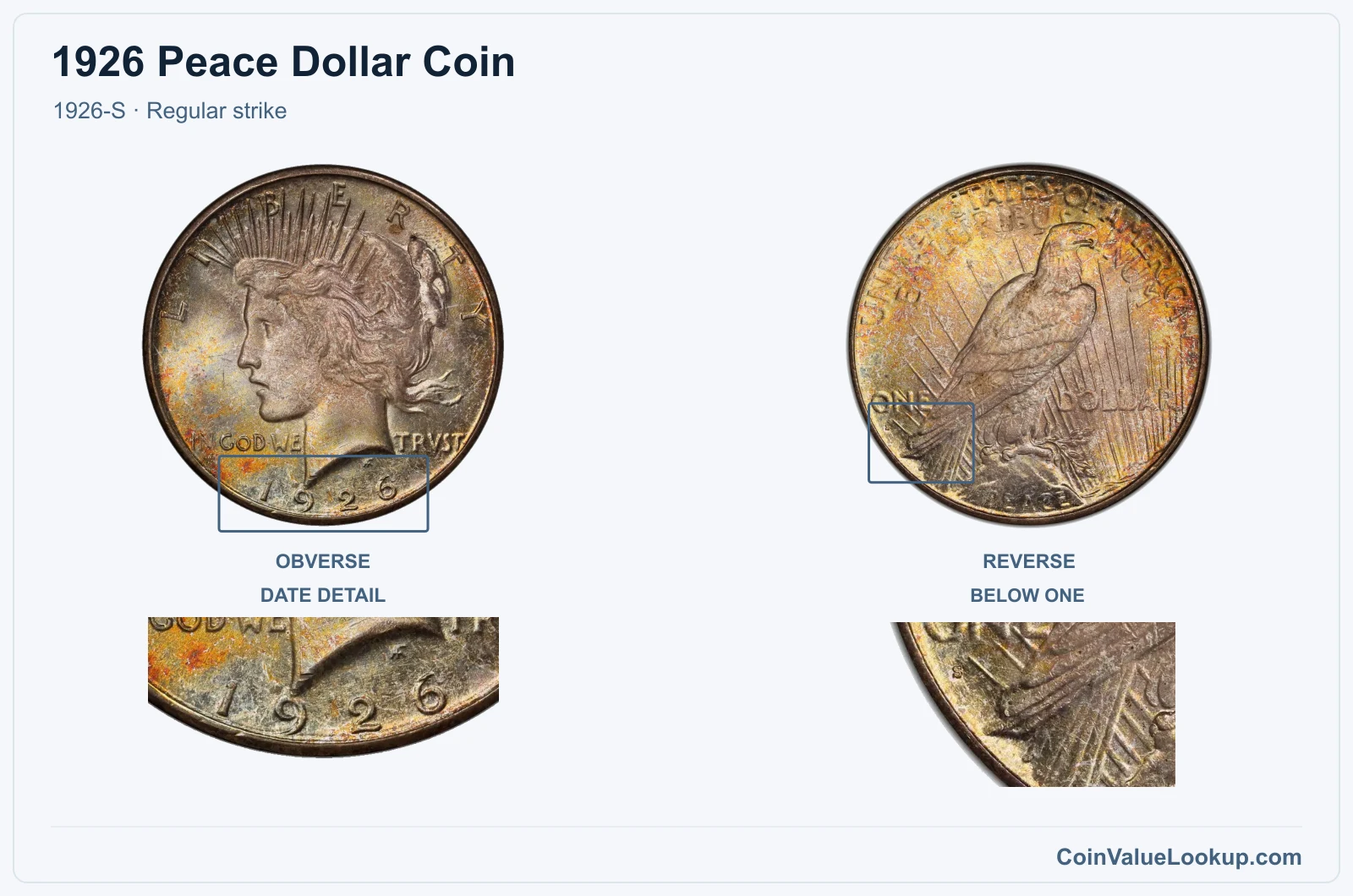
The 1926-S bears a small "S" mint mark in the same reverse location. Guide estimates run from $65.00 at the G4 grade level up to $1,036.00 in MS65.
That upper figure reflects genuine scarcity in gem condition with original surfaces intact.
San Francisco Peace Dollars sometimes show luster that differs slightly in character from Philadelphia coins, appearing a bit more satiny. This is normal.
What matters for value is that the luster is original and uninterrupted, with no hairlines from cleaning and only light, scattered contact marks at most.
Range Grade
Price Auction Records Appraisal PO PO 1
—
Coin Identifier FR FR 2
—
Coin Identifier AG AG 3
—
Coin Identifier G G 4
—
Coin Identifier
G 6
—
Coin Identifier VG VG 8
—
Coin Identifier
VG 10
—
Coin Identifier F F 12
—
Coin Identifier
F 15
Coin Identifier VF VF 20
—
Coin Identifier
VF 25
—
Coin Identifier
VF 30
—
Coin Identifier
VF 35
—
Coin Identifier XF XF 40
Coin Identifier
XF 45
Coin Identifier AU AU 50
Coin Identifier
AU 53
Coin Identifier
AU 55
Coin Identifier
AU 58
Coin Identifier MS MS 60
Coin Identifier
MS 61
Coin Identifier
MS 62
Coin Identifier
MS 63
Coin Identifier
MS 64
Coin Identifier
MS 65
Coin Identifier
MS 66
Coin Identifier
MS 67
Coin Identifier
MS 68
—
—
—
MS 69
—
—
—
MS 70
—
—
—
1926 Peace Silver Dollar Error List
1. 1926 Peace Silver Dollar — Doubled Die Reverse
A doubled die reverse on the 1926 Peace Dollar shows extra thickness or a second outline on reverse lettering or design elements. To check, compare your coin's reverse legends, particularly around PEACE and E PLURIBUS UNUM, against a normal example under magnification.
Genuine doubling is consistent and repeatable across the same design features.
Do not confuse this with machine doubling, which produces flat, shelf-like distortions rather than the rounded, raised secondary image of a true doubled die. Reflections from lighting and minor striking anomalies can also mimic doubling at first glance.
No specific price range is adopted for this error because value depends on the visibility of the doubling, overall coin condition and professional confirmation.
2. 1926 Peace Silver Dollar — Struck-Through Error
A struck-through error occurs when foreign material, such as grease, a thread or a fragment of metal, sits between the die and the planchet during striking. The result is a localized depression or an area of incomplete design where the obstruction blocked the metal from flowing into the die cavity.
On a 1926 Peace Dollar, look for an impression that does not match normal wear. A grease fill-through typically creates a smooth, slightly sunken patch, while a retained-object strike-through may leave a distinct outline of whatever was trapped.
Ordinary weak strikes, old scratches and cleaning damage can look similar, so examine the area under magnification. No adopted price range exists for this category; value hinges on the size, location and clarity of the obstruction impression, along with the coin's overall grade.
3. 1926 Peace Silver Dollar — Lamination / Split Planchet
A lamination error on the 1926 Peace Dollar appears as peeling metal, a raised flap or a visible split within the coin's alloy. This happens when impurities or gas pockets in the planchet cause layers to separate during or after striking.
Check both faces and the edge. Photograph the affected area alongside the edge for the clearest documentation.
The separation should follow the coin's surface contour rather than cutting across it at sharp angles, which would suggest deliberate damage or scraping.
Corrosion pitting and surface scrapes can resemble lamination at a glance but lack the characteristic layered, flaky appearance. No numerical price is adopted for this error; value depends on the size and visibility of the lamination, the coin's overall condition, and professional verification of the defect.