1882 Morgan Silver Dollar Coin Value: How Much Is It Worth?
The 1882 Morgan Silver Dollar is a popular date in the series, struck at up to four mints with several collectible branches worth knowing. Guide estimates for explicitly listed grades and versions range from about $74 in well-worn condition to $62,651 at the gem Mint State level, depending on mint, variety and surface quality.
Not every coin lands near those extremes, so identifying your specific version matters before you start dreaming about vacation money.
Fast Way to Identify Your 1882 Morgan Silver Dollar
The quickest way to get a preliminary identification is to upload clear photos of both the front and back of your coin. That lets the details — mintmark, surface condition, and any variety clues — come through for a first pass.
Snap the images in even lighting without glare, and make sure the mintmark area under the wreath bow on the reverse is in focus.
1882 Morgan Silver Dollar Value
Upload both sides of your 1882 Morgan Silver Dollar.
Front Obverse
Upload photo
Back Reverse
Upload photo
Which 1882 Morgan Silver Dollar Versions Are Worth Money?
- 1882-O/S Strong — an overmintmark variety where remnants of an S punch are clearly visible beneath the O mintmark; guide estimates reach $62,651 in MS-65 condition.
- 1882-O/S Weak — same overmintmark concept but with less visible S remnants; still carries the same elevated guide estimates as the Strong version at comparable grades.
- 1882 Proof — a special manufacturing finish from Philadelphia with mirror fields; value depends on authenticated identity and condition, assessed individually.
- 1882-CC — the Carson City mint issue, which consistently commands a premium over Philadelphia and San Francisco strikes, with guide estimates from $184 in G4 to $966 in MS-65.
Step 1: Identify Your 1882 Morgan Silver Dollar Mint Mark and Version
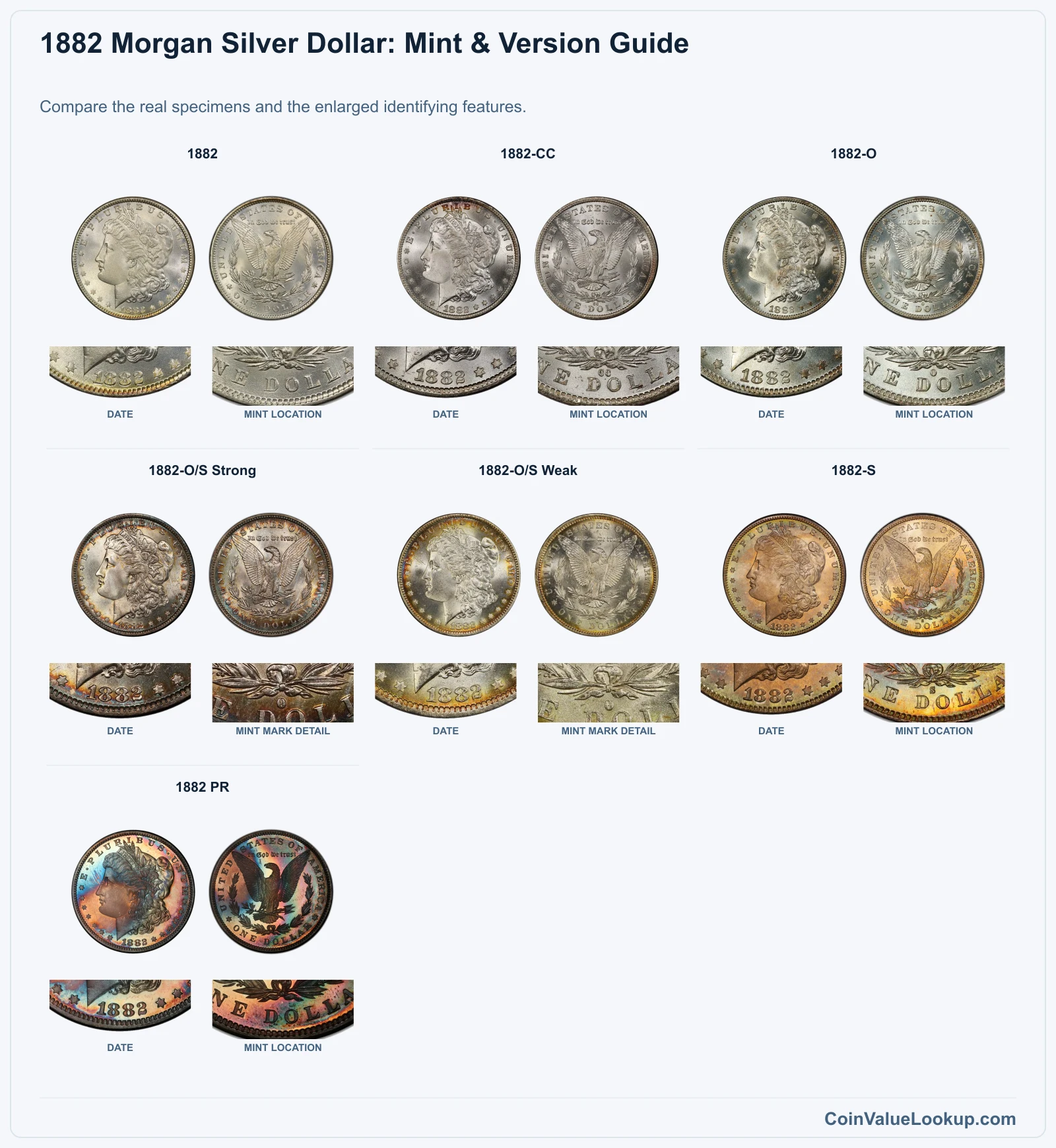
The 1882 Morgan Dollar features the classic Morgan Liberty head on the obverse and an eagle within a wreath on the reverse, with a reeded edge. It is struck in 90% silver and 10% copper, weighing 26.73 grams.
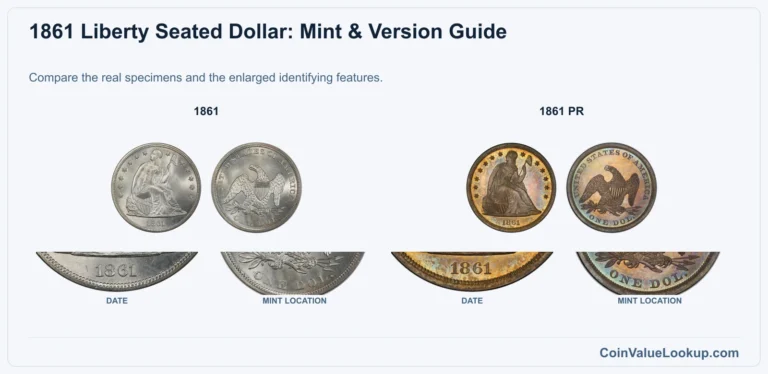
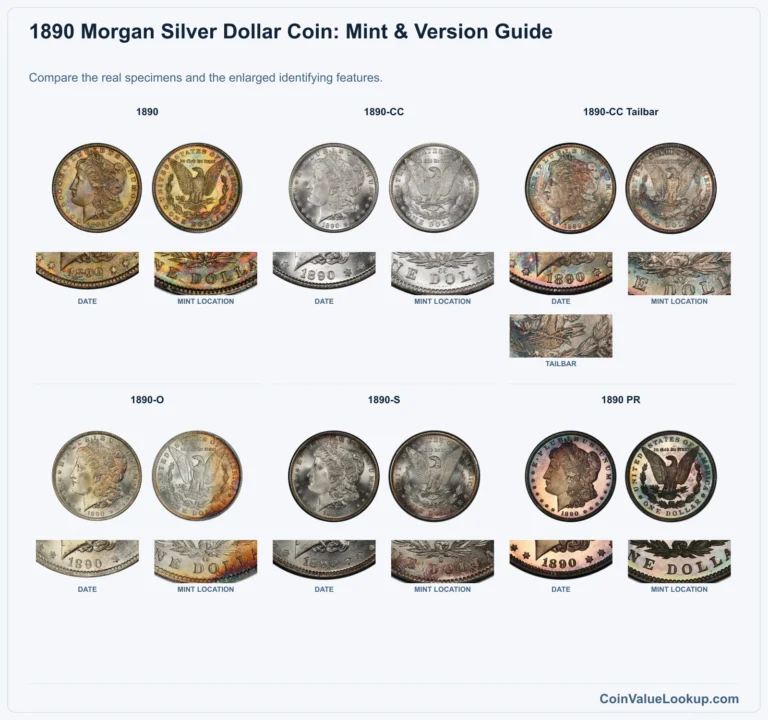
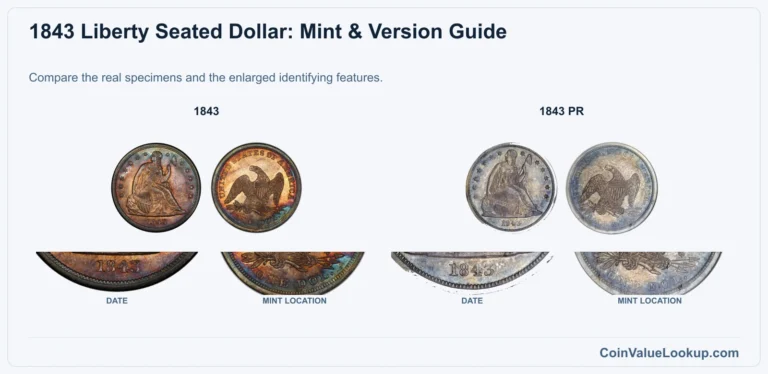
To figure out which version you have, flip the coin over and look below the bow that ties the wreath together. If there is no mintmark, it was struck in Philadelphia.
A "CC" means Carson City, "O" means New Orleans, and "S" means San Francisco.
The 1882-O mint coins deserve extra scrutiny. Some were struck with a die that originally carried an S mintmark, later punched over with an O.
These O/S overmintmark varieties come in Strong and Weak versions and carry significant premiums. You will need magnification to spot the remnants of the underlying S beneath the O.
Proof 1882 dollars were made at Philadelphia with no mintmark, but they are a distinct manufacturing finish — mirror fields, sharp details from specially prepared dies. A shiny coin is not automatically a proof; that attribution requires careful comparison or professional certification.
Likewise, Prooflike (PL) and Deep Mirror Prooflike (DMPL) are surface designations applied to eligible business strikes, not proof manufacture.
Step 2: Check Your 1882 Morgan Silver Dollar Grade
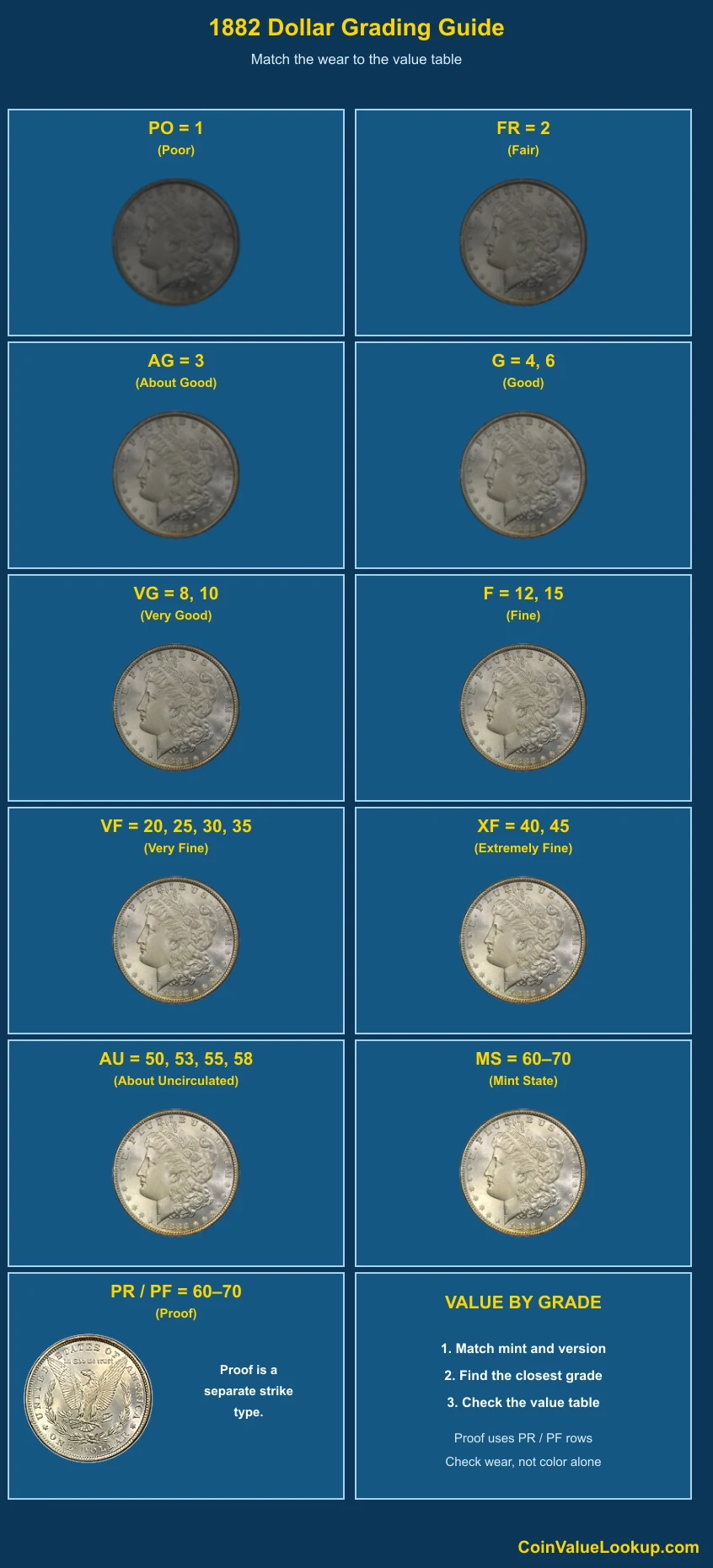
When grading an 1882 Morgan Dollar, start with Liberty's hair above the ear and the high point of her cheek. These areas lose detail first.
On the reverse, the eagle's breast feathers flatten early in circulation.
Bag marks are a constant companion on Morgan Dollars. Large silver coins were tossed into canvas bags at the mint and shuffled around in Treasury vaults for decades, so even uncirculated pieces can show contact marks that drag down the grade.
A coin with full luster but heavy bag marks may grade MS-60 or MS-61 rather than MS-65.
Use the comparison image to see the progression from circulated grades through AU and into Mint State. Proof coins should be evaluated separately from business strikes — different surfaces, different standards.
Cleaning, polishing or artificial toning will reduce a coin's desirability and comparability to guide values, even if the underlying detail looks sharp.
Step 3: Check 1882 Morgan Silver Dollar Value by Mint and Version
1882 Morgan Silver Dollar
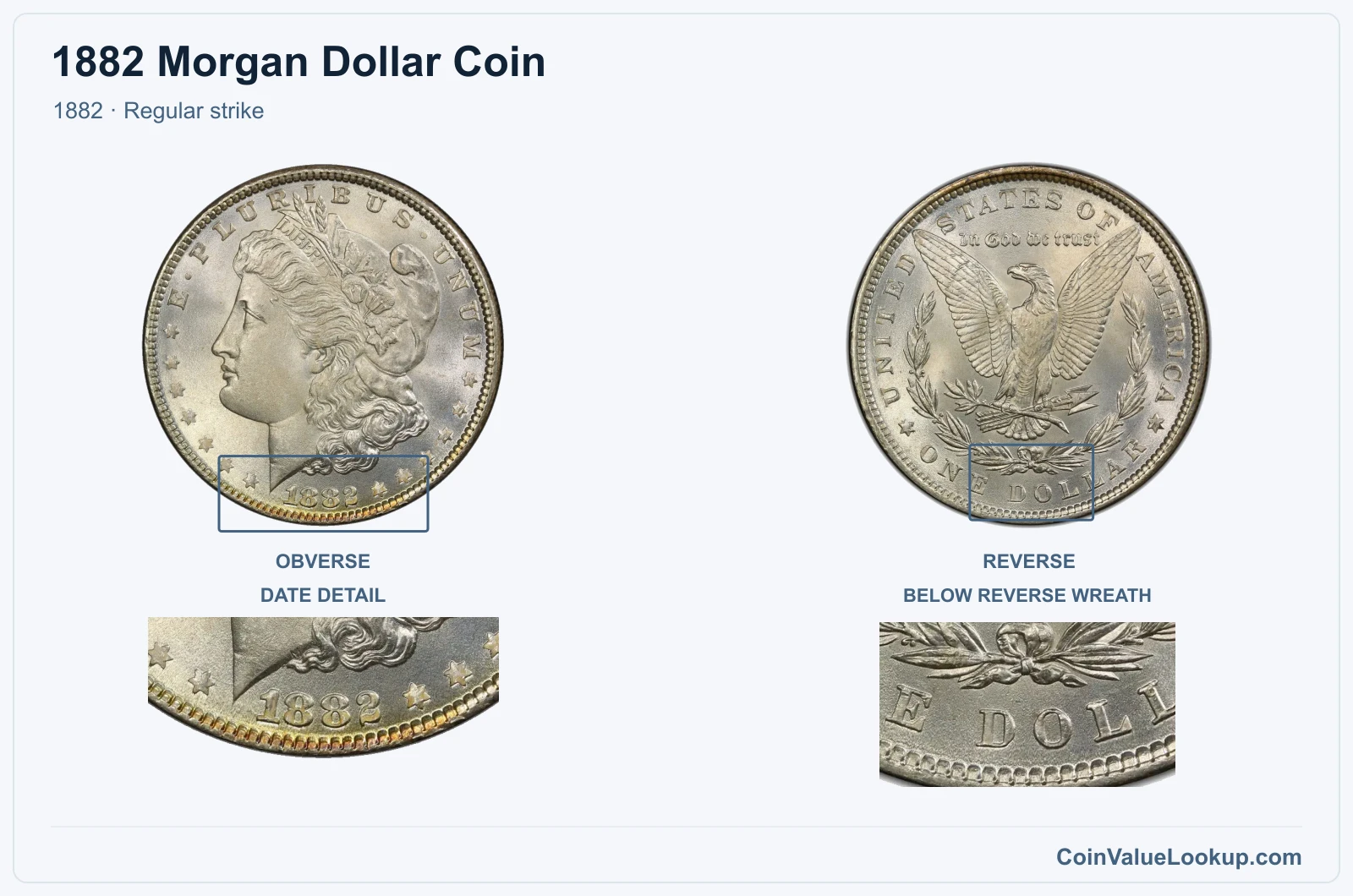
The 1882 Philadelphia Morgan Dollar has no mintmark. It is the most common mint for this date, and circulated examples are readily available.
A coin grading G4 (Good) carries a guide estimate around $74, while a gem MS-65 example runs about $534 per USA Coin Book estimates. Original, uncleaned surfaces matter — a polished coin will not match these figures.
PL and DMPL surface designations can appear on business strikes like this one and may affect pricing, but a reflective surface alone does not make a coin prooflike in the grading-service sense.
Range Grade
Price Auction Records Appraisal PO PO 1
—
Coin Identifier FR FR 2
—
Coin Identifier AG AG 3
—
Coin Identifier G G 4
—
Coin Identifier
G 6
—
Coin Identifier VG VG 8
—
Coin Identifier
VG 10
Coin Identifier F F 12
—
Coin Identifier
F 15
—
Coin Identifier VF VF 20
—
Coin Identifier
VF 25
—
Coin Identifier
VF 30
—
Coin Identifier
VF 35
—
Coin Identifier XF XF 40
—
Coin Identifier
XF 45
Coin Identifier AU AU 50
—
Coin Identifier
AU 53
Coin Identifier
AU 55
Coin Identifier
AU 58
Coin Identifier MS MS 60
Coin Identifier
MS 61
Coin Identifier
MS 62
Coin Identifier
MS 63
Coin Identifier
MS 64
Coin Identifier
MS 65
Coin Identifier
MS 66
Coin Identifier
MS 67
Coin Identifier
MS 68
—
Coin Identifier
MS 69
—
—
—
MS 70
—
—
—
1882 Morgan Silver Dollar — CC
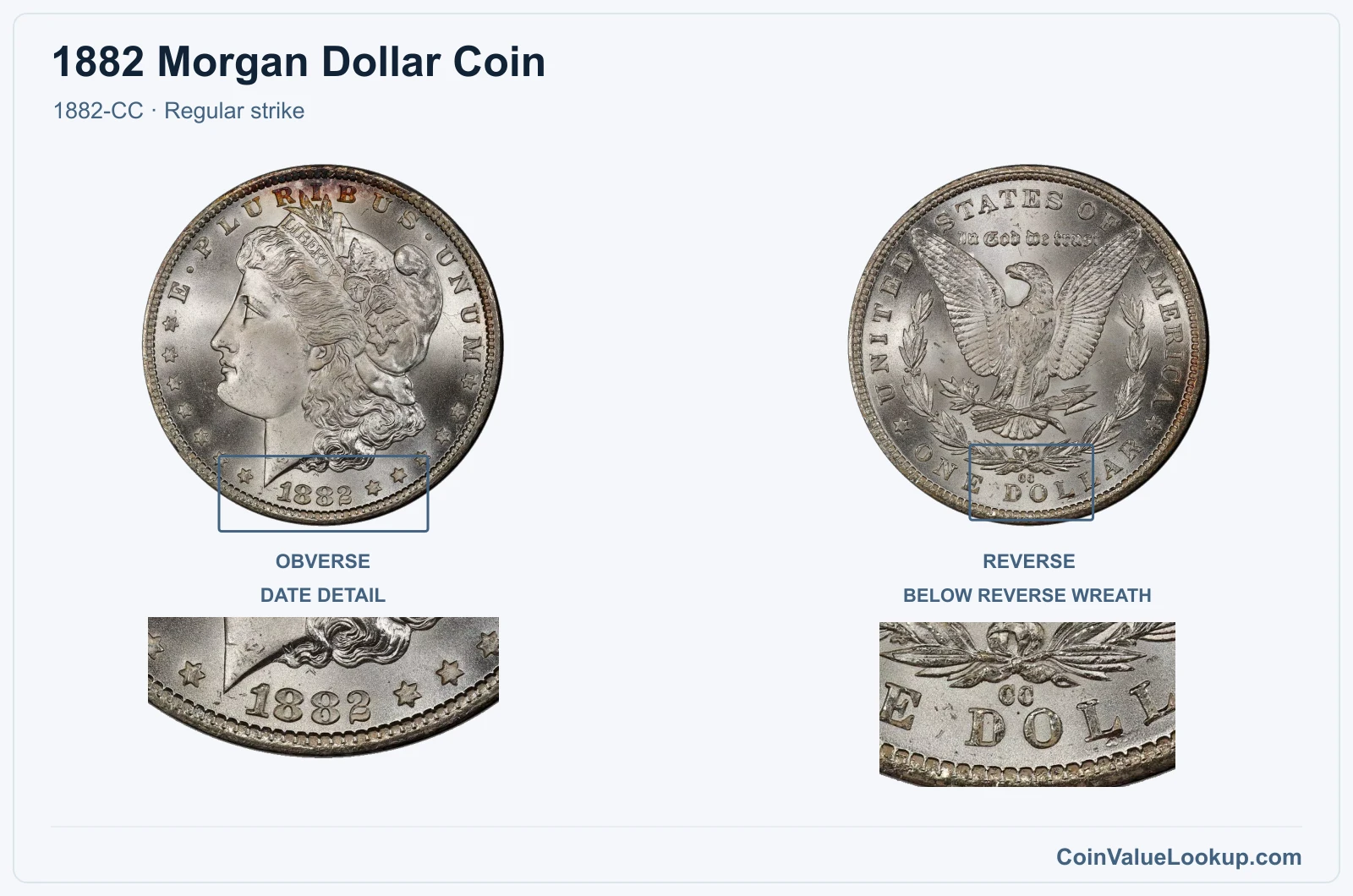
The 1882-CC carries the Carson City mintmark, and that two-letter designation always adds a premium. Carson City produced fewer coins than the eastern mints, and the Old West association keeps demand strong.
Guide estimates place a G4 example at about $184 and an MS-65 at roughly $966, per USA Coin Book. Many 1882-CC dollars survived in uncirculated condition from old Treasury hoards, so Mint State examples are available more often than you might expect for a CC-mint coin.
Still, confirm the mintmark carefully — it should sit squarely below the wreath bow.
Range Grade
Price Auction Records Appraisal PO PO 1
—
Coin Identifier FR FR 2
Coin Identifier AG AG 3
Coin Identifier G G 4
Coin Identifier
G 6
Coin Identifier VG VG 8
Coin Identifier
VG 10
Coin Identifier F F 12
Coin Identifier
F 15
Coin Identifier VF VF 20
Coin Identifier
VF 25
Coin Identifier
VF 30
Coin Identifier
VF 35
Coin Identifier XF XF 40
Coin Identifier
XF 45
Coin Identifier AU AU 50
Coin Identifier
AU 53
Coin Identifier
AU 55
Coin Identifier
AU 58
Coin Identifier MS MS 60
Coin Identifier
MS 61
Coin Identifier
MS 62
Coin Identifier
MS 63
Coin Identifier
MS 64
Coin Identifier
MS 65
Coin Identifier
MS 66
Coin Identifier
MS 67
Coin Identifier
MS 68
Coin Identifier
MS 69
—
—
—
MS 70
—
—
—
1882 Morgan Silver Dollar — O
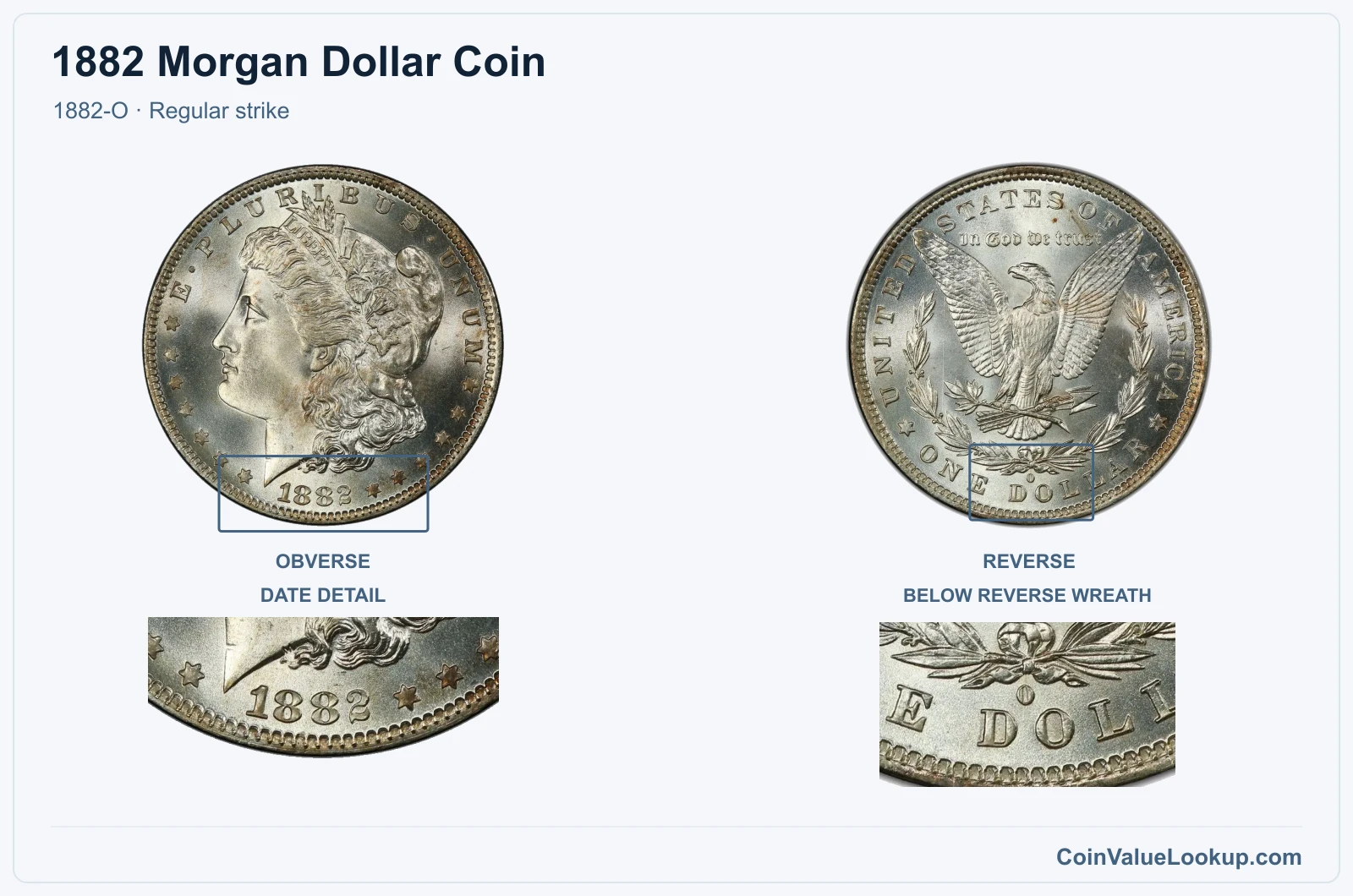
The standard 1882-O, struck in New Orleans, starts at a guide estimate of about $86 in G4 and climbs to around $62,651 at MS-65 according to USA Coin Book. That enormous MS-65 figure reflects the O/S overmintmark variety data grouped under the same table identity.
For a plain 1882-O without any overmintmark, high-grade values are typically more modest. Examine the mintmark under magnification to rule out any trace of an underlying S punch before treating your coin as an ordinary New Orleans issue.
Range Grade
Price Auction Records Appraisal PO PO 1
—
Coin Identifier FR FR 2
Coin Identifier AG AG 3
—
Coin Identifier G G 4
—
Coin Identifier
G 6
—
Coin Identifier VG VG 8
—
Coin Identifier
VG 10
—
Coin Identifier F F 12
—
Coin Identifier
F 15
—
Coin Identifier VF VF 20
—
Coin Identifier
VF 25
—
Coin Identifier
VF 30
—
Coin Identifier
VF 35
—
Coin Identifier XF XF 40
—
Coin Identifier
XF 45
Coin Identifier AU AU 50
Coin Identifier
AU 53
Coin Identifier
AU 55
Coin Identifier
AU 58
Coin Identifier MS MS 60
Coin Identifier
MS 61
Coin Identifier
MS 62
Coin Identifier
MS 63
Coin Identifier
MS 64
Coin Identifier
MS 65
Coin Identifier
MS 66
Coin Identifier
MS 67
Coin Identifier
MS 68
Coin Identifier
MS 69
—
—
—
MS 70
—
—
—
1882 Morgan Silver Dollar — O/S Strong
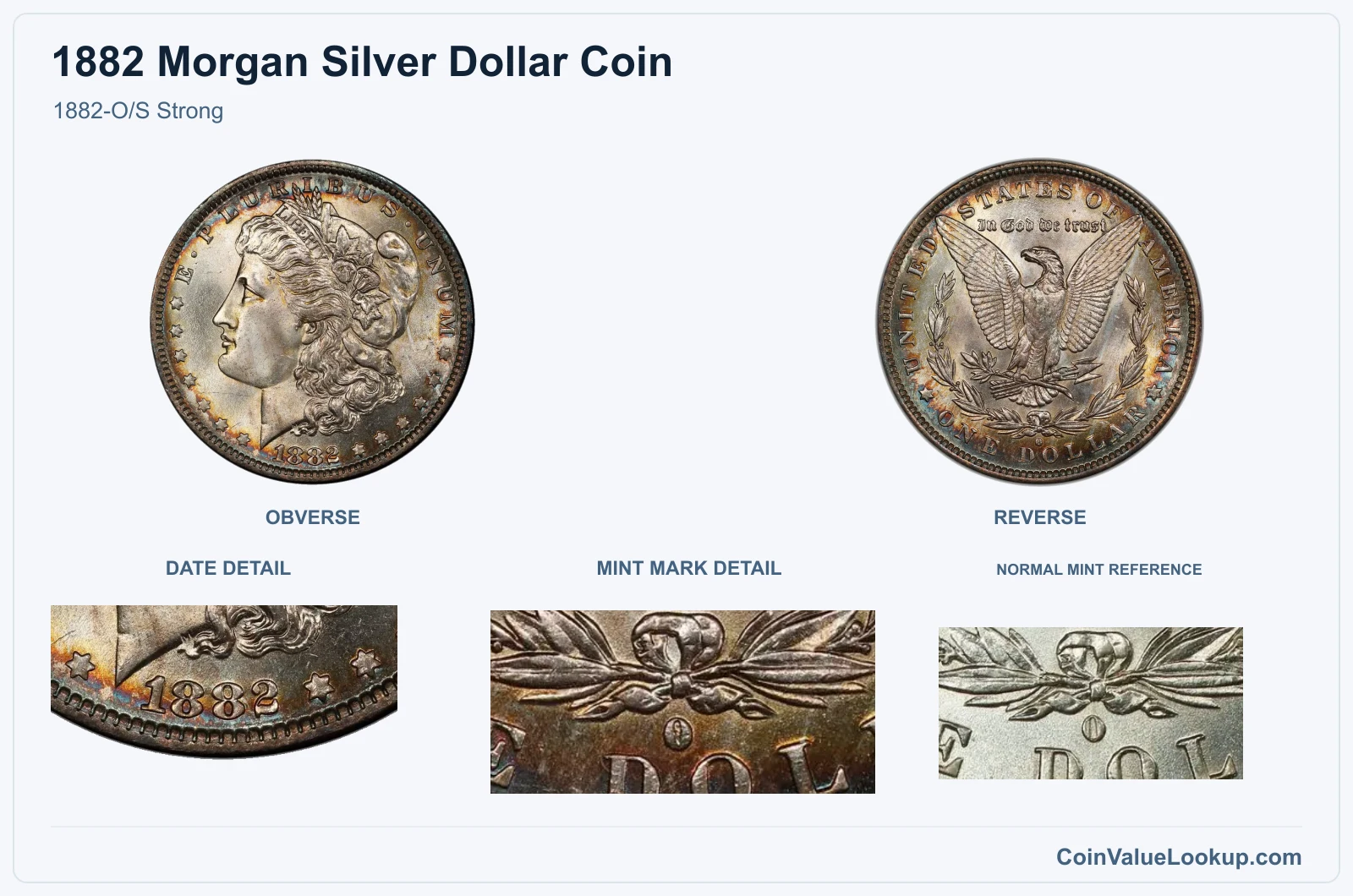
The 1882-O/S Strong is a genuine overmintmark variety. An S mintmark was first punched into the working die, then corrected with an O punch on top.
Under magnification, the leftover curves of the S are clearly visible around the O. This is one of the more dramatic overmintmark varieties in the Morgan series.
Guide estimates from USA Coin Book place the O/S at about $86 in G4 and up to $62,651 in MS-65. Condition matters enormously here, and so does confident attribution — you need to see that S remnant, not just wish it into existence.
Cleaning or damage will cut into the premium. If you think you have one, magnify the mintmark area and compare against known examples before getting excited.
Coin Value Lookup is a handy starting point if you are researching other dates or denominations in the Morgan series alongside this one.
Range Grade
Price Auction Records Appraisal PO PO 1
—
Coin Identifier FR FR 2
—
Coin Identifier AG AG 3
—
Coin Identifier G G 4
—
Coin Identifier
G 6
—
Coin Identifier VG VG 8
—
Coin Identifier
VG 10
Coin Identifier F F 12
—
Coin Identifier
F 15
—
Coin Identifier VF VF 20
Coin Identifier
VF 25
Coin Identifier
VF 30
—
Coin Identifier
VF 35
Coin Identifier XF XF 40
Coin Identifier
XF 45
Coin Identifier AU AU 50
Coin Identifier
AU 53
Coin Identifier
AU 55
Coin Identifier
AU 58
Coin Identifier MS MS 60
Coin Identifier
MS 61
Coin Identifier
MS 62
Coin Identifier
MS 63
Coin Identifier
MS 64
Coin Identifier
MS 65
Coin Identifier
MS 66
—
—
—
MS 67
—
—
—
MS 68
—
—
—
MS 69
—
—
—
MS 70
—
—
—
1882 Morgan Silver Dollar — O/S Weak
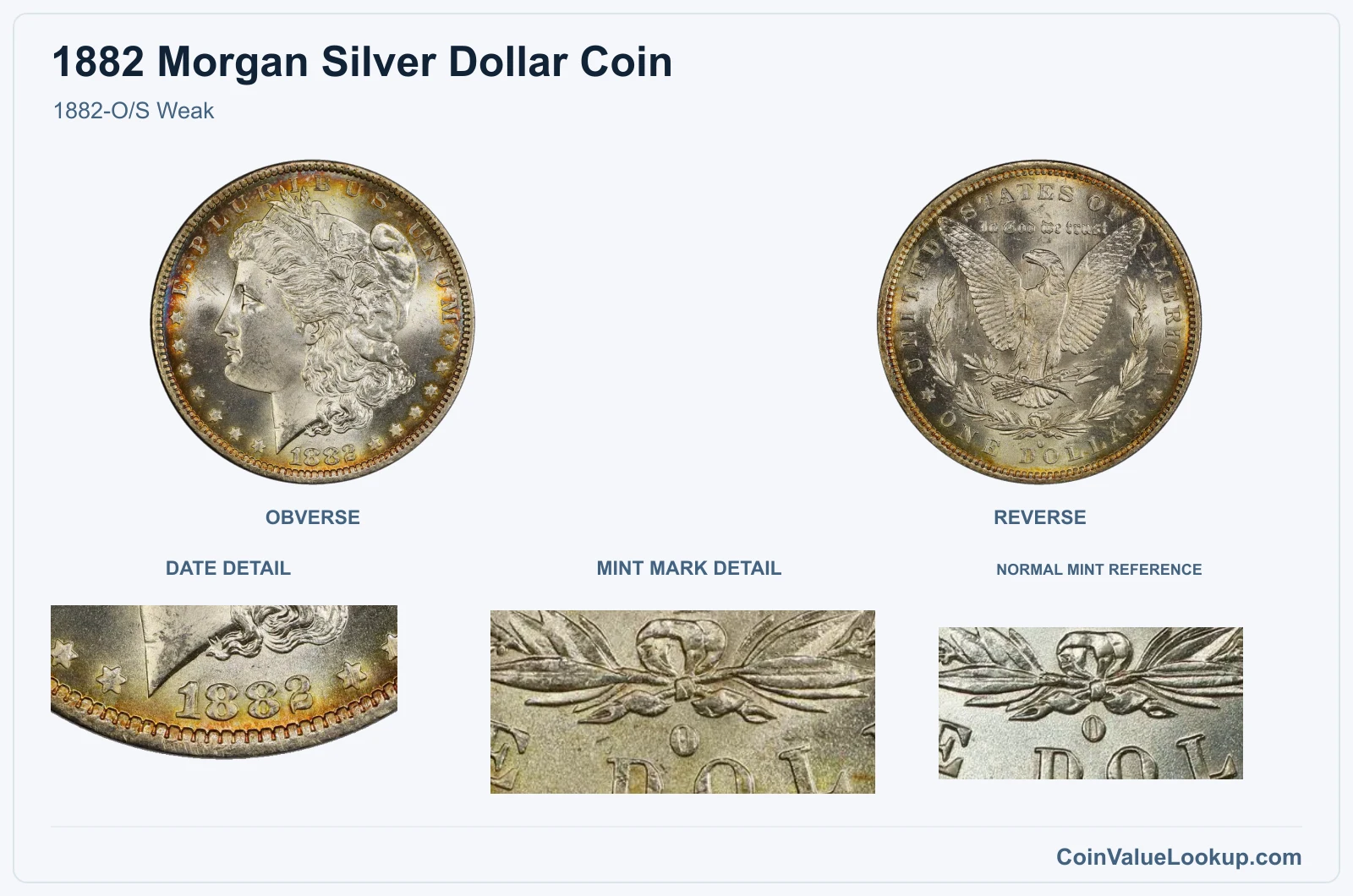
The 1882-O/S Weak is the same overmintmark concept as the Strong, but the remnants of the underlying S punch are less prominent. You still need magnification, and you are looking for subtle curves or serifs peeking out from beneath the O mintmark.
It takes patience and good lighting.
Guide estimates match the Strong version at about $86 in G4 and $62,651 in MS-65 per USA Coin Book. The Weak version can be harder to attribute with certainty, which makes professional grading service confirmation more important if you plan to sell at a variety premium.
Original surfaces without cleaning or corrosion around the mintmark area help enormously when trying to confirm the underlying S.
Range Grade
Price Auction Records Appraisal PO PO 1
—
Coin Identifier FR FR 2
—
Coin Identifier AG AG 3
—
Coin Identifier G G 4
—
Coin Identifier
G 6
—
Coin Identifier VG VG 8
—
Coin Identifier
VG 10
—
Coin Identifier F F 12
—
Coin Identifier
F 15
—
Coin Identifier VF VF 20
—
Coin Identifier
VF 25
—
Coin Identifier
VF 30
—
Coin Identifier
VF 35
—
Coin Identifier XF XF 40
—
Coin Identifier
XF 45
Coin Identifier AU AU 50
Coin Identifier
AU 53
Coin Identifier
AU 55
Coin Identifier
AU 58
Coin Identifier MS MS 60
Coin Identifier
MS 61
Coin Identifier
MS 62
Coin Identifier
MS 63
Coin Identifier
MS 64
Coin Identifier
MS 65
Coin Identifier
MS 66
—
—
—
MS 67
—
—
—
MS 68
—
—
—
MS 69
—
—
—
MS 70
—
—
—
1882 Morgan Silver Dollar — S
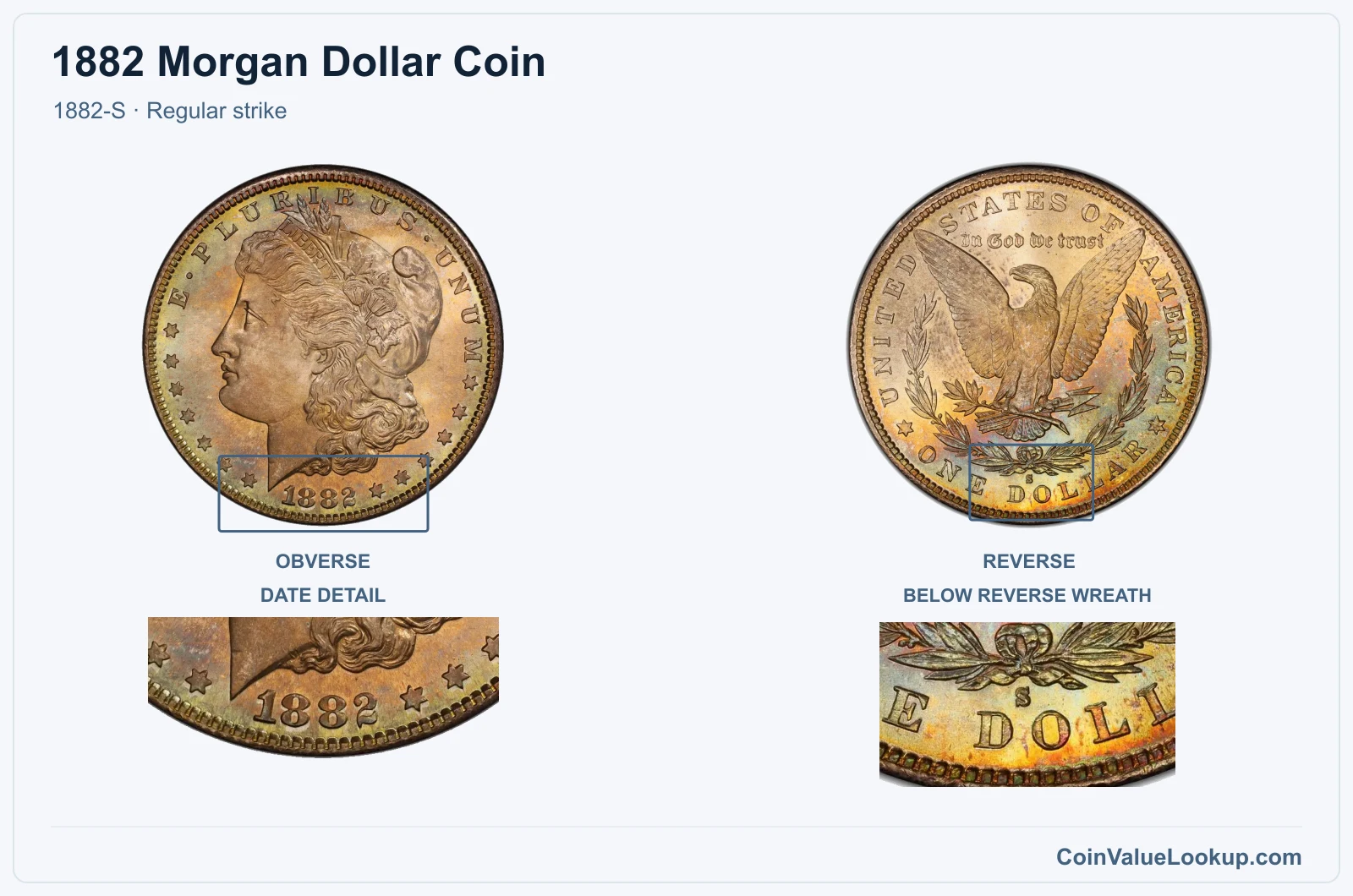
The 1882-S, struck in San Francisco, is one of the more affordable branches for this date. Guide estimates from USA Coin Book put G4 at about $74 and MS-65 at roughly $302.
San Francisco coins from this era often come well-struck with decent luster, so finding a nice example is not terribly difficult. Look for the small S mintmark beneath the wreath bow on the reverse.
As with all business-strike Morgans, PL and DMPL surface designations can apply and may influence value, but they require proper attribution.
Range Grade
Price Auction Records Appraisal PO PO 1
—
Coin Identifier FR FR 2
—
Coin Identifier AG AG 3
—
Coin Identifier G G 4
—
Coin Identifier
G 6
—
Coin Identifier VG VG 8
—
Coin Identifier
VG 10
—
Coin Identifier F F 12
—
Coin Identifier
F 15
—
Coin Identifier VF VF 20
—
Coin Identifier
VF 25
—
Coin Identifier
VF 30
—
Coin Identifier
VF 35
—
Coin Identifier XF XF 40
—
Coin Identifier
XF 45
—
Coin Identifier AU AU 50
—
Coin Identifier
AU 53
—
Coin Identifier
AU 55
Coin Identifier
AU 58
Coin Identifier MS MS 60
—
Coin Identifier
MS 61
Coin Identifier
MS 62
Coin Identifier
MS 63
Coin Identifier
MS 64
Coin Identifier
MS 65
Coin Identifier
MS 66
Coin Identifier
MS 67
Coin Identifier
MS 68
Coin Identifier
MS 69
—
—
—
MS 70
—
—
—
1882 Morgan Silver Dollar — PR
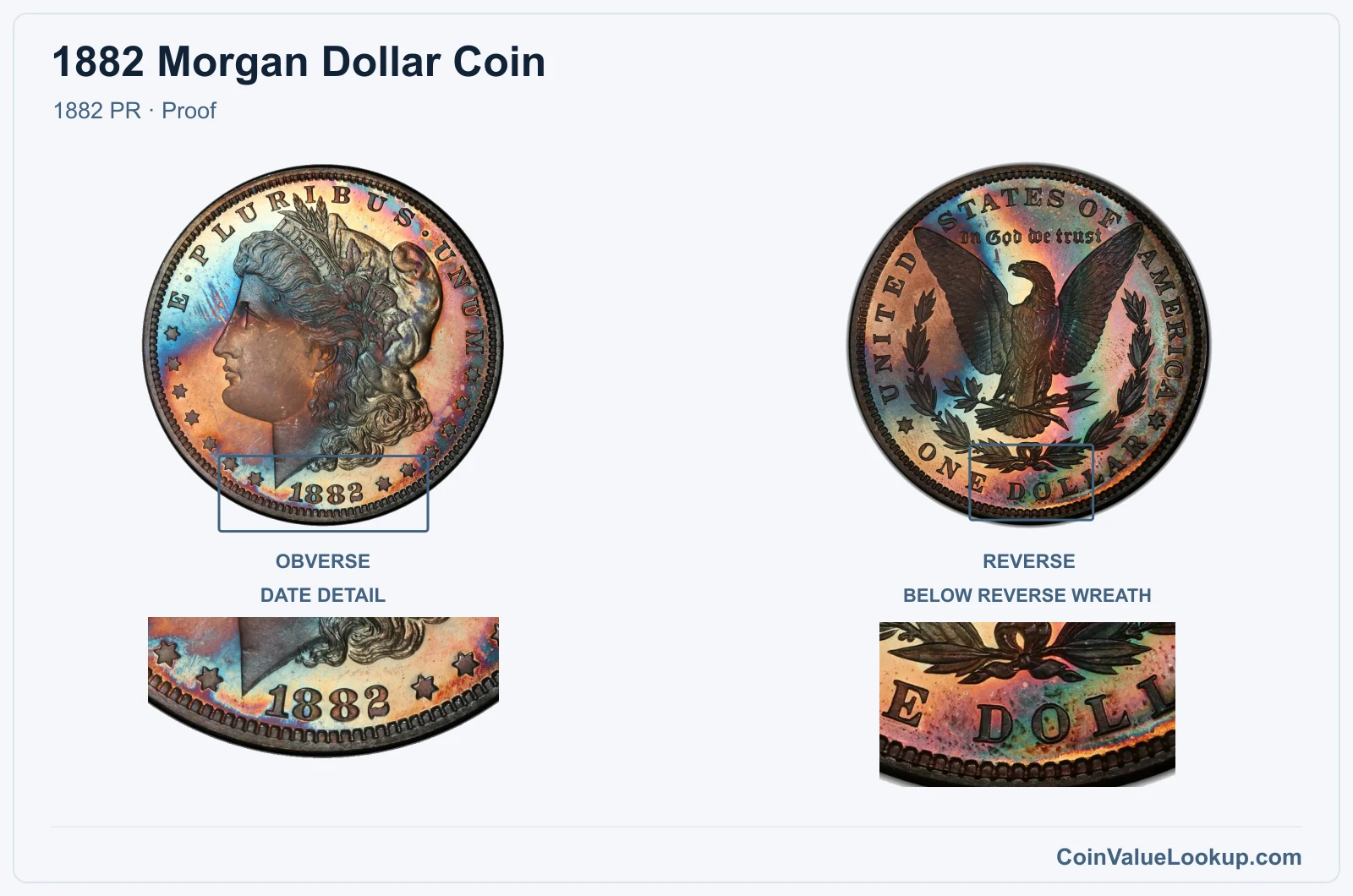
The 1882 Proof Morgan Dollar was struck at Philadelphia using specially prepared dies on polished planchets, producing mirror-like fields and sharp detail. There is no mintmark.
A proof is a manufacturing method, not simply a high grade — plenty of shiny business strikes get mistaken for proofs.
No supported numerical price range is available for this version. Value depends on the coin's authenticated identity, its condition, and any cameo contrast or imperfections.
Professional certification is effectively required for a proof Morgan to realize its potential, because buyers need assurance the finish is genuine. If your coin has deeply mirrored fields and razor-sharp devices with no bag marks, it is worth investigating further.
Range Grade
Price Auction Records Appraisal PR PR 1
—
Coin Identifier
PR 2
—
Coin Identifier
PR 3
—
Coin Identifier
PR 4
—
Coin Identifier
PR 6
—
Coin Identifier
PR 8
—
Coin Identifier
PR 10
—
Coin Identifier
PR 12
—
Coin Identifier
PR 15
—
Coin Identifier
PR 20
—
Coin Identifier
PR 25
—
Coin Identifier
PR 30
—
Coin Identifier
PR 35
—
Coin Identifier
PR 40
—
Coin Identifier
PR 45
—
Coin Identifier
PR 50
—
Coin Identifier
PR 53
—
Coin Identifier
PR 55
—
Coin Identifier
PR 58
—
Coin Identifier
PR 60
Coin Identifier
PR 61
Coin Identifier
PR 62
Coin Identifier
PR 63
Coin Identifier
PR 64
Coin Identifier
PR 65
Coin Identifier
PR 66
Coin Identifier
PR 67
Coin Identifier
PR 68
Coin Identifier
PR 69
—
—
—
PR 70
—
—
—
1882 Morgan Silver Dollar Error List
1. 1882 Morgan Silver Dollar — Misplaced Date
A misplaced date error on the 1882 Morgan Dollar has been reported specifically on the 1882-CC issue. This occurs when a digit from the date punch appears in an unexpected location on the die — away from the normal date position — leaving a partial impression of one or more numerals where they should not be.
You would need magnification to spot the stray digit remnant, often faint and partially formed.
Do not confuse this with a scratch, die crack, or random dent. Those marks lack the structured shape of a numeral.
Check that the normal date is also visible in its correct position for context. No specific price data is available for this variety, so value depends on condition, how visible the misplacement is, and the particular die involved.
Professional attribution strengthens any claim.
2. 1882 Morgan Silver Dollar — Repunched Mintmark
A repunched mintmark has been reported on the 1882-O Morgan Dollar, specifically an O/O variety where the O mintmark was punched into the die more than once in slightly different positions. Under magnification, you will see traces of the first O peeking out from behind the final, properly positioned O — look for doubling of the curves or a slight shadow offset.
This is different from machine doubling, which tends to produce flat, shelf-like doubling rather than a clearly separated second impression. Die chips or corrosion around the mintmark can also mimic a repunched mark to the untrained eye.
Compare your coin's mintmark at matching magnification against a known normal example. No numerical price data is available for this variety; value depends on the coin's overall condition and how visible the repunching is.
3. 1882 Morgan Silver Dollar — Off-Center Strike
Off-center strikes have been reported on 1882 Morgan Dollars. This happens when the planchet is not properly seated between the dies at the moment of striking, resulting in a design that is shifted to one side with an unstruck crescent of blank metal on the opposite edge.
The further off-center the strike, the more dramatic the error.
For collectors, the key is that the date must still be visible — an off-center Morgan missing its date loses much of its attribution value. Do not confuse a genuine off-center strike with a clipped planchet, which has a different edge profile, or with post-mint damage like a coin that was flattened unevenly after leaving the press.
No numerical price data is available; value depends on the percentage of off-center shift, date visibility, and overall condition.