1921 Buffalo Nickel Coin Value: How Much Is It Worth?
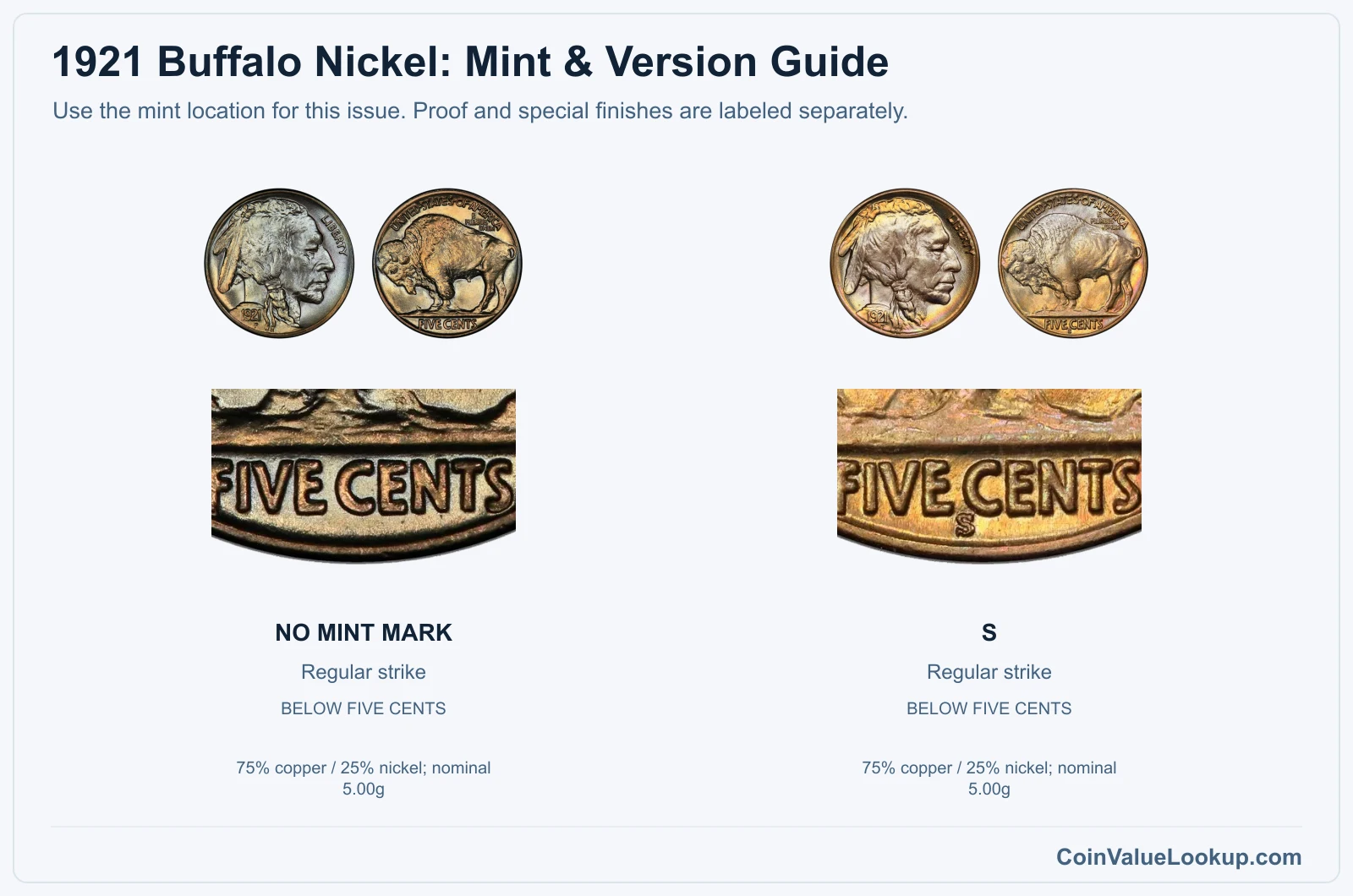
A 1921 Buffalo Nickel in ordinary circulation condition can range from roughly $4.96 in Good-4 up to around $3,085 in MS-63, depending on the mint. Those are guide estimates from USA Coin Book, not guaranteed sale prices.
The San Francisco mint issue carries a serious premium over the Philadelphia coin, so identifying your mintmark is the first order of business.
Fast Way to Identify Your 1921 Buffalo Nickel
Snap clear photos of both sides of your coin — front and back — and upload them for a preliminary identification. Make sure the date is readable and the area below FIVE CENTS on the reverse is in focus, since that is where the mintmark lives.
This step helps sort out which mint and version you are working with before digging into values.
1921 Buffalo Nickel Value
Upload both sides of your 1921 Buffalo Nickel.
Front Obverse
Upload photo
Back Reverse
Upload photo
Which 1921 Buffalo Nickel Versions Are Worth Money?
- The 1921-S (San Francisco) commands a large premium — about $92 in G-4 and around $3,085 in MS-63 per guide estimates, making the mintmark check essential.
- Philadelphia issues are far more common, with guide values near $4.96 in G-4 and about $391 in MS-63, so condition is the main value driver for no-mintmark coins.
- Error varieties such as the Two Feathers obverse and Doubled Die Obverse have been reported for 1921 and can carry additional value depending on visibility and condition.
- Original, problem-free surfaces in higher grades are scarce for both mints; coins with full luster and no cleaning stand out.
Step 1: Identify Your 1921 Buffalo Nickel Mint Mark and Version
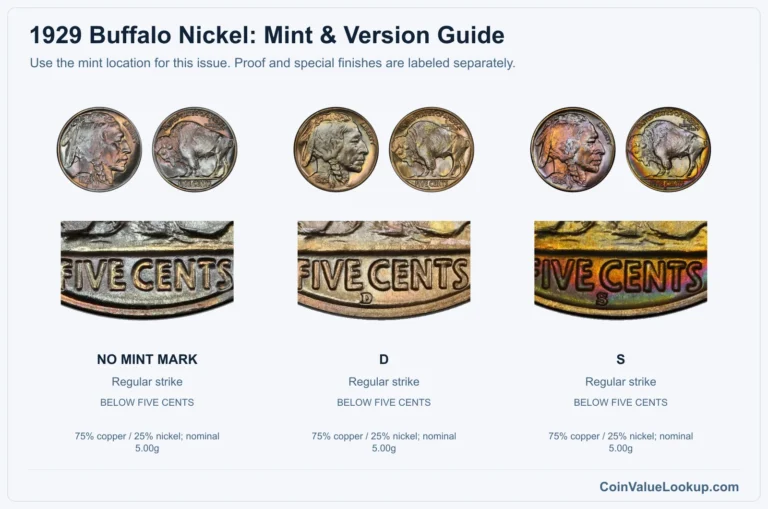
The 1921 Buffalo Nickel was struck at two mints: Philadelphia and San Francisco. Philadelphia coins carry no mintmark at all.
San Francisco coins show a small "S" on the reverse, sitting just below the words FIVE CENTS in the recessed area.
All 1921 nickels use the Type 2 reverse design, where FIVE CENTS sits in a recessed flat area below the bison. There is no Type 1 raised-mound version for this year — that design was only used in 1913.
The coin is 75% copper and 25% nickel, weighs about 5 grams, measures 21.2 mm across, and has a plain edge. There is no silver variety, no proof issue, and no D-mint for 1921.
If you see a "D" mintmark, you have a different date.
Step 2: Check Your 1921 Buffalo Nickel Grade
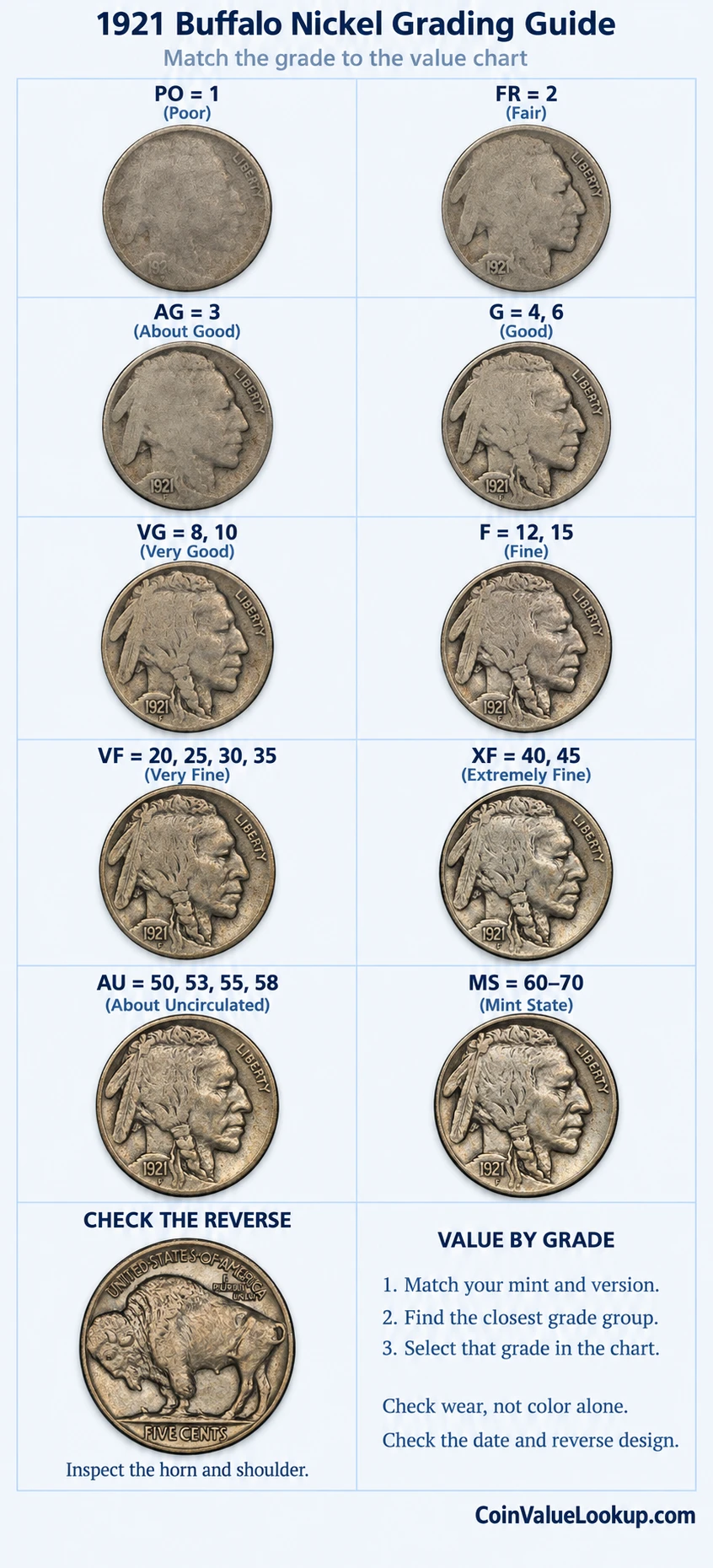
Start with the obverse. The Native American portrait loses detail in a predictable order: the braid and hair above the forehead go first, then the cheek flattens.
On well-worn coins the date can fade entirely.
Flip to the reverse. The bison's shoulder and hip are high points that wear early.
The horn is trickier — 1920s Buffalo Nickels sometimes left the mint with a weak horn due to strike issues, not circulation. Do not assume a soft horn means heavy wear.
Original mint luster matters a lot for mid-grade and higher coins. A coin with full cartwheel luster grades differently from one that has been cleaned or whizzed, even if the detail looks sharp.
Never acid-treat the date to make it readable; that destroys value.
Use the comparison image to match your coin's wear pattern against known grade benchmarks. Focus on the hair, braid, cheek, horn and shoulder together, not just one feature.
Step 3: Check 1921 Buffalo Nickel Value by Mint and Version
1921 Buffalo Nickel — No Mint Mark — Type2 Circulation
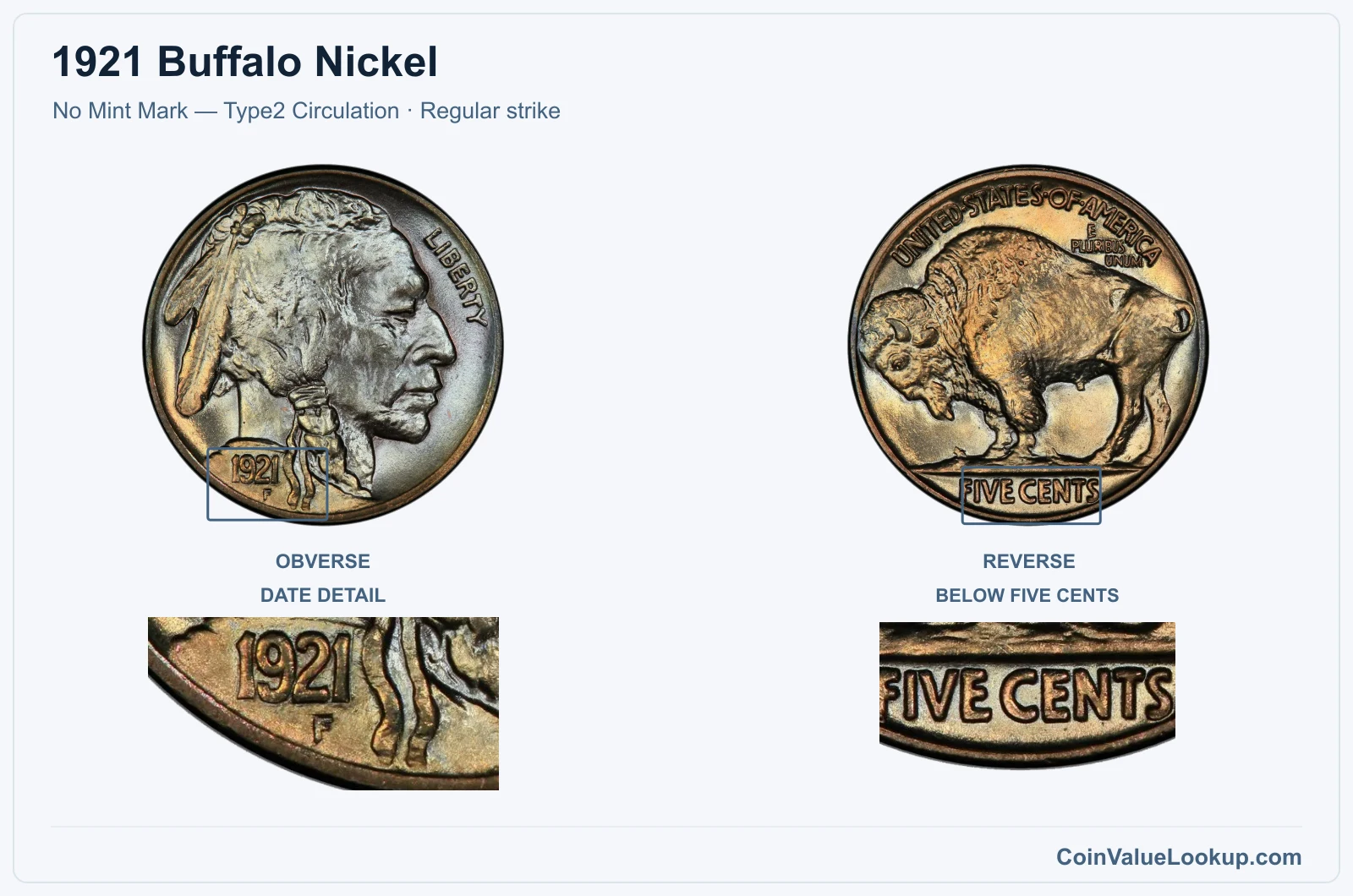
The 1921 Philadelphia Buffalo Nickel has no mintmark — the space below FIVE CENTS on the reverse is blank. This is the more common of the two 1921 issues, so circulated examples turn up regularly.
Guide estimates from USA Coin Book place a Good-4 example around $4.96 and an MS-63 near $391. Those are retail reference points, not offers.
The real action is in preservation: a problem-free coin with original surfaces and clear date will always outperform a cleaned or damaged one at the same technical grade.
Coin Value Lookup is a handy starting point when you want to look up guides for other dates and mints in the Buffalo Nickel series or check values across different denominations.
Range Grade
Price Auction Records Appraisal PO PO 1
—
Coin Identifier FR FR 2
—
Coin Identifier AG AG 3
—
Coin Identifier G G 4
—
Coin Identifier
G 6
—
Coin Identifier VG VG 8
—
Coin Identifier
VG 10
—
Coin Identifier F F 12
—
Coin Identifier
F 15
Coin Identifier VF VF 20
—
Coin Identifier
VF 25
—
Coin Identifier
VF 30
—
Coin Identifier
VF 35
Coin Identifier XF XF 40
Coin Identifier
XF 45
Coin Identifier AU AU 50
Coin Identifier
AU 53
Coin Identifier
AU 55
Coin Identifier
AU 58
Coin Identifier MS MS 60
—
Coin Identifier
MS 61
Coin Identifier
MS 62
Coin Identifier
MS 63
Coin Identifier
MS 64
Coin Identifier
MS 65
Coin Identifier
MS 66
Coin Identifier
MS 67
Coin Identifier
MS 68
—
—
—
MS 69
—
—
—
MS 70
—
—
—
1921 Buffalo Nickel — S — Type2 Circulation
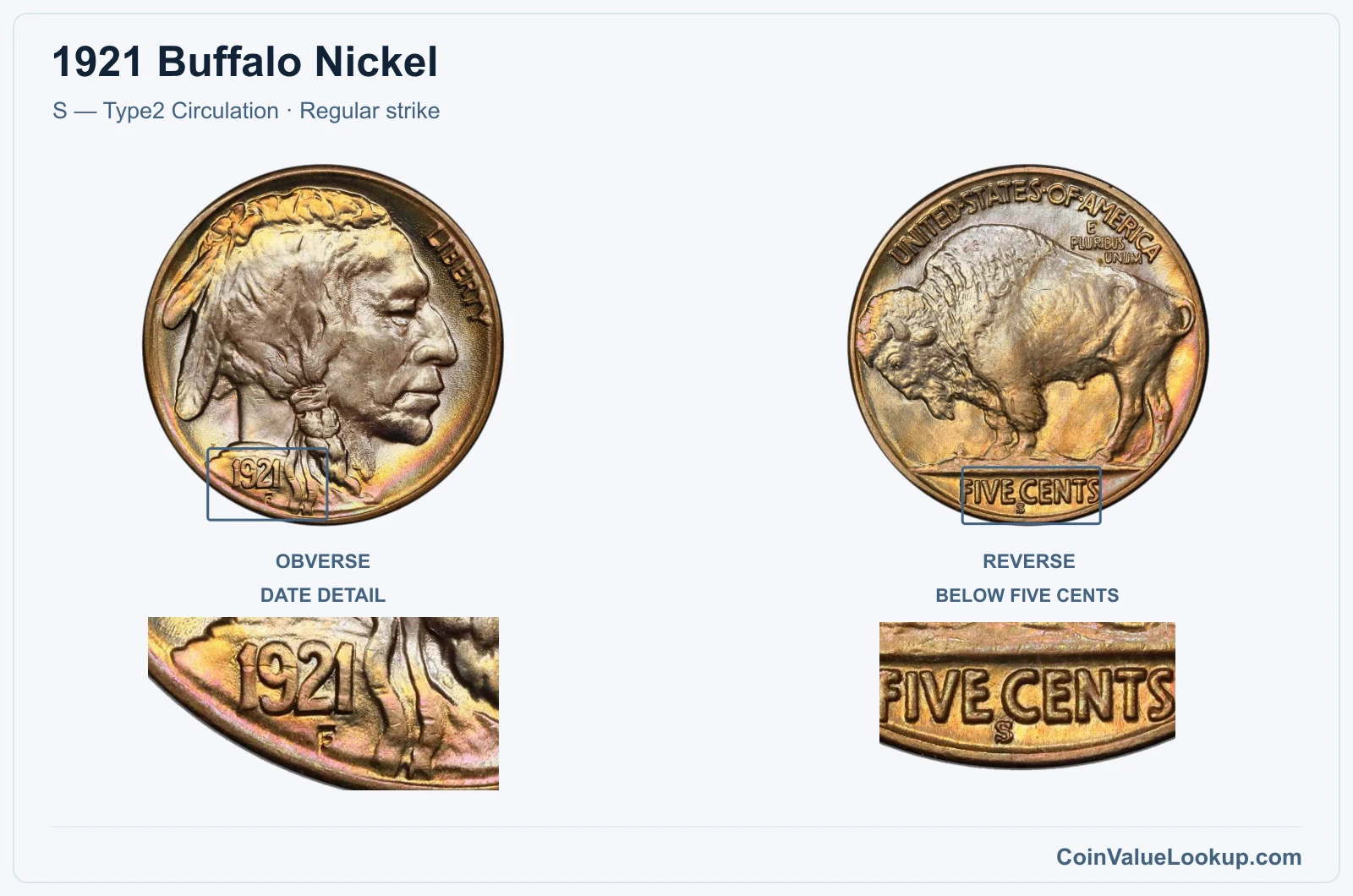
The 1921-S carries a small "S" mintmark on the reverse, tucked below FIVE CENTS in the recessed panel. It is considerably scarcer than the Philadelphia issue and commands a steep premium at every grade level.
USA Coin Book guide estimates place this coin at roughly $92 in Good-4 and around $3,085 in MS-63. Even heavily worn examples hold meaningful value because the mintage was relatively low and collector demand stays strong.
Because the S mintmark sits in the recessed area, it can fill with grime or wear down on well-circulated coins. Tilt the coin under good light and look carefully.
Confirming that letter is the single most important step in pricing a 1921 Buffalo Nickel. Do not confuse a scratch or debris for a mintmark — the S should be centered and punched with consistent depth.
Range Grade
Price Auction Records Appraisal PO PO 1
—
Coin Identifier FR FR 2
—
Coin Identifier AG AG 3
—
Coin Identifier G G 4
Coin Identifier
G 6
Coin Identifier VG VG 8
Coin Identifier
VG 10
Coin Identifier F F 12
Coin Identifier
F 15
Coin Identifier VF VF 20
Coin Identifier
VF 25
Coin Identifier
VF 30
Coin Identifier
VF 35
Coin Identifier XF XF 40
Coin Identifier
XF 45
Coin Identifier AU AU 50
Coin Identifier
AU 53
Coin Identifier
AU 55
Coin Identifier
AU 58
Coin Identifier MS MS 60
Coin Identifier
MS 61
Coin Identifier
MS 62
Coin Identifier
MS 63
Coin Identifier
MS 64
Coin Identifier
MS 65
Coin Identifier
MS 66
Coin Identifier
MS 67
—
—
—
MS 68
—
—
—
MS 69
—
—
—
MS 70
—
—
—
1921 Buffalo Nickel Error List
1. 1921 Buffalo Nickel — Two Feathers / Abraded Third Feather
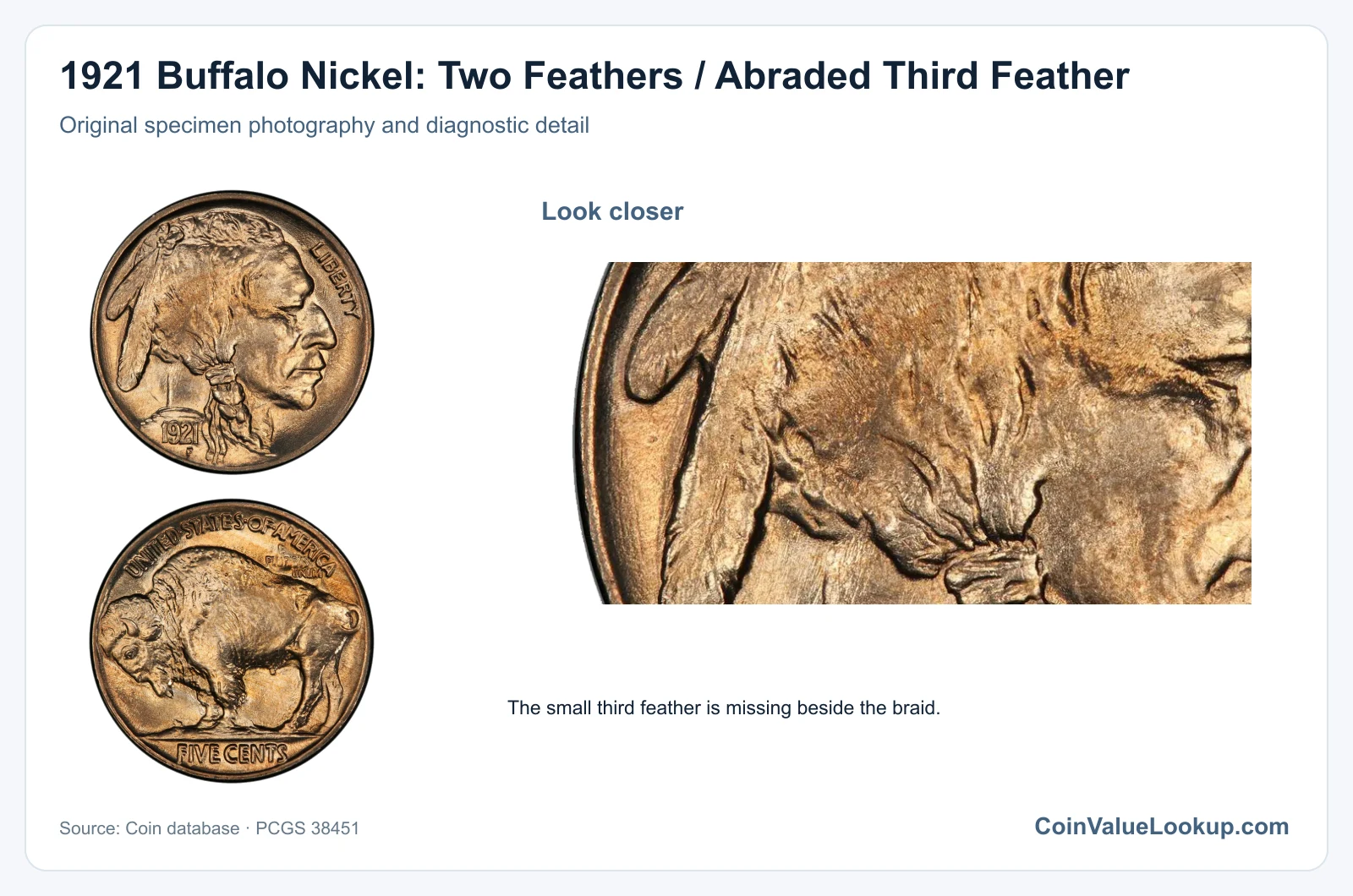
On a normal 1921 Buffalo Nickel obverse, three feathers extend behind the Native American's neck. On the Two Feathers variety, the third feather nearest the neck appears abraded or missing, leaving only two clearly visible feathers.
This has been reported on both 1921 Philadelphia and San Francisco issues. To check, compare the feather group on your coin against a standard three-feather example under magnification.
The key diagnostic is a consistently absent or ghosted third feather — not just a soft impression from wear.
Lookalikes are common. A weak strike, heavy circulation, grease-filled die, or deliberate scraping can all reduce a feather's visibility without being a genuine die variety.
If the rest of the coin shows heavy wear and the feather area matches that wear pattern, it is likely just a tired coin. No specific price range is adopted here; value depends on the coin's condition, the clarity of the missing feather, and whether it can be attributed by a grading service.
2. 1921 Buffalo Nickel — Wrong Planchet / Off-Metal Strike
A wrong-planchet error means the 1921 Buffalo Nickel design was struck on a blank intended for a different denomination. A reported example involves a Philadelphia strike on what appears to be a cent planchet, which would differ noticeably in weight, diameter, and edge profile from a standard nickel blank.
To evaluate a suspect coin, weigh it and measure its diameter. A normal Buffalo Nickel is about 5 grams and 21.2 mm across.
A cent planchet would be lighter and potentially smaller, and the design may not fill the edges completely.
Be cautious. Plating, corrosion, acid-thinning, and deliberate alteration can all make a nickel look or weigh wrong.
If the surface shows chemical discoloration, uneven color, or filed edges, that points toward damage rather than a mint error. No adopted price is available — genuine wrong-planchet errors are evaluated individually based on the specific blank, the completeness of the strike, and overall condition.
3. 1921 Buffalo Nickel — Doubled Die Obverse
A Doubled Die Obverse on a 1921 Buffalo Nickel shows consistent doubling on obverse design elements — typically letters or portions of the portrait. The doubling appears as separation or notching along the edges of affected features, and it should look the same under different lighting angles.
The critical distinction is between a genuine doubled die and machine doubling. Machine doubling produces a flat, shelf-like distortion on one side of a letter or design element, while a true doubled die shows distinct, rounded secondary impressions.
Reflections or worn die contours can also mimic doubling at first glance.
Use magnification and compare your coin's obverse lettering against a confirmed normal specimen. The doubling should be repeatable from coin to coin if struck from the same die.
No specific price is adopted for this variety; value depends on the strength of the doubling, the coin's condition, and third-party attribution.
4. 1921 Buffalo Nickel — Lamination / Split Planchet
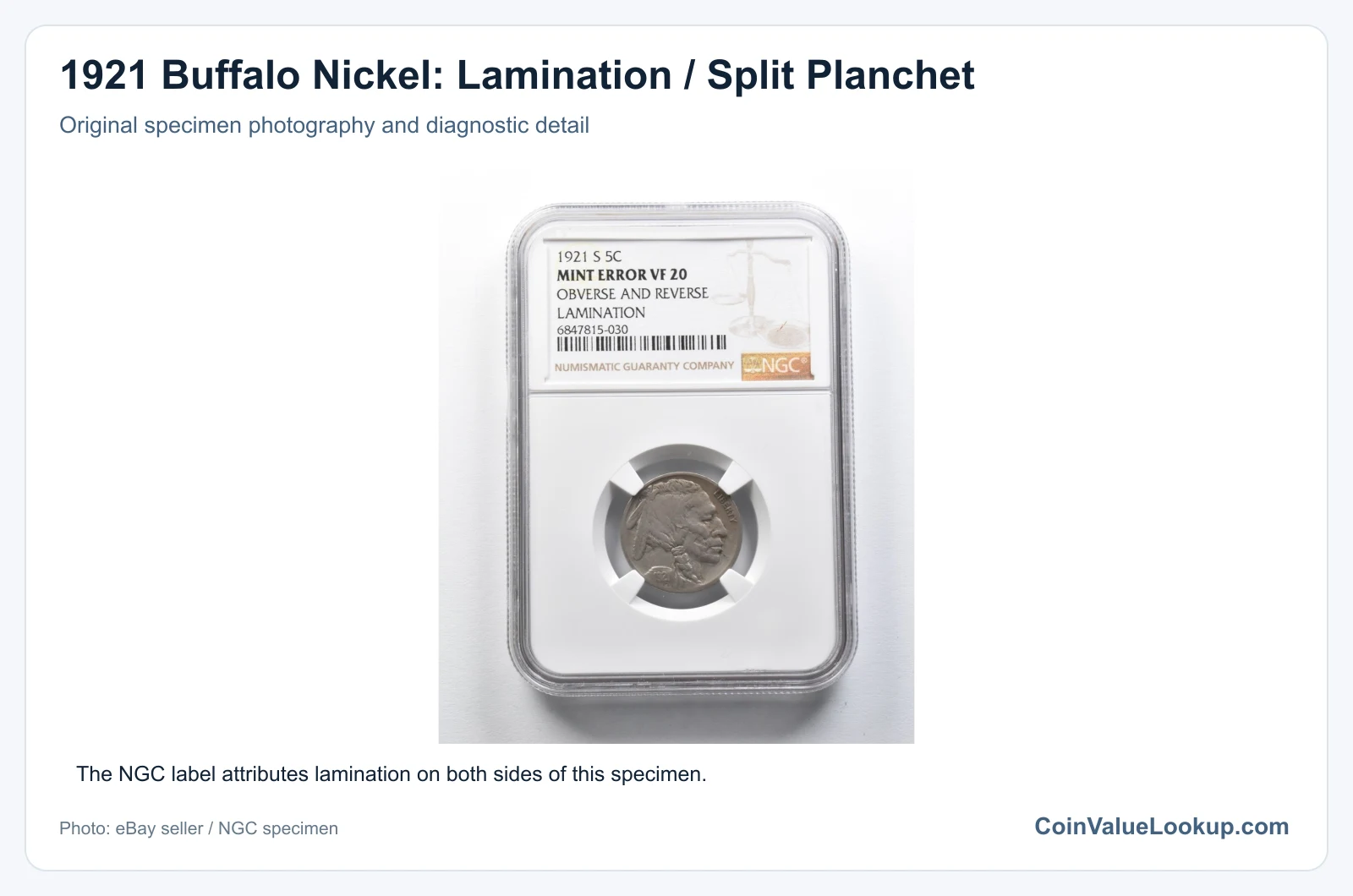
Lamination errors occur when the metal alloy separates within the planchet, producing a visible flaw on the finished coin. On a 1921 Buffalo Nickel, this can appear as peeling metal, a retained flap that lifts away from the surface, or a thin crack where layers have started to split.
Photograph both the affected face and the edge of the coin together — edge views help confirm that the separation runs through the metal rather than sitting only on the surface. Genuine lamination flaws usually have an irregular, natural boundary.
Scraping, corrosion pitting, and deliberately cut or gouged coins can look similar. Corrosion tends to eat into the surface unevenly and often changes the color or texture of the metal.
A deliberate cut usually shows tool marks or a clean, straight edge. If the flaw follows natural metal grain and reveals intact design underneath the lifted area, lamination is more likely.
No specific price is adopted; value depends on the size, location, and visual impact of the flaw along with the coin's overall grade.