1971 Jefferson Nickel Coin Value: How Much Is It Worth?
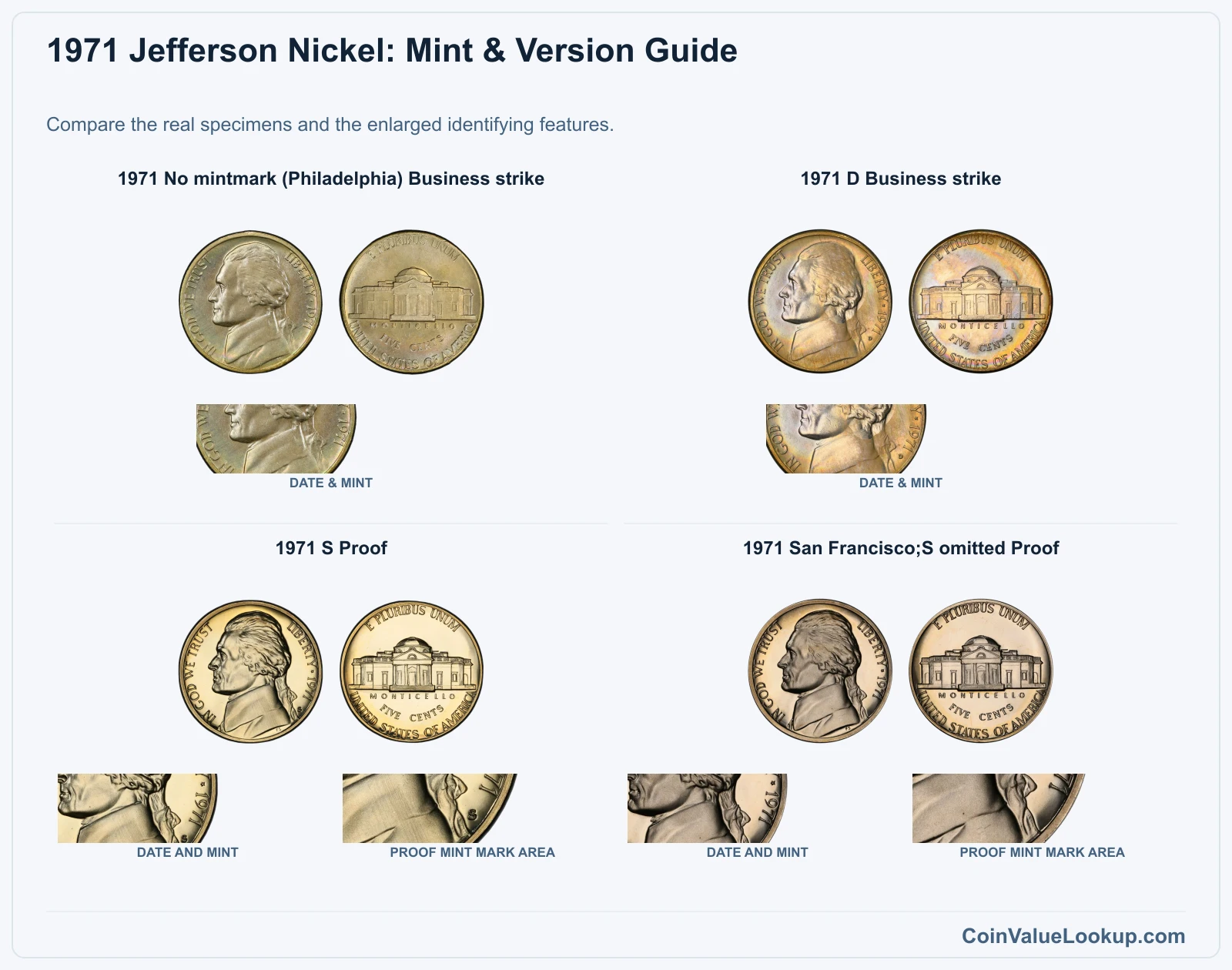
Most 1971 Jefferson nickels pulled from pocket change are worth face value or close to it. Uncirculated examples carry modest guide estimates — roughly $0.36 at MS60 up to $3.62 at MS65, depending on mint and condition.
Proofs and authenticated error coins occupy a different tier entirely, so knowing exactly what you have matters before assuming any premium.
Fast Way to Identify Your 1971 Jefferson Nickel
The quickest way to start figuring out what your 1971 nickel is worth is to upload clear photos of the front and back. Our identifier can give you a preliminary read on the mint, finish, and general type.
Good lighting and a steady shot help — try to capture the area below the date where a mintmark may or may not appear.
1971 Jefferson Nickel Value
Upload both sides of your 1971 Jefferson Nickel.
Front Obverse
Upload photo
Back Reverse
Upload photo
Which 1971 Jefferson Nickel Versions Are Worth Money?
- The 1971 No S Proof is a rare mintmark omission from San Francisco — guide estimates around $1,345 at PR65. Do not confuse it with ordinary Philadelphia nickels, which also lack a mintmark.
- High-grade uncirculated Philadelphia or Denver coins with certified Full Steps can carry a premium above typical MS65 guide values.
- San Francisco proofs with strong cameo or deep cameo contrast trade on a separate market from base proof values.
- Authenticated mint errors such as off-center strikes on wrong planchets or multiple strikes can command significant prices at auction.
Step 1: Identify Your 1971 Jefferson Nickel Mint Mark and Version
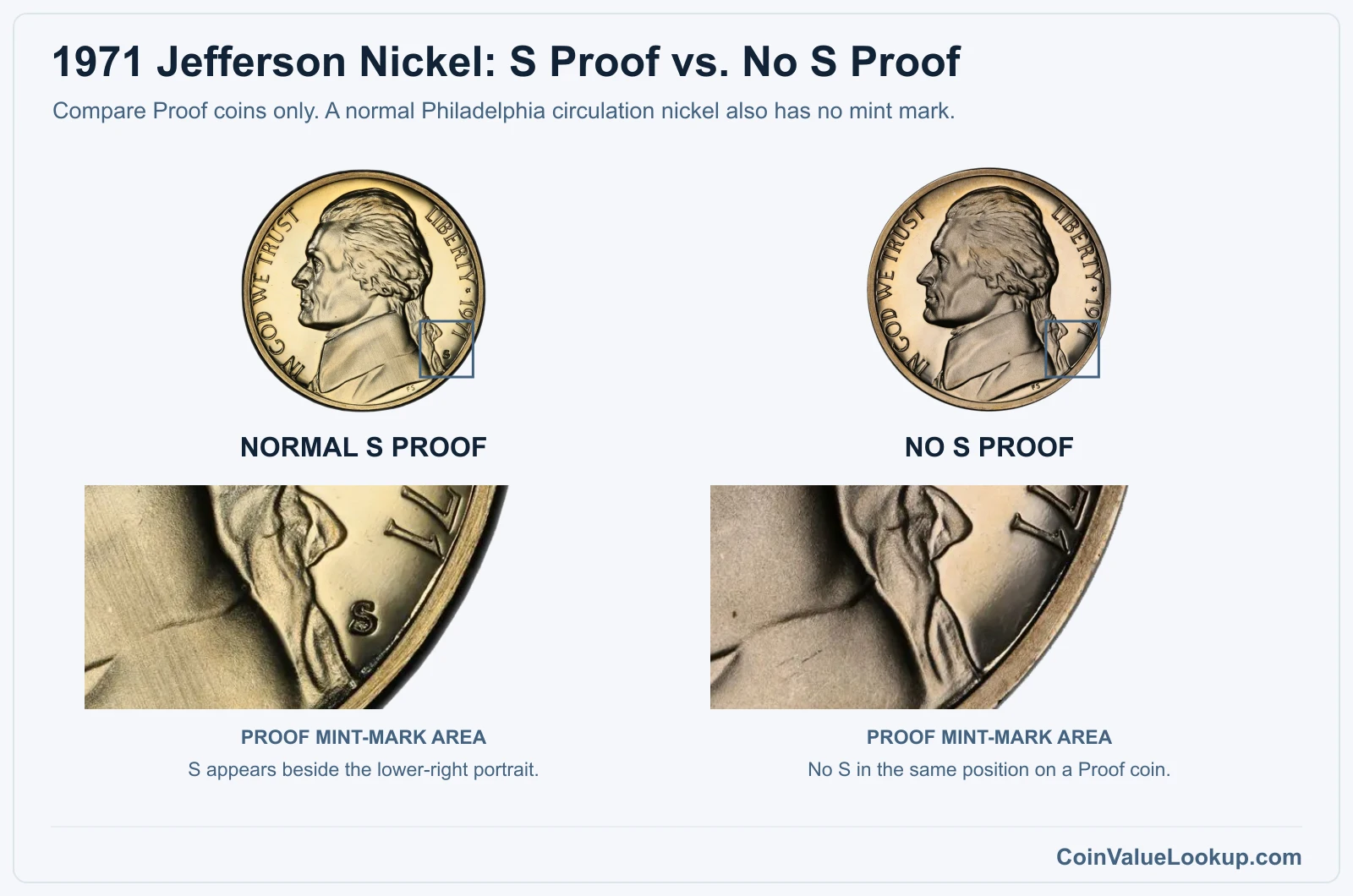
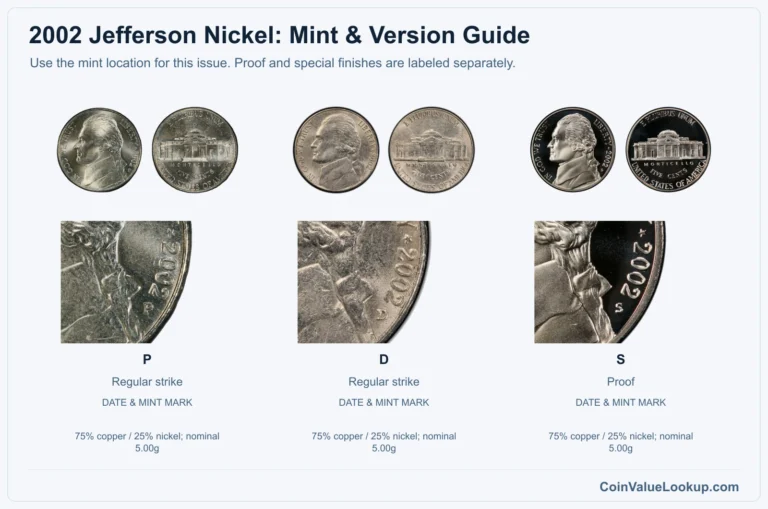
Three basic versions exist for 1971. A nickel with no mintmark below the date is a Philadelphia business strike — the most common type.
A small "D" in that same spot means Denver. An "S" means San Francisco, and those were struck as proofs only.
All three share the same Jefferson portrait obverse and Monticello reverse. The coin is 75% copper and 25% nickel, weighs about 5 grams, measures 21.2 mm across, and has a plain edge.
This is a solid copper-nickel alloy, not a clad sandwich.
To properly identify your coin, note the mintmark (or lack of one), whether the surfaces show mirror-like proof fields or the satiny luster of a business strike, and any unusual size or weight. Record both sides, the date, and any oddities you spot.
A proof finish — with its reflective fields — is a manufacturing method, not a grade above Mint State.
Step 2: Check Your 1971 Jefferson Nickel Grade
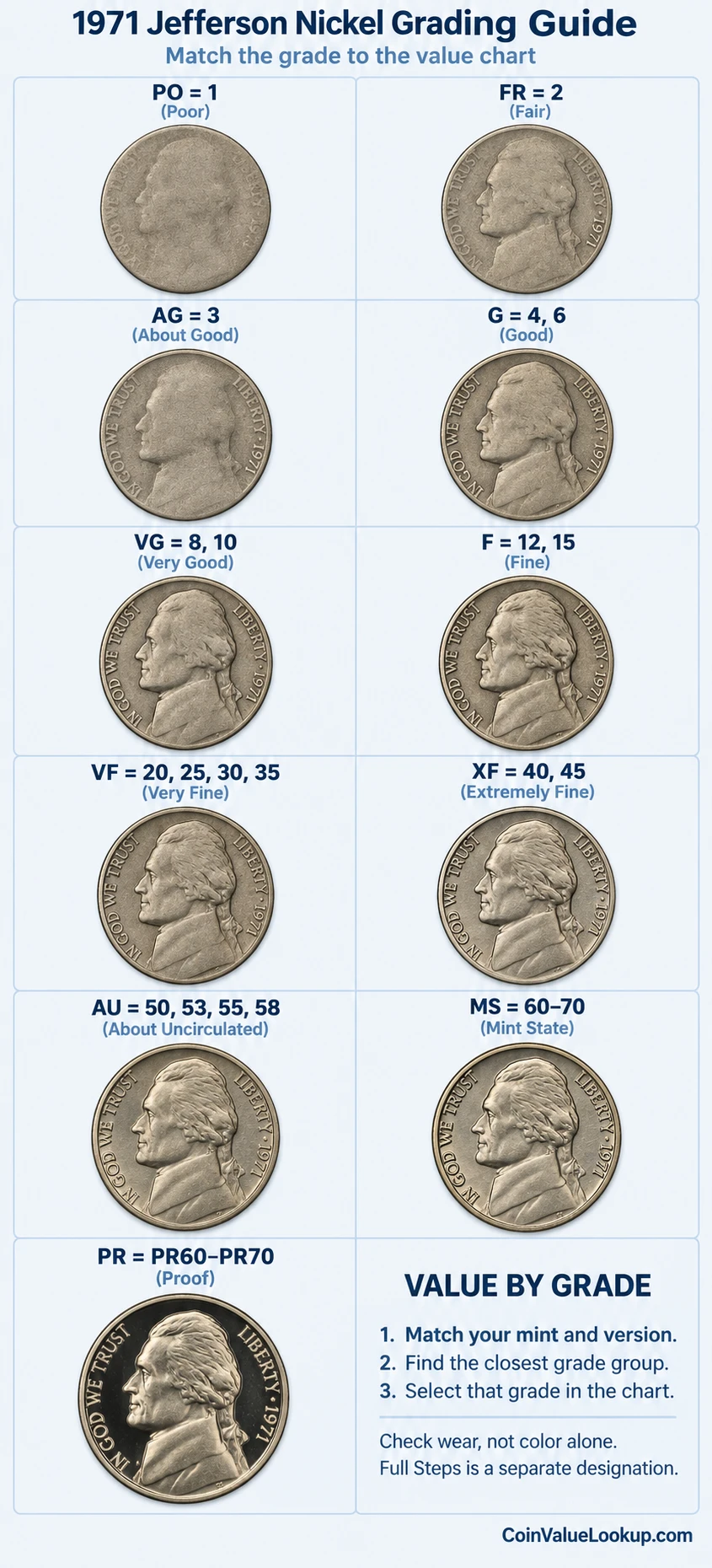
Start by checking Jefferson's cheekbone and the hair detail behind his ear. On a well-worn coin, these areas flatten first and lose their fine texture.
Then flip to the reverse and examine the columns, windows, and steps of Monticello.
The comparison image can help you gauge where your coin falls on the wear scale. Look for original mint luster across the high points — its presence or absence is one of the fastest tells between a circulated and uncirculated piece.
Full Steps is a specific attributed designation for business strikes where the horizontal lines across the base of Monticello remain uninterrupted. This reflects strike quality, not just preservation.
A coin can look shiny and still lack Full Steps if the die didn't fully impress those details. Surface marks, bag contact, and overall eye appeal also influence grade, so consider the whole picture.
Step 3: Check 1971 Jefferson Nickel Value by Mint and Version
1971 Jefferson Nickel — No mintmark (Philadelphia) Business strike
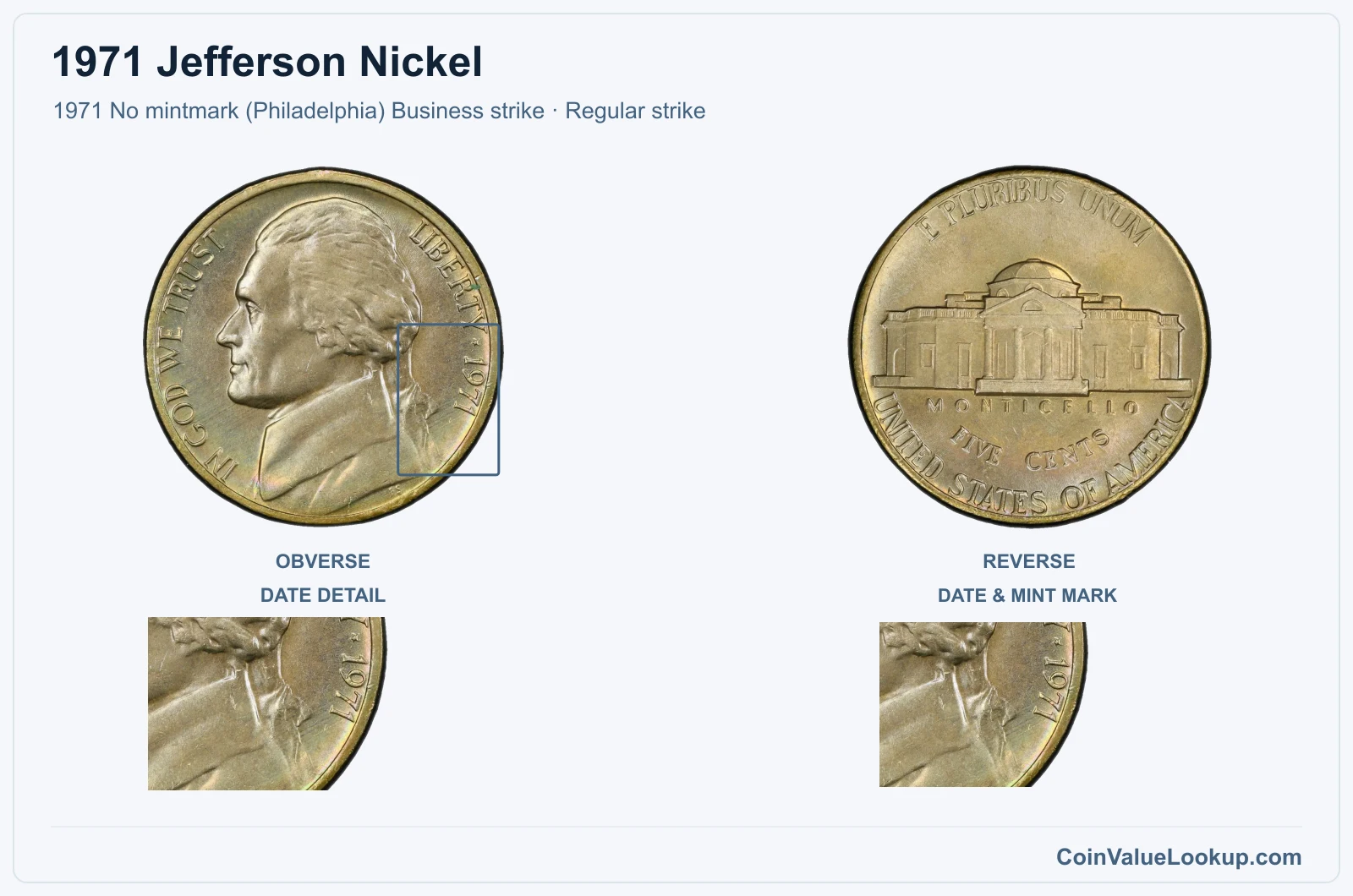
The 1971 Philadelphia nickel has no mintmark below the date. That blank space is normal — every Philadelphia Jefferson nickel of this era was struck without a mark.
Millions were made, and most circulated examples are worth face value.
In uncirculated condition, guide estimates from USA Coin Book place this coin at about $0.93 at MS60 and $3.62 at MS65. Coins with certified Full Steps designation can carry a premium, but don't assume a nice-looking nickel automatically qualifies.
That attribution requires uninterrupted horizontal lines on Monticello's base, confirmed by a grading service.
| Range | Grade | Price | Auction Records | Appraisal |
|---|---|---|---|---|
| PO | PO 1 | — | Coin Identifier | |
| FR | FR 2 | — | Coin Identifier | |
| AG | AG 3 | — | Coin Identifier | |
| G | G 4 | — | Coin Identifier | |
| G 6 | — | Coin Identifier | ||
| VG | VG 8 | — | Coin Identifier | |
| VG 10 | — | Coin Identifier | ||
| F | F 12 | — | Coin Identifier | |
| F 15 | — | Coin Identifier | ||
| VF | VF 20 | — | Coin Identifier | |
| VF 25 | — | Coin Identifier | ||
| VF 30 | — | Coin Identifier | ||
| VF 35 | — | Coin Identifier | ||
| XF | XF 40 | — | Coin Identifier | |
| XF 45 | — | Coin Identifier | ||
| AU | AU 50 | — | Coin Identifier | |
| AU 53 | — | Coin Identifier | ||
| AU 55 | — | Coin Identifier | ||
| AU 58 | — | Coin Identifier | ||
| MS | MS 60 | — | Coin Identifier | |
| MS 61 | — | Coin Identifier | ||
| MS 62 | Coin Identifier | |||
| MS 63 | Coin Identifier | |||
| MS 64 | Coin Identifier | |||
| MS 65 | Coin Identifier | |||
| MS 66 | Coin Identifier | |||
| MS 67 | — | — | — | |
| MS 68 | — | — | — | |
| MS 69 | — | — | — | |
| MS 70 | — | — | — |
1971 Jefferson Nickel — D Business strike
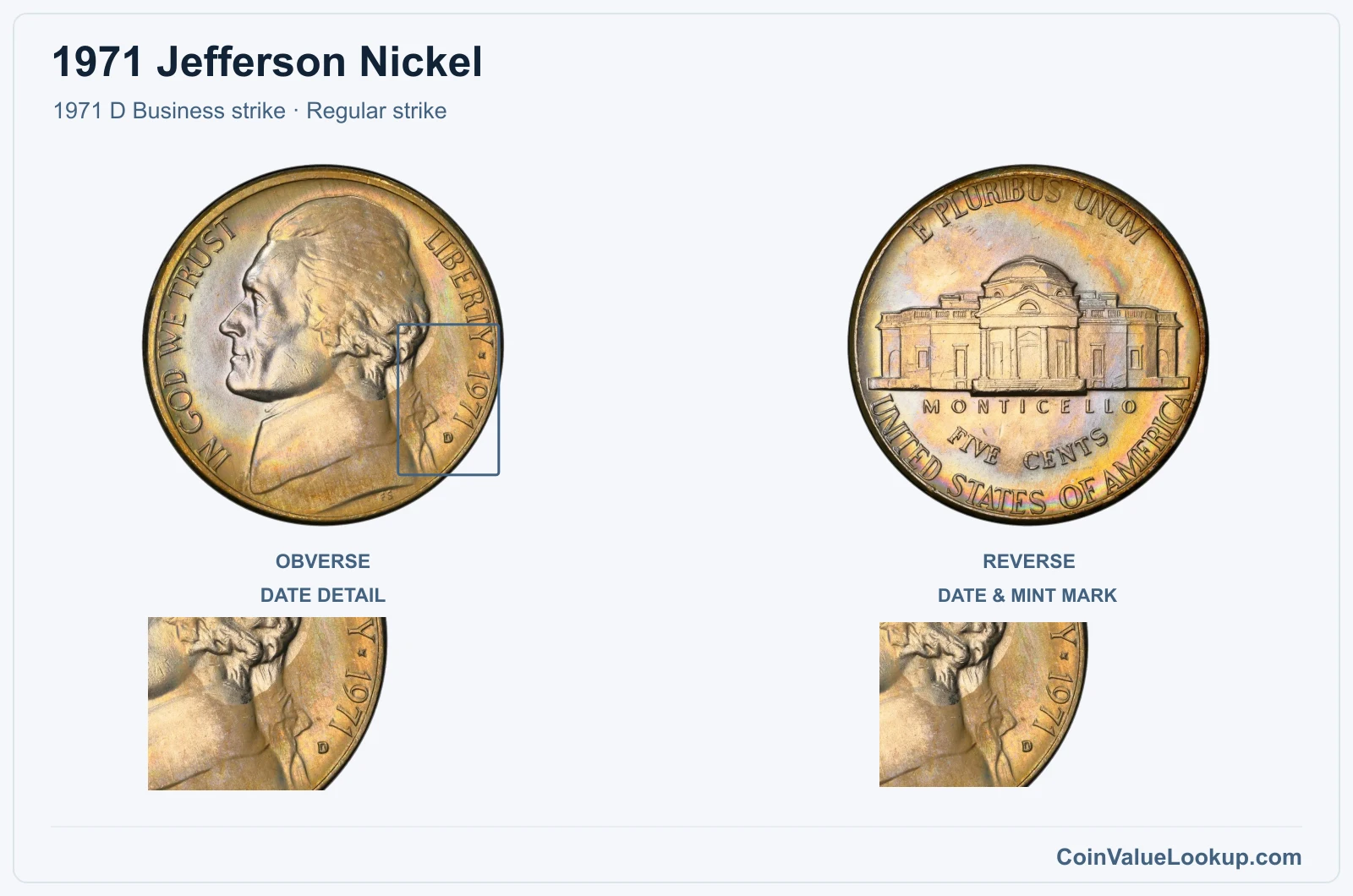
The 1971-D comes from the Denver Mint and carries a small "D" mintmark on the obverse, just below the date. Like the Philadelphia issue, this is a common business-strike coin that saw heavy circulation.
USA Coin Book guide estimates put this version at about $0.36 at MS60 and $3.62 at MS65. Those are uncirculated grades, so a worn coin from your change jar won't reach those figures.
As with the Philadelphia strike, Full Steps examples graded by a major service can be worth checking — strike quality varies from coin to coin.
Coin Value Lookup is a good starting point if you want to look up guides for other Jefferson nickel dates or denominations. It can help you compare values across years without hunting through multiple sources.
| Range | Grade | Price | Auction Records | Appraisal |
|---|---|---|---|---|
| PO | PO 1 | — | Coin Identifier | |
| FR | FR 2 | — | Coin Identifier | |
| AG | AG 3 | — | Coin Identifier | |
| G | G 4 | — | Coin Identifier | |
| G 6 | — | Coin Identifier | ||
| VG | VG 8 | — | Coin Identifier | |
| VG 10 | — | Coin Identifier | ||
| F | F 12 | — | Coin Identifier | |
| F 15 | — | Coin Identifier | ||
| VF | VF 20 | — | Coin Identifier | |
| VF 25 | — | Coin Identifier | ||
| VF 30 | — | Coin Identifier | ||
| VF 35 | — | Coin Identifier | ||
| XF | XF 40 | — | Coin Identifier | |
| XF 45 | — | Coin Identifier | ||
| AU | AU 50 | — | Coin Identifier | |
| AU 53 | — | Coin Identifier | ||
| AU 55 | — | Coin Identifier | ||
| AU 58 | — | Coin Identifier | ||
| MS | MS 60 | — | Coin Identifier | |
| MS 61 | — | Coin Identifier | ||
| MS 62 | — | Coin Identifier | ||
| MS 63 | Coin Identifier | |||
| MS 64 | — | Coin Identifier | ||
| MS 65 | Coin Identifier | |||
| MS 66 | Coin Identifier | |||
| MS 67 | Coin Identifier | |||
| MS 68 | — | — | — | |
| MS 69 | — | — | — | |
| MS 70 | — | — | — |
1971 Jefferson Nickel — S Proof
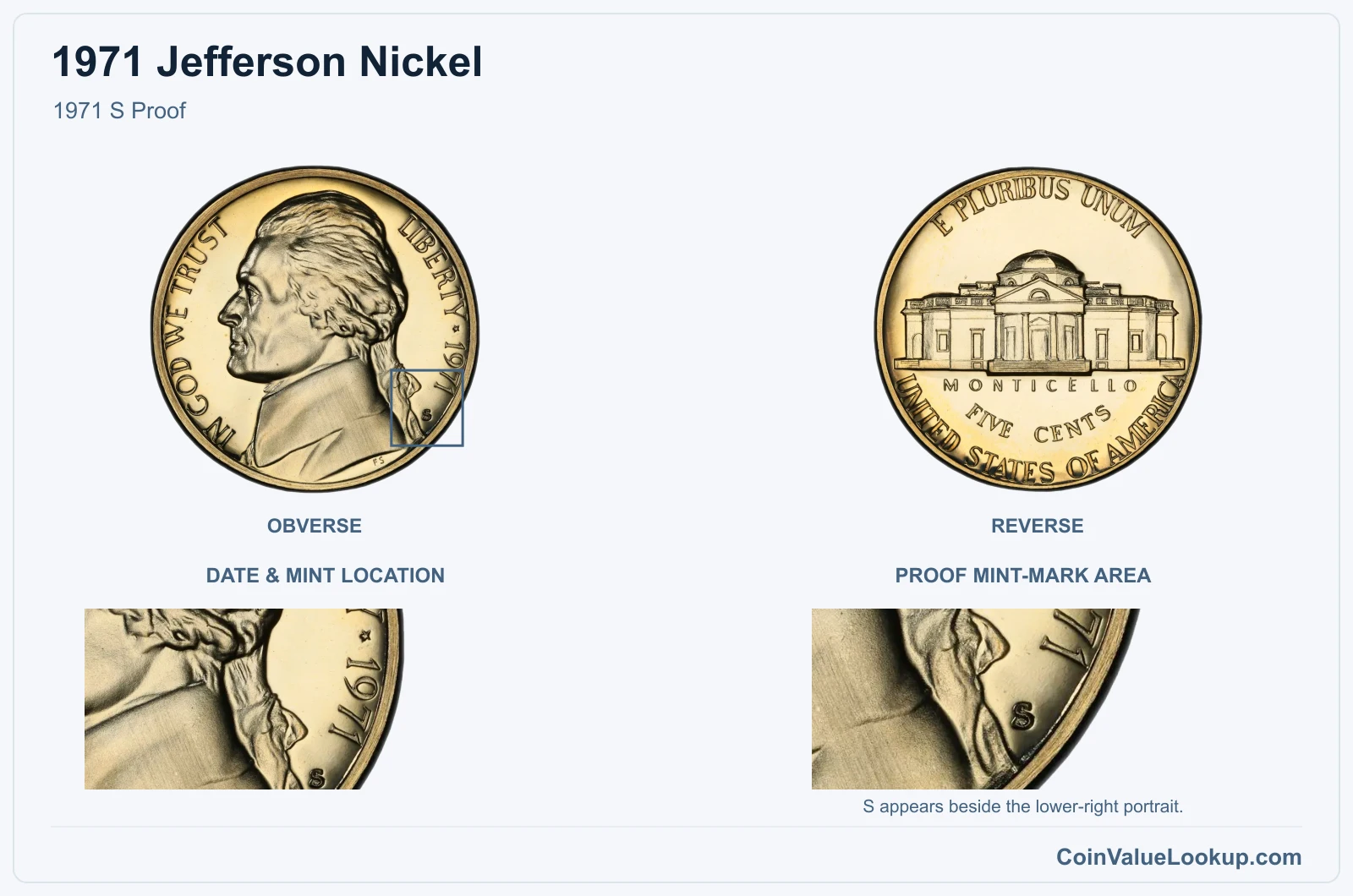
The 1971-S Proof was struck at the San Francisco Mint exclusively for collectors, sold in proof sets. You'll see an "S" mintmark below the date, and the surfaces should display the sharp, mirror-like fields characteristic of proof manufacture.
A USA Coin Book guide estimate places the base proof at about $3.08 at PR65. Coins with cameo or deep cameo contrast trade separately and at different values — the base figure does not apply to those finishes.
If your proof came from an original 1971 proof set and shows strong contrast between frosted devices and mirror fields, it may warrant individual evaluation by a grading service.
| Range | Grade | Price | Auction Records | Appraisal |
|---|---|---|---|---|
| PR | PR 1 | — | Coin Identifier | |
| PR 2 | — | Coin Identifier | ||
| PR 3 | — | Coin Identifier | ||
| PR 4 | — | Coin Identifier | ||
| PR 6 | — | Coin Identifier | ||
| PR 8 | — | Coin Identifier | ||
| PR 10 | — | Coin Identifier | ||
| PR 12 | — | Coin Identifier | ||
| PR 15 | — | Coin Identifier | ||
| PR 20 | — | Coin Identifier | ||
| PR 25 | — | Coin Identifier | ||
| PR 30 | — | Coin Identifier | ||
| PR 35 | — | Coin Identifier | ||
| PR 40 | — | Coin Identifier | ||
| PR 45 | — | Coin Identifier | ||
| PR 50 | — | Coin Identifier | ||
| PR 53 | — | Coin Identifier | ||
| PR 55 | — | Coin Identifier | ||
| PR 58 | — | Coin Identifier | ||
| PR 60 | — | Coin Identifier | ||
| PR 61 | — | Coin Identifier | ||
| PR 62 | — | Coin Identifier | ||
| PR 63 | — | Coin Identifier | ||
| PR 64 | Coin Identifier | |||
| PR 65 | — | Coin Identifier | ||
| PR 66 | Coin Identifier | |||
| PR 67 | Coin Identifier | |||
| PR 68 | Coin Identifier | |||
| PR 69 | Coin Identifier | |||
| PR 70 | — | — | — |
1971 Jefferson Nickel — San Francisco;S omitted Proof
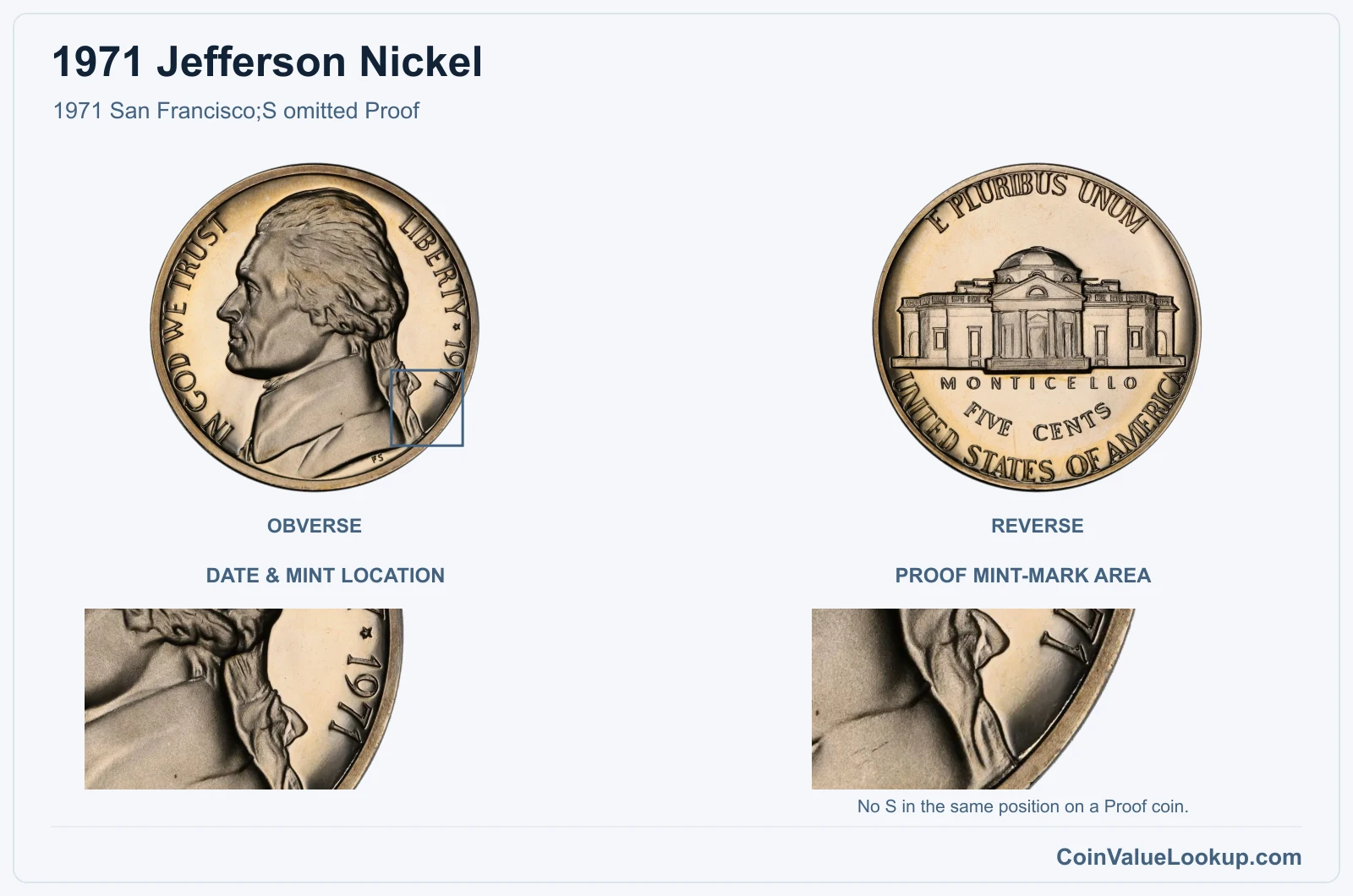
This is the famous 1971 No S Proof — a San Francisco proof nickel struck from a die that was never punched with the "S" mintmark. It is genuinely rare and genuinely valuable.
A USA Coin Book guide estimate places it around $1,345 at PR65.
Here is the critical distinction: every Philadelphia business-strike 1971 nickel also lacks a mintmark. That is completely normal and not valuable.
The No S Proof must show proof manufacturing characteristics — mirror fields, sharp squared-off rims, and the overall appearance of a coin that was never meant for circulation. If your coin looks like it came from a cash register, it is almost certainly an ordinary Philadelphia strike worth a few cents.
Authentication by a major grading service is essential. Any coin where the mintmark area shows tooling marks, unusual surface texture, or evidence of removal is not a No S Proof — it is an altered coin.
Legitimate examples came from 1971 proof sets and were discovered by collectors who noticed the missing mark.
| Range | Grade | Price | Auction Records | Appraisal |
|---|---|---|---|---|
| PR | PR 1 | — | Coin Identifier | |
| PR 2 | — | Coin Identifier | ||
| PR 3 | — | Coin Identifier | ||
| PR 4 | — | Coin Identifier | ||
| PR 6 | — | Coin Identifier | ||
| PR 8 | — | Coin Identifier | ||
| PR 10 | — | Coin Identifier | ||
| PR 12 | — | Coin Identifier | ||
| PR 15 | — | Coin Identifier | ||
| PR 20 | — | Coin Identifier | ||
| PR 25 | — | Coin Identifier | ||
| PR 30 | — | Coin Identifier | ||
| PR 35 | — | Coin Identifier | ||
| PR 40 | — | Coin Identifier | ||
| PR 45 | — | Coin Identifier | ||
| PR 50 | — | Coin Identifier | ||
| PR 53 | — | Coin Identifier | ||
| PR 55 | — | Coin Identifier | ||
| PR 58 | — | Coin Identifier | ||
| PR 60 | — | Coin Identifier | ||
| PR 61 | — | Coin Identifier | ||
| PR 62 | — | Coin Identifier | ||
| PR 63 | — | Coin Identifier | ||
| PR 64 | — | Coin Identifier | ||
| PR 65 | Coin Identifier | |||
| PR 66 | Coin Identifier | |||
| PR 67 | Coin Identifier | |||
| PR 68 | Coin Identifier | |||
| PR 69 | Coin Identifier | |||
| PR 70 | — | — | — |
1971 Jefferson Nickel Error List
1. 1971 Jefferson Nickel — Missing S on proof
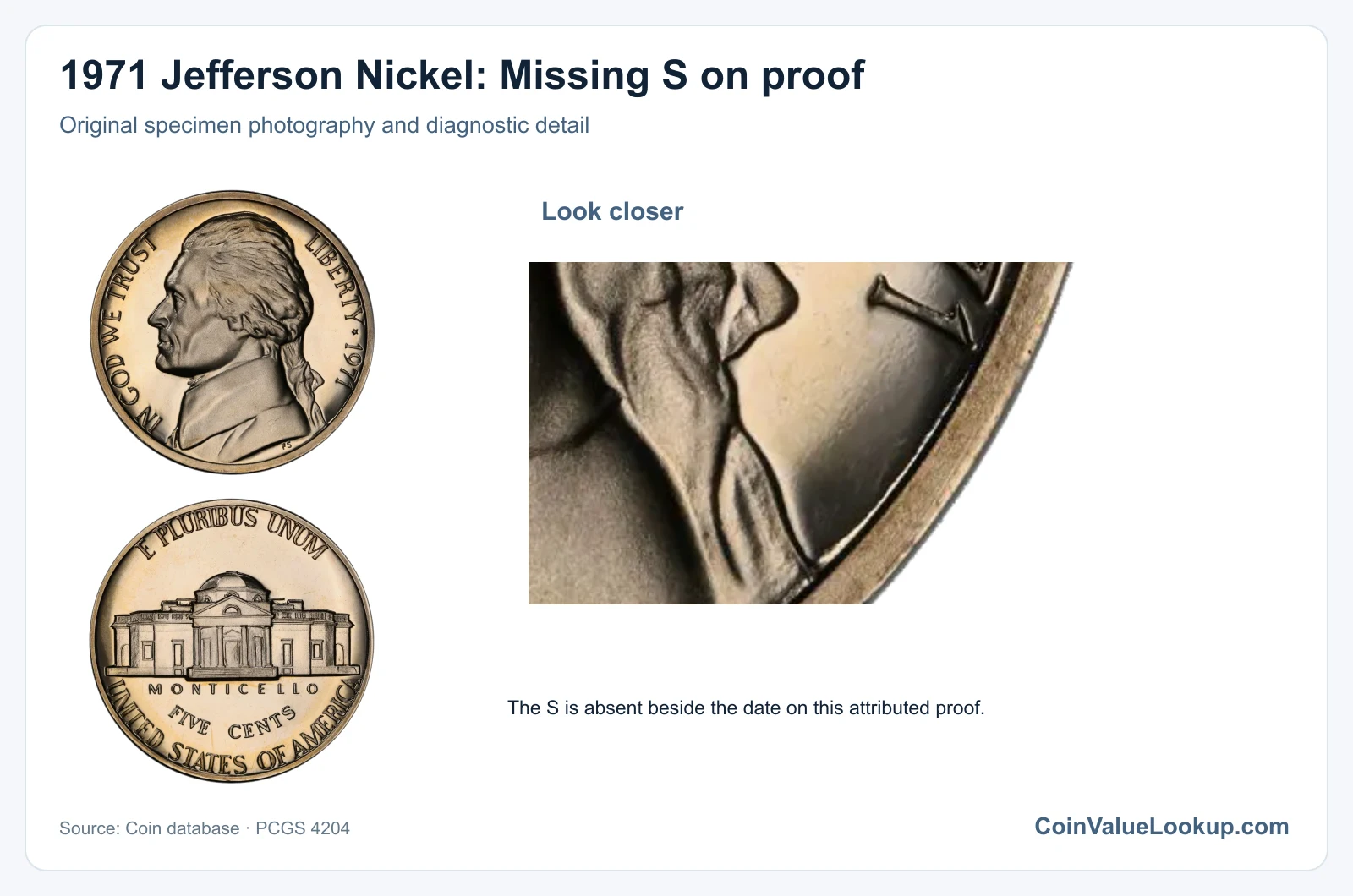
The 1971 No S Proof is a San Francisco proof nickel where the mintmark was omitted from the die. The coin must display mirror proof fields and sharp proof manufacturing traits — not just a missing mintmark.
Every normal 1971 Philadelphia nickel also lacks a mintmark, so the absence alone means nothing.
To distinguish a real No S Proof from a common Philadelphia coin, look for highly reflective surfaces, squared-off rims, and the overall precision of proof striking. Also watch for fakes: a regular proof with the "S" filed or scraped away will show disturbed metal, scratches, or a shallow depression in the mintmark area.
These are altered coins, not mint errors.
Guide estimates place this variety at about $1,345 in PR65. Professional authentication is necessary — no photo-based check replaces a third-party grading service for confirming proof origin and an unaltered surface.
2. 1971 Jefferson Nickel — Cracked planchet
A cracked planchet error occurs when the blank metal disc fractures before or during striking. The crack runs through the coin and shows original metal texture along its edges, distinguishing it from a cut, scratch, or a coin that was bent and snapped after leaving the mint.
On a post-strike break, you will typically see sharp, unnatural edges or damage that interrupts the design without the telltale original-surface texture inside the fracture. A genuine cracked planchet will show the design impressed across both sides of the crack, confirming the break existed before or during the strike.
A Heritage Auctions sale in October 2022 saw one 1971 Jefferson nickel with this error, graded NGC AU58, bring $46. That is a single recorded result, not a guaranteed market price for every cracked-planchet nickel.
3. 1971 Jefferson Nickel — Off-center on clad dime blank
This is a combined error: a 1971 Jefferson nickel die struck a clad dime-sized blank, and the strike landed roughly 45% off center. The result is a small coin — noticeably thinner and narrower than a normal nickel — with a partial Jefferson nickel design displaced well away from center.
To identify this error, check for the smaller diameter and clad composition of a dime planchet combined with the nickel's design elements. Enough of the date must be visible to confirm the 1971 attribution.
An ordinary off-center nickel struck on the correct blank, or a nickel that has been trimmed down after the fact, will not match the size and weight profile of a dime planchet.
A Heritage Auctions example graded PCGS MS63 sold for $480 in October 2022. That price reflects the combined rarity of both the wrong planchet and the dramatic off-center strike.
4. 1971 Jefferson Nickel — Triple strike
A triple-struck 1971-D Jefferson nickel shows three distinct impressions. The first strike lands normally, then the coin shifts between subsequent strikes, producing strongly offset overlapping designs.
On the example recorded, the final reverse impression was blocked, adding to the visual complexity.
Do not confuse this with machine doubling, which produces flat, shelf-like outlines close to the original design and carries almost no premium. A genuine triple strike shows bold, fully separated impressions at different angles — it is obvious even without magnification.
Also rule out vise jobs, where someone deliberately re-strikes a coin outside the mint using another coin as a die.
A Heritage Auctions sale in February 2005 recorded a 1971-D triple-struck nickel graded PCGS MS64 at $97.75. That is one auction result, not a broad value range for every multi-strike nickel.