1971 Roosevelt Dime Coin Value: How Much Is It Worth?
Most 1971 Roosevelt dimes you pull from a jar are worth face value — ten cents, no more. In uncirculated condition the numbers climb a bit: a USA Coin Book guide estimate places an MS 65 Philadelphia coin around $3.62 and a Denver piece near $3.08.
Normal S proofs sit around $2.50 at PR 65. The real action is in authenticated mint errors and properly designated strike varieties, which can push values considerably higher.
Fast Way to Identify Your 1971 Roosevelt Dime
Snap a clear photo of both sides of your 1971 dime and upload them here for a preliminary identification. The tool can help you figure out the mint, finish and general condition so you know which branch of the value chart applies.
It is not a substitute for professional authentication or precise grading, but it gives you a solid starting point.
1971 Roosevelt Dime Value
Upload both sides of your 1971 Roosevelt Dime.
Front Obverse
Upload photo
Back Reverse
Upload photo
Which 1971 Roosevelt Dime Versions Are Worth Money?
- Philadelphia and Denver business strikes in MS 65 or better with strong, fully separated torch bands can carry a modest premium over typical uncirculated examples.
- S proofs with clean, undisturbed mirror fields and genuine cameo contrast between frosted devices and reflective backgrounds deserve closer inspection.
- A 1971-D elliptical clipped planchet graded MS 63 sold for $460 in July 2002 — authentication is essential before assuming any clip is genuine.
- A 1971-D partial missing obverse clad layer graded MS 65 brought $186 in December 2022 — weight and edge examination help confirm this error.
- A 1971-D partial obverse brockage has been certified; value depends on the severity and condition of the specific piece, assessed individually.
Step 1: Identify Your 1971 Roosevelt Dime Mint Mark and Version
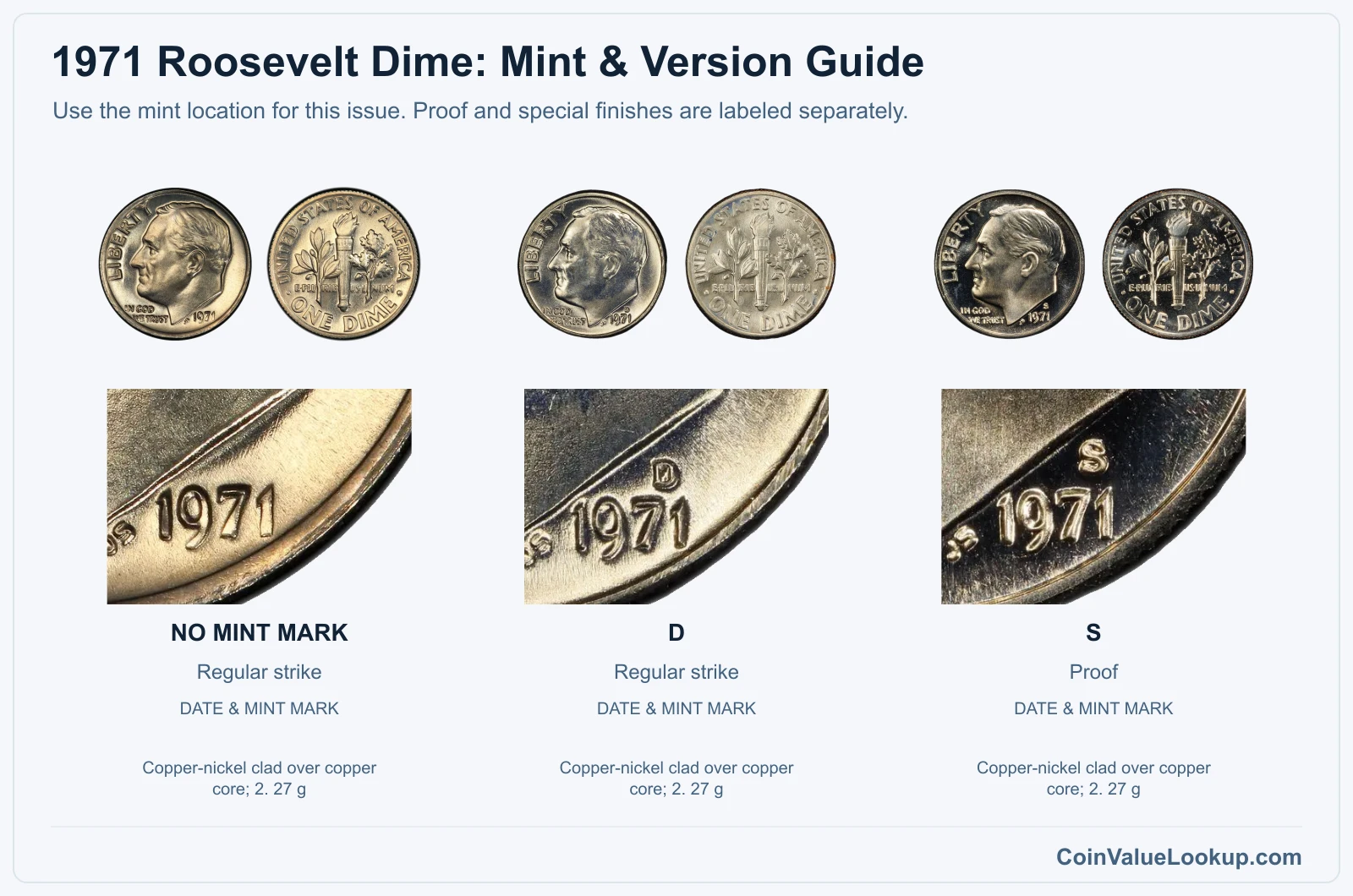
Start with the basics: confirm a 1971 date, Roosevelt's portrait on the obverse, and the torch-and-branches reverse. That part is easy.
Next, check for a mintmark. Philadelphia coins carry no mintmark at all.
Denver strikes show a small D on the obverse near the date. An S mintmark indicates a San Francisco proof — these were struck as proofs, not business coins.
All normal 1971 dimes are copper-nickel clad, weighing about 2.27 grams with a diameter around 17.9 mm. There is no silver version for this date.
If your coin looks coppery on the edge, that is the normal copper core showing through, not a sign of a different metal.
No normal "No S" proof variety is recognized for the 1971 dime. If someone claims otherwise, ask for third-party certification before paying a premium.
Step 2: Check Your 1971 Roosevelt Dime Grade
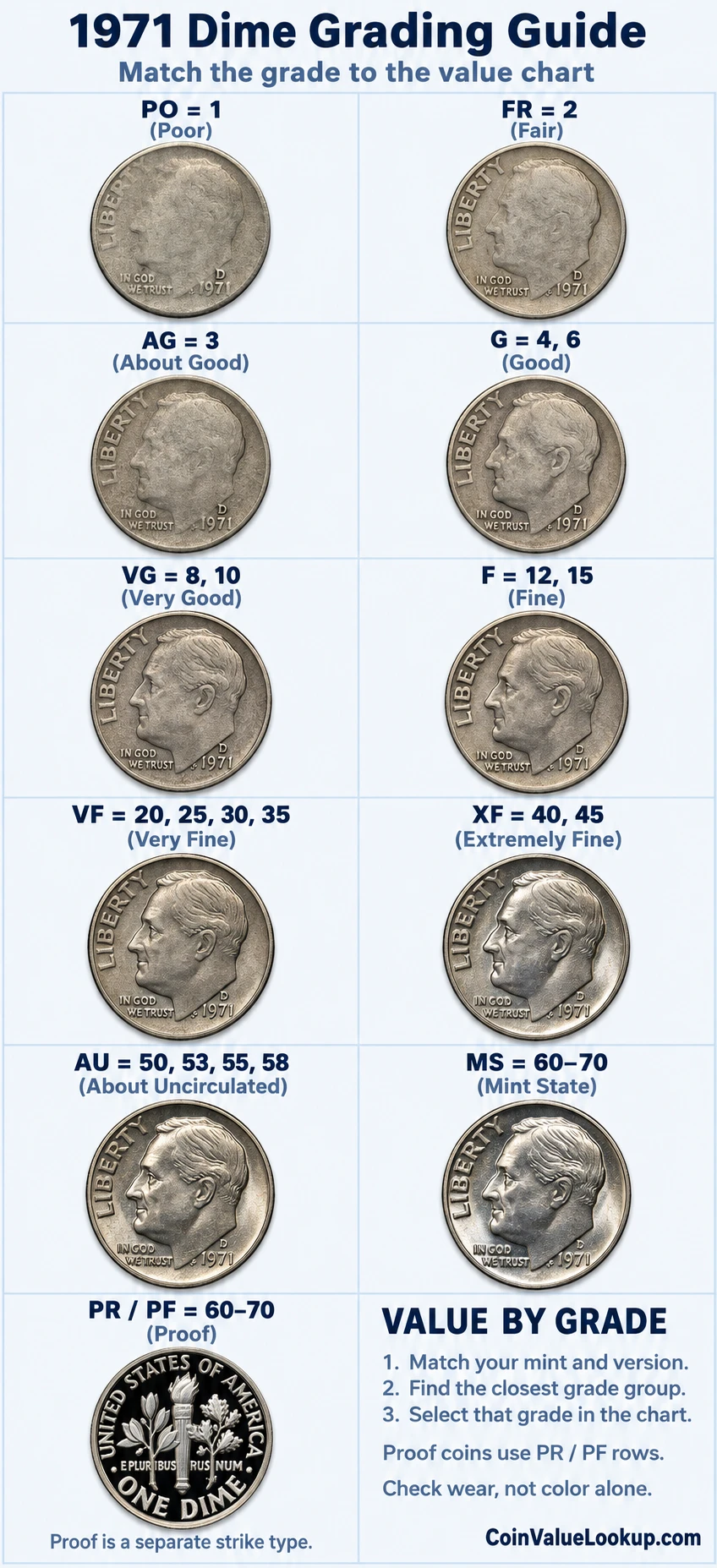
Focus on Roosevelt's cheek and jawline first — that is where wear appears earliest. Then check the hair detail above the ear.
On the reverse, inspect the torch lines and the leaf details on each branch.
A coin that still has full original luster across both sides with no contact marks visible to the naked eye is solidly uncirculated. Do not confuse a weakly struck area with actual wear; a weak strike looks mushy but keeps its luster, while wear creates flat, shiny spots where the metal has been rubbed.
Scratches, cleaning and corrosion all drag a coin's grade down regardless of how sharp the design looks. Use the comparison image to match your coin's surfaces against known grade benchmarks.
Remember that "proof" describes how the coin was made — mirror fields, frosted devices, struck multiple times on polished dies — not a grade higher than Mint State. Proof coins get their own PR scale and should be evaluated for hairlines, haze and contact marks on those mirror surfaces.
Step 3: Check 1971 Roosevelt Dime Value by Mint and Version
1971 Roosevelt Dime — No Mintmark Business Strike
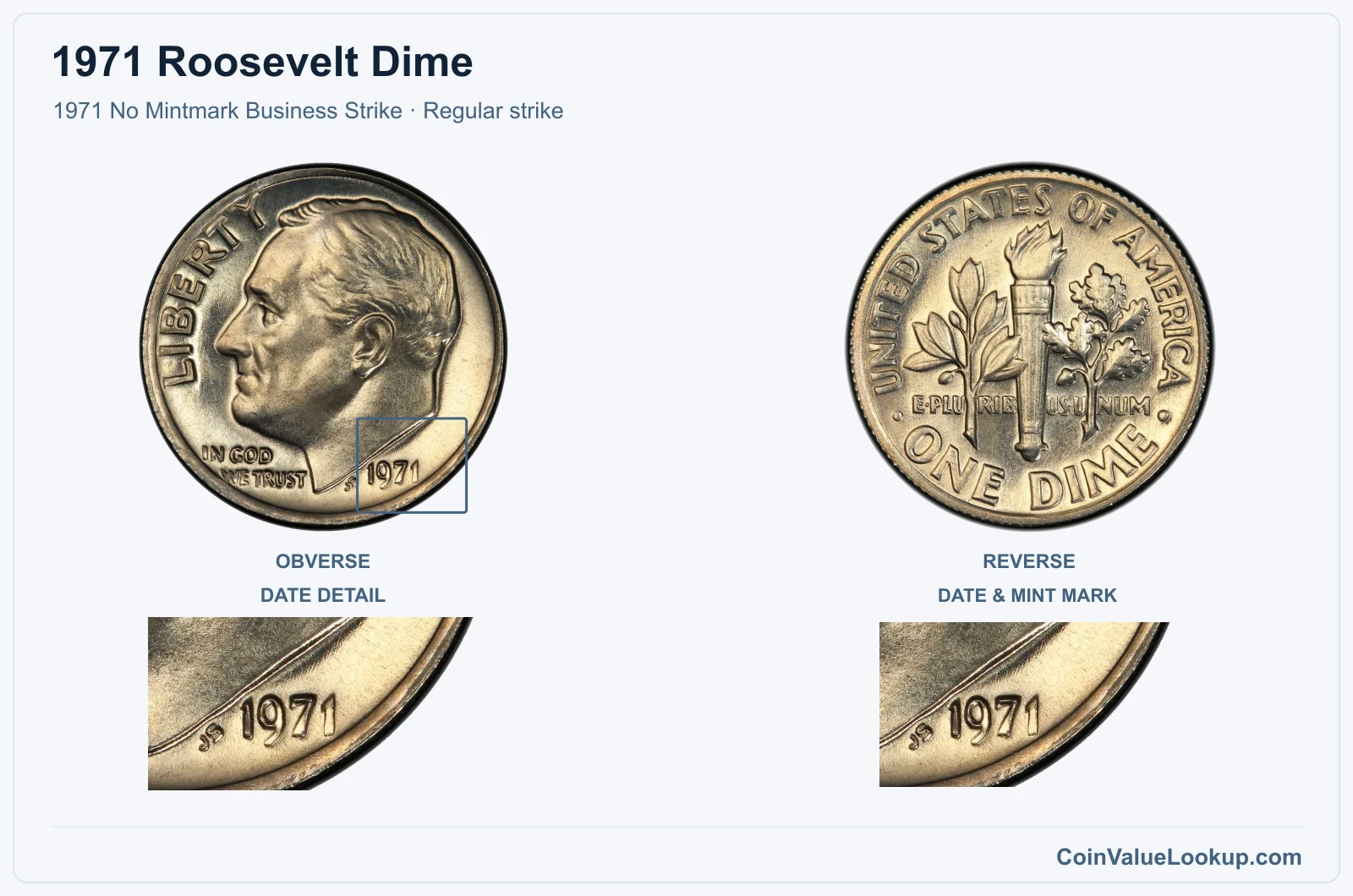
The 1971 Philadelphia dime has no mintmark — look at the obverse near the date and you should see bare field. It is a copper-nickel clad coin weighing about 2.27 grams.
Circulated examples are worth face value. The USA Coin Book guide places an MS 65 example at roughly $3.62.
If you are chasing the "Full Bands" designation, both horizontal pairs on the torch must show clear separation. That is a strike quality designation, not an error, and matching it to a certified example matters before claiming the premium.
Coin Value Lookup is a handy place to look up guides for other Roosevelt dime dates and denominations when you are working through a collection.
Range Grade
Price Auction Records Appraisal PO PO 1
—
Coin Identifier FR FR 2
—
Coin Identifier AG AG 3
—
Coin Identifier G G 4
—
Coin Identifier
G 6
—
Coin Identifier VG VG 8
—
Coin Identifier
VG 10
—
Coin Identifier F F 12
—
Coin Identifier
F 15
—
Coin Identifier VF VF 20
—
Coin Identifier
VF 25
—
Coin Identifier
VF 30
—
Coin Identifier
VF 35
—
Coin Identifier XF XF 40
—
Coin Identifier
XF 45
—
Coin Identifier AU AU 50
—
Coin Identifier
AU 53
—
Coin Identifier
AU 55
—
Coin Identifier
AU 58
—
Coin Identifier MS MS 60
—
Coin Identifier
MS 61
—
Coin Identifier
MS 62
—
Coin Identifier
MS 63
—
Coin Identifier
MS 64
Coin Identifier
MS 65
Coin Identifier
MS 66
Coin Identifier
MS 67
—
Coin Identifier
MS 68
—
—
—
MS 69
—
—
—
MS 70
—
—
—
1971 Roosevelt Dime — D Business Strike
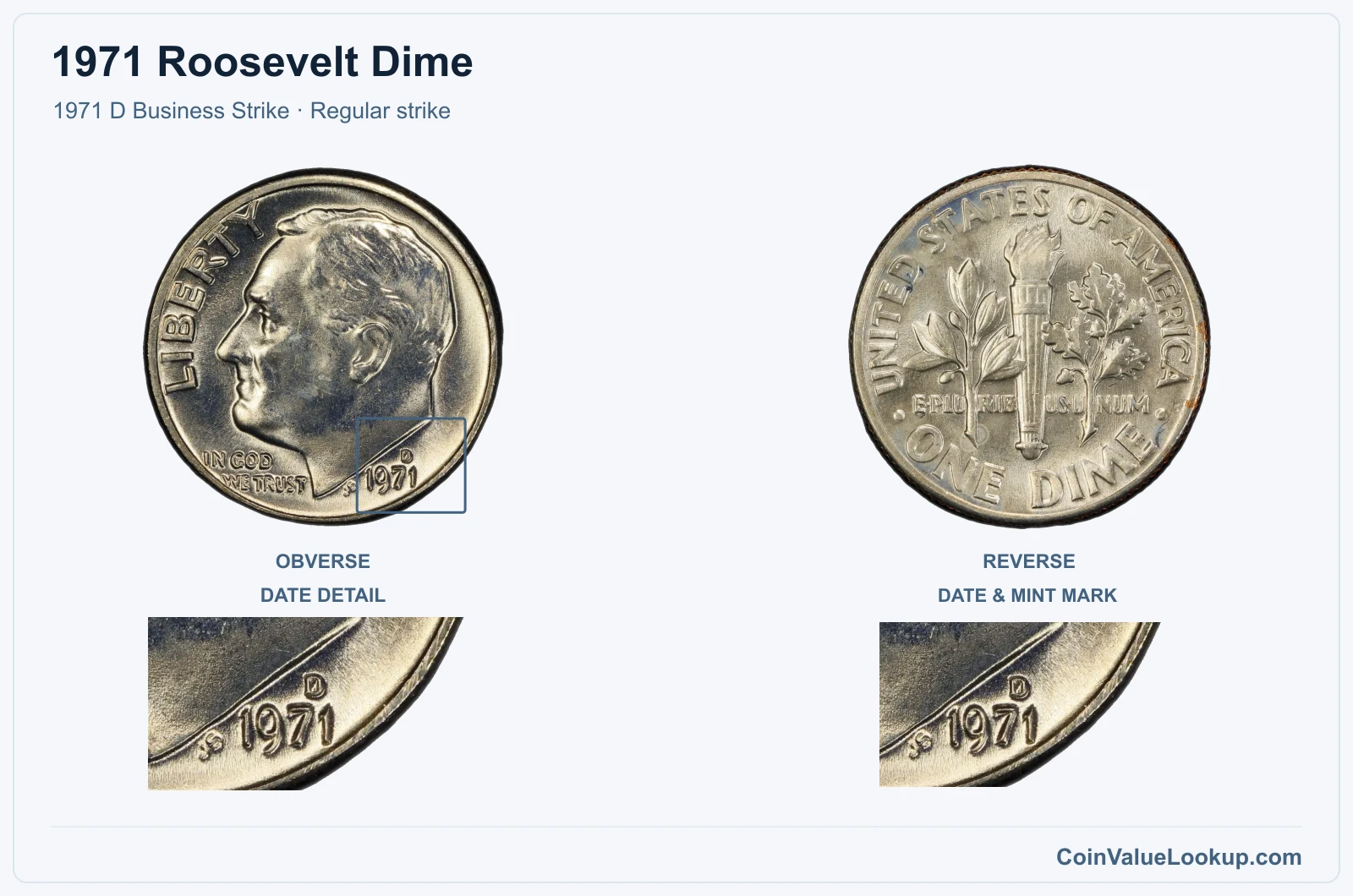
Denver strikes carry a small D mintmark on the obverse near the date. Same clad composition, same 2.27-gram weight as Philadelphia.
In worn condition these are face-value coins.
At MS 65 the USA Coin Book guide estimate is about $3.08 — slightly below the Philadelphia issue at the same grade. Full Bands designation can add a premium when both horizontal torch-band pairs are fully separated, but that needs matched, certified comparison to confirm.
Denver 1971 dimes are common in circulated grades, so the hunt is really for well-preserved uncirculated pieces or authenticated errors.
Range Grade
Price Auction Records Appraisal PO PO 1
—
Coin Identifier FR FR 2
—
Coin Identifier AG AG 3
—
Coin Identifier G G 4
—
Coin Identifier
G 6
—
Coin Identifier VG VG 8
—
Coin Identifier
VG 10
—
Coin Identifier F F 12
—
Coin Identifier
F 15
—
Coin Identifier VF VF 20
—
Coin Identifier
VF 25
—
Coin Identifier
VF 30
—
Coin Identifier
VF 35
—
Coin Identifier XF XF 40
—
Coin Identifier
XF 45
—
Coin Identifier AU AU 50
—
Coin Identifier
AU 53
—
Coin Identifier
AU 55
—
Coin Identifier
AU 58
—
Coin Identifier MS MS 60
—
Coin Identifier
MS 61
—
Coin Identifier
MS 62
—
Coin Identifier
MS 63
Coin Identifier
MS 64
Coin Identifier
MS 65
Coin Identifier
MS 66
Coin Identifier
MS 67
Coin Identifier
MS 68
—
—
—
MS 69
—
—
—
MS 70
—
—
—
1971 Roosevelt Dime — S Proof
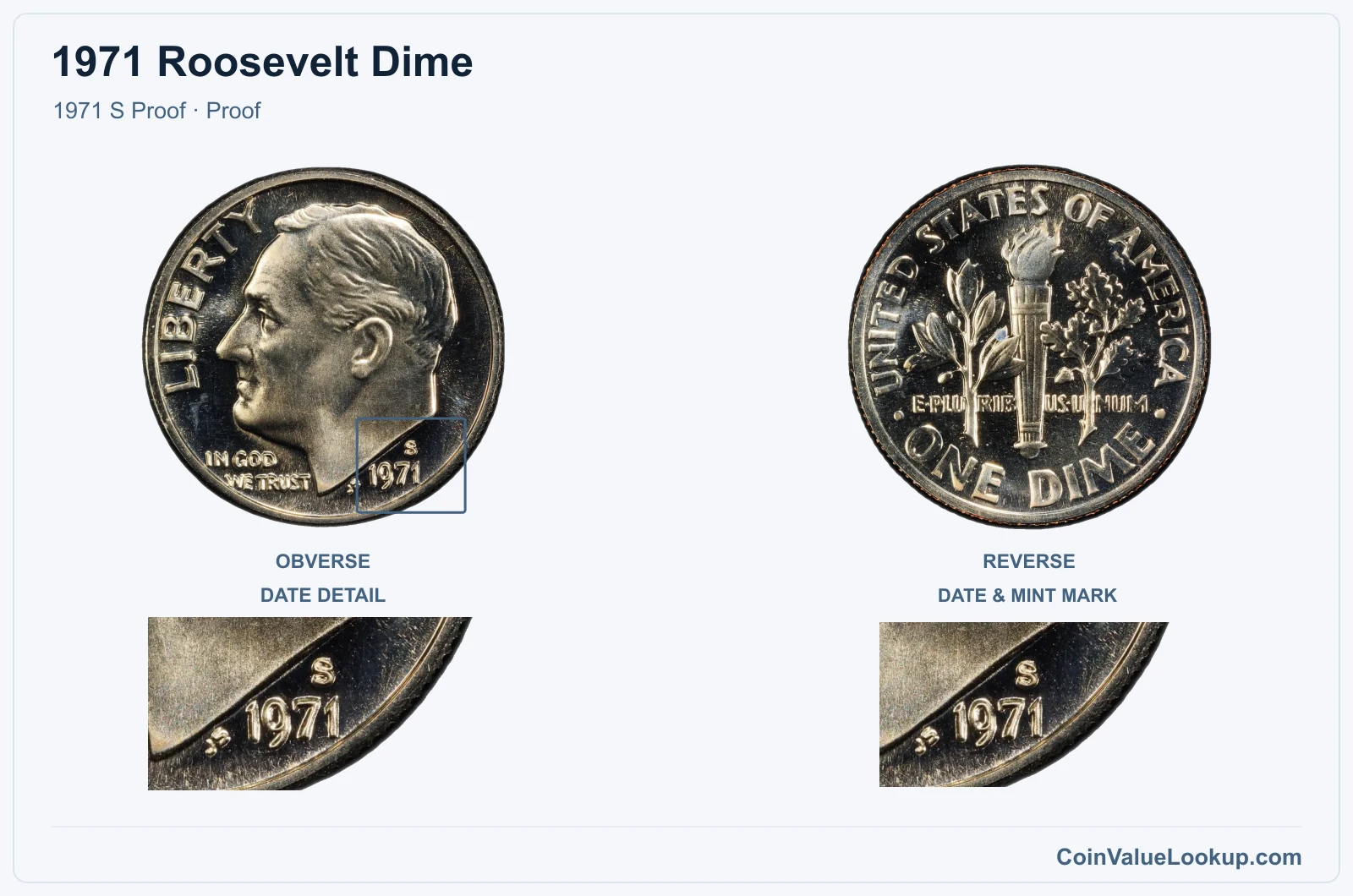
San Francisco struck proof dimes carry an S mintmark on the obverse. These were made for collectors using polished dies and planchets, resulting in mirror-like fields and sharply defined devices.
The composition is still copper-nickel clad at about 2.27 grams — no silver proofs were produced for the Roosevelt dime series during this period.
A PR 65 normal proof is estimated around $2.50 by USA Coin Book. Coins with genuine cameo contrast — frosted raised design elements against deeply mirrored fields — can command higher prices, but that contrast must be real and consistent, not the result of haze or toning masking the fields.
Evaluate proof surfaces for hairlines and contact marks rather than the cheek-wear tests used on business strikes.
Range Grade
Price Auction Records Appraisal PR PR 1
—
Coin Identifier
PR 2
—
Coin Identifier
PR 3
—
Coin Identifier
PR 4
—
Coin Identifier
PR 6
—
Coin Identifier
PR 8
—
Coin Identifier
PR 10
—
Coin Identifier
PR 12
—
Coin Identifier
PR 15
—
Coin Identifier
PR 20
—
Coin Identifier
PR 25
—
Coin Identifier
PR 30
—
Coin Identifier
PR 35
—
Coin Identifier
PR 40
—
Coin Identifier
PR 45
—
Coin Identifier
PR 50
—
Coin Identifier
PR 53
—
Coin Identifier
PR 55
—
Coin Identifier
PR 58
—
Coin Identifier
PR 60
—
Coin Identifier
PR 61
—
Coin Identifier
PR 62
—
Coin Identifier
PR 63
—
Coin Identifier
PR 64
—
Coin Identifier
PR 65
—
Coin Identifier
PR 66
Coin Identifier
PR 67
Coin Identifier
PR 68
Coin Identifier
PR 69
Coin Identifier
PR 70
—
—
—
1971 Roosevelt Dime Error List
1. 1971 Roosevelt Dime — Elliptical Clipped Planchet
An elliptical clipped planchet means the blank was incompletely punched from the metal strip, producing an oval or elongated shape that omits part of the normal design. On the cited 1971-D specimen, the lower obverse and upper reverse retain their design while the clipped area shows a curved absence of metal.
A PCGS MS 63 example sold for $460 in July 2002, though a reverse scrape was noted on that particular coin. That sale is one documented result, not a guaranteed market range.
Watch out for post-mint imitations: a coin that was squeezed, ground or cut into an oval after leaving the mint will lack the characteristic Blakesley effect and natural metal-flow distortion around the clip. Third-party authentication is the safest way to confirm a genuine clip.
2. 1971 Roosevelt Dime — Partial Missing Obverse Clad Layer
A partial missing obverse clad layer occurs when part of the outer copper-nickel layer is absent from the obverse before striking. The result is an exposed copper area with a visible boundary where the surviving clad layer ends.
The cited 1971-D specimen weighed only 1.8 grams — well below the normal 2.27 grams — and was certified MS 65 by NGC.
That coin sold for $186 in December 2022. This is one recorded sale, not a broad market value.
Environmental discoloration can turn a dime coppery, and deliberate chemical stripping can remove plating. The key difference is the sharp, natural boundary line on a genuine missing-layer coin and the corresponding weight loss.
If your dime just looks brownish all over, that is almost certainly damage, not a mint error.
3. 1971 Roosevelt Dime — Partial Obverse Brockage
A partial obverse brockage happens when a previously struck coin sticks to the upper die and impresses its design — reversed and incuse — into the next coin fed through the press. Part of the new coin shows normal 1971-D detail while the brockage area carries a sunken, mirror-image impression of the obverse.
A certified example exists: Heritage Auctions listed a 1971-D partial obverse brockage graded MS 64 by NGC. No specific sale price is available for this piece, so value depends on the severity of the impression, overall condition, and how much of the normal design survives.
Individual assessment by a grading service is the practical path to establishing worth.
Do not confuse a brockage with a die clash, which leaves faint outlines but no incuse relief, or a vise-job fake where someone squeezed two coins together outside the mint.
4. 1971 Roosevelt Dime — Off-Center Strike
An off-center strike occurs when the planchet is not properly seated in the collar before the dies come together, shifting the entire design to one side and leaving an unstruck crescent of blank metal. On a 1971 dime, the key question is whether the date remains visible — collectors pay far more when it does.
The degree of off-center shift, overall condition and date visibility all affect value, but no specific price range is adopted here. Each off-center coin is essentially unique in its displacement percentage.
Be careful not to confuse a clipped planchet edge with an off-center strike. A clip removes part of the blank before striking, while off-center means the whole blank was misaligned.
Post-mint flattening or damage can also mimic an off-center look but will lack the characteristic unstruck crescent with natural planchet texture.
5. 1971 Roosevelt Dime — Broadstrike
A broadstrike happens when the retaining collar fails to surround the planchet during striking. Without that collar, metal flows outward freely, producing a coin that is wider than normal with a distorted or absent rim.
The design is still centered — that is what separates a broadstrike from an off-center strike.
For 1971 dimes, condition and the degree of spread determine value, but no specific price range is adopted. Examine the edge profile: a genuine broadstrike has a smooth, expanded edge rather than the normal reeded edge of a dime.
Coins flattened after minting — by a train, a hammer, or sheer boredom — can look spread out, but they will show surface distortion and smeared detail rather than the crisp strike a genuine broadstrike retains.
6. 1971 Roosevelt Dime — Wrong Planchet / Off-Metal Strike
A wrong-planchet error means the 1971 dime dies struck a blank intended for a different denomination or coin series. The result is a coin that looks like a dime in design but feels wrong in hand — wrong weight, wrong diameter, possibly incomplete design coverage if the blank was smaller.
No specific price is adopted, and value depends entirely on which planchet was used, condition, and how complete the dime design appears on the foreign blank. Compare your coin's measured weight and diameter against the normal 2.27 grams and 17.9 mm.
Plating loss, corrosion, acid-treated thinning and deliberate alteration can all make a normal dime seem unusual in weight or appearance. Professional authentication is the only reliable way to confirm a genuine wrong-planchet strike.
7. 1971 Roosevelt Dime — Repunched Mintmark
A repunched mintmark on the 1971-D dime shows remnants of a second D punch position near the primary mintmark. The reported variety is cataloged as a 1971-D issue.
Under magnification, look for a ghost image, notch, or partial second letter overlapping or offset from the main D.
No specific price range is adopted for this variety. Condition, clarity of the repunching and collector demand for the particular punch position all factor into what someone might pay.
Machine doubling can create a shelf-like shadow near the mintmark that looks similar at first glance, but it lacks the rounded, distinct secondary impression of a true repunched mark. Die chips and corrosion around the mintmark area can also fool you.
Compare at consistent magnification against a known normal 1971-D mintmark.
8. 1971 Roosevelt Dime — Struck-Through Error
A struck-through error occurs when foreign material — grease, a metal fragment, cloth fiber or other debris — sits between the die and the planchet during striking. The result is a localized depression or incomplete area in the design where the obstruction blocked full impression.
Grease-filled dies are the most commonly reported version on 1971 dimes, producing smooth, slightly sunken patches that lack detail. A retained foreign object, by contrast, may leave a distinct impression or outline of whatever was trapped.
No specific price range is adopted. The size, location, and type of struck-through feature all affect what a collector might offer.
Ordinary wear, cleaning scratches, and weak strikes can all mimic a struck-through look, so compare the suspicious area against normal design detail on the same coin. A genuine struck-through will have a consistent, depressed surface rather than the gradual fading of simple wear.
9. 1971 Roosevelt Dime — Doubled Die
A doubled die on a 1971 dime shows consistent design separation or notching on affected elements — letters, numerals, or design features appear to have a second, slightly offset image built into the die itself. This is different from machine doubling, which produces flat, shelf-like distortion without the raised, distinct secondary profile.
No specific price range is adopted for this variety. Value depends on which elements are doubled, how dramatic the separation is, and the coin's overall condition.
To check, compare the suspected area directly against a normal 1971 dime at the same magnification. Genuine die doubling will be consistent on every struck coin from that die, with the same direction and spread on each affected element.
Reflections, post-mint contact marks and strike-through impressions can create confusing look-alikes, so a side-by-side comparison with a known normal coin is your best first step.