1902 Barber Dime Coin Value: How Much Is It Worth?
A 1902 Barber Dime in circulated condition starts around $12.26 at G4 for a Philadelphia strike, while the San Francisco issue can reach about $967 at MS63. Three business-strike mints and a proof version exist for this date.
Your coin's actual value depends on which mint produced it, its condition, and whether any striking errors are present.
Fast Way to Identify Your 1902 Barber Dime
The quickest way to start figuring out what you have is to upload clear photos of both sides of your coin. Front and back images let us provide a preliminary identification of your mint, approximate condition, and version.
Snap them in good light, keep the coin flat, and avoid glare from plastic holders.
1902 Barber Dime Value
Upload both sides of your 1902 Barber Dime.
Front Obverse
Upload photo
Back Reverse
Upload photo
Which 1902 Barber Dime Versions Are Worth Money?
- The San Francisco "S" mint issue commands the highest guide values among business strikes, listed at about $25 in G4 and $967 at MS63.
- The New Orleans "O" mint follows, with guide values of roughly $15 at G4 and $933 at MS63, though soft strikes can complicate grading.
- Philadelphia proofs in PR63 are listed around $616; cameo contrast on later Barber proofs (after 1901) tends to be weak, so strong contrast examples may stand apart.
- Broadstrike errors have been documented for the 1902 date and can carry a premium depending on visibility and condition.
Step 1: Identify Your 1902 Barber Dime Mint Mark and Version
The 1902 Barber Dime shows Charles Barber's right-facing Liberty head on the front, wearing a Phrygian cap over a laurel wreath. The reverse reads ONE DIME inside a cereal wreath tied with a ribbon bow at the bottom.
Don't confuse it with Mercury dimes or half dimes — they're completely different designs.
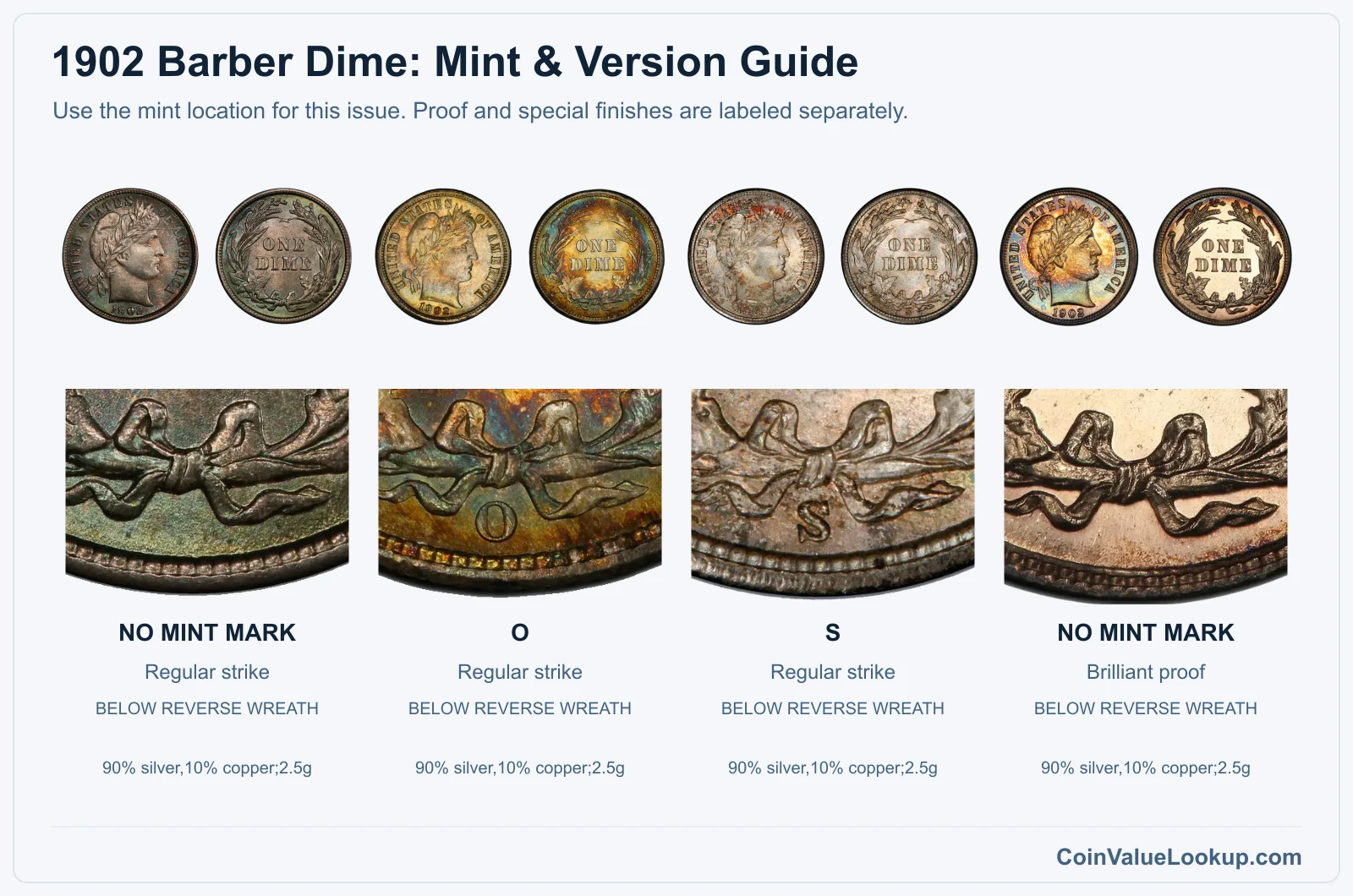
Your mintmark sits just below the wreath bow on the reverse. No letter means Philadelphia.
An "O" means New Orleans, and an "S" means San Francisco. You may need a magnifying glass; a century of wear can make that tiny letter hard to spot.
All standard 1902 Barber Dimes are 90% silver and 10% copper, weighing 2.5 grams with a diameter of 17.9 mm and a reeded edge. Proofs were struck only at Philadelphia.
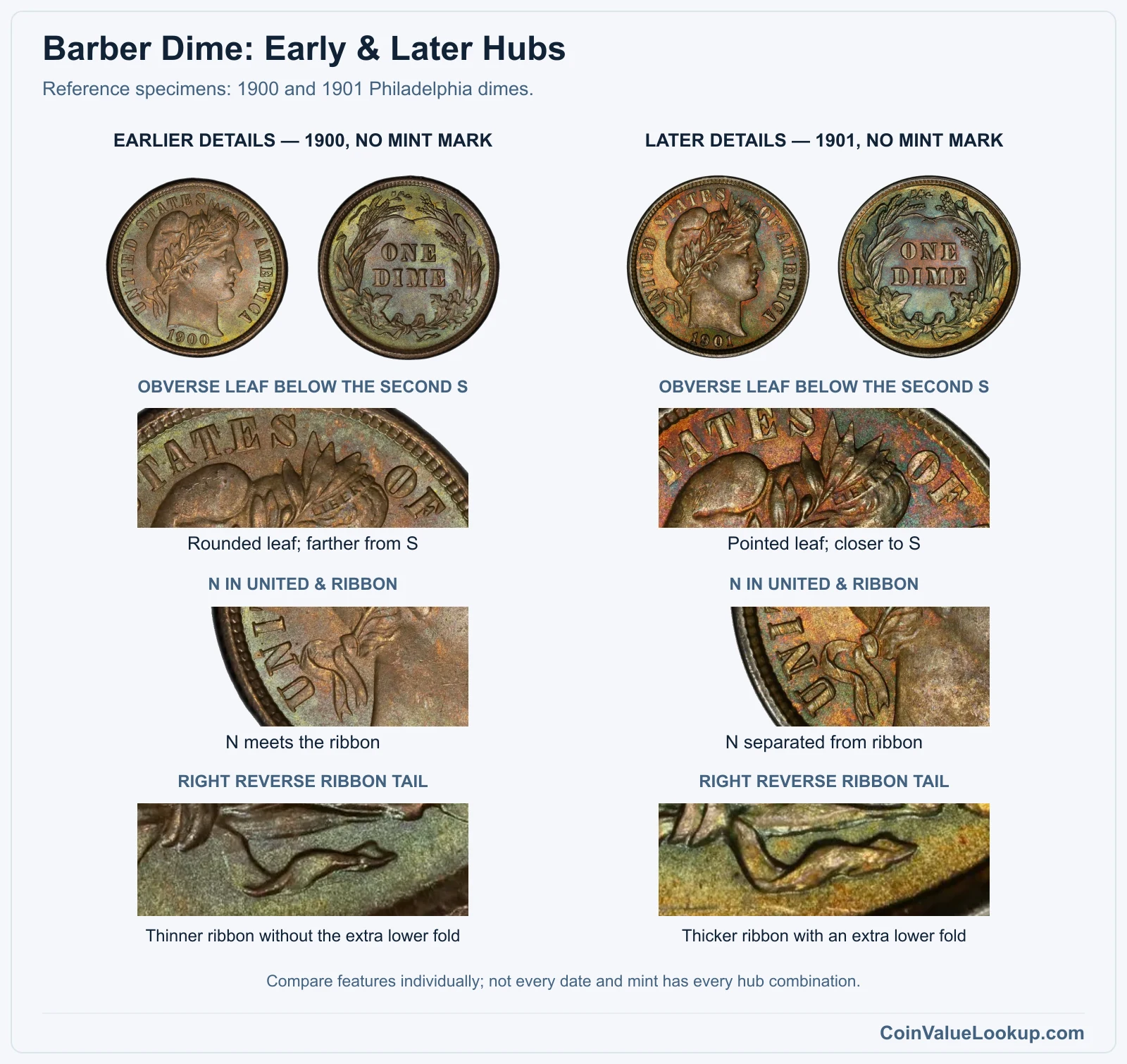
Hub modifications around 1900–1901 changed some design details, so inspect your actual coin rather than assuming every piece looks identical.
Step 2: Check Your 1902 Barber Dime Grade
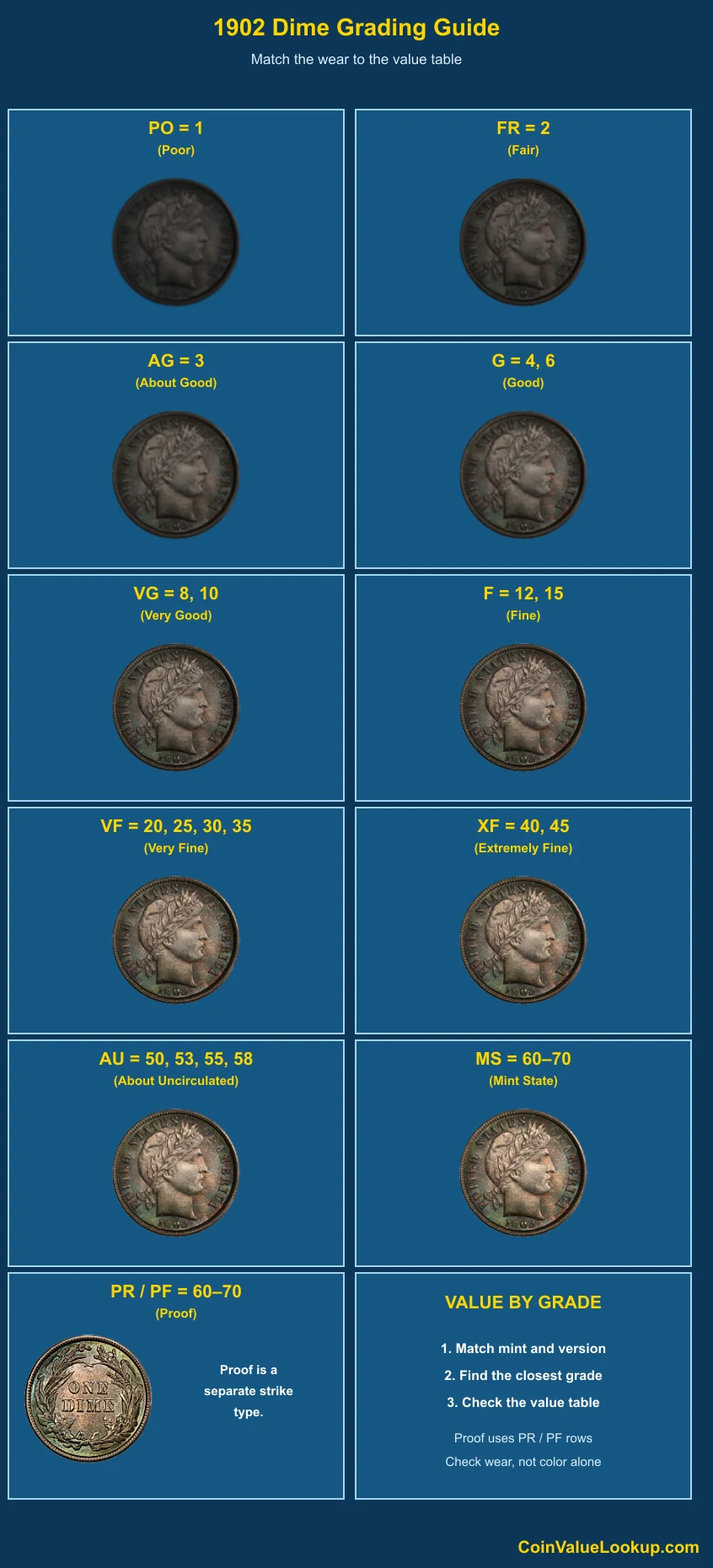
Don't rely on counting letters in LIBERTY on the headband alone — that's a shortcut that misleads people. Instead, evaluate wear across the full headband, the hair above the ear, the cheek, the wreath detail, and the rim sharpness together.
The comparison image above shows these key areas at different wear levels.
New Orleans coins are often softly struck from the factory, which can mimic wear on a coin that actually saw little circulation. A hub change around 1900–1901 also affects how sharp certain details appear, so weak headband letters aren't always from pocket wear.
Mint State means unbroken original luster across the entire surface. Check carefully for hairlines from old cleanings and for tooling marks — both kill value even if the coin otherwise looks sharp.
Proof is a special manufacturing process with mirrored fields, not simply a grade above Mint State.
Step 3: Check 1902 Barber Dime Value by Mint and Version
1902 Barber Dime — No Mint Mark — Silver Circulation
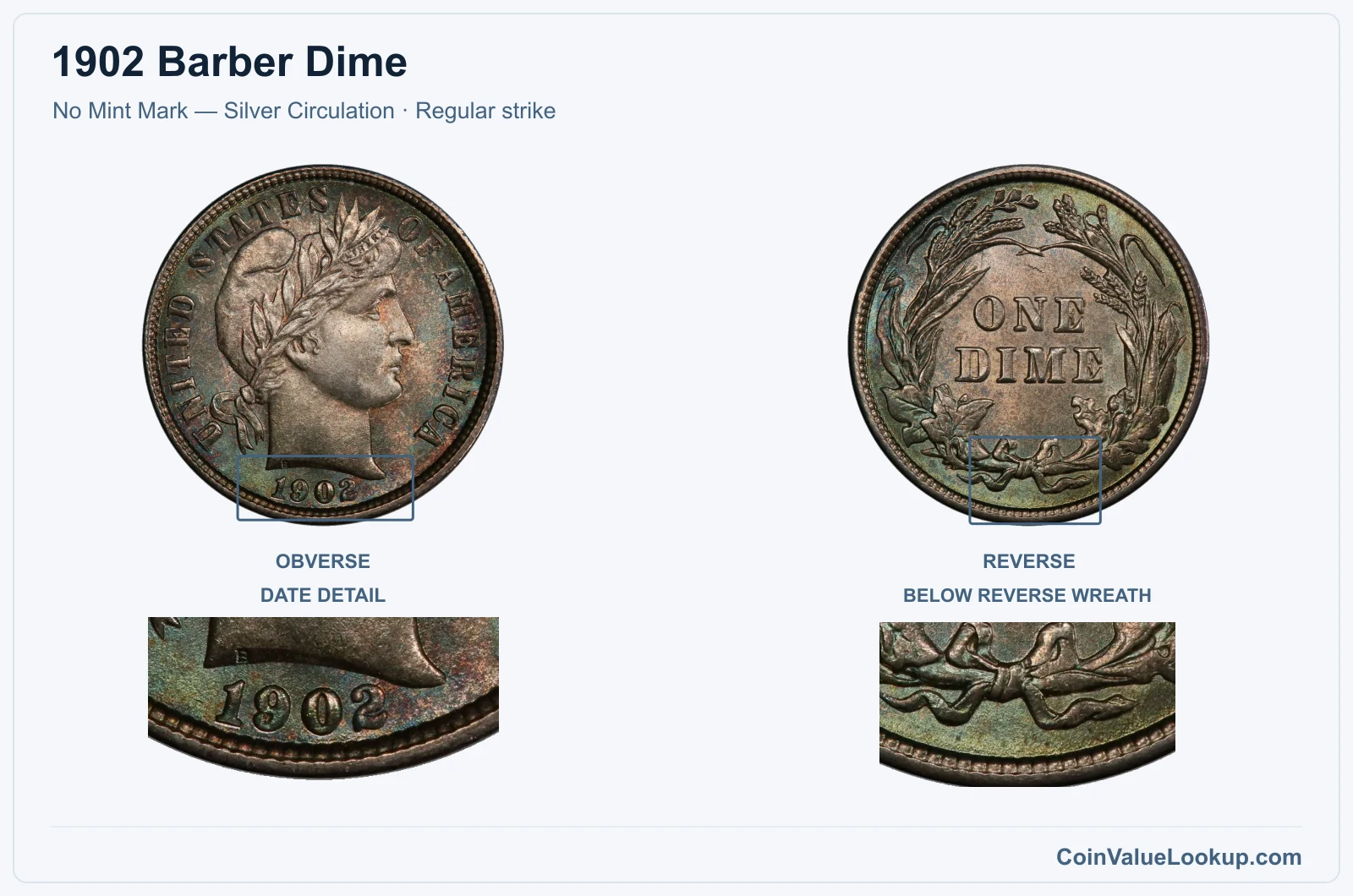
The Philadelphia 1902 Barber Dime has no mintmark — just a blank space below the reverse wreath bow. It's the most common mint for this date.
Guide estimates place it at about $12.26 in G4 and around $253 at MS63.
Look for a clean reverse field below the ribbon and confirm both date and design details are fully visible. At lower grades the silver content alone gives the coin a floor value, but uncirculated examples with original luster are where the real jump happens.
Range Grade
Price Auction Records Appraisal PO PO 1
—
Coin Identifier FR FR 2
—
Coin Identifier AG AG 3
—
Coin Identifier G G 4
—
Coin Identifier
G 6
—
Coin Identifier VG VG 8
—
Coin Identifier
VG 10
—
Coin Identifier F F 12
—
Coin Identifier
F 15
—
Coin Identifier VF VF 20
—
Coin Identifier
VF 25
—
Coin Identifier
VF 30
—
Coin Identifier
VF 35
—
Coin Identifier XF XF 40
Coin Identifier
XF 45
Coin Identifier AU AU 50
Coin Identifier
AU 53
Coin Identifier
AU 55
Coin Identifier
AU 58
Coin Identifier MS MS 60
Coin Identifier
MS 61
Coin Identifier
MS 62
Coin Identifier
MS 63
Coin Identifier
MS 64
Coin Identifier
MS 65
Coin Identifier
MS 66
Coin Identifier
MS 67
Coin Identifier
MS 68
—
—
—
MS 69
—
—
—
MS 70
—
—
—
1902 Barber Dime — O — Silver Circulation
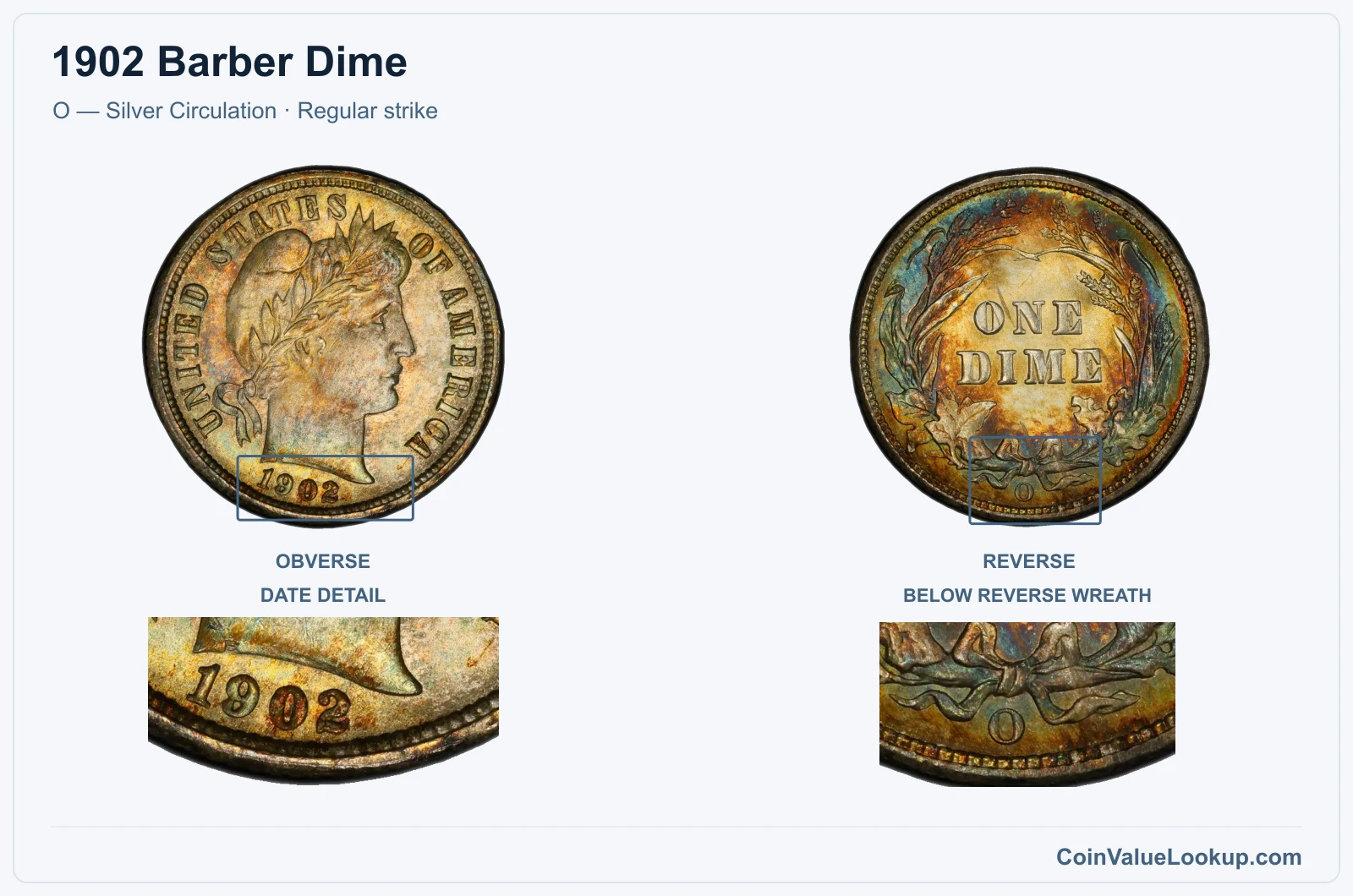
An "O" mintmark below the wreath bow identifies the New Orleans strike. Guide estimates run about $15 at G4 up to roughly $933 at MS63, a significant jump over Philadelphia at the upper end.
Here's the catch: New Orleans Barber Dimes are notorious for mushy strikes. The headband and wreath details can look worn even on a coin that barely circulated.
Compare the luster and high-point flatness carefully before assuming heavy wear. A genuinely uncirculated O-mint piece with strong detail is considerably scarcer than its Philadelphia counterpart, which is reflected in that MS63 figure.
Coin Value Lookup is a good starting point if you want to compare values across different Barber Dime dates and mints before deciding whether professional grading is worthwhile.
Range Grade
Price Auction Records Appraisal PO PO 1
—
Coin Identifier FR FR 2
—
Coin Identifier AG AG 3
—
Coin Identifier G G 4
—
Coin Identifier
G 6
—
Coin Identifier VG VG 8
—
Coin Identifier
VG 10
—
Coin Identifier F F 12
—
Coin Identifier
F 15
—
Coin Identifier VF VF 20
—
Coin Identifier
VF 25
—
Coin Identifier
VF 30
—
Coin Identifier
VF 35
Coin Identifier XF XF 40
Coin Identifier
XF 45
Coin Identifier AU AU 50
Coin Identifier
AU 53
Coin Identifier
AU 55
Coin Identifier
AU 58
Coin Identifier MS MS 60
Coin Identifier
MS 61
Coin Identifier
MS 62
Coin Identifier
MS 63
Coin Identifier
MS 64
Coin Identifier
MS 65
Coin Identifier
MS 66
Coin Identifier
MS 67
Coin Identifier
MS 68
—
—
—
MS 69
—
—
—
MS 70
—
—
—
1902 Barber Dime — S — Silver Circulation
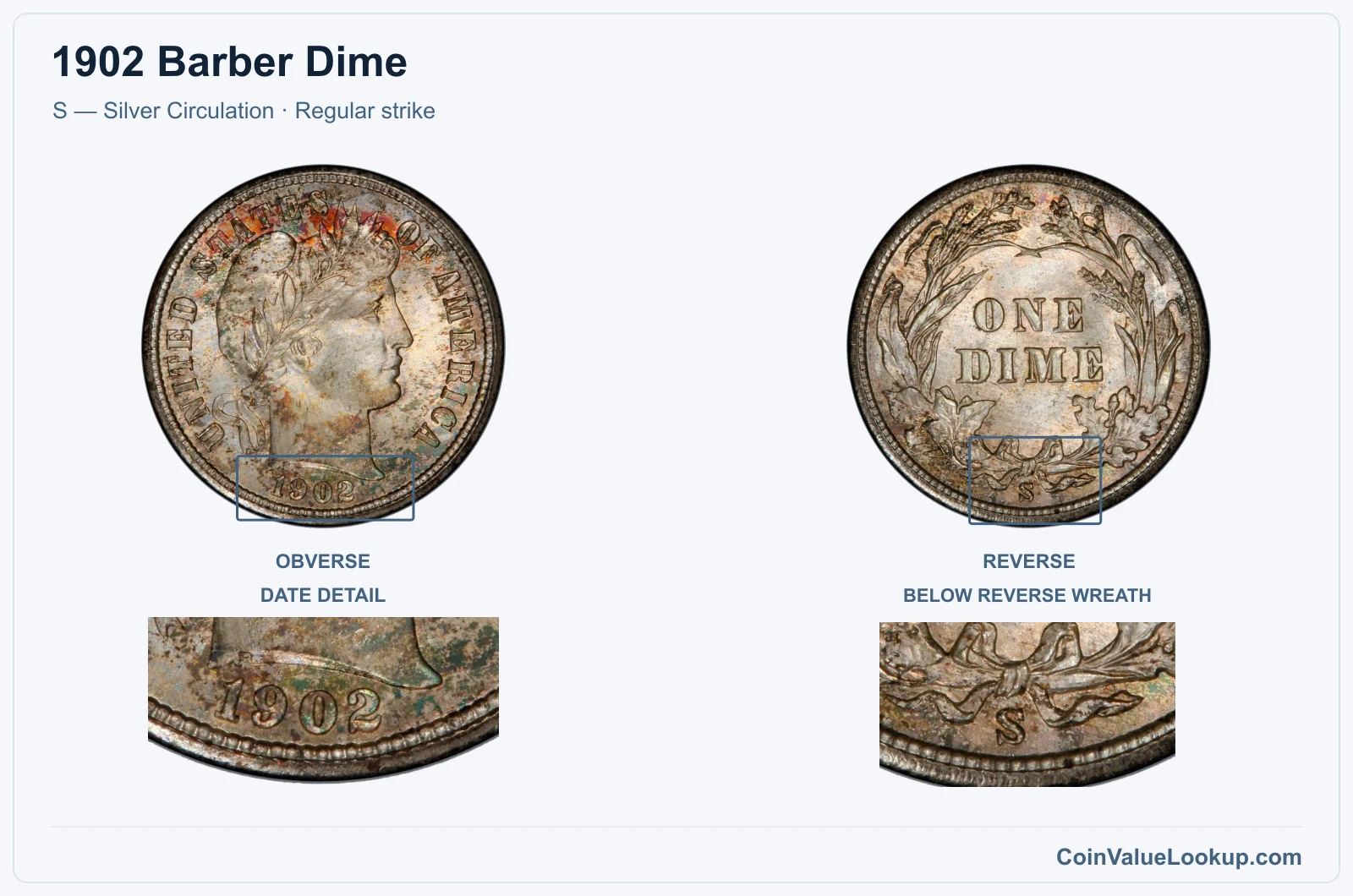
The San Francisco issue carries an "S" below the reverse wreath bow. It posts the highest business-strike guide values for 1902: about $25 at G4 and roughly $967 at MS63.
That G4-to-MS63 spread tells you something — well-preserved S-mint Barber Dimes from this era are tough to find. Most surviving examples went through heavy commercial use on the West Coast.
If yours still shows full headband detail and unbroken luster, it deserves a close look. Confirm the mintmark is a genuine "S" and not damage or corrosion mimicking a letter.
Range Grade
Price Auction Records Appraisal PO PO 1
—
Coin Identifier FR FR 2
—
Coin Identifier AG AG 3
Coin Identifier G G 4
—
Coin Identifier
G 6
—
Coin Identifier VG VG 8
—
Coin Identifier
VG 10
—
Coin Identifier F F 12
Coin Identifier
F 15
Coin Identifier VF VF 20
—
Coin Identifier
VF 25
Coin Identifier
VF 30
Coin Identifier
VF 35
Coin Identifier XF XF 40
Coin Identifier
XF 45
Coin Identifier AU AU 50
Coin Identifier
AU 53
Coin Identifier
AU 55
Coin Identifier
AU 58
Coin Identifier MS MS 60
Coin Identifier
MS 61
Coin Identifier
MS 62
Coin Identifier
MS 63
Coin Identifier
MS 64
Coin Identifier
MS 65
Coin Identifier
MS 66
Coin Identifier
MS 67
Coin Identifier
MS 68
—
—
—
MS 69
—
—
—
MS 70
—
—
—
1902 Barber Dime — No Mint Mark — Brilliant Silver Proof
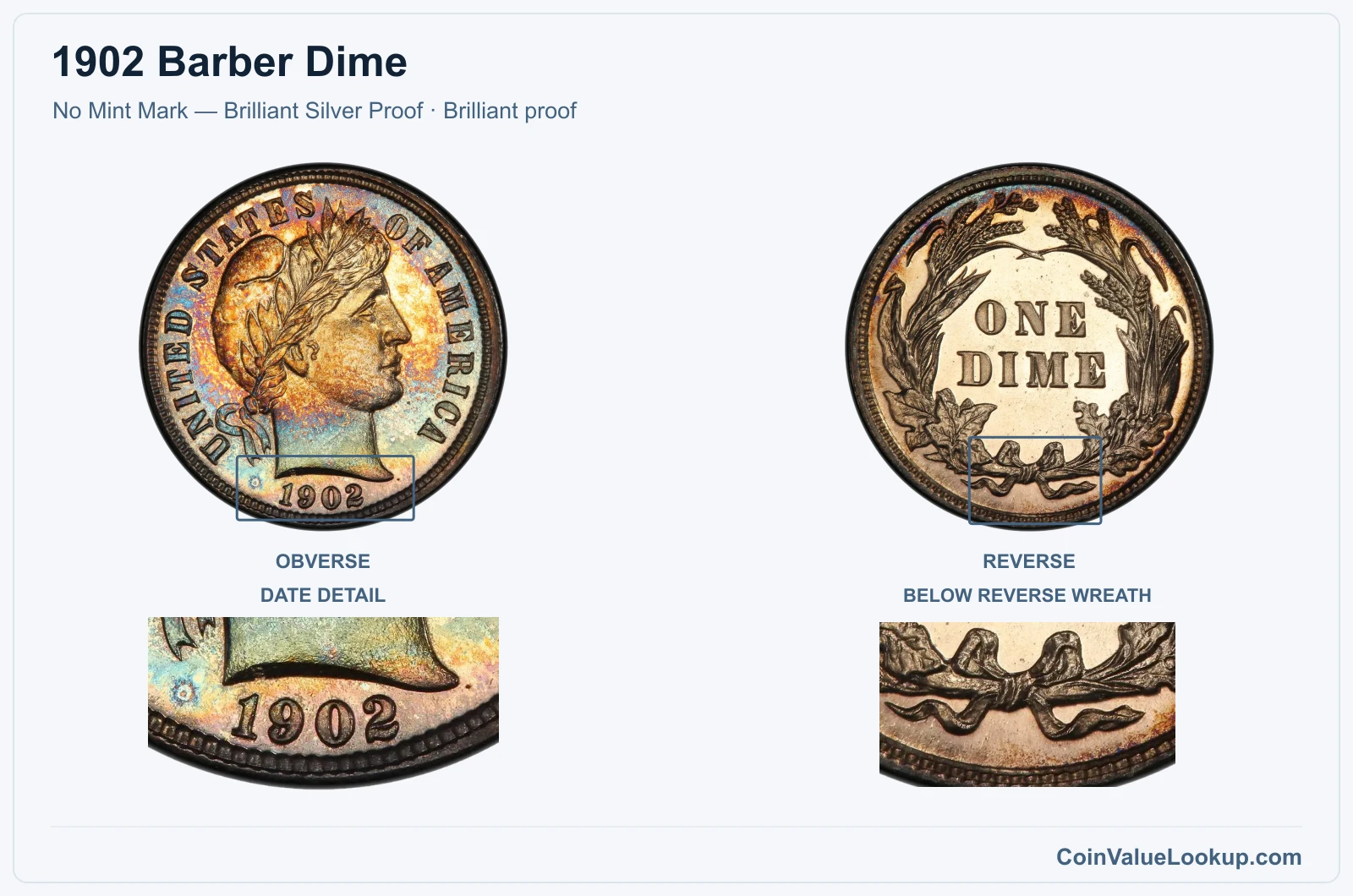
Proofs were struck exclusively at Philadelphia, so there's no mintmark. Guide estimates place a PR63 example at about $616.
These coins display mirrored fields and sharply defined rims that business strikes simply don't have.
One thing to know about later Barber proofs: cameo contrast — that frosty device against a mirror field — tends to be weaker on issues after 1901. Don't assume a brilliant proof is a Cameo or Deep Cameo just because it looks shiny.
Those contrast designations are separate classifications, and a standard PR63 price should not be applied to a DCAM coin or vice versa. Examine the fields under angled light for the telltale liquid-mirror reflection that separates a real proof from a well-preserved business strike.
Range Grade
Price Auction Records Appraisal PR PR 1
—
Coin Identifier
PR 2
—
Coin Identifier
PR 3
—
Coin Identifier
PR 4
—
Coin Identifier
PR 6
—
Coin Identifier
PR 8
—
Coin Identifier
PR 10
—
Coin Identifier
PR 12
—
Coin Identifier
PR 15
—
Coin Identifier
PR 20
—
Coin Identifier
PR 25
—
Coin Identifier
PR 30
—
Coin Identifier
PR 35
—
Coin Identifier
PR 40
—
Coin Identifier
PR 45
—
Coin Identifier
PR 50
—
Coin Identifier
PR 53
—
Coin Identifier
PR 55
—
Coin Identifier
PR 58
—
Coin Identifier
PR 60
Coin Identifier
PR 61
Coin Identifier
PR 62
Coin Identifier
PR 63
Coin Identifier
PR 64
Coin Identifier
PR 65
Coin Identifier
PR 66
Coin Identifier
PR 67
Coin Identifier
PR 68
—
Coin Identifier
PR 69
—
—
—
PR 70
—
—
—
1902 Barber Dime Error List
1. 1902 Barber Dime — Broadstrike
A broadstrike happens when the coin is struck without the normal restraining collar that forms the reeded edge and keeps the planchet from spreading. The result is a 1902 Barber Dime that's slightly wider than normal, with design elements that spread outward toward the rim.
The edge may appear smooth or irregular rather than sharply reeded.
At least one 1902 Barber Dime has been documented as a broadstrike — an AU55 example appeared in a Stacks Bowers auction. No specific price range is adopted here because value depends heavily on the severity of the error, the coin's preservation, and how clearly the broadstrike characteristics show.
Don't confuse a broadstrike with an off-center strike, which shifts the design and leaves a blank crescent. Also rule out post-mint damage: a coin smashed flat after leaving the mint will show distorted details and contact marks that a genuine broadstrike won't.
Look at the overall symmetry and edge profile together.