1950 Roosevelt Dime Coin Value: How Much Is It Worth?
The 1950 Roosevelt Dime is a 90% silver coin struck across three mints, with proof production resuming at Philadelphia that year. Guide estimates for ordinary business strikes range from about $5.81 in G4 to $73 for a San Francisco example in MS65, while a standard PR65 proof sits around $64.
These are grade-specific retail reference points from USA Coin Book, not guaranteed offers, and the silver content means melt value shifts with the metal market.
Fast Way to Identify Your 1950 Roosevelt Dime
Want a quick read on what you have? Upload clear photos of both sides of your 1950 dime.
The front shows the date and mint condition, and the reverse reveals the mintmark and any strike anomalies. This preliminary identification from images can help point you toward the right branch and narrow down a value range before you decide on further steps.
1950 Roosevelt Dime Value
Upload both sides of your 1950 Roosevelt Dime.
Front Obverse
Upload photo
Back Reverse
Upload photo
Which 1950 Roosevelt Dime Versions Are Worth Money?
- Uncirculated 1950-S dimes with strong Full Bands torch detail can reach the highest guide values among ordinary business strikes.
- Philadelphia proofs, especially those independently graded with cameo or deep-cameo contrast, carry separate premium potential above the standard PR65 estimate.
- 1950-D broadstrike errors with expanded metal and missing reeding are documented and individually assessed.
- 1950-S thin planchet errors, confirmed by underweight measurement, are a recognized variety.
- 1950-D doubled die reverse examples show spread on the torch, leaves and lettering.
- Die cracks on 1950-D and 1950-S dimes, including a spike-head variety, have been cataloged by specialists.
- 1950-D/S over-mintmark dimes with remnants of an S beneath the D are a collected variety.
Step 1: Identify Your 1950 Roosevelt Dime Mint Mark and Version
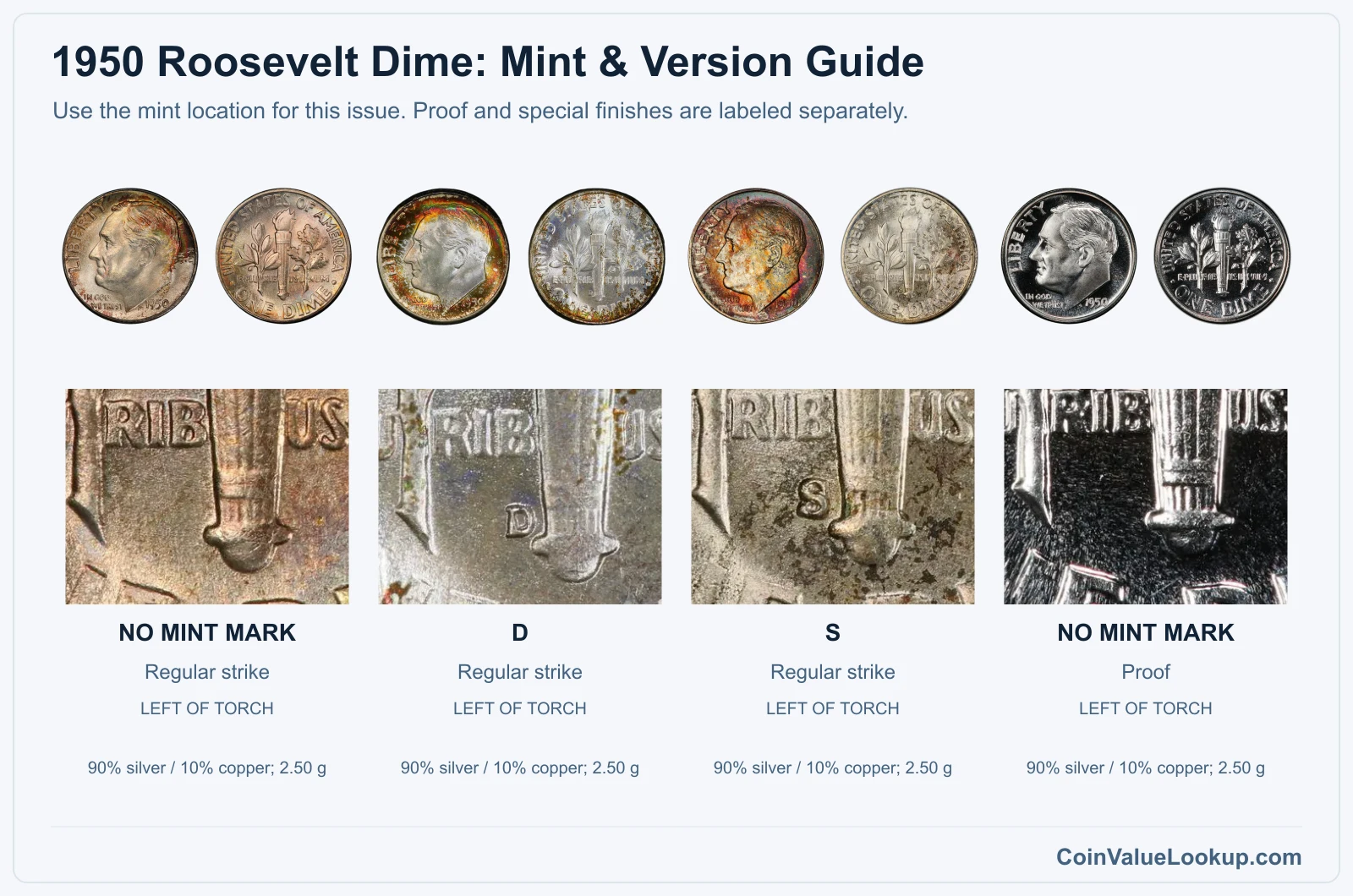
Start with the basics: confirm the date reads 1950 and you are looking at Roosevelt's profile on the obverse with a torch flanked by olive and oak branches on the reverse.
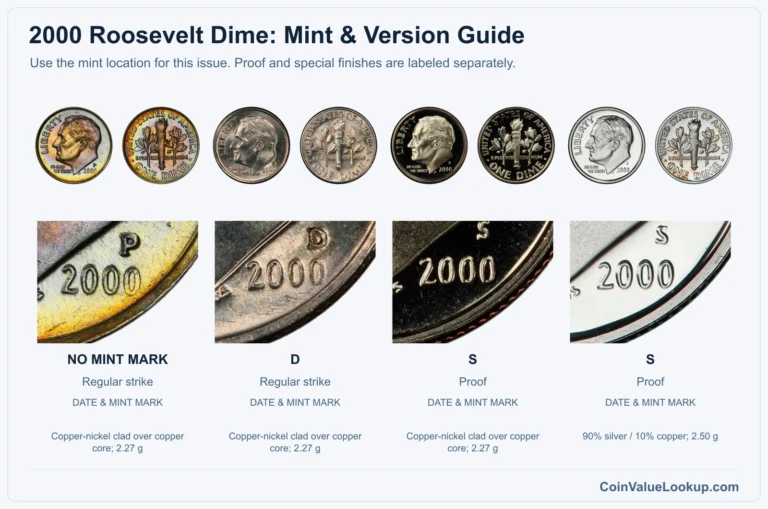
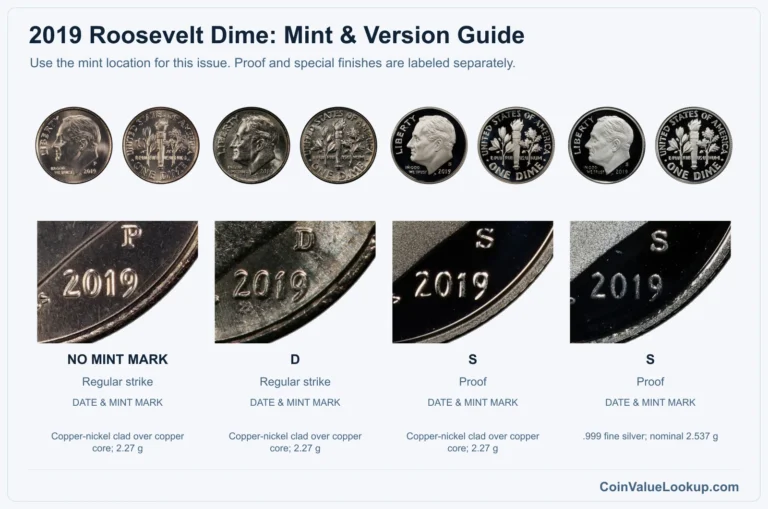
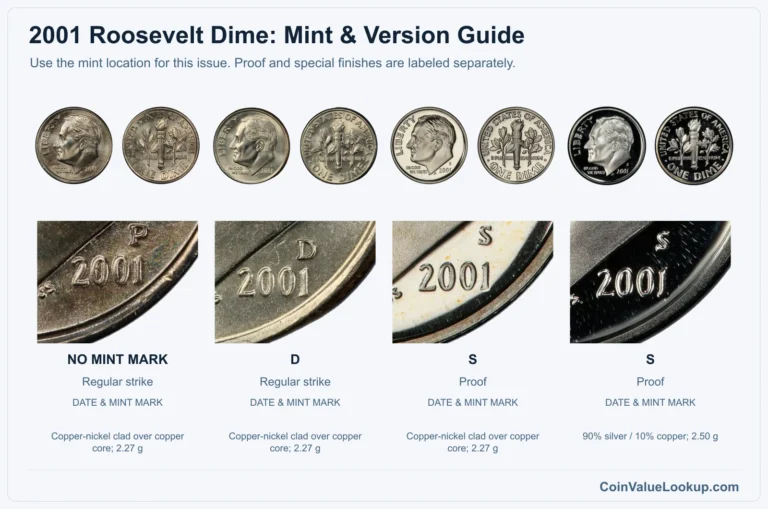
The mintmark sits on the reverse, near the base of the torch. A "D" means Denver, an "S" means San Francisco, and no letter at all means Philadelphia.
That blank space is normal for Philly coins, not a missing-mintmark error.
All regular 1950 dimes are 90% silver and 10% copper, weighing about 2.50 grams with a diameter of roughly 17.9 mm. There is no clad version of this date.
Philadelphia also produced proof dimes in 1950, the first year proof coinage resumed. A proof is a special manufacturing finish with mirrored fields and sharp rims, not a circulation strike.
If your coin has squared-off edges and deeply reflective surfaces, you may have a proof rather than a business strike.
Step 2: Check Your 1950 Roosevelt Dime Grade
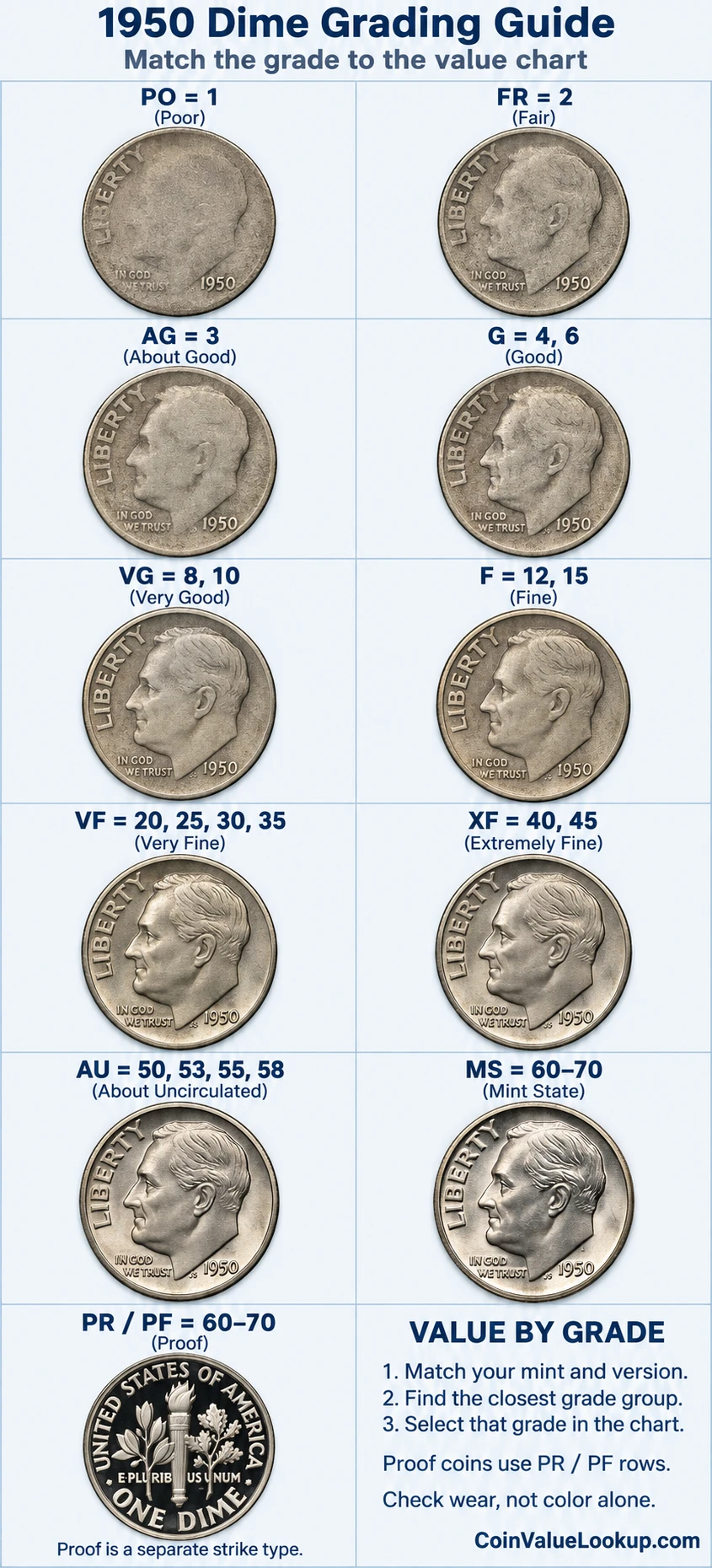
Focus on Roosevelt's cheekbone first. That high point catches wear before anything else, followed by the hair detail above the ear and along the jawline.
On the reverse, check the upper torch lines and the tips of the leaves.
A coin with full original luster and no contact marks is in Mint State territory. One with slight rub on the cheek but visible luster underneath is borderline.
Heavy wear that flattens the hair into the cheek puts you solidly in circulated grades.
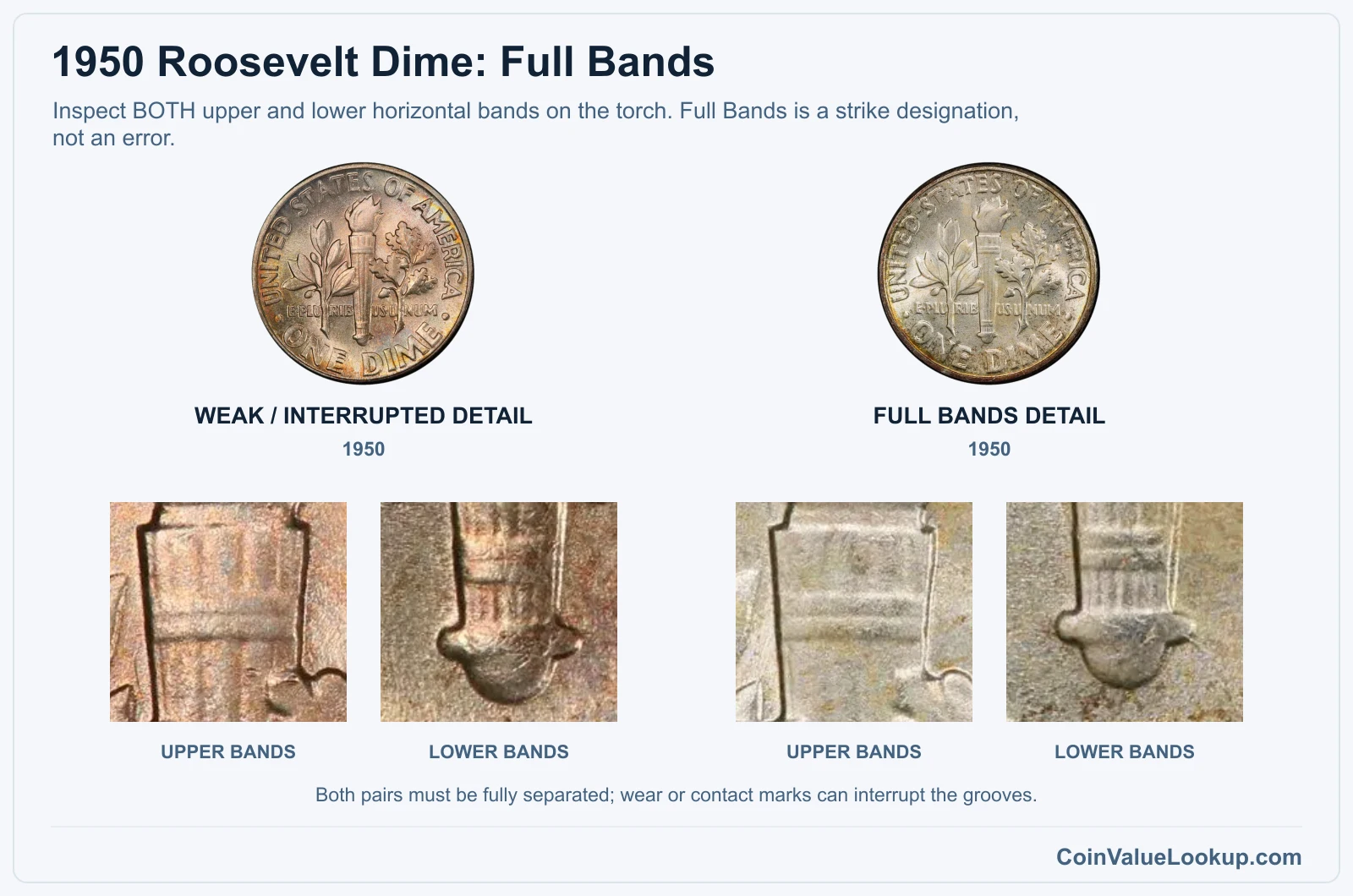
Don't confuse a weak strike with wear. Some 1950 dimes came off the press with soft torch bands, especially from certain mints.
A mushy torch on a coin dripping with luster is a strike issue, not a sign of circulation. The Full Bands designation refers to complete separation of both horizontal torch-band pairs; it is a strike quality, not an error or a grade.
Compare your coin against the grading comparison image, matching the same mint and strike type. Full Bands comparisons only make sense within the same mint and numerical grade.
Proof and cameo coins belong to a completely different evaluation track.
Step 3: Check 1950 Roosevelt Dime Value by Mint and Version
1950 Roosevelt Dime — No Mintmark / Philadelphia
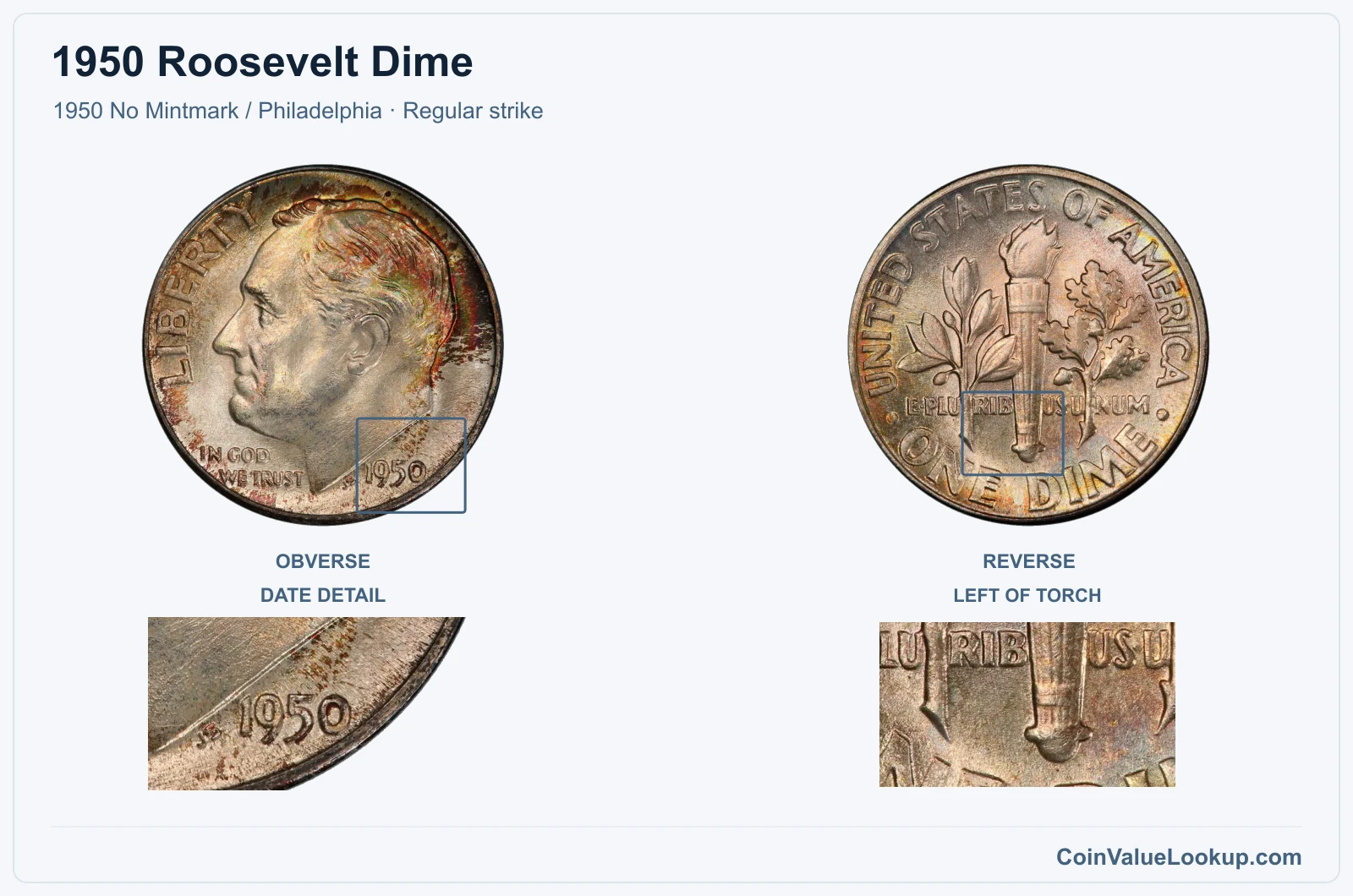
The 1950 Philadelphia dime carries no mintmark on the reverse. In well-worn G4 condition, the guide estimate is about $5.81, which tracks close to silver melt.
An MS65 example steps up to around $23.
Look at the reverse near the torch base and confirm the space is blank. Preserve the original toning and luster if you can; cleaned silver dimes lose appeal fast.
Full Bands examples with complete torch-band separation will command more attention than flat-strike pieces at the same numerical grade.
Remember that Philadelphia also struck proofs in 1950, so a no-mintmark coin with mirrored fields belongs in the proof category, not here.
Range Grade
Price Auction Records Appraisal PO PO 1
—
Coin Identifier FR FR 2
—
Coin Identifier AG AG 3
—
Coin Identifier G G 4
—
Coin Identifier
G 6
—
Coin Identifier VG VG 8
—
Coin Identifier
VG 10
—
Coin Identifier F F 12
—
Coin Identifier
F 15
—
Coin Identifier VF VF 20
—
Coin Identifier
VF 25
—
Coin Identifier
VF 30
—
Coin Identifier
VF 35
—
Coin Identifier XF XF 40
—
Coin Identifier
XF 45
—
Coin Identifier AU AU 50
—
Coin Identifier
AU 53
—
Coin Identifier
AU 55
—
Coin Identifier
AU 58
—
Coin Identifier MS MS 60
—
Coin Identifier
MS 61
—
Coin Identifier
MS 62
—
Coin Identifier
MS 63
—
Coin Identifier
MS 64
—
Coin Identifier
MS 65
Coin Identifier
MS 66
Coin Identifier
MS 67
Coin Identifier
MS 68
Coin Identifier
MS 69
—
—
—
MS 70
—
—
—
1950 Roosevelt Dime — D / Denver
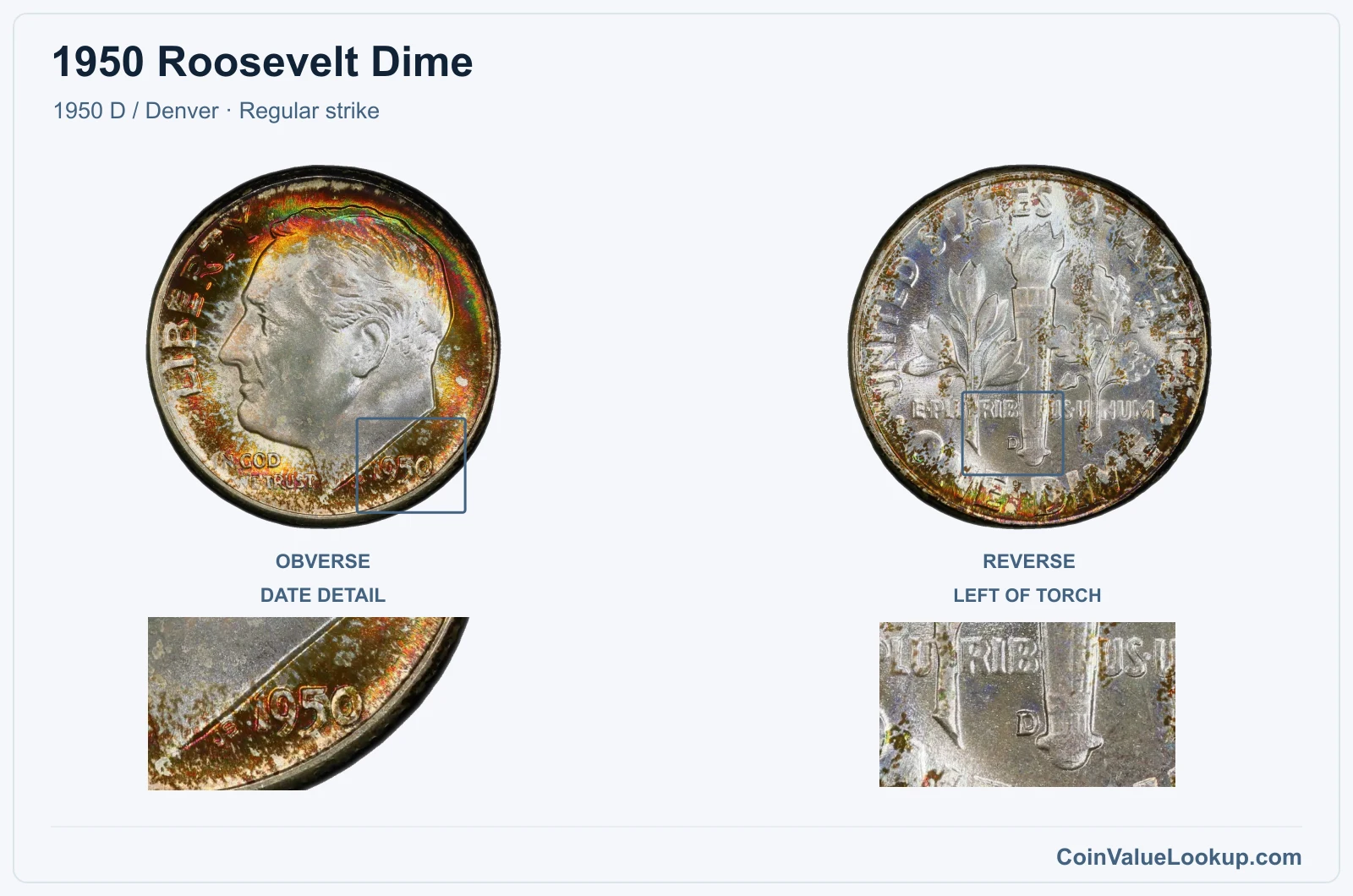
Denver struck business-strike dimes in 1950 with the small "D" mintmark beside the torch base. The guide puts G4 at $5.81 and MS65 at about $18.
Denver coins are also the host for several listed varieties and errors for this date, including broadstrikes, a doubled die reverse, repunched mintmarks, and the D/S over-mintmark. So give that mintmark area and the reverse lettering a careful look under magnification before dropping it in a flip.
As with all silver Roosevelt dimes, a clean original surface matters. Bag marks are common on mint-state examples, so eye appeal separates the average coin from one a collector actually wants.
Range Grade
Price Auction Records Appraisal PO PO 1
—
Coin Identifier FR FR 2
—
Coin Identifier AG AG 3
—
Coin Identifier G G 4
—
Coin Identifier
G 6
—
Coin Identifier VG VG 8
—
Coin Identifier
VG 10
—
Coin Identifier F F 12
—
Coin Identifier
F 15
—
Coin Identifier VF VF 20
—
Coin Identifier
VF 25
—
Coin Identifier
VF 30
—
Coin Identifier
VF 35
—
Coin Identifier XF XF 40
—
Coin Identifier
XF 45
—
Coin Identifier AU AU 50
—
Coin Identifier
AU 53
—
Coin Identifier
AU 55
—
Coin Identifier
AU 58
—
Coin Identifier MS MS 60
—
Coin Identifier
MS 61
—
Coin Identifier
MS 62
Coin Identifier
MS 63
—
Coin Identifier
MS 64
—
Coin Identifier
MS 65
Coin Identifier
MS 66
Coin Identifier
MS 67
Coin Identifier
MS 68
Coin Identifier
MS 69
—
—
—
MS 70
—
—
—
1950 Roosevelt Dime — S / San Francisco
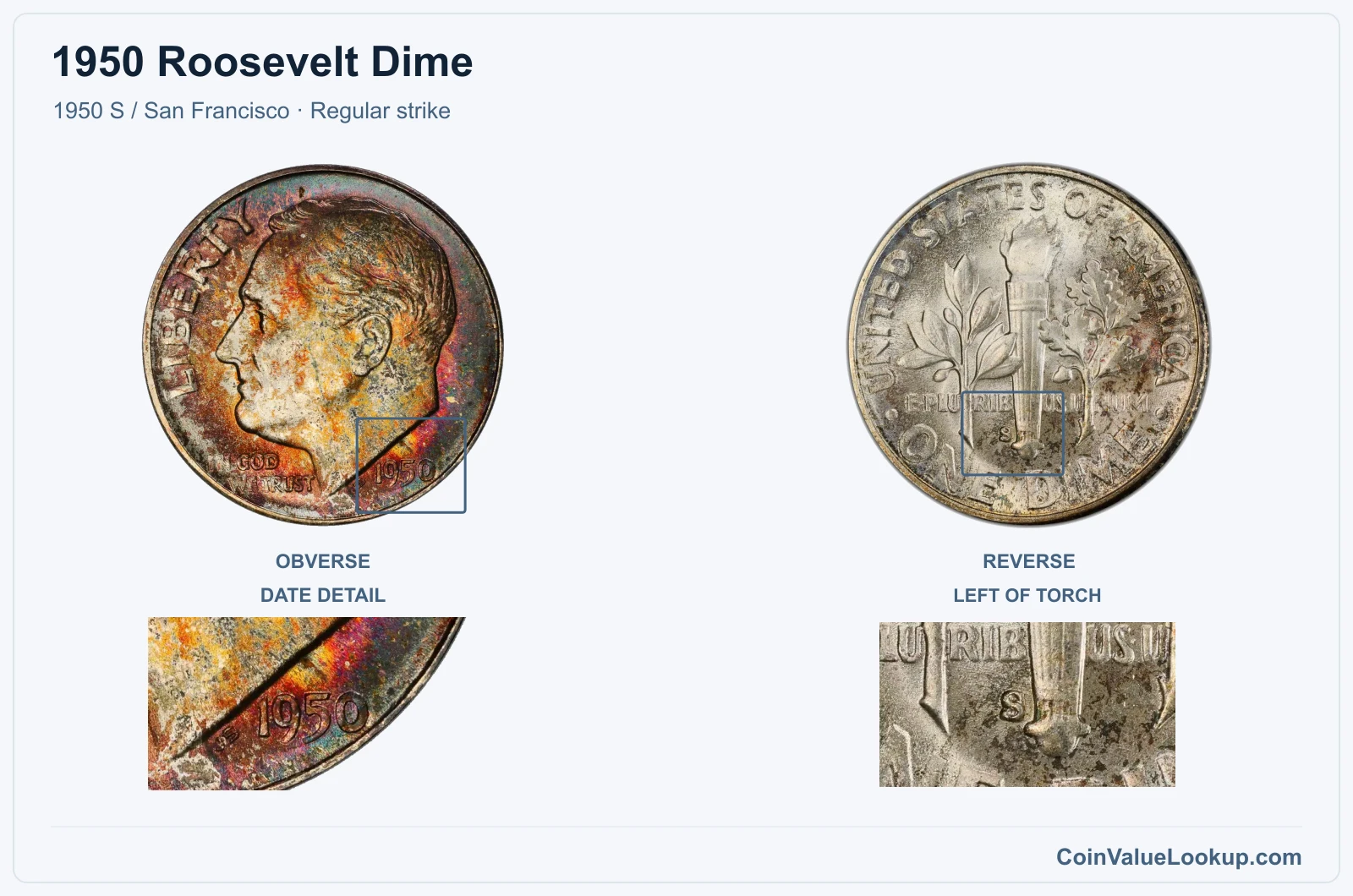
San Francisco's 1950 dime carries an "S" mintmark and posts the highest ordinary business-strike guide value of the three mints: $5.81 in G4 but roughly $73 in MS65. That spread tells you condition is doing a lot of heavy lifting.
Why the premium at the top end? Fewer gem-quality survivors with strong strikes tend to make it through.
Full Bands pieces in MS65 are where the real competition sits among collectors. A soft torch on an otherwise lustrous coin drags the price back toward non-FB territory.
Coin Value Lookup is a handy starting point if you are checking values across multiple Roosevelt Dime dates or other series. You can look up guides organized by year and denomination without hunting through multiple sites.
Range Grade
Price Auction Records Appraisal PO PO 1
—
Coin Identifier FR FR 2
—
Coin Identifier AG AG 3
—
Coin Identifier G G 4
—
Coin Identifier
G 6
—
Coin Identifier VG VG 8
—
Coin Identifier
VG 10
—
Coin Identifier F F 12
—
Coin Identifier
F 15
—
Coin Identifier VF VF 20
—
Coin Identifier
VF 25
—
Coin Identifier
VF 30
—
Coin Identifier
VF 35
—
Coin Identifier XF XF 40
—
Coin Identifier
XF 45
—
Coin Identifier AU AU 50
—
Coin Identifier
AU 53
—
Coin Identifier
AU 55
—
Coin Identifier
AU 58
—
Coin Identifier MS MS 60
—
Coin Identifier
MS 61
—
Coin Identifier
MS 62
—
Coin Identifier
MS 63
Coin Identifier
MS 64
Coin Identifier
MS 65
Coin Identifier
MS 66
Coin Identifier
MS 67
Coin Identifier
MS 68
Coin Identifier
MS 69
—
—
—
MS 70
—
—
—
1950 Roosevelt Dime — Philadelphia Proof (No Mintmark)
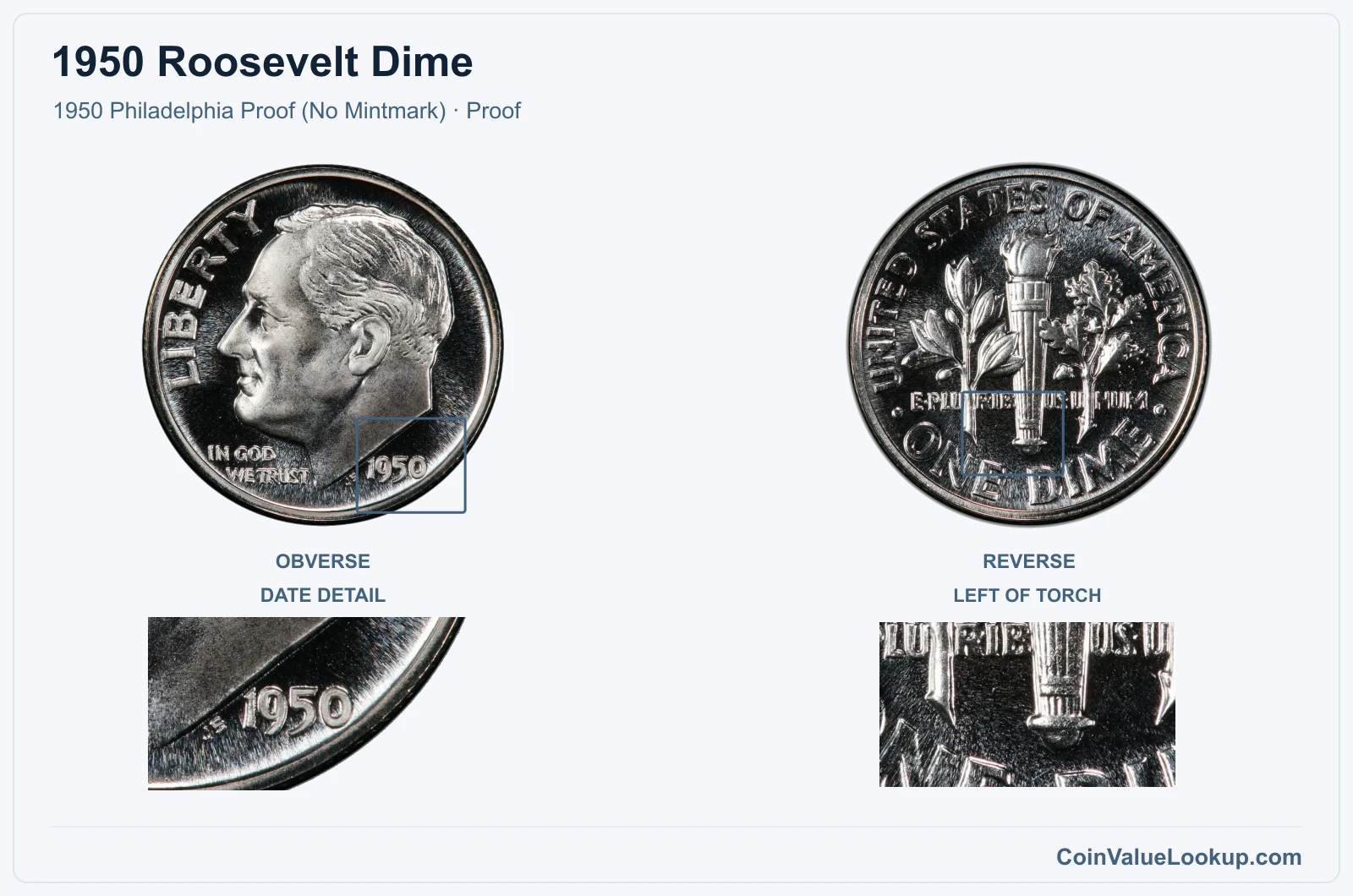
Proof coinage resumed at Philadelphia in 1950 after a wartime hiatus, making this a historically significant issue for the series. These coins show mirrored fields, squared rims and crisp device edges that no business strike can match.
The guide estimate for a standard PR65 is about $64.
Cameo and deep-cameo designations describe the contrast between frosted devices and mirror fields. They are graded and valued separately from ordinary proofs, so do not apply the $64 PR65 figure to a coin that has been independently graded as a cameo or deep cameo.
Those carry their own market.
A proof without its original case may still show squared rims and reflective depth that distinguish it from a well-preserved business strike. Check the edge profile and field quality under good light.
Range Grade
Price Auction Records Appraisal PR PR 1
—
Coin Identifier
PR 2
—
Coin Identifier
PR 3
—
Coin Identifier
PR 4
—
Coin Identifier
PR 6
—
Coin Identifier
PR 8
—
Coin Identifier
PR 10
—
Coin Identifier
PR 12
—
Coin Identifier
PR 15
—
Coin Identifier
PR 20
—
Coin Identifier
PR 25
—
Coin Identifier
PR 30
—
Coin Identifier
PR 35
—
Coin Identifier
PR 40
—
Coin Identifier
PR 45
—
Coin Identifier
PR 50
—
Coin Identifier
PR 53
—
Coin Identifier
PR 55
—
Coin Identifier
PR 58
—
Coin Identifier
PR 60
—
Coin Identifier
PR 61
—
Coin Identifier
PR 62
—
Coin Identifier
PR 63
—
Coin Identifier
PR 64
Coin Identifier
PR 65
Coin Identifier
PR 66
Coin Identifier
PR 67
Coin Identifier
PR 68
Coin Identifier
PR 69
—
—
—
PR 70
—
—
—
1950 Roosevelt Dime Error List
1. 1950 Roosevelt Dime — Broadstrike
A broadstrike happens when the coin is struck outside or without the collar that normally constrains its diameter and imparts reeding on the edge. On the documented 1950-D example, the metal expands beyond the standard 17.9 mm while retaining the complete design.
The edge will be smooth or partially reeded instead of fully reeded.
Scope here is the Denver mint silver business strike. Look for design elements that reach further toward the rim than normal, and compare the edge against a regular dime.
Post-mint flattening or damage can mimic the wider look, but a genuine broadstrike keeps the full design without the distortion you see on a coin that was simply smashed. An off-center strike also differs because it shifts the design rather than expanding it evenly.
No fixed price range applies. Value depends on the coin's authenticated identity, preservation and severity of the error.
2. 1950 Roosevelt Dime — Thin Planchet
A thin planchet error means the blank was rolled too thin before striking. The documented 1950-S example weighs only 1.74 grams versus the standard 2.50 grams, a significant deficit.
That missing metal can affect strike sharpness across the design.
To check, weigh your coin on a precise scale. A normal worn dime will still be close to 2.50 grams; a thin planchet will fall well short.
Be careful with lookalikes. Coins that have been acid-treated, polished down, or clipped from the edge can also weigh less, but they show different surface characteristics.
Acid leaves a pitted texture. Polishing removes luster and detail uniformly.
A clip shows a curved bite from the rim.
No standard price range is established for this variety. Each example is assessed individually based on authenticated identity, condition and the degree of the planchet anomaly.
3. 1950 Roosevelt Dime — Doubled Die Reverse
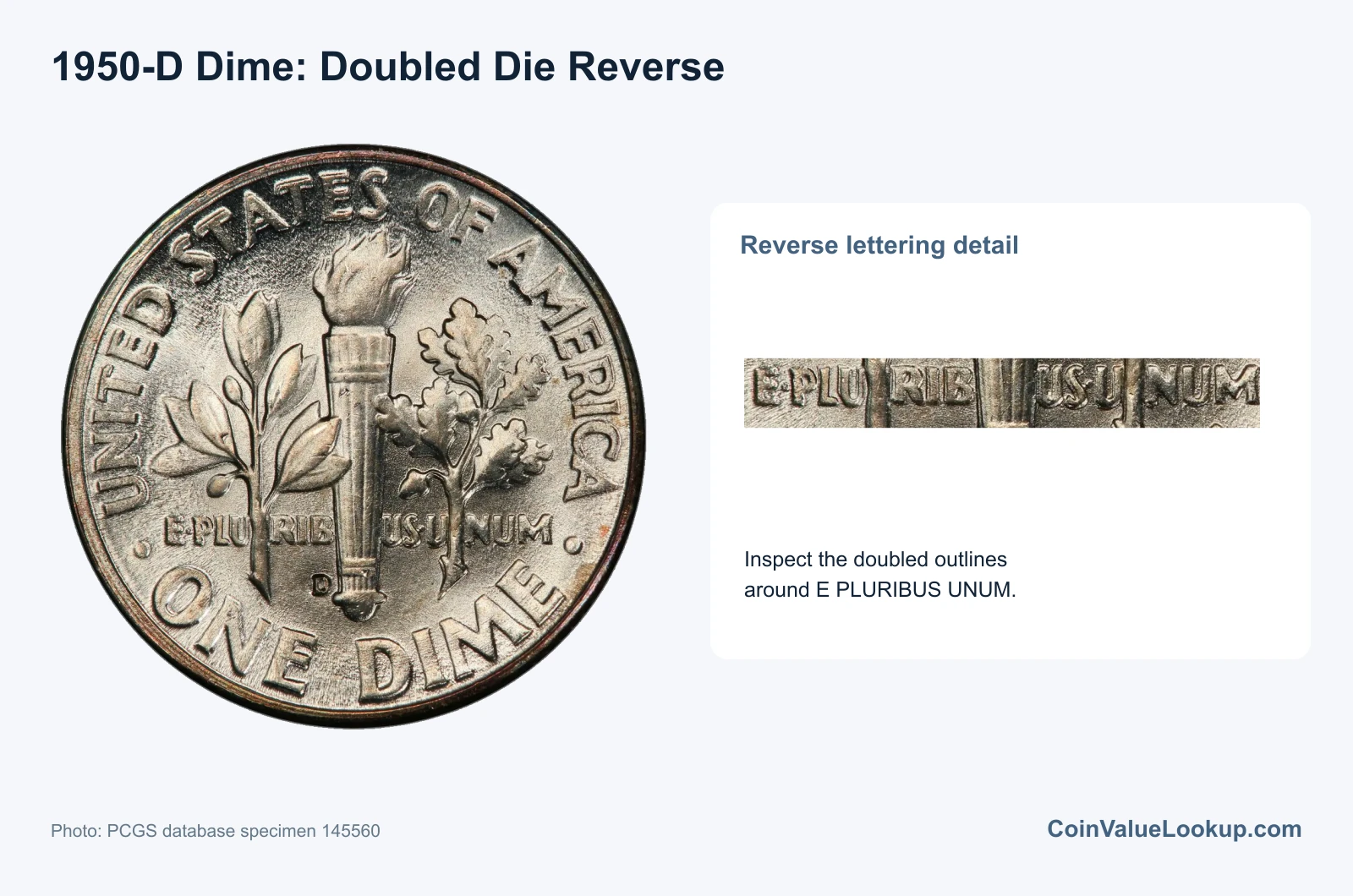
The 1950-D doubled die reverse shows spread visible around the torch, leaves and the lettering of E PLURIBUS UNUM. On attributed examples, you can see separation at the flame and opposing displacement at UNUM.
A PCGS MS66 Full Bands specimen has been documented.
Use magnification and compare your reverse directly against known attributed images. The doubling is a die variety, meaning it appears consistently on every coin struck from that die, unlike random strike artifacts.
Machine doubling is the main lookalike. It produces shelf-like flat displacement on lettering rather than the rounded, separated profiles of a true doubled die.
Light reflections beside raised letters can also trick the eye at low magnification.
Pricing depends on condition, the clarity of the doubling and independent attribution. No fixed range is adopted here, so individual assessment applies.
4. 1950 Roosevelt Dime — Die Cracks
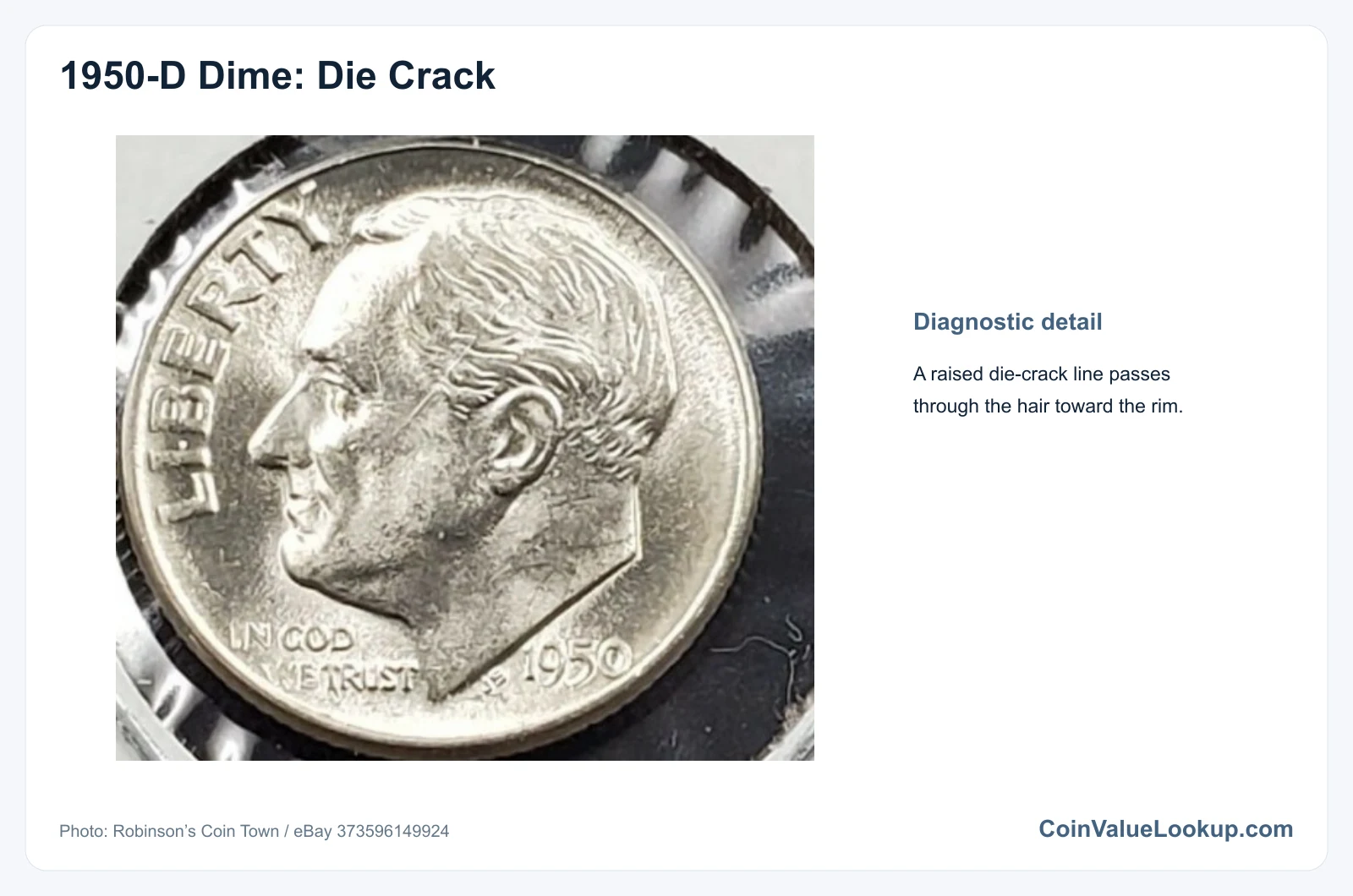
Die cracks appear as raised, irregular lines on the coin's surface where the steel die fractured during use. On a documented 1950-D specimen, the crack runs from about the 1 o'clock rim position down toward Roosevelt's cheek.
A separate 1950-S example shows a spike-head variety where the crack creates a protruding line from Roosevelt's head.
These are found on both Denver and San Francisco business strikes. The crack is raised because metal fills the gap in the broken die during striking.
Run your fingernail across a suspect line; a genuine die crack is raised, while an incuse scratch sits below the surface.
Lookalikes include post-mint scratches, metal seams on damaged coins, and large rim cuds that might be confused with a thin crack line. Each die crack's value is assessed individually based on the authenticated coin's identity, preservation and the prominence of the crack.
5. 1950 Roosevelt Dime — Repunched Mintmark
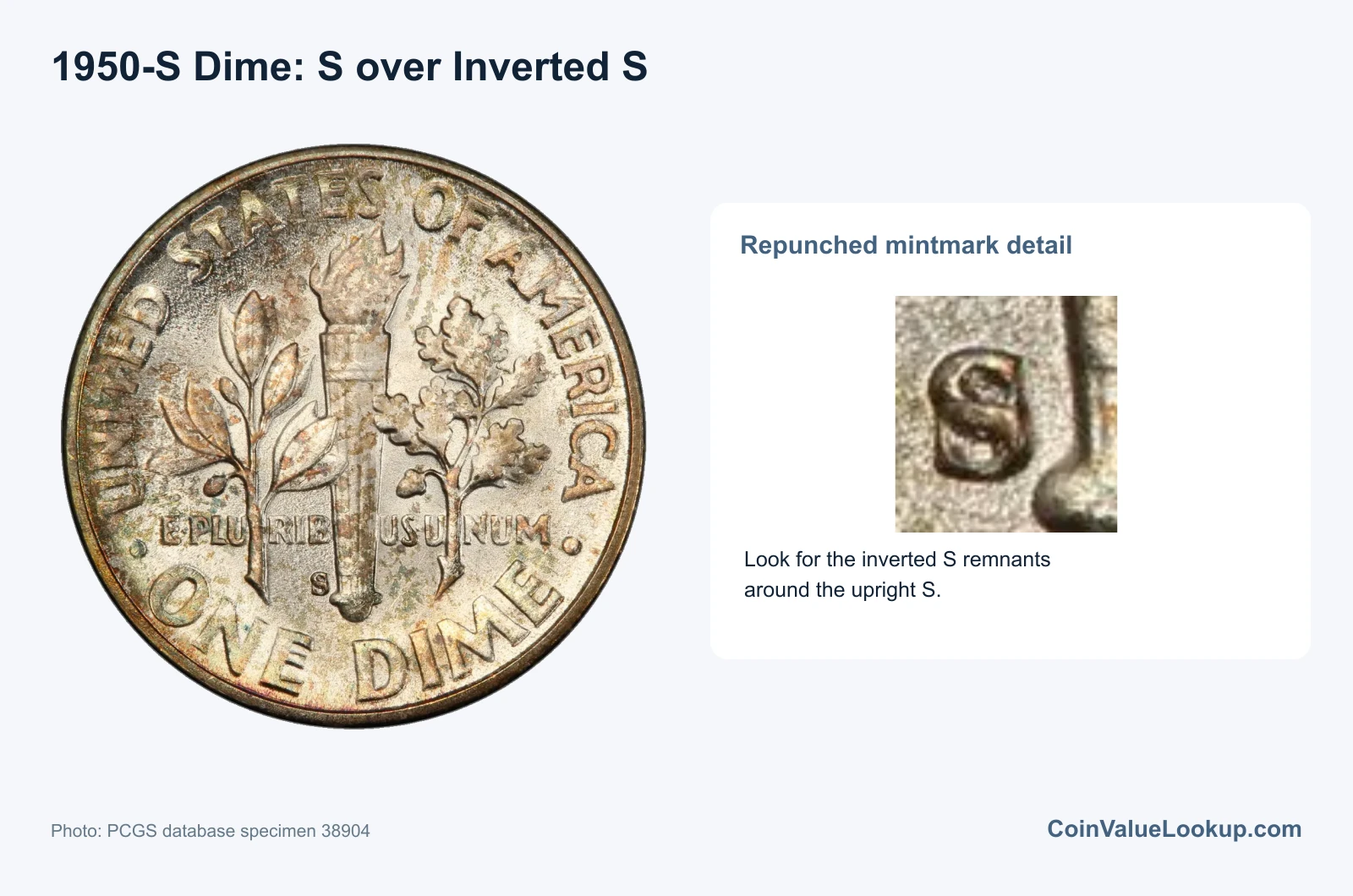
Repunched mintmark varieties on the 1950-D dime occur when the D mintmark punch was applied more than once in slightly different positions on the working die. Two varieties have been reported for this date.
To identify one, examine the mintmark under magnification and look for traces of an earlier punch position partially visible beneath or beside the final D. A normal D will appear as a single clean impression.
Compare your mintmark to images of attributed examples at matching magnification to see whether a second impression is present.
Machine doubling around the mintmark, die chips and simple corrosion can mimic the appearance, so be cautious. A repunched mintmark shows a distinct secondary outline of the same letter, not a flat shelf or a pitted blob.
No numerical price range is adopted. Condition, the clarity of the repunching and independent attribution all factor into what a given example is worth.
6. 1950 Roosevelt Dime — Over-Mintmark
The 1950-D/S over-mintmark variety shows remnants of an S punch beneath the final D mintmark. This happened when a die originally punched with an S for San Francisco was corrected with a D for Denver production.
Under magnification, look for curved traces of the S visible around or beneath the D. The S remnants are typically most visible at the upper and lower serifs of the D where the two letter shapes diverge.
A normal 1950-D will show only a clean single D impression with no foreign curves.
Don't confuse this with a repunched mintmark, where two impressions of the same letter overlap, or with die chips and corrosion that can fill the area around the mark. The key diagnostic is the distinctly different letter shape underneath.
Value depends on the visibility of the underlying S, overall condition and whether the coin has been independently attributed. No standard price range applies to this variety.