1846 Liberty Seated Dime Coin Value: How Much Is It Worth?
The 1846 Liberty Seated Dime is a scarce Philadelphia-only date that commands real money even in worn condition. USA Coin Book guide estimates place the regular issue at roughly $411 in G4 and around $62,607 in MS63, while a confirmed Proof in PR63 is estimated near $20,000 by PCGS.
Rare Proofs from this era need specialist attribution, not just a shiny surface.
Fast Way to Identify Your 1846 Liberty Seated Dime
Snap a clear photo of each side of your dime and upload both images here for a preliminary identification. The tool can help you confirm the date, design subtype, and whether a mintmark is present.
It is not a substitute for professional authentication or grading, but it gives you a solid starting point before you spend money on services.
1846 Liberty Seated Dime Value
Upload both sides of your 1846 Liberty Seated Dime.
Front Obverse
Upload photo
Back Reverse
Upload photo
Which 1846 Liberty Seated Dime Versions Are Worth Money?
- Philadelphia is the only mint for the 1846 dime, so there is no mintmark hunt, but the date itself is scarce with low original mintage.
- The regular business strike ranges from about $411 at G4 to roughly $62,607 at MS63 per USA Coin Book guide estimates, making even low-grade survivors worth checking.
- A confirmed Proof in PR63 carries a PCGS guide estimate near $20,000, though genuine early Proofs are rare and require professional attribution.
- Die crack or die chip varieties exist for this date and may carry a collector premium depending on their size and placement.
- Original surfaces and correct design-branch identification matter far more than a polished or cleaned appearance.
Step 1: Identify Your 1846 Liberty Seated Dime Mint Mark and Version
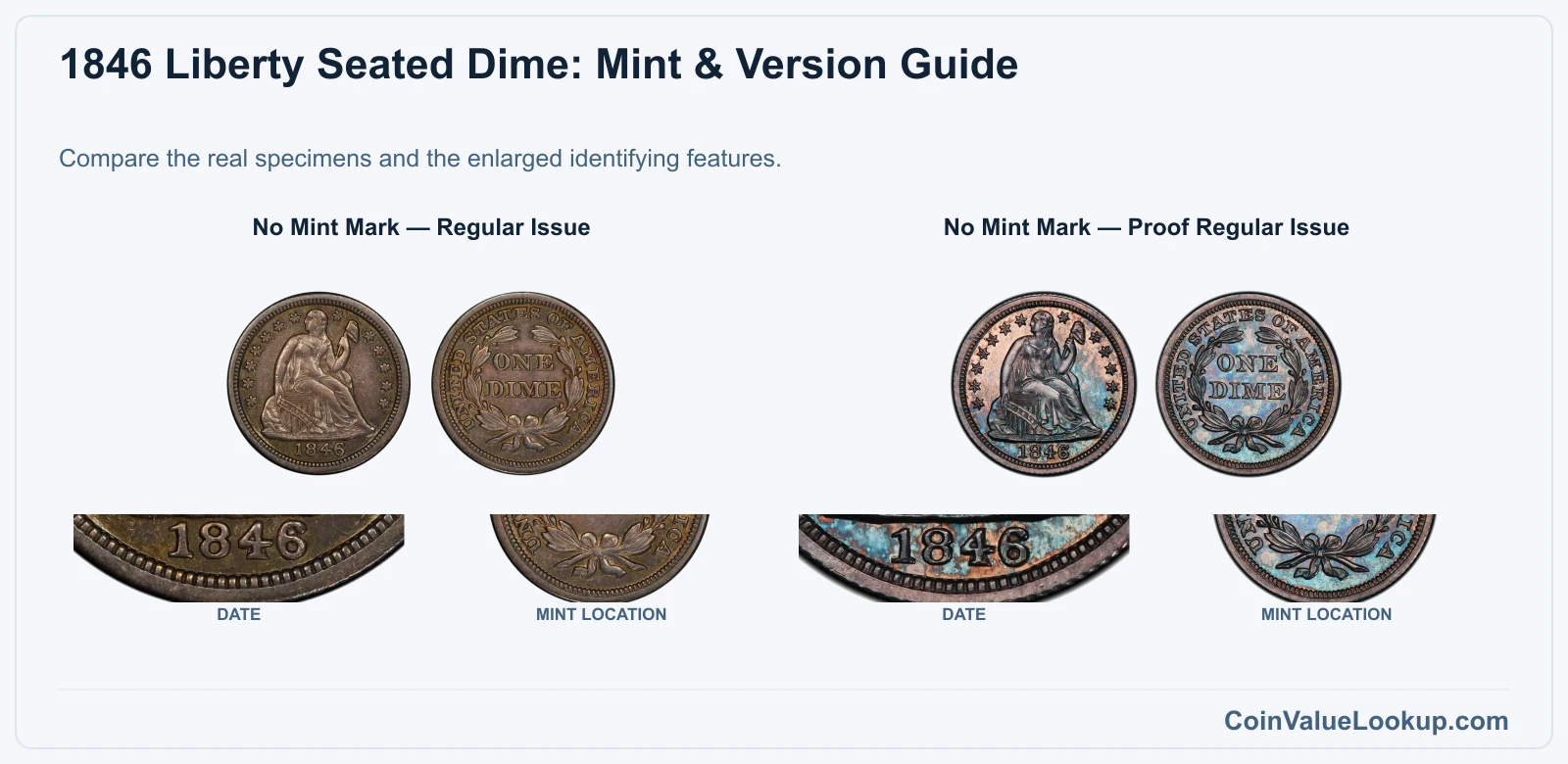
First, make sure you have a dime, not a half dime. The reverse should read ONE DIME inside a small wreath surrounded by the legend UNITED STATES OF AMERICA.
Half dimes are smaller and say HALF DIME.
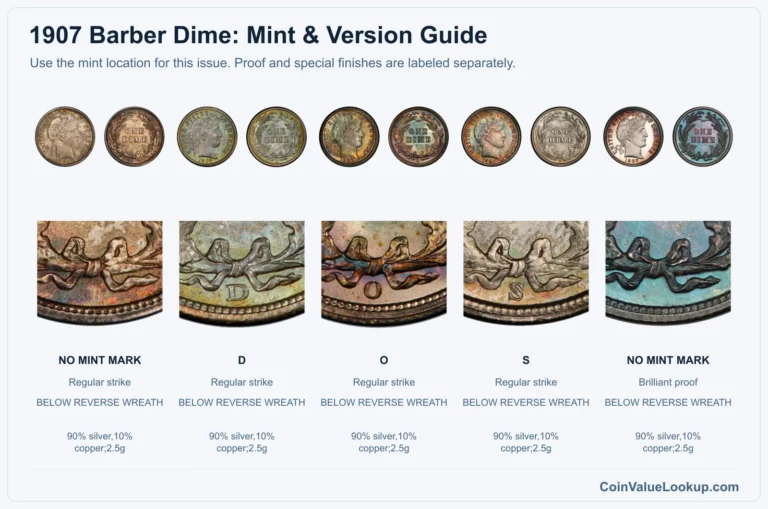
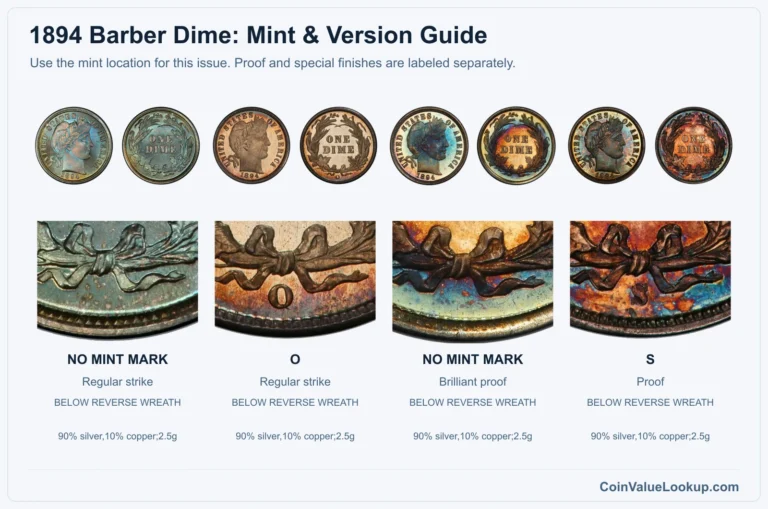
All 1846 dimes were struck at the Philadelphia Mint, so there should be no mintmark letter beneath the wreath on the reverse. If you see a letter there, you may have a different date or a counterfeit.
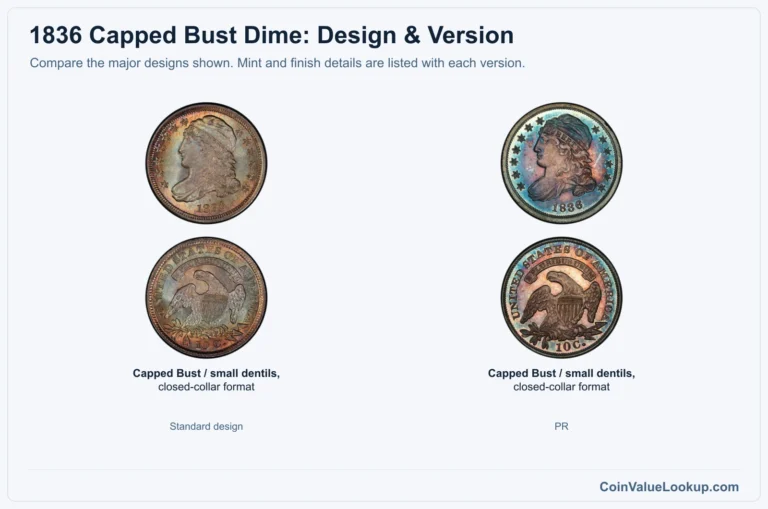
The obverse shows Liberty seated on a rock, holding a pole topped with a Liberty cap. This date falls within the Stars Obverse, With Drapery subtype, meaning stars ring the obverse border and a fold of drapery appears at Liberty's elbow.
The coin is 90 percent silver and 10 percent copper, weighs about 2.67 grams, measures 17.9 mm across, and has a reeded edge.
A genuine early Proof requires careful specialist attribution. Many circulated dimes have been polished to look reflective, but mirror-like fields alone do not make a coin a Proof.
Step 2: Check Your 1846 Liberty Seated Dime Grade
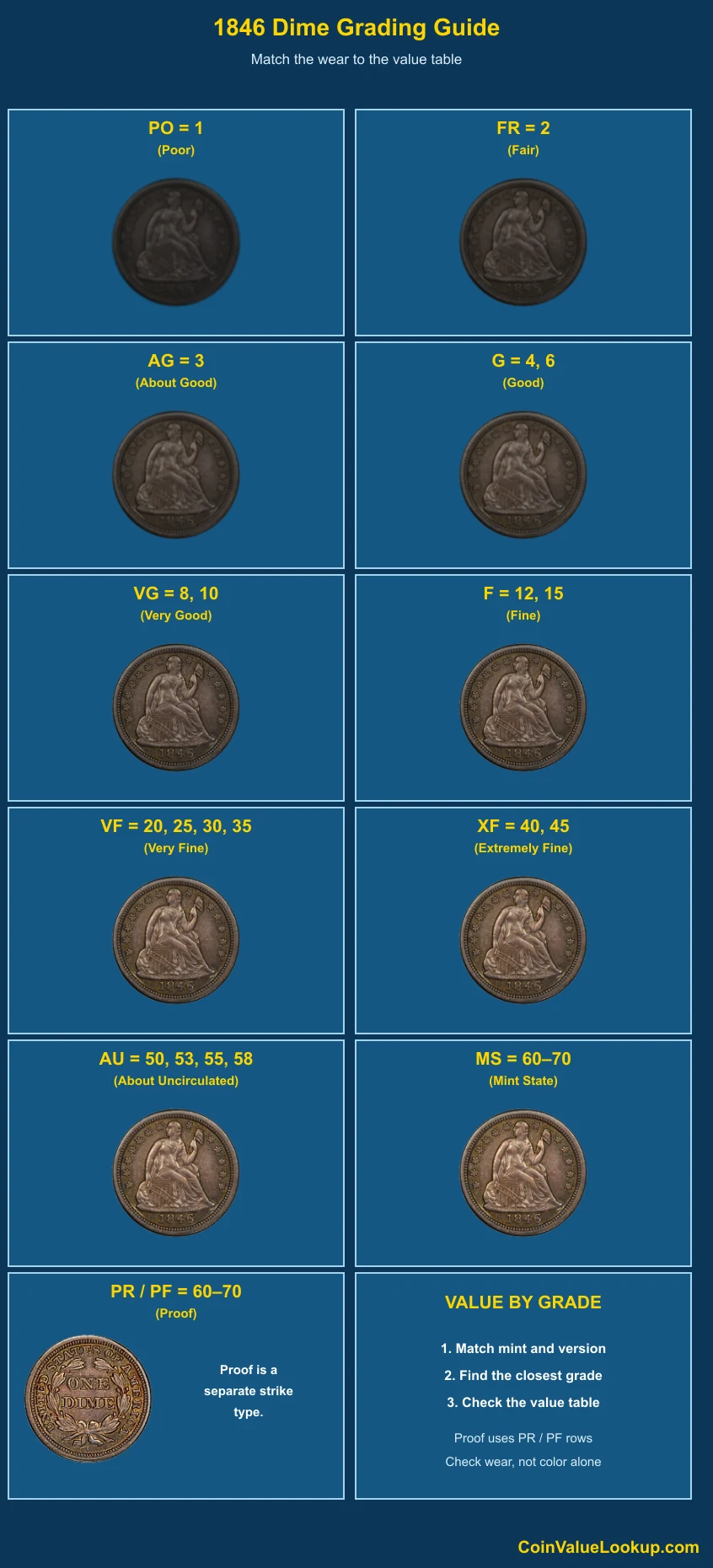
When grading your 1846 dime, compare it side by side with the condition montage for the Stars With Drapery subtype. The key wear points on the obverse are Liberty's head, the shield on her arm, the folds of her gown, and her feet and toes.
On the reverse, check the wreath leaves, especially near the base.
A coin in Good (G4) will show Liberty as a flat outline with the date still readable. By About Uncirculated you should see only the slightest friction on the highest points, with most original luster intact.
Full Mint State means no wear at all, just contact marks from handling.
Do not confuse weak details from a worn or failing die with actual circulation wear. Some 1846 dimes left the press with soft strikes in certain areas.
Original luster, when present, has a cartwheel effect under a light; a polished coin glows uniformly and often shows hairlines under magnification. Keep Proof and Mint State as separate categories.
A polished circulated coin is still a circulated coin, no matter how shiny you make it.
Step 3: Check 1846 Liberty Seated Dime Value by Mint and Version
1846 Liberty Seated Dime — No Mint Mark — Regular Issue
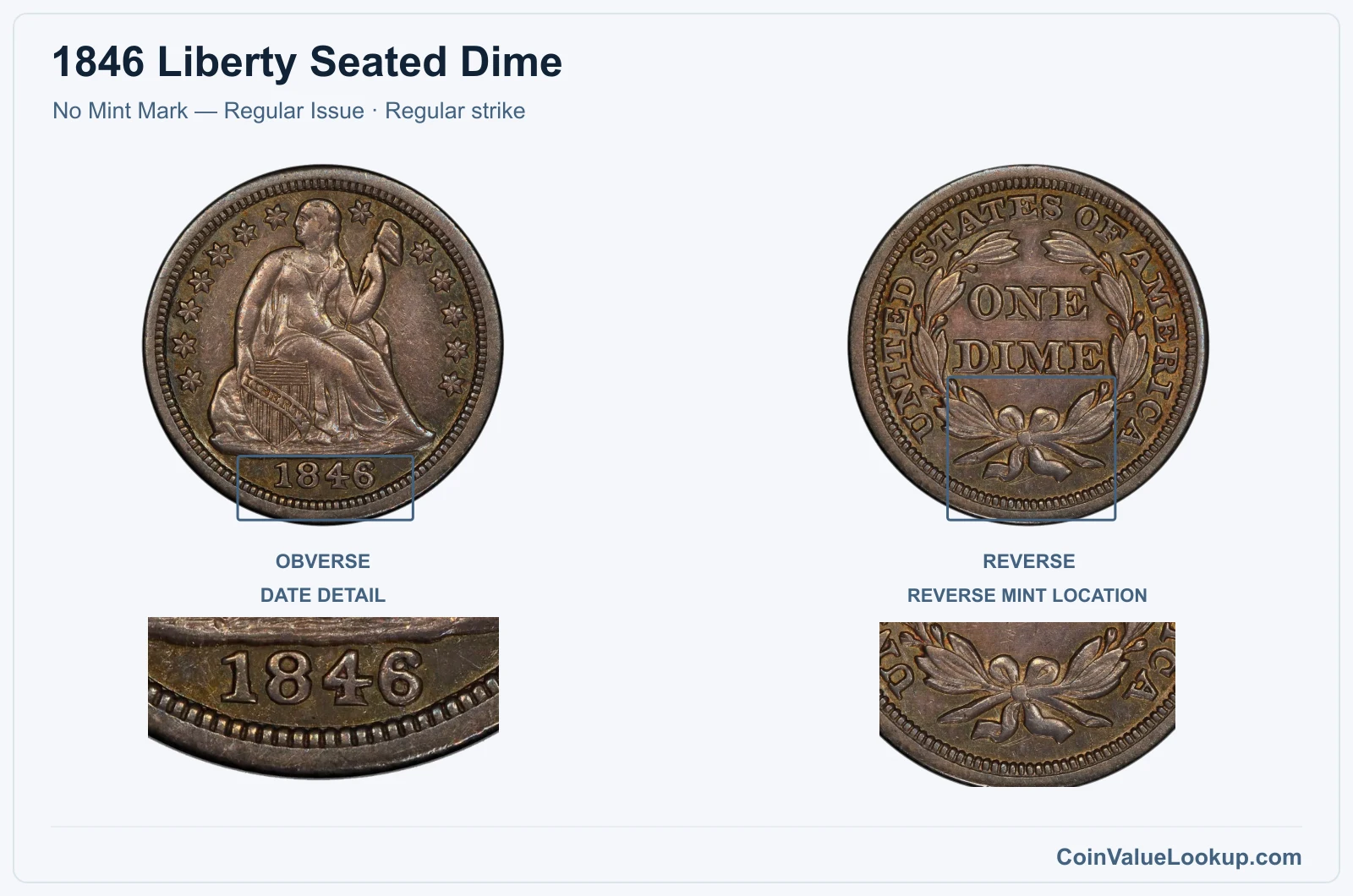
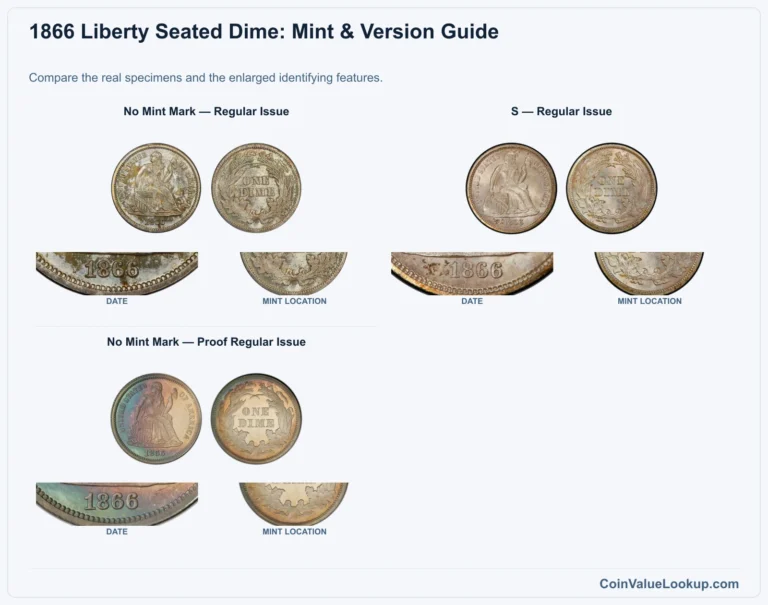
Every 1846 dime came from Philadelphia, so yours will have no mintmark below the reverse wreath. The design is the Stars Obverse with Drapery subtype: thirteen stars border Liberty on the obverse, and a small fold of extra drapery hangs at her elbow.
Weight should be around 2.67 grams in 90 percent silver.
USA Coin Book guide estimates place this issue at approximately $411 in G4 and roughly $62,607 in MS63. Those are retail guide snapshots, not guaranteed sale prices, and the market shifts with silver content and collector demand.
Even a well-worn example holds significant value because the overall mintage for this date was low. When evaluating your coin, confirm the drapery detail and check that the date digits match known 1846 characteristics before assuming grade alone sets the price.
Range Grade
Price Auction Records Appraisal PO PO 1
—
Coin Identifier FR FR 2
—
Coin Identifier AG AG 3
—
Coin Identifier G G 4
Coin Identifier
G 6
Coin Identifier VG VG 8
Coin Identifier
VG 10
Coin Identifier F F 12
Coin Identifier
F 15
Coin Identifier VF VF 20
Coin Identifier
VF 25
Coin Identifier
VF 30
Coin Identifier
VF 35
Coin Identifier XF XF 40
Coin Identifier
XF 45
Coin Identifier AU AU 50
Coin Identifier
AU 53
Coin Identifier
AU 55
Coin Identifier
AU 58
Coin Identifier MS MS 60
—
Coin Identifier
MS 61
Coin Identifier
MS 62
—
Coin Identifier
MS 63
Coin Identifier
MS 64
—
—
—
MS 65
—
—
—
MS 66
—
—
—
MS 67
—
—
—
MS 68
—
—
—
MS 69
—
—
—
MS 70
—
—
—
1846 Liberty Seated Dime — No Mint Mark — Proof Regular Issue
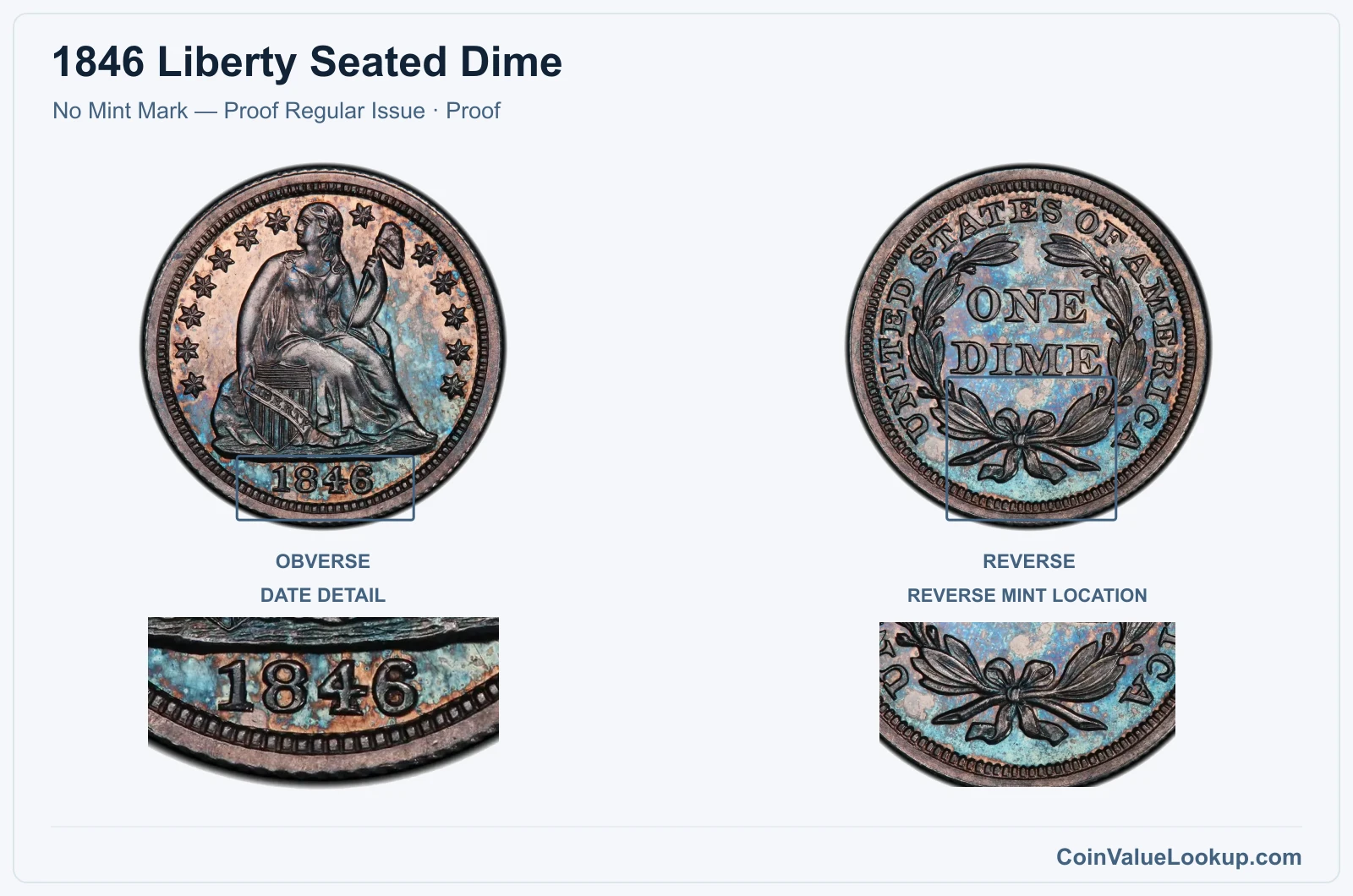
Proof 1846 dimes are genuinely rare. These were not mass-produced annual collector products the way later Proofs were.
A real Proof from this period will show deeply mirrored fields, squared-off rims, and sharp detail that goes beyond what even the best business strike can deliver. PCGS guide estimates place a PR63 example at around $20,000.
Here is the critical part: polished circulation coins are not Proofs. If someone buffed a worn dime until it shines, it still carries the surface damage and wear of its actual grade.
Cameo contrast, where frosted devices stand out against mirror fields, is a characteristic some Proofs display, but it is a description of the finish, not a separate mint or variety.
Coin Value Lookup is a handy place to look up guide values and identification details for Liberty Seated Dimes and other U.S. coin series. It can help you narrow down what you have before committing to a professional attribution service.
Range Grade
Price Auction Records Appraisal PR PR 1
—
Coin Identifier
PR 2
—
Coin Identifier
PR 3
—
Coin Identifier
PR 4
—
Coin Identifier
PR 6
—
Coin Identifier
PR 8
—
Coin Identifier
PR 10
—
Coin Identifier
PR 12
—
Coin Identifier
PR 15
—
Coin Identifier
PR 20
—
Coin Identifier
PR 25
—
Coin Identifier
PR 30
—
Coin Identifier
PR 35
—
Coin Identifier
PR 40
—
Coin Identifier
PR 45
—
Coin Identifier
PR 50
—
Coin Identifier
PR 53
—
Coin Identifier
PR 55
—
Coin Identifier
PR 58
—
Coin Identifier
PR 60
—
Coin Identifier
PR 61
—
Coin Identifier
PR 62
Coin Identifier
PR 63
Coin Identifier
PR 64
Coin Identifier
PR 65
Coin Identifier
PR 66
—
—
—
PR 67
—
—
—
PR 68
—
—
—
PR 69
—
—
—
PR 70
—
—
—
1846 Liberty Seated Dime Error List
1. 1846 Liberty Seated Dime — Die Crack / Die Chip
Die cracks and die chips are documented for the 1846 dime. A die crack appears as a thin raised line on the coin's surface, tracing the path where the steel die fractured during use.
A die chip looks like a small raised blob, usually inside a letter or design element, where a tiny piece of the die broke away.
To spot them, examine both sides under magnification and good lighting. Raised lines that cross fields or connect design elements are the telltale sign.
If the line runs from the rim inward and leaves a flat, shelf-like raised area, that is a cud, a more advanced form of die damage.
Do not confuse die cracks with incuse scratches, which are cut into the surface rather than raised above it. Corrosion pitting or debris stuck to the coin can also mimic a chip.
The value of a die crack or chip depends on its size, location, and the overall condition of the coin. No single numerical premium applies to every example.