1846 Liberty Seated Quarter Coin Value: How Much Is It Worth?
An 1846 Liberty Seated quarter is a Philadelphia-only issue struck in 90% silver. Guide estimates place a well-worn example around $78 in G4 and climb to roughly $2,266 for a choice uncirculated MS63 business strike.
Early proofs exist but live in a separate specialist market. Knowing the exact condition and any die varieties is essential before putting a value on your coin.
Fast Way to Identify Your 1846 Liberty Seated Quarter
Upload clear photos of both sides of your 1846 quarter and our identifier will give you a preliminary read on which version you have. A straight-on shot in good light helps — catch the date, the seated figure and the full eagle reverse.
This is not a substitute for professional authentication, but it is a solid first step.
1846 Liberty Seated Quarter Value
Upload both sides of your 1846 Liberty Seated Quarter.
Front Obverse
Upload photo
Back Reverse
Upload photo
Which 1846 Liberty Seated Quarter Versions Are Worth Money?
- Business strikes in higher grades (VF20 and above) carry meaningful premiums over heavily worn examples — the jump from $78 at G4 to $2,266 at MS63 shows how much condition drives value.
- Authenticated early Philadelphia proofs are rare specialist pieces valued individually based on condition, provenance and expert attribution rather than standard guide curves.
- The Repunched 6 in Date variety shows an extra knob in the final digit — a die-specific feature worth investigating under magnification.
- Reverse Die Cracks following specific paths below the eagle and through lettering mark a known die state that collectors track separately.
Step 1: Identify Your 1846 Liberty Seated Quarter Mint Mark and Version
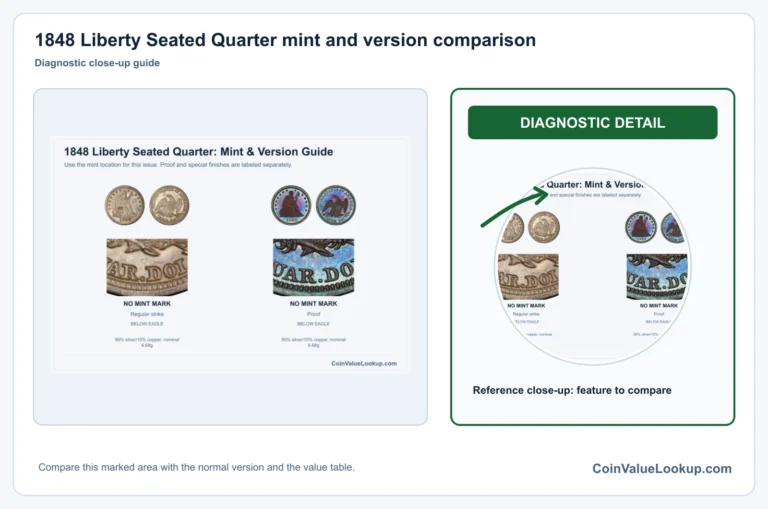
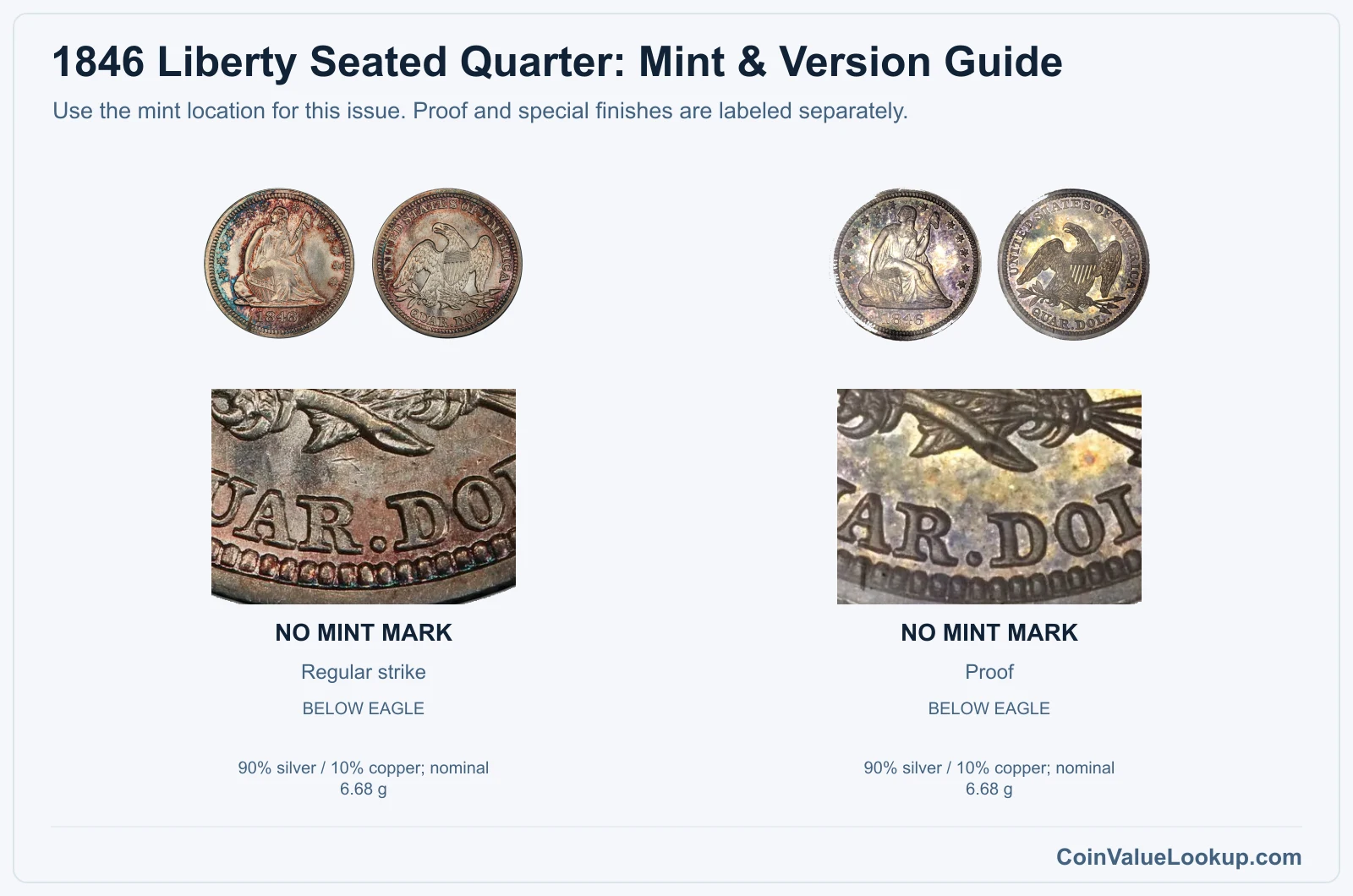
Every quarter struck in 1846 came from the Philadelphia Mint, so there is no mintmark anywhere on the coin. If you see an "O" below the eagle, you are looking at a different denomination — the 1846-O marking appears on gold quarter eagles and dollars, not on quarters.
The obverse shows a seated Liberty figure with drapery at the elbow, a liberty cap on a pole, and thirteen stars around the border. The reverse features a heraldic eagle with no motto above it.
The design is the With Drapery subtype that began in 1840.
Composition is 90% silver and 10% copper, with a nominal weight of 6.68 grams and a diameter of about 24.3 mm. Worn coins can weigh slightly less due to metal loss.
If your coin feels unusually light or the wrong size, compare it carefully against a known example.
A shiny, mirror-like surface alone does not make your coin a proof. Early proof attribution requires expert die analysis and provenance, not just reflectivity — plenty of business strikes were polished over the decades.
Step 2: Check Your 1846 Liberty Seated Quarter Grade
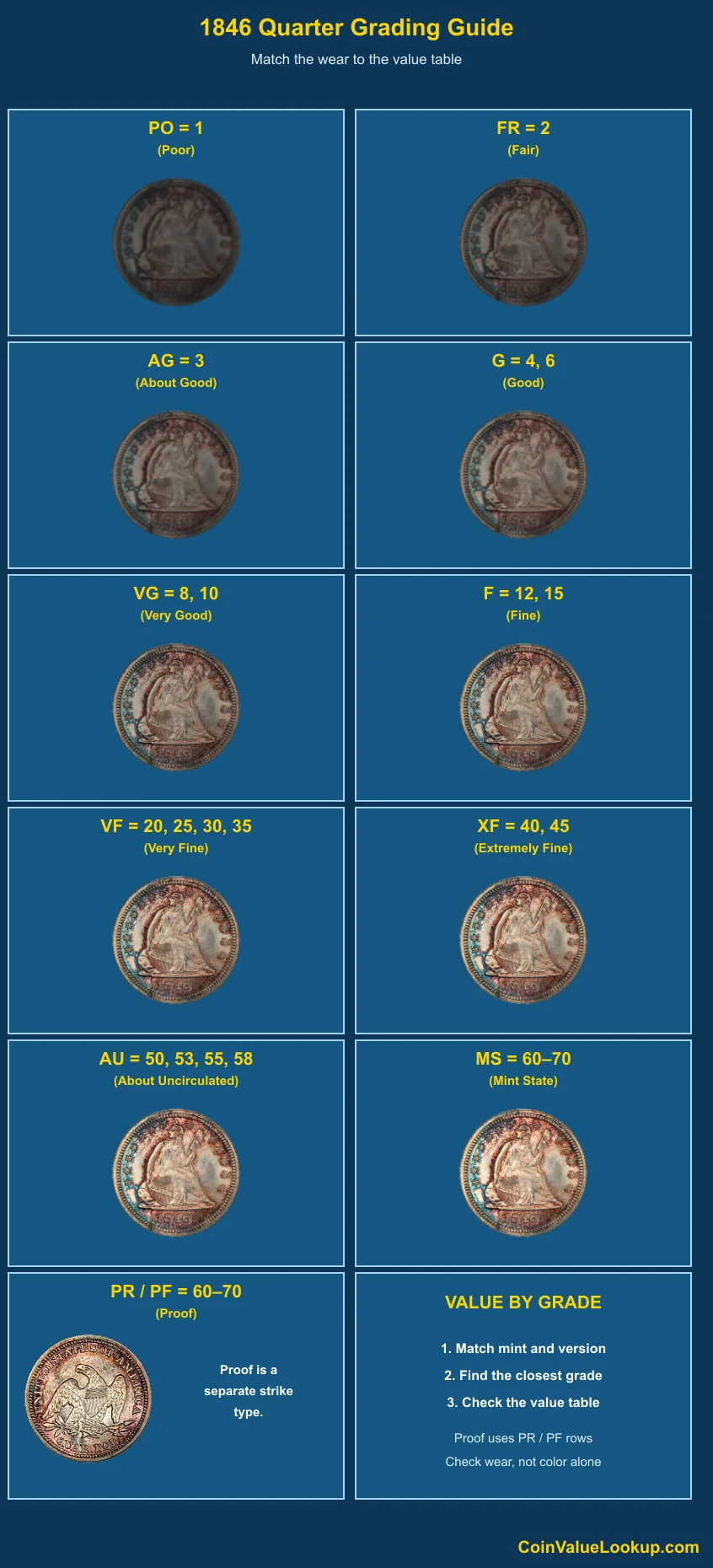
Start with Liberty's head, breast, knee and the letters across her shield. These are the first details to soften with wear.
Then flip and check the eagle's breast feathers, wing tips and claws.
A coin grading G4 (Good) will show a clear outline of Liberty but most internal detail is gone. At VF20 (Very Fine) you will see partial shield letters and defined drapery folds.
MS63 means full original luster with only minor contact marks — compare your coin against the reference image to see these stages side by side.
Do not confuse a weak strike with actual wear. Some 1846 quarters left the press with mushy shield lettering, and that is a production quirk, not a grade penalty.
Look at overall surface continuity and remaining luster to judge.
Hairlines from old cleaning, holes, rim damage and green or black environmental corrosion all reduce value significantly, sometimes more than wear itself. These problems matter to buyers and grading services alike.
Step 3: Check 1846 Liberty Seated Quarter Value by Mint and Version
1846 Liberty Seated Quarter — Philadelphia Business Strike
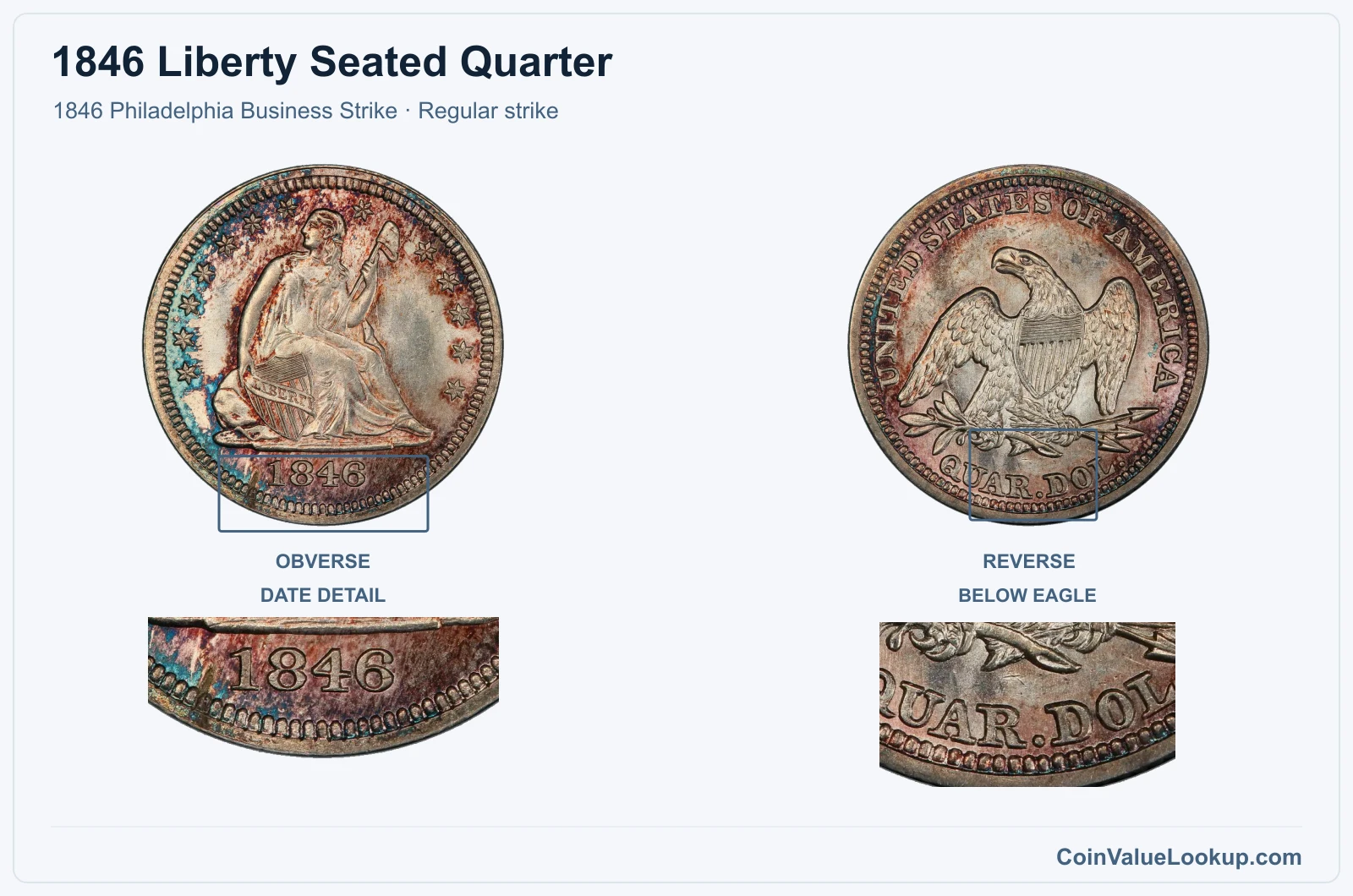
This is the standard 1846 business strike from the Philadelphia Mint. No mintmark appears on the coin.
The design is the With Drapery seated Liberty obverse paired with the no-motto eagle reverse, struck in 90% silver at a nominal 6.68 grams.
Guide estimates from USA Coin Book place this version at about $78 in G4, around $163 in VF20, and approximately $2,266 in MS63. Those are retail guide figures, not guaranteed sale prices, and actual transactions vary with eye appeal, surface quality and market timing.
Most surviving examples sit in lower circulated grades, so anything approaching uncirculated territory commands a steep premium.
Coin Value Lookup is a good starting point if you want to compare this quarter's guide values against other dates in the Seated Liberty series.
| Range | Grade | Price | Auction Records | Appraisal |
|---|---|---|---|---|
| PO | PO 1 | — | Coin Identifier | |
| FR | FR 2 | — | Coin Identifier | |
| AG | AG 3 | — | Coin Identifier | |
| G | G 4 | — | Coin Identifier | |
| G 6 | — | Coin Identifier | ||
| VG | VG 8 | — | Coin Identifier | |
| VG 10 | — | Coin Identifier | ||
| F | F 12 | Coin Identifier | ||
| F 15 | Coin Identifier | |||
| VF | VF 20 | — | Coin Identifier | |
| VF 25 | Coin Identifier | |||
| VF 30 | Coin Identifier | |||
| VF 35 | Coin Identifier | |||
| XF | XF 40 | Coin Identifier | ||
| XF 45 | Coin Identifier | |||
| AU | AU 50 | Coin Identifier | ||
| AU 53 | Coin Identifier | |||
| AU 55 | Coin Identifier | |||
| AU 58 | Coin Identifier | |||
| MS | MS 60 | — | Coin Identifier | |
| MS 61 | Coin Identifier | |||
| MS 62 | — | Coin Identifier | ||
| MS 63 | Coin Identifier | |||
| MS 64 | Coin Identifier | |||
| MS 65 | Coin Identifier | |||
| MS 66 | Coin Identifier | |||
| MS 67 | — | — | — | |
| MS 68 | — | — | — | |
| MS 69 | — | — | — | |
| MS 70 | — | — | — |
1846 Liberty Seated Quarter — Proof Philadelphia
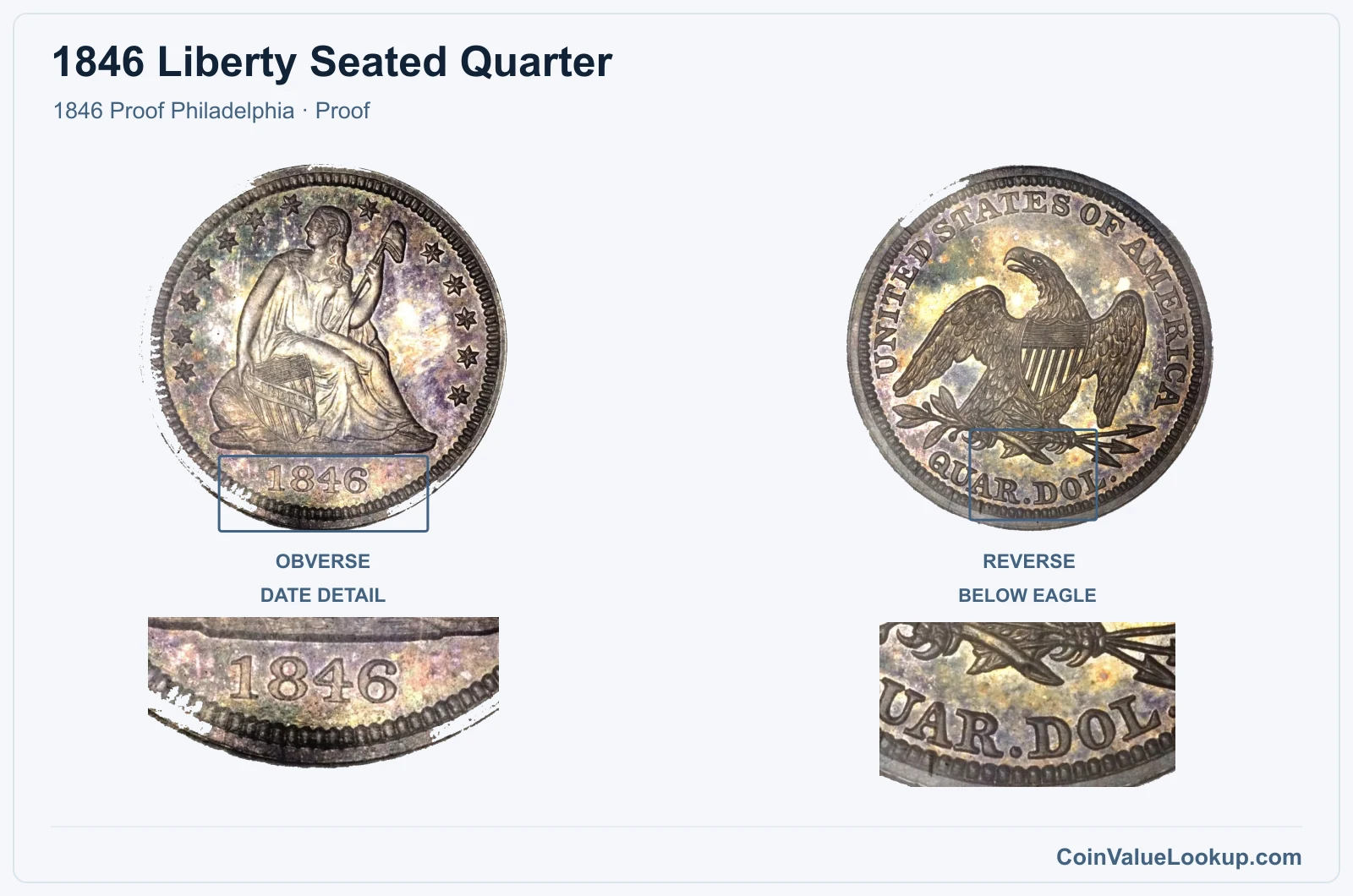
Early proofs of the 1846 quarter were struck at the Philadelphia Mint from specially prepared dies. They share the same composition, weight and design as business strikes — 90% silver, 6.68 grams, seated Liberty with drapery, and the no-motto eagle reverse.
Do not assume your coin is a proof because it looks shiny. A polished business strike is not a proof.
Genuine proof attribution for this era requires detailed die-surface comparison, examination of edge and field characteristics, and ideally documented provenance. Third-party grading services handle this routinely.
No reliable numeric price range is adopted here. Each authenticated proof is assessed individually based on its condition, surface preservation and history.
These are rare specialist coins, and their market is driven by individual transactions rather than broad guide tables.
| Range | Grade | Price | Auction Records | Appraisal |
|---|---|---|---|---|
| PR | PR 1 | — | Coin Identifier | |
| PR 2 | — | Coin Identifier | ||
| PR 3 | — | Coin Identifier | ||
| PR 4 | — | Coin Identifier | ||
| PR 6 | — | Coin Identifier | ||
| PR 8 | — | Coin Identifier | ||
| PR 10 | — | Coin Identifier | ||
| PR 12 | — | Coin Identifier | ||
| PR 15 | — | Coin Identifier | ||
| PR 20 | — | Coin Identifier | ||
| PR 25 | — | Coin Identifier | ||
| PR 30 | — | Coin Identifier | ||
| PR 35 | — | Coin Identifier | ||
| PR 40 | — | Coin Identifier | ||
| PR 45 | — | Coin Identifier | ||
| PR 50 | — | Coin Identifier | ||
| PR 53 | — | Coin Identifier | ||
| PR 55 | — | Coin Identifier | ||
| PR 58 | — | Coin Identifier | ||
| PR 60 | — | Coin Identifier | ||
| PR 61 | — | Coin Identifier | ||
| PR 62 | Coin Identifier | |||
| PR 63 | — | Coin Identifier | ||
| PR 64 | Coin Identifier | |||
| PR 65 | Coin Identifier | |||
| PR 66 | — | — | — | |
| PR 67 | — | — | — | |
| PR 68 | — | — | — | |
| PR 69 | — | — | — | |
| PR 70 | — | — | — |
1846 Liberty Seated Quarter Error List
1. 1846 Liberty Seated Quarter — Repunched 6 in Date
On certain 1846 Philadelphia business strikes, the final digit 6 in the date was first punched too low and then corrected. The visible diagnostic is an extra knob that appears between the upper knob and the lower loop of the 6.
Under moderate magnification — 5x to 10x — this remnant is distinct from the normal curves of the digit.
Do not confuse this with a filled or mushy date caused by die wear, grease-filled dies or post-strike damage. A repunched date shows a clear doubled or shifted element of the original punch, not just softness.
It also differs from an overdate, which involves digits of different years.
No standard guide price is adopted for this variety. Value depends on the coin's overall grade, surface quality and whether the repunching has been confirmed by a grading service.
Individual assessment is the way to go here.
2. 1846 Liberty Seated Quarter — Reverse Die Cracks
Some 1846 Philadelphia business strikes display a network of raised die cracks on the reverse. The documented pattern runs below the eagle's beak toward the wing, near the letters ME and R in AMERICA, and between the upper arrowheads toward the denomination.
Heritage Auctions documented one such example as an early die state without noticeable cuds.
These cracks appear as thin raised lines on the coin's surface because metal fills the crack in the die during striking. They differ from scratches, which are incised into the surface rather than raised above it.
They also should not be confused with normal feather separation or shield line detail, which follows the engraved design.
No specific price premium is adopted for this variety. The value of any die-crack example depends on the crack's prominence, the coin's overall grade and market demand.
Do not assume an exceptional high-grade sale applies to a lower-grade specimen with similar cracks.