1848 Liberty Seated Quarter Coin Value: How Much Is It Worth?
The 1848 Liberty Seated Quarter was struck only at the Philadelphia Mint, and every known business-strike example shows some form of repunched date. Guide estimates for this issue start around $78 in G4, climb to about $258 in VF20, and reach roughly $5,728 at the MS63 level according to USA Coin Book.
Proofs exist but require individual assessment rather than a simple price-chart lookup.
Fast Way to Identify Your 1848 Liberty Seated Quarter
Want a quick read on your 1848 quarter? Upload clear photos of the front and back, and our identifier can help with a preliminary identification of the mint, design type, and major version.
It is not a substitute for professional authentication or grading, but it gives you a solid starting point before you dig deeper.
1848 Liberty Seated Quarter Value
Upload both sides of your 1848 Liberty Seated Quarter.
Front Obverse
Upload photo
Back Reverse
Upload photo
Which 1848 Liberty Seated Quarter Versions Are Worth Money?
- Both documented 1848 die pairings feature repunched dates; identifying whether yours is doubled or tripled can affect collector interest.
- The doubled-date version pairs with a distinctive compass-point reverse, making it visually identifiable from both sides.
- Proofs from 1848 are rare early Philadelphia strikes that require authenticated attribution, not just reflective surfaces.
- Problem-free higher-grade examples command strong premiums; an MS63 guide estimate sits near $5,728.
Step 1: Identify Your 1848 Liberty Seated Quarter Mint Mark and Version
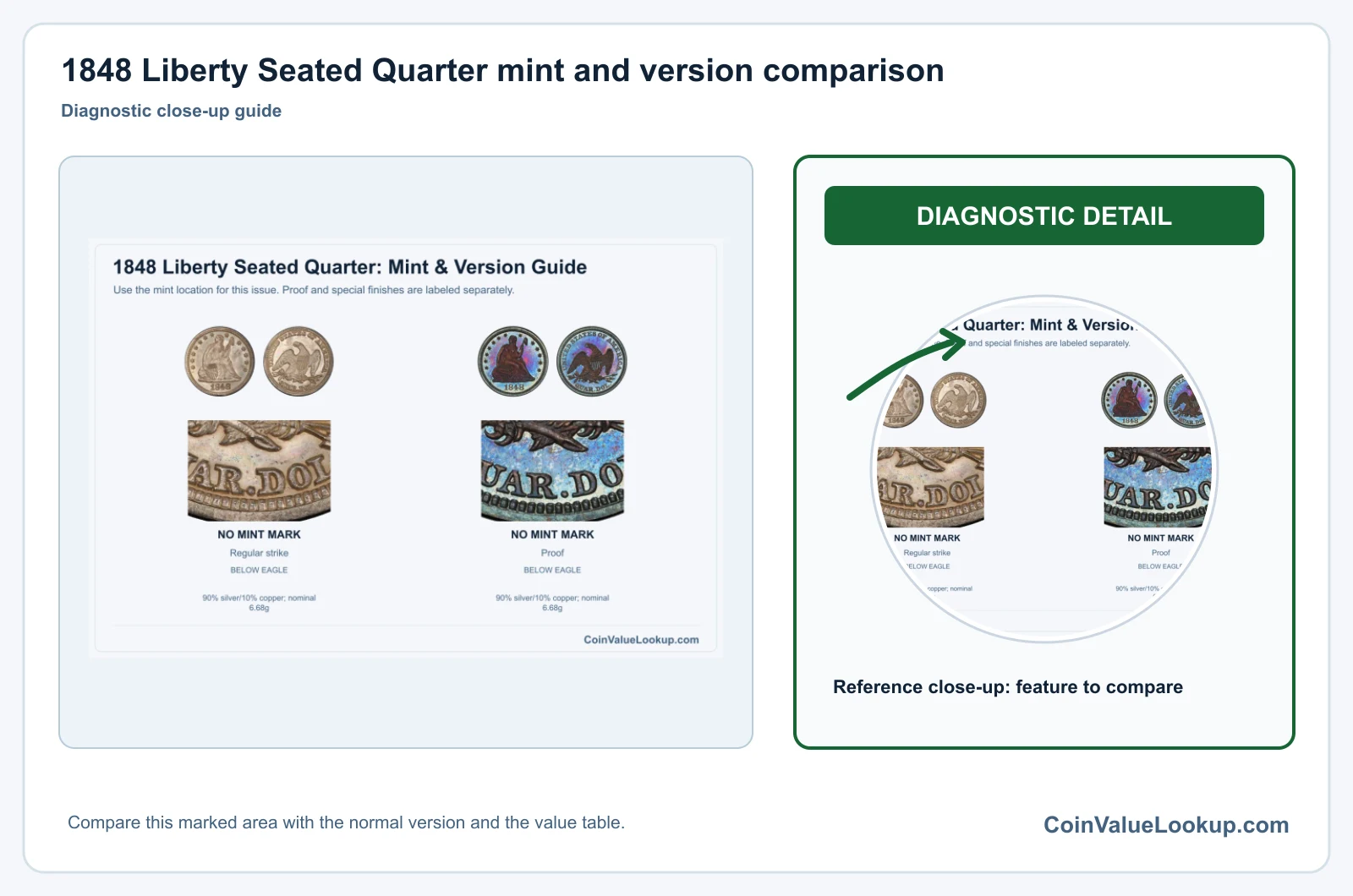
Every 1848 Seated Liberty quarter came from Philadelphia. There is no mintmark on these coins.
If you see an "O" or "S" below the eagle on the reverse, you have a different date or an altered coin, since New Orleans did not strike this denomination in 1848 and San Francisco production did not begin until 1855.
The design shows Liberty seated on the obverse with stars around the border and the date below. The reverse features an eagle without the motto "In God We Trust," which was not added until later in the series.
No arrows flank the date and no rays surround the eagle, placing this firmly in the pre-1853 heavy-standard era.
Specifications are 90% silver and 10% copper, approximately 24.3 mm in diameter, with a nominal weight of 6.68 grams. That weight is heavier than post-1853 quarters, which dropped to 6.22 grams.
A genuine 1848 that weighs significantly less may have been cleaned aggressively, damaged, or is not what it appears to be.
The key identification step is the date. Both documented die pairings show repunching in the date digits, so you need to determine whether yours is the doubled-date version or the tripled-date version.
Grab a loupe and look carefully at the bases and tops of the numerals.
Step 2: Check Your 1848 Liberty Seated Quarter Grade
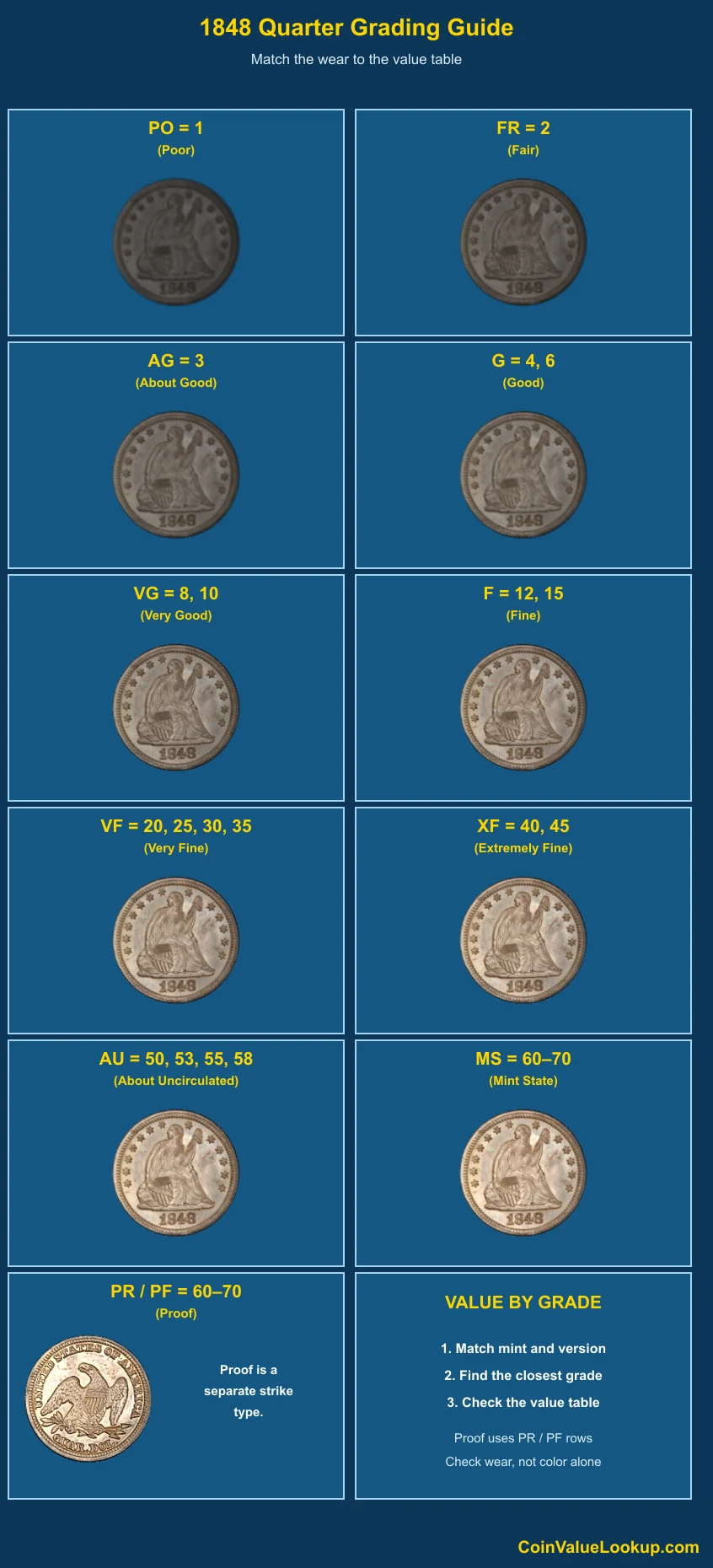
Start with the obverse. Liberty's head, the lines across her breast, her knee, and the lettering on the shield are the first places to lose detail as a coin circulates.
In lower grades like G4, Liberty is a mostly flat outline with the shield text gone. By VF20, you should see moderate detail in the gown and partial shield letters.
Now flip it over. The eagle's breast feathers, wing tips, and claws tell the same story on the reverse.
Sharp, separated feathers with full luster point toward mint state; mushy, blended feathers suggest heavy wear.
Do not confuse a weak strike for wear. Some 1848 quarters left the press with soft star points or incomplete head detail.
A weakly struck coin will still show original luster in protected areas, while a worn coin will not. Compare your piece to the reference image to see the difference.
Surface quality matters enormously. Hairlines from old cleaning, rim dings, corrosion spots, and artificial toning all reduce value well below what a grade number alone would suggest.
Original, problem-free surfaces are what collectors pay up for.
Coin Value Lookup is a handy place to look up quarter values across the entire Seated Liberty series and beyond. If you are sorting through a collection, it can help you quickly find the right guide for each date and denomination.
Step 3: Check 1848 Liberty Seated Quarter Value by Mint and Version
1848 Liberty Seated Quarter — Doubled Date with Compass-Point Reverse
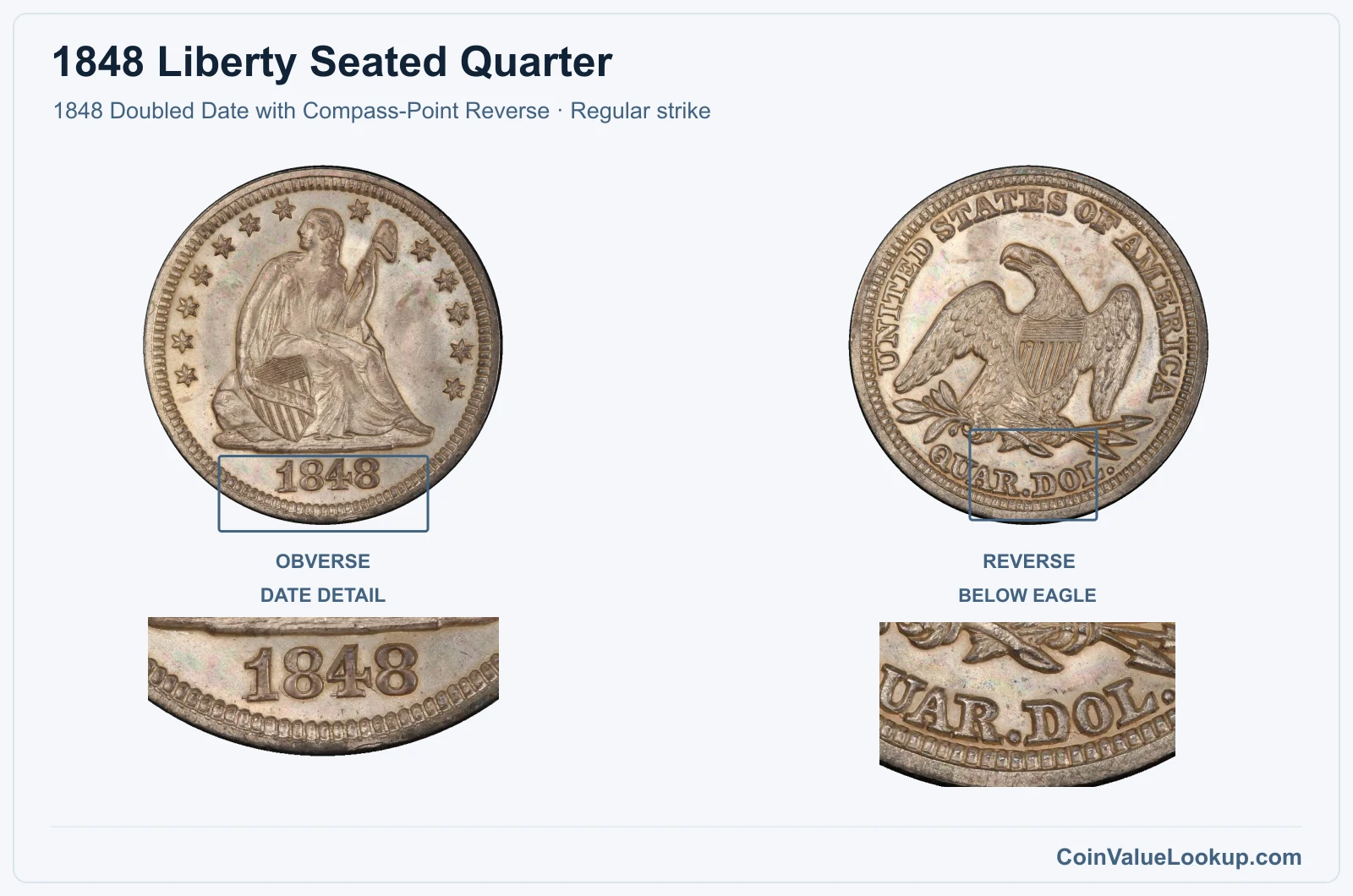
This is one of two known die pairings for 1848, and it is the one collectors tend to notice first. The date digits show clear doubling, with raised remnants visible where the date punch was impressed a second time slightly offset from the first.
Under magnification, you can see split serifs and thickened bases on the numerals.
The reverse clinches the attribution. Look at the shield lines on the eagle: this die has a distinctive circular gap in the horizontal lines that resembles compass points.
No other 1848 reverse shows this defect. USA Coin Book guide estimates for the general 1848 quarter place G4 around $78, VF20 near $258, and MS63 at roughly $5,728.
No separate premium for this specific pairing has been adopted, so treat those figures as a baseline for the date.
Range Grade
Price Auction Records Appraisal PO PO 1
—
Coin Identifier FR FR 2
—
Coin Identifier AG AG 3
—
Coin Identifier G G 4
—
Coin Identifier
G 6
—
Coin Identifier VG VG 8
—
Coin Identifier
VG 10
—
Coin Identifier F F 12
Coin Identifier
F 15
Coin Identifier VF VF 20
Coin Identifier
VF 25
Coin Identifier
VF 30
Coin Identifier
VF 35
Coin Identifier XF XF 40
Coin Identifier
XF 45
Coin Identifier AU AU 50
Coin Identifier
AU 53
Coin Identifier
AU 55
Coin Identifier
AU 58
Coin Identifier MS MS 60
—
Coin Identifier
MS 61
—
Coin Identifier
MS 62
Coin Identifier
MS 63
Coin Identifier
MS 64
Coin Identifier
MS 65
—
Coin Identifier
MS 66
—
—
—
MS 67
—
—
—
MS 68
—
—
—
MS 69
—
—
—
MS 70
—
—
—
1848 Liberty Seated Quarter — Proof
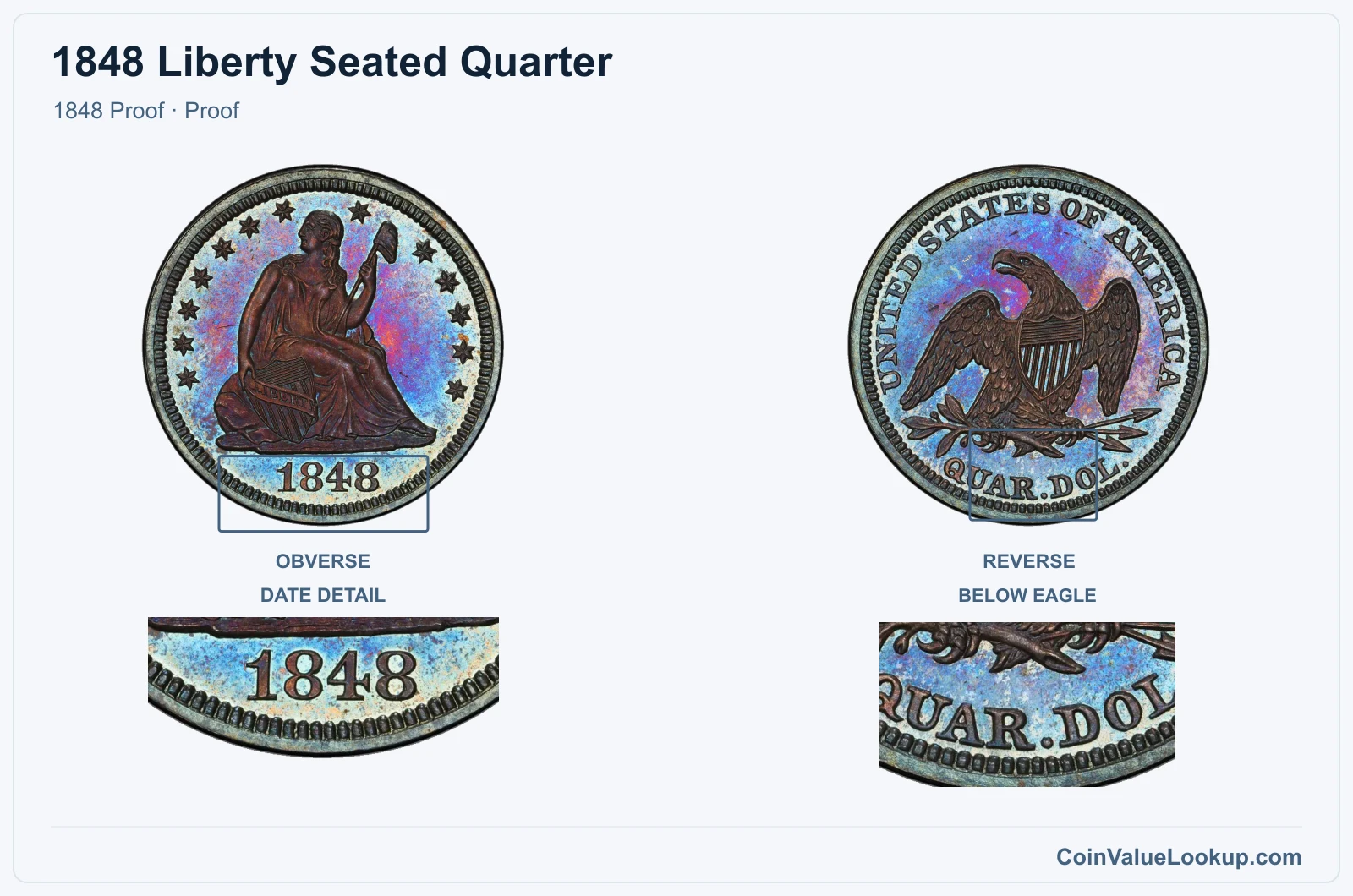
Philadelphia struck a small number of proof 1848 Seated Liberty quarters. These are early proofs from an era before the Mint had standardized proof production, so they can be tricky to confirm.
Reflective surfaces alone do not prove a coin is a proof; genuine specimens need comparison against authenticated examples.
No supported price range has been adopted for the 1848 proof quarter. Each piece needs individual assessment based on its authenticated identity, surface preservation, and overall condition.
If you suspect you have one, professional third-party certification is the appropriate next step rather than relying on visual impression or a price chart.
| Range | Grade | Price | Auction Records | Appraisal |
|---|---|---|---|---|
| PR | PR 1 | — | Coin Identifier | |
| PR 2 | — | Coin Identifier | ||
| PR 3 | — | Coin Identifier | ||
| PR 4 | — | Coin Identifier | ||
| PR 6 | — | Coin Identifier | ||
| PR 8 | — | Coin Identifier | ||
| PR 10 | — | Coin Identifier | ||
| PR 12 | — | Coin Identifier | ||
| PR 15 | — | Coin Identifier | ||
| PR 20 | — | Coin Identifier | ||
| PR 25 | — | Coin Identifier | ||
| PR 30 | — | Coin Identifier | ||
| PR 35 | — | Coin Identifier | ||
| PR 40 | — | Coin Identifier | ||
| PR 45 | — | Coin Identifier | ||
| PR 50 | — | Coin Identifier | ||
| PR 53 | — | Coin Identifier | ||
| PR 55 | — | Coin Identifier | ||
| PR 58 | — | Coin Identifier | ||
| PR 60 | — | Coin Identifier | ||
| PR 61 | — | Coin Identifier | ||
| PR 62 | — | Coin Identifier | ||
| PR 63 | — | Coin Identifier | ||
| PR 64 | — | Coin Identifier | ||
| PR 65 | Coin Identifier | |||
| PR 66 | Coin Identifier | |||
| PR 67 | — | — | — | |
| PR 68 | — | — | — | |
| PR 69 | — | — | — | |
| PR 70 | — | — | — |
1848 Liberty Seated Quarter — Tripled Date
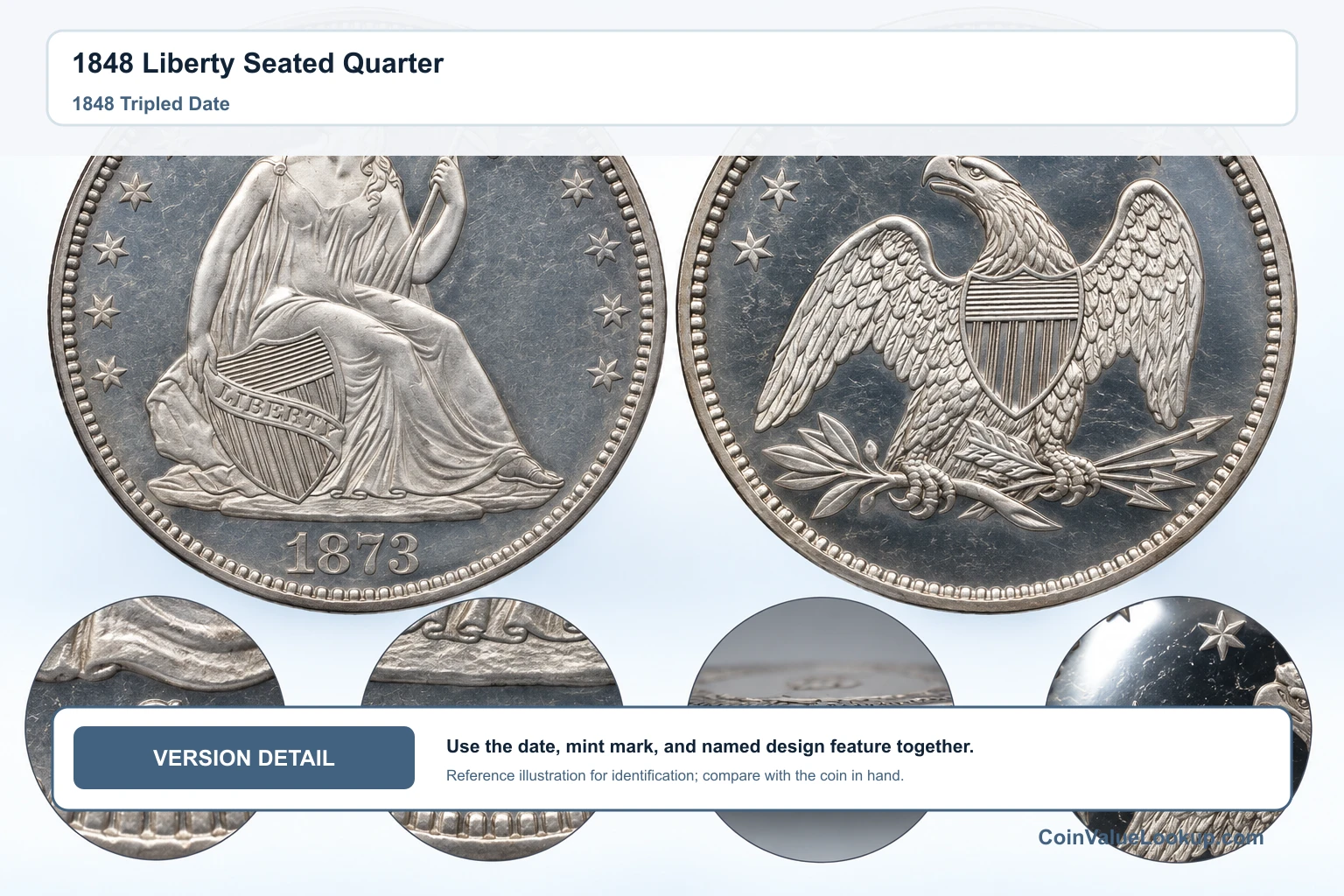
The second documented 1848 die pairing shows tripled date digits instead of doubled ones. Under magnification you will see three overlapping impressions of the numerals, giving the date a slightly busier, more layered appearance than the doubled-date version.
The reverse is the key separator. Unlike the doubled-date pairing, this reverse does not carry the compass-point gap in the shield lines.
If your coin has tripled date digits and a clean reverse shield, you are looking at this variety. No specific price range has been adopted for this pairing, so value depends on the individual coin's grade, surface quality, and authenticated attribution.
Range Grade
Price Auction Records Appraisal PO PO 1
—
Coin Identifier FR FR 2
—
Coin Identifier AG AG 3
—
Coin Identifier G G 4
—
Coin Identifier
G 6
—
Coin Identifier VG VG 8
—
Coin Identifier
VG 10
—
Coin Identifier F F 12
Coin Identifier
F 15
Coin Identifier VF VF 20
Coin Identifier
VF 25
Coin Identifier
VF 30
Coin Identifier
VF 35
Coin Identifier XF XF 40
Coin Identifier
XF 45
Coin Identifier AU AU 50
Coin Identifier
AU 53
Coin Identifier
AU 55
Coin Identifier
AU 58
Coin Identifier MS MS 60
—
Coin Identifier
MS 61
—
Coin Identifier
MS 62
Coin Identifier
MS 63
Coin Identifier
MS 64
Coin Identifier
MS 65
—
Coin Identifier
MS 66
—
—
—
MS 67
—
—
—
MS 68
—
—
—
MS 69
—
—
—
MS 70
—
—
—
1848 Liberty Seated Quarter Error List
1. 1848 Liberty Seated Quarter — Repunched Date
Both known 1848 die pairings are repunched dates, so this is not a rare exception for the year; it is the norm. The date was hand-punched into each working die, and in both cases the punch landed more than once in slightly different positions, leaving raised remnants of earlier impressions on every coin struck from those dies.
The doubled-date version shows two clear impressions. The tripled-date version shows three.
To tell them apart, inspect the date digits under at least 5x magnification and then check the reverse shield lines for the compass-point gap that only appears on the doubled-date die.
Watch out for machine doubling, which is a flat, shelf-like distortion from loose dies during striking. True repunched-date remnants are raised and sharply defined, matching the profile of the surrounding design.
No separate premium for these repunched dates has been adopted, so value depends on the specific pairing, the coin's overall grade, and its surface condition. Professional attribution is worthwhile if you believe you have a high-grade example.