1860 Liberty Seated Quarter Coin Value: How Much Is It Worth?
The 1860 Liberty Seated Quarter is a pre-Civil War silver coin struck at three different mints, and its value depends heavily on which mint produced it, what condition it survived in, and whether it was made as a proof. Guide estimates range from $46.00 to $54,390.00 across the listed versions and grades, so identifying your specific coin matters before jumping to a number.
Fast Way to Identify Your 1860 Liberty Seated Quarter
The quickest way to start figuring out what you have is to upload clear photos of both the front and back of your coin. Our identifier can give you a preliminary identification based on those images, helping you narrow down the mint, version, and general condition before you dig deeper into values.
1860 Liberty Seated Quarter Value
Upload both sides of your 1860 Liberty Seated Quarter.
Front Obverse
Upload photo
Back Reverse
Upload photo
Which 1860 Liberty Seated Quarter Versions Are Worth Money?
- 1860-S: Guide estimate reaches $54,390.00 in MS60, reflecting the extreme rarity of this San Francisco issue in uncirculated condition.
- 1860-O: Guide estimate of $2,120.00 at MS63 — the New Orleans mint version carries a solid premium in higher grades.
- 1860 PR: Proof strikes guide at $1,453.00 in PR63; these were deliberately made for collectors and have mirror-like fields when properly preserved.
Step 1: Identify Your 1860 Liberty Seated Quarter Mint Mark and Version
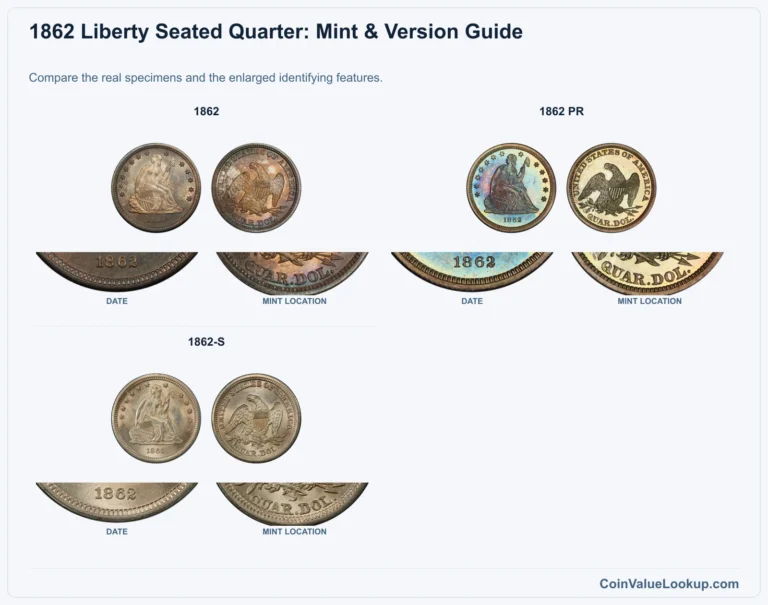
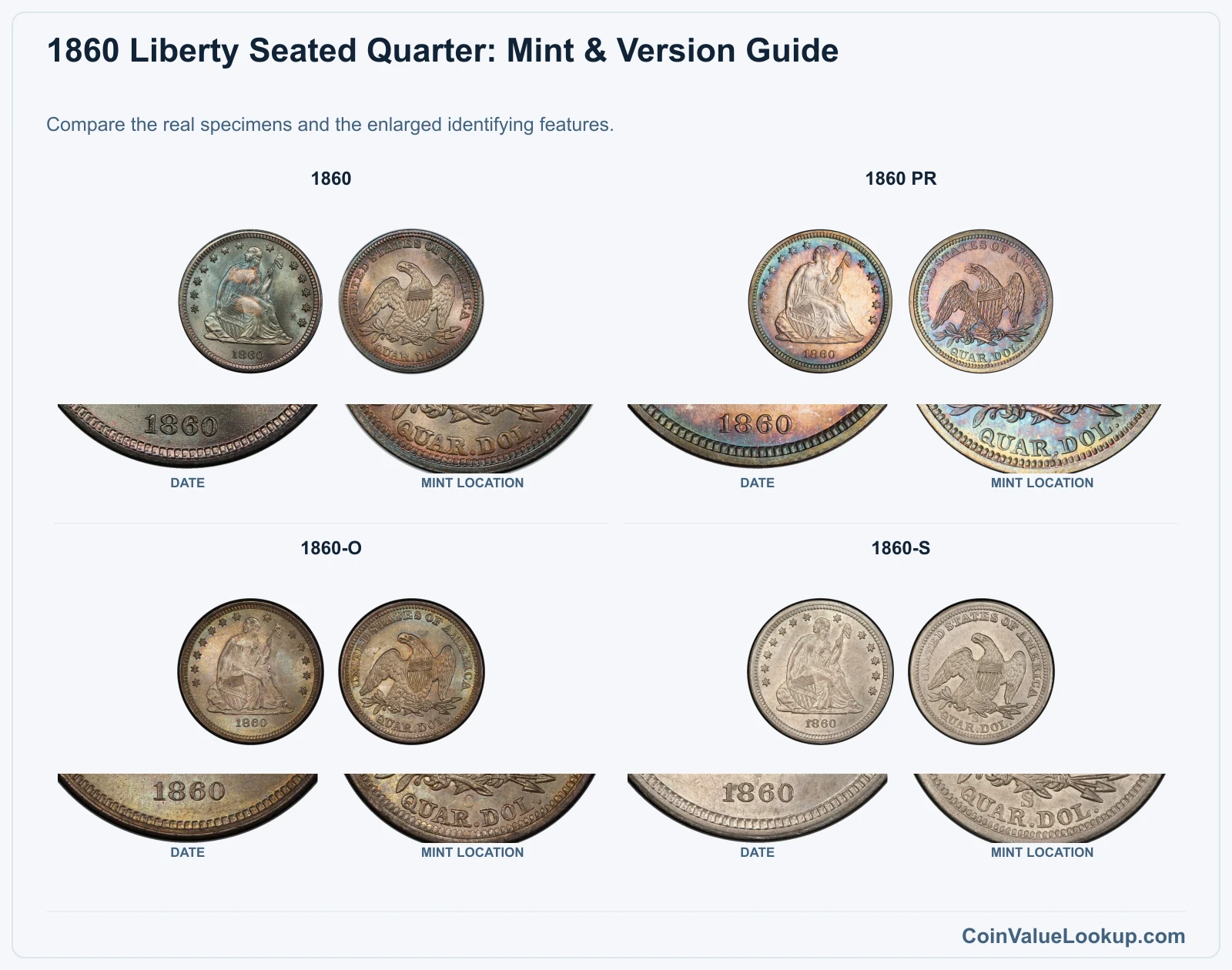
The 1860 quarter was struck in Philadelphia, New Orleans, and San Francisco. Philadelphia coins carry no mintmark.
For the branch mints, look on the reverse beneath the eagle: an "O" means New Orleans, an "S" means San Francisco.
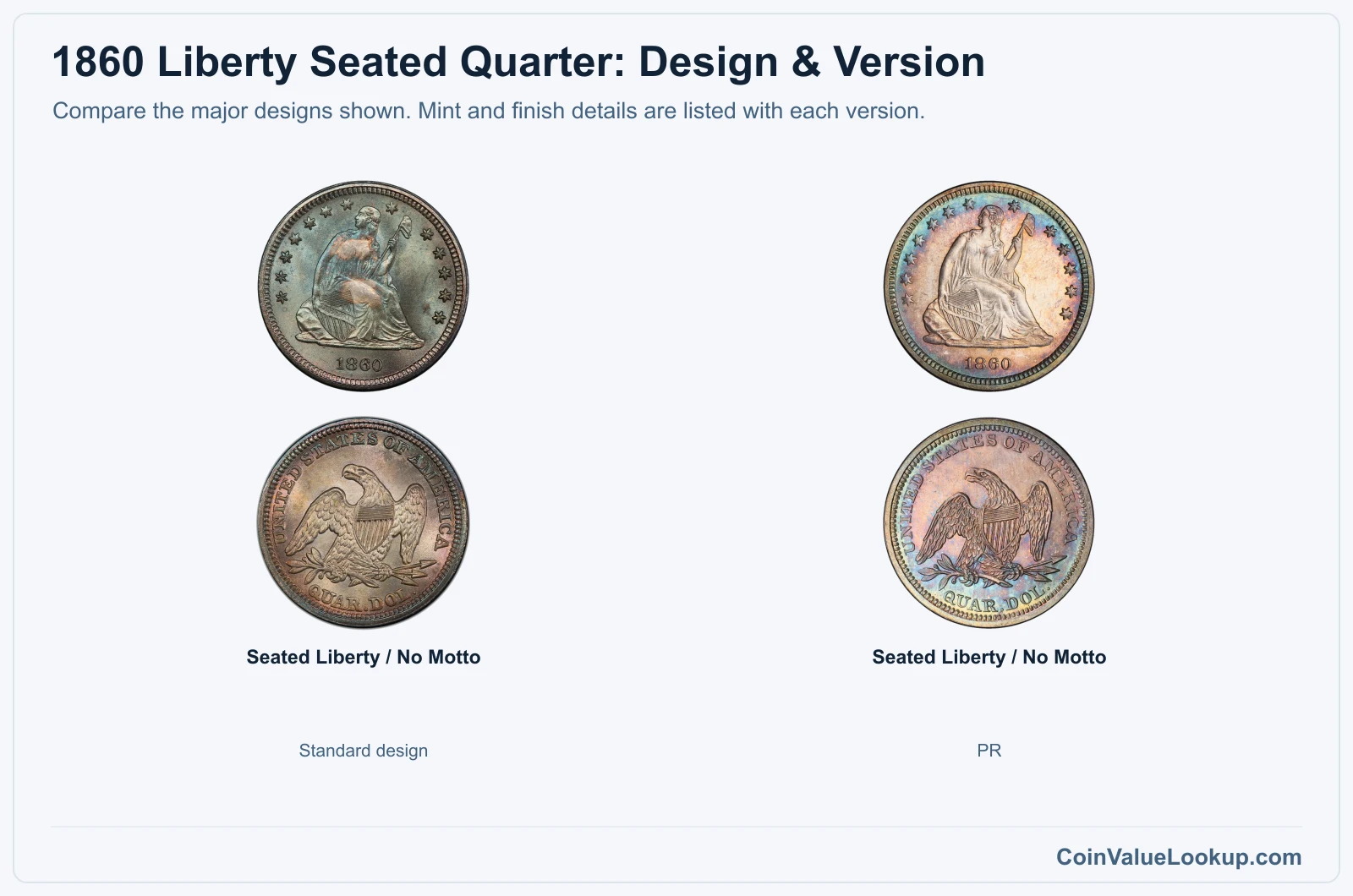
All 1860 quarters are 90% silver and 10% copper, weighing 6.22 grams at the standard weight. The design features the Seated Liberty on the obverse and an eagle on the reverse without the "In God We Trust" motto, which was not added to this series until 1866.
Four branches exist for this year: the regular Philadelphia business strike (1860), the Philadelphia proof (1860 PR), the New Orleans issue (1860-O), and the San Francisco issue (1860-S). Confirm which one you hold before looking at any price guide.
A shiny coin is not automatically a proof, and a worn coin from the right mint can still carry strong value.
Step 2: Check Your 1860 Liberty Seated Quarter Grade
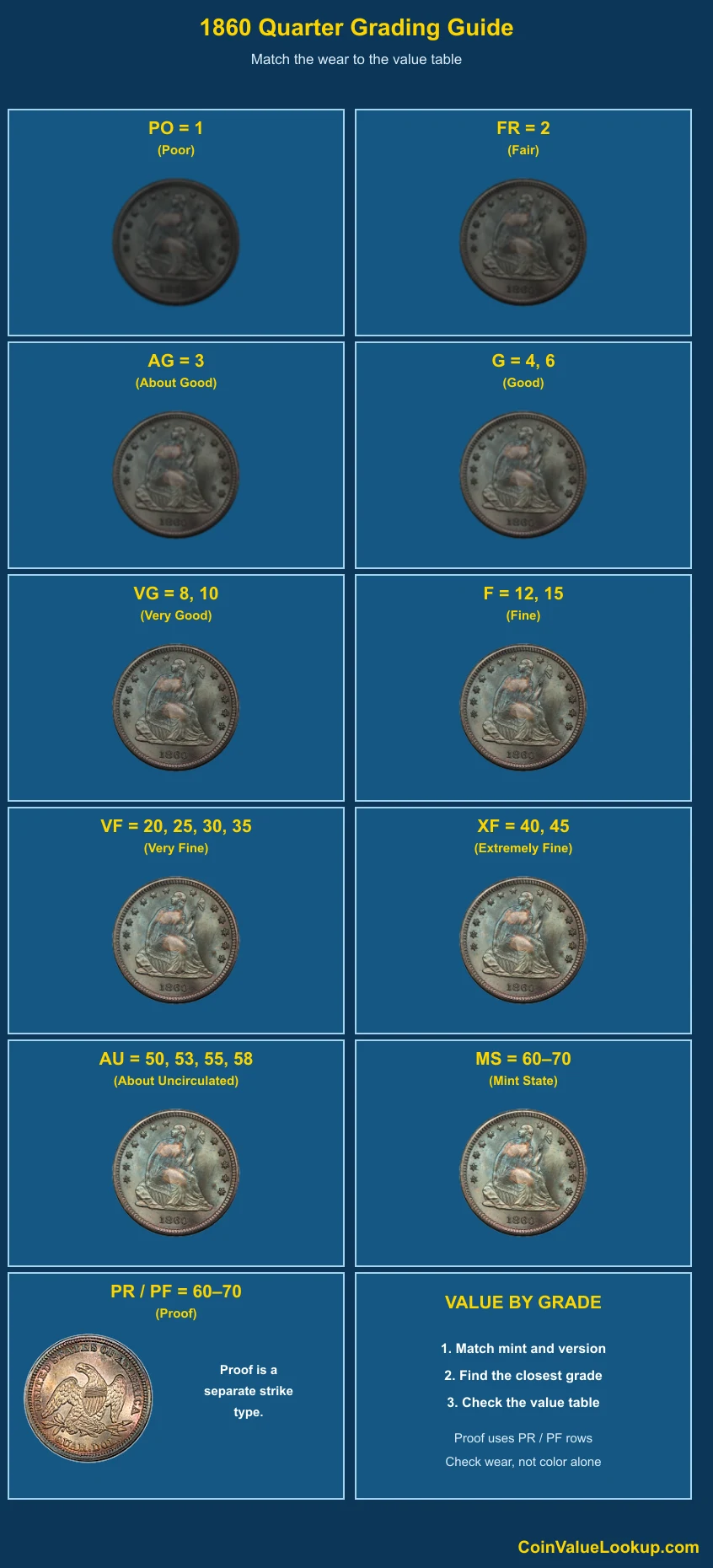
Focus on four areas of the obverse: Liberty's head, breast, knee, and the shield she holds. On the reverse, check the eagle's breast feathers and the tops of the wings.
These are the high points that wear first.
Compare your coin's wear against the reference image for this type. A coin grading Good-4 will show a clear outline of Liberty but almost no interior detail.
At Mint State 60 and above, there should be no wear, though bag marks and contact marks are expected.
Don't confuse a weak strike with wear. Some 1860 quarters left the press with soft details in the centers, even though they were never circulated.
Luster is your ally here: an unworn coin retains its original mint sheen across the fields, while a worn coin loses it on the high points first. A cleaned coin may look bright but will lack natural luster and often shows fine hairlines under magnification, which reduces its collector value.
Step 3: Check 1860 Liberty Seated Quarter Value by Mint and Version
1860 Liberty Seated Quarter
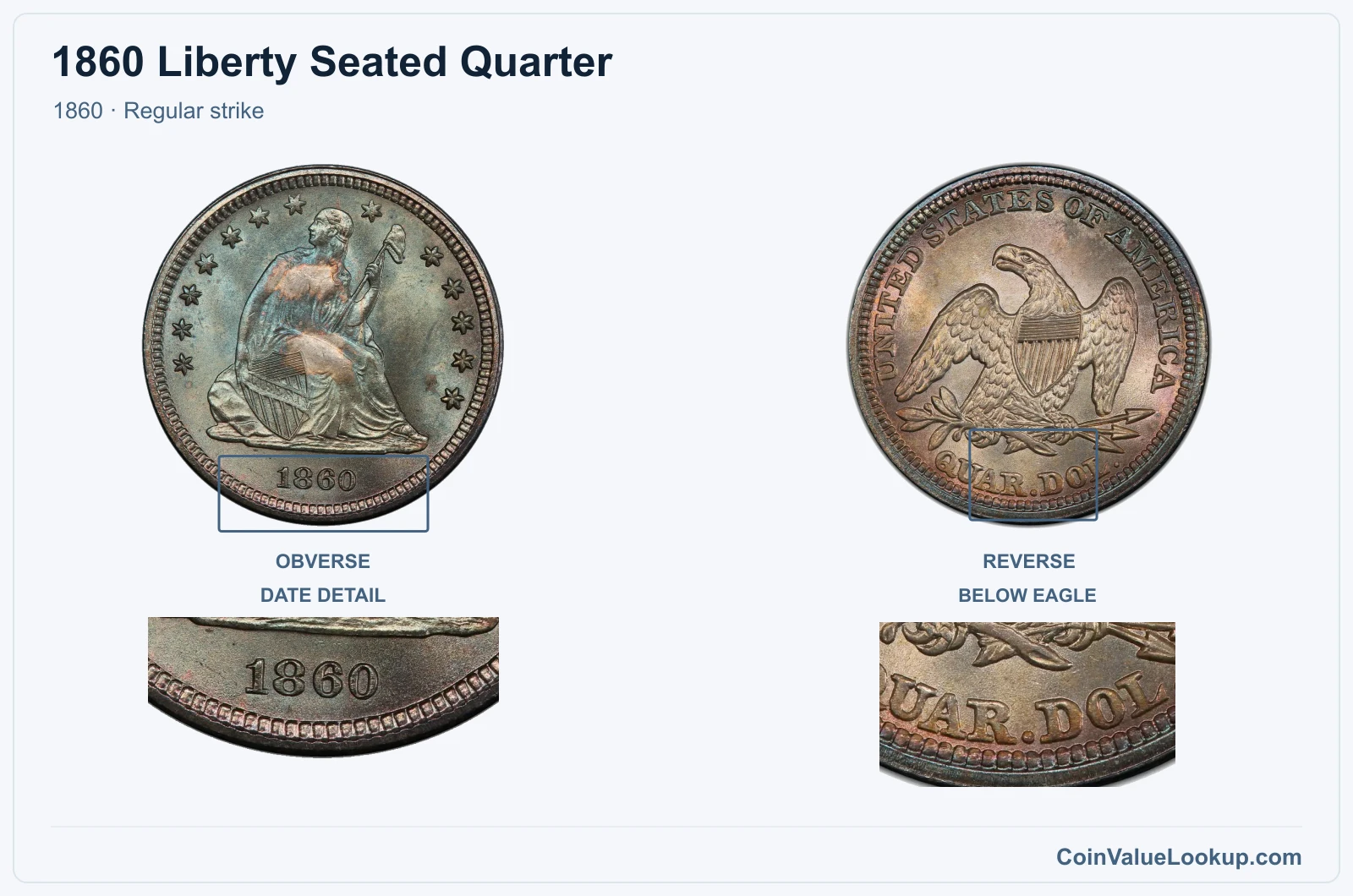
The 1860 Philadelphia business strike is the most accessible version of this year's quarter. It has no mintmark — the reverse below the eagle should be clean of any letter.
Guide estimates from USA Coin Book place this coin at $46.00 in G4, $621.00 in MS60, and $1,072.00 in MS63. These are retail guide estimates, not guaranteed sale prices.
Original surfaces matter. A coin with natural gray or golden toning will generally be preferred over one that has been cleaned to look shiny.
Strike quality varies, so compare carefully before assuming wear.
Range Grade
Price Auction Records Appraisal PO PO 1
—
Coin Identifier FR FR 2
—
Coin Identifier AG AG 3
—
Coin Identifier G G 4
—
Coin Identifier
G 6
Coin Identifier VG VG 8
—
Coin Identifier
VG 10
—
Coin Identifier F F 12
—
Coin Identifier
F 15
—
Coin Identifier VF VF 20
Coin Identifier
VF 25
—
Coin Identifier
VF 30
—
Coin Identifier
VF 35
—
Coin Identifier XF XF 40
Coin Identifier
XF 45
Coin Identifier AU AU 50
Coin Identifier
AU 53
Coin Identifier
AU 55
Coin Identifier
AU 58
Coin Identifier MS MS 60
Coin Identifier
MS 61
Coin Identifier
MS 62
Coin Identifier
MS 63
Coin Identifier
MS 64
Coin Identifier
MS 65
Coin Identifier
MS 66
Coin Identifier
MS 67
Coin Identifier
MS 68
—
—
—
MS 69
—
—
—
MS 70
—
—
—
1860 Liberty Seated Quarter — PR
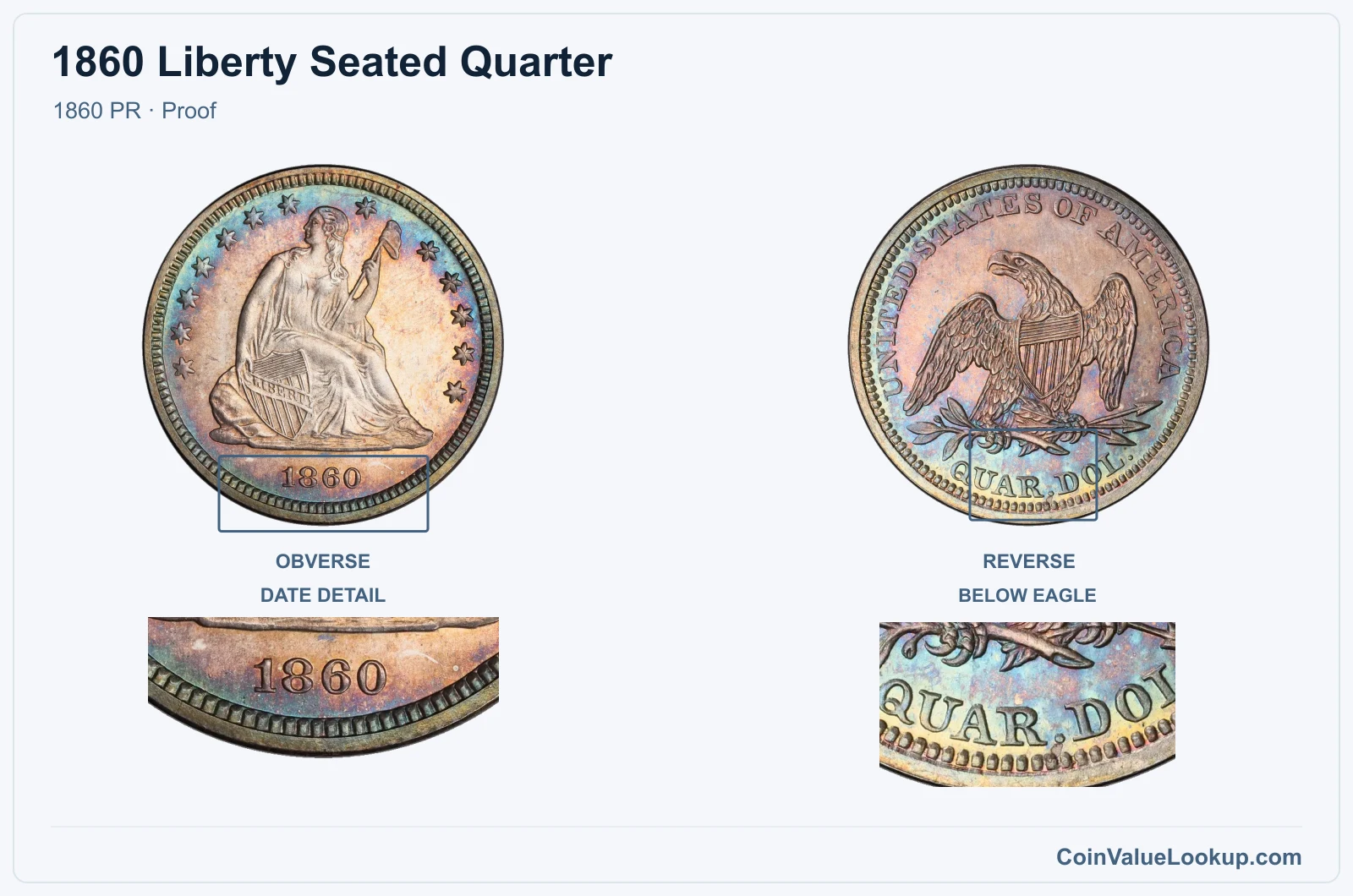
The 1860 proof quarter was made at Philadelphia for collectors, not for commerce. There is no mintmark.
These coins were struck with polished dies on polished planchets, producing mirror-like fields and sharp detail that a regular business strike simply does not have.
Don't mistake a shiny circulated coin for a proof. Real proofs show a distinctive reflective surface in the fields, and the devices often appear slightly more sculpted.
Hairlines from mishandling and surface haze are common problems that reduce collector value. USA Coin Book's guide estimate is $1,453.00 in PR63.
Coin Value Lookup is a handy starting point if you want to look up guides for other dates and denominations in this series. It can save you a lot of time compared to hunting through multiple sources.
Range Grade
Price Auction Records Appraisal PR PR 1
—
Coin Identifier
PR 2
—
Coin Identifier
PR 3
—
Coin Identifier
PR 4
—
Coin Identifier
PR 6
—
Coin Identifier
PR 8
—
Coin Identifier
PR 10
—
Coin Identifier
PR 12
—
Coin Identifier
PR 15
—
Coin Identifier
PR 20
—
Coin Identifier
PR 25
—
Coin Identifier
PR 30
—
Coin Identifier
PR 35
—
Coin Identifier
PR 40
—
Coin Identifier
PR 45
—
Coin Identifier
PR 50
—
Coin Identifier
PR 53
—
Coin Identifier
PR 55
—
Coin Identifier
PR 58
—
Coin Identifier
PR 60
Coin Identifier
PR 61
Coin Identifier
PR 62
Coin Identifier
PR 63
Coin Identifier
PR 64
Coin Identifier
PR 65
Coin Identifier
PR 66
Coin Identifier
PR 67
Coin Identifier
PR 68
Coin Identifier
PR 69
—
—
—
PR 70
—
—
—
1860 Liberty Seated Quarter — O
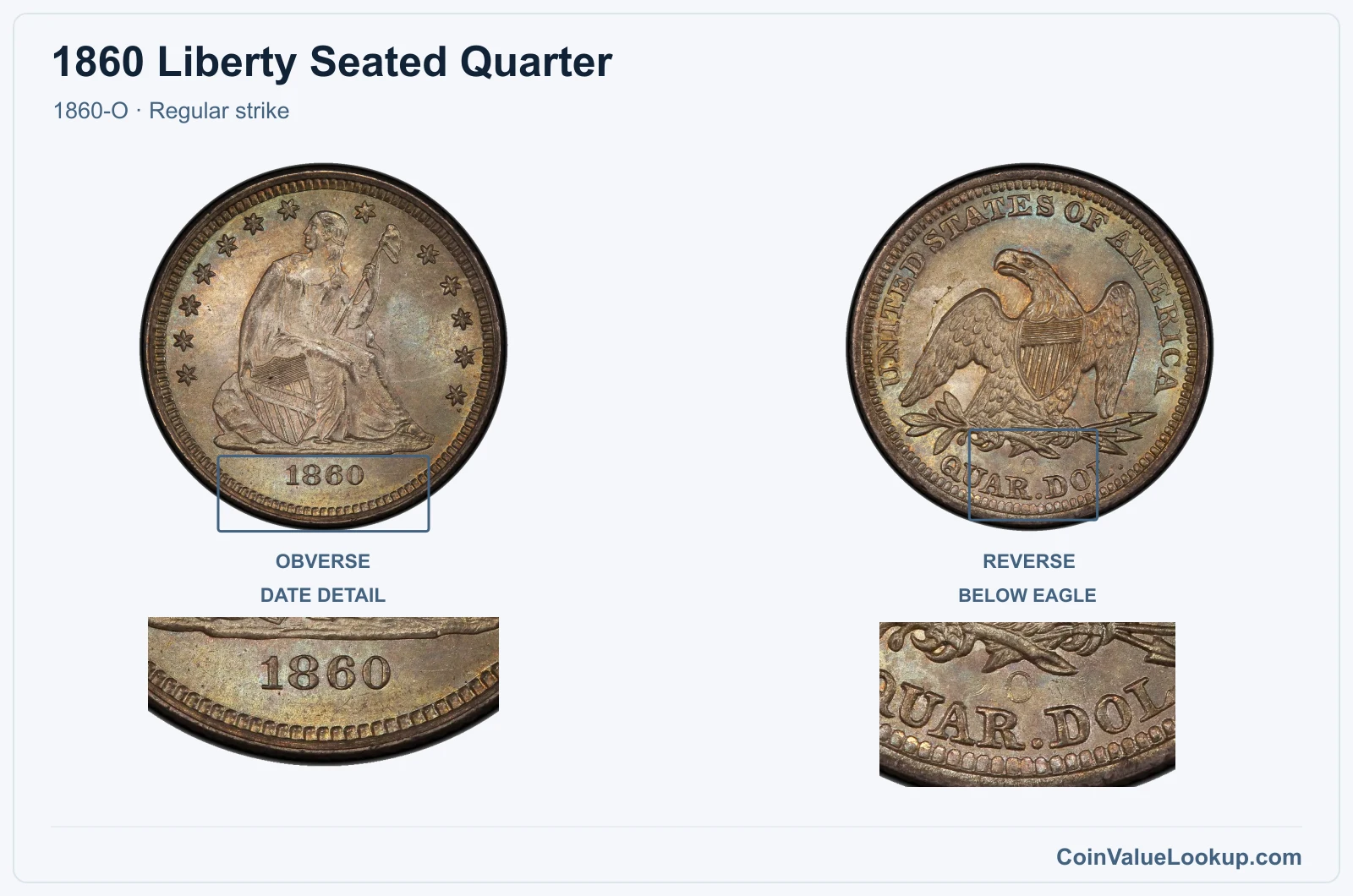
The 1860-O was struck at the New Orleans Mint. Look for a small "O" on the reverse below the eagle.
This is a Civil War-era mint that would cease operations entirely in 1861, making its final-year issues historically significant.
USA Coin Book guide estimates place the 1860-O at $69.00 in G4, $1,252.00 in MS60, and $2,120.00 in MS63. Original surfaces and honest wear are key.
Cleaning or damage can sharply reduce value regardless of the mintmark's appeal. Match the mint, confirm the design, and then assess condition honestly.
Range Grade
Price Auction Records Appraisal PO PO 1
—
Coin Identifier FR FR 2
—
Coin Identifier AG AG 3
—
Coin Identifier G G 4
—
Coin Identifier
G 6
—
Coin Identifier VG VG 8
—
Coin Identifier
VG 10
—
Coin Identifier F F 12
—
Coin Identifier
F 15
—
Coin Identifier VF VF 20
Coin Identifier
VF 25
Coin Identifier
VF 30
Coin Identifier
VF 35
Coin Identifier XF XF 40
Coin Identifier
XF 45
Coin Identifier AU AU 50
Coin Identifier
AU 53
Coin Identifier
AU 55
Coin Identifier
AU 58
Coin Identifier MS MS 60
—
Coin Identifier
MS 61
Coin Identifier
MS 62
Coin Identifier
MS 63
Coin Identifier
MS 64
Coin Identifier
MS 65
Coin Identifier
MS 66
Coin Identifier
MS 67
—
—
—
MS 68
—
—
—
MS 69
—
—
—
MS 70
—
—
—
1860 Liberty Seated Quarter — S
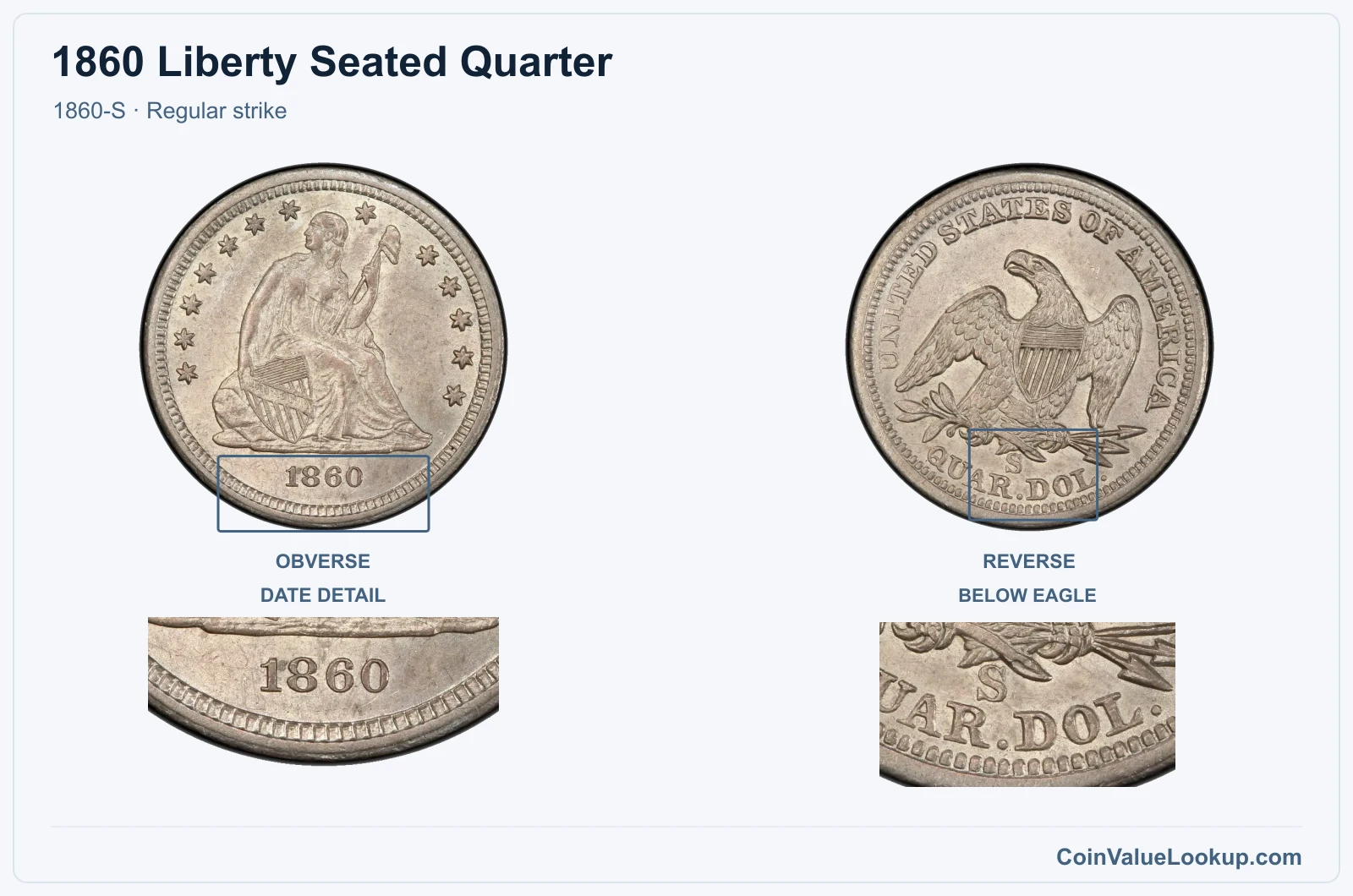
The 1860-S is the heavy hitter of this year. Struck at the San Francisco Mint, it carries an "S" mintmark below the eagle on the reverse.
Survival rates in higher grades are extremely low, and the guide numbers reflect that scarcity.
USA Coin Book estimates $1,252.00 even in G4, a heavily worn grade. In MS60, the guide jumps to $54,390.00 — a staggering figure that tells you how few uncirculated examples are known.
Even well-circulated pieces command strong prices because demand far outstrips supply.
If you think you have one, confirm the mintmark carefully under magnification. An altered mintmark from a cheaper date is a known risk with high-value branch mint coins.
Professional certification is worth considering for any genuine example.
Range Grade
Price Auction Records Appraisal PO PO 1
—
Coin Identifier FR FR 2
Coin Identifier AG AG 3
Coin Identifier G G 4
Coin Identifier
G 6
Coin Identifier VG VG 8
Coin Identifier
VG 10
Coin Identifier F F 12
Coin Identifier
F 15
Coin Identifier VF VF 20
Coin Identifier
VF 25
Coin Identifier
VF 30
Coin Identifier
VF 35
Coin Identifier XF XF 40
Coin Identifier
XF 45
Coin Identifier AU AU 50
Coin Identifier
AU 53
—
Coin Identifier
AU 55
Coin Identifier
AU 58
Coin Identifier MS MS 60
—
Coin Identifier
MS 61
Coin Identifier
MS 62
—
—
—
MS 63
—
—
—
MS 64
—
—
—
MS 65
—
—
—
MS 66
—
—
—
MS 67
—
—
—
MS 68
—
—
—
MS 69
—
—
—
MS 70
—
—
—