1860 Liberty Seated Dollar Coin Value: How Much Is It Worth?
The 1860 Liberty Seated Dollar is a late-era silver dollar struck on the eve of the Civil War, and guide estimates for this year range from about $416 in well-worn grades to $6,298 in choice uncirculated condition, depending on mint and grade. Those figures are guide estimates from USA Coin Book, not guaranteed offers.
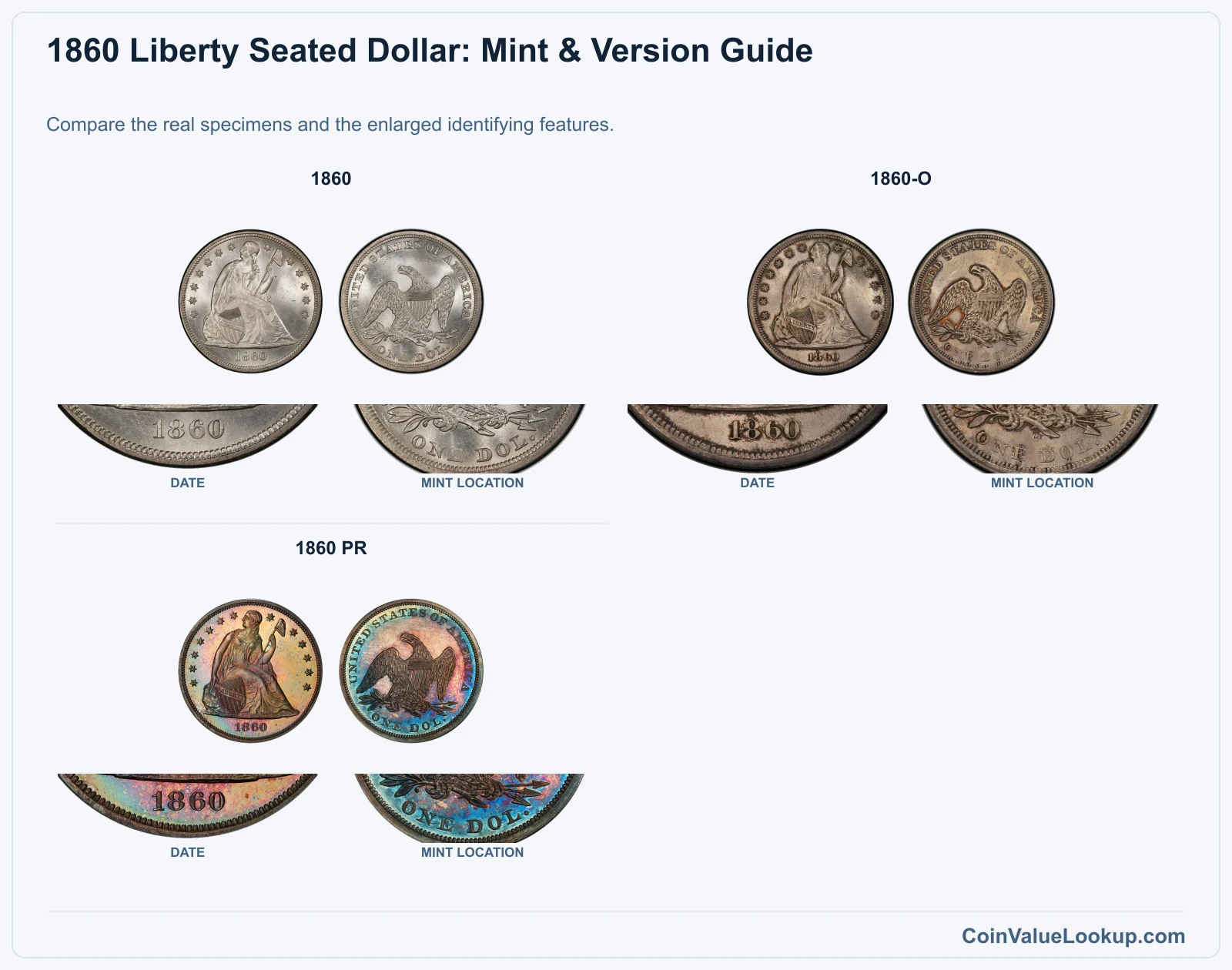
Three distinct branches exist for 1860: a Philadelphia business strike, a New Orleans mint issue, and a Philadelphia proof. Identifying which one you have is the first step toward understanding its value.
Fast Way to Identify Your 1860 Liberty Seated Dollar
Upload clear photos of your coin's front and back, and our identifier can help with a preliminary identification of your 1860 Liberty Seated Dollar. Good lighting and a flat angle work best.
This won't authenticate or grade your coin, but it can point you toward the right branch so you know what to research next.
1860 Liberty Seated Dollar Value
Upload both sides of your 1860 Liberty Seated Dollar.
Front Obverse
Upload photo
Back Reverse
Upload photo
Which 1860 Liberty Seated Dollar Versions Are Worth Money?
- The 1860-O (New Orleans) business strike starts around $416 in Good-4 and reaches an estimated $4,711 in MS63 — a wide spread that rewards careful grading.
- The 1860 Philadelphia business strike carries higher guide estimates, from $508 in Good-4 to $6,298 in MS63, making mint identification essential.
- The 1860 Proof is a collector-focused issue that requires individual assessment based on authenticated identity and condition rather than a simple price-chart lookup.
Step 1: Identify Your 1860 Liberty Seated Dollar Mint Mark and Version
Philadelphia-minted dollars carry no mintmark at all. For the New Orleans issue, look on the reverse beneath the eagle and just above the ONE DOL.
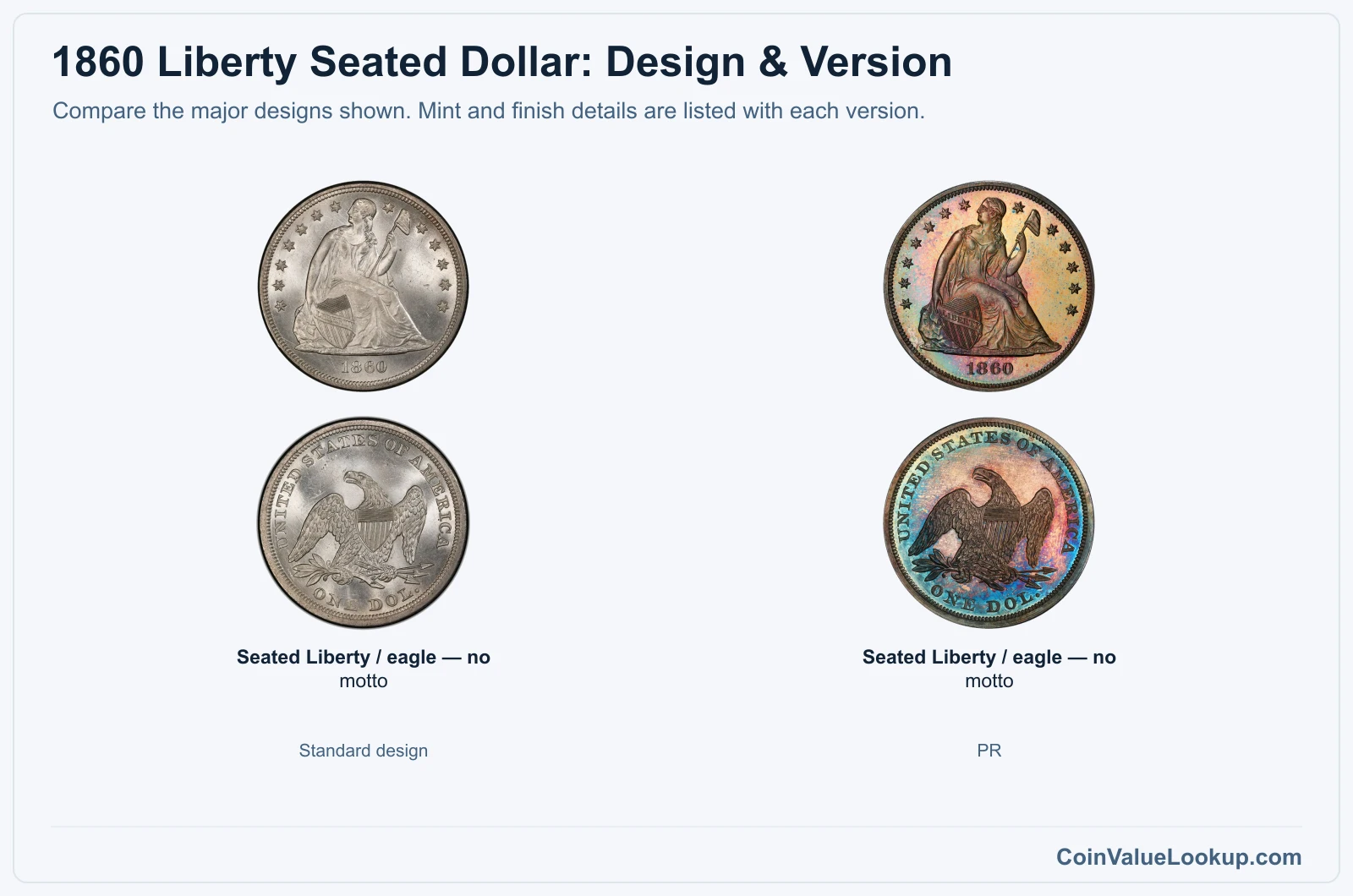
denomination — a small "O" mintmark sits there. Both business-strike versions share the same no-motto reverse design: a heraldic eagle without the IN GOD WE TRUST banner that appeared on later dates.
All 1860 dollars are composed of 90% silver and 10% copper, with a nominal weight of 26.73 grams. If your coin is noticeably lighter or doesn't ring like silver, it may be a contemporary counterfeit or a plated replica.
Proofs were also struck at Philadelphia with no mintmark, so the absence of an "O" alone doesn't tell you whether you have a business strike or a proof — you need to examine the surfaces and strike quality.
Proofs show deeply mirrored fields and unusually sharp design details from specially prepared dies. A business strike that's been cleaned to a mirror-like shine is not a proof.
If you suspect a proof, third-party authentication is the safest route.
Step 2: Check Your 1860 Liberty Seated Dollar Grade
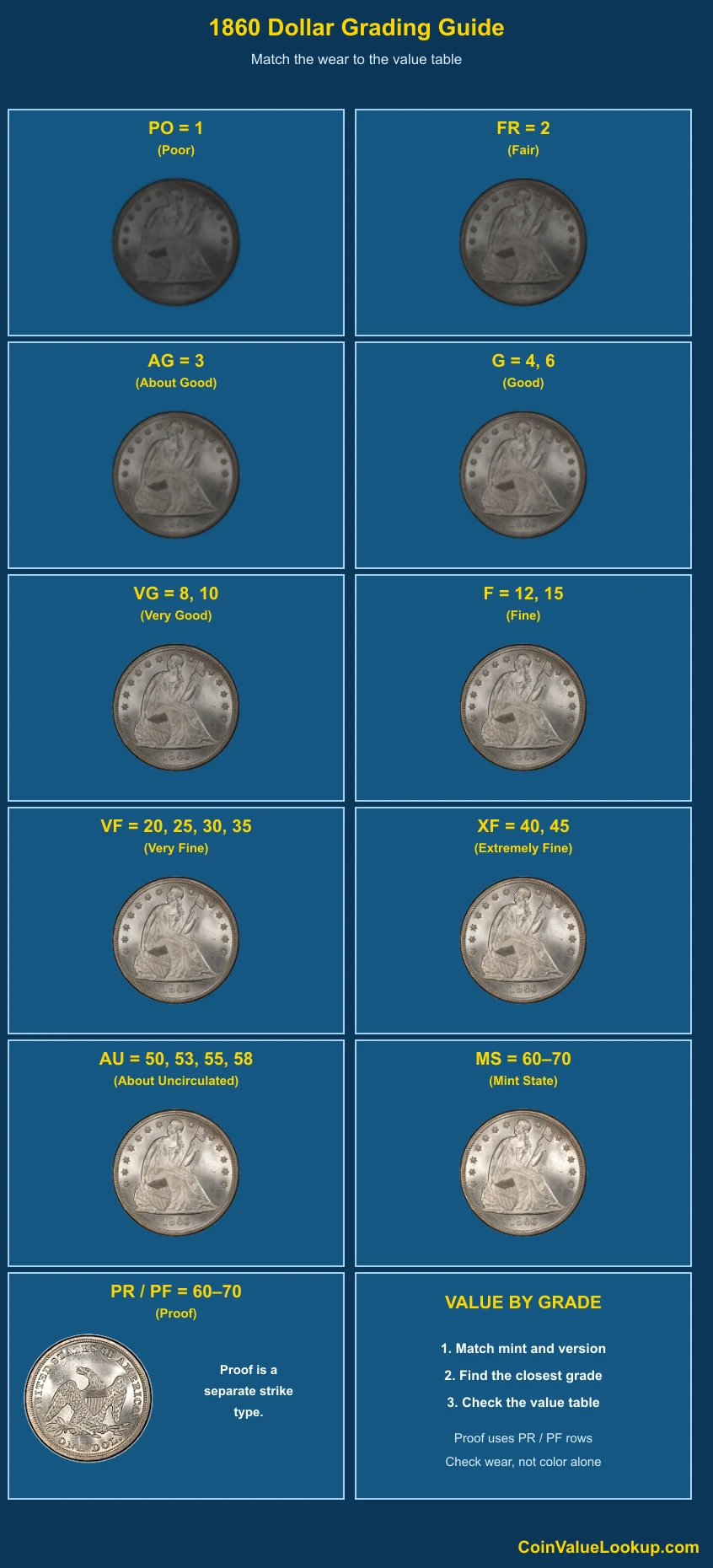
Start with Liberty's head on the obverse — hair detail above the ear disappears first in light wear. Move down to her breast and knee area; these high points lose definition quickly in circulation.
The shield on her lap retains detail longer, so if that's worn, you're looking at a coin that saw real use.
On the reverse, check the eagle's breast feathers and the tips of both wings. These areas match the obverse high points in vulnerability to wear.
A coin grading around Good-4 will have Liberty's outline visible but most interior detail gone, while an MS63 example retains full luster with only minor contact marks. Don't confuse weak strike for wear — some Seated Dollars left the press soft in spots, especially on Liberty's head, and that's a die characteristic, not damage.
Use a genuine same-type grading comparison image to judge your coin. Compare circulated, About Uncirculated, and Mint State examples separately from proofs, since proof surfaces look fundamentally different from business strikes even in similar preservation.
Step 3: Check 1860 Liberty Seated Dollar Value by Mint and Version
1860 Liberty Seated Dollar
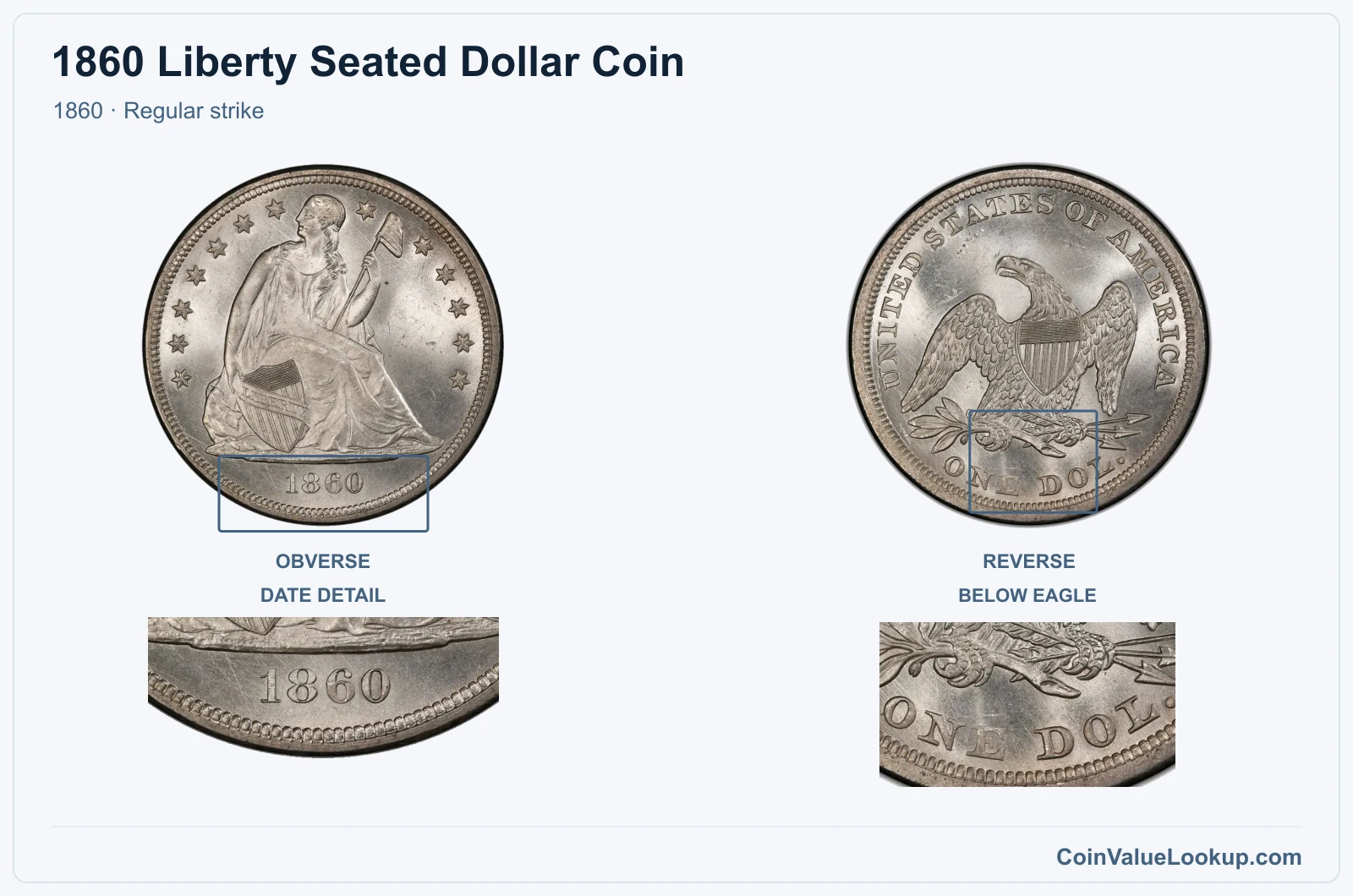
The 1860 Philadelphia business strike has no mintmark anywhere on the coin. It features the Seated Liberty obverse paired with the no-motto eagle reverse.
Guide estimates from USA Coin Book place this version at roughly $508 in Good-4 and up to $6,298 in MS63.
Those are the two anchor grades in the data; coins falling between them scale with condition. Original, uncleaned surfaces matter here.
A coin that's been polished or dipped may technically grade the same number but will trade below a piece with natural toning. Before comparing values, confirm your coin matches this exact branch — Philadelphia mint, business strike, no motto.
Range Grade
Price Auction Records Appraisal PO PO 1
Coin Identifier FR FR 2
—
Coin Identifier AG AG 3
—
Coin Identifier G G 4
—
Coin Identifier
G 6
—
Coin Identifier VG VG 8
—
Coin Identifier
VG 10
Coin Identifier F F 12
Coin Identifier
F 15
Coin Identifier VF VF 20
Coin Identifier
VF 25
—
Coin Identifier
VF 30
Coin Identifier
VF 35
Coin Identifier XF XF 40
Coin Identifier
XF 45
Coin Identifier AU AU 50
Coin Identifier
AU 53
Coin Identifier
AU 55
Coin Identifier
AU 58
Coin Identifier MS MS 60
Coin Identifier
MS 61
Coin Identifier
MS 62
Coin Identifier
MS 63
Coin Identifier
MS 64
Coin Identifier
MS 65
Coin Identifier
MS 66
Coin Identifier
MS 67
—
—
—
MS 68
—
—
—
MS 69
—
—
—
MS 70
—
—
—
1860 Liberty Seated Dollar — O
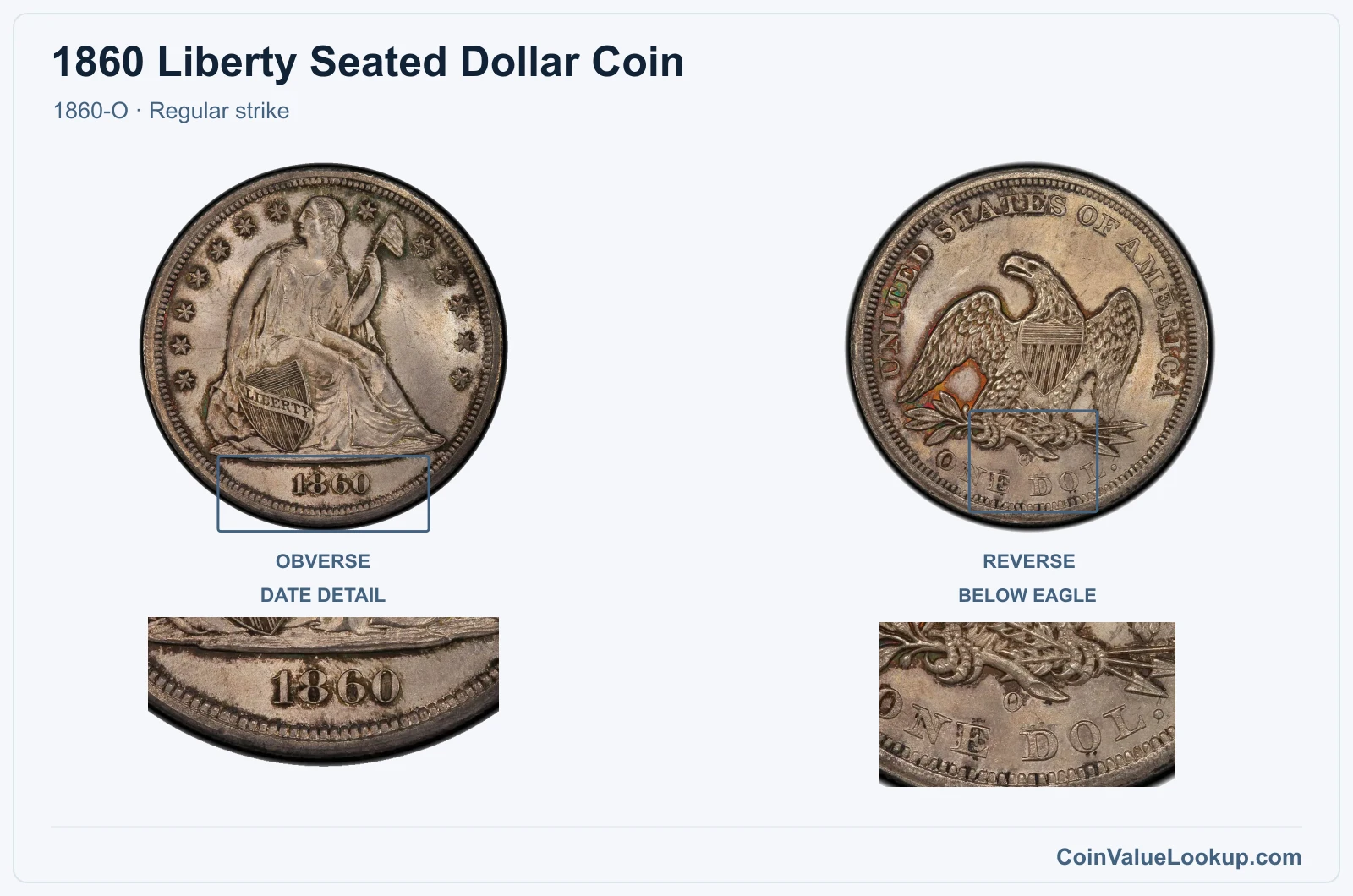
The 1860-O was struck at the New Orleans Mint, and you'll find a small "O" on the reverse below the eagle. This is the same Seated Liberty no-motto design used in Philadelphia.
Guide estimates sit at about $416 in Good-4 and around $4,711 in MS63, per USA Coin Book.
New Orleans dollars sometimes come with softer strikes than their Philadelphia counterparts, so don't mistake weak details for extra wear. Cleaned or damaged examples lose much of their collector appeal regardless of the date.
If you're browsing Coin Value Lookup for other Liberty Seated Dollar dates, keep in mind that mintmark and condition together drive the value picture for every year in the series.
Range Grade
Price Auction Records Appraisal PO PO 1
—
Coin Identifier FR FR 2
Coin Identifier AG AG 3
Coin Identifier G G 4
Coin Identifier
G 6
Coin Identifier VG VG 8
Coin Identifier
VG 10
Coin Identifier F F 12
Coin Identifier
F 15
Coin Identifier VF VF 20
Coin Identifier
VF 25
Coin Identifier
VF 30
Coin Identifier
VF 35
Coin Identifier XF XF 40
Coin Identifier
XF 45
Coin Identifier AU AU 50
Coin Identifier
AU 53
Coin Identifier
AU 55
Coin Identifier
AU 58
Coin Identifier MS MS 60
Coin Identifier
MS 61
Coin Identifier
MS 62
Coin Identifier
MS 63
Coin Identifier
MS 64
Coin Identifier
MS 65
Coin Identifier
MS 66
Coin Identifier
MS 67
—
—
—
MS 68
—
—
—
MS 69
—
—
—
MS 70
—
—
—
1860 Liberty Seated Dollar — PR
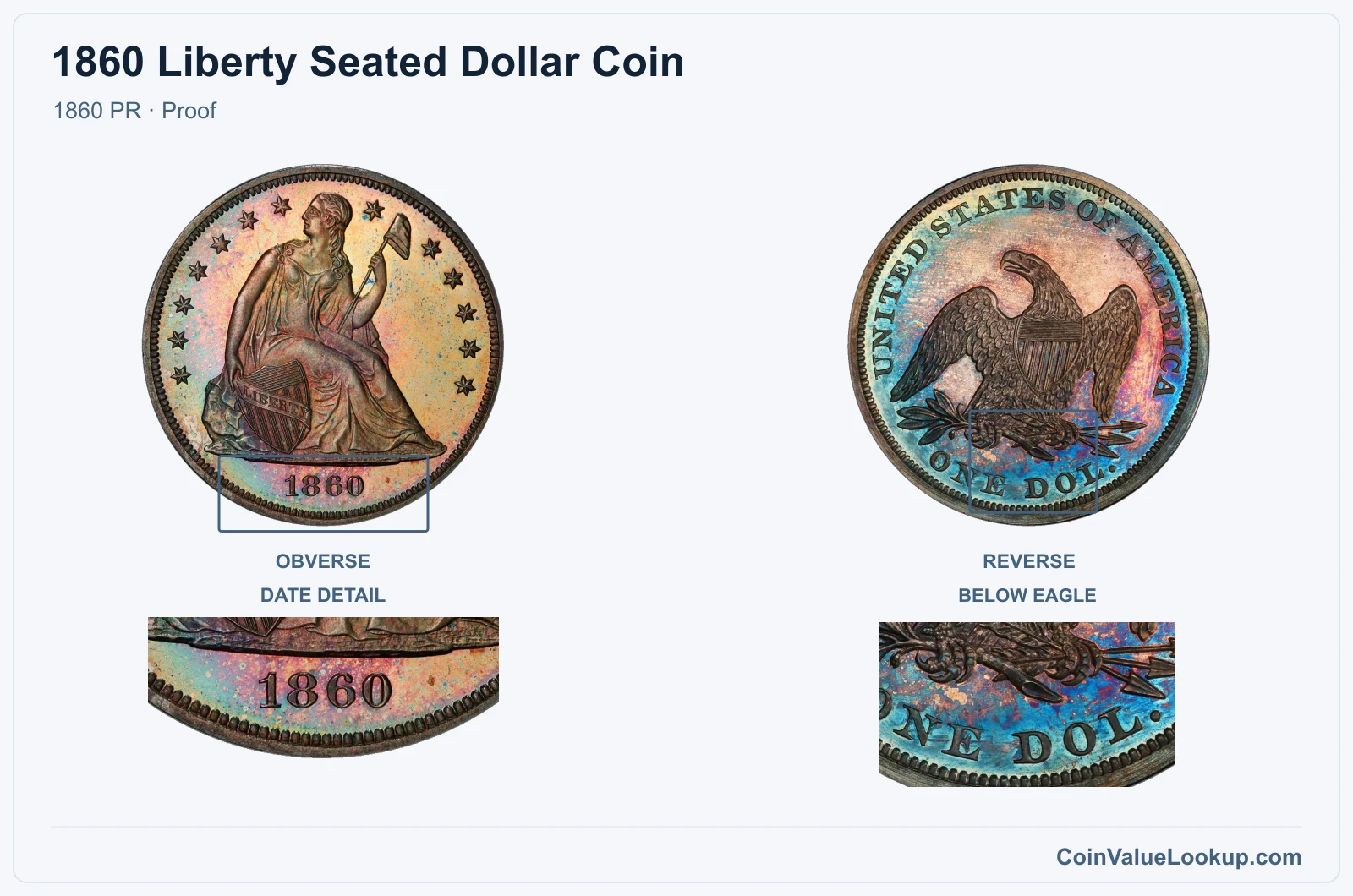
The 1860 Proof was produced at Philadelphia using polished dies and specially prepared planchets. There is no mintmark.
The fields should display deep, glassy mirrors, and the design elements will appear sharper than even the finest business strikes. A proof is a manufacturing method, not simply a grade above Mint State — a shiny circulated coin is not a proof.
No supported numeric price range is available for this version in the current data. Value depends on the coin's authenticated identity, its condition within the proof grading scale, and whether the surfaces remain original.
Third-party certification from a major grading service is practically essential for anyone buying or selling a proof Seated Dollar, since the premium over a business strike can be substantial. Individual assessment is the way to go here.
Range Grade
Price Auction Records Appraisal PR PR 1
—
Coin Identifier
PR 2
—
Coin Identifier
PR 3
—
Coin Identifier
PR 4
—
Coin Identifier
PR 6
—
Coin Identifier
PR 8
—
Coin Identifier
PR 10
—
Coin Identifier
PR 12
—
Coin Identifier
PR 15
—
Coin Identifier
PR 20
—
Coin Identifier
PR 25
—
Coin Identifier
PR 30
—
Coin Identifier
PR 35
—
Coin Identifier
PR 40
—
Coin Identifier
PR 45
—
Coin Identifier
PR 50
—
Coin Identifier
PR 53
—
Coin Identifier
PR 55
Coin Identifier
PR 58
Coin Identifier
PR 60
Coin Identifier
PR 61
Coin Identifier
PR 62
Coin Identifier
PR 63
Coin Identifier
PR 64
Coin Identifier
PR 65
Coin Identifier
PR 66
Coin Identifier
PR 67
Coin Identifier
PR 68
—
—
—
PR 69
—
—
—
PR 70
—
—
—