1848 Braided Hair Cent Coin Value: How Much Is It Worth?
An 1848 Braided Hair Cent in well-worn Good-4 condition carries a guide value around $30, climbing to roughly $721 in choice Mint State (MS63) for a regular business strike. Proof examples and major mint errors fall outside that range and need individual evaluation.
Identify your exact variety before assuming any price applies.
Fast Way to Identify Your 1848 Braided Hair Cent
The fastest way to start figuring out what your 1848 cent is worth is to upload clear photos of both sides. A sharp image of the obverse (Liberty's portrait) and the reverse (wreath and denomination) lets us provide a preliminary identification of the version and approximate condition.
Snap both faces in even, natural light and avoid glare.
1848 Braided Hair Cent Value
Upload both sides of your 1848 Braided Hair Cent.
Front Obverse
Upload photo
Back Reverse
Upload photo
Which 1848 Braided Hair Cent Versions Are Worth Money?
- Business strikes range from about $30 in Good-4 to $721 in MS63 per USA Coin Book; identify grade carefully before estimating value.
- Proof 1848 cents are cataloged but extremely rare; they require professional attribution of die characteristics, surfaces, and rims rather than a simple price lookup.
- Coins with prominent mint errors such as off-center strikes or die breaks deserve closer inspection, though each needs individual assessment for value.
- Original, problem-free surfaces add significant appeal; cleaned, corroded, or damaged coins trade well below guide figures for the same grade.
Step 1: Identify Your 1848 Braided Hair Cent Mint Mark and Version
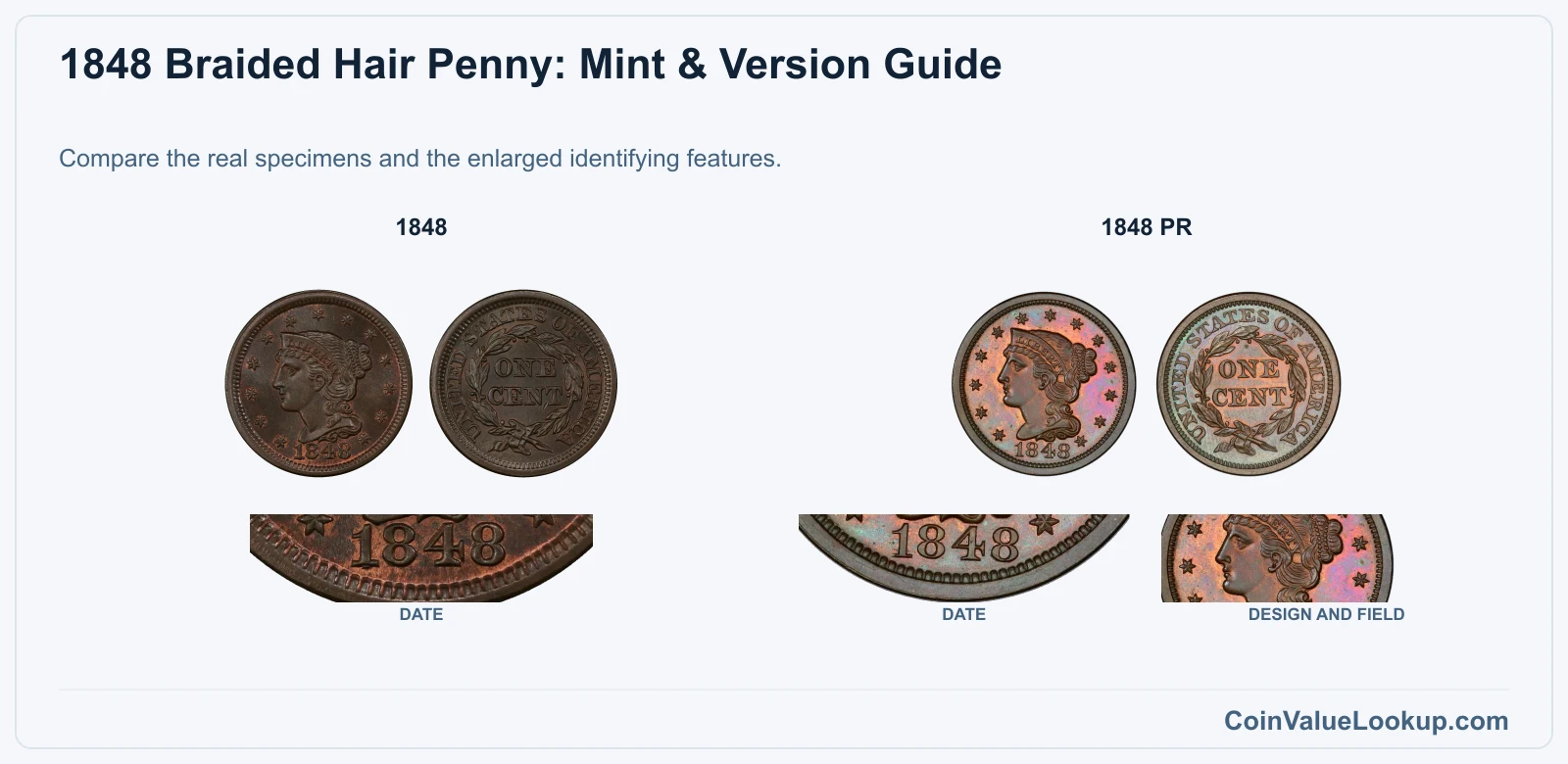
The 1848 Braided Hair Cent was struck only at Philadelphia, so there is no mintmark to look for. Every genuine example should show Liberty facing left with her hair braided and bound by a cord, surrounded by thirteen stars and the date below.
The reverse displays ONE CENT inside a laurel wreath with UNITED STATES OF AMERICA around the border.
Match those design elements carefully. Other large cent types from nearby years, like the Coronet or Classic Head, have noticeably different portraits and hair treatments.
If the portrait does not show the distinctive braided-hair style, you may have a different series entirely.
Weight can help as a secondary check. The nominal specification is about 10.89 grams in copper, but wear, corrosion, and original production tolerances mean a slightly light coin is not automatically fake.
Date-punch shape and legend spacing are more reliable than weight alone.
Separate business strikes from proofs. A proof is a specific manufacturing method with squared rims, reflective fields, and sharp detail from specially prepared dies.
A shiny coin is not automatically a proof; polishing does not change how a coin was made.
Step 2: Check Your 1848 Braided Hair Cent Grade
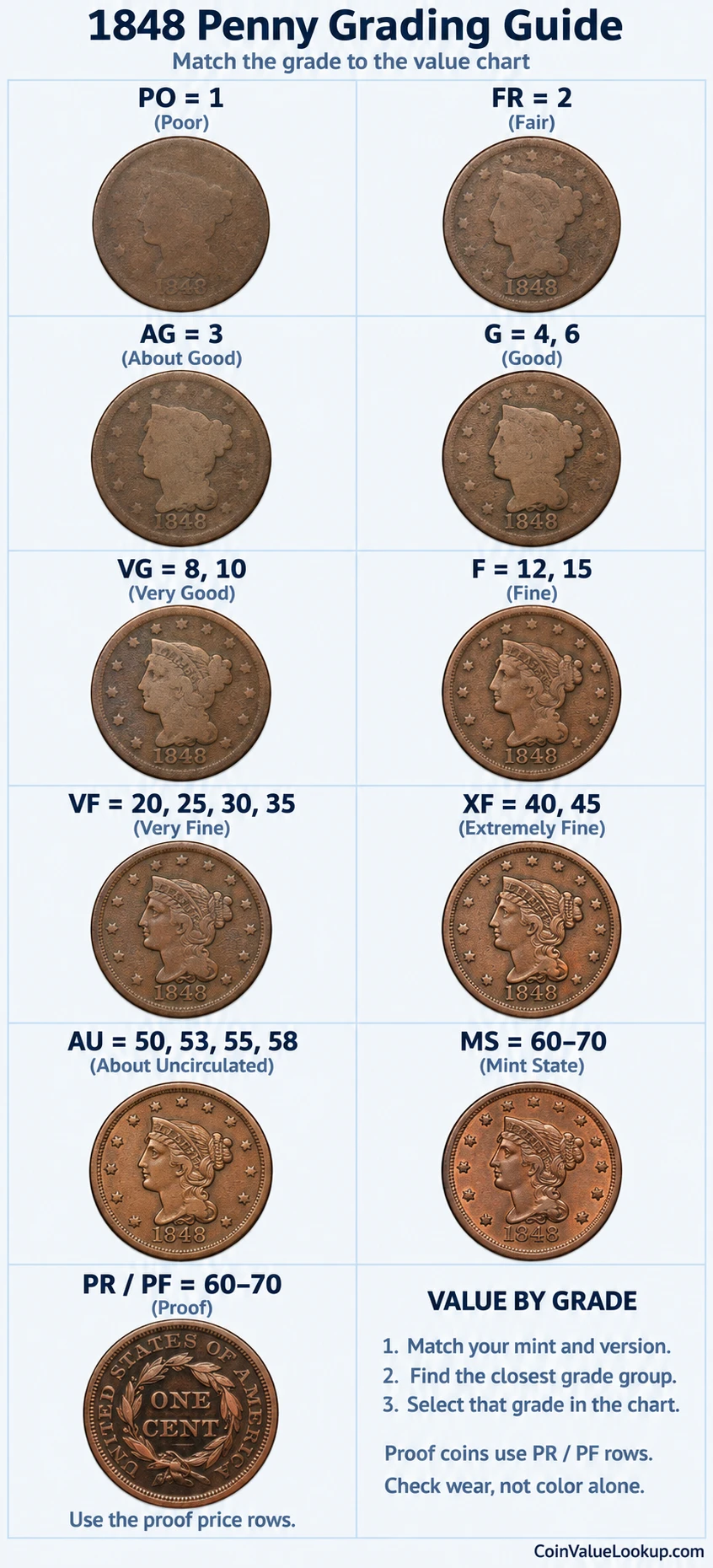
Start by examining Liberty's hair above the ear and the cheek area on the obverse. In lower grades, the braid details merge and the stars lose their central lines.
On the reverse, check the individual leaf veins in the wreath; these wear away progressively as the grade drops.
Compare your coin against the reference image for this type. A Good-4 coin will show a clear outline of Liberty and a readable date, but almost all fine detail is gone.
By contrast, an MS63 coin retains full hair strands and wreath detail with original luster.
Do not confuse a weak strike with heavy wear. Some 1848 cents left the press with mushy detail in spots, and that is a production issue, not a sign of circulation.
Similarly, porosity and corrosion eat detail differently than honest wear does; surface problems can substantially reduce a coin's market appeal even if the underlying sharpness is decent.
On copper coins, color descriptions like BN (brown), RB (red-brown), and RD (red) describe remaining original surface color, not different metals. Most surviving 1848 cents are fully brown, which is perfectly normal for a coin this old.
Step 3: Check 1848 Braided Hair Cent Value by Mint and Version
1848 Braided Hair Cent
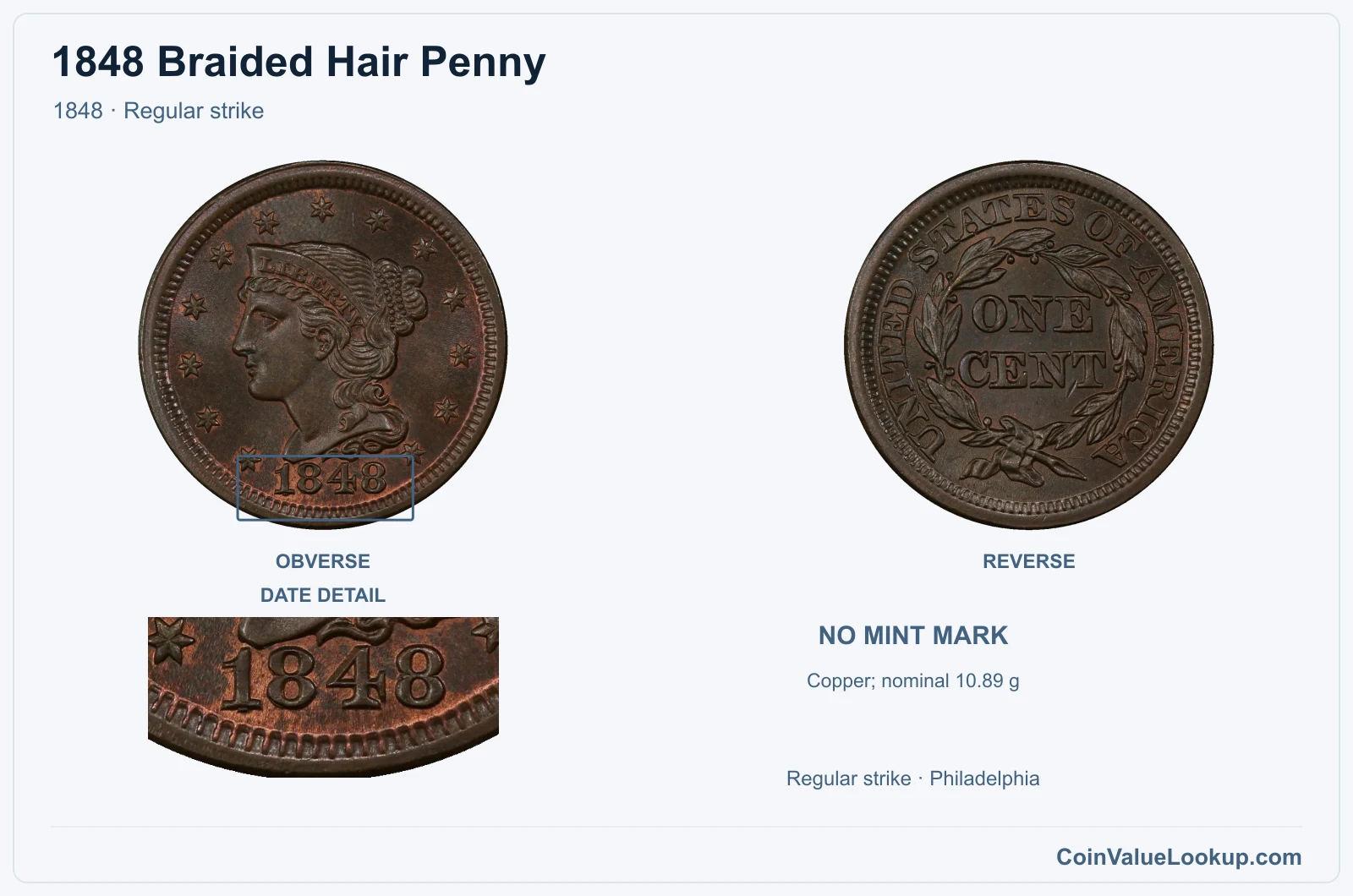
This is the standard 1848 Braided Hair Cent struck for circulation at Philadelphia. No mintmark appears on any genuine example.
The copper planchet weighs nominally 10.89 grams, though slight variation is expected.
USA Coin Book lists guide values from about $30 in Good-4 up to approximately $721 in MS63. Grades in between fill that spread steadily, so condition matters a lot.
Look for clear braid detail and original brown surfaces without signs of cleaning or tooling. Most survivors are well-circulated, so a sharp example with full wreath leaves and intact star points stands out.
| Range | Grade | Price | Auction Records | Appraisal |
|---|---|---|---|---|
| PO | PO 1 | — | Coin Identifier | |
| FR | FR 2 | — | Coin Identifier | |
| AG | AG 3 | — | Coin Identifier | |
| G | G 4 | — | Coin Identifier | |
| G 6 | Coin Identifier | |||
| VG | VG 8 | Coin Identifier | ||
| VG 10 | Coin Identifier | |||
| F | F 12 | Coin Identifier | ||
| F 15 | Coin Identifier | |||
| VF | VF 20 | Coin Identifier | ||
| VF 25 | Coin Identifier | |||
| VF 30 | Coin Identifier | |||
| VF 35 | Coin Identifier | |||
| XF | XF 40 | Coin Identifier | ||
| XF 45 | Coin Identifier | |||
| AU | AU 50 | Coin Identifier | ||
| AU 53 | Coin Identifier | |||
| AU 55 | Coin Identifier | |||
| AU 58 | Coin Identifier | |||
| MS | MS 60 | Coin Identifier | ||
| MS 61 | Coin Identifier | |||
| MS 62 | Coin Identifier | |||
| MS 63 | Coin Identifier | |||
| MS 64 | Coin Identifier | |||
| MS 65 | Coin Identifier | |||
| MS 66 | Coin Identifier | |||
| MS 67 | Coin Identifier | |||
| MS 68 | — | — | — | |
| MS 69 | — | — | — | |
| MS 70 | — | — | — |
1848 Braided Hair Cent — PR
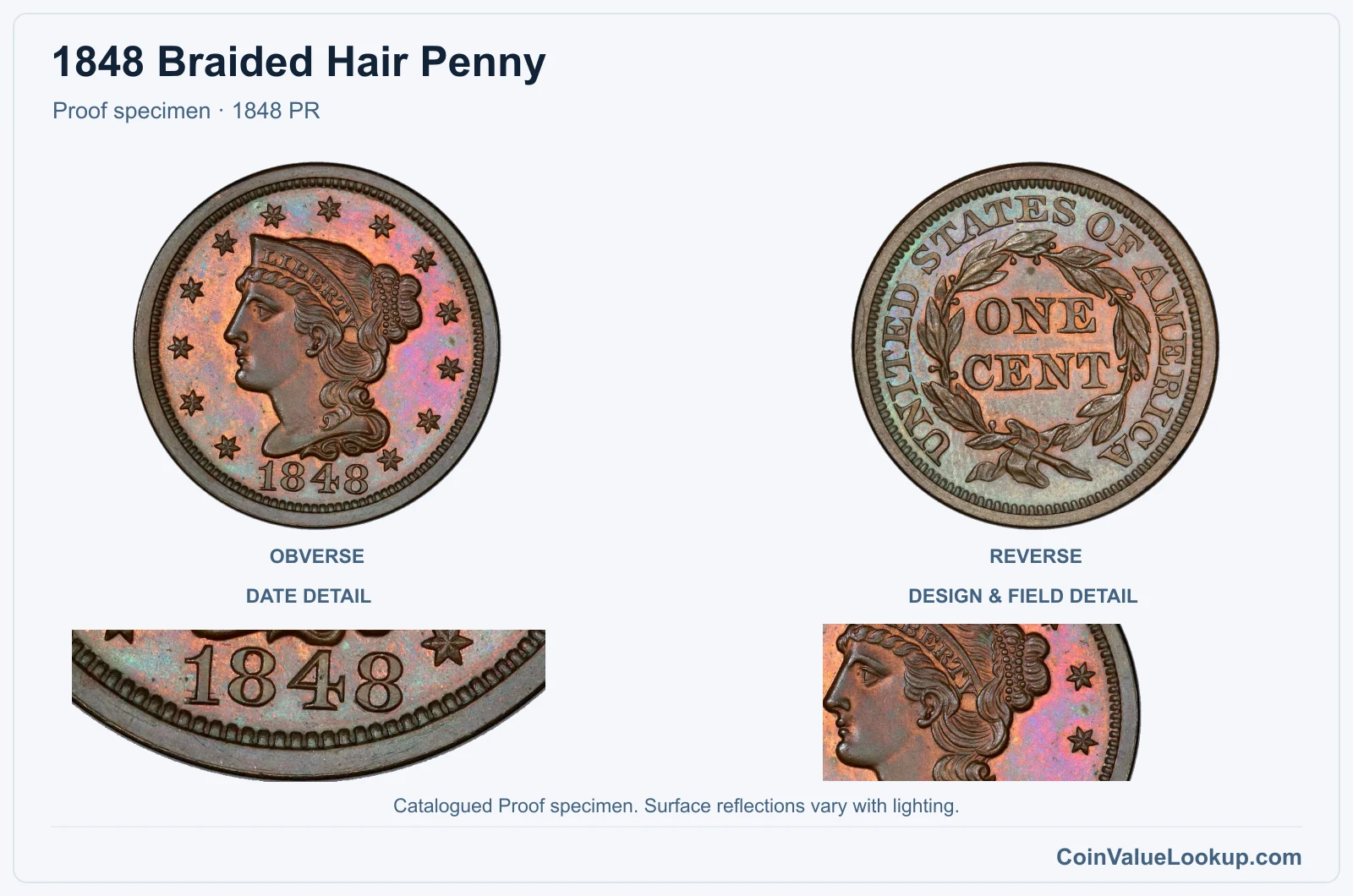
Proof 1848 Braided Hair Cents are cataloged by PCGS and other references, but they are genuinely rare pre-Civil War proofs. These were struck from specially prepared dies on carefully selected planchets, producing squared rims, deeply mirrored fields, and exceptionally sharp detail.
Polishing a business strike does not create a proof. The distinction lives in the die preparation and striking method, visible in rim shape and surface character.
If you think you have one, professional authentication is essential, because the manufacturing diagnostics require expert comparison.
Coin Value Lookup can help you explore guides for many U.S. coin series, including large cents, to get oriented before seeking professional attribution.
No standard guide price is adopted here for the proof version; each example needs individual evaluation based on its authenticated identity, surface preservation, and any impairments. These are coins where the right provenance and third-party slab make an enormous difference.
| Range | Grade | Price | Auction Records | Appraisal |
|---|---|---|---|---|
| PR | PR 1 | — | Coin Identifier | |
| PR 2 | — | Coin Identifier | ||
| PR 3 | — | Coin Identifier | ||
| PR 4 | — | Coin Identifier | ||
| PR 6 | — | Coin Identifier | ||
| PR 8 | — | Coin Identifier | ||
| PR 10 | — | Coin Identifier | ||
| PR 12 | — | Coin Identifier | ||
| PR 15 | — | Coin Identifier | ||
| PR 20 | — | Coin Identifier | ||
| PR 25 | — | Coin Identifier | ||
| PR 30 | — | Coin Identifier | ||
| PR 35 | — | Coin Identifier | ||
| PR 40 | — | Coin Identifier | ||
| PR 45 | — | Coin Identifier | ||
| PR 50 | — | Coin Identifier | ||
| PR 53 | — | Coin Identifier | ||
| PR 55 | — | Coin Identifier | ||
| PR 58 | — | Coin Identifier | ||
| PR 60 | Coin Identifier | |||
| PR 61 | — | Coin Identifier | ||
| PR 62 | Coin Identifier | |||
| PR 63 | Coin Identifier | |||
| PR 64 | Coin Identifier | |||
| PR 65 | Coin Identifier | |||
| PR 66 | — | Coin Identifier | ||
| PR 67 | — | — | — | |
| PR 68 | — | — | — | |
| PR 69 | — | — | — | |
| PR 70 | — | — | — |
1848 Braided Hair Cent Error List
1. 1848 Braided Hair Cent — Off-Center Strike
An off-center strike happens when the planchet is not properly seated between the dies. The result is a displaced design with a blank, unstruck crescent on one side of the coin.
The farther off center the strike, the more dramatic the appearance.
On an 1848 Braided Hair Cent, the key factor is whether the date remains fully visible. A 10-15 percent off-center coin with a clear 1848 date is far more collectible than one where the date wandered into the unstruck zone.
Look at both sides; the design shift should be consistent in direction.
Do not confuse this with a clipped planchet, a one-sided die misalignment, or post-mint damage from a vise or hammer. Genuine off-center errors show a complete shift of the entire design, not selective flattening.
Each coin needs individual assessment based on the degree of mis-strike and overall condition.
2. 1848 Braided Hair Cent — Broadstrike
A broadstrike occurs when a coin is struck without the normal collar that confines the planchet's edge. The metal spreads outward freely, producing a coin that is wider than normal with a distorted or absent rim.
The full design is usually present but appears stretched toward the edges.
On an 1848 cent, compare the diameter and rim profile against a normal example. A genuine broadstrike will show outward metal flow and a soft, rounded edge rather than the usual sharp collar line.
The design elements near the border may look spread or slightly blurred.
This is different from an off-center error, where part of the design is missing entirely. It also differs from a coin flattened after leaving the mint by a railroad track or other external force.
Post-mint damage typically shows uneven compression and does not preserve the full struck design. Individual assessment by an authenticated service determines value.
3. 1848 Braided Hair Cent — Die Crack
Die cracks appear as raised lines running across the coin's surface. They form when the steel die develops a fracture from repeated use and stress.
The crack transfers as a thin raised ridge on every coin struck from that broken die.
On an 1848 Braided Hair Cent, look for fine raised lines crossing the fields or cutting through letters and design elements. They follow no logical design path; that randomness is part of what distinguishes them from intentional features.
Do not confuse die cracks with incuse scratches, which are recessed into the surface rather than raised above it. Corrosion lines and tool marks also sit in or below the surface.
A genuine die crack stands above the surrounding field when viewed under magnification. The size, location, and severity of the crack all affect collector interest, and each coin requires its own evaluation.
4. 1848 Braided Hair Cent — Die Break / Cud
A die break, sometimes called a cud, results from a chunk of the die face breaking away entirely. The missing section leaves a raised, featureless blob of metal on the struck coin.
A true cud connects to the rim; interior breaks that do not reach the rim are typically called retained die breaks.
On an 1848 cent, look for a smooth, raised lump along the rim area that replaces part of the normal design or lettering. The boundary between the cud and the surviving design should be relatively sharp, not gradual.
Rim dents from post-mint contact look different because they push metal inward and show impact marks rather than a smooth raised mass. Corrosion pits and interior die chips are also distinct.
A large, well-defined cud on a pre-Civil War copper cent draws attention, but value depends on size, location, and the coin's overall condition. Professional evaluation is recommended.
5. 1848 Braided Hair Cent — Lamination / Split Planchet
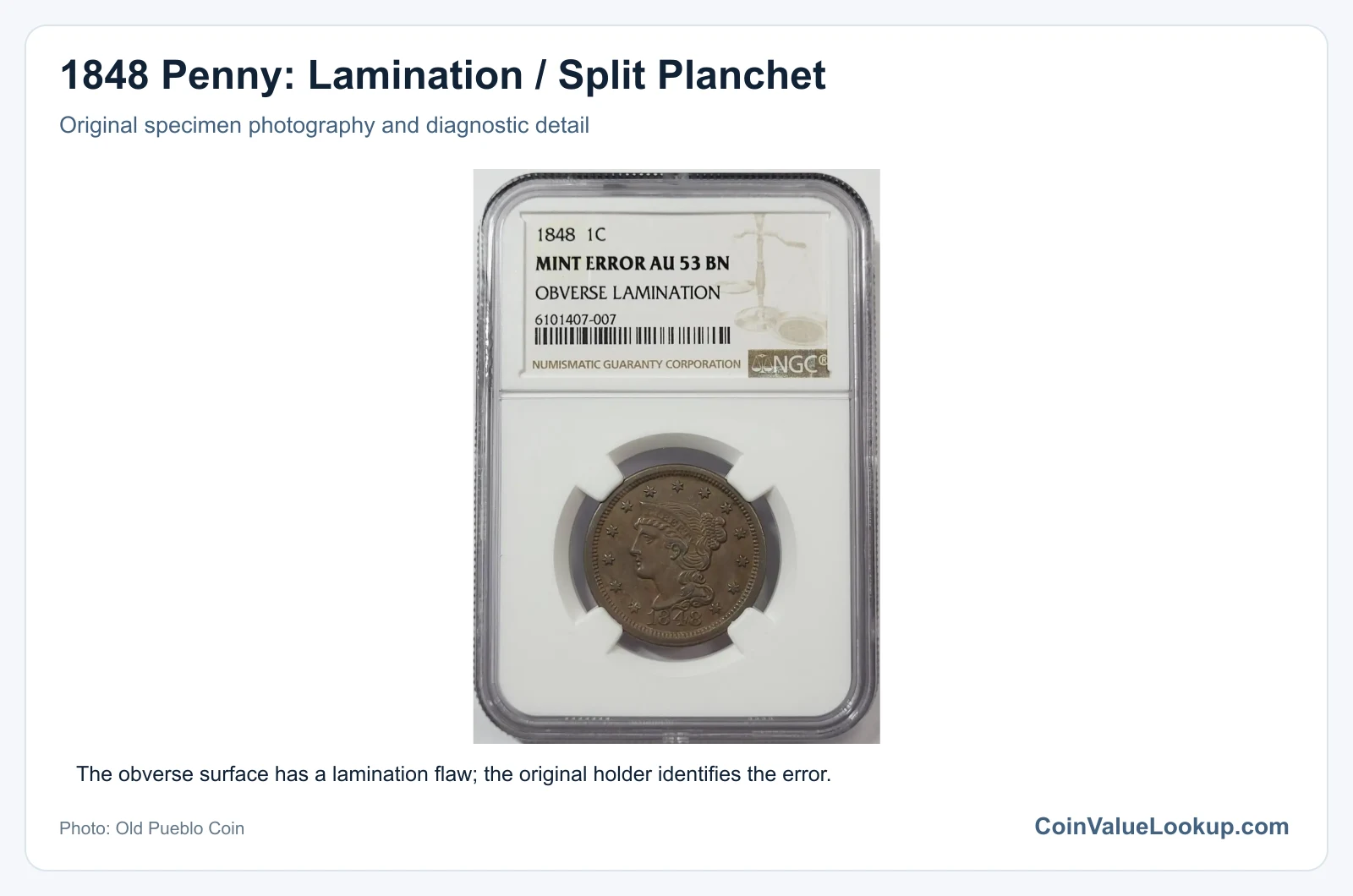
Lamination errors occur when the metal planchet contains impurities or internal stress fractures that cause layers to separate. The result can be a peeling flap of metal, a missing layer exposing rough subsurface, or a visible split along the coin's edge.
On an 1848 copper cent, look for a flap of metal lifting away from the surface or an area where the surface has separated and partially detached. Photograph the edge alongside the affected face; edge views often show the separation most clearly.
This is not the same as deliberate scraping, corrosion eating into the surface, or a coin that someone cut or filed. Genuine laminations follow the internal structure of the metal and often have a smooth, layered appearance at the separation line.
Each example needs individual assessment because severity varies enormously, from a tiny retained flap to a dramatically split planchet.
6. 1848 Braided Hair Cent — Clashed Dies
Clashed dies occur when the obverse and reverse dies strike each other without a planchet between them. The force transfers a ghost image of each die's design onto the opposing die face.
Every subsequent coin struck from those dies carries faint traces of the wrong-side design.
On an 1848 Braided Hair Cent, look for ghostly outlines of wreath elements appearing in the obverse field around Liberty's portrait, or traces of the stars and hair showing up in the reverse field. These transferred images should align with where the opposing die's features would logically contact.
Do not confuse die clash marks with random scratches, raised lines from die cracks, or brockage errors where a previously struck coin acts as a die. Clash marks are symmetrical and correspond to specific opposing design elements.
The strength and visibility of the clash determine collector interest, and individual assessment is necessary.