2011 Lincoln Penny Coin Value: How Much Is It Worth?
Most 2011 Lincoln pennies you find in pocket change are worth one cent. That is the honest baseline for a circulated example.
A guide estimate for an uncirculated MS65 business strike sits around $0.36, while a San Francisco proof in PR65 is estimated near $6.25. Collector finishes, major varieties, and visible mint errors each occupy their own separate market, so the version and condition of your specific coin matter.
Fast Way to Identify Your 2011 Lincoln Penny
Snap a clear photo of the front and back of your 2011 penny and upload both images. The preliminary identifier can help you figure out which mint version you have and flag any obvious features worth a closer look.
Good lighting and a steady hand go a long way — blurry shots hide the details that matter most.
2011 Penny Value
Upload both sides of your 2011 Lincoln Penny.
Front Obverse
Upload photo
Back Reverse
Upload photo
Which 2011 Lincoln Penny Versions Are Worth Money?
- Uncirculated 2011 or 2011-D cents with full original red surfaces can bring a small premium over face value; a guide estimate for MS65 is about $0.36.
- San Francisco proof cents (2011-S) are collector-finish coins with a PR65 guide estimate around $6.25 and should be separated from ordinary business strikes before comparing value.
Step 1: Identify Your 2011 Lincoln Penny Mint Mark and Version
Flip the coin over first. You should see Lincoln's portrait on the front and the Union Shield on the back.
If your reverse shows the Lincoln Memorial instead, you have a different series entirely.
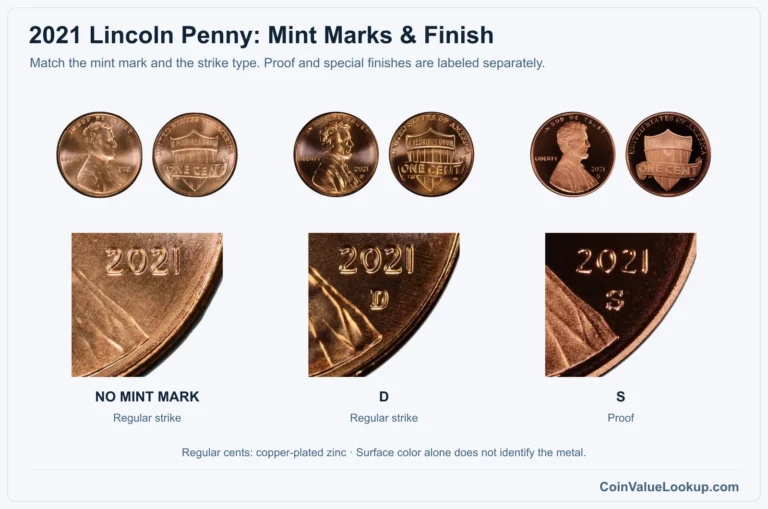
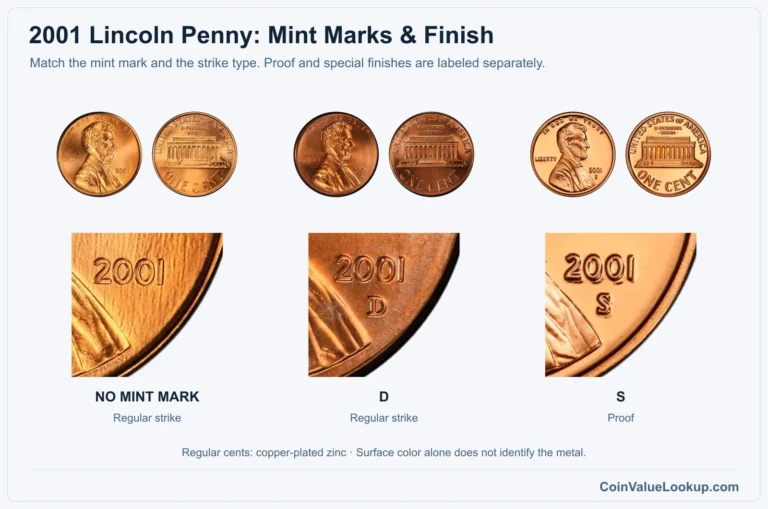
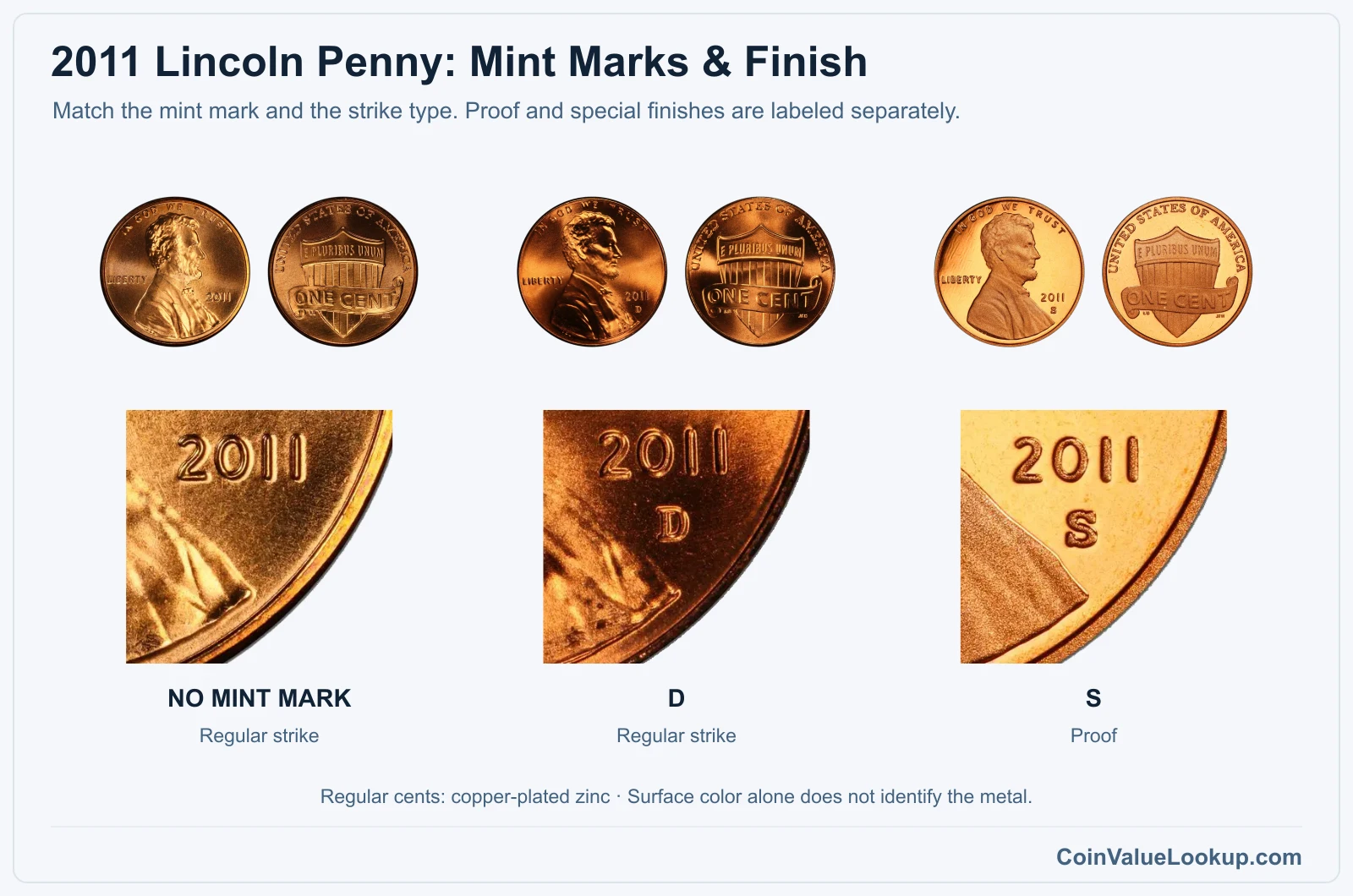
Now check below the date on the obverse. No letter means Philadelphia.
A small "D" means Denver. An "S" means San Francisco, and those are proof coins sold in collector sets, not found in circulation.
All three versions are struck on copper-plated zinc planchets weighing about 2.50 grams. The copper is only a thin plating over a zinc core.
You cannot identify an off-metal error by appearance alone — weight and composition testing matter.
Coin Value Lookup is a good starting point if you want to look up guides for other dates and denominations while you are sorting through a jar of change.
Step 2: Check Your 2011 Lincoln Penny Grade
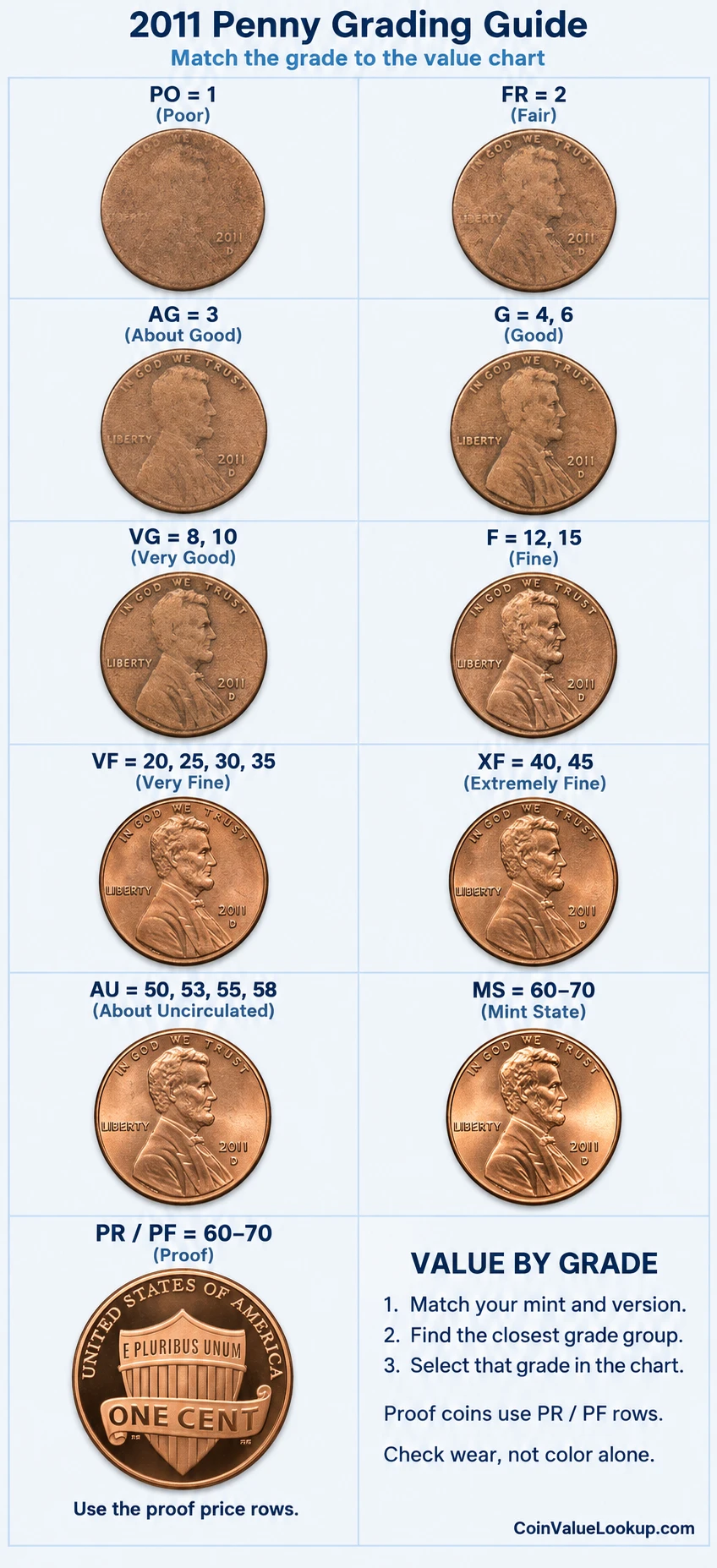
Start with Lincoln's cheek and jawline. On a well-worn coin these areas are flat and smooth, with little hair detail remaining.
A lightly circulated piece still shows some texture on the jaw and the high points of the hair above the ear.
An uncirculated coin retains full original luster across both sides. Compare your coin to the reference image to gauge where it falls.
Color designations — RD (red), RB (red-brown), and BN (brown) — describe how much original copper color remains. They are separate from the wear grade.
A coin can be technically uncirculated yet fully brown.
Proof is a manufacturing finish with mirror-like fields, not a grade above Mint State. Do not confuse a proof's sharp strike with a higher circulated grade.
Step 3: Check 2011 Lincoln Penny Value by Mint and Version
2011 Lincoln Penny — Shield
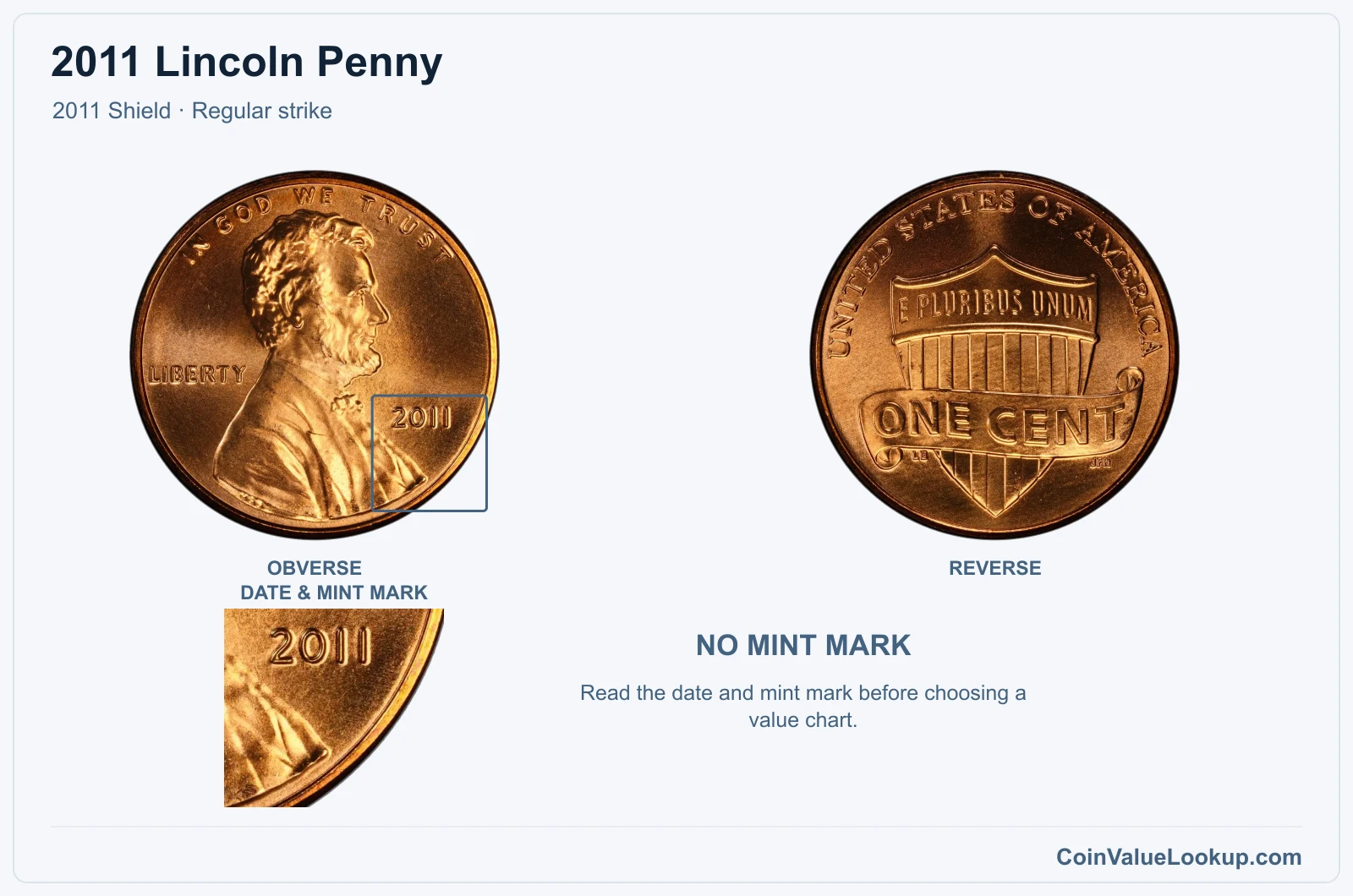
The 2011 Philadelphia cent has no mintmark below the date. It is a standard business strike on a copper-plated zinc planchet weighing about 2.50 grams.
Billions were produced, so circulated examples trade at face value.
In uncirculated condition the guide estimate at MS65 is roughly $0.36. To reach that level the coin needs full luster and minimal contact marks.
Original bright red color adds appeal, but the grade and surface quality come first.
| Range | Grade | Price | Auction Records | Appraisal |
|---|---|---|---|---|
| PO | PO 1 | — | Coin Identifier | |
| FR | FR 2 | — | Coin Identifier | |
| AG | AG 3 | — | Coin Identifier | |
| G | G 4 | — | Coin Identifier | |
| G 6 | — | Coin Identifier | ||
| VG | VG 8 | — | Coin Identifier | |
| VG 10 | — | Coin Identifier | ||
| F | F 12 | — | Coin Identifier | |
| F 15 | — | Coin Identifier | ||
| VF | VF 20 | — | Coin Identifier | |
| VF 25 | — | Coin Identifier | ||
| VF 30 | — | Coin Identifier | ||
| VF 35 | — | Coin Identifier | ||
| XF | XF 40 | — | Coin Identifier | |
| XF 45 | — | Coin Identifier | ||
| AU | AU 50 | — | Coin Identifier | |
| AU 53 | — | Coin Identifier | ||
| AU 55 | — | Coin Identifier | ||
| AU 58 | — | Coin Identifier | ||
| MS | MS 60 | — | Coin Identifier | |
| MS 61 | — | Coin Identifier | ||
| MS 62 | — | Coin Identifier | ||
| MS 63 | — | Coin Identifier | ||
| MS 64 | — | Coin Identifier | ||
| MS 65 | Coin Identifier | |||
| MS 66 | Coin Identifier | |||
| MS 67 | Coin Identifier | |||
| MS 68 | Coin Identifier | |||
| MS 69 | — | — | — | |
| MS 70 | — | — | — |
2011 Lincoln Penny — D Shield
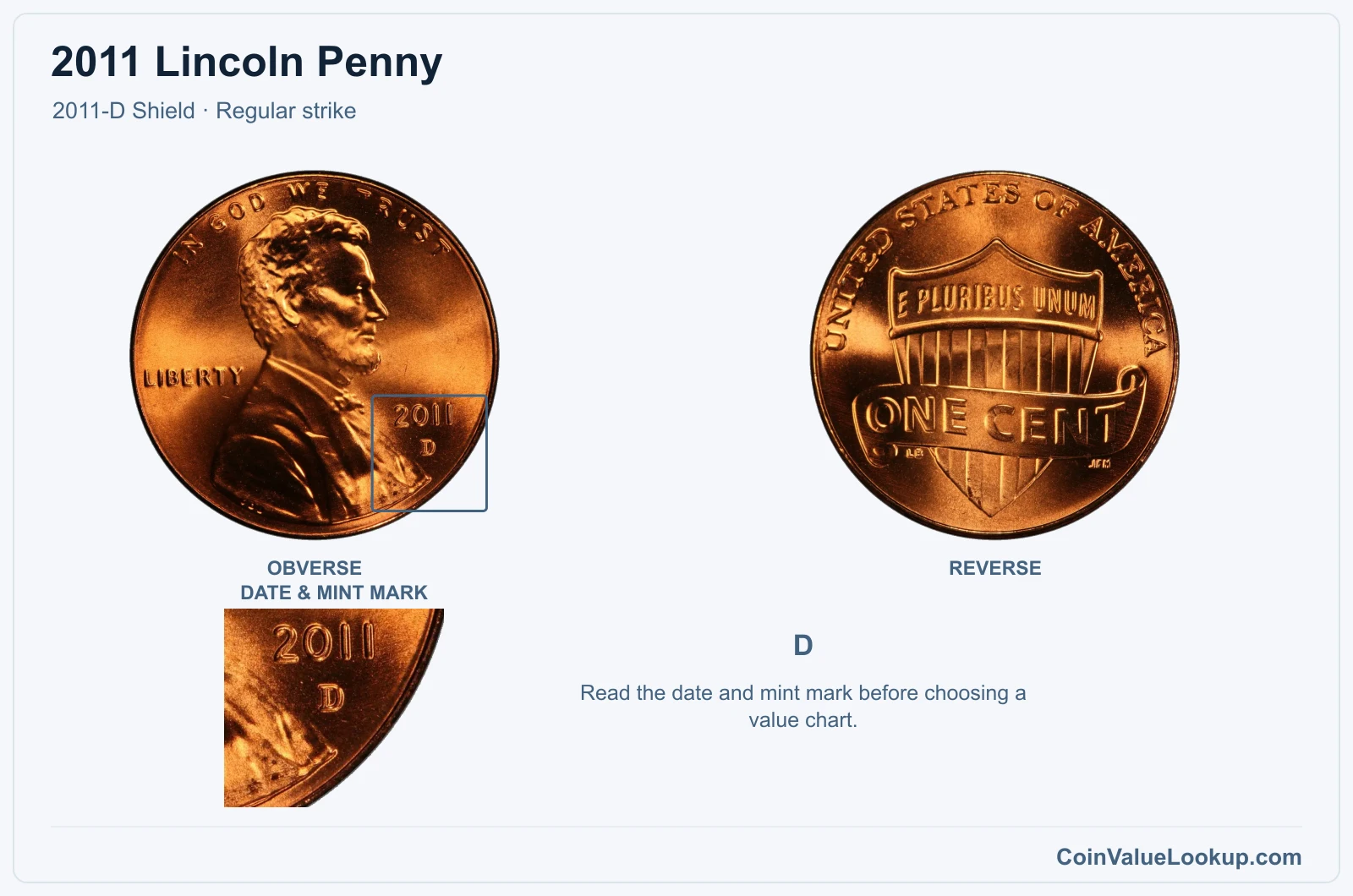
Look for the small "D" mintmark below the date. The 2011-D was struck in Denver on the same copper-plated zinc planchet as the Philadelphia issue.
It carries the identical Union Shield reverse.
Circulated pieces are worth one cent. At MS65, a guide estimate is about $0.36 — the same as the Philadelphia version.
Sorting these from the no-mintmark coins is straightforward: the "D" is easy to spot under mild magnification or even with the naked eye on a clean example.
| Range | Grade | Price | Auction Records | Appraisal |
|---|---|---|---|---|
| PO | PO 1 | — | Coin Identifier | |
| FR | FR 2 | — | Coin Identifier | |
| AG | AG 3 | — | Coin Identifier | |
| G | G 4 | — | Coin Identifier | |
| G 6 | — | Coin Identifier | ||
| VG | VG 8 | — | Coin Identifier | |
| VG 10 | — | Coin Identifier | ||
| F | F 12 | — | Coin Identifier | |
| F 15 | — | Coin Identifier | ||
| VF | VF 20 | — | Coin Identifier | |
| VF 25 | — | Coin Identifier | ||
| VF 30 | — | Coin Identifier | ||
| VF 35 | — | Coin Identifier | ||
| XF | XF 40 | — | Coin Identifier | |
| XF 45 | — | Coin Identifier | ||
| AU | AU 50 | — | Coin Identifier | |
| AU 53 | — | Coin Identifier | ||
| AU 55 | — | Coin Identifier | ||
| AU 58 | — | Coin Identifier | ||
| MS | MS 60 | — | Coin Identifier | |
| MS 61 | — | Coin Identifier | ||
| MS 62 | — | Coin Identifier | ||
| MS 63 | — | Coin Identifier | ||
| MS 64 | — | Coin Identifier | ||
| MS 65 | Coin Identifier | |||
| MS 66 | Coin Identifier | |||
| MS 67 | Coin Identifier | |||
| MS 68 | — | Coin Identifier | ||
| MS 69 | — | — | — | |
| MS 70 | — | — | — |
2011 Lincoln Penny — S Shield PR
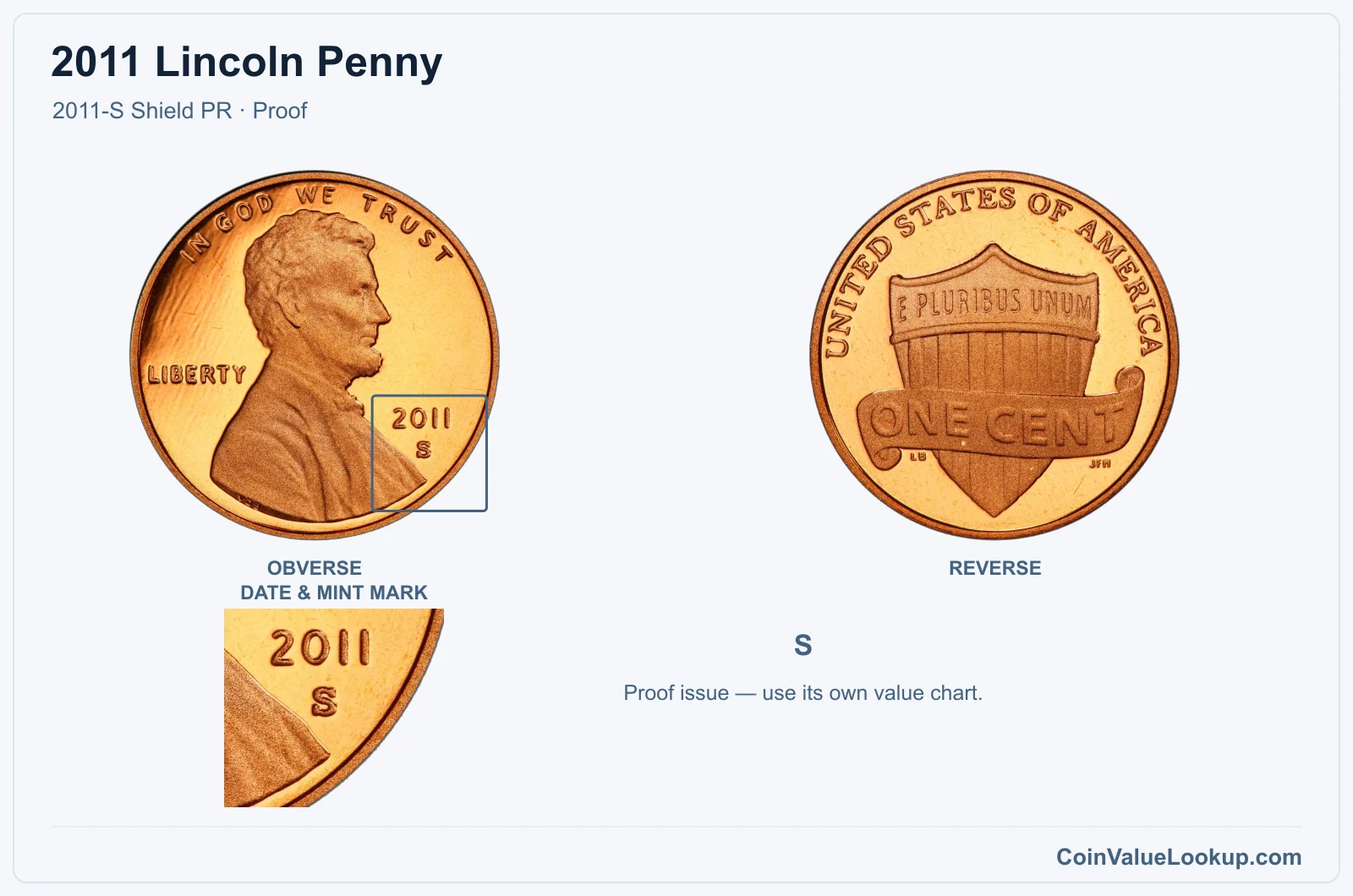
The 2011-S proof was struck at San Francisco for collector sets, not released into circulation. It carries an "S" mintmark below the date.
Proof cents show mirror-like fields and sharply struck devices.
A guide estimate at PR65 is approximately $6.25. That is considerably above the business-strike value because proofs are produced in controlled quantities for collectors.
When evaluating one, look at the mirror fields for hairlines and haze. Cameo contrast — frosted devices against deep mirrors — is a separate quality factor to compare on proof coins.
| Range | Grade | Price | Auction Records | Appraisal |
|---|---|---|---|---|
| PR | PR 1 | — | Coin Identifier | |
| PR 2 | — | Coin Identifier | ||
| PR 3 | — | Coin Identifier | ||
| PR 4 | — | Coin Identifier | ||
| PR 6 | — | Coin Identifier | ||
| PR 8 | — | Coin Identifier | ||
| PR 10 | — | Coin Identifier | ||
| PR 12 | — | Coin Identifier | ||
| PR 15 | — | Coin Identifier | ||
| PR 20 | — | Coin Identifier | ||
| PR 25 | — | Coin Identifier | ||
| PR 30 | — | Coin Identifier | ||
| PR 35 | — | Coin Identifier | ||
| PR 40 | — | Coin Identifier | ||
| PR 45 | — | Coin Identifier | ||
| PR 50 | — | Coin Identifier | ||
| PR 53 | — | Coin Identifier | ||
| PR 55 | — | Coin Identifier | ||
| PR 58 | — | Coin Identifier | ||
| PR 60 | — | Coin Identifier | ||
| PR 61 | — | Coin Identifier | ||
| PR 62 | — | Coin Identifier | ||
| PR 63 | — | Coin Identifier | ||
| PR 64 | — | Coin Identifier | ||
| PR 65 | — | Coin Identifier | ||
| PR 66 | — | Coin Identifier | ||
| PR 67 | Coin Identifier | |||
| PR 68 | — | Coin Identifier | ||
| PR 69 | Coin Identifier | |||
| PR 70 | Coin Identifier |
2011 Lincoln Penny Error List
1. 2011 Lincoln Penny — BIE Die Break
A BIE die break shows up as a small raised vertical bar or blob sitting between the letters B and E in LIBERTY on the obverse. It is caused by a crack or chip in the die, and the resulting void fills with metal during striking.
To confirm one, look closely at LIBERTY under magnification. The raised area should be part of the coin's surface, not sitting on top of it.
Dirt, a scratch, or a glued piece of metal can mimic a BIE break. A genuine example is flush with the surrounding field and consistent in texture.
No fixed price range is established for this variety on 2011 cents. Value depends on the authenticated identity of the coin, the severity and visual appeal of the break, and overall condition.
2. 2011 Lincoln Penny — Die Crack / Die Chip
Die cracks appear as thin raised lines running across part of the coin's surface. Die chips look like small raised blobs.
Both result from damage to the steel die during use.
A crack that reaches the rim can create a larger displaced section called a cud, which is a different beast. Interior cracks and chips are more common and generally less dramatic.
Compare both sides of the coin under magnification.
Do not confuse raised die cracks with incuse scratches, corrosion, or foreign material stuck to the surface. Die cracks follow the die's fracture pattern and are consistent in relief.
Pricing depends on the authenticated coin, the size and location of the crack, and overall condition — no standard range is adopted here.
3. 2011 Lincoln Penny — Off-Center Strike
An off-center strike happens when the planchet is not properly seated between the dies. The result is a design shifted to one side with an unstruck crescent of blank metal on the opposite edge.
The percentage of off-center displacement matters. A 5% shift is minor; a 50% shift with the date still visible is far more dramatic and desirable.
Always confirm the date is readable — without it, attributing the coin to 2011 is difficult.
This is not the same as a clipped planchet or a one-sided die misalignment. Post-mint flattening from a vise or hammer can also fake the look.
Genuine off-center strikes show consistent design displacement across the entire face. Value is assessed individually based on severity, condition, and authentication.
4. 2011 Lincoln Penny — Struck-Through Error
A struck-through error occurs when foreign material — grease, thread, a metal fragment, or debris — sits between the die and the planchet during striking. The result is a localized depression, an impression of the obstruction, or an area of incomplete design.
Grease-filled dies produce broad, smooth weak areas. A retained foreign object leaves a sharper, more defined impression.
These are distinct categories worth describing separately if you can tell which one you have.
Normal wear, scratches, cleaning, and ordinary weak strikes can look similar. A struck-through impression should be recessed into the design and show no raised scratch edges.
Pricing depends on authentication, the type and size of the struck-through area, and the coin's overall grade.
5. 2011 Lincoln Penny — Doubled Die
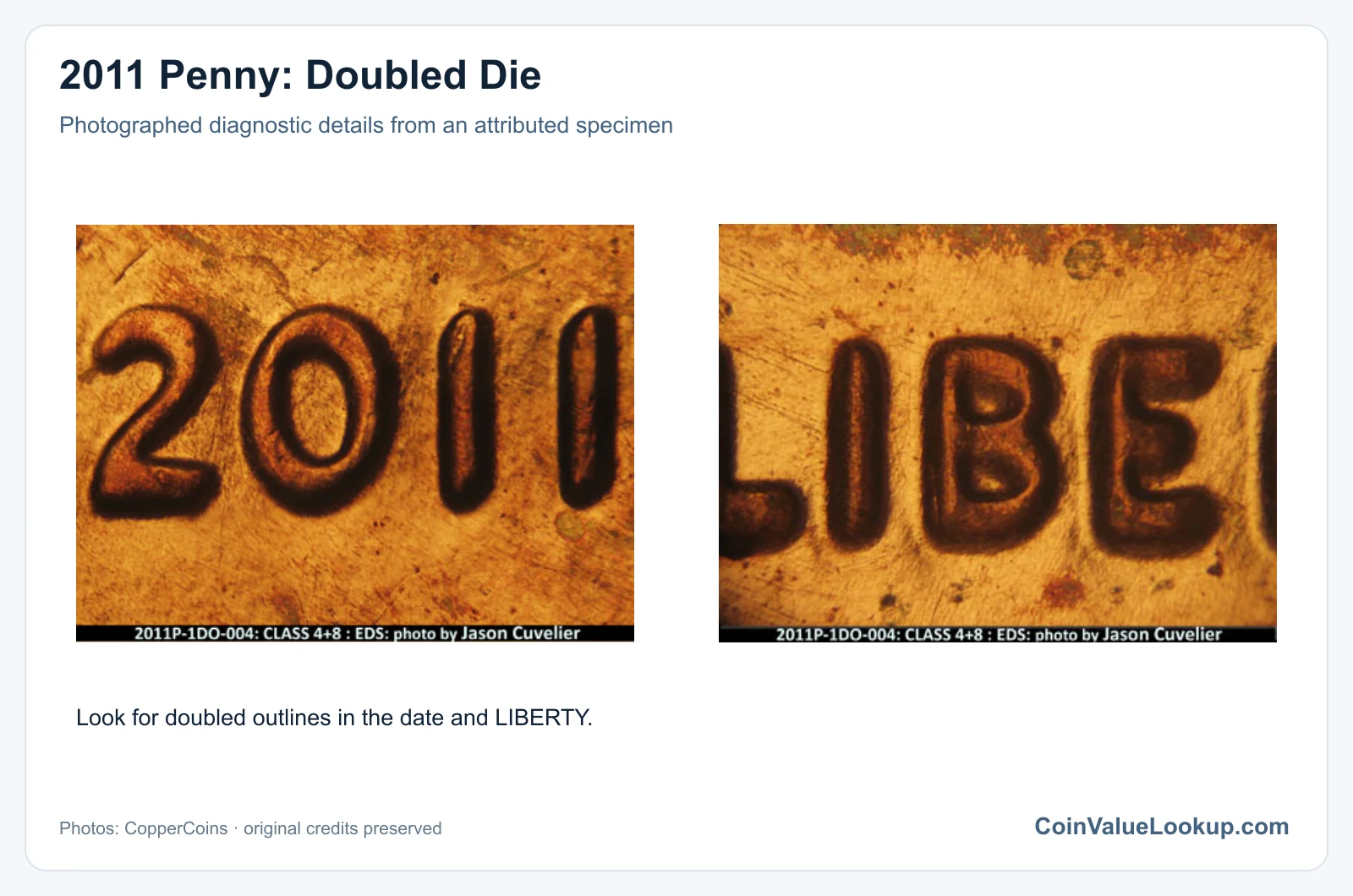
A doubled-die variety shows consistent doubling of design elements caused by a misalignment during the die-making process. Look for separation, notching, or shelf-like doubling on lettering, the date, or design features.
The key word is consistent. Every example struck from that die should show the same doubling in the same location.
Compare your coin side by side with a normal 2011 cent to spot differences.
Machine doubling — also called mechanical doubling — is a far more common and less valuable form of distortion. It tends to look flat and shelf-like, while hub doubling shows fuller, more defined secondary images.
Reflections and post-mint impressions can also fool you. No standard pricing is adopted; value depends on the specific die, severity, and authenticated condition.
6. 2011 Lincoln Penny — Feeder-Finger Marks
Feeder-finger marks are parallel or repeated linear impressions caused by the mechanism that feeds blank planchets into the striking chamber. They appear as raised or incuse marks, often in a repeating pattern, across the coin's surface.
Not every scratch on a penny is a mint error. Handling marks, cleaning hairlines, and die-polish lines can all look vaguely similar.
Genuine feeder-finger marks tend to be parallel, evenly spaced, and consistent in depth and direction. They should also make sense relative to the feeding direction of the planchet.
No fixed price range applies. Each coin needs individual assessment based on authentication, mark prominence, and overall condition.
7. 2011 Lincoln Penny — Improper Annealing
Improper annealing produces unusual surface discoloration or texture on the planchet before striking. The coin may look strangely dark, streaky, or have a rough, woodgrain-like surface that is different from normal toning.
Check the edge as well — it can show similar abnormalities. Compare your coin to a normal 2011 cent under the same lighting.
The tricky part: environmental toning, corrosion, and post-mint heat exposure can all mimic annealing errors. Surface appearance is a screening clue, not proof of the cause.
Professional authentication is the only way to confirm the error. Pricing is determined individually based on authenticated identity, visual severity, and the coin's overall grade.
8. 2011 Lincoln Penny — Clashed Dies
Clashed dies occur when the obverse and reverse dies strike each other without a planchet between them. The impact transfers faint traces of one die's design onto the opposing die.
Subsequent coins struck from those damaged dies carry ghost-like impressions of the opposite design in the fields.
Look for faint outlines — parts of Lincoln's profile in the reverse field, or shield elements on the obverse — that align with the expected position of the opposing die. The transferred images should be consistent and properly oriented.
Scratches, random raised lines, or a brockage can be confused with a clash. Value depends on authentication, clash severity, and overall coin condition.
9. 2011 Lincoln Penny — Clipped Planchet
A clipped planchet error means a portion of the blank was missing before the coin was struck. Clips can be curved (from overlapping punches), straight, or ragged, depending on the cause.
Look for a missing section of the coin with metal flow and weakness opposite the clip — this opposite weakness is a useful diagnostic. The edge at the clip should show the planchet's original cut, not a filed or ground surface.
An edge that has been cut, notched, or corroded after minting is not a clip. Post-mint damage usually shows sharp, irregular tool marks and lacks the corresponding design weakness on the opposite side.
No standard pricing is adopted; value depends on the authenticated clip type, size, and the coin's grade.
10. 2011 Lincoln Penny — Die Cap / Capped-Die Strike
A die cap forms when a struck coin sticks to one of the dies and is not ejected. That coin becomes a cap over the die, and subsequent planchets are struck through it.
The capped coin itself cups around the die like a bottle cap, while coins struck beneath it show a mushy, spread-out impression of the design.
These are dramatic errors and relatively scarce on modern cents. Distinguish the actual capped coin (cupped, with one incuse side) from a coin that was merely struck under a cap (distorted design, possible brockage effects).
A bent coin, vise damage, or a normal weak strike can superficially resemble a cap. Authentication is essential.
Value is assessed individually by error severity and condition.
11. 2011 Lincoln Penny — Misaligned Die
A misaligned die shifts the design on one side of the coin relative to the planchet or the opposite face. You will see a uniform crescent of extra rim on one side and a narrow rim on the opposite side — but the design itself is fully struck, just off-center on the planchet.
This is different from an off-center strike, where the planchet itself was mispositioned and part of the design is missing entirely. It is also different from a rotated die, where the alignment is angular rather than lateral.
Post-mint rim damage or a tilted photograph can create the illusion of misalignment. Examine the coin in hand, checking that the rim width variation is consistent.
No pricing range is adopted; individual assessment by severity and authenticated condition determines value.