2011 Roosevelt Dime Coin Value: How Much Is It Worth?
Most 2011 Roosevelt dimes you find in change are worth face value — ten cents, no more. In mint state, a USA Coin Book guide lists the 2011-P or 2011-D at about $2.50 in MS65 condition.
The S-mint silver proof at PR65 is guided around $10.69. Before comparing prices, you need to confirm the mint, metal and finish of your specific coin.
Fast Way to Identify Your 2011 Roosevelt Dime
The quickest way to start is to snap clear photos of both sides of your dime and upload them using the identification tool on this page. This gives you a preliminary read on the mint and version so you know which price column to check.
Good lighting and a steady hand help — blurry photos make identification harder.
2011 Roosevelt Dime Value
Upload both sides of your 2011 Roosevelt Dime.
Front Obverse
Upload photo
Back Reverse
Upload photo
Which 2011 Roosevelt Dime Versions Are Worth Money?
- A 2011-P or 2011-D dime with full, separated torch bands in high mint state can bring a small premium over typical uncirculated examples.
- The 2011-S silver proof, struck in 90% silver, carries a higher base value than the clad versions — around $10.69 at PR65 per USA Coin Book — and is worth confirming by weight and edge color.
Step 1: Identify Your 2011 Roosevelt Dime Mint Mark and Version
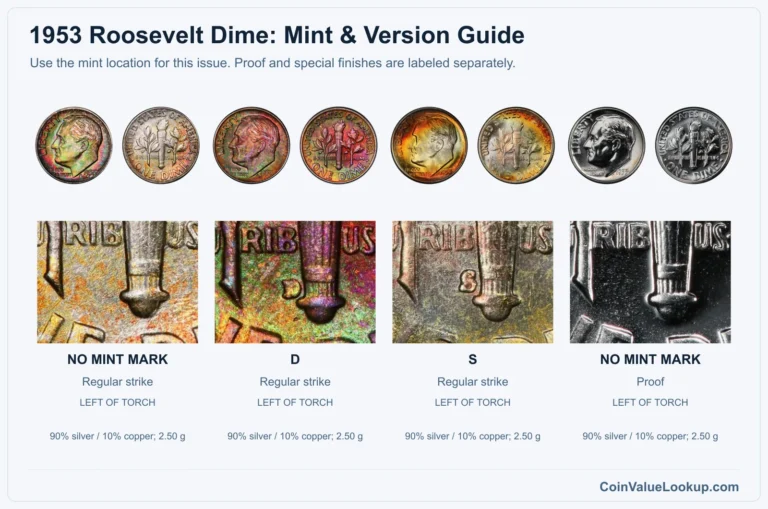
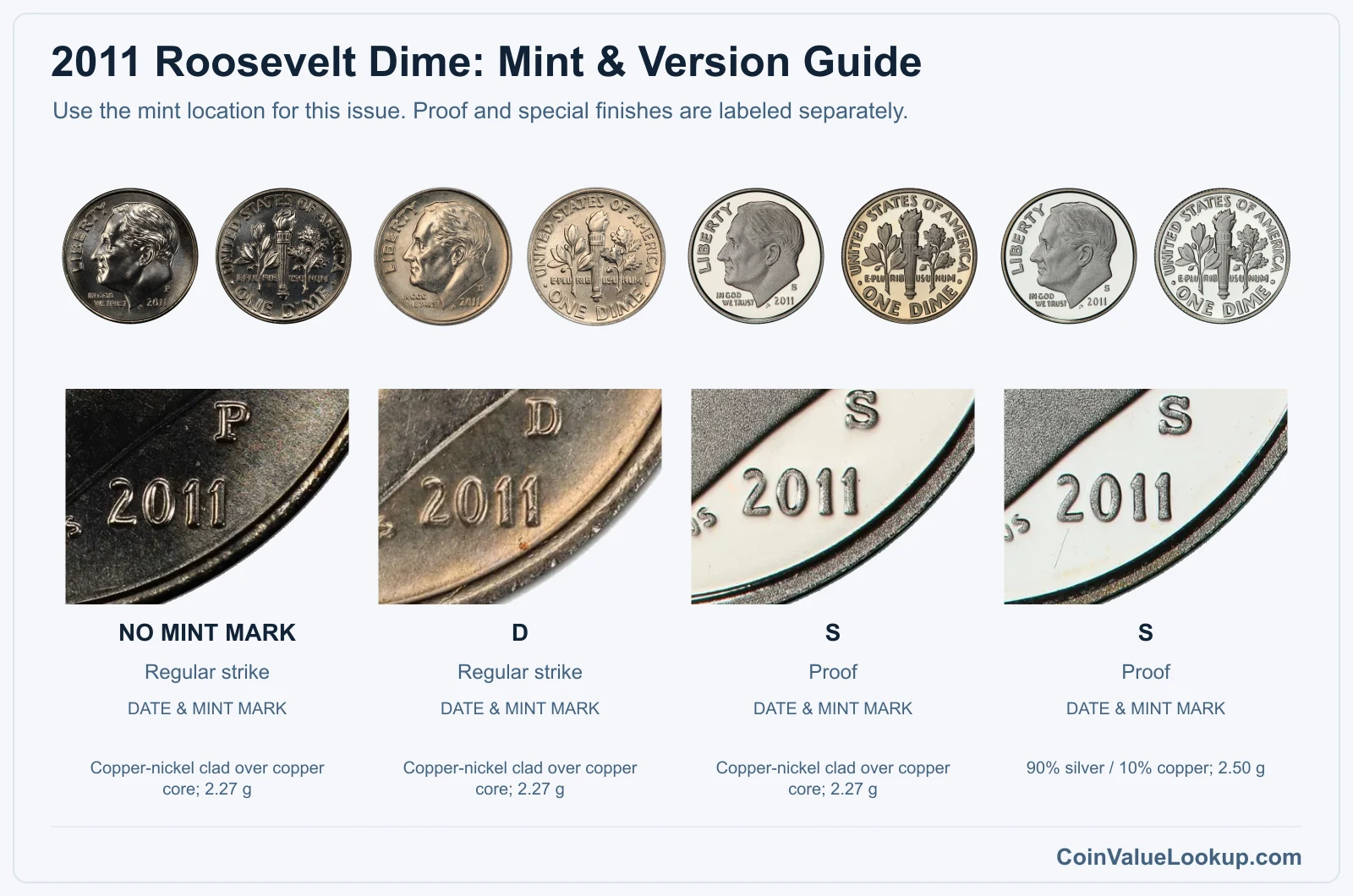
Every 2011 dime shares the Roosevelt portrait on the obverse and a torch flanked by olive and oak branches on the reverse. The mintmark sits on the obverse, just above the date.
A "P" means Philadelphia, "D" means Denver, and "S" means San Francisco.
Philadelphia and Denver coins are standard business strikes made from copper-nickel clad. San Francisco produced two proof versions: one in the same copper-nickel clad composition and one in 90% silver.
Telling clad from silver matters. A clad dime weighs about 2.27 grams; the silver proof weighs roughly 2.50 grams.
The edge is the easiest visual clue — a clad coin shows a visible copper-colored stripe, while a silver coin has a uniform gray edge. Original proof packaging also confirms the metal, but weight and edge together are your best tools when the packaging is gone.
There was no Satin Finish version produced for 2011, so you are working with two business strikes and two proof finishes — four branches total.
Step 2: Check Your 2011 Roosevelt Dime Grade
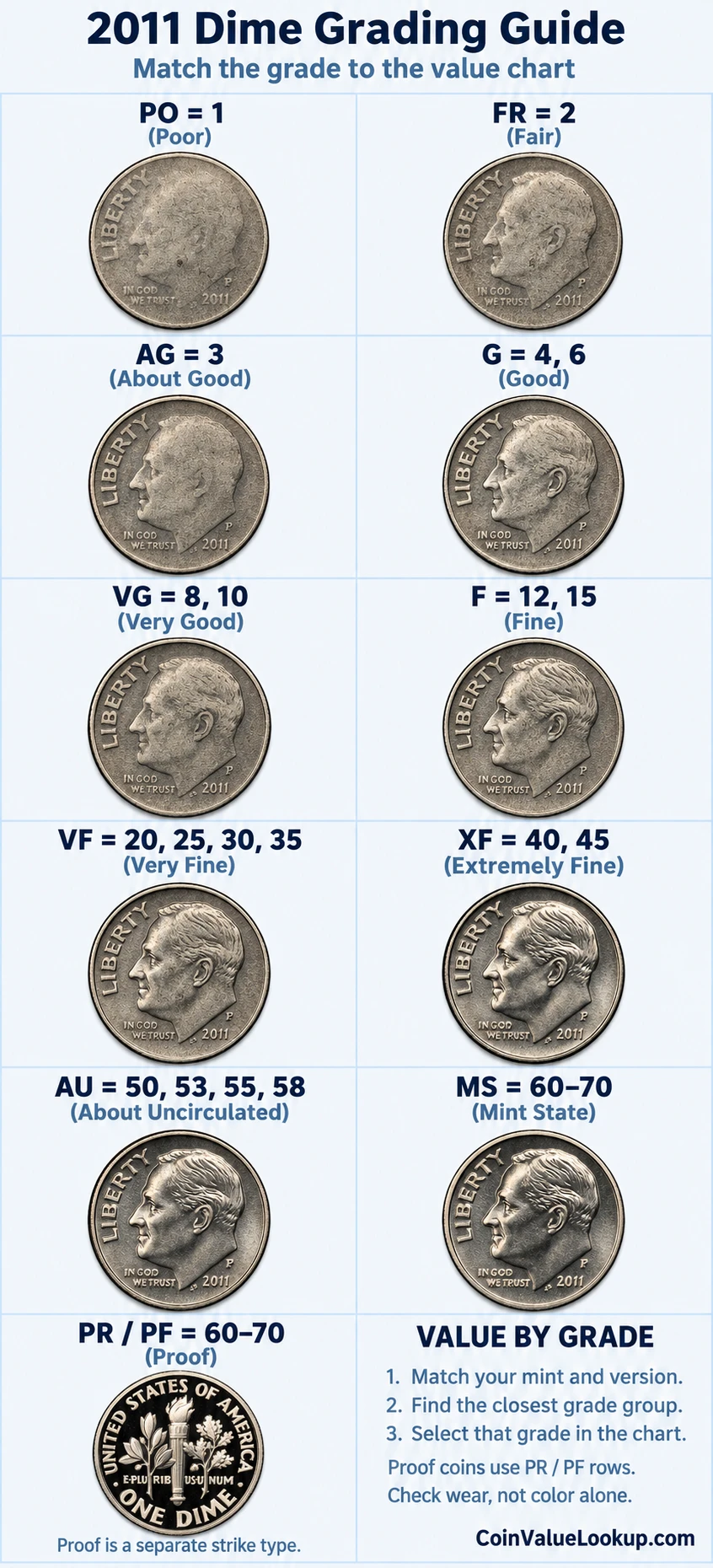
Start by checking Roosevelt's cheekbone and jawline. On a well-preserved coin these areas retain full, unbroken luster.
Wear shows up there first as a flat, dull patch. The hair above the ear is another early-wear zone.
On the reverse, examine the torch bands closely. "Full Bands" means both pairs of horizontal bands across the torch are clearly separated — this is a strike quality designation, not an indication of grade.
A weakly struck coin can still be uncirculated; the bands just did not fully form.
Use the comparison image on this page to gauge where your coin falls. Original mint luster has a cartwheel shimmer that cleaning cannot replicate, so a shiny coin is not automatically high grade.
For proofs, look at the mirrored fields and frosted devices under good light. Hairlines, haze and finger marks all pull the grade down.
Compare your proof against other proof examples, not against business strikes — they are graded within their own finish category.
Step 3: Check 2011 Roosevelt Dime Value by Mint and Version
2011 Roosevelt Dime — P Business Strike
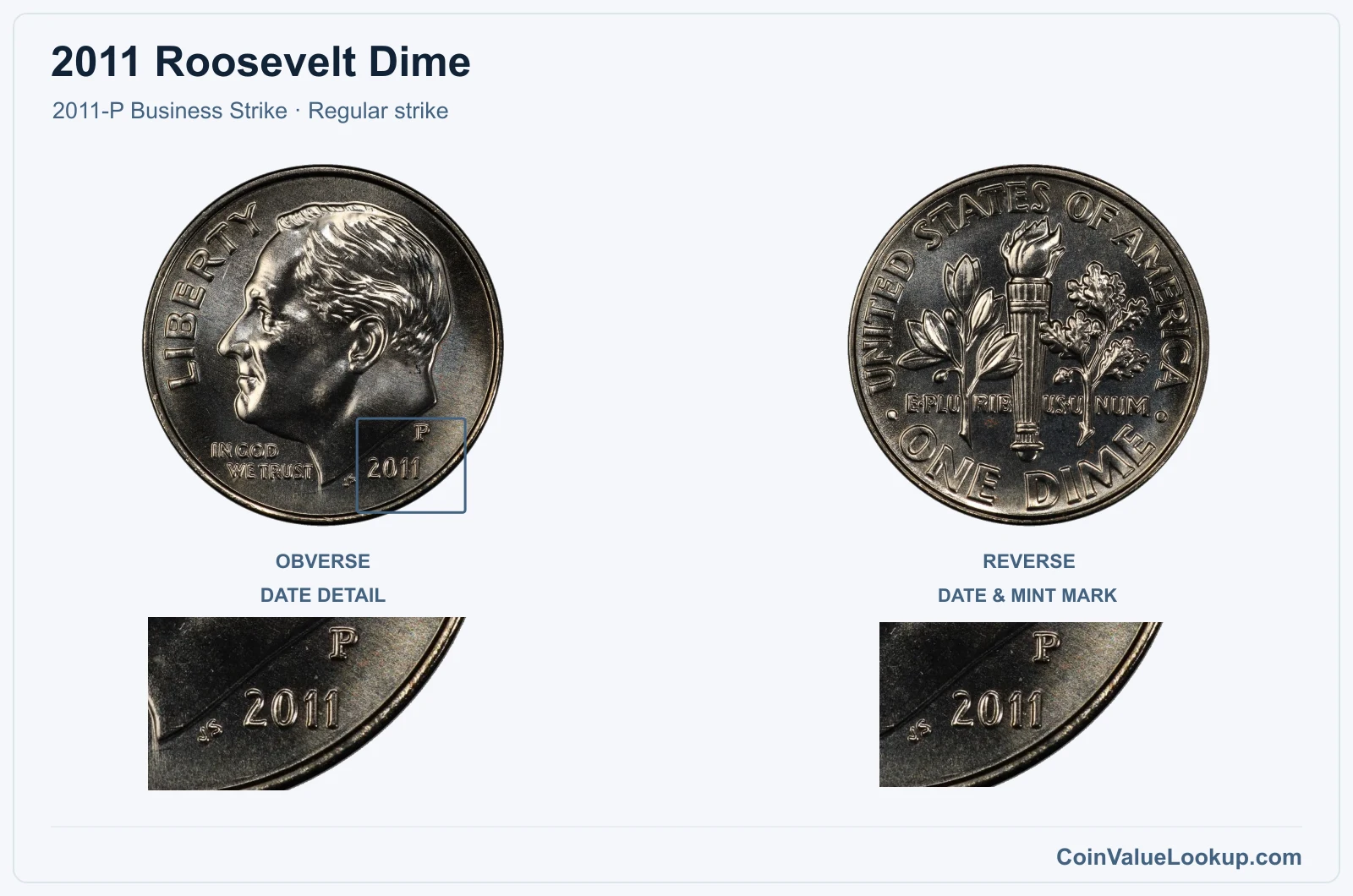
The 2011-P dime was struck at Philadelphia on a copper-nickel clad planchet weighing 2.27 grams. Look for the small "P" mintmark on the obverse near the date.
In typical circulated condition these trade at face value.
USA Coin Book guides the MS65 grade at about $2.50. Coins with fully separated torch bands — both horizontal pairs distinct — can attract collector attention in higher grades.
A clean, lustrous example with sharp bands is worth setting aside, even if the dollar premium at MS65 is modest.
Range Grade
Price Auction Records Appraisal PO PO 1
—
Coin Identifier FR FR 2
—
Coin Identifier AG AG 3
—
Coin Identifier G G 4
—
Coin Identifier
G 6
—
Coin Identifier VG VG 8
—
Coin Identifier
VG 10
—
Coin Identifier F F 12
—
Coin Identifier
F 15
—
Coin Identifier VF VF 20
—
Coin Identifier
VF 25
—
Coin Identifier
VF 30
—
Coin Identifier
VF 35
—
Coin Identifier XF XF 40
—
Coin Identifier
XF 45
—
Coin Identifier AU AU 50
—
Coin Identifier
AU 53
—
Coin Identifier
AU 55
—
Coin Identifier
AU 58
—
Coin Identifier MS MS 60
—
Coin Identifier
MS 61
—
Coin Identifier
MS 62
Coin Identifier
MS 63
—
Coin Identifier
MS 64
—
Coin Identifier
MS 65
—
Coin Identifier
MS 66
—
Coin Identifier
MS 67
—
Coin Identifier
MS 68
Coin Identifier
MS 69
—
—
—
MS 70
—
—
—
2011 Roosevelt Dime — D Business Strike
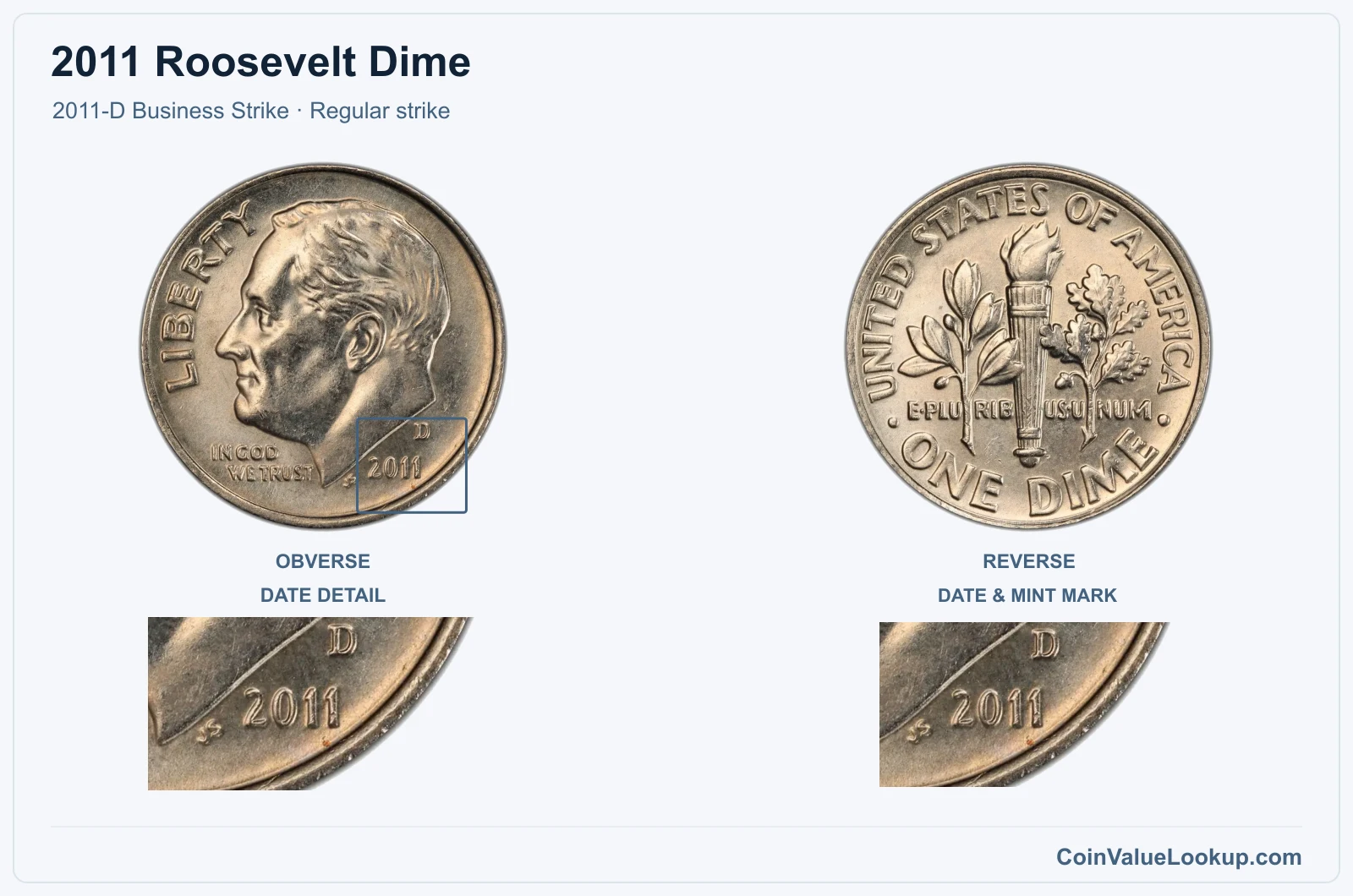
Denver's 2011-D dime uses the same copper-nickel clad composition and 2.27-gram weight as its Philadelphia sibling. The "D" mintmark appears in the same obverse location.
Circulated pieces are worth ten cents.
At MS65, the USA Coin Book guide sits at $2.50. As with the P mint, the torch bands are the detail to watch — well-separated bands in a high-grade example are what make one 2011-D more desirable than another.
Most rolls from circulation will not yield Full Bands coins, so cherry-picking uncirculated rolls is where the fun is.
Range Grade
Price Auction Records Appraisal PO PO 1
—
Coin Identifier FR FR 2
—
Coin Identifier AG AG 3
—
Coin Identifier G G 4
—
Coin Identifier
G 6
—
Coin Identifier VG VG 8
—
Coin Identifier
VG 10
—
Coin Identifier F F 12
—
Coin Identifier
F 15
—
Coin Identifier VF VF 20
—
Coin Identifier
VF 25
—
Coin Identifier
VF 30
—
Coin Identifier
VF 35
—
Coin Identifier XF XF 40
—
Coin Identifier
XF 45
—
Coin Identifier AU AU 50
—
Coin Identifier
AU 53
—
Coin Identifier
AU 55
—
Coin Identifier
AU 58
—
Coin Identifier MS MS 60
—
Coin Identifier
MS 61
—
Coin Identifier
MS 62
—
Coin Identifier
MS 63
—
Coin Identifier
MS 64
—
Coin Identifier
MS 65
—
Coin Identifier
MS 66
—
Coin Identifier
MS 67
—
Coin Identifier
MS 68
—
Coin Identifier
MS 69
—
—
—
MS 70
—
—
—
2011 Roosevelt Dime — S Clad Proof
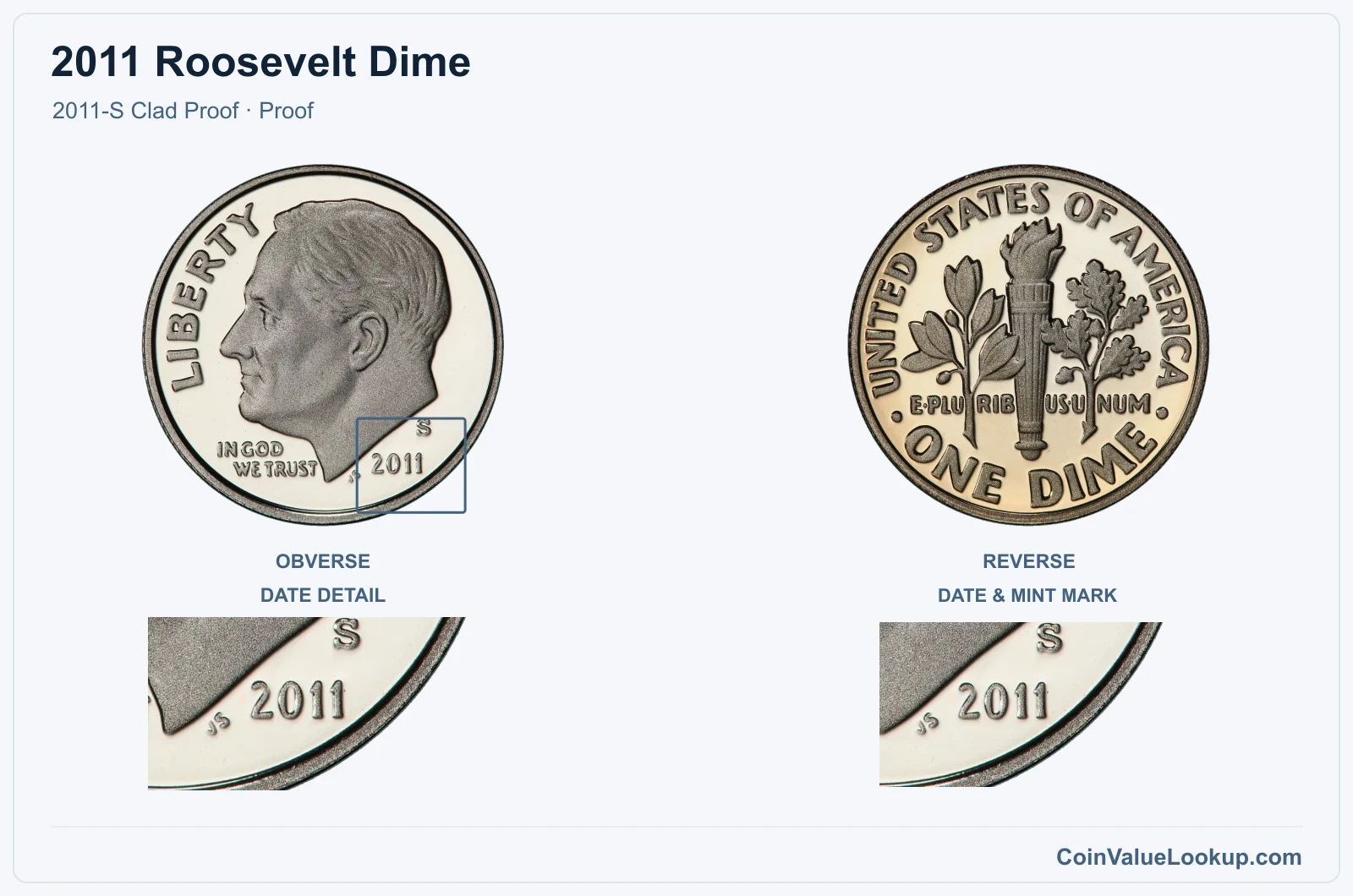
The 2011-S clad proof was produced at San Francisco for collector sets. It shares the copper-nickel clad composition and 2.27-gram weight of the business strikes but has mirror-finish fields and frosted design elements.
Coin Value Lookup is a handy starting point if you want to compare this coin with other Roosevelt Dime years and their guide values.
USA Coin Book guides PR65 at $3.08. Most of these proofs survive in high grade because they were sold directly to collectors and handled carefully.
Check the fields for hairlines or haze — that is what separates an average proof from a top-grade example.
Range Grade
Price Auction Records Appraisal PR PR 1
—
Coin Identifier
PR 2
—
Coin Identifier
PR 3
—
Coin Identifier
PR 4
—
Coin Identifier
PR 6
—
Coin Identifier
PR 8
—
Coin Identifier
PR 10
—
Coin Identifier
PR 12
—
Coin Identifier
PR 15
—
Coin Identifier
PR 20
—
Coin Identifier
PR 25
—
Coin Identifier
PR 30
—
Coin Identifier
PR 35
—
Coin Identifier
PR 40
—
Coin Identifier
PR 45
—
Coin Identifier
PR 50
—
Coin Identifier
PR 53
—
Coin Identifier
PR 55
—
Coin Identifier
PR 58
—
Coin Identifier
PR 60
—
Coin Identifier
PR 61
—
Coin Identifier
PR 62
—
Coin Identifier
PR 63
—
Coin Identifier
PR 64
—
Coin Identifier
PR 65
—
Coin Identifier
PR 66
—
Coin Identifier
PR 67
—
Coin Identifier
PR 68
—
Coin Identifier
PR 69
Coin Identifier
PR 70
Coin Identifier
2011 Roosevelt Dime — S Silver Proof
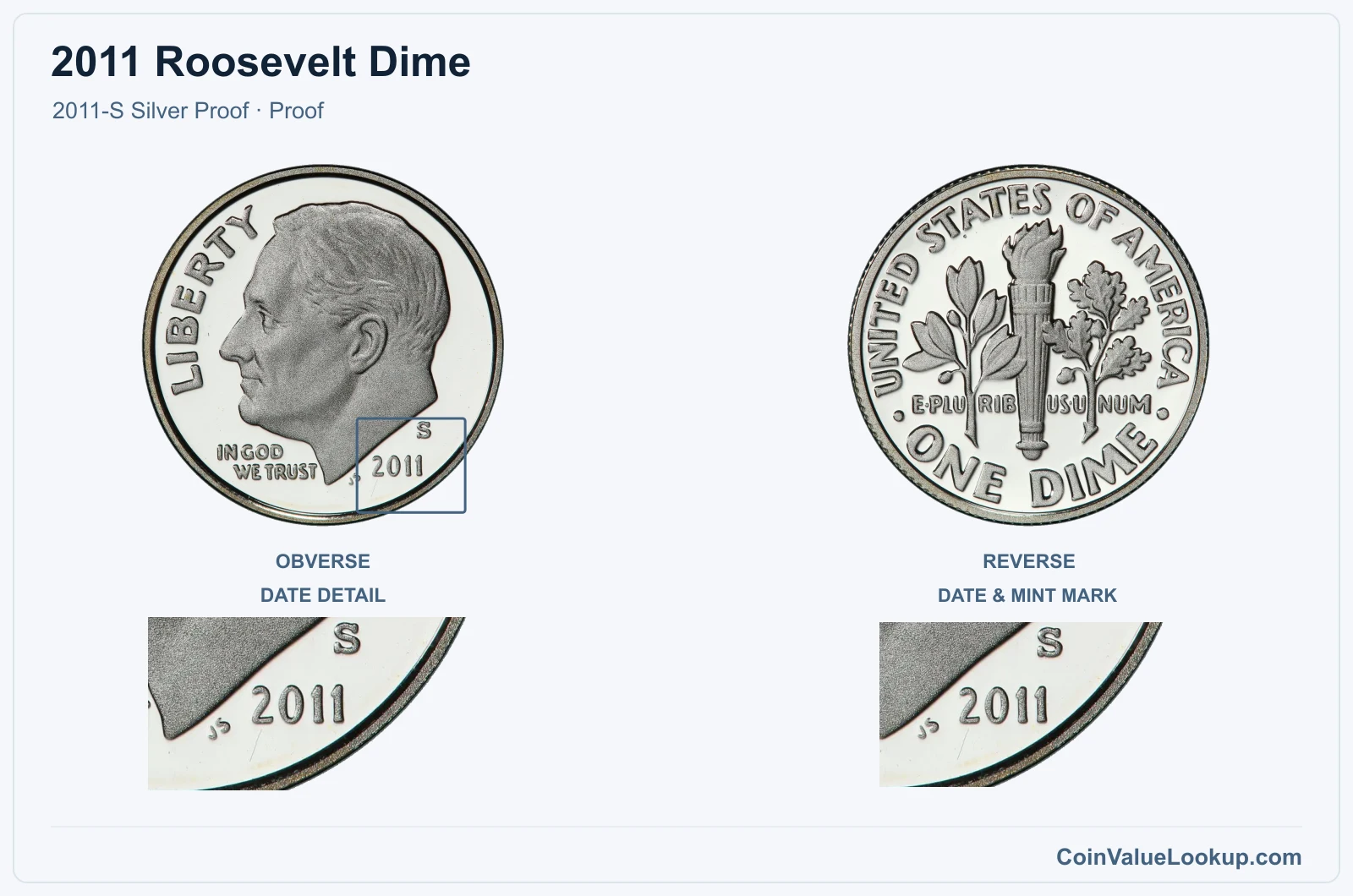
This is the 90% silver version of the 2011-S proof, weighing approximately 2.50 grams versus the 2.27 grams of the clad issue. The edge will look uniformly gray rather than showing the copper-colored stripe of a clad coin.
Weight and edge together are the most reliable identifiers when original mint packaging is absent.
USA Coin Book guides this version at about $10.69 in PR65 — the highest guided value among the four 2011 dime branches at comparable grade levels. The silver content alone provides a floor, and pristine examples with strong contrast between frosted devices and mirror fields will appeal to Roosevelt series collectors.
Confirm the metal before assuming any S-mint proof is silver; clad S proofs exist for this year too.
Range Grade
Price Auction Records Appraisal PR PR 1
—
Coin Identifier
PR 2
—
Coin Identifier
PR 3
—
Coin Identifier
PR 4
—
Coin Identifier
PR 6
—
Coin Identifier
PR 8
—
Coin Identifier
PR 10
—
Coin Identifier
PR 12
—
Coin Identifier
PR 15
—
Coin Identifier
PR 20
—
Coin Identifier
PR 25
—
Coin Identifier
PR 30
—
Coin Identifier
PR 35
—
Coin Identifier
PR 40
—
Coin Identifier
PR 45
—
Coin Identifier
PR 50
—
Coin Identifier
PR 53
—
Coin Identifier
PR 55
—
Coin Identifier
PR 58
—
Coin Identifier
PR 60
—
Coin Identifier
PR 61
—
Coin Identifier
PR 62
—
Coin Identifier
PR 63
—
Coin Identifier
PR 64
—
Coin Identifier
PR 65
—
Coin Identifier
PR 66
—
Coin Identifier
PR 67
—
Coin Identifier
PR 68
—
Coin Identifier
PR 69
Coin Identifier
PR 70
Coin Identifier
2011 Roosevelt Dime Error List
1. 2011 Roosevelt Dime — Missing Clad Layer
A missing clad layer error occurs when one of the outer copper-nickel layers is absent from the planchet before striking. The result is a coin that looks noticeably different on the affected side — typically showing exposed copper with an off-color, brownish or reddish tone instead of the usual silvery surface.
To check, compare the edge of your coin with a normal dime. A standard clad dime shows a copper stripe sandwiched between two outer layers.
A missing-layer coin may show a thinner or lopsided edge profile, and it should weigh less than the normal 2.27 grams.
Be careful with lookalikes. Environmental toning, corrosion, chemical exposure and deliberate surface removal can all mimic the appearance.
Genuine missing clad errors affect the coin uniformly on the affected face, not in random patches. Value depends on the coin's condition, how visible the error is, and professional verification.
2. 2011 Roosevelt Dime — Wrong Planchet / Off-Metal Strike
A wrong planchet error means a 2011 dime die struck a blank intended for a different denomination or even a different country's coin. The result is a dime design on a planchet that does not match the expected weight, diameter or edge characteristics of a normal dime.
Diagnosis starts with measuring the coin. Compare your specimen's weight, diameter and edge against the standard 2.27-gram, 17.9-mm clad dime specs.
A genuine wrong-planchet strike may show an incomplete design if the blank was smaller, or an unusual color and weight if the metal is different.
Lookalikes include coins that have been plated, acid-treated, filed down or otherwise altered after leaving the mint. These alterations create uneven surfaces, pitting or weight loss that a wrong-planchet coin would not exhibit.
No specific price is adopted here because value varies widely based on the particular planchet involved, the coin's condition and authenticated attribution.
3. 2011 Roosevelt Dime — Doubled Die Obverse
A doubled die obverse on a 2011 dime means the die itself carried a doubled impression of part of the design, which then transferred to every coin struck with that die. Look at the obverse lettering — "LIBERTY," "IN GOD WE TRUST" and the date — under magnification with consistent lighting.
Genuine doubling shows as a secondary image with distinct separation or notching on the letters.
The key distinction is between a true doubled die and machine doubling. Machine doubling produces a flat, shelf-like distortion on one side of the letters, often with a mushy look.
A doubled die typically shows sharper, more defined secondary lines. Worn dies can also create slightly fuzzy letters that look doubled at first glance but lack consistent directionality.
No specific price is adopted for this variety. Value depends on the strength of the doubling, overall coin condition and whether the variety has been independently attributed.