1928 Mercury Dime Coin Value: How Much Is It Worth?
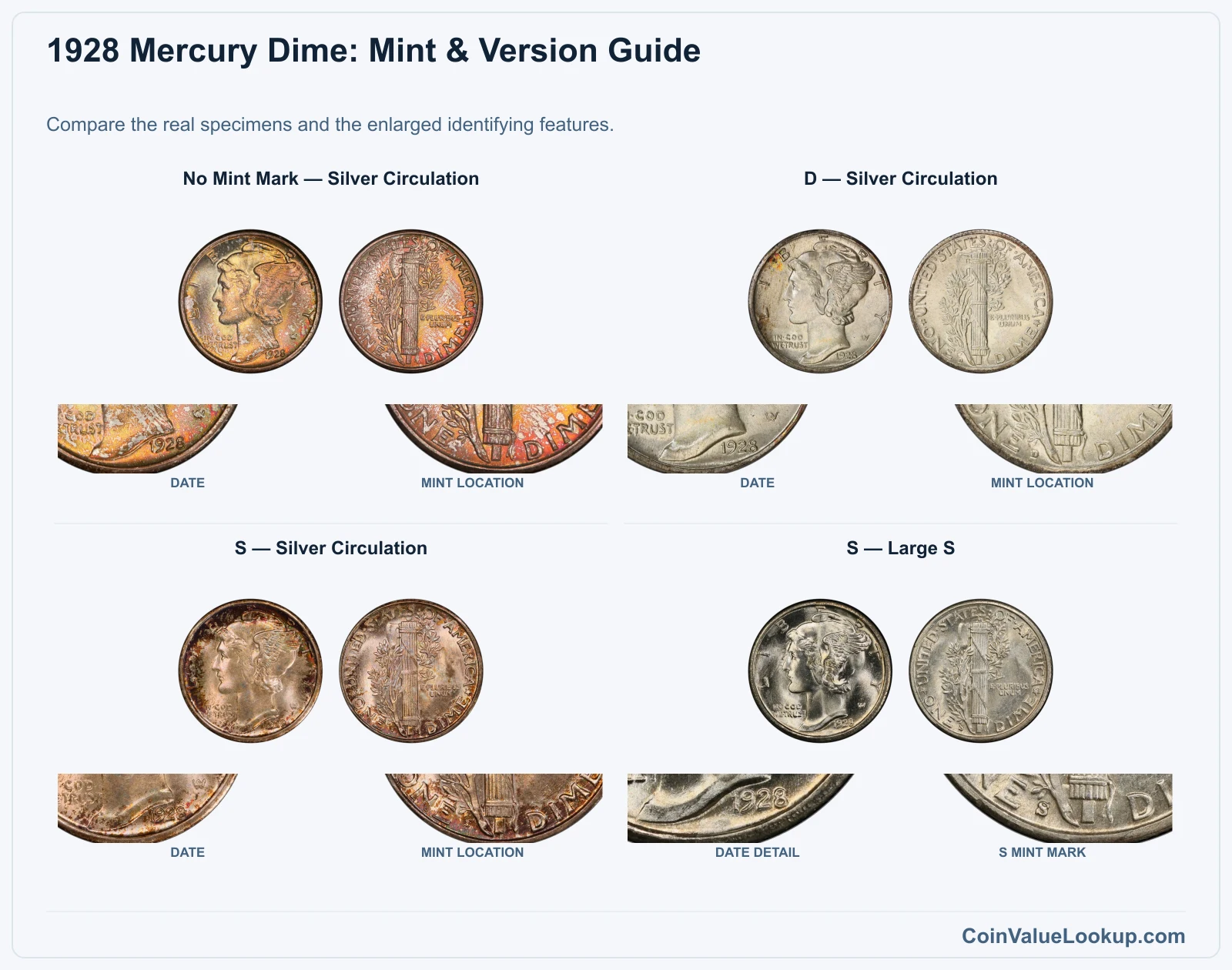
A 1928 Mercury Dime in well-worn G4 condition starts around $7.16, while uncirculated MS65 examples range up to about $1,067 depending on mint. Three mints produced this date — Philadelphia, Denver, and San Francisco — all in business strike only, with no proofs issued.
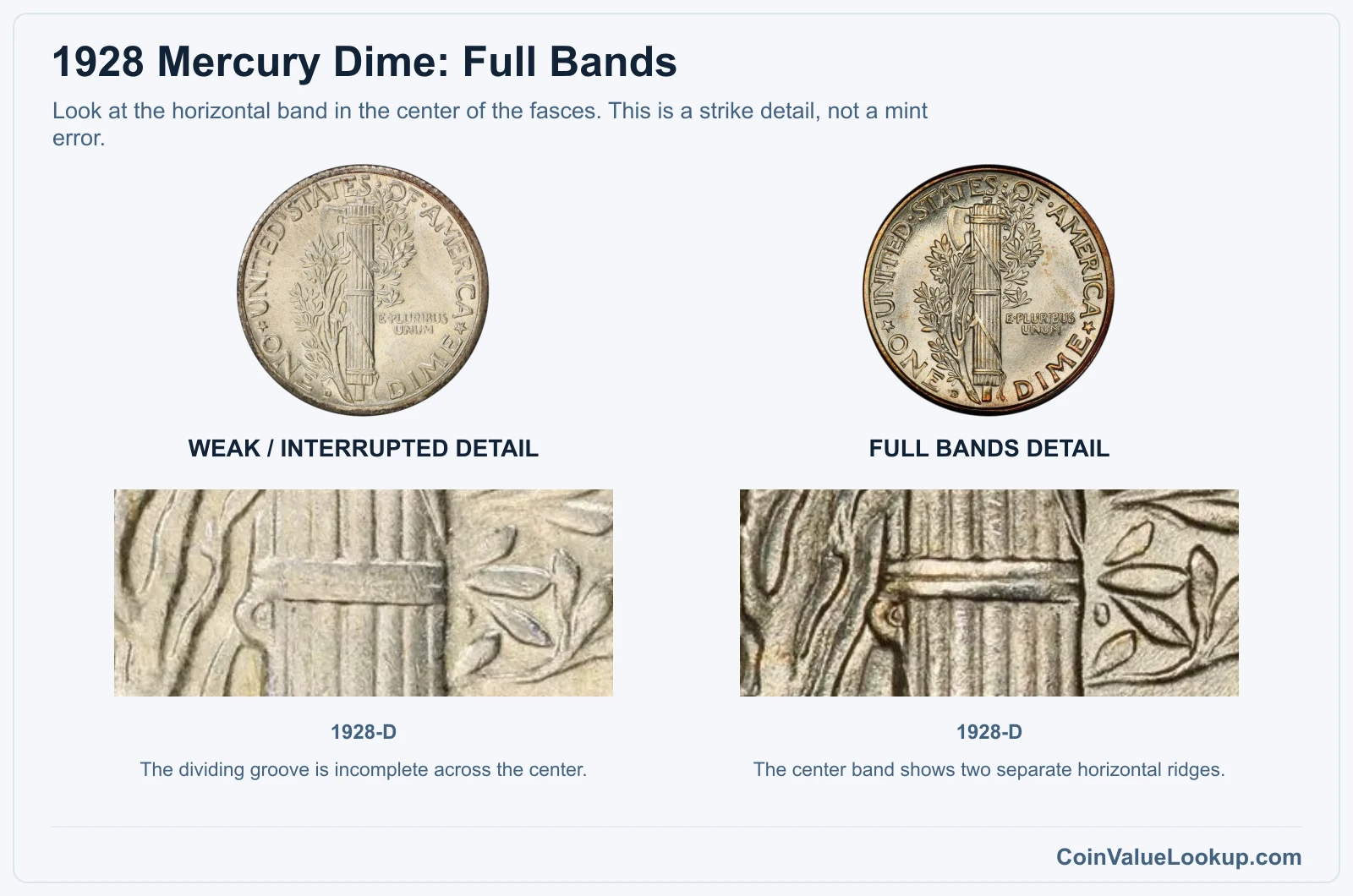
Coins showing fully separated fasces bands on the reverse can command additional premiums beyond the standard guide figures listed here.
Fast Way to Identify Your 1928 Mercury Dime
Snap clear photos of both sides of your 1928 Mercury Dime and upload them to our identifier. This gives you a preliminary identification of your coin's mint, condition range, and version.
Good lighting on the mintmark area (lower left reverse) and the fasces bands helps the most. A straight-on shot beats an angled glamour photo every time.
1928 Mercury Dime Value
Upload both sides of your 1928 Mercury Dime.
Front Obverse
Upload photo
Back Reverse
Upload photo
Which 1928 Mercury Dime Versions Are Worth Money?
- The 1928-D in MS65 reaches about $1,067 according to USA Coin Book, the highest regular guide figure among this year's three mints.
- The 1928-S in MS65 lists around $531, also a strong premium over its circulated value of about $7.16 in G4.
- A Large S variety exists for the 1928-S and is tracked separately — no specific price is quoted here, so check exact-variety references.
- Full Bands examples of any mint can carry premiums above the standard Mint State values listed on this page.
- Recognized mint errors such as off-center strikes, clipped planchets, laminations, and die breaks add collector interest when properly identified.
Step 1: Identify Your 1928 Mercury Dime Mint Mark and Version
Three mints struck the 1928 Mercury Dime: Philadelphia, Denver, and San Francisco. No proofs were made this year.
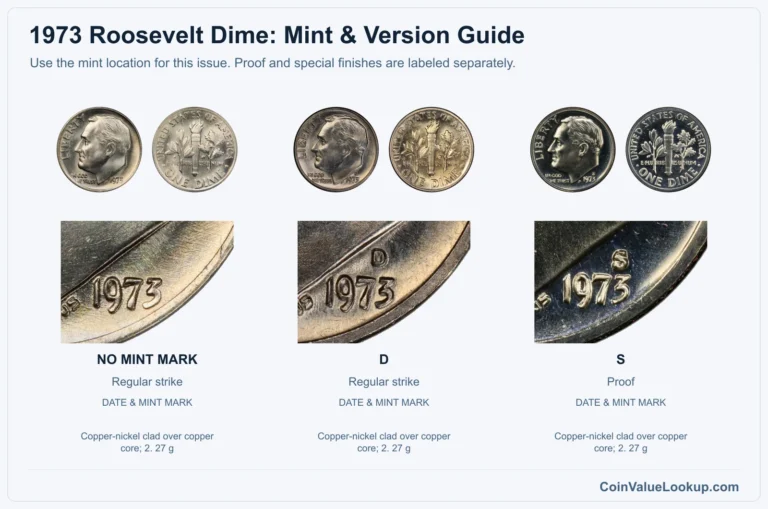
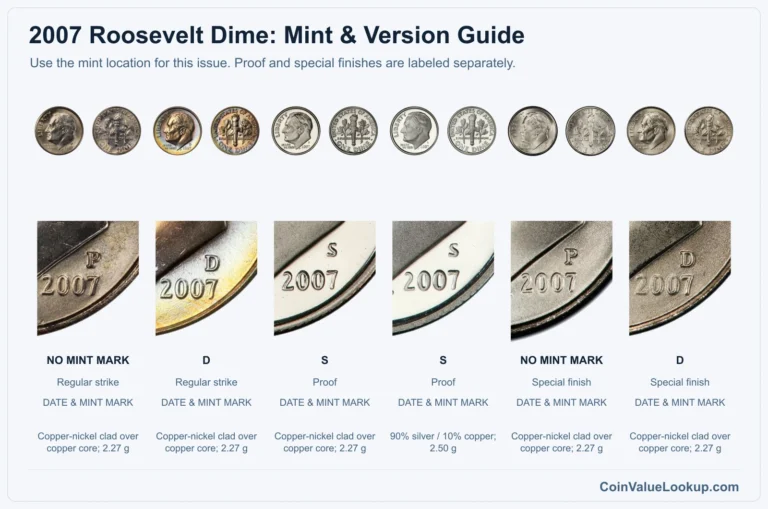
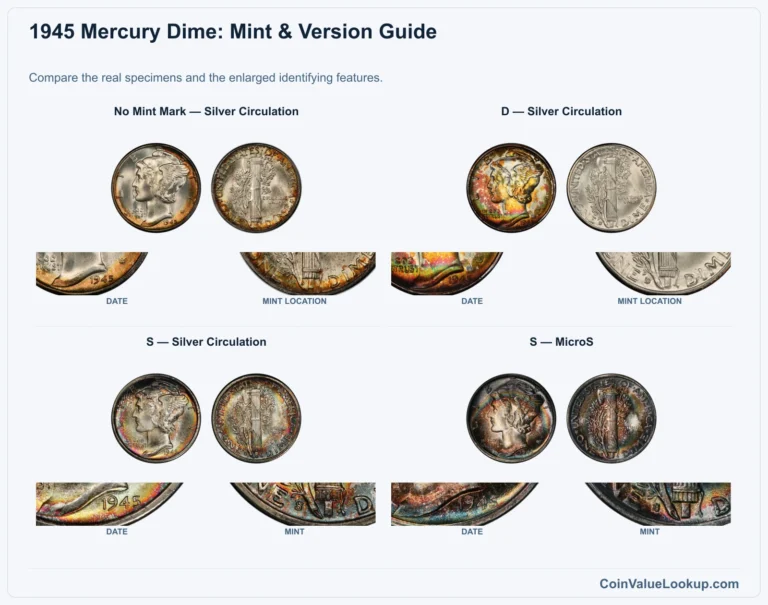
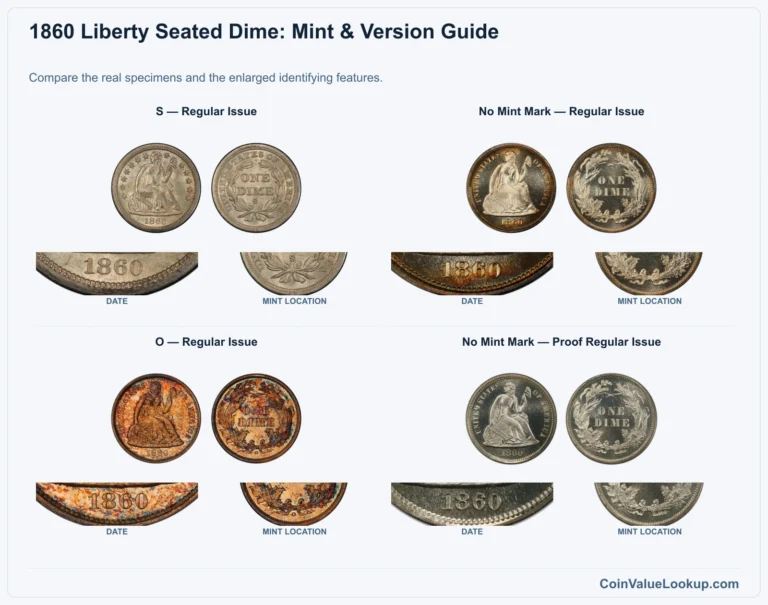
Philadelphia coins carry no mintmark at all. Denver pieces show a small "D" and San Francisco pieces a small "S," both located on the reverse to the lower left of the word ONE, near the base of the fasces.
Do not confuse the "AW" monogram on the obverse near the date with a mintmark — that is designer Adolph Weinman's initials.
All 1928 dimes are struck in 90% silver and 10% copper, weigh about 2.5 grams, measure 17.9 mm across, and have a reeded edge. San Francisco also produced a recognized Large S variety where the mintmark is noticeably bigger than the normal S punch — this is a distinct size variant, not a repunched mintmark.
Check your S-mint coin against a known example before assuming either way.
Step 2: Check Your 1928 Mercury Dime Grade
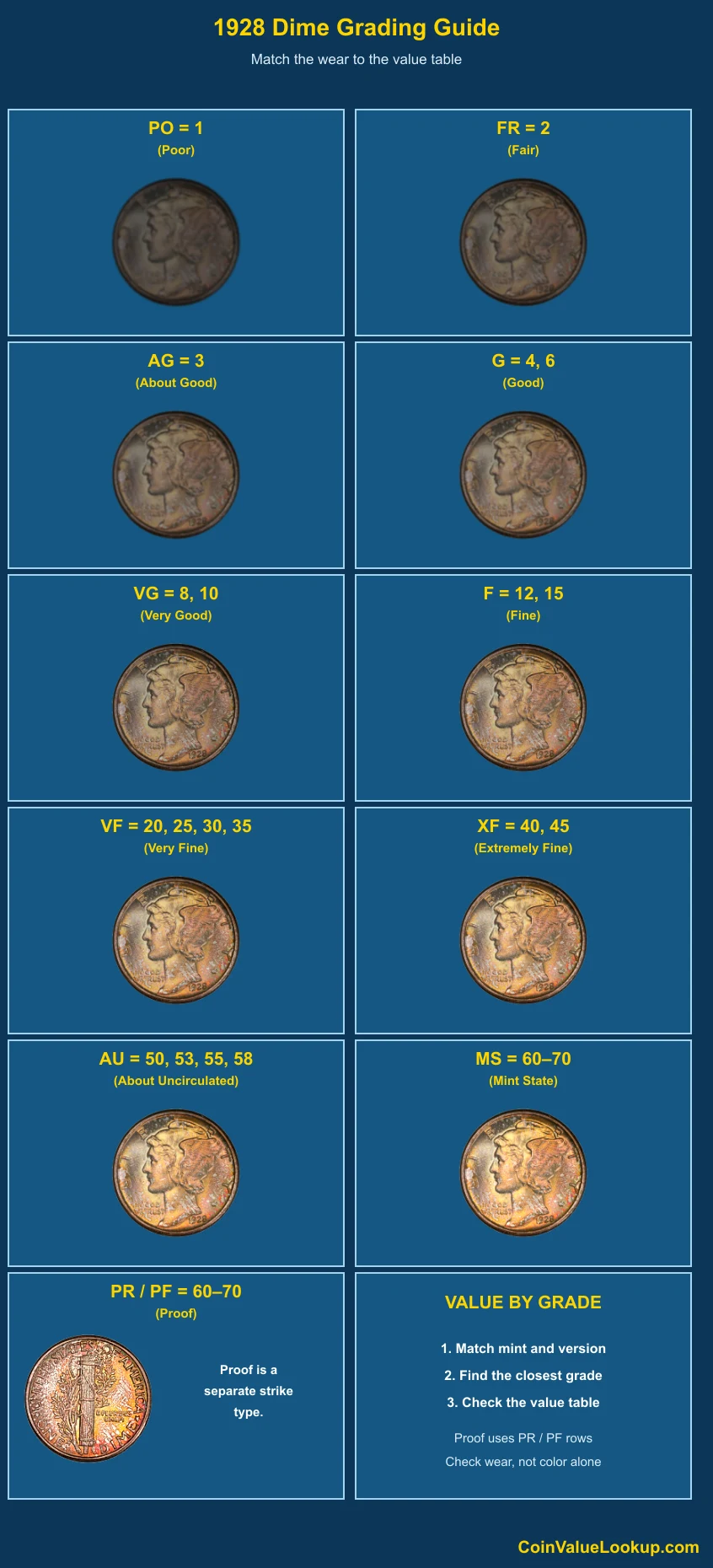
Start with the obverse. The hair detail directly above and in front of Liberty's ear wears first, followed by the wing feathers on the cap.
On the reverse, the horizontal bands crossing the center of the fasces are your key wear indicator.
A coin in Good condition will have a full outline of Liberty but very little interior hair detail. Fine examples show partial hair strands.
At About Uncirculated, only the highest points show light friction.
Mint State coins retain full original luster with no wear, though they may have contact marks from bag handling. Weak bands or soft peripheral lettering do not automatically mean a coin circulated — branch-mint strikes from Denver and San Francisco were often softer from the press.
Compare your coin against the grading image to judge actual wear versus a weak strike.
Full Bands is a separate designation that checks whether the central and outer bands on the fasces are clearly separated. Different grading services may apply slightly different criteria for this designation.
It is a strike characteristic, not a grade above Mint State or a minting error.
Step 3: Check 1928 Mercury Dime Value by Mint and Version
1928 Mercury Dime — No Mint Mark — Silver Circulation
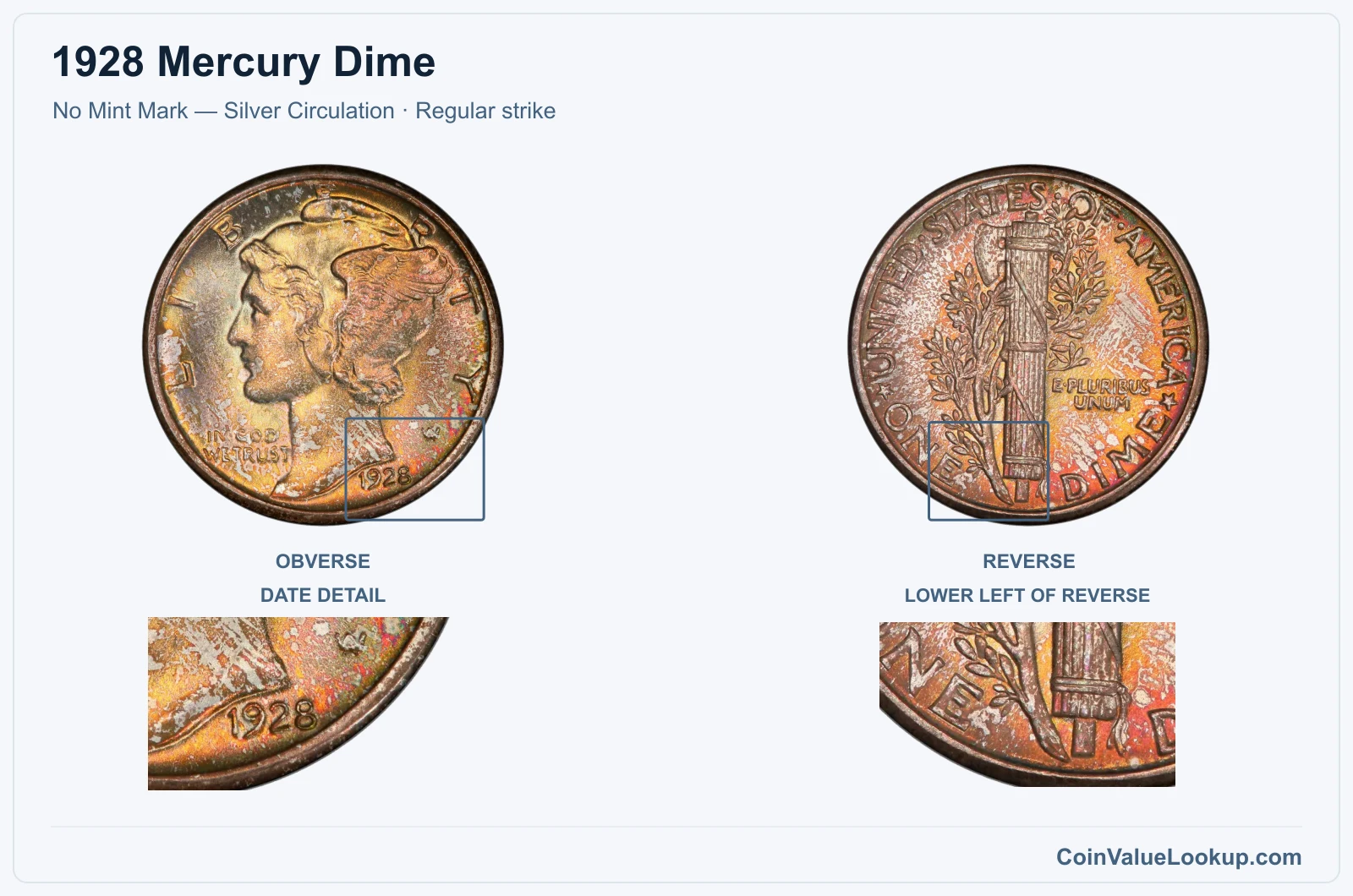
The 1928 Philadelphia dime has no mintmark anywhere on the coin. In G4 condition, USA Coin Book estimates about $7.16.
At MS65, the guide lists roughly $166.
Philadelphia strikes tend to be a bit sharper than their branch-mint siblings, so finding one with decent detail in circulated grades is common. Mint State examples with clean, lustrous surfaces are where the premium lives.
Full Bands pieces are tracked separately and can trade above the standard MS65 figure, but no FB-specific price is quoted here.
Coin Value Lookup is a handy starting point if you want to look up guides for other dates and denominations in the Mercury Dime series or beyond.
Range Grade
Price Auction Records Appraisal PO PO 1
—
Coin Identifier FR FR 2
—
Coin Identifier AG AG 3
—
Coin Identifier G G 4
—
Coin Identifier
G 6
—
Coin Identifier VG VG 8
—
Coin Identifier
VG 10
—
Coin Identifier F F 12
—
Coin Identifier
F 15
—
Coin Identifier VF VF 20
—
Coin Identifier
VF 25
—
Coin Identifier
VF 30
—
Coin Identifier
VF 35
—
Coin Identifier XF XF 40
—
Coin Identifier
XF 45
—
Coin Identifier AU AU 50
—
Coin Identifier
AU 53
—
Coin Identifier
AU 55
—
Coin Identifier
AU 58
—
Coin Identifier MS MS 60
Coin Identifier
MS 61
—
Coin Identifier
MS 62
Coin Identifier
MS 63
Coin Identifier
MS 64
Coin Identifier
MS 65
Coin Identifier
MS 66
Coin Identifier
MS 67
Coin Identifier
MS 68
—
—
—
MS 69
—
—
—
MS 70
—
—
—
1928 Mercury Dime — D — Silver Circulation
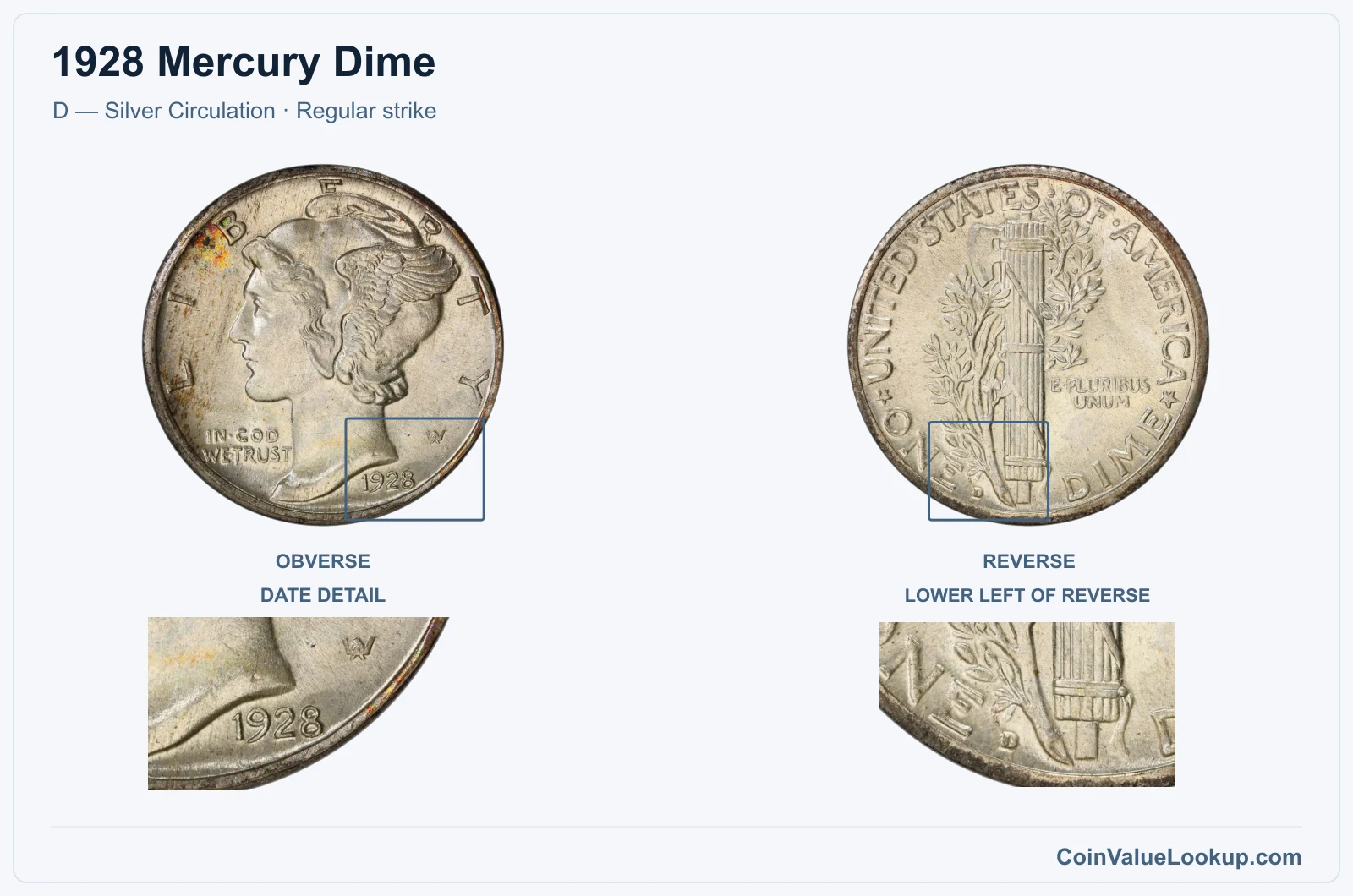
Look for a small "D" on the reverse, lower left of the fasces near ONE. The 1928-D is the standout mint this year for value in higher grades.
USA Coin Book estimates about $8.50 in G4 — barely above melt — but jumps to roughly $1,067 at MS65.
That gap tells you something: surviving uncirculated Denver dimes from 1928 are scarce relative to demand. A well-struck, original-surface example in the MS64 to MS65 range is where collectors compete hardest.
Full Bands pieces exist and trade at their own premium, but no separate FB price is provided here. Check your coin's bands carefully before assuming either way.
Range Grade
Price Auction Records Appraisal PO PO 1
—
Coin Identifier FR FR 2
—
Coin Identifier AG AG 3
—
Coin Identifier G G 4
—
Coin Identifier
G 6
—
Coin Identifier VG VG 8
—
Coin Identifier
VG 10
—
Coin Identifier F F 12
Coin Identifier
F 15
—
Coin Identifier VF VF 20
—
Coin Identifier
VF 25
—
Coin Identifier
VF 30
—
Coin Identifier
VF 35
—
Coin Identifier XF XF 40
Coin Identifier
XF 45
—
Coin Identifier AU AU 50
Coin Identifier
AU 53
Coin Identifier
AU 55
Coin Identifier
AU 58
Coin Identifier MS MS 60
Coin Identifier
MS 61
—
Coin Identifier
MS 62
Coin Identifier
MS 63
Coin Identifier
MS 64
Coin Identifier
MS 65
Coin Identifier
MS 66
Coin Identifier
MS 67
Coin Identifier
MS 68
—
—
—
MS 69
—
—
—
MS 70
—
—
—
1928 Mercury Dime — S — Silver Circulation
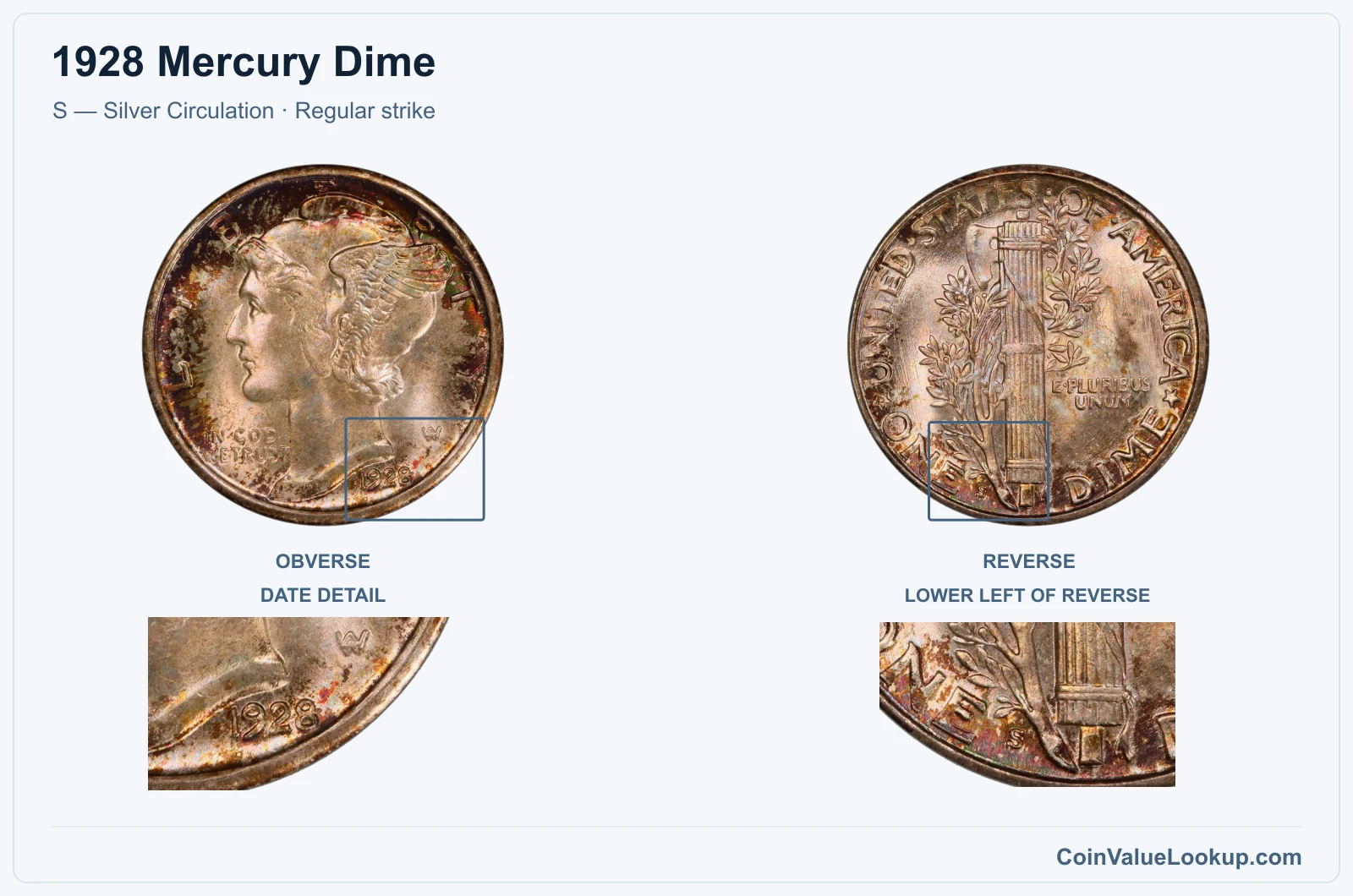
San Francisco dimes carry a small "S" in the same lower-left reverse position. In G4, USA Coin Book lists about $7.16.
MS65 examples jump to around $531.
S-mint Mercury Dimes are notorious for softer strikes, so finding one with sharp detail and full luster takes patience. A weakly struck coin is not necessarily circulated — compare against wear patterns, not just sharpness.
Full Bands pieces are tracked separately, and no FB price is inferred from the regular MS65 figure here.
Range Grade
Price Auction Records Appraisal PO PO 1
—
Coin Identifier FR FR 2
—
Coin Identifier AG AG 3
—
Coin Identifier G G 4
—
Coin Identifier
G 6
—
Coin Identifier VG VG 8
—
Coin Identifier
VG 10
—
Coin Identifier F F 12
—
Coin Identifier
F 15
—
Coin Identifier VF VF 20
Coin Identifier
VF 25
—
Coin Identifier
VF 30
—
Coin Identifier
VF 35
—
Coin Identifier XF XF 40
—
Coin Identifier
XF 45
Coin Identifier AU AU 50
Coin Identifier
AU 53
Coin Identifier
AU 55
Coin Identifier
AU 58
Coin Identifier MS MS 60
—
Coin Identifier
MS 61
Coin Identifier
MS 62
Coin Identifier
MS 63
Coin Identifier
MS 64
Coin Identifier
MS 65
Coin Identifier
MS 66
Coin Identifier
MS 67
Coin Identifier
MS 68
—
—
—
MS 69
—
—
—
MS 70
—
—
—
1928 Mercury Dime — S — Large S
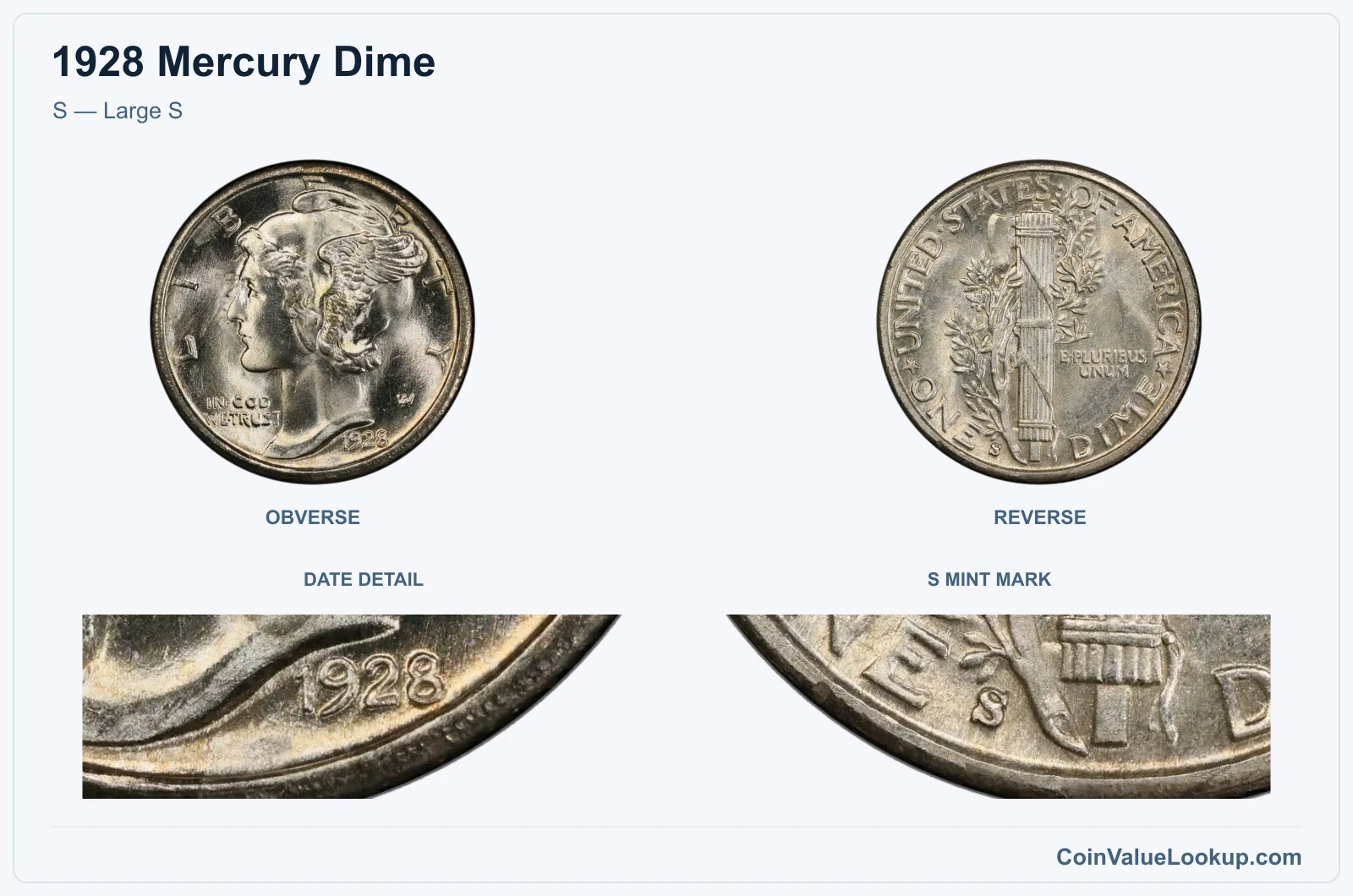
The 1928-S Large S is a recognized variety where the mintmark punch is visibly larger than the standard S used on regular strikes. This is a size difference in the mintmark itself, not a repunched mintmark — do not confuse the two.
Compare your coin side by side with a known normal-S example; the size difference should be apparent without magnification on a sharp specimen.
PCGS tracks this variety in its registry. No separate price anchor for the Large S was captured in the current data, so the general 1928-S MS65 figure of about $531 should not be treated as a Large S quote.
For accurate pricing on this specific variety, consult exact-variety references or recent auction records for the 1928-S Large S designation.
Range Grade
Price Auction Records Appraisal PO PO 1
—
Coin Identifier FR FR 2
—
Coin Identifier AG AG 3
—
Coin Identifier G G 4
—
Coin Identifier
G 6
—
Coin Identifier VG VG 8
—
Coin Identifier
VG 10
—
Coin Identifier F F 12
—
Coin Identifier
F 15
—
Coin Identifier VF VF 20
—
Coin Identifier
VF 25
—
Coin Identifier
VF 30
—
Coin Identifier
VF 35
Coin Identifier XF XF 40
Coin Identifier
XF 45
—
Coin Identifier AU AU 50
—
Coin Identifier
AU 53
—
Coin Identifier
AU 55
—
Coin Identifier
AU 58
—
Coin Identifier MS MS 60
—
Coin Identifier
MS 61
—
Coin Identifier
MS 62
—
Coin Identifier
MS 63
—
Coin Identifier
MS 64
Coin Identifier
MS 65
Coin Identifier
MS 66
Coin Identifier
MS 67
—
—
—
MS 68
—
—
—
MS 69
—
—
—
MS 70
—
—
—
1928 Mercury Dime Error List
1. 1928 Mercury Dime — Off-Center Strike
An off-center strike happens when the planchet is not properly seated in the collar before the dies come together. The result is a design that is shifted to one side, leaving an unstruck crescent of blank metal on the opposite edge.
On a 1928 dime, look for the displaced Liberty head or fasces plus that telltale blank crescent. The date must remain visible for the coin to be attributable — and collectible.
More displacement generally means more visual drama, but only if the date survives.
Do not confuse this with a clipped planchet, one-sided die misalignment, or post-mint flattening from damage. Condition, the percentage of off-center shift, and whether the date is legible all affect what the coin is worth.
No specific price range is provided here.
2. 1928 Mercury Dime — Clipped Planchet
A clipped planchet error occurs when the blank is punched incorrectly from the metal strip, leaving a missing curved, straight, or ragged section along the edge. On a 1928 dime, you may also notice design weakness on the side opposite the clip — this is called the Blakesley effect and helps confirm a genuine clip.
Examine the edge texture carefully. A real clip will show the natural metal flow from the blanking process, not a sharp or filed cut.
Coins with edges damaged after minting by tools, corrosion, or deliberate cutting can mimic a clip but lack that characteristic metal-flow signature.
The size and type of clip, overall condition, and how much design remains visible all factor into value. No numerical price is quoted here for this category.
3. 1928 Mercury Dime — Lamination / Split Planchet
A lamination or split planchet error shows up as peeling metal, a retained flap, or an actual separation within the coin's silver alloy. On a 1928 dime, this typically appears as a raised flake or a section that is lifting away from the surface.
Photograph both the affected face and the edge together — the edge view often reveals the depth and nature of the split most clearly. A genuine lamination results from impurities or gas trapped in the alloy during production.
Watch out for lookalikes. Scraping, environmental corrosion, or deliberately cut coins can produce similar surface disruptions.
The difference is that a true lamination follows the metal's internal structure rather than showing tool marks or uniform chemical damage. Value depends on severity, visibility, and the coin's overall condition.
4. 1928 Mercury Dime — Die Break / Cud
A die break happens when a piece of the die cracks or falls away. The missing section leaves a raised, featureless blob on the struck coin.
When that blob connects to the rim, collectors call it a cud.
On a 1928 dime, look for an irregular raised area that disrupts the normal design — usually along the rim or at a letter. The boundary between the cud and the remaining design should be distinct, and you can often see where the normal detail just stops.
Do not confuse this with a rim dent (which is incuse, not raised), surface corrosion, or a small interior die chip that does not reach the rim. A true cud is part of the coin's original strike.
Condition, size, and location all influence desirability; no specific price is quoted for this error on the 1928 dime.