1917 Mercury Dime Coin Value: How Much Is It Worth?
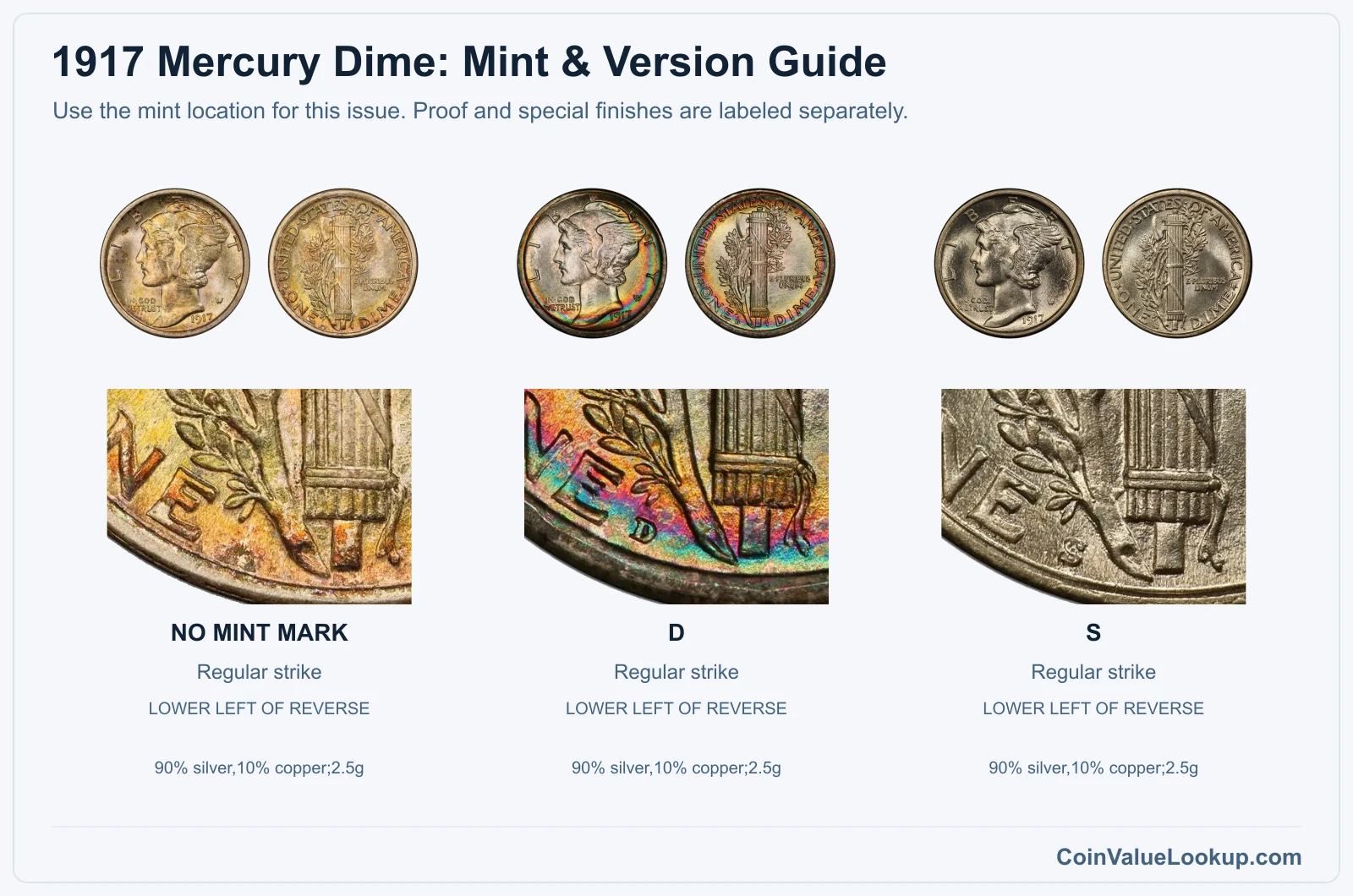
The 1917 Mercury Dime — technically the Winged Liberty Head Dime — is a 90% silver coin that still turns up in old collections and junk silver bins. Guide estimates for business strikes range from about $7.16 in Good-4 up to $1,131 in MS-65, depending on which mint produced the coin.
Compare each mint separately, because the three facilities struck very different quantities and quality levels.
Fast Way to Identify Your 1917 Mercury Dime
Snap a clear photo of each side of your 1917 dime and upload both images here for a preliminary identification. The tool can help you figure out which mint struck your coin and give you a starting point on its version.
From there, grading and any special strike characteristics determine where the value really lands.
1917 Mercury Dime Value
Upload both sides of your 1917 Mercury Dime.
Front Obverse
Upload photo
Back Reverse
Upload photo
Which 1917 Mercury Dime Versions Are Worth Money?
- Philadelphia coins range from about $7.16 in G-4 to $211 in MS-65; common in lower grades but original Mint State pieces with clean surfaces carry real premiums.
- Denver strikes range from about $9.79 in G-4 to $1,131 in MS-65 — the highest guide value among the three mints, reflecting scarcity in top condition.
- San Francisco issues range from about $7.16 in G-4 to $531 in MS-65; mid-range in uncirculated grades but still a meaningful step up from Philadelphia.
- Full Bands examples from any mint can attract additional premiums over regular Mint State prices; FB is a strike quality designation, not an error.
- Broadstrike and off-center strike errors have been reported for the 1917 Dime and are worth checking for, though individual value depends on the specific coin.
Step 1: Identify Your 1917 Mercury Dime Mint Mark and Version
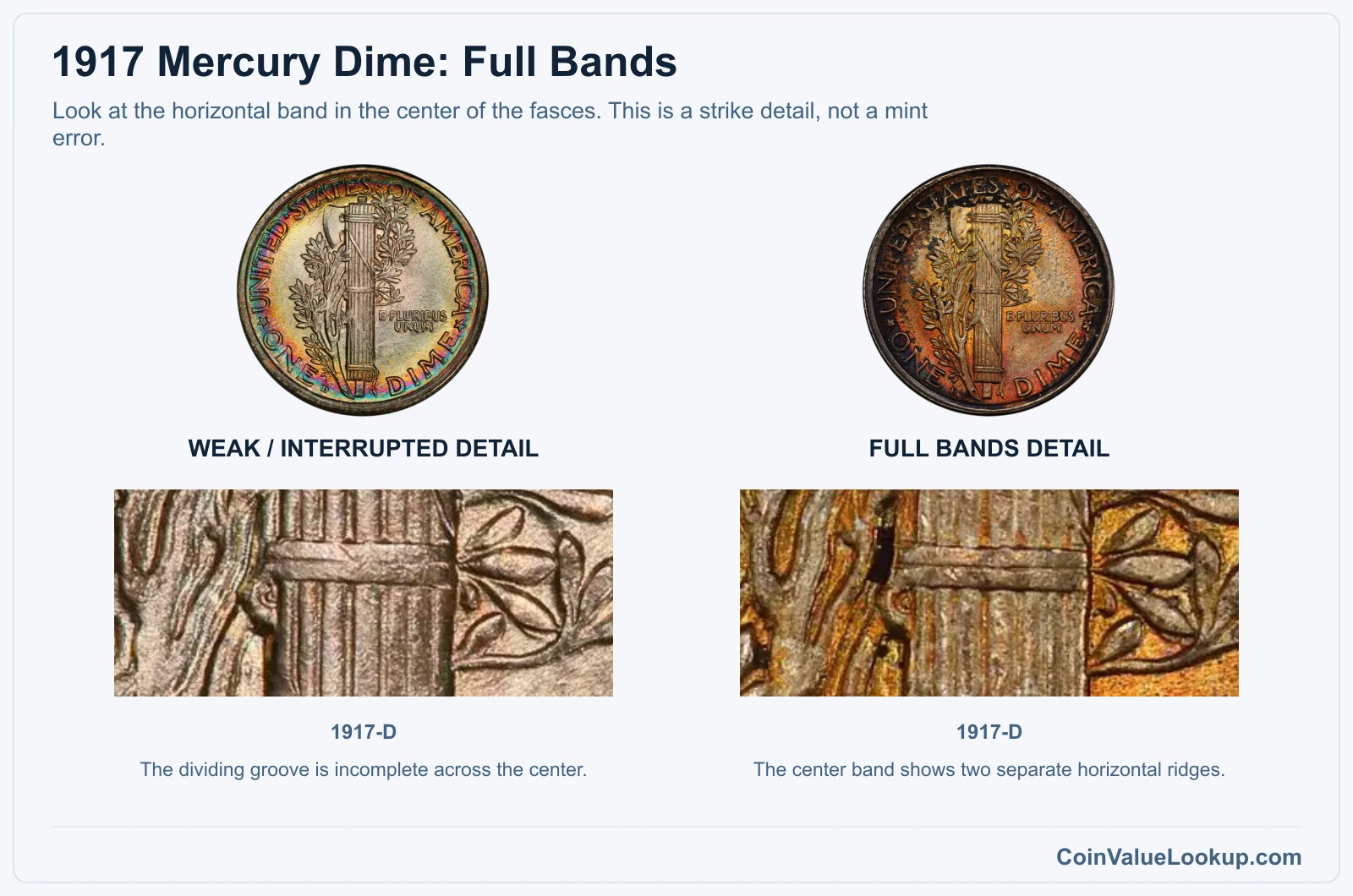
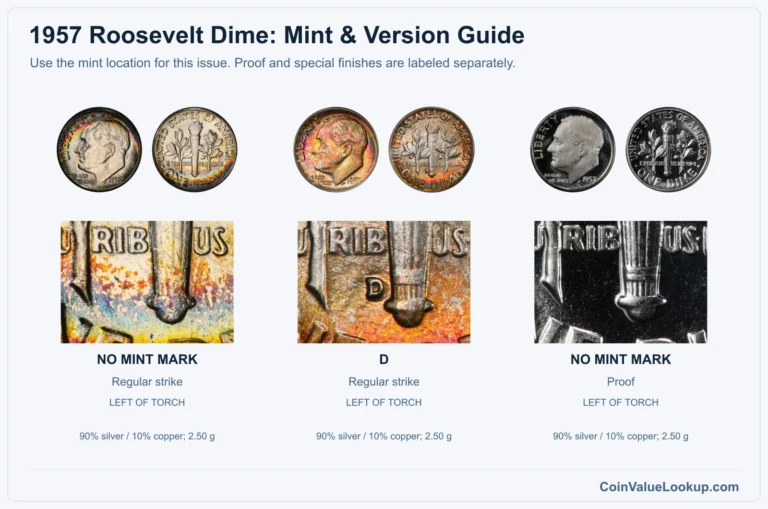
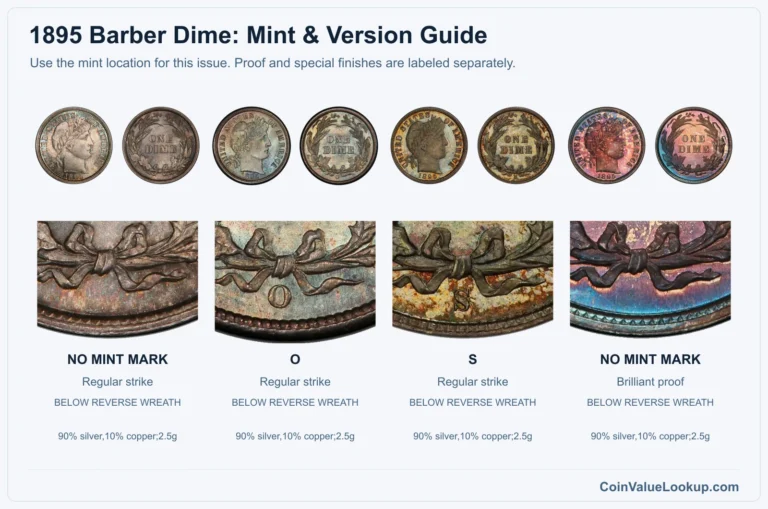
Three mints produced 1917 Mercury Dimes: Philadelphia, Denver, and San Francisco. Philadelphia coins carry no mintmark at all.
Denver coins show a small "D" and San Francisco coins show an "S," both located on the reverse at the lower left, near the word ONE.
Do not confuse the "AW" monogram on the obverse with a mintmark. Those are designer Adolph Weinman's initials, present on every Mercury Dime regardless of mint.
The coin is 90% silver and 10% copper, weighs about 2.5 grams, and measures 17.9 mm with a reeded edge.
Weak bands on the reverse fasces are a strike characteristic, not a minting error. Full Bands (FB) is a separate designation that services like NGC apply when the horizontal bands on the fasces show complete separation.
Each mint should be evaluated on its own merits, since branch-mint strikes from Denver and San Francisco often came softer than Philadelphia issues.
Step 2: Check Your 1917 Mercury Dime Grade
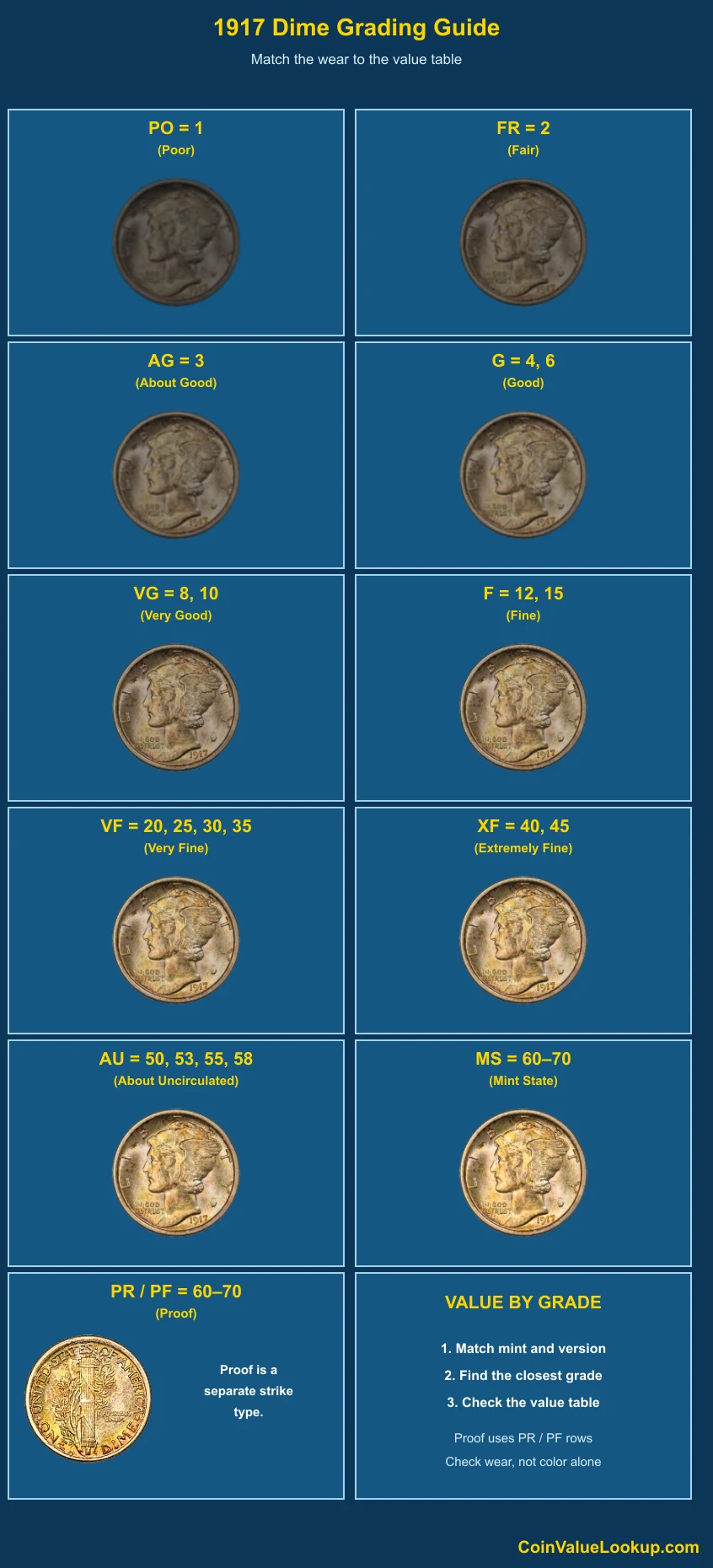
Start with Liberty's hair detail. On a well-worn coin, the hair above and in front of the ear goes flat first, then the wing feathers on the cap lose definition.
On the reverse, the fasces bands and diagonal wrapping wear down progressively. A coin grading Good-4 will show a clear outline and date but little interior detail.
Luster matters a lot on Mint State examples. Look for original cartwheel shine unbroken by cleaning or heavy contact marks.
A dipped or polished coin may look shiny but will lack that natural frost and can actually grade lower than a toned piece with original surfaces.
Full Bands is a strike designation, not a grade. A coin can be MS-65 without Full Bands, or MS-63 with them.
NGC evaluates central and outer band separation specifically, and different grading services may apply slightly different criteria. Use the comparison image to judge actual wear versus a weak strike — they look different once you know what to check.
Step 3: Check 1917 Mercury Dime Value by Mint and Version
1917 Mercury Dime — No Mint Mark — Silver Circulation
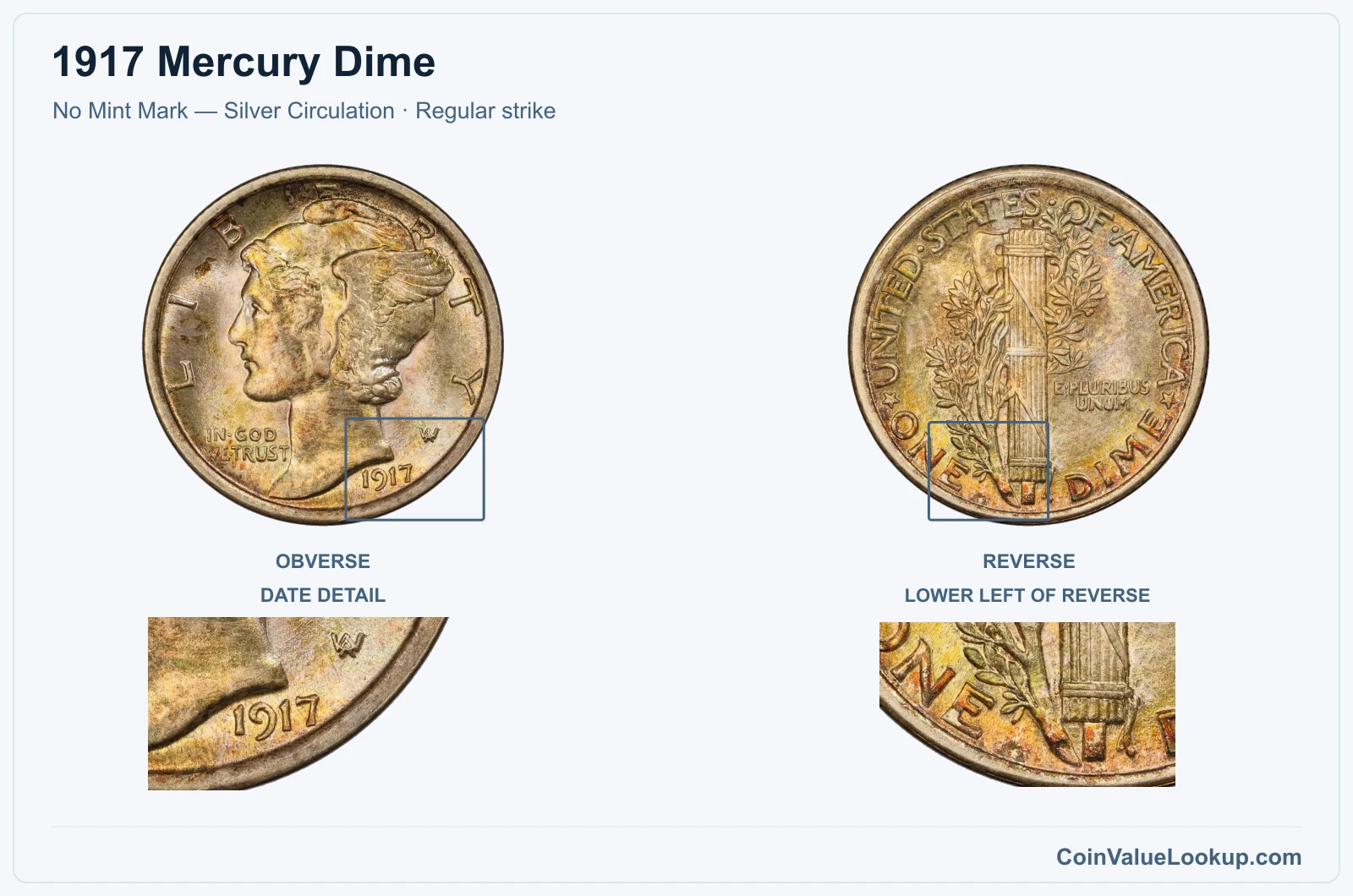
The Philadelphia 1917 Mercury Dime carries no mintmark. Guide estimates run about $7.16 in G-4 to $211 in MS-65 per USA Coin Book.
These are the most commonly encountered of the three mints in circulated grades, so the real action is in uncirculated territory.
Look on the reverse near the bottom left — if there is no letter beside ONE, you have a Philadelphia coin. Full Bands coins exist as a subset of Mint State grades, but the FB designation is tracked separately and no FB-specific price is inferred from the regular MS-65 figure here.
Range Grade
Price Auction Records Appraisal PO PO 1
—
Coin Identifier FR FR 2
—
Coin Identifier AG AG 3
—
Coin Identifier G G 4
—
Coin Identifier
G 6
—
Coin Identifier VG VG 8
—
Coin Identifier
VG 10
—
Coin Identifier F F 12
—
Coin Identifier
F 15
—
Coin Identifier VF VF 20
—
Coin Identifier
VF 25
—
Coin Identifier
VF 30
—
Coin Identifier
VF 35
—
Coin Identifier XF XF 40
—
Coin Identifier
XF 45
—
Coin Identifier AU AU 50
—
Coin Identifier
AU 53
—
Coin Identifier
AU 55
—
Coin Identifier
AU 58
Coin Identifier MS MS 60
Coin Identifier
MS 61
—
Coin Identifier
MS 62
Coin Identifier
MS 63
Coin Identifier
MS 64
Coin Identifier
MS 65
Coin Identifier
MS 66
Coin Identifier
MS 67
Coin Identifier
MS 68
—
—
—
MS 69
—
—
—
MS 70
—
—
—
1917 Mercury Dime — D — Silver Circulation
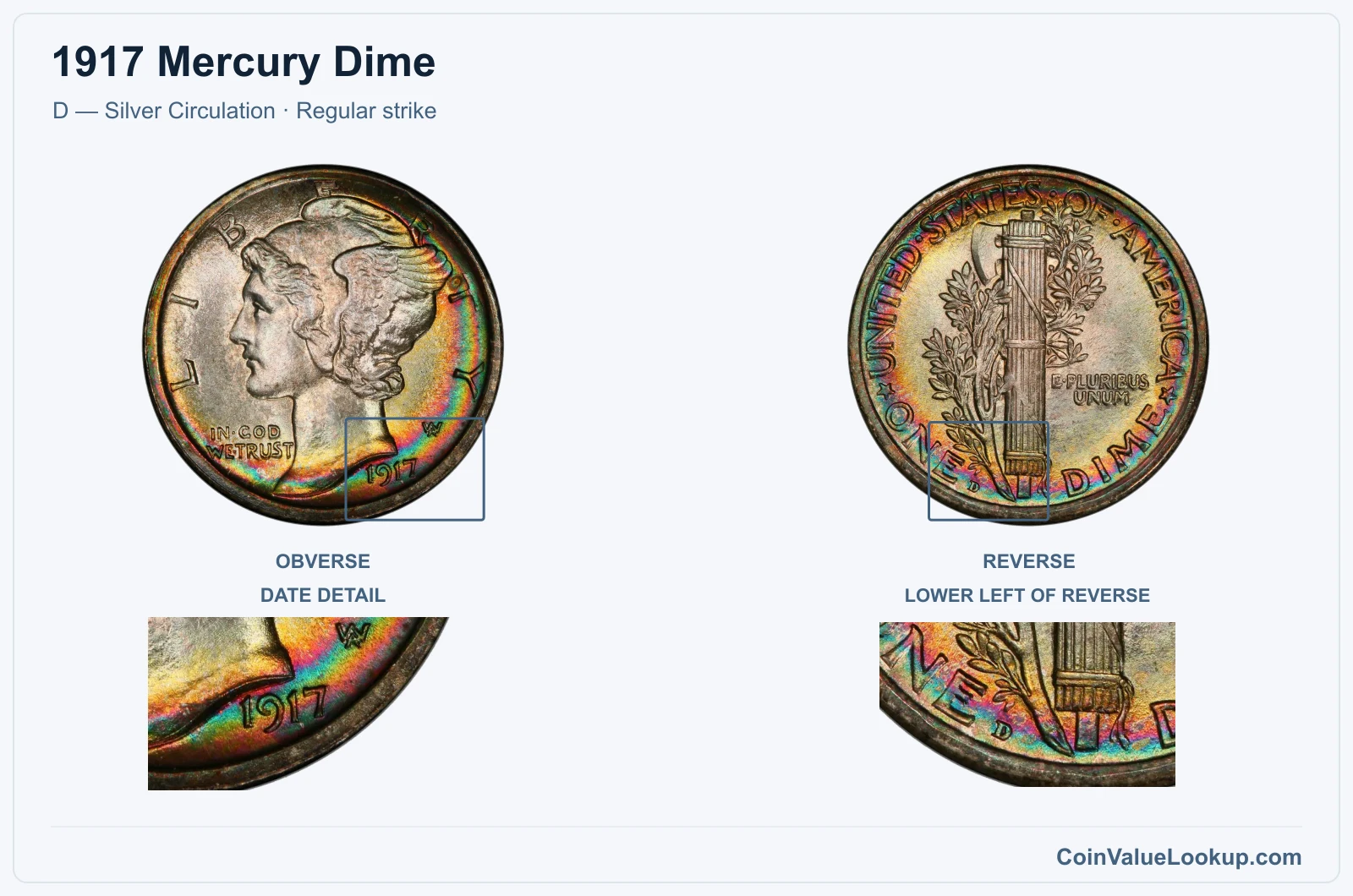
Denver strikes carry a small "D" mintmark on the lower-left reverse. Guide values run from about $9.79 in G-4 to $1,131 in MS-65 according to USA Coin Book — a substantial jump at the top end compared to Philadelphia.
That high-end figure reflects genuine scarcity in gem condition. Denver branch-mint strikes often came with softer detail, making fully lustrous, well-struck survivors uncommon.
Do not assume weak fasces bands on a Denver coin mean it circulated heavily; many left the press that way. Full Bands examples are tracked as a separate filter.
Coin Value Lookup is a good starting point if you want to compare this dime against other dates and denominations in your collection.
Range Grade
Price Auction Records Appraisal PO PO 1
—
Coin Identifier FR FR 2
—
Coin Identifier AG AG 3
—
Coin Identifier G G 4
—
Coin Identifier
G 6
—
Coin Identifier VG VG 8
—
Coin Identifier
VG 10
—
Coin Identifier F F 12
—
Coin Identifier
F 15
—
Coin Identifier VF VF 20
—
Coin Identifier
VF 25
—
Coin Identifier
VF 30
Coin Identifier
VF 35
—
Coin Identifier XF XF 40
—
Coin Identifier
XF 45
Coin Identifier AU AU 50
Coin Identifier
AU 53
Coin Identifier
AU 55
Coin Identifier
AU 58
Coin Identifier MS MS 60
—
Coin Identifier
MS 61
Coin Identifier
MS 62
Coin Identifier
MS 63
Coin Identifier
MS 64
Coin Identifier
MS 65
Coin Identifier
MS 66
Coin Identifier
MS 67
Coin Identifier
MS 68
—
—
—
MS 69
—
—
—
MS 70
—
—
—
1917 Mercury Dime — S — Silver Circulation
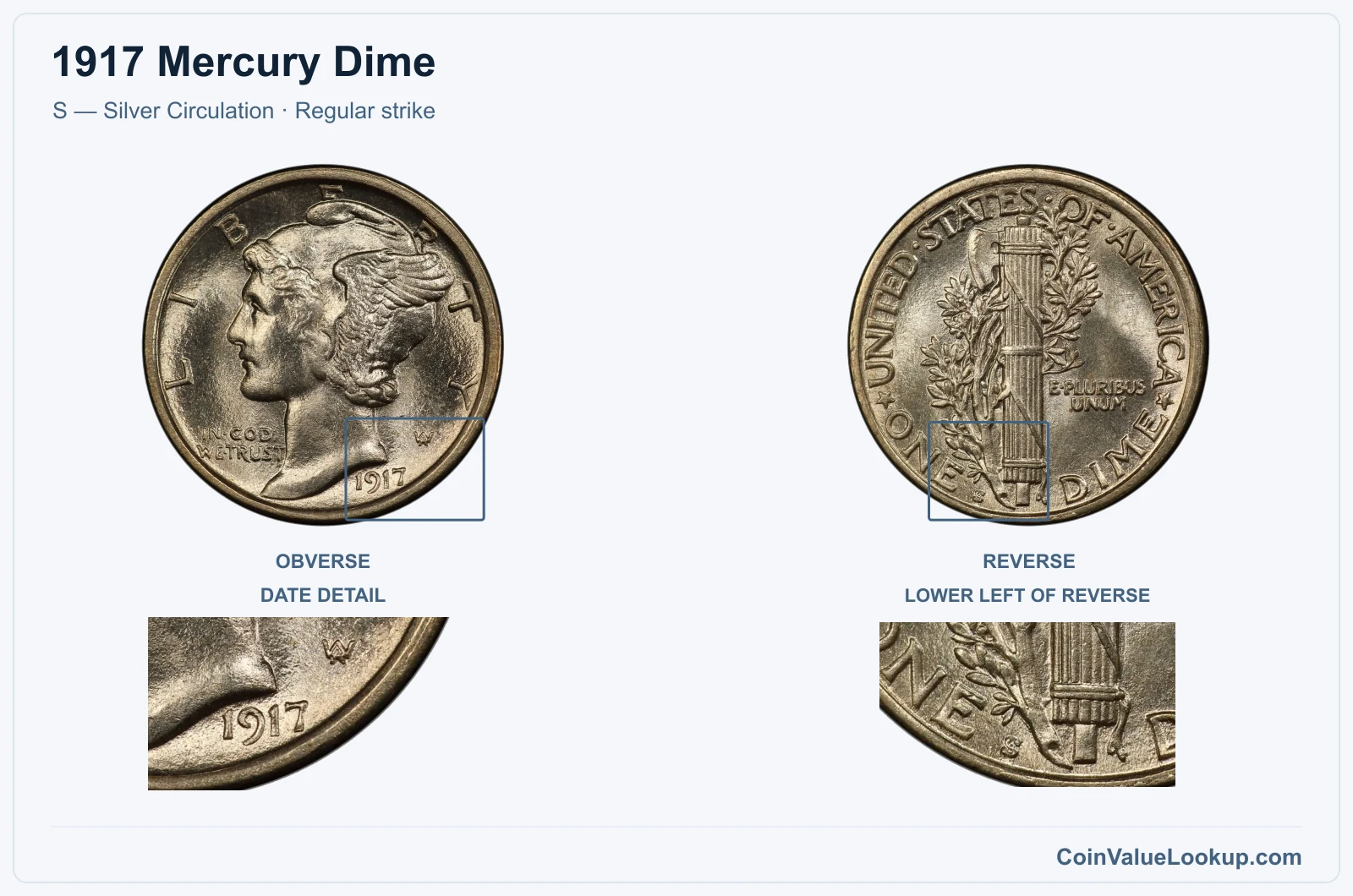
San Francisco coins show an "S" mintmark in the same lower-left reverse position. Guide values range from about $7.16 in G-4 to $531 in MS-65 per USA Coin Book.
That puts the S-mint squarely between Philadelphia and Denver in uncirculated premiums.
Like Denver issues, San Francisco dimes can show weaker strikes, so do not mistake soft bands for wear. A properly graded MS-65 with original luster is a different animal than a cleaned AU passed off as Mint State.
Check surfaces carefully under good light, and compare your coin's detail against known grade references for the S-mint specifically.
Range Grade
Price Auction Records Appraisal PO PO 1
—
Coin Identifier FR FR 2
—
Coin Identifier AG AG 3
—
Coin Identifier G G 4
—
Coin Identifier
G 6
—
Coin Identifier VG VG 8
—
Coin Identifier
VG 10
—
Coin Identifier F F 12
—
Coin Identifier
F 15
—
Coin Identifier VF VF 20
—
Coin Identifier
VF 25
—
Coin Identifier
VF 30
—
Coin Identifier
VF 35
—
Coin Identifier XF XF 40
—
Coin Identifier
XF 45
—
Coin Identifier AU AU 50
Coin Identifier
AU 53
—
Coin Identifier
AU 55
Coin Identifier
AU 58
Coin Identifier MS MS 60
—
Coin Identifier
MS 61
Coin Identifier
MS 62
Coin Identifier
MS 63
Coin Identifier
MS 64
Coin Identifier
MS 65
Coin Identifier
MS 66
Coin Identifier
MS 67
Coin Identifier
MS 68
—
—
—
MS 69
—
—
—
MS 70
—
—
—
1917 Mercury Dime Error List
1. 1917 Mercury Dime — Broadstrike
A broadstrike happens when the coin is struck without the normal retaining collar that keeps the planchet confined. The result is a dime that spreads outward, appearing slightly wider than normal with a thinner, less defined rim.
The full design is still present — just expanded.
This error has been reported for the 1917 Dime. To identify one, look at the edge profile: a genuine broadstrike will show metal that flowed beyond the normal diameter, and the reeding may be weak, distorted, or absent.
The entire design should still be intact and centered, just oversized.
Do not confuse a broadstrike with an off-center strike, which displaces the design, or with a coin that was flattened after leaving the mint. Post-mint damage typically shows uneven distortion and does not preserve the struck-in detail.
No specific price range is adopted here, as value depends on the severity of the error, overall condition, and the coin's surfaces.
2. 1917 Mercury Dime — Off-Center Strike
An off-center strike occurs when the planchet is not properly seated between the dies, so only part of the design is impressed. The telltale sign is an unstruck crescent of blank metal on one side, with the design shifted in the opposite direction.
This error category has been reported for the 1917 Dime. The value of an off-center coin depends heavily on how far off-center the strike is and whether the date remains visible — a date-showing off-center Mercury Dime is far more desirable than one where the date was lost.
Be careful not to confuse a genuine off-center strike with a clipped planchet, which produces a curved missing section with a different edge profile. Post-mint flattening can also mimic some off-center characteristics but will lack the crisp unstruck crescent and properly struck opposing detail.
No specific price range is adopted, as value varies with the degree of displacement, date visibility, and overall condition of the coin.