1917 Buffalo Nickel Coin Value: How Much Is It Worth?
The 1917 Buffalo Nickel was struck at three mints and carries the Type 2 recessed-denomination reverse used from mid-1913 onward. Guide estimates from USA Coin Book range from about $10 in Good-4 for a Philadelphia strike up to $1,936 in MS-63 for the San Francisco issue, though actual market results can fall above or below those figures.
Mint, condition, and recognized varieties all drive the price on this date.
Fast Way to Identify Your 1917 Buffalo Nickel
Want a quick read on what you have? Upload clear photos of the front and back of your 1917 Buffalo Nickel.
Make sure the date is legible and the area below FIVE CENTS on the reverse is in focus so the mintmark (or lack of one) can be checked. That preliminary identification will point you toward the right value range for your specific coin.
1917 Buffalo Nickel Value
Upload both sides of your 1917 Buffalo Nickel.
Front Obverse
Upload photo
Back Reverse
Upload photo
Which 1917 Buffalo Nickel Versions Are Worth Money?
- The 1917-S (San Francisco) carries the highest guide estimates of the three mints, reaching about $1,936 at MS-63 according to USA Coin Book.
- The 1917-D (Denver) commands a solid premium over Philadelphia in all grades, with guide estimates up to roughly $929 at MS-63.
- Several recognized error categories exist for 1917, including a Two Feathers variety and a Three-and-a-Half Legs variety on 1917-D coins, both worth investigating.
- Mint-state examples with full, original luster from any mint are considerably more valuable than circulated pieces; the jump from G-4 to MS-63 is dramatic across all three issues.
Step 1: Identify Your 1917 Buffalo Nickel Mint Mark and Version
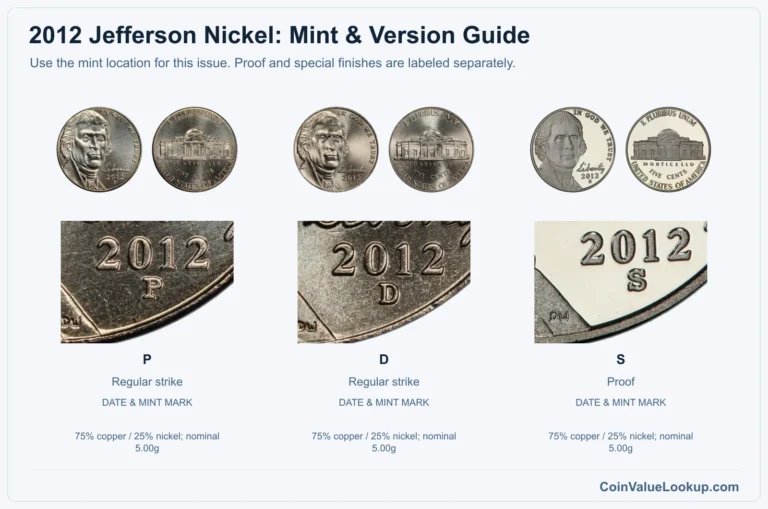
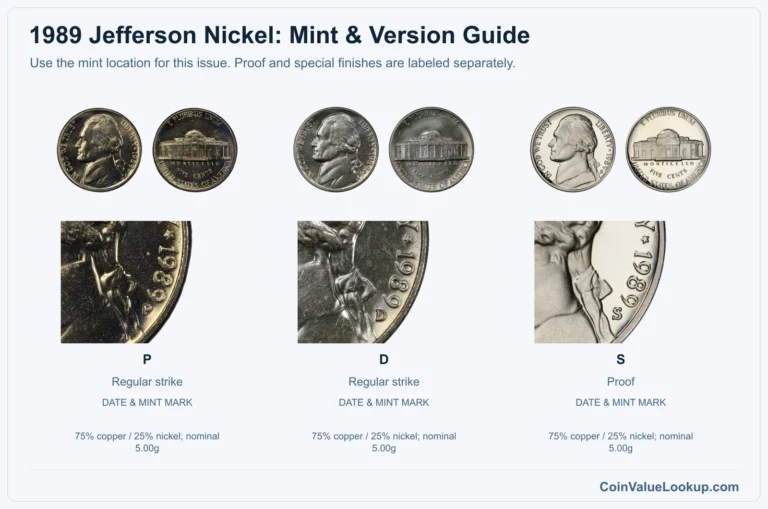
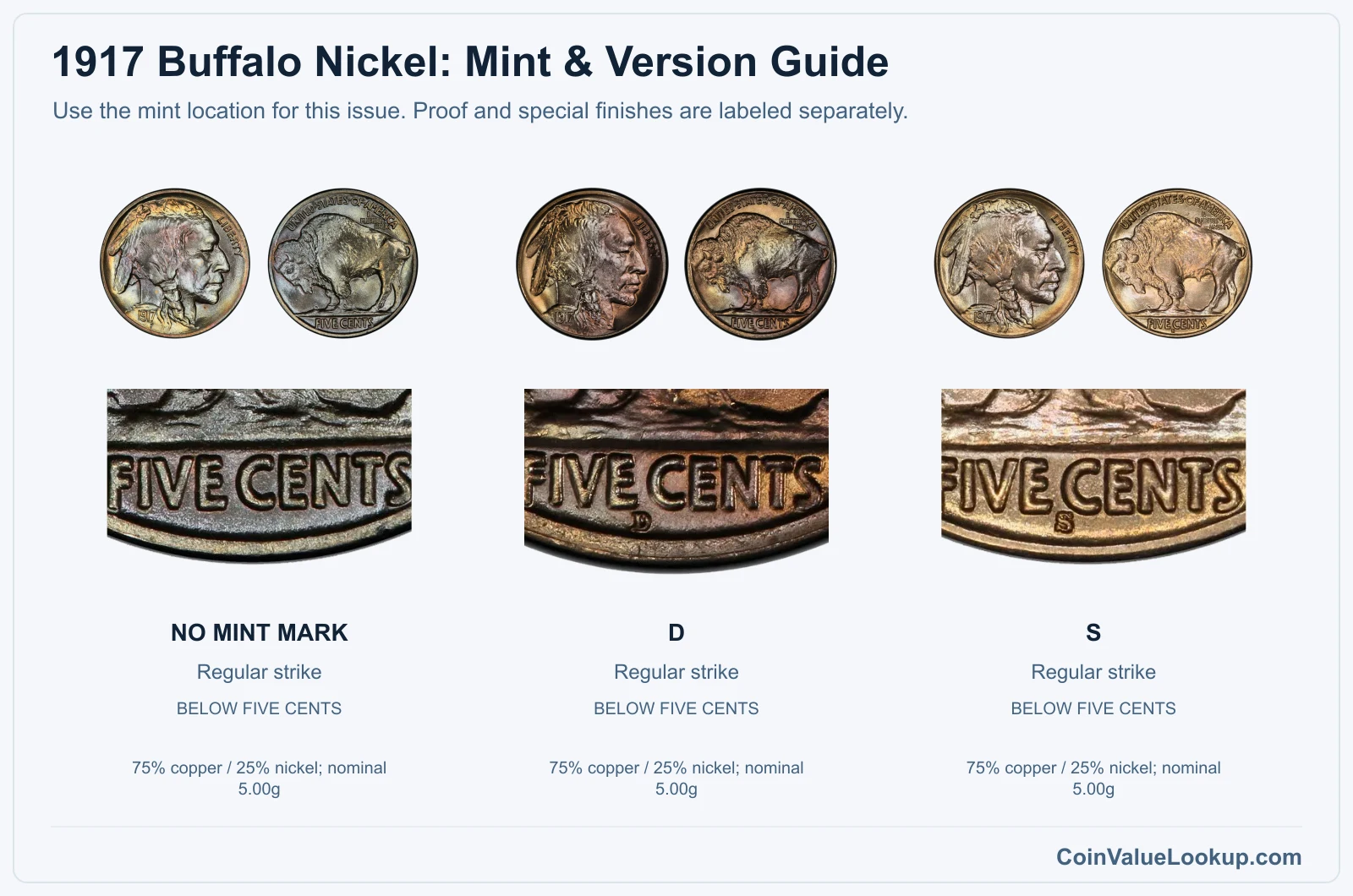
Three mints produced 1917 Buffalo Nickels. Philadelphia coins carry no mintmark.
Denver (D) and San Francisco (S) pieces show their letter on the reverse, just below FIVE CENTS.
All three are copper-nickel, 75% copper and 25% nickel, weighing about 5 grams with a 21.2 mm diameter and a plain edge. There is no silver version.
Every 1917 nickel uses the Type 2 reverse where FIVE CENTS sits in a recessed area below the bison. The raised-mound Type 1 design was only used during part of 1913, so you will not encounter it on a genuine 1917 coin.
If someone offers you a 1917 "Type 1," that is a red flag.
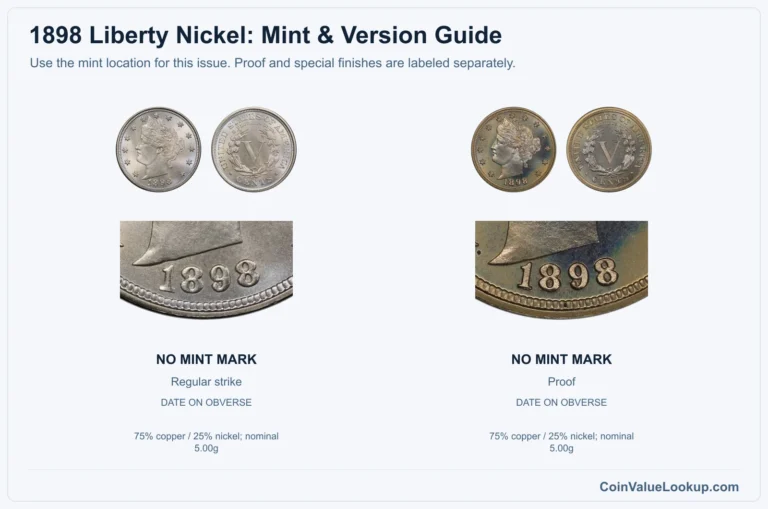
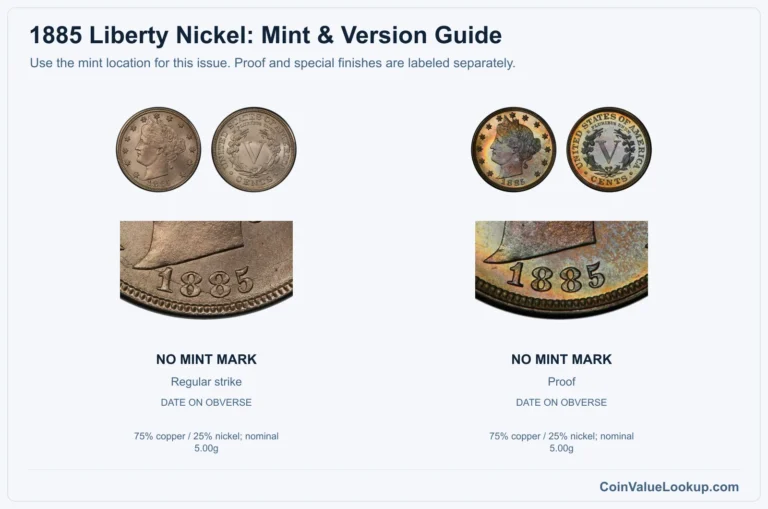
No regular proof nickels were made in 1917. The Mint produced matte proofs from 1913 through 1916 and proof issues resumed in 1936, but 1917 falls in the gap.
Step 2: Check Your 1917 Buffalo Nickel Grade
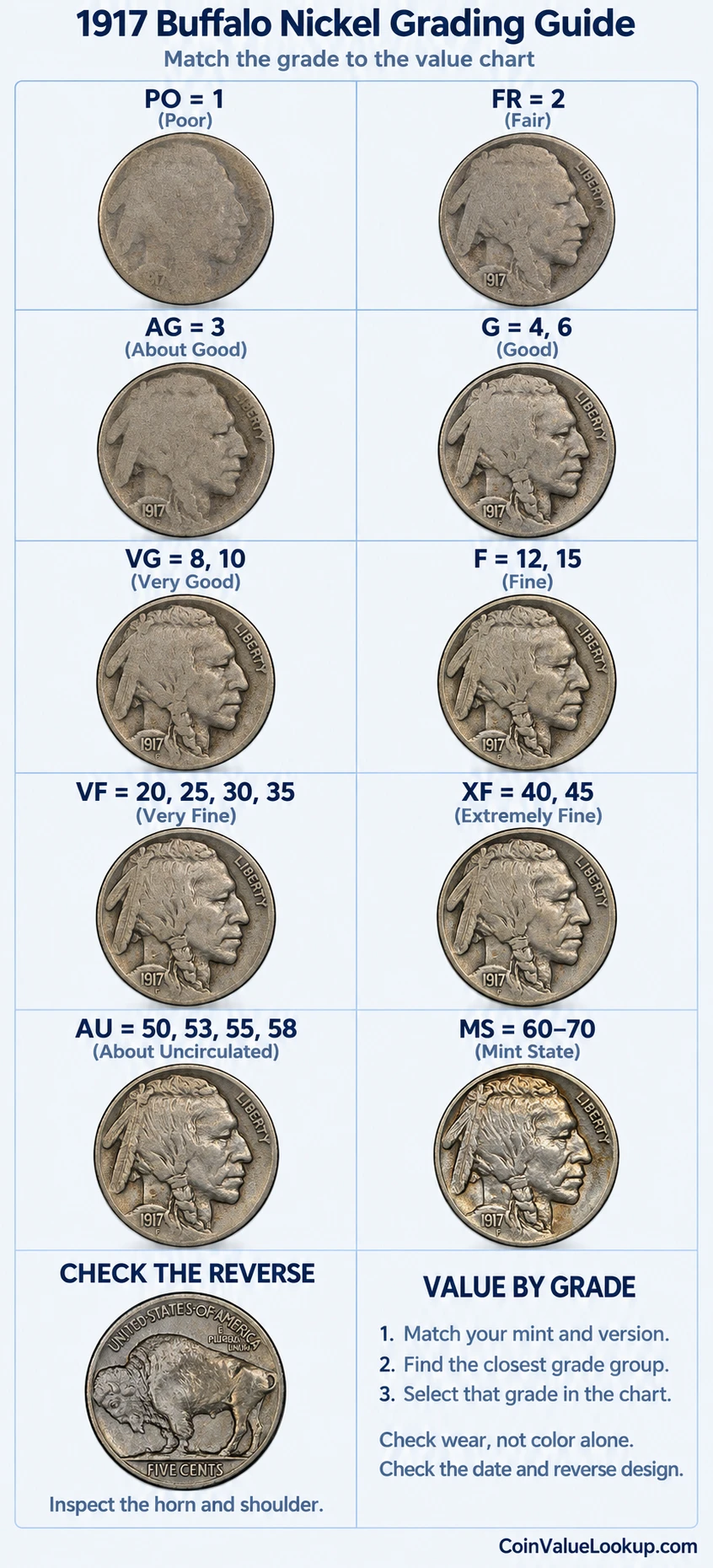
Start with the obverse. The Native American portrait loses detail in a predictable order: the braid ribbon and hair above the ear soften first, then the cheekbone flattens.
On the reverse, the bison's shoulder and horn are the key checkpoints.
Here is the tricky part. Buffalo Nickels from certain branch mints can come weakly struck, meaning the horn or other details never fully formed even on a brand-new coin.
Do not automatically downgrade a coin because the horn looks soft; compare it against the reference image to separate actual wear from a weak strike.
Original luster matters a lot once you get into the uncirculated grades. Bag marks, scratches, and cleaning all reduce eye appeal and value.
Never use acid or chemicals to "restore" a worn date; that permanently damages the surface and tanks the coin's collectibility.
Step 3: Check 1917 Buffalo Nickel Value by Mint and Version
1917 Buffalo Nickel — No Mint Mark — Type2 Circulation
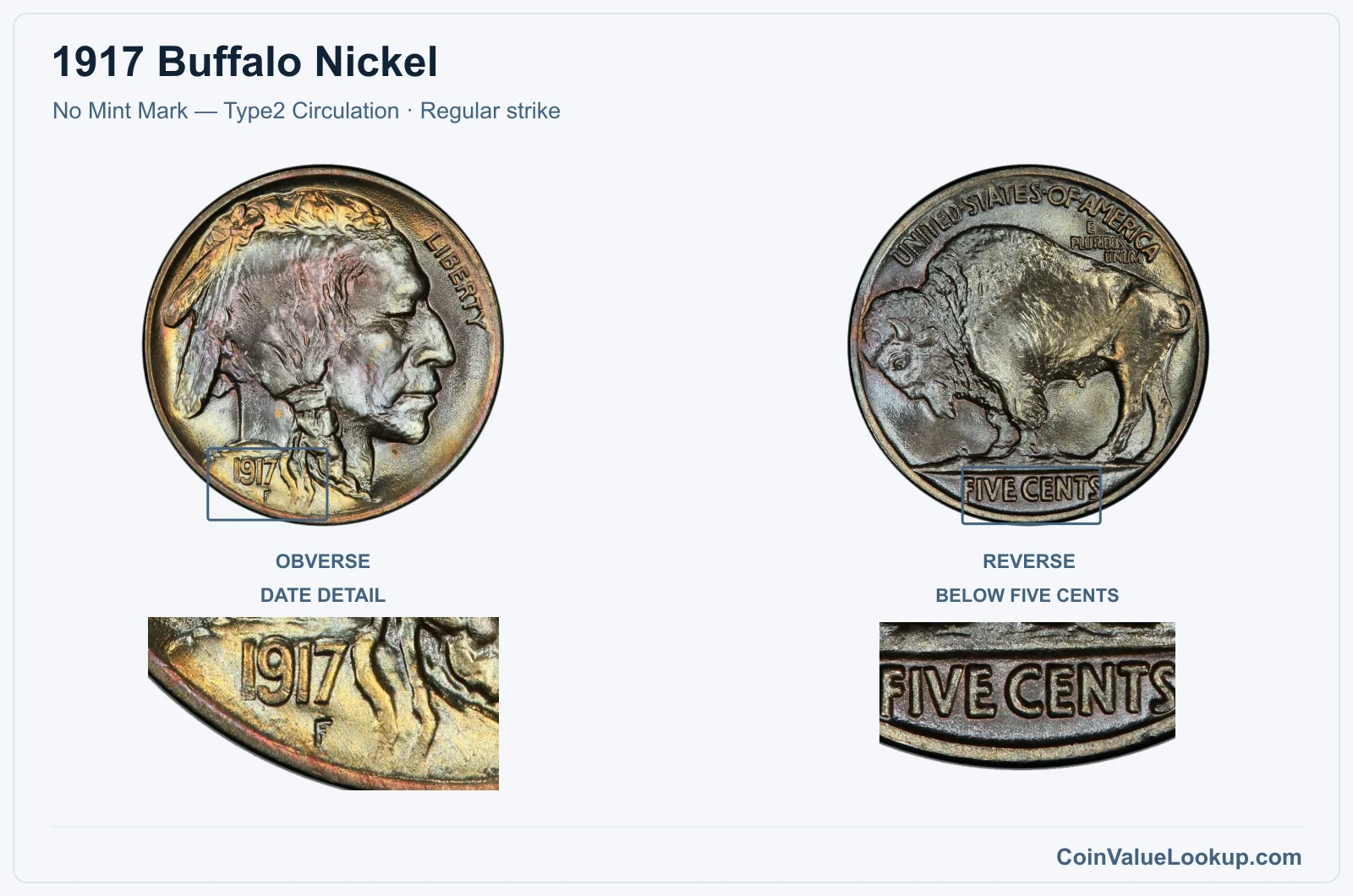
The Philadelphia 1917 Buffalo Nickel has no mintmark. Look at the reverse below FIVE CENTS; if the space is empty, you have the P-mint coin.
This is the most available of the three 1917 issues. USA Coin Book guide estimates place it around $10 in Good-4 and about $186 in MS-63.
Circulated examples turn up regularly, but clean, lustrous uncirculated pieces are a different story. Check both faces for original surface quality before assuming a grade.
Range Grade
Price Auction Records Appraisal PO PO 1
—
Coin Identifier FR FR 2
—
Coin Identifier AG AG 3
—
Coin Identifier G G 4
—
Coin Identifier
G 6
—
Coin Identifier VG VG 8
—
Coin Identifier
VG 10
—
Coin Identifier F F 12
—
Coin Identifier
F 15
—
Coin Identifier VF VF 20
—
Coin Identifier
VF 25
Coin Identifier
VF 30
—
Coin Identifier
VF 35
—
Coin Identifier XF XF 40
—
Coin Identifier
XF 45
Coin Identifier AU AU 50
Coin Identifier
AU 53
—
Coin Identifier
AU 55
—
Coin Identifier
AU 58
Coin Identifier MS MS 60
Coin Identifier
MS 61
Coin Identifier
MS 62
Coin Identifier
MS 63
Coin Identifier
MS 64
Coin Identifier
MS 65
Coin Identifier
MS 66
Coin Identifier
MS 67
Coin Identifier
MS 68
—
Coin Identifier
MS 69
—
—
—
MS 70
—
—
—
1917 Buffalo Nickel — D — Type2 Circulation
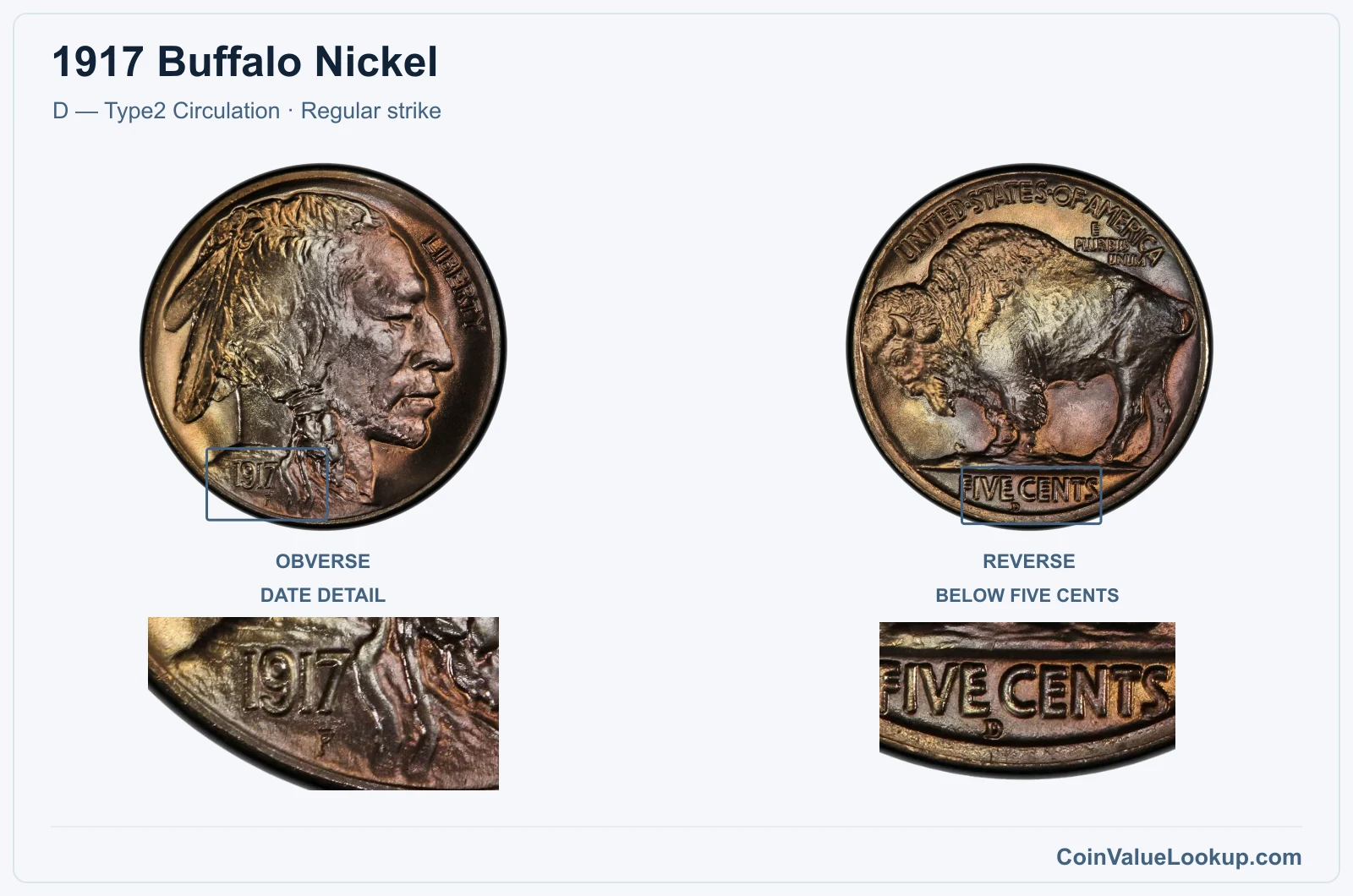
The Denver issue shows a small D on the reverse beneath FIVE CENTS. Guide estimates from USA Coin Book run about $26 in Good-4 up to roughly $929 at MS-63, a significant step above the Philadelphia coin.
Denver strikes can sometimes show softness on the bison's horn or the portrait braid, so compare carefully against a known sharp example before concluding the coin is heavily worn. A coin with a weak strike but otherwise clean, lustrous surfaces is still a better find than a cleaned or damaged piece in similar apparent detail.
Coin Value Lookup is a good starting point if you want to compare this date against other Buffalo Nickel years and mints. You can look up guides organized by series to see where your coin fits in the broader picture.
Range Grade
Price Auction Records Appraisal PO PO 1
—
Coin Identifier FR FR 2
—
Coin Identifier AG AG 3
—
Coin Identifier G G 4
—
Coin Identifier
G 6
—
Coin Identifier VG VG 8
Coin Identifier
VG 10
Coin Identifier F F 12
Coin Identifier
F 15
Coin Identifier VF VF 20
Coin Identifier
VF 25
Coin Identifier
VF 30
Coin Identifier
VF 35
Coin Identifier XF XF 40
Coin Identifier
XF 45
Coin Identifier AU AU 50
Coin Identifier
AU 53
Coin Identifier
AU 55
Coin Identifier
AU 58
Coin Identifier MS MS 60
Coin Identifier
MS 61
Coin Identifier
MS 62
Coin Identifier
MS 63
Coin Identifier
MS 64
Coin Identifier
MS 65
Coin Identifier
MS 66
Coin Identifier
MS 67
Coin Identifier
MS 68
—
—
—
MS 69
—
—
—
MS 70
—
—
—
1917 Buffalo Nickel — S — Type2 Circulation
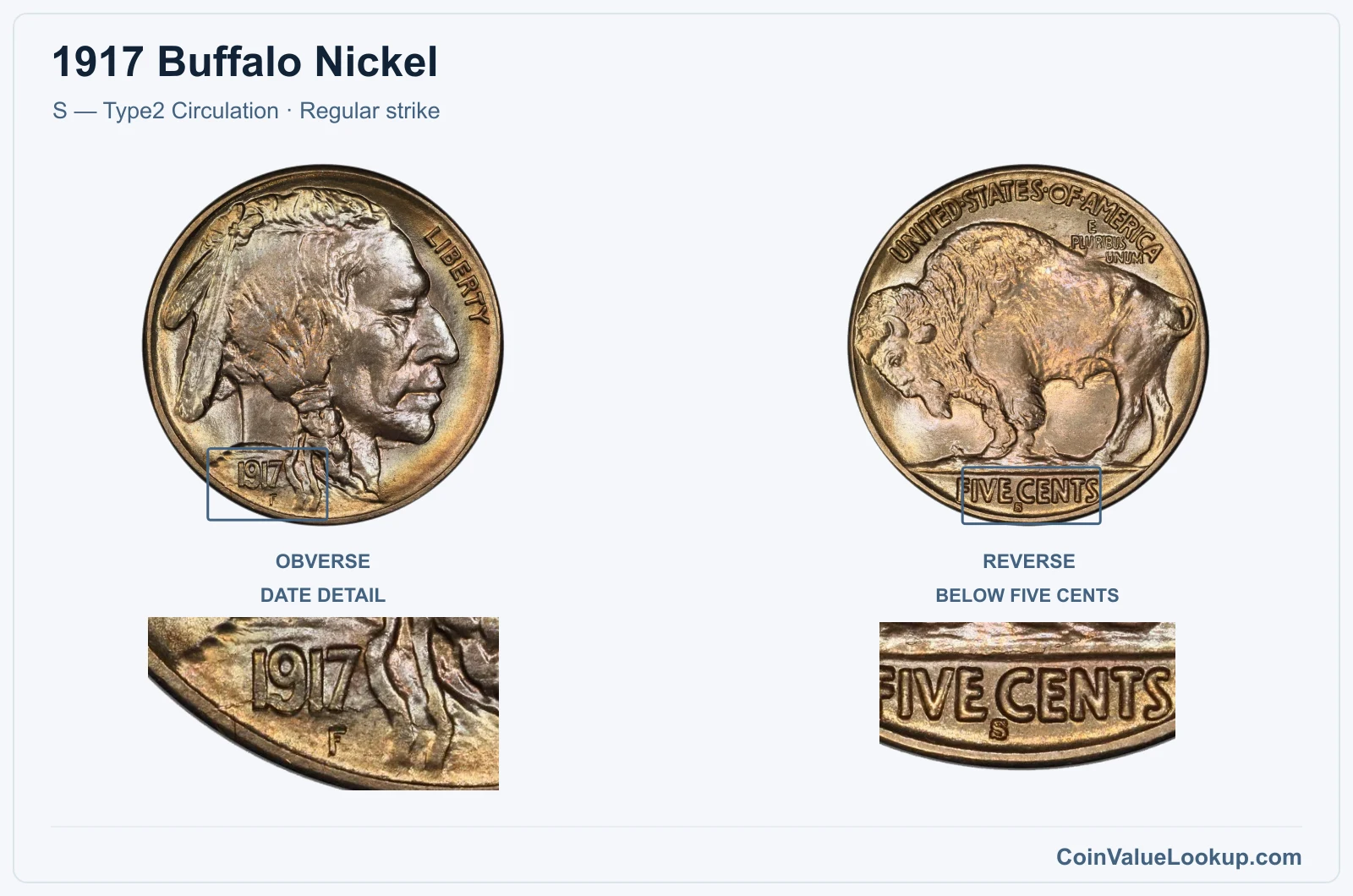
San Francisco's 1917-S carries the S mintmark in the same reverse location below FIVE CENTS. This is the key date of the three 1917 mints.
USA Coin Book guide estimates start around $38 in Good-4 and climb to approximately $1,936 at MS-63.
That steep price curve reflects genuine scarcity in higher grades. Most surviving examples saw heavy pocket time.
If you find one with strong detail and original surfaces, it is worth careful evaluation by a grading service. Confirm the mintmark is genuinely struck into the metal and not added after the fact, since the S-mint premium invites counterfeits.
Range Grade
Price Auction Records Appraisal PO PO 1
—
Coin Identifier FR FR 2
—
Coin Identifier AG AG 3
—
Coin Identifier G G 4
Coin Identifier
G 6
Coin Identifier VG VG 8
—
Coin Identifier
VG 10
Coin Identifier F F 12
Coin Identifier
F 15
Coin Identifier VF VF 20
Coin Identifier
VF 25
Coin Identifier
VF 30
Coin Identifier
VF 35
Coin Identifier XF XF 40
Coin Identifier
XF 45
Coin Identifier AU AU 50
Coin Identifier
AU 53
Coin Identifier
AU 55
Coin Identifier
AU 58
Coin Identifier MS MS 60
—
Coin Identifier
MS 61
Coin Identifier
MS 62
Coin Identifier
MS 63
Coin Identifier
MS 64
Coin Identifier
MS 65
Coin Identifier
MS 66
Coin Identifier
MS 67
Coin Identifier
MS 68
—
—
—
MS 69
—
—
—
MS 70
—
—
—
1917 Buffalo Nickel Error List
1. 1917 Buffalo Nickel — Wrong Planchet / Off-Metal Strike
A wrong-planchet 1917 Buffalo Nickel was struck on a blank intended for a different denomination, such as a cent planchet. These coins look immediately odd: the diameter, thickness, or weight will not match a standard nickel's 5-gram, 21.2 mm specifications.
To check, weigh the coin and measure its diameter. The design may be incomplete because a smaller or thinner blank cannot fill the die cavity.
Compare it side by side with a normal nickel.
Watch out for coins that look off-metal but are actually corroded, acid-treated, plated, or deliberately ground down. Those post-mint alterations can mimic the lighter weight or different color of a wrong planchet.
Value depends on the specific blank, the completeness of the strike, and overall condition, so individual assessment is essential.
2. 1917 Buffalo Nickel — Off-Center Strike
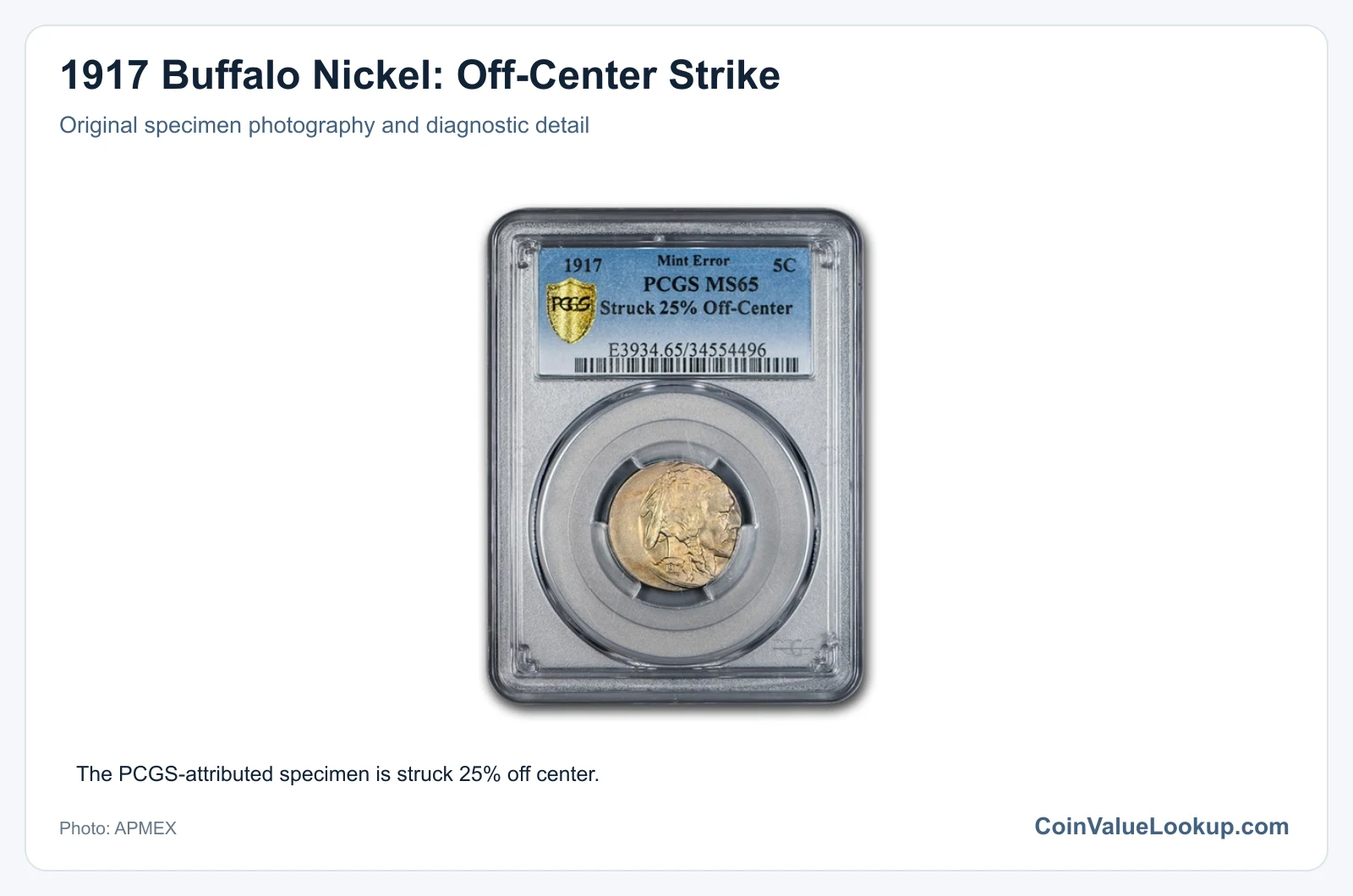
An off-center 1917 Buffalo Nickel shows the design shifted to one side with a blank crescent of unstruck metal on the opposite edge. The percentage of off-center displacement and whether the date remains visible are the two biggest factors collectors care about.
A coin with a readable 1917 date and a dramatic shift commands far more attention than one where the date disappeared into the blank crescent. Mint attribution may not be possible if the mintmark area was not struck.
Do not confuse an off-center strike with a clipped planchet, which removes a curved bite from the blank before striking, or with post-mint damage like a flattened rim. Value depends on the degree of displacement, date visibility, and the coin's preservation.
3. 1917 Buffalo Nickel — Die Break / Cud
A die break or cud on a 1917 Buffalo Nickel appears as a raised, featureless blob of metal where part of the die literally broke away. A true cud connects to the rim; interior breaks that do not reach the rim are called retained die breaks.
The 1917-S is specifically reported with an obverse cud. Look for a raised lump along the rim that interrupts the normal design, replacing portrait or lettering detail with a smooth, shapeless mound.
Rim dents and corrosion can superficially resemble a cud, but dents are depressed into the coin while a cud is raised. Corrosion tends to be rough and pitted rather than smooth.
Size, location, and overall coin condition all affect how much a cud adds to the coin's value.
4. 1917 Buffalo Nickel — Doubled Die Reverse
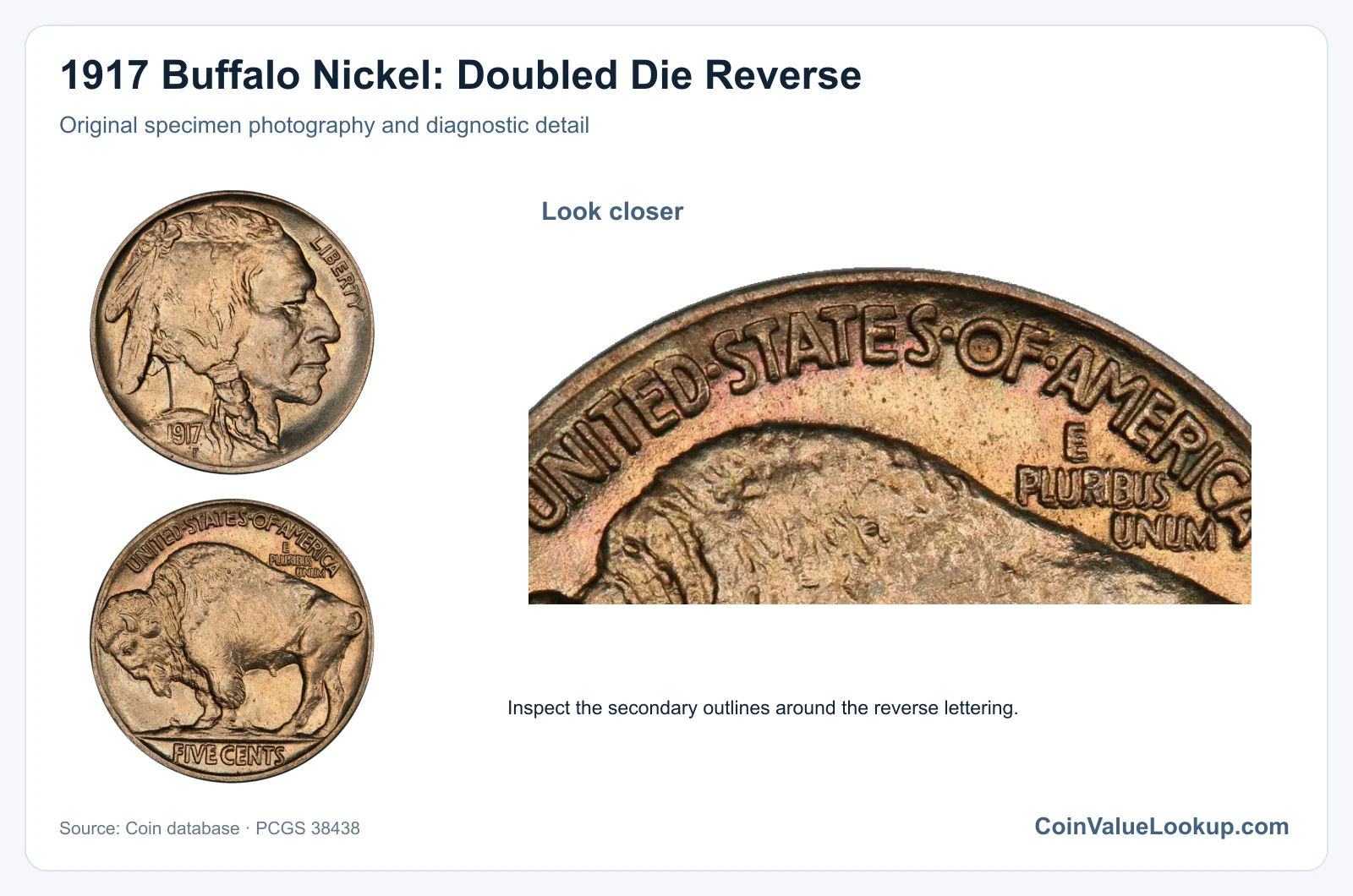
A doubled-die reverse on a 1917 Buffalo Nickel shows doubling on the reverse design elements, such as the lettering of FIVE CENTS, UNITED STATES OF AMERICA, or the bison's outline. This doubling was created during the die-making process, not at the moment of striking.
Compare the reverse legends on your coin against a normal example, ideally under magnification. Genuine hub doubling produces a secondary image that is consistent across every coin struck by that die.
Machine doubling is the common lookalike. It produces flat, shelf-like displacement rather than the rounded, equally sharp secondary image of a true doubled die.
Random scratches or light reflections can also fool the eye. Value depends on the strength and visibility of the doubling, the coin's overall condition, and collector demand for the specific die.
5. 1917 Buffalo Nickel — Die Crack / Die Chip
Die cracks on a 1917 Buffalo Nickel appear as thin, raised lines running across the surface where the steel die developed a fracture during use. Die chips look like small raised dots or blobs from a tiny piece of the die face breaking away.
These features are raised because they fill in a recessed flaw on the die. That is the key test: a crack or chip sits above the field, while a scratch is cut into the coin's surface.
Minor die cracks are common on well-used dies and add only modest interest. Larger or dramatically placed cracks draw more collector attention.
Value depends on the prominence of the crack, its location on the design, and the coin's condition. Do not confuse incuse scratches, corrosion lines, or dirt in the fields with a die crack.
6. 1917 Buffalo Nickel — Lamination / Split Planchet
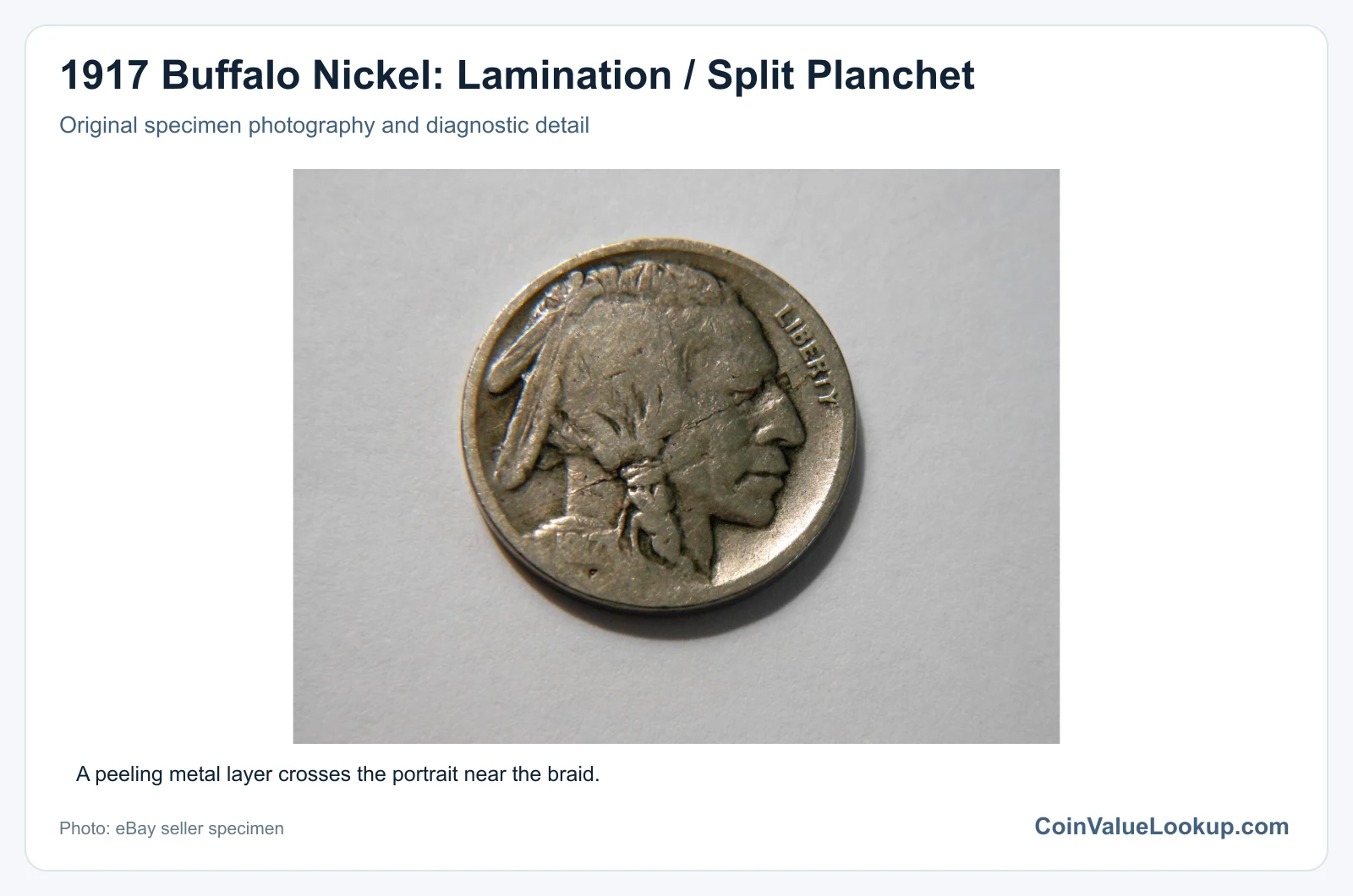
A lamination error on a 1917 Buffalo Nickel shows as peeling, flaking, or splitting within the metal itself. You might see a retained flap of metal still attached at one edge, or a missing layer that exposes a rough underlayer.
These flaws originate from impurities or gas pockets trapped in the alloy during preparation of the planchet. They are a pre-strike defect made visible by the striking pressure.
Photograph the affected area alongside the edge of the coin so the separation is clearly documented. Scraping damage, corrosion, or a deliberately cut coin can look similar, but lamination flaws follow the metal's natural layers rather than showing tool marks or uniform cuts.
Value hinges on the size, visibility, and whether the coin retains a complete design despite the defect.
7. 1917 Buffalo Nickel — Two Feathers / Abraded Third Feather
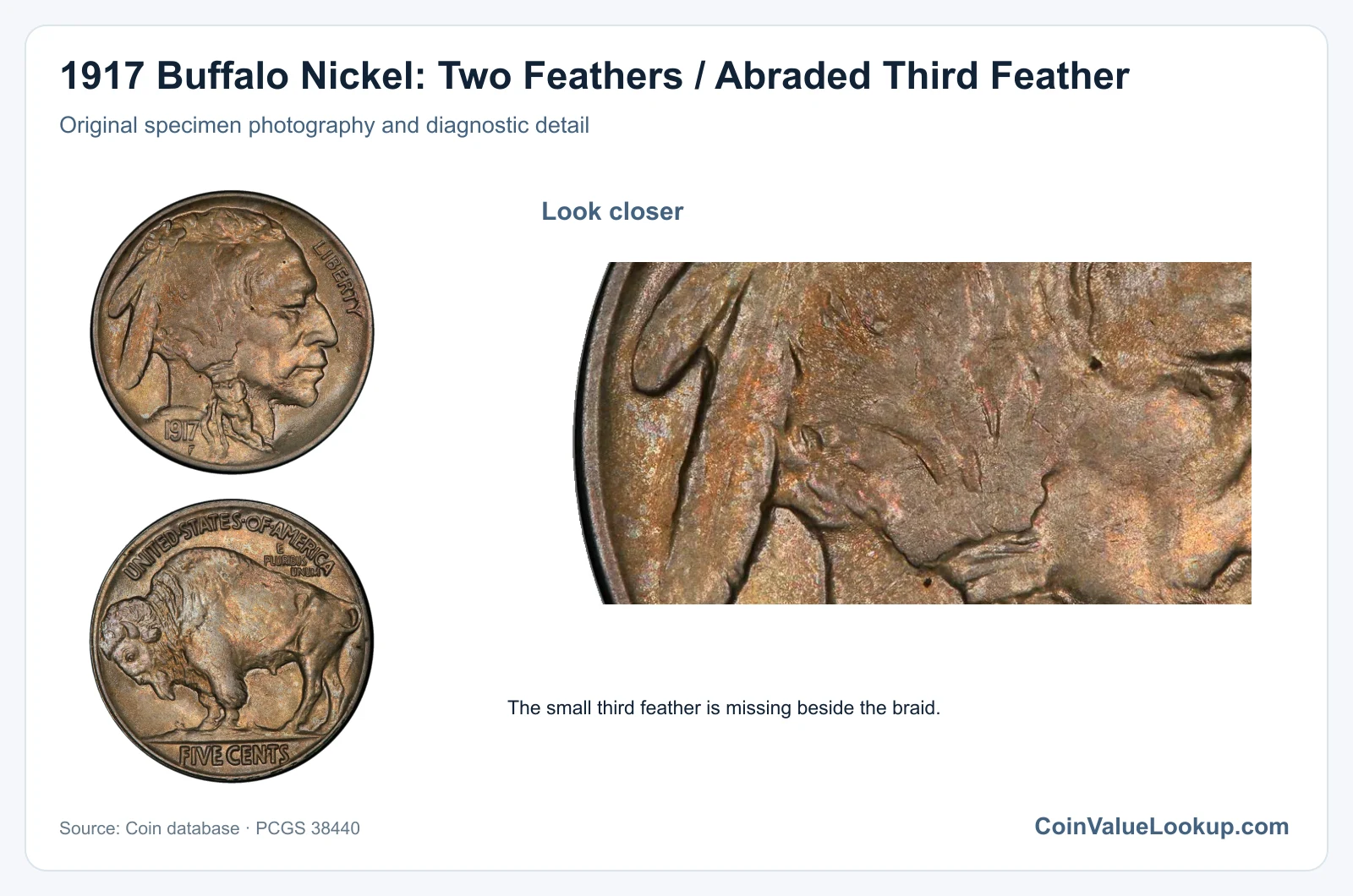
Normal Buffalo Nickel obverses show three feathers extending from the back of the Native American's hair. The Two Feathers variety on 1917 nickels has the third, smallest feather partially or fully missing due to die abrasion or a die preparation issue.
This variety has been reported across 1917 Philadelphia, Denver, and San Francisco issues. To check, look closely at the feather cluster near the neck.
On a normal coin, three distinct feather tips are visible. On the Two Feathers variety, the innermost feather is absent or reduced to a faint remnant.
Do not mistake normal wear for this variety. On a heavily circulated coin, all three feathers lose definition.
A genuine Two Feathers coin will show the absence even with strong remaining detail on the other two feathers. Weak strikes and grease-filled dies can also obscure that feather.
Value depends on how cleanly the variety is expressed and the coin's overall grade.
8. 1917 Buffalo Nickel — Three-and-a-Half Legs
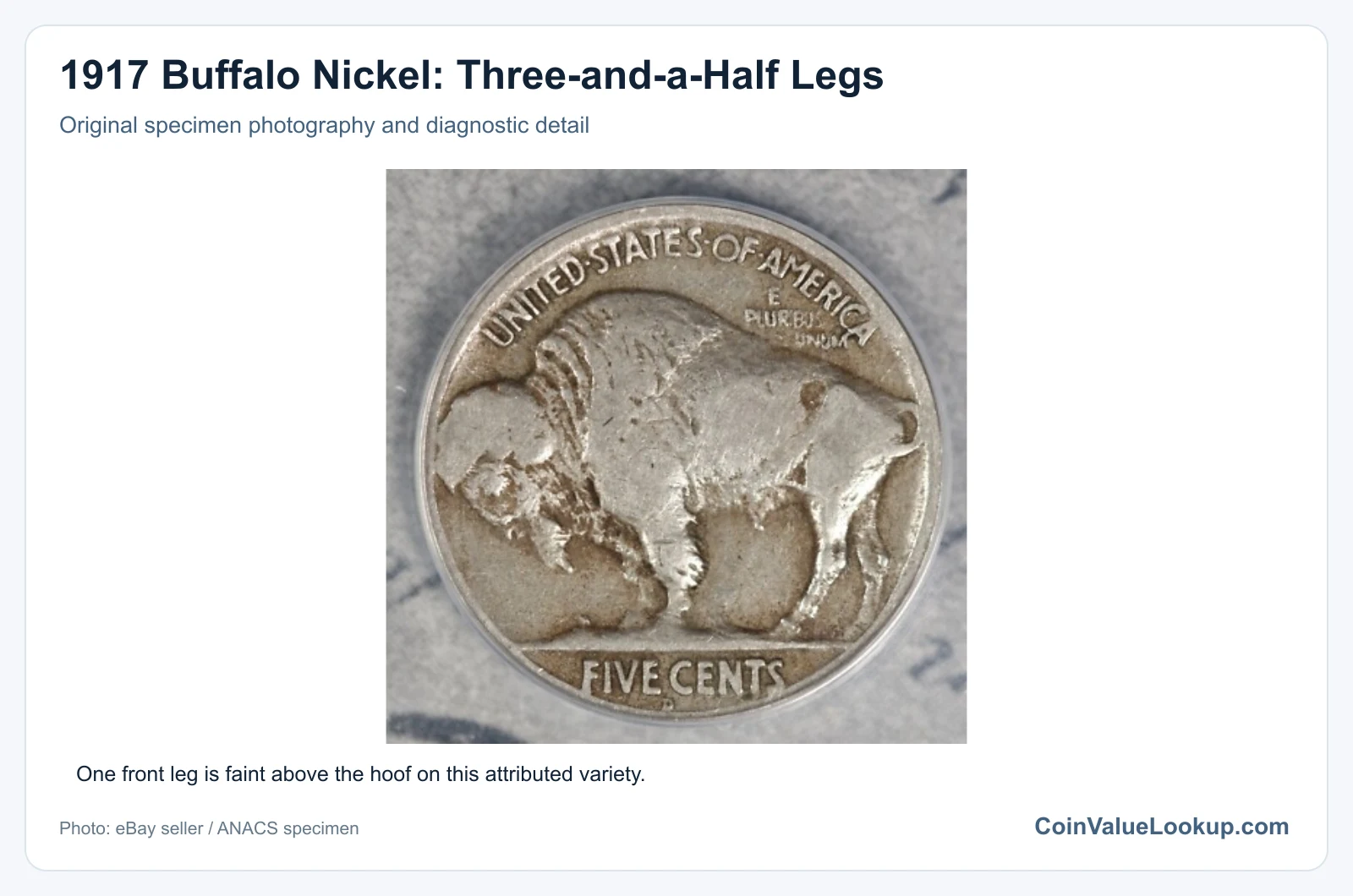
The Three-and-a-Half Legs variety is reported on the 1917-D Buffalo Nickel. It affects the bison's front leg on the reverse, where part of the leg appears weakened or partially missing due to excessive die polishing.
Compare the front leg against a normal 1917-D reverse. On the affected die, a segment of the leg is visibly thinner or partially erased while the hoof and the upper portion remain intact.
The surrounding design should still be relatively sharp, which distinguishes this from simple circulation wear.
Heavy wear, weak strikes, acid treatment, and post-mint scraping can all make a bison's leg look incomplete. The key difference is consistency: a die-polishing variety affects one specific area in a repeatable pattern across multiple coins from that die.
Value is driven by the clarity of the missing-leg segment and the coin's overall condition.