1885 Liberty Nickel Coin Value: How Much Is It Worth?
The 1885 Liberty Nickel is a key date in the series, and even a well-worn example carries a serious premium. A USA Coin Book guide estimate places the With CENTS business strike at about $344 in G4 and around $4,247 in MS63, while a PR63 proof sits near $1,445.
This is not a coin you want to misidentify, so confirming the date carefully is the first step.
Fast Way to Identify Your 1885 Liberty Nickel
Want a quick read on what you have? Upload clear photos of both the front and back of your coin, and our identifier can give you a preliminary take on the year, design type, and general condition.
It is not a substitute for professional authentication or certified grading, but it is a solid starting point before you dig deeper.
1885 Liberty Nickel Value
Upload both sides of your 1885 Liberty Nickel.
Front Obverse
Upload photo
Back Reverse
Upload photo
Which 1885 Liberty Nickel Versions Are Worth Money?
- Key circulation date — even a G4 business strike guides near $344, far above a common-date Liberty Nickel.
- High-grade MS63 business strikes guide around $4,247, reflecting the scarcity of original, well-preserved survivors.
- Proof strikes guide near $1,445 at PR63 and represent a distinct manufacturing method worth identifying separately.
- Error categories such as repunched dates, clashed dies, die cracks, and broadstrikes have been reported for 1885 and are worth inspecting for.
Step 1: Identify Your 1885 Liberty Nickel Mint Mark and Version
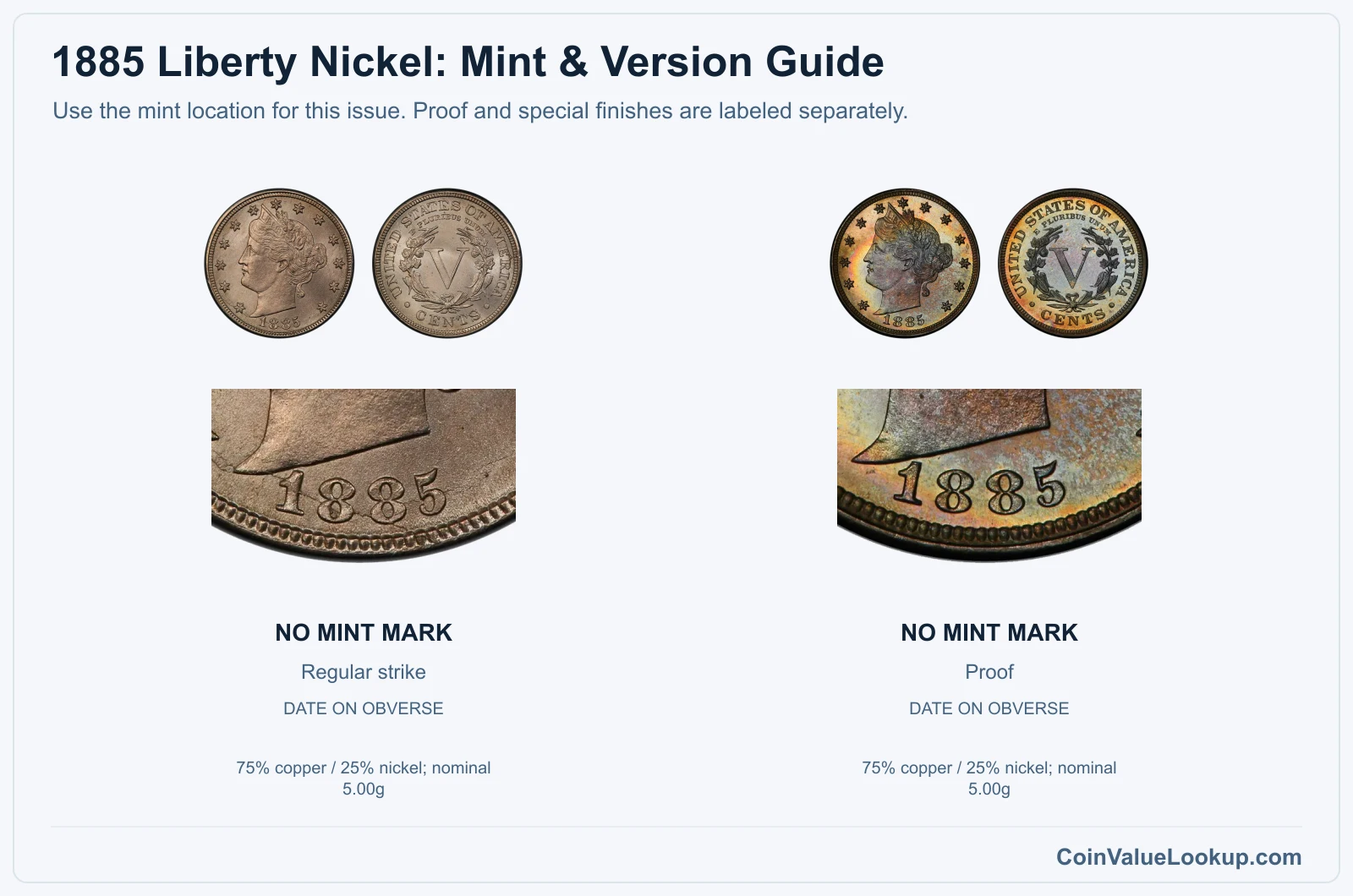
Every 1885 Liberty Nickel was struck at the Philadelphia Mint. There is no mintmark, and there are no branch-mint versions — no D, no S.
If you see a mintmark on an 1885 nickel, something is wrong.
The coin is 75% copper and 25% nickel, weighs about 5 grams, measures 21.2 mm across, and has a plain edge. There was no silver version produced this year.
All genuine 1885 nickels carry the With CENTS reverse, where the word CENTS appears at the bottom of the wreath. The earlier No CENTS design was used only in 1883, so your 1885 should always read CENTS on the back.
Because this is a key date, the 1885 is a frequent target for alterations. Some altered coins start as cheaper dates with digits re-cut to mimic an 1885.
Always verify the date under magnification and compare the numeral spacing and style against a known genuine example before assuming you have the real thing.
Step 2: Check Your 1885 Liberty Nickel Grade
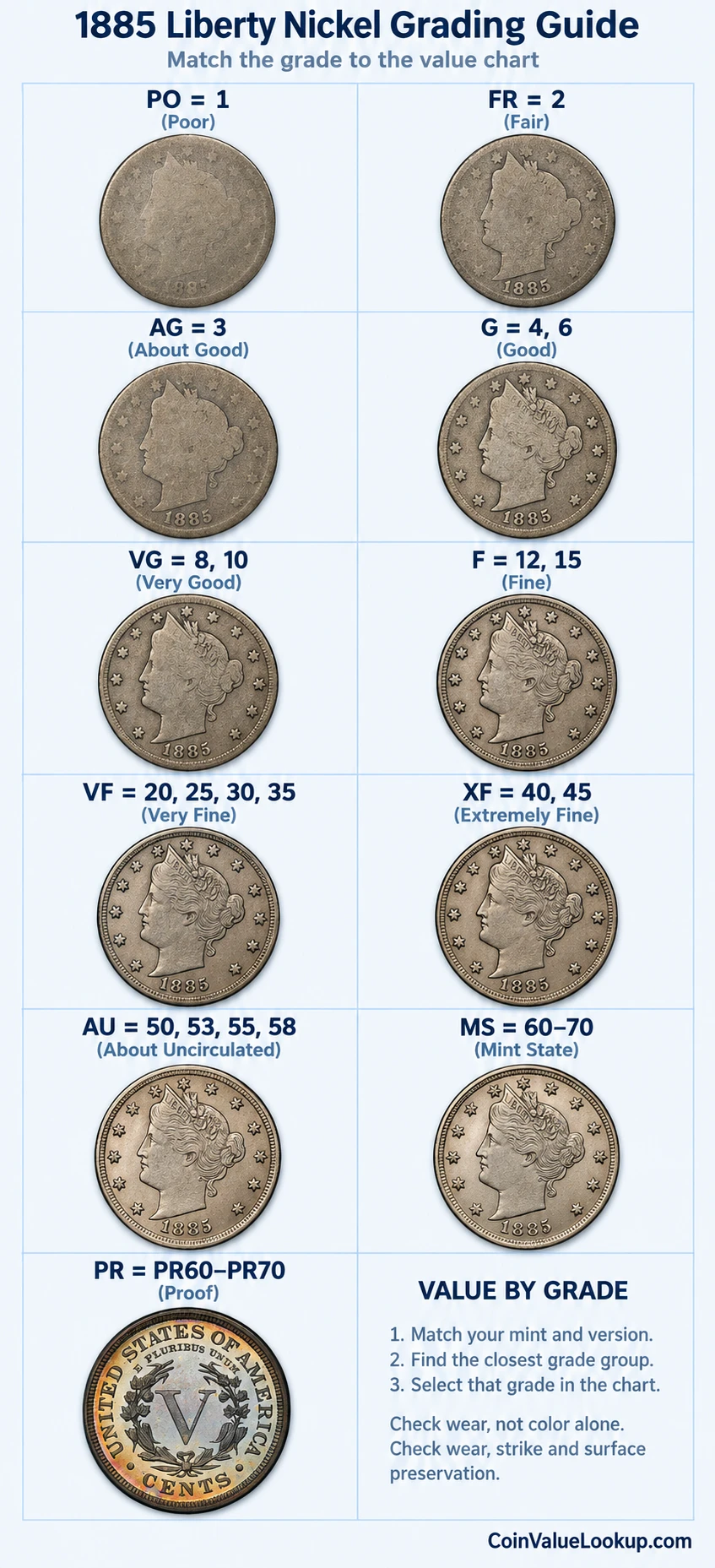
Start with the word LIBERTY on the coronet above the forehead. On a well-circulated coin, the letters merge into the headband.
A coin grading around Good will show a partial or fully worn LIBERTY, while one at Fine retains most letters with minor softness.
Next check the high curls of hair near the ear and the cheek. These are the first areas to flatten with wear.
Use the comparison image to match your coin against known grade benchmarks.
On the reverse, examine the individual kernels of the corn ears inside the wreath. Soft kernels can mean wear, but they can also signal a weakly struck coin.
Weak details alone do not prove the coin circulated — look at the fields and overall luster to separate strike softness from genuine wear.
For mint-state examples, focus on luster quality, the severity of contact marks, and the sharpness of the strike. A coin can be technically uncirculated yet still show bagmarks from storage.
Proof is a manufacturing method, not a grade above Mint State. Proof 1885 nickels should show mirrored fields and squared-off rims.
Examine under angled light for hairlines and handling marks; compare against attributed proof examples before drawing conclusions.
Step 3: Check 1885 Liberty Nickel Value by Mint and Version
1885 Liberty Nickel — No Mint Mark — With CENTS Circulation
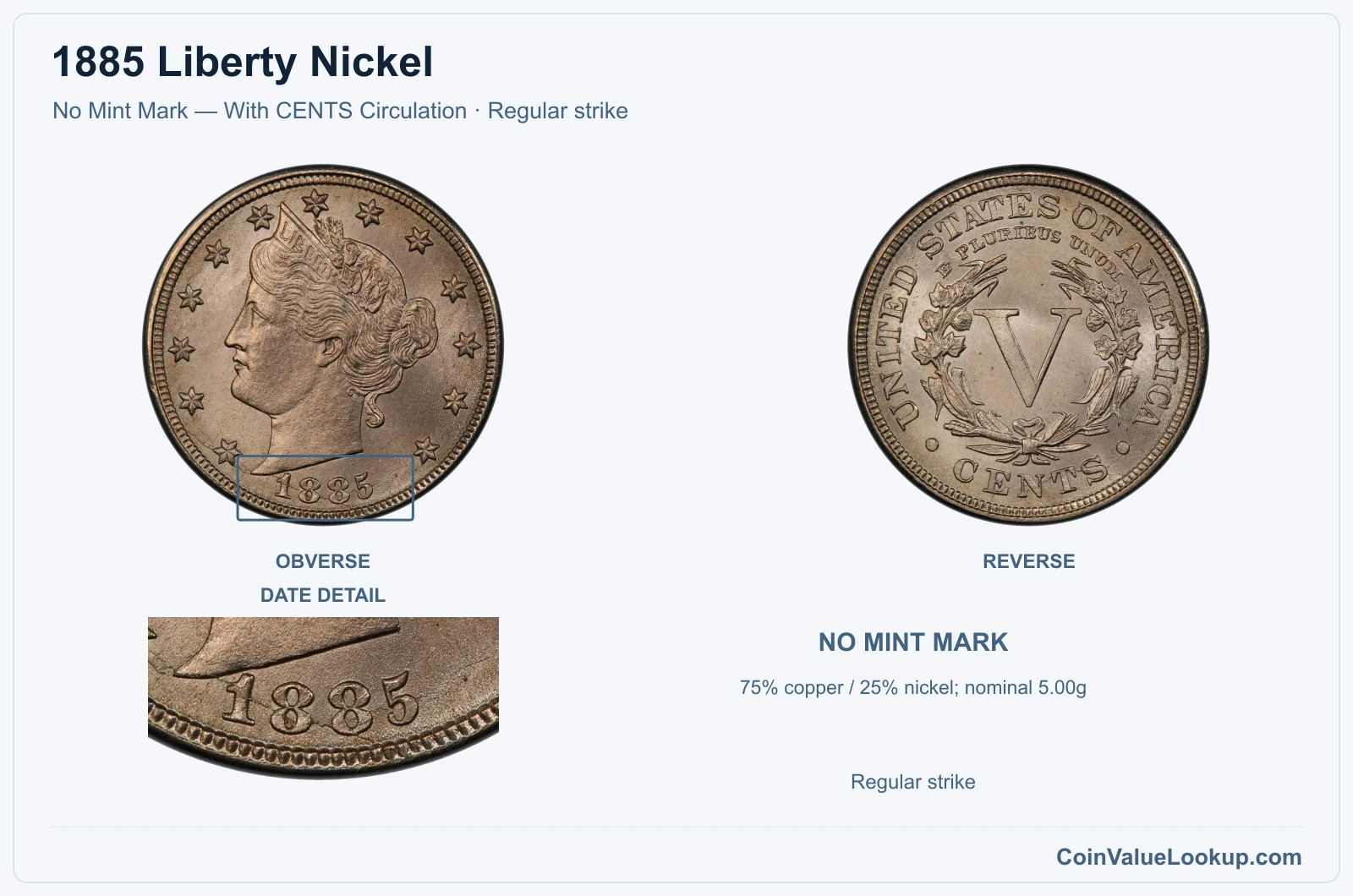
The 1885 With CENTS business strike is the sole regular-issue version for this year, produced only at Philadelphia with no mintmark. It is struck on a 75% copper, 25% nickel planchet weighing about 5 grams.
This is a key date. A USA Coin Book guide estimate puts a G4 example around $344 and an MS63 near $4,247.
Those figures reflect how few survived relative to demand. Even low-grade coins command prices that dwarf most other Liberty Nickels.
Before celebrating, verify the date. Altered dates are a real hazard here.
Look at the numeral spacing, the style of the 5, and the overall die characteristics under magnification. A genuine 1885 is worth the effort to confirm properly.
Range Grade
Price Auction Records Appraisal PO PO 1
Coin Identifier FR FR 2
Coin Identifier AG AG 3
Coin Identifier G G 4
Coin Identifier
G 6
Coin Identifier VG VG 8
Coin Identifier
VG 10
Coin Identifier F F 12
Coin Identifier
F 15
Coin Identifier VF VF 20
Coin Identifier
VF 25
Coin Identifier
VF 30
Coin Identifier
VF 35
Coin Identifier XF XF 40
Coin Identifier
XF 45
Coin Identifier AU AU 50
Coin Identifier
AU 53
Coin Identifier
AU 55
Coin Identifier
AU 58
Coin Identifier MS MS 60
Coin Identifier
MS 61
Coin Identifier
MS 62
Coin Identifier
MS 63
Coin Identifier
MS 64
Coin Identifier
MS 65
Coin Identifier
MS 66
Coin Identifier
MS 67
Coin Identifier
MS 68
—
—
—
MS 69
—
—
—
MS 70
—
—
—
1885 Liberty Nickel — No Mint Mark — With CENTS Proof
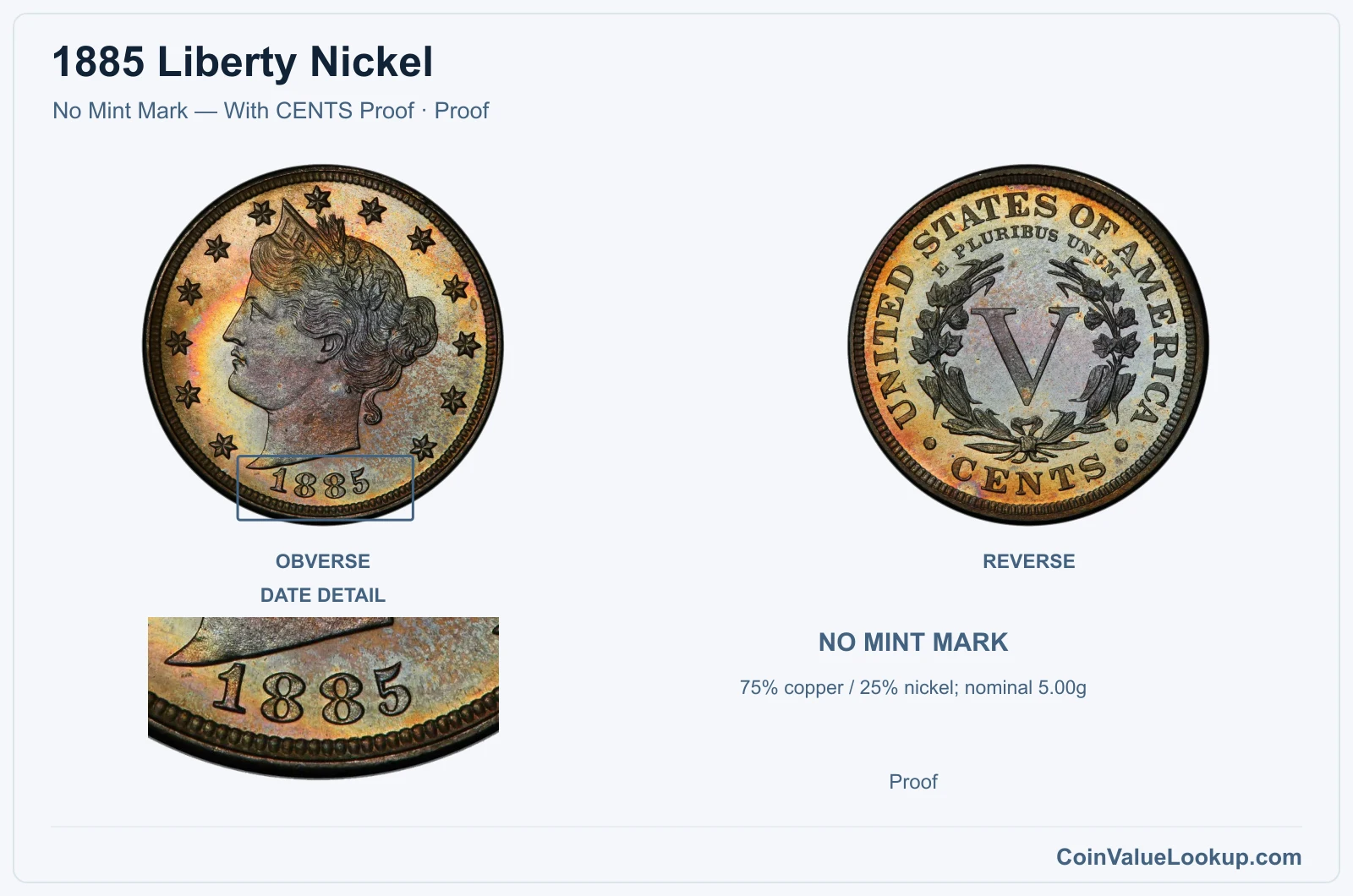
Philadelphia also produced proof Liberty Nickels in 1885, struck with the same With CENTS reverse design on the same 75% copper, 25% nickel composition. A PR63 example guides around $1,445 per USA Coin Book.
To identify a proof, look for deeply mirrored fields that reflect like a dark mirror under direct light. The rims should appear squared and sharp, distinct from the rounded rims of a business strike.
Hairlines from improper cleaning are common on older proofs and affect both grade and value.
Coin Value Lookup is a good place to start when you want to compare your coin against guide values for different years and finishes in the Liberty Nickel series. Show both faces of your coin and pay attention to the field quality and rim profile when seeking an initial identification.
Range Grade
Price Auction Records Appraisal PR PR 1
—
Coin Identifier
PR 2
—
Coin Identifier
PR 3
—
Coin Identifier
PR 4
—
Coin Identifier
PR 6
—
Coin Identifier
PR 8
—
Coin Identifier
PR 10
—
Coin Identifier
PR 12
—
Coin Identifier
PR 15
—
Coin Identifier
PR 20
—
Coin Identifier
PR 25
—
Coin Identifier
PR 30
—
Coin Identifier
PR 35
—
Coin Identifier
PR 40
—
Coin Identifier
PR 45
—
Coin Identifier
PR 50
—
Coin Identifier
PR 53
—
Coin Identifier
PR 55
—
Coin Identifier
PR 58
Coin Identifier
PR 60
Coin Identifier
PR 61
Coin Identifier
PR 62
Coin Identifier
PR 63
Coin Identifier
PR 64
Coin Identifier
PR 65
Coin Identifier
PR 66
Coin Identifier
PR 67
Coin Identifier
PR 68
Coin Identifier
PR 69
—
—
—
PR 70
—
—
—
1885 Liberty Nickel Error List
1. 1885 Liberty Nickel — Repunched Date
A repunched date on an 1885 Liberty Nickel shows remnants of an earlier position of one or more date numerals alongside the final placement. Under magnification, look for a secondary image or traces of a numeral slightly offset from where the final digit sits.
This is a die variety — the date punch was applied more than once during die preparation, not during the striking of your coin.
Do not confuse this with machine doubling, which produces flat, shelf-like doubling across the entire design rather than isolated to the date area. Also rule out simple damage — a gouge or scratch near a numeral is not a repunched date.
The specific variety, its visibility, and the coin's overall condition all influence any premium. No reliable price range is available here, so have a strong example evaluated individually by a specialist or grading service.
2. 1885 Liberty Nickel — Clashed Dies
Clashed dies occur when the obverse and reverse dies strike each other without a planchet between them. The result is faint traces of the opposite design transferred into each die, which then appear on subsequently struck coins.
On an 1885 nickel, you might spot ghostly impressions of Liberty's profile in the reverse fields, or hints of the wreath on the obverse.
These traces align with where the opposing design would normally sit if the coin were transparent — that alignment is key to confirming a genuine clash. Random raised lines, scratches, or a brockage impression will not match the expected opposing-design position.
Condition and the strength of the clash impression both matter for any premium. No specific price data is available, so assessment by an experienced dealer or third-party grading service is recommended for a coin you suspect is clashed.
3. 1885 Liberty Nickel — Die Crack / Die Chip
Die cracks show up as raised lines on the coin's surface, created when a crack forms in the steel die and the planchet metal fills that void during striking. On an 1885 nickel, look for thin raised ridges that may run from the rim inward or appear entirely within the design.
A die chip is similar but appears as a small raised blob rather than a line — the result of a small piece of the die face breaking away.
A crack that connects to the rim and produces a larger raised area is called a cud, which is a more dramatic form of the same problem. Distinguish these from incuse scratches (which are recessed, not raised), corrosion buildup, or foreign material stuck to the surface.
Value depends on the size, location, and the coin's grade. No numerical price range is available for this category, so individual evaluation is the way to go.
4. 1885 Liberty Nickel — Broadstrike
A broadstrike happens when the coin is struck without the retaining collar that normally confines the planchet to its correct diameter. The result is a coin that spreads outward, appearing slightly wider than normal with a distorted or absent rim profile.
The design is still centered — that is what separates a broadstrike from an off-center strike, where part of the design is missing entirely.
On an 1885 nickel, check the edge. A broadstruck coin will lack the sharp, defined edge of a normal piece, and the design elements near the rim may appear stretched or distorted.
Do not confuse this with a coin that was simply flattened or damaged after leaving the mint — post-mint damage will show different surface characteristics and will not display the uniform metal flow of a genuine broadstrike.
Condition, the degree of spread, and overall eye appeal all factor into any premium. No specific price data is available for this error on the 1885 nickel.