1885 Liberty Seated Dime Coin Value: How Much Is It Worth?
The 1885 Liberty Seated Dime spans a wide value range depending on mint and condition. A Philadelphia issue in well-worn G4 grade books at about $22 according to USA Coin Book, while a San Francisco example in the same grade jumps to around $933.
At the upper end, an uncirculated MS63 San Francisco coin reaches roughly $11,092 in guide estimates. That spread tells you the mint of origin matters enormously for this date.
Fast Way to Identify Your 1885 Liberty Seated Dime
The quickest way to start figuring out what you have is to upload clear photos of both the front and back of your coin. Our identifier can give you a preliminary read on the mint, design type, and major version based on those images.
It won't replace professional authentication or grading, but it gets you pointed in the right direction fast.
1885 Liberty Seated Dime Value
Upload both sides of your 1885 Liberty Seated Dime.
Front Obverse
Upload photo
Back Reverse
Upload photo
Which 1885 Liberty Seated Dime Versions Are Worth Money?
- The 1885-S (San Francisco) is a key issue, with guide values from about $933 at G4 to roughly $11,092 at MS63, far exceeding Philadelphia at every grade.
- The 1885 Philadelphia Proof carries a guide value near $725 at PR63, reflecting its limited mintage for collectors.
- Die errors such as repunched dates, misplaced dates, die cracks, and clashed dies have been reported for this year and can add value depending on visibility and condition.
Step 1: Identify Your 1885 Liberty Seated Dime Mint Mark and Version
The 1885 dime features the Legend Obverse design with a seated Liberty figure on the front and an agricultural wreath surrounding ONE DIME on the reverse. The coin is struck in 90% silver and 10% copper, weighs about 2.50 grams, and measures 17.9mm with a reeded edge.
First, confirm you actually have a dime and not a half dime. They look similar at a glance, but size and denomination text differ.
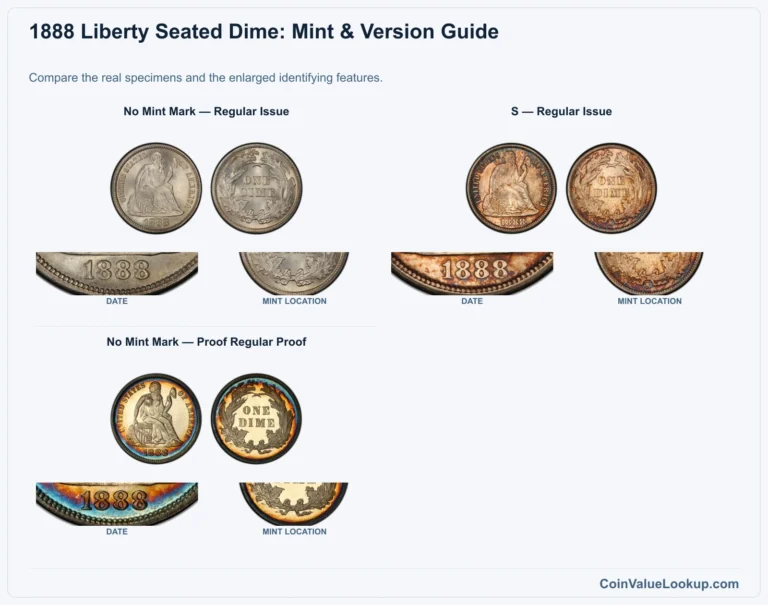
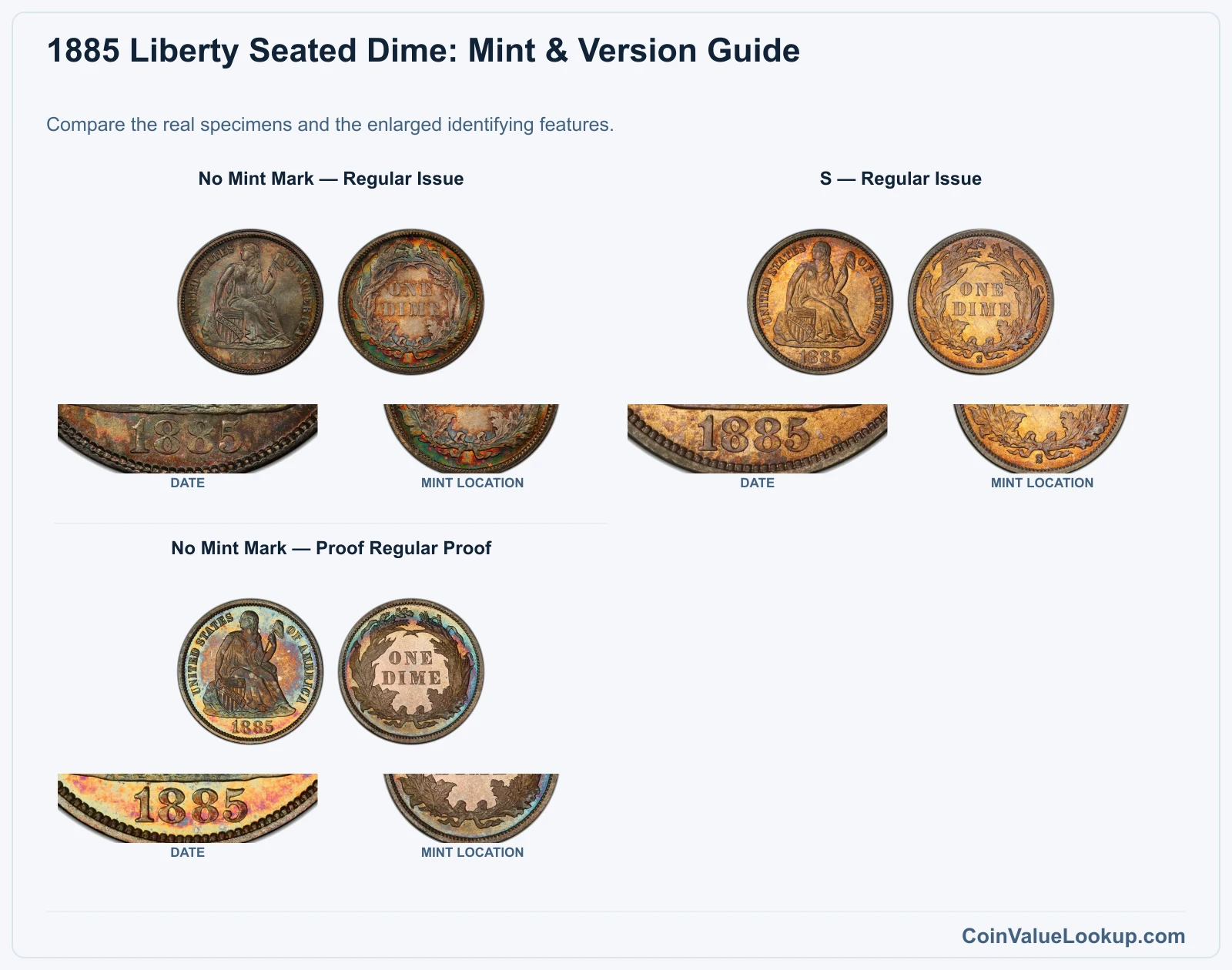
Mintmark location is on the reverse, inside the wreath near the bottom. Philadelphia coins carry no mintmark at all.
San Francisco pieces show a small "S" in that spot. If you see any letter there, look carefully under magnification to read it correctly.
The San Francisco issue is a key date in the series and commands dramatically higher prices than its Philadelphia counterpart at every grade level. Identifying the correct mint is the single most important step for this year.
Step 2: Check Your 1885 Liberty Seated Dime Grade
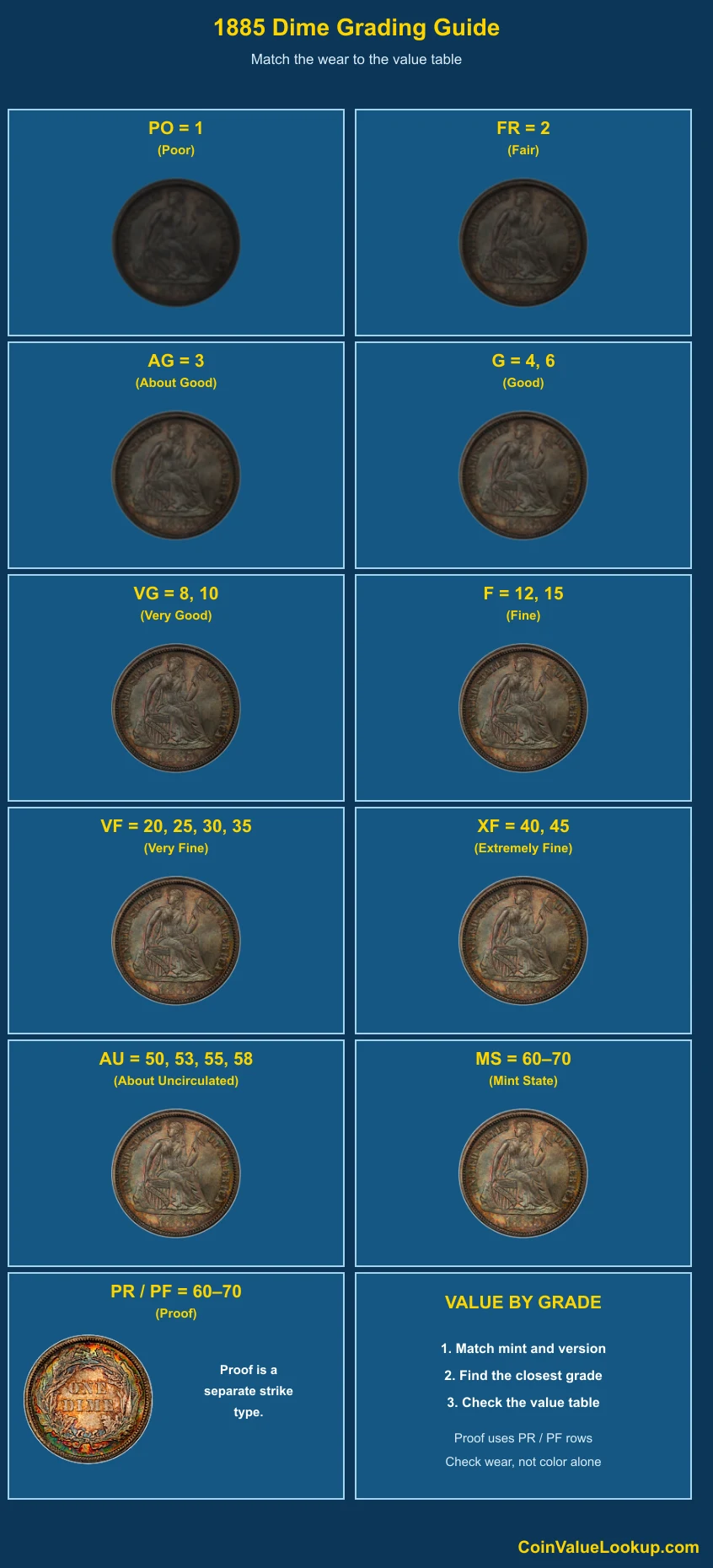
Start with Liberty's head on the obverse. In lower grades, the hair detail above the forehead wears smooth first.
Next check the breast and knee area of the seated figure, along with the horizontal lines on the shield. These are the high points that show friction earliest.
On the reverse, the highest leaves in the wreath lose definition before the lower ones. Compare your coin against the reference image to judge where it falls.
Surviving original luster matters a lot for mid-grade and higher coins. A coin can look detailed but lack any mint shine, which caps its grade.
Conversely, a weakly struck coin from tired dies can appear worn when it actually never circulated. Look at the fields, not just the devices.
Proof coins are a separate category entirely. They were deliberately struck on polished planchets with prepared dies and show mirror-like fields.
A shiny coin that has been cleaned or polished is not a Proof. Keep business strikes and Proofs firmly apart when evaluating.
Step 3: Check 1885 Liberty Seated Dime Value by Mint and Version
1885 Liberty Seated Dime — No Mint Mark — Regular Issue
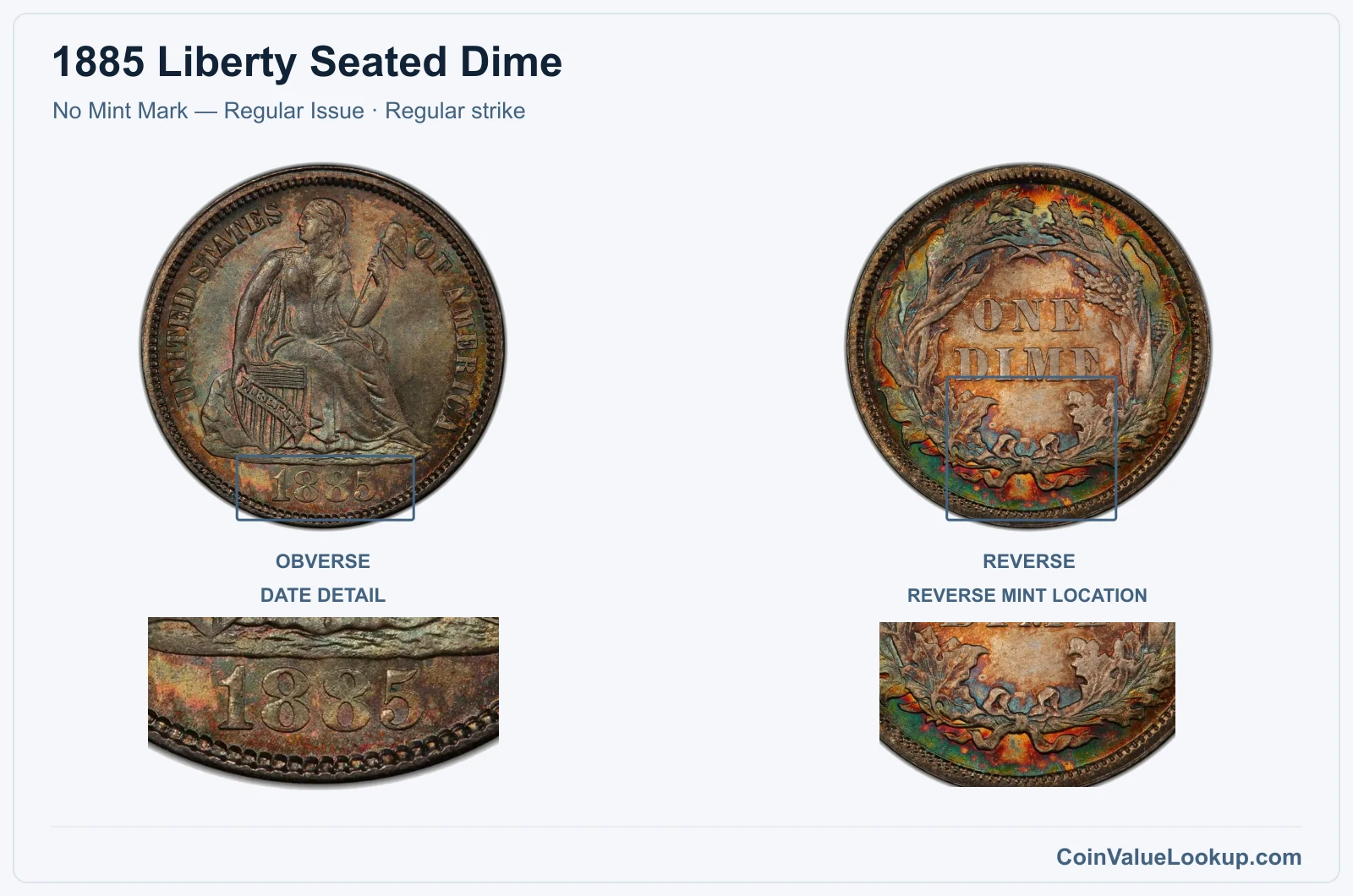
The 1885 Philadelphia dime has no mintmark. You will find a clean reverse with nothing between the wreath bow and the denomination.
This is the common business-strike issue for the year.
USA Coin Book lists this version at about $22 in G4 and around $316 in MS63. Those are retail guide estimates, not guaranteed sale prices.
Actual results depend on surfaces, eye appeal, and the specific grade a coin earns. Still, even at the MS63 level this is a modest coin compared to its San Francisco sibling.
Range Grade
Price Auction Records Appraisal PO PO 1
—
Coin Identifier FR FR 2
—
Coin Identifier AG AG 3
—
Coin Identifier G G 4
—
Coin Identifier
G 6
—
Coin Identifier VG VG 8
—
Coin Identifier
VG 10
—
Coin Identifier F F 12
—
Coin Identifier
F 15
—
Coin Identifier VF VF 20
—
Coin Identifier
VF 25
—
Coin Identifier
VF 30
Coin Identifier
VF 35
—
Coin Identifier XF XF 40
—
Coin Identifier
XF 45
—
Coin Identifier AU AU 50
—
Coin Identifier
AU 53
—
Coin Identifier
AU 55
Coin Identifier
AU 58
Coin Identifier MS MS 60
Coin Identifier
MS 61
Coin Identifier
MS 62
Coin Identifier
MS 63
Coin Identifier
MS 64
Coin Identifier
MS 65
Coin Identifier
MS 66
Coin Identifier
MS 67
Coin Identifier
MS 68
—
Coin Identifier
MS 69
—
—
—
MS 70
—
—
—
1885 Liberty Seated Dime — S — Regular Issue
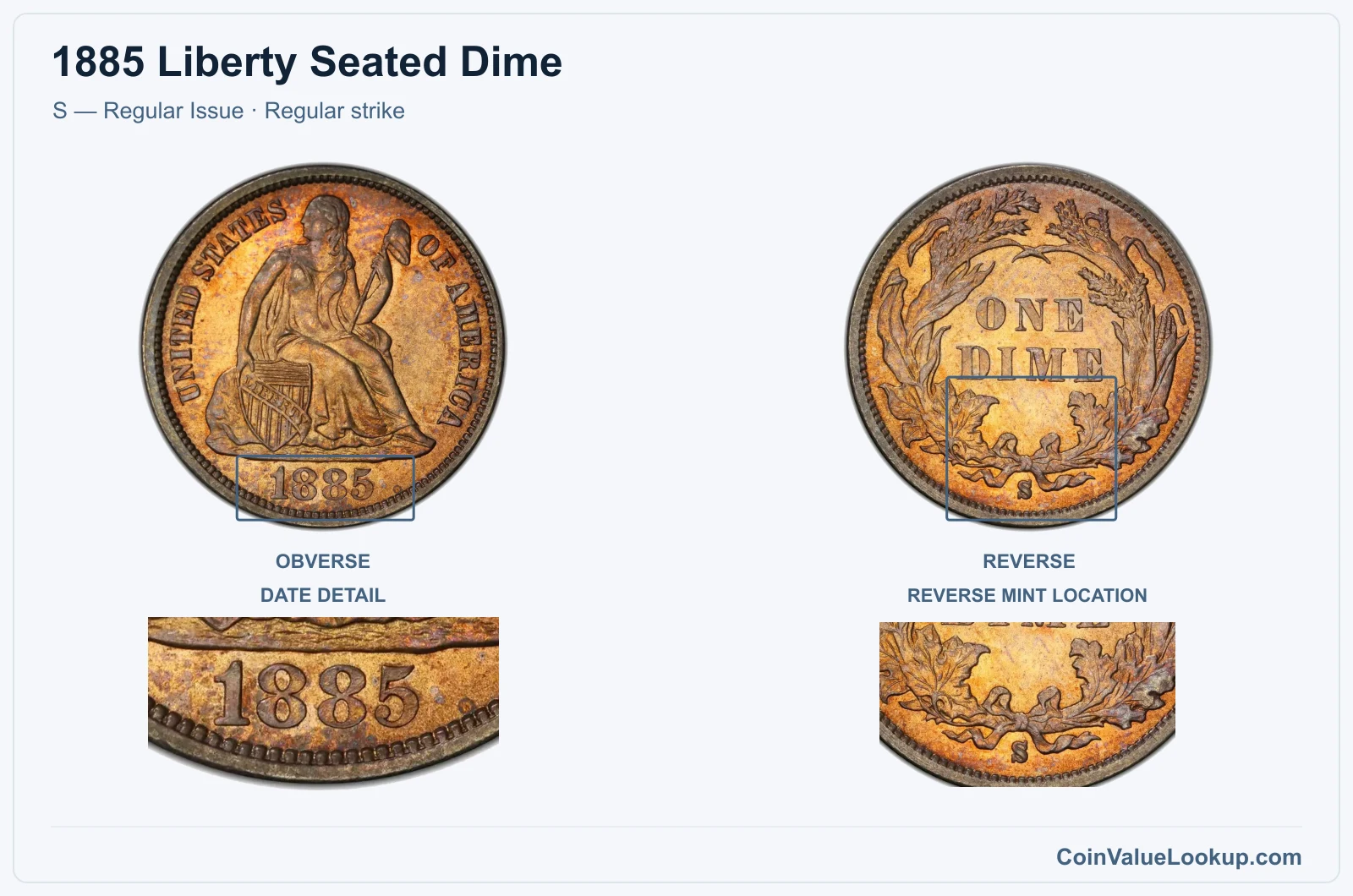
This is the one that gets people excited, and for good reason. The 1885-S carries a small "S" mintmark on the reverse inside the wreath.
It is a genuine key date in the Liberty Seated Dime series.
Guide values reflect the scarcity. USA Coin Book lists about $933 at G4 and approximately $11,092 at MS63.
Even heavily worn examples carry serious value. That means correct identification is critical.
Use magnification to confirm the mintmark shape and position, because a damaged or corroded area can sometimes be misread.
If you think you have an 1885-S, handle it carefully and consider professional authentication. The price gap between this and the Philadelphia issue is enormous at every grade level.
Coin Value Lookup is a good starting point if you want to look up guide values for other dates and mints in the Seated Dime series.
Range Grade
Price Auction Records Appraisal PO PO 1
—
Coin Identifier FR FR 2
Coin Identifier AG AG 3
Coin Identifier G G 4
Coin Identifier
G 6
Coin Identifier VG VG 8
Coin Identifier
VG 10
Coin Identifier F F 12
Coin Identifier
F 15
Coin Identifier VF VF 20
Coin Identifier
VF 25
Coin Identifier
VF 30
Coin Identifier
VF 35
Coin Identifier XF XF 40
Coin Identifier
XF 45
Coin Identifier AU AU 50
Coin Identifier
AU 53
Coin Identifier
AU 55
Coin Identifier
AU 58
Coin Identifier MS MS 60
—
Coin Identifier
MS 61
Coin Identifier
MS 62
Coin Identifier
MS 63
Coin Identifier
MS 64
Coin Identifier
MS 65
Coin Identifier
MS 66
Coin Identifier
MS 67
—
—
—
MS 68
—
—
—
MS 69
—
—
—
MS 70
—
—
—
1885 Liberty Seated Dime — No Mint Mark — Proof Regular Proof
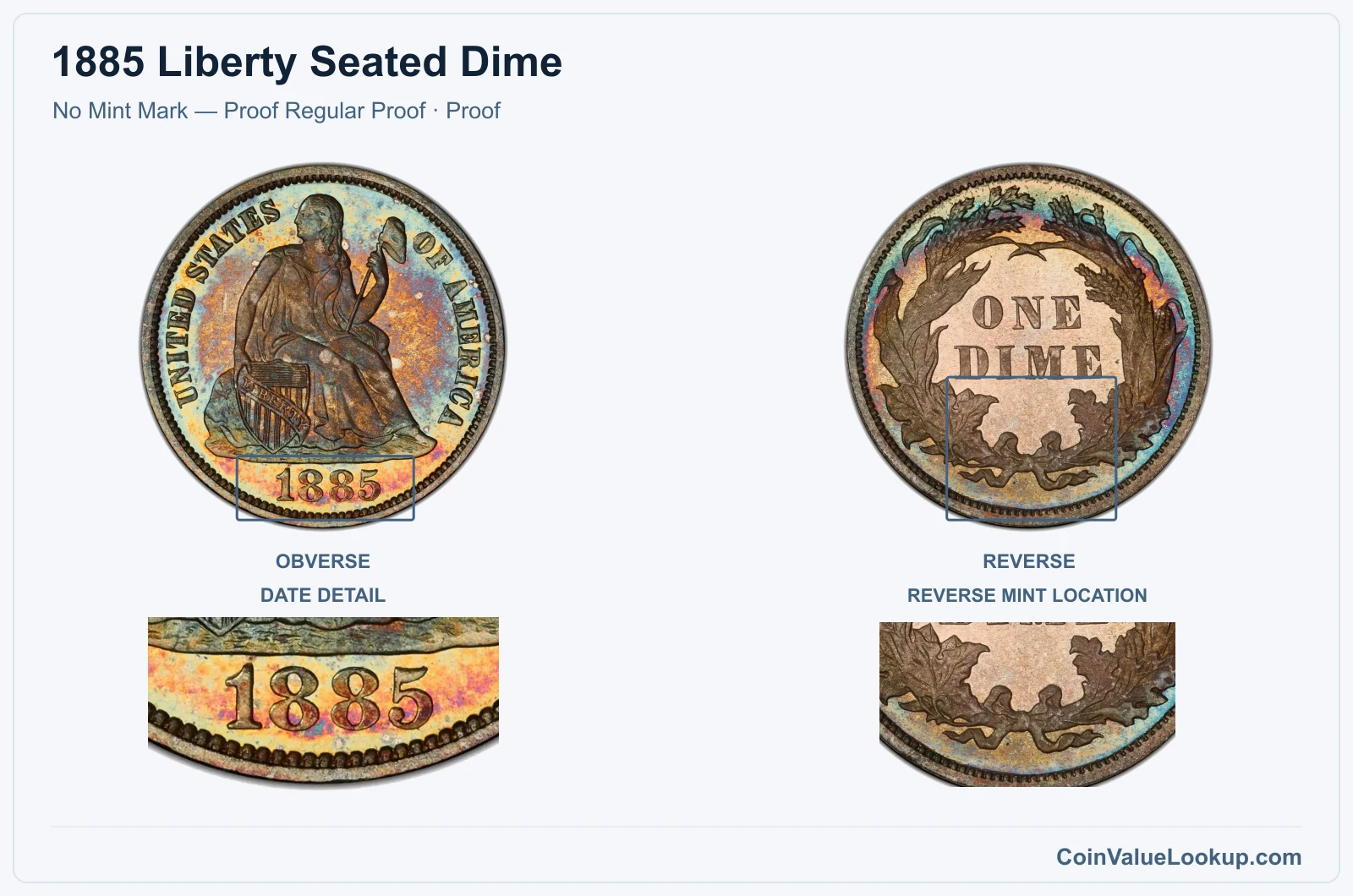
Philadelphia struck Proof dimes in 1885 for collectors. These were made with specially prepared dies on polished planchets, producing deep mirror fields that reflect like glass.
The telltale sign is those mirror fields combined with sharp, fully formed design details. Hairlines from old cleaning are common on surviving Proofs and will affect the grade.
USA Coin Book lists the Proof at about $725 in PR63.
Do not confuse a cleaned or polished business strike for a Proof. Genuine Proofs show a distinctive edge quality and field texture that cleaning cannot replicate.
If you suspect you have one, tilt the coin under a single light source and watch how the fields reflect. A real Proof produces a single, continuous mirror reflection rather than a hazy shine.
Range Grade
Price Auction Records Appraisal PR PR 1
—
Coin Identifier
PR 2
—
Coin Identifier
PR 3
—
Coin Identifier
PR 4
—
Coin Identifier
PR 6
—
Coin Identifier
PR 8
—
Coin Identifier
PR 10
—
Coin Identifier
PR 12
—
Coin Identifier
PR 15
—
Coin Identifier
PR 20
—
Coin Identifier
PR 25
—
Coin Identifier
PR 30
—
Coin Identifier
PR 35
—
Coin Identifier
PR 40
—
Coin Identifier
PR 45
—
Coin Identifier
PR 50
—
Coin Identifier
PR 53
—
Coin Identifier
PR 55
—
Coin Identifier
PR 58
—
Coin Identifier
PR 60
—
Coin Identifier
PR 61
Coin Identifier
PR 62
Coin Identifier
PR 63
Coin Identifier
PR 64
Coin Identifier
PR 65
Coin Identifier
PR 66
Coin Identifier
PR 67
Coin Identifier
PR 68
Coin Identifier
PR 69
—
—
—
PR 70
—
—
—
1885 Liberty Seated Dime Error List
1. 1885 Liberty Seated Dime — Repunched Date
A repunched date on an 1885 dime shows remnants of an earlier position of one or more date numerals alongside the final placement. Under magnification, look for ghostly outlines or partial digits slightly offset from where the numbers sit now.
The most common spots to check are the bases and tops of the "1," "8," and "5" digits.
This is a die variety, not post-strike damage. The date punch was physically impressed into the die more than once in slightly different positions.
That makes it different from mechanical doubling, which produces flat, shelf-like distortion on the struck coin rather than distinct secondary impressions.
Damage to the date area from contact marks or corrosion can mimic a repunched date to the untrained eye. Compare what you see to known examples before drawing conclusions.
No specific price data is available here; value depends on the visibility of the repunching, overall coin condition, and collector demand for the particular variety.
2. 1885 Liberty Seated Dime — Misplaced Date
A misplaced date occurs when part of a date digit appears outside the normal date position on the die. On the 1885 dime, the area to inspect is the denticles beneath the "18" portion of the date.
You are looking for recognizable fragments of a numeral embedded in or near those denticles.
The key diagnostic is shape. A genuine misplaced digit will have contours matching an actual numeral from the date logotype, raised on the coin's surface because it was incused into the die.
Random die scratches or polishing lines will not match the profile of a specific number.
This variety is distinct from a repunched date, which shows doubling within the normal date area. Here the fragment sits entirely outside where the date belongs.
Condition and how clearly the misplaced fragment shows will drive any premium, but no specific pricing is available for this category on the 1885 issue.
3. 1885 Liberty Seated Dime — Die Crack / Die Chip
Die cracks appear as thin, raised lines on the coin's surface, tracing where the steel die fractured during use. Die chips look like small raised blobs where a piece of the die face broke away.
Both are reported for the 1885 Philadelphia dime.
A crack connecting the rim to an interior design element is the most common form. A larger break at the rim that leaves a raised, irregular blob is sometimes called a cud.
Interior chips tend to be smaller and rounder.
Do not confuse die cracks with scratches. Cracks are raised because metal filled the gap in the broken die.
Scratches are incuse, meaning they cut into the surface. Corrosion and encrusted debris can also mimic small chips.
Magnification and good lighting sort these out quickly. Value depends on the size, location, and overall condition of the coin; no specific price data is adopted for this category.
4. 1885 Liberty Seated Dime — Clashed Dies
Clashed dies result when the obverse and reverse dies strike each other without a planchet between them. The impact transfers design elements from one die onto the other, and those ghost impressions then appear on subsequently struck coins.
This has been reported for the 1885 Philadelphia dime.
On the obverse, look for faint traces of the wreath or lettering from the reverse in the open fields around Liberty. On the reverse, you might spot outlines of Liberty's seated figure or shield transferred into the area around the denomination.
The transferred images will be correctly oriented relative to the opposing die, which helps distinguish them from random scratches or contact marks. A brockage, where a previously struck coin acts as a die, produces a different mirror-image effect and is not the same thing.
Value for clashed-die examples depends on how prominent the clash marks are and the coin's overall grade; no numerical price data is available for this variety.