1885 Indian Head Penny Coin Value: How Much Is It Worth?
The 1885 Indian Head penny is a solid Philadelphia-only issue that collectors actively seek. Guide estimates for regular business strikes range from about $15 in G4 (a well-worn but readable coin) to around $249 in MS63 (a choice uncirculated example with original luster).
Proofs, significant varieties, and error coins each require their own evaluation beyond those anchors.
Fast Way to Identify Your 1885 Indian Head Penny
Want a quick read on your 1885 Indian Head cent? Upload clear photos of both the front and back of your coin.
That gives us enough detail for a preliminary identification of the version, finish, and approximate condition. Sharp, well-lit images help distinguish business strikes from proofs and reveal any potential errors worth investigating further.
1885 Indian Head Penny Value
Upload both sides of your 1885 Indian Head Penny.
Front Obverse
Upload photo
Back Reverse
Upload photo
Which 1885 Indian Head Penny Versions Are Worth Money?
- Business strikes in original uncirculated condition (MS63) can reach around $249 per guide estimates, especially with attractive remaining color.
- Proof 1885 cents carry a guide value near $313 at PR63, reflecting their limited special production.
- Error varieties such as doubled die reverses or repunched dates require individual assessment and authenticated examples may trade at premiums.
- Even circulated examples in G4 carry a guide value of roughly $15, making this a date worth checking rather than spending.
Step 1: Identify Your 1885 Indian Head Penny Mint Mark and Version
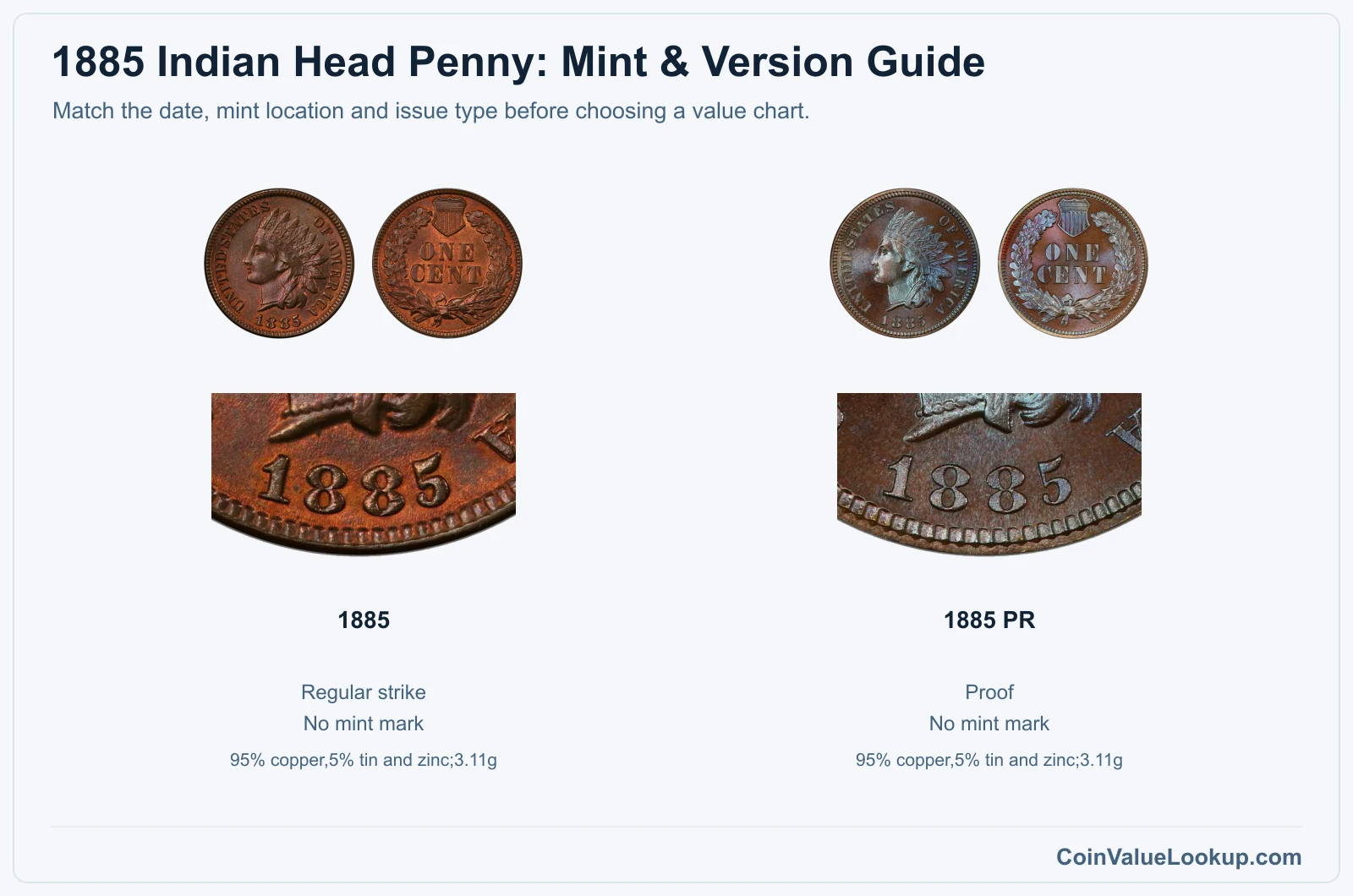
Every regular 1885 Indian Head cent was struck at the Philadelphia Mint. There is no mintmark on this coin, and the small "L" on the ribbon behind the neck is a designer's initial, not a mint identifier.
Do not confuse it with a mintmark.
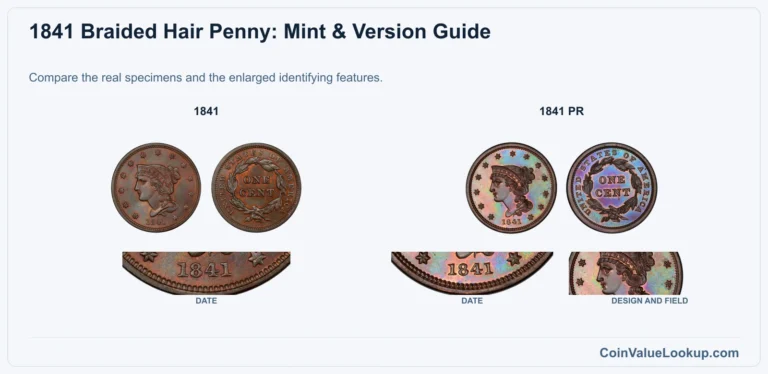
The obverse shows a portrait wearing a feathered headdress with "LIBERTY" spelled across the headband. The reverse features an oak wreath surrounding "ONE CENT" with a small shield at the top.
If your coin has wheat ears or a Lincoln portrait, you are looking at a different series entirely.
The two main branches for 1885 are the standard business strike and the proof. Proofs were specially manufactured with polished dies and planchets, producing mirror-like fields and sharp rims.
A business strike that someone has polished at home is not a proof. Proof status comes from how the coin was made, not how shiny it looks today.
Coin Value Lookup is a good starting point if you want to compare your 1885 cent against guides for other dates and denominations in the Indian Head series. You can look up values across many U.S. coin types in one place.
Step 2: Check Your 1885 Indian Head Penny Grade
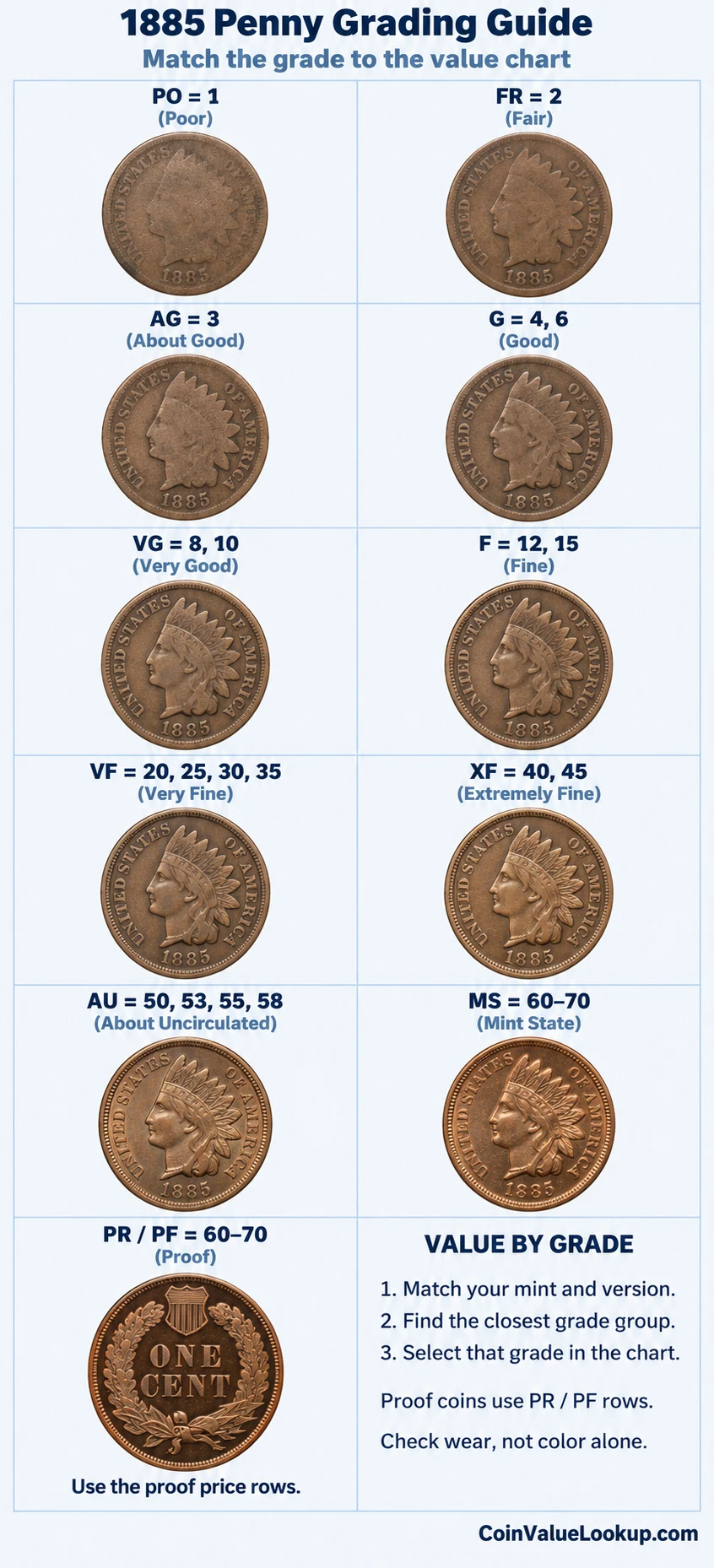
Start with the headband. On a well-worn coin, the word "LIBERTY" gradually disappears, starting with the outer letters.
A G4 coin will show a readable date and basic portrait outline, but most headband detail is gone. By contrast, an MS63 coin retains full design sharpness with original mint luster and only minor contact marks.
Don't rely on a single letter of "LIBERTY" to assign a grade. Some 1885 cents were softly struck at the feathers, hair curls, or headband diamonds, and that softness is a manufacturing trait, not wear.
Look at the high points of the cheek and hair above the ear for actual friction.
On the reverse, check the wreath tips and shield detail. Wear shows first on the highest leaf clusters.
Use the comparison image to match your coin's overall sharpness.
Bronze color designations like BN (brown), RB (red-brown), and RD (red) describe how much original copper color remains. They are not separate materials.
A coin with full original red surfaces commands a premium over a fully toned brown example at the same technical grade. Cleaning, corrosion, or artificial recoloring all hurt a coin's desirability regardless of the remaining detail.
Step 3: Check 1885 Indian Head Penny Value by Mint and Version
1885 Indian Head Penny
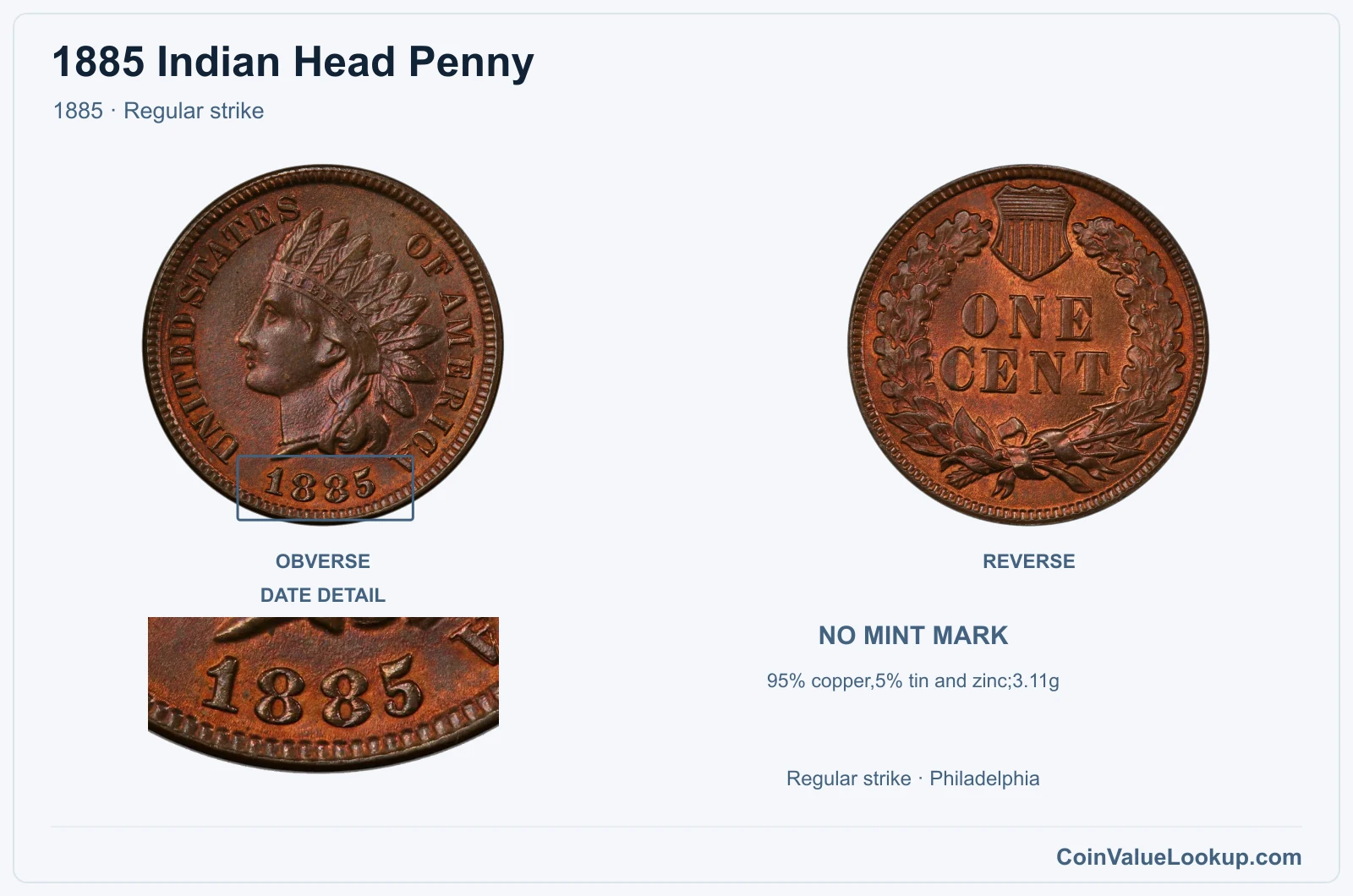
The 1885 business strike is the coin most people will encounter. Struck at Philadelphia with no mintmark, it is composed of 95% copper with 5% tin and zinc, weighing 3.11 grams.
Guide estimates place this version at roughly $15 in G4 and around $249 in MS63.
Condition drives the spread here. A brown, heavily circulated piece is affordable and common enough for any collection.
An uncirculated coin with original surfaces and strong luster is a different animal entirely. Compare your coin to known grade examples before assuming a high value, and keep in mind that cleaned or damaged coins trade well below guide figures for problem-free pieces.
| Range | Grade | Price | Auction Records | Appraisal |
|---|---|---|---|---|
| PO | PO 1 | — | Coin Identifier | |
| FR | FR 2 | — | Coin Identifier | |
| AG | AG 3 | — | Coin Identifier | |
| G | G 4 | — | Coin Identifier | |
| G 6 | — | Coin Identifier | ||
| VG | VG 8 | Coin Identifier | ||
| VG 10 | — | Coin Identifier | ||
| F | F 12 | — | Coin Identifier | |
| F 15 | — | Coin Identifier | ||
| VF | VF 20 | Coin Identifier | ||
| VF 25 | — | Coin Identifier | ||
| VF 30 | Coin Identifier | |||
| VF 35 | Coin Identifier | |||
| XF | XF 40 | — | Coin Identifier | |
| XF 45 | Coin Identifier | |||
| AU | AU 50 | Coin Identifier | ||
| AU 53 | Coin Identifier | |||
| AU 55 | Coin Identifier | |||
| AU 58 | Coin Identifier | |||
| MS | MS 60 | — | Coin Identifier | |
| MS 61 | — | Coin Identifier | ||
| MS 62 | Coin Identifier | |||
| MS 63 | Coin Identifier | |||
| MS 64 | Coin Identifier | |||
| MS 65 | Coin Identifier | |||
| MS 66 | Coin Identifier | |||
| MS 67 | — | — | — | |
| MS 68 | — | — | — | |
| MS 69 | — | — | — | |
| MS 70 | — | — | — |
1885 Indian Head Penny — PR
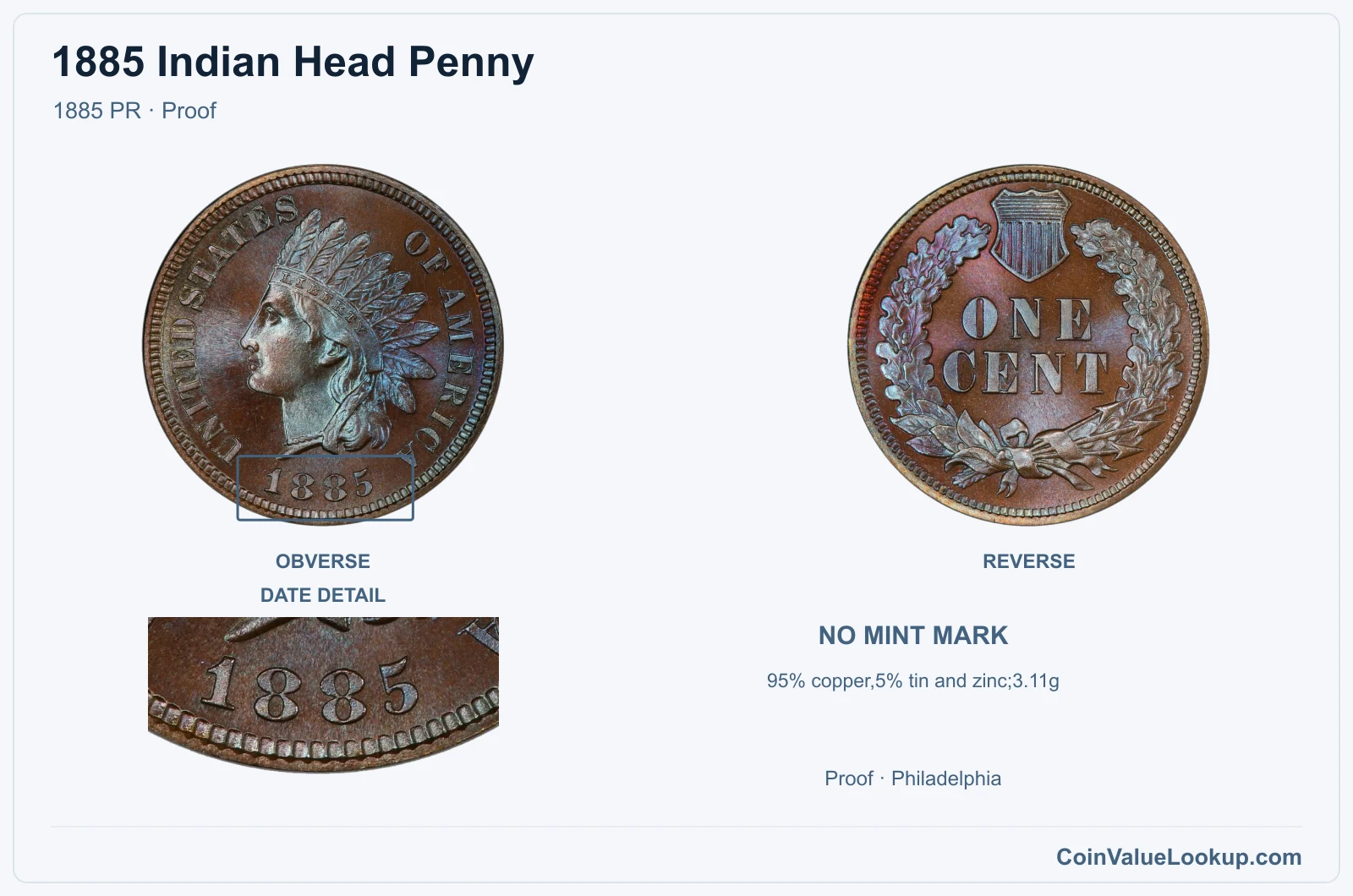
The 1885 proof was a special striking made for collectors at the Philadelphia Mint, using the same bronze composition and design as the business strike. A PR63 example carries a guide estimate of about $313.
Identifying a genuine proof requires more than a shiny surface. Look for squared, well-defined rims, deeply mirrored fields, and exceptionally sharp design details that result from multiple strikes with polished dies.
The overall look is distinctly different from a business strike, even a lustrous uncirculated one. A coin that has simply been polished or dipped will lack the sharp rim geometry and consistent field reflectivity of a true proof.
If you are unsure, professional authentication is the safest path before assigning proof status.
| Range | Grade | Price | Auction Records | Appraisal |
|---|---|---|---|---|
| PR | PR 1 | — | Coin Identifier | |
| PR 2 | — | Coin Identifier | ||
| PR 3 | — | Coin Identifier | ||
| PR 4 | — | Coin Identifier | ||
| PR 6 | — | Coin Identifier | ||
| PR 8 | — | Coin Identifier | ||
| PR 10 | — | Coin Identifier | ||
| PR 12 | — | Coin Identifier | ||
| PR 15 | — | Coin Identifier | ||
| PR 20 | — | Coin Identifier | ||
| PR 25 | — | Coin Identifier | ||
| PR 30 | — | Coin Identifier | ||
| PR 35 | — | Coin Identifier | ||
| PR 40 | — | Coin Identifier | ||
| PR 45 | — | Coin Identifier | ||
| PR 50 | — | Coin Identifier | ||
| PR 53 | — | Coin Identifier | ||
| PR 55 | — | Coin Identifier | ||
| PR 58 | — | Coin Identifier | ||
| PR 60 | — | Coin Identifier | ||
| PR 61 | — | Coin Identifier | ||
| PR 62 | Coin Identifier | |||
| PR 63 | Coin Identifier | |||
| PR 64 | Coin Identifier | |||
| PR 65 | Coin Identifier | |||
| PR 66 | Coin Identifier | |||
| PR 67 | Coin Identifier | |||
| PR 68 | — | — | — | |
| PR 69 | — | — | — | |
| PR 70 | — | — | — |
1885 Indian Head Penny Error List
1. 1885 Indian Head Penny — Die Break / Cud
A cud on an 1885 Indian Head cent appears as a raised, featureless blob of metal connected to the rim. It forms when a chunk of the die breaks away completely, leaving nothing to stamp that portion of the design.
The result is a smooth raised area where part of the lettering, wreath, or portrait should be.
To confirm a cud, check that it connects to the rim and that the displaced design is genuinely missing, not just weak. A rim dent or corrosion spot can mimic the look, but dents are depressed into the coin rather than raised above the surface.
Interior die chips that do not reach the rim are related but classified differently.
No standard price range is adopted for this error. Value depends on the size and location of the cud, overall coin condition, and professional authentication of the variety.
2. 1885 Indian Head Penny — Doubled Die Reverse
A doubled die reverse on the 1885 cent shows secondary design impressions on the back of the coin. This happens during die production, not during striking, so the doubling is consistent from coin to coin struck by that die.
Compare the reverse lettering of "ONE CENT" and the wreath details against a normal example, looking for offset or thickened elements.
The key distinction is separating true die doubling from machine doubling. Machine doubling produces flat, shelf-like distortion and is far less collectible.
Random scratches or optical reflections can also fool you under magnification. Use a loupe and compare multiple reference points on the reverse.
No standard price range is adopted. Each doubled die reverse must be evaluated individually based on the strength of the doubling, the coin's grade, and whether the variety has been authenticated by a grading service.
3. 1885 Indian Head Penny — Misplaced Date
A misplaced date variety on an 1885 Indian Head cent shows partial remnants of date digits in an unexpected location, typically embedded within the denticles near the rim or close to the portrait base, away from the final correctly placed date. The Mint punched the date into each working die by hand during this era, and an initial misaligned punch sometimes left faint traces that were not fully erased.
Look for the distinct curve or serif of a numeral in an area where no digit belongs. Die chips, random scratches, and small bumps can look similar at first glance but will not match the exact profile of a known numeral from the 1885 date.
No standard price range is adopted for this variety. Pricing depends on the clarity of the misplaced digit, overall coin condition, and third-party authentication.
4. 1885 Indian Head Penny — Repunched Date
A repunched date on the 1885 cent reveals traces of an earlier date-punch position alongside the final numerals. Because each die received its date by hand punching, minor positional adjustments left ghost images of digits slightly offset from the accepted placement.
You might see a shadow of the "8" or "5" shifted north, south, or to one side of its final location.
This is different from a doubled die, which involves the entire design hub, not just the date. It is also distinct from a damaged date, which shows post-strike distortion rather than die-stage remnants.
Machine doubling tends to produce flat, shelf-like distortion rather than the rounded secondary impressions of a repunch.
No adopted price range exists for this category. Value is assessed individually based on the prominence of the repunching, the coin's preservation, and professional variety attribution.
5. 1885 Indian Head Penny — Die Crack
Die cracks on the 1885 Indian Head cent appear as thin, raised lines running across the coin's surface. They form when a hardened steel die develops a fracture from repeated use, and that fracture transfers as a raised ridge onto every coin struck afterward.
A crack can cross open fields, cut through lettering, or trace along the portrait.
To confirm a die crack, verify the line is raised above the surface. An incuse scratch or a corrosion track sits below or level with the field.
Displaced-metal scrapes from contact with other coins will also lack the consistent, slightly rounded profile of a true die crack. Note where the crack begins and ends for identification purposes.
No standard price range is adopted. The collectibility of a particular die crack depends on its size, location, visual drama, and the coin's overall condition, assessed on a case-by-case basis.