1841 Braided Hair Cent Coin Value: How Much Is It Worth?
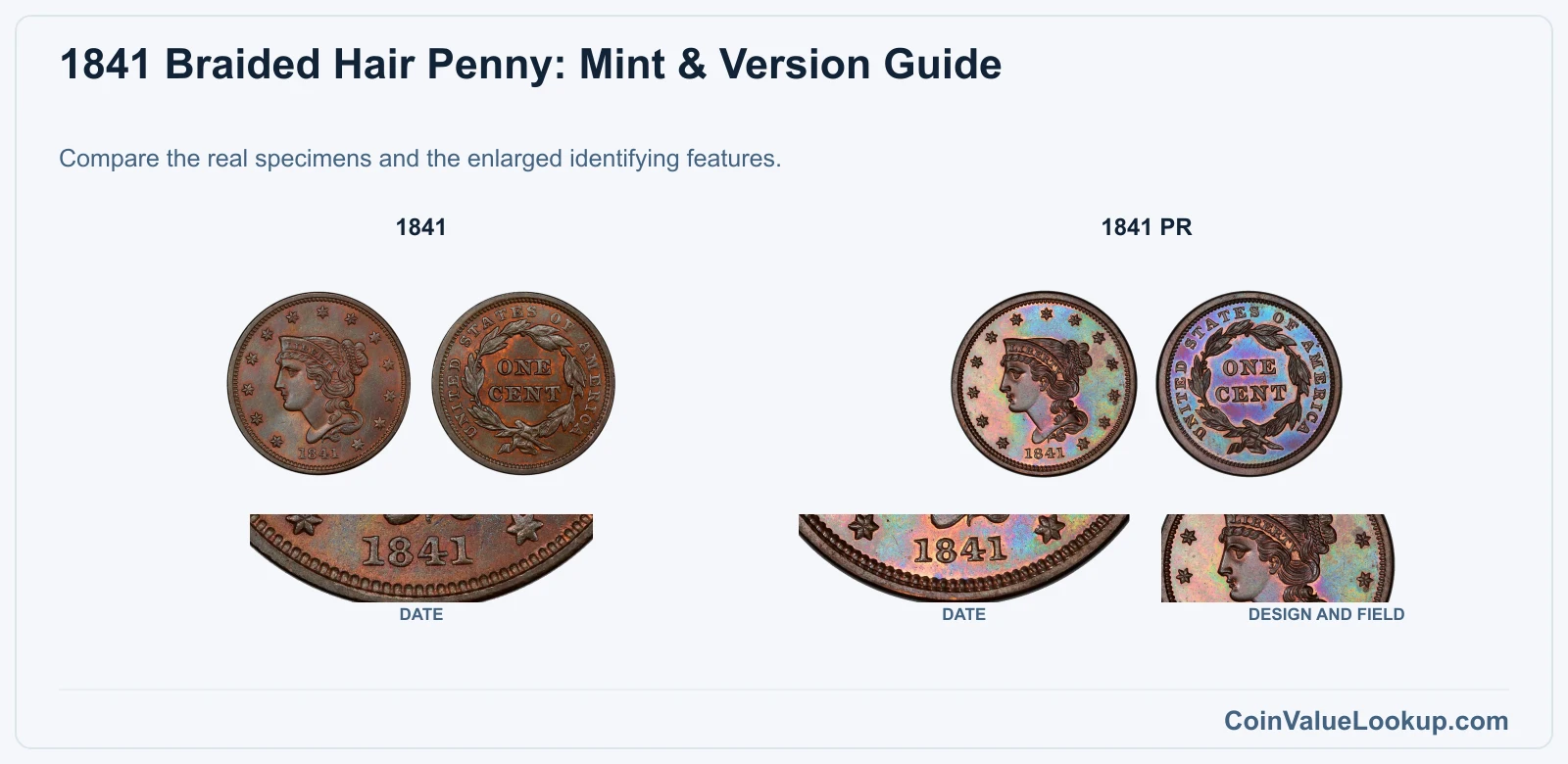
An 1841 Braided Hair Cent in well-worn condition can start around $38 at the G4 grade level, while an uncirculated example in MS63 may reach about $1,599 according to USA Coin Book guide estimates. These are guide anchors for the ordinary business strike, not guaranteed sale prices.
Rare proofs, restrikes, and major mint errors require separate evaluation beyond those figures.
Fast Way to Identify Your 1841 Braided Hair Cent
The fastest way to start figuring out what your 1841 cent is worth is to upload clear photos of the front and back. Our identifier can give you a preliminary read on which variety you have and its approximate condition.
Sharp, well-lit images showing the full coin, including the rim, help the most.
1841 Braided Hair Cent Value
Upload both sides of your 1841 Braided Hair Cent.
Front Obverse
Upload photo
Back Reverse
Upload photo
Which 1841 Braided Hair Cent Versions Are Worth Money?
- The ordinary 1841 business strike ranges from about $38 in G4 to $1,599 in MS63 per USA Coin Book, making higher-grade survivors the ones to watch.
- The 1841 Proof is a separately cataloged variety requiring authenticated die characteristics, not just shiny surfaces; no standard numeric price range is adopted, so each example needs individual assessment.
- Mint errors such as off-center strikes or die breaks on this date can carry added value, but pricing depends on the specific error, its severity, and authenticated condition.
Step 1: Identify Your 1841 Braided Hair Cent Mint Mark and Version
The 1841 Braided Hair Cent was struck only at the Philadelphia Mint, so there is no mintmark to look for. Every genuine example should show Liberty facing left with braided hair tied in a bun on the obverse and a wreath surrounding the denomination on the reverse.
Start by matching the portrait style and wreath to the Braided Hair series specifically. Earlier Large Cent designs, like the Classic Head or Coronet, have noticeably different hair and portrait treatments.
If the face and wreath match, you are in the right family.
Next, determine whether your coin is an ordinary business strike or a proof. Proofs have mirror-like fields, sharp rims, and precise die characteristics that a polished circulation strike will not replicate.
Rubbing a business strike with a cloth does not create a proof.
Weight can help confirm the denomination. A genuine example should be close to 10.89 grams in copper, but wear, corrosion, and original production tolerances mean weight alone cannot prove authenticity.
Use it as supporting evidence alongside visual inspection.
Step 2: Check Your 1841 Braided Hair Cent Grade
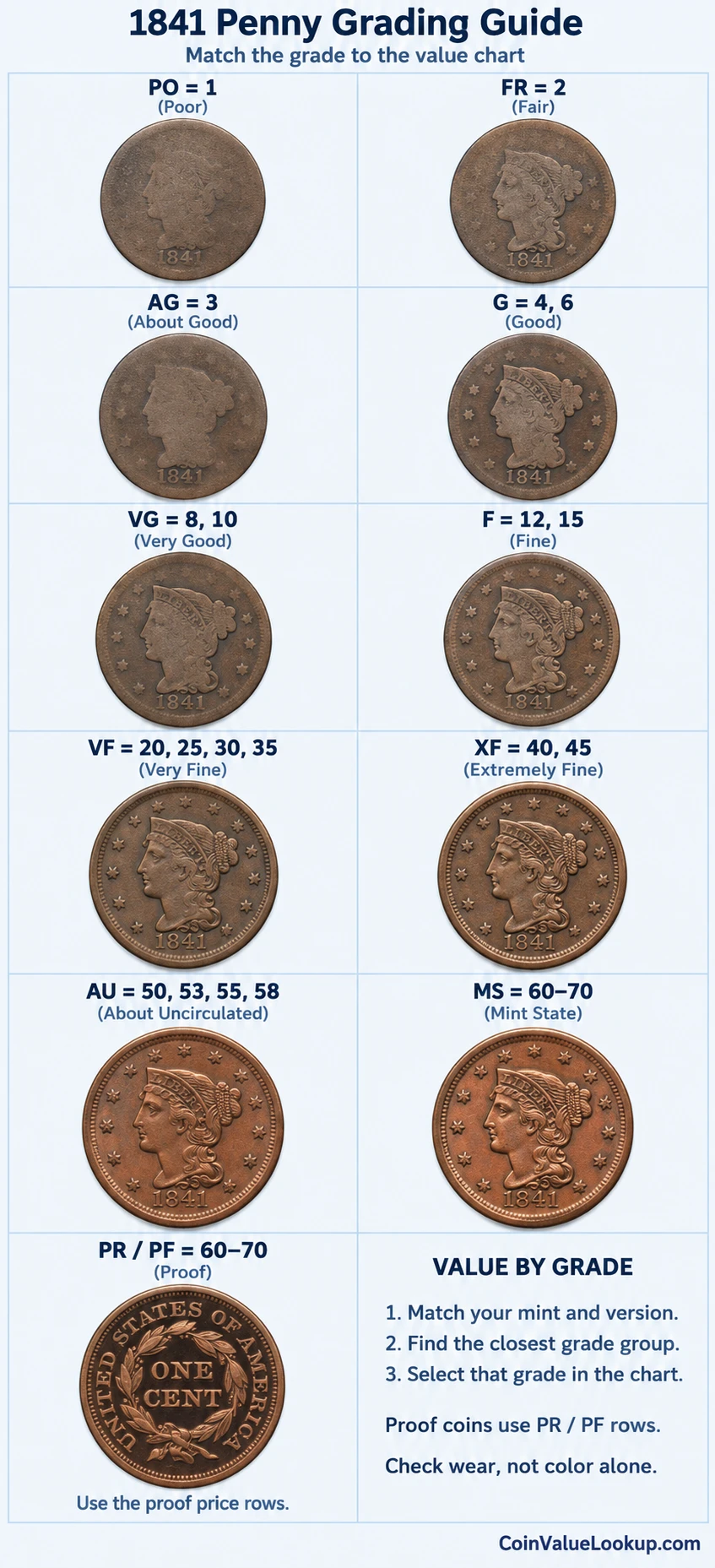
Focus on Liberty's hair detail, especially the braid above the ear and the individual strands near the forehead. On a well-worn coin these merge into flat areas, while on a higher-grade piece they remain distinct and raised.
Check the cheek for smoothing. Even light circulation softens the high point of Liberty's cheek before other areas show wear.
On the reverse, examine the wreath leaves for full separation and vein detail.
Use the comparison image to match your coin's detail level against known grade benchmarks for this type. A coin grading G4 will show a clear outline of Liberty with most legend readable, while an MS63 should have full original detail with only minor contact marks.
Don't confuse a weak strike with heavy wear. Some 1841 cents left the press with softer detail in spots, which is a manufacturing trait, not circulation damage.
Corrosion, porosity, and cleaning can also mimic wear but reduce market value more than honest circulation does.
On copper coins you will see color descriptions like BN (brown), RB (red-brown), and RD (red). These describe the remaining original copper color, not different metals.
Most survivors are BN; significant original red is scarce and commands a premium at mint-state levels.
Step 3: Check 1841 Braided Hair Cent Value by Mint and Version
1841 Braided Hair Cent
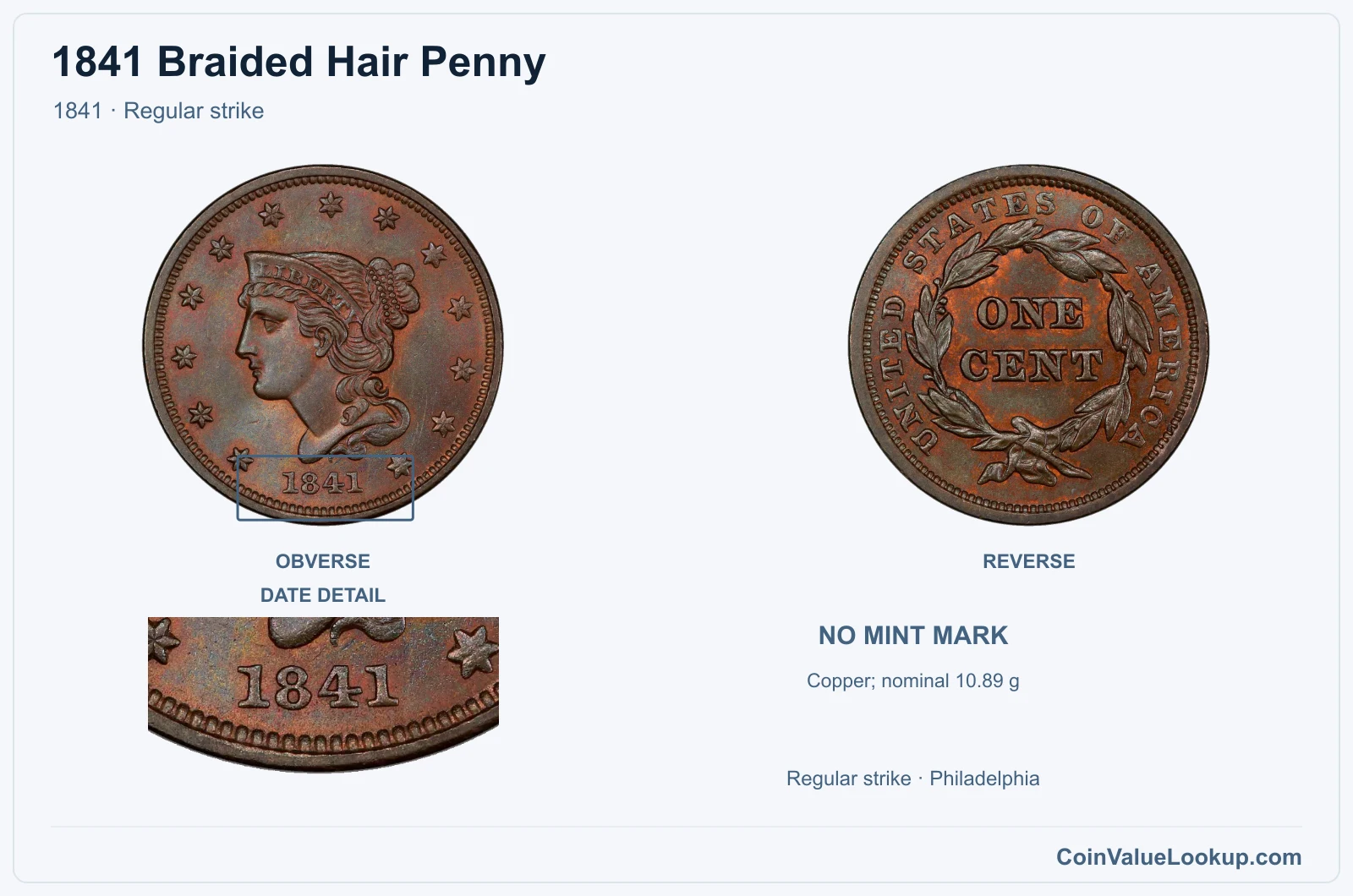
This is the standard 1841 Braided Hair Cent struck for circulation at the Philadelphia Mint, with no mintmark. It is a copper coin weighing nominally 10.89 grams.
The obverse shows Liberty with braided hair, and the reverse carries a wreath with the denomination.
USA Coin Book guide estimates place this coin at roughly $38 in G4 and up to about $1,599 in MS63. Most survivors fall somewhere in the well-circulated range, so a piece with strong detail and original surfaces stands out.
Match the portrait and wreath carefully to this series before assuming value; earlier Large Cent types look similar at a glance but belong to different price structures.
| Range | Grade | Price | Auction Records | Appraisal |
|---|---|---|---|---|
| PO | PO 1 | — | Coin Identifier | |
| FR | FR 2 | — | Coin Identifier | |
| AG | AG 3 | — | Coin Identifier | |
| G | G 4 | — | Coin Identifier | |
| G 6 | — | Coin Identifier | ||
| VG | VG 8 | Coin Identifier | ||
| VG 10 | Coin Identifier | |||
| F | F 12 | Coin Identifier | ||
| F 15 | — | Coin Identifier | ||
| VF | VF 20 | Coin Identifier | ||
| VF 25 | Coin Identifier | |||
| VF 30 | Coin Identifier | |||
| VF 35 | Coin Identifier | |||
| XF | XF 40 | Coin Identifier | ||
| XF 45 | Coin Identifier | |||
| AU | AU 50 | Coin Identifier | ||
| AU 53 | Coin Identifier | |||
| AU 55 | Coin Identifier | |||
| AU 58 | Coin Identifier | |||
| MS | MS 60 | — | Coin Identifier | |
| MS 61 | Coin Identifier | |||
| MS 62 | Coin Identifier | |||
| MS 63 | Coin Identifier | |||
| MS 64 | Coin Identifier | |||
| MS 65 | Coin Identifier | |||
| MS 66 | Coin Identifier | |||
| MS 67 | — | — | — | |
| MS 68 | — | — | — | |
| MS 69 | — | — | — | |
| MS 70 | — | — | — |
1841 Braided Hair Cent — PR
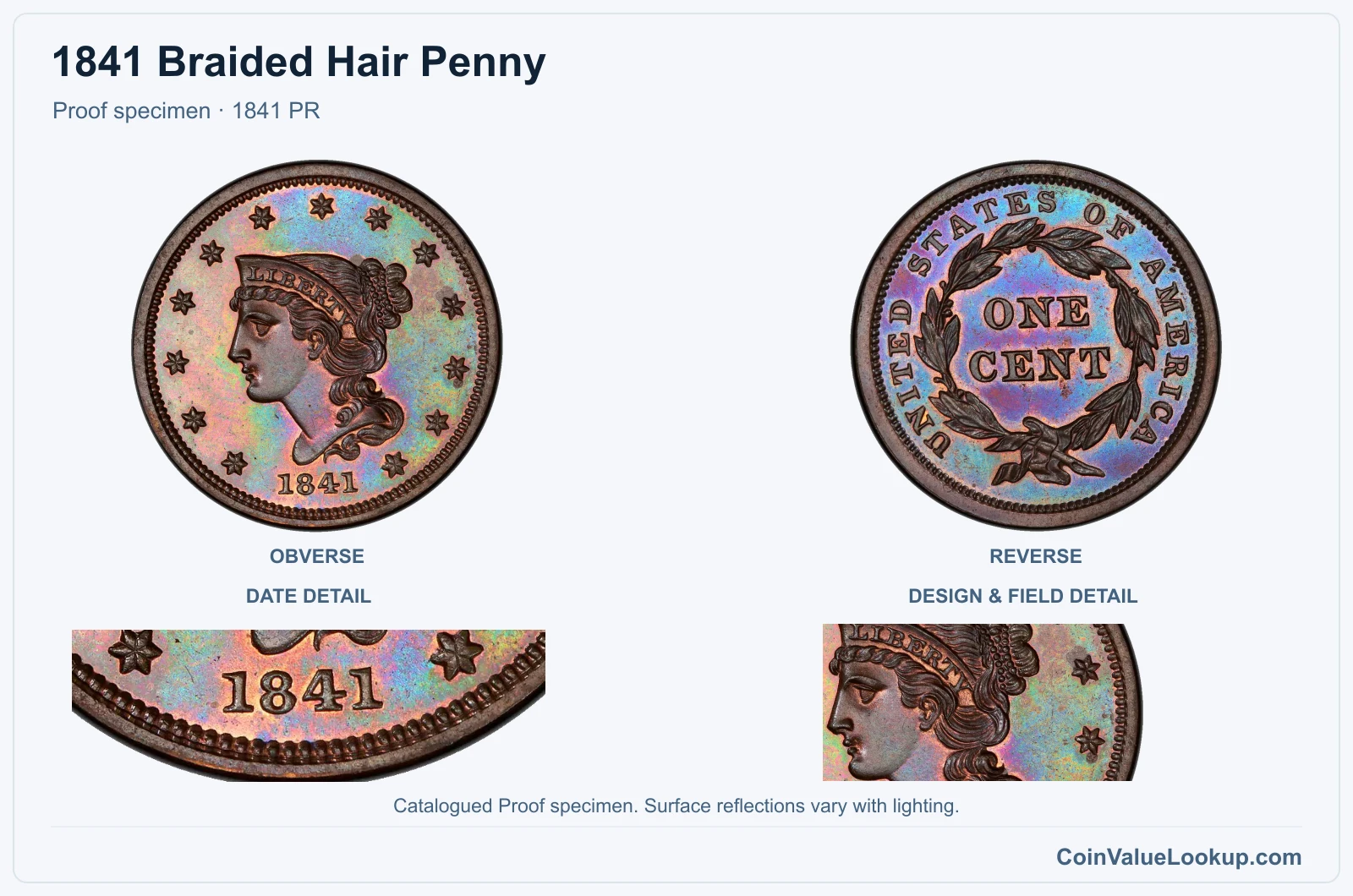
The 1841 Proof Braided Hair Cent is a separate manufacturing category, not simply a high-grade business strike. Genuine proofs were produced on specially prepared planchets and struck with polished dies, producing mirror-like fields and crisp rims that differ from even the finest circulation pieces.
Attributing a coin as a proof requires examining die characteristics, surface quality, and rim sharpness. Polishing or cleaning an ordinary cent does not transform it into a proof, and many supposed proofs on the market are simply nice business strikes.
No standard numeric price range is adopted for this variety, so each coin needs individual assessment based on its authenticated identity, condition, and surface preservation.
Coin Value Lookup is a good starting point if you want to compare your coin against other Braided Hair Cent dates and varieties. You can look up guides for the full series to understand where the 1841 fits relative to its neighbors.
| Range | Grade | Price | Auction Records | Appraisal |
|---|---|---|---|---|
| PR | PR 1 | — | Coin Identifier | |
| PR 2 | — | Coin Identifier | ||
| PR 3 | — | Coin Identifier | ||
| PR 4 | — | Coin Identifier | ||
| PR 6 | — | Coin Identifier | ||
| PR 8 | — | Coin Identifier | ||
| PR 10 | — | Coin Identifier | ||
| PR 12 | — | Coin Identifier | ||
| PR 15 | — | Coin Identifier | ||
| PR 20 | — | Coin Identifier | ||
| PR 25 | — | Coin Identifier | ||
| PR 30 | — | Coin Identifier | ||
| PR 35 | — | Coin Identifier | ||
| PR 40 | — | Coin Identifier | ||
| PR 45 | — | Coin Identifier | ||
| PR 50 | — | Coin Identifier | ||
| PR 53 | — | Coin Identifier | ||
| PR 55 | — | Coin Identifier | ||
| PR 58 | — | Coin Identifier | ||
| PR 60 | — | Coin Identifier | ||
| PR 61 | — | Coin Identifier | ||
| PR 62 | Coin Identifier | |||
| PR 63 | — | Coin Identifier | ||
| PR 64 | Coin Identifier | |||
| PR 65 | Coin Identifier | |||
| PR 66 | Coin Identifier | |||
| PR 67 | — | — | — | |
| PR 68 | — | — | — | |
| PR 69 | — | — | — | |
| PR 70 | — | — | — |
1841 Braided Hair Cent Error List
1. 1841 Braided Hair Cent — Off-Center Strike
An off-center strike happens when the planchet is not seated properly between the dies, leaving part of the design missing and a blank crescent on one side. On an 1841 Braided Hair Cent, you want the date to remain fully visible for the error to carry meaningful collector interest.
Look for the displaced design with a clear unstruck area. The shift should be consistent across the entire affected side.
If the coin simply has a clipped edge, a one-sided die misalignment, or post-mint flattening from damage, that is a different situation entirely.
No standard numeric price range is adopted for this error on the 1841 date. Value depends on the percentage of off-center shift, date visibility, and the coin's overall authenticated condition.
2. 1841 Braided Hair Cent — Lamination / Split Planchet
A lamination or split planchet error shows peeling metal, a retained flap, or a visible layer separating within the copper. On an 1841 cent, photograph the edge alongside the affected face to document the separation clearly.
This error occurs during the planchet preparation process and results in genuine internal separation. It differs from surface scraping, corrosion pitting, or a coin that has been deliberately cut or filed after leaving the mint.
Corrosion especially can mimic a lamination on old copper, so look for clean internal metal at the separation point.
No standard numeric price is adopted for lamination errors on this date. Each example requires individual evaluation based on the size and location of the flaw, whether it affects major design elements, and its authenticated condition.
3. 1841 Braided Hair Cent — Die Crack
Die cracks appear as thin raised lines crossing the coin's surface. They transfer from fractures in the steel die onto the struck coin.
On an 1841 Braided Hair Cent, look for lines that cut across the fields or devices and follow a path that would make sense as a crack propagating through a rigid die.
A raised line is the key distinction. Scratches from contact or tools are incuse, meaning they dip below the surface.
Corrosion trails can meander but lack the sharp, linear character of a genuine die crack. Photograph the full coin and a closeup tracing the crack.
No numeric price range is adopted for die crack errors on the 1841 date. Larger, more dramatic cracks generally draw more collector interest, but each coin needs individual assessment.
4. 1841 Braided Hair Cent — Die Break / Cud
A cud is a specific type of die break where a piece of the die breaks away at the rim, leaving a raised blob of metal that connects to the coin's edge. Smaller interior die breaks also create raised lumps but do not touch the rim.
On an 1841 cent, look for a featureless raised area at the rim that displaces part of the normal design. Show the boundary where normal detail transitions into the raised blank area.
A rim dent from post-mint damage pushes metal inward, which is the opposite direction. Corrosion bumps lack the sharp boundary of a true cud.
No numeric price range is adopted here. Cuds on early copper are appreciated by error collectors, but value depends on size, location, and authenticated condition of the specific coin.
5. 1841 Braided Hair Cent — Double / Multiple Strike
A double or multiple strike occurs when a coin receives two or more separate impressions from the dies. The result is visibly displaced or rotated design elements, often with parts of the design appearing twice in slightly different positions.
Do not confuse this with a doubled die, which is a different error category involving a misaligned die hub during die production. Doubled dies show consistent doubling on every coin struck from that die, while a double strike is unique to the individual coin.
Also watch for post-mint impressions from vises or other damage that can mimic a second strike.
No numeric price is adopted for double strikes on the 1841 Braided Hair Cent. Assessment depends on how dramatic and clearly attributable the extra strike is, plus overall coin condition.
6. 1841 Braided Hair Cent — Misaligned Die
A misaligned die shifts one face of the coin off-center relative to the opposite face or the blank, but unlike a full off-center strike, the design may still be mostly within the coin's border. Compare both sides carefully: one side may appear centered while the other shows uneven rim width.
This is distinct from a rotated die, where the alignment angle between obverse and reverse is wrong, and from a true off-center strike, where the planchet itself was mispositioned. Post-mint rim damage or a tilted photograph can also create the illusion of misalignment, so examine the coin in hand.
No numeric price range is adopted for misaligned die errors on the 1841 date. The degree of displacement, whether it affects design elements, and the coin's authenticated condition all factor into individual value.