1857 Liberty Seated Dime Coin Value: How Much Is It Worth?
The 1857 Liberty Seated Dime spans roughly $23 at G4 to about $933 at MS63 across its normal business-strike issues, based on USA Coin Book guide estimates. Philadelphia Proofs occupy a separate, much higher bracket.
Only Philadelphia and New Orleans struck dimes this year — no San Francisco issue exists for 1857. Condition and correct branch identification drive real-world value more than a polished look ever will.
Fast Way to Identify Your 1857 Liberty Seated Dime
Want a quick read on what you have? Upload clear photos of both the front and back of your 1857 dime.
Our identifier can offer a preliminary take on the mint, design type, and general condition from your images. It is not a substitute for professional grading or authentication, but it gives you a solid starting point before digging deeper.
1857 Liberty Seated Dime Value
Upload both sides of your 1857 Liberty Seated Dime.
Front Obverse
Upload photo
Back Reverse
Upload photo
Which 1857 Liberty Seated Dime Versions Are Worth Money?
- Philadelphia business strikes range from about $23 at G4 to $670 at MS63 per USA Coin Book; higher-grade uncirculated examples carry the real premium.
- New Orleans (O mintmark) business strikes guide slightly higher, from roughly $26 at G4 up to $933 at MS63, reflecting lower survival rates in top condition.
- Philadelphia Proofs are rare early-date issues, with a PR63 guide value around $3,637 according to PCGS — well above any normal business strike.
- A repunched date variety exists for 1857 and can add collector interest when the remnants of the earlier punch position are clearly visible.
- Off-center strikes with the date still readable are scarce mint errors that draw specialist attention beyond typical type-coin pricing.
Step 1: Identify Your 1857 Liberty Seated Dime Mint Mark and Version
Start with the obverse: a seated Liberty figure facing left, surrounded by stars, with drapery flowing from her elbow. The reverse reads ONE DIME inside a small wreath.
If the coin says HALF DIME, set it aside — different denomination entirely.
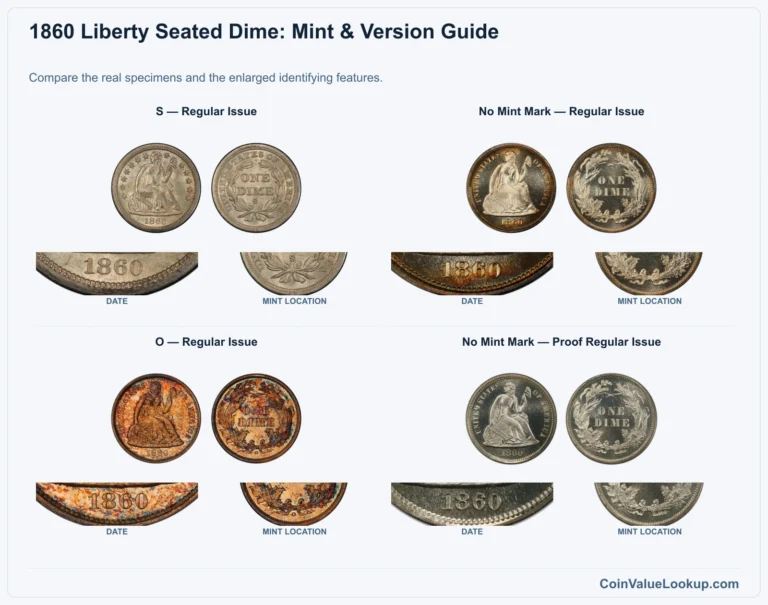
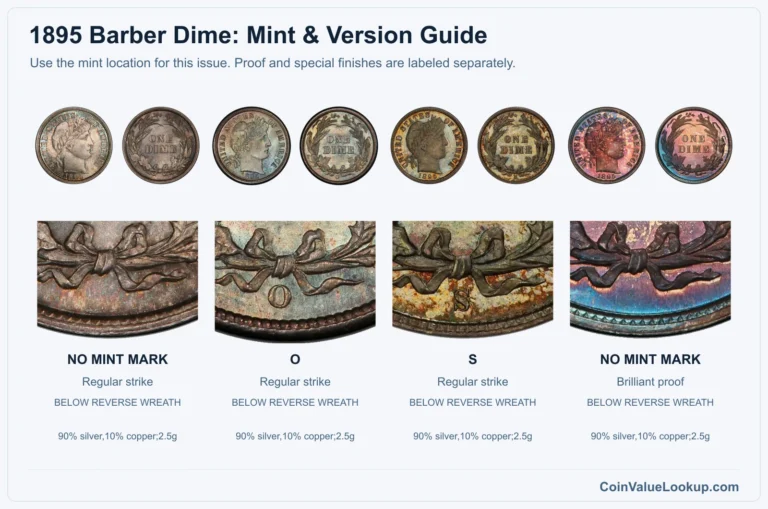
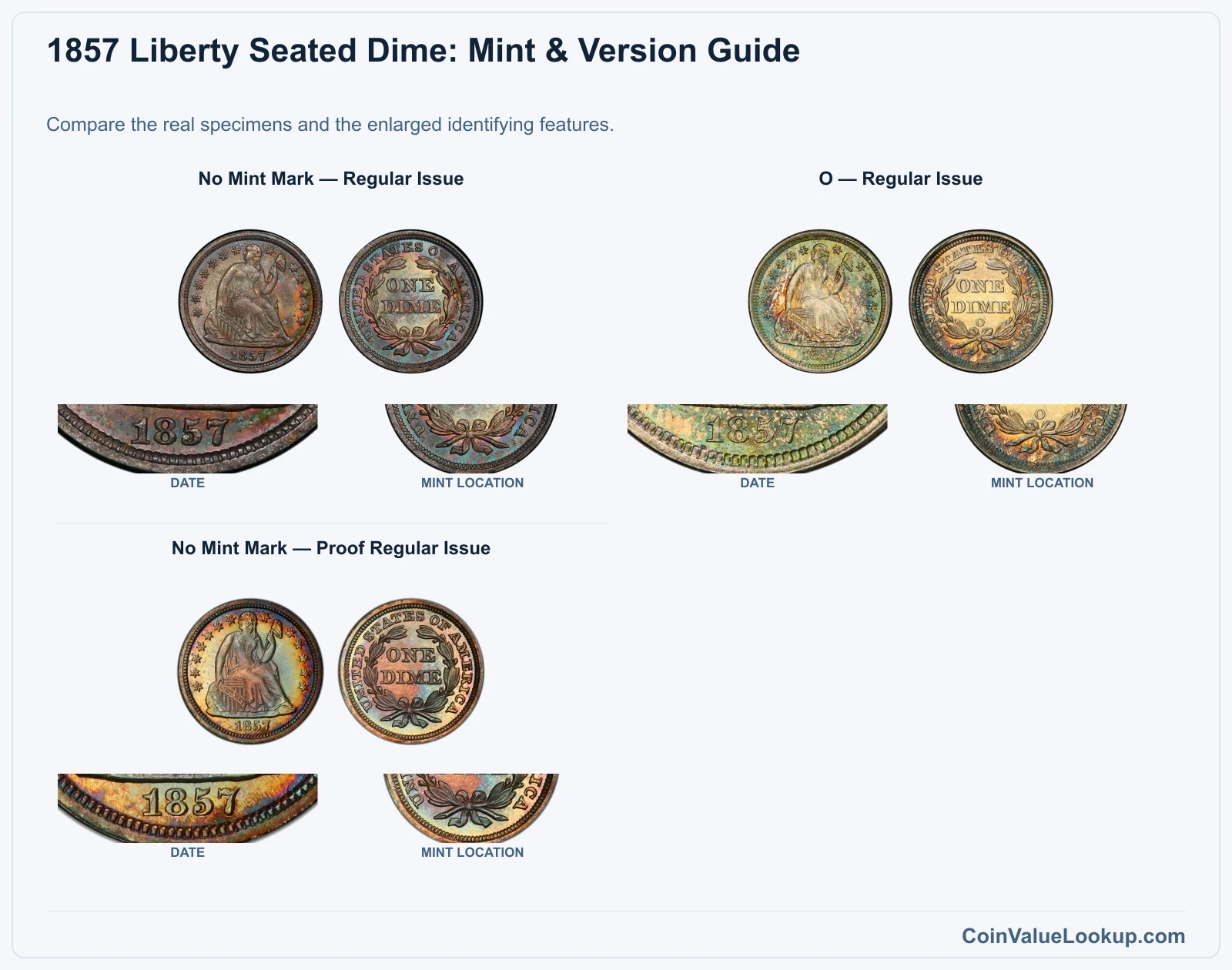
Flip to the reverse and look below the wreath for a mintmark. An "O" means New Orleans.
No letter means Philadelphia. That is the only fork for 1857 business strikes.
The coin should weigh about 2.49 grams, measure 17.9 mm across, and have a reeded edge. Composition is 90% silver and 10% copper.
Arrows beside the date are absent on this year; the reduced-weight standard adopted a few years earlier was already in effect without them.
You may encounter references to a supposed 1857-O doubled die obverse. Specialist sources attribute that appearance to strike doubling — a mechanical effect during minting — rather than a genuine doubled die.
So do not pay a doubled-die premium for that variety without expert confirmation.
Step 2: Check Your 1857 Liberty Seated Dime Grade
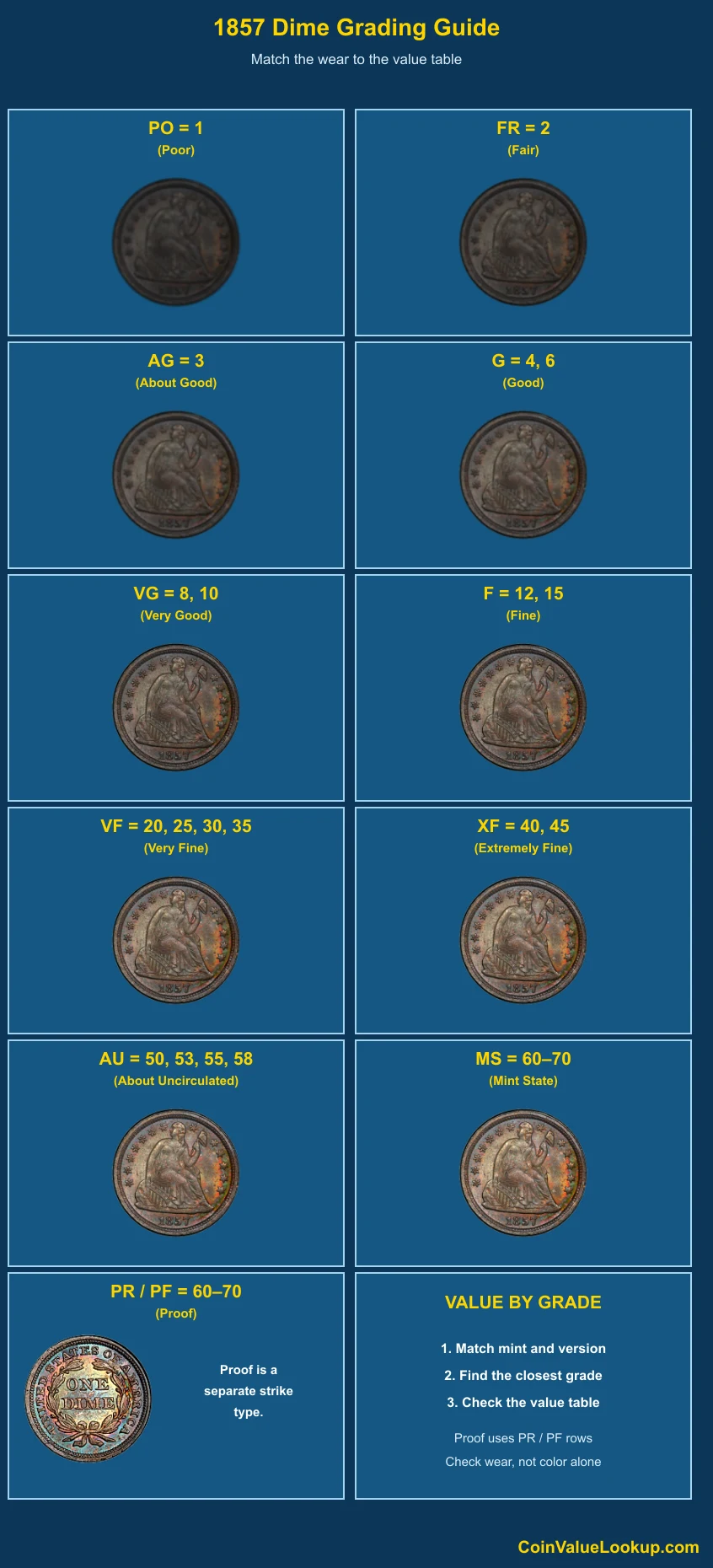
When grading an 1857 Seated dime, focus on Liberty's head, the shield on her lap, the gown folds across her knee, and her feet. These are the first high points to lose detail from circulation wear.
On the reverse, check the wreath leaves nearest the bow at the base.
Compare your coin side-by-side with the grading image for this specific subtype (Stars, With Drapery). A G4 coin will show Liberty's outline and a readable date but most interior detail is gone.
By MS63, full luster and sharp details remain, with only minor contact marks.
Do not confuse original strike weakness with wear. Some 1857 dimes left the press with soft spots — particularly on the head or feet — because the dies were already tired.
Look at surrounding areas for luster: if the metal still has a frosty or satiny sheen around a flat spot, that is likely strike softness, not rubbing.
Proof coins are a separate category. They show mirror-like fields from specially prepared dies and planchets.
A polished circulation coin is not a Proof, no matter how shiny someone made it. Hairlines from cleaning actually hurt a Proof's grade.
Step 3: Check 1857 Liberty Seated Dime Value by Mint and Version
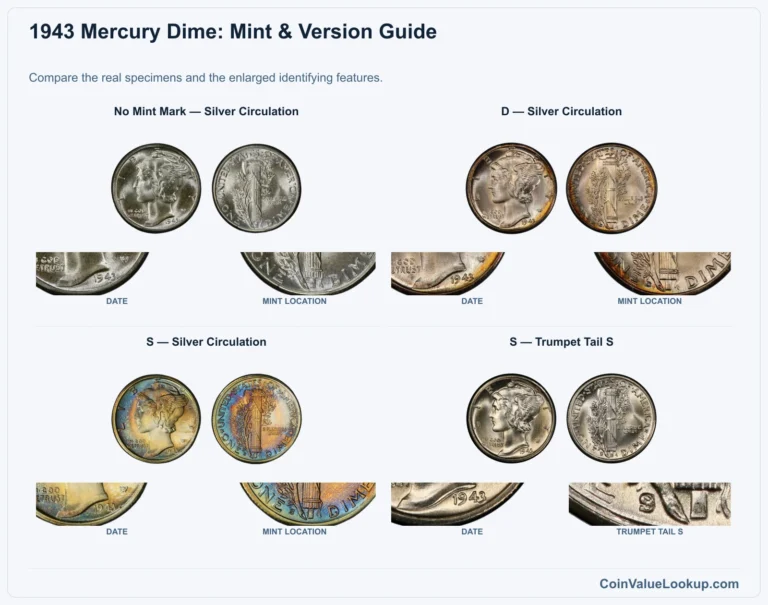
1857 Liberty Seated Dime — No Mint Mark — Regular Issue
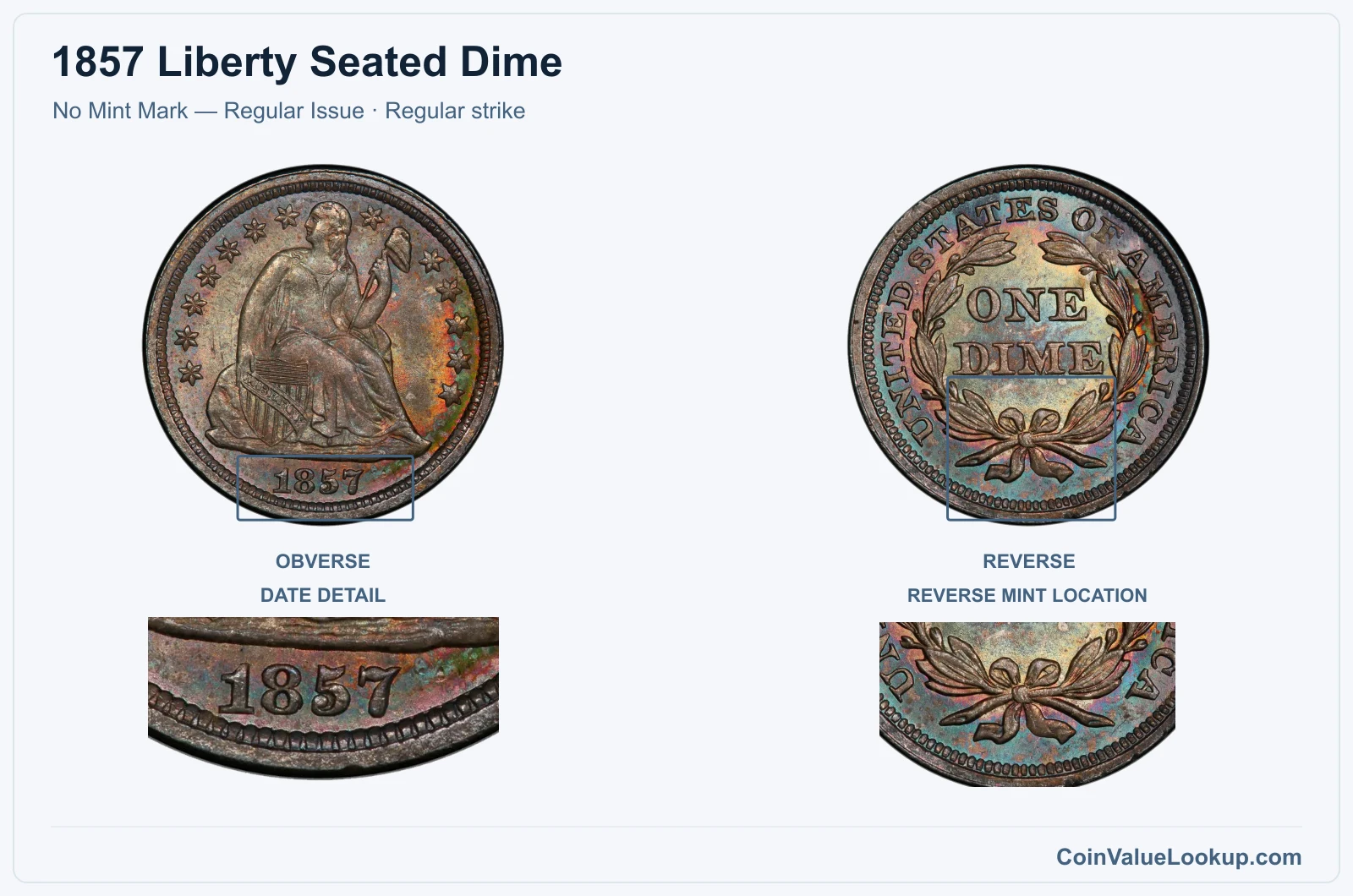
The Philadelphia issue carries no mintmark — look below the wreath on the reverse and you should see blank space. This is the Stars, With Drapery subtype on a 90% silver planchet weighing about 2.49 grams.
USA Coin Book estimates place this version at roughly $23 in G4 and around $670 in MS63. Most survivors sit in circulated grades, so an original, problem-free uncirculated example is where the real jump in value begins.
Confirm full drapery detail at Liberty's elbow and check for cleaning or tooling before assuming a high grade.
Range Grade
Price Auction Records Appraisal PO PO 1
—
Coin Identifier FR FR 2
—
Coin Identifier AG AG 3
—
Coin Identifier G G 4
—
Coin Identifier
G 6
—
Coin Identifier VG VG 8
—
Coin Identifier
VG 10
—
Coin Identifier F F 12
—
Coin Identifier
F 15
—
Coin Identifier VF VF 20
—
Coin Identifier
VF 25
—
Coin Identifier
VF 30
Coin Identifier
VF 35
—
Coin Identifier XF XF 40
Coin Identifier
XF 45
Coin Identifier AU AU 50
Coin Identifier
AU 53
Coin Identifier
AU 55
Coin Identifier
AU 58
Coin Identifier MS MS 60
Coin Identifier
MS 61
Coin Identifier
MS 62
Coin Identifier
MS 63
Coin Identifier
MS 64
Coin Identifier
MS 65
Coin Identifier
MS 66
Coin Identifier
MS 67
Coin Identifier
MS 68
—
—
—
MS 69
—
—
—
MS 70
—
—
—
1857 Liberty Seated Dime — O — Regular Issue
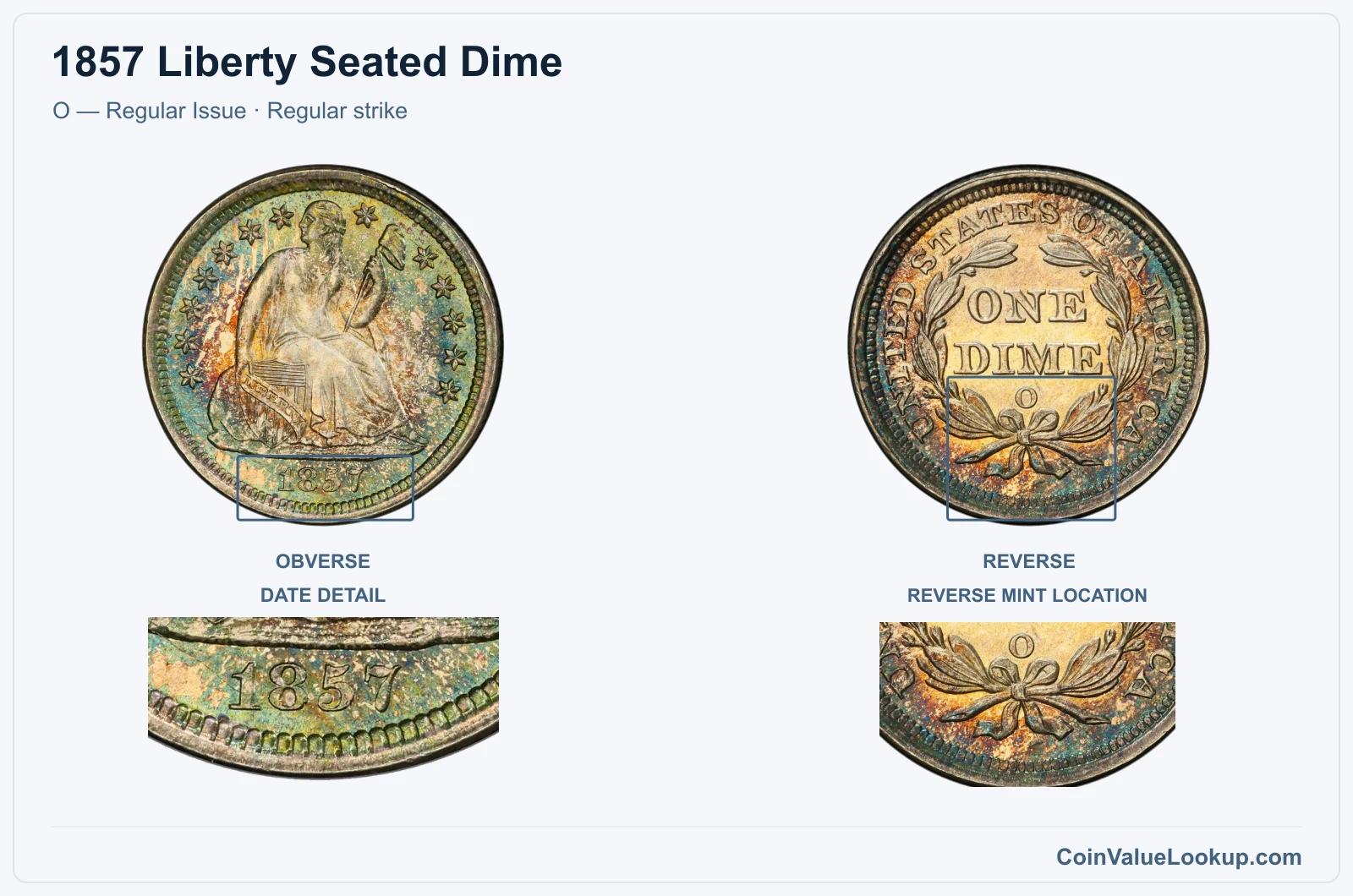
The New Orleans dime shows a small "O" mintmark below the wreath on the reverse. Same design, same 90% silver composition, same 2.49-gram target weight.
Guide values from USA Coin Book run about $26 at G4 up to approximately $933 at MS63 — a noticeable step above the Philadelphia issue in uncirculated condition. New Orleans coins often come with softer strikes, so do not mistake weak stars or a mushy head for heavy wear.
Check luster carefully before downgrading.
Coin Value Lookup is a handy place to compare guide values across different Liberty Seated Dime dates and mints whenever you want quick reference while sorting through a group.
Range Grade
Price Auction Records Appraisal PO PO 1
—
Coin Identifier FR FR 2
—
Coin Identifier AG AG 3
—
Coin Identifier G G 4
—
Coin Identifier
G 6
—
Coin Identifier VG VG 8
—
Coin Identifier
VG 10
—
Coin Identifier F F 12
—
Coin Identifier
F 15
—
Coin Identifier VF VF 20
—
Coin Identifier
VF 25
—
Coin Identifier
VF 30
Coin Identifier
VF 35
—
Coin Identifier XF XF 40
Coin Identifier
XF 45
Coin Identifier AU AU 50
Coin Identifier
AU 53
Coin Identifier
AU 55
Coin Identifier
AU 58
Coin Identifier MS MS 60
—
Coin Identifier
MS 61
Coin Identifier
MS 62
Coin Identifier
MS 63
Coin Identifier
MS 64
Coin Identifier
MS 65
Coin Identifier
MS 66
Coin Identifier
MS 67
Coin Identifier
MS 68
—
—
—
MS 69
—
—
—
MS 70
—
—
—
1857 Liberty Seated Dime — No Mint Mark — Proof Regular Issue
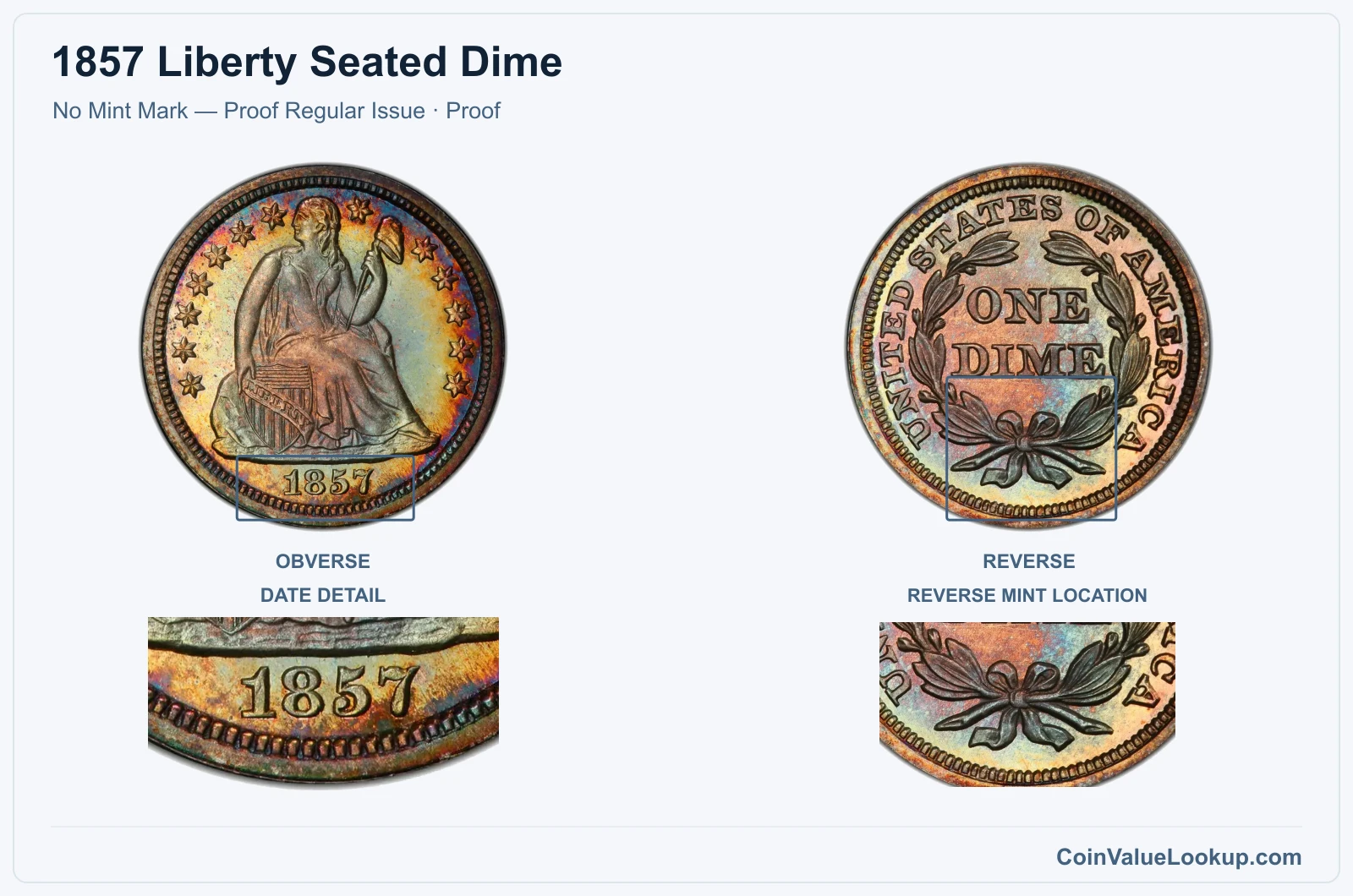
Philadelphia Proof dimes from 1857 are genuinely rare. These are not ordinary collector-set coins like later decades produced in quantity.
They were struck from polished dies on prepared planchets, yielding mirror-like fields.
A PCGS guide estimate puts PR63 at about $3,637. That single anchor gives you a sense of the tier, but actual sale prices depend heavily on eye appeal, hairlines, and any toning present.
Do not confuse a cleaned or polished business strike for a Proof. True Proofs show a distinctive reflective depth in the fields and squared-off, sharp rim details that circulation strikes lack.
Any 1857 dime you suspect might be a Proof deserves professional attribution before you assign this kind of value.
Range Grade
Price Auction Records Appraisal PR PR 1
—
Coin Identifier
PR 2
—
Coin Identifier
PR 3
—
Coin Identifier
PR 4
—
Coin Identifier
PR 6
—
Coin Identifier
PR 8
—
Coin Identifier
PR 10
—
Coin Identifier
PR 12
—
Coin Identifier
PR 15
—
Coin Identifier
PR 20
—
Coin Identifier
PR 25
—
Coin Identifier
PR 30
—
Coin Identifier
PR 35
—
Coin Identifier
PR 40
—
Coin Identifier
PR 45
—
Coin Identifier
PR 50
—
Coin Identifier
PR 53
—
Coin Identifier
PR 55
—
Coin Identifier
PR 58
—
Coin Identifier
PR 60
—
Coin Identifier
PR 61
—
Coin Identifier
PR 62
—
Coin Identifier
PR 63
Coin Identifier
PR 64
Coin Identifier
PR 65
Coin Identifier
PR 66
Coin Identifier
PR 67
Coin Identifier
PR 68
—
—
—
PR 69
—
—
—
PR 70
—
—
—
1857 Liberty Seated Dime Error List
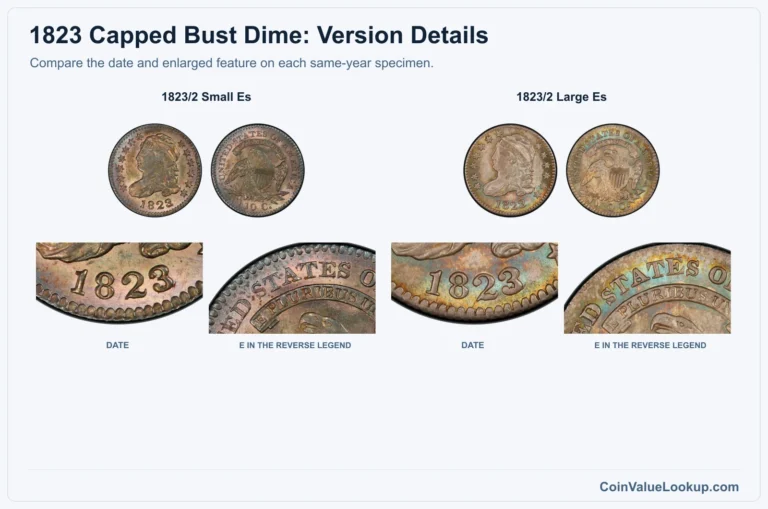
1. 1857 Liberty Seated Dime — Repunched Date
A repunched date on an 1857 dime shows traces of an earlier position of one or more date numerals alongside the final placement. Look closely at the bases and tops of the digits — you may see a ghost image slightly offset from the accepted position.
This happened when the date punch was applied more than once to the working die at slightly different angles or locations.
Do not confuse this with machine doubling, which produces a flat, shelf-like distortion across multiple design elements rather than isolated date-punch remnants. Damage or corrosion near the date can also mimic a repunched appearance, so inspect the surrounding fields for consistent surface quality.
No specific price premium is adopted here because the value depends on visibility of the repunching, the particular die marriage involved, and the coin's overall condition. A dramatic, clearly visible repunched date attracts more interest than a faint one.
2. 1857 Liberty Seated Dime — Die Crack / Die Chip
Die cracks appear as thin raised lines on the coin's surface, running from one design element toward another or toward the rim. Die chips show up as small raised blobs, usually in open field areas or inside letters.
Both result from fractures in the steel die during production.
A crack that reaches the rim and produces a raised, irregular lump is called a cud — those tend to draw more collector attention than a hairline interior crack. On the other hand, incuse scratches, surface corrosion, or debris stuck to the coin can look superficially similar but sit into the surface rather than above it.
Genuine die cracks are always raised.
No set price premium is adopted for die cracks on the 1857 dime. Value depends on the crack's size, location, and the coin's grade.
A bold cud on an otherwise attractive coin will command more than a faint interior line on a well-worn piece.
3. 1857 Liberty Seated Dime — Off-Center Strike
An off-center 1857 Seated dime has its entire design shifted away from the center of the planchet, leaving an unstruck crescent of blank metal on one side. A historical dealer catalog describes one example struck about 20% off center at roughly the 5 o'clock position — enough displacement to be visually dramatic while still preserving the date.
Date visibility matters enormously. An off-center dime with a readable 1857 is far more collectible than one where the date vanished into the unstruck area.
The more displacement, the more eye-catching — but only if the date survived.
Do not confuse this with a clipped planchet, which has a curved bite missing from a blank-cutting error, or with a misaligned die, where one side is shifted but both sides are fully struck. Post-mint damage like flattening or bending can also create an uneven appearance.
No specific price is adopted because the coin's value depends on the degree of displacement, date completeness, and overall condition.