1864 Liberty Seated Dime Coin Value: How Much Is It Worth?
The 1864 Liberty Seated Dime is a Civil War-era silver coin that draws attention from collectors for its low mintages and genuine scarcity. Guide estimates for the two business-strike issues range from about $158 at G4 to $3,637 at MS63, depending on mint and condition.
Philadelphia Proofs occupy their own price tier. Identifying your exact version is the first step toward understanding what you have.
Fast Way to Identify Your 1864 Liberty Seated Dime
The quickest way to start is to upload clear photos of both the front and back of your coin. A well-lit image lets us provide a preliminary identification of the mint, design type, and general condition.
Snap one photo of each side, keeping the coin flat and in focus, and you will have a useful starting point.
1864 Liberty Seated Dime Value
Upload both sides of your 1864 Liberty Seated Dime.
Front Obverse
Upload photo
Back Reverse
Upload photo
Which 1864 Liberty Seated Dime Versions Are Worth Money?
- The 1864 Philadelphia business strike (no mintmark) lists around $725 at G4 and $3,637 at MS63 per USA Coin Book, reflecting its low Civil War-era mintage.
- The 1864-S (San Francisco) is the more available issue, guiding around $158 at G4 and $2,501 at MS63, still a solid collector coin.
- Philadelphia Proofs carry a guide value near $863 at PR63 per PCGS; early-date Proofs in this series are genuinely rare.
- Correct mint and design-branch identification, plus original unmolested surfaces, matter far more than surface shine when determining value.
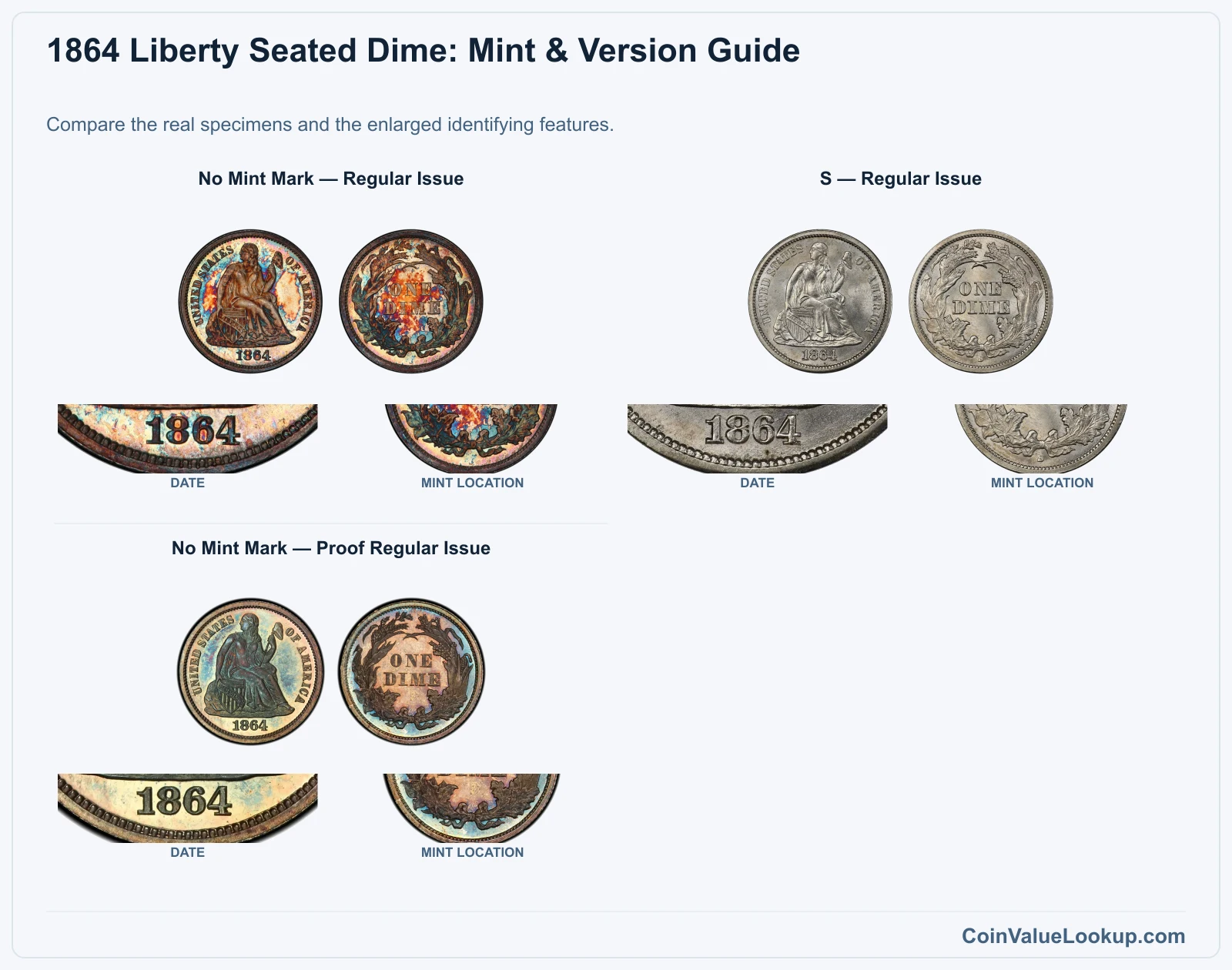
Step 1: Identify Your 1864 Liberty Seated Dime Mint Mark and Version
Every 1864 dime in this series shows a seated Liberty figure on the obverse and the words ONE DIME inside a large agricultural wreath on the reverse. The design is the Legend Obverse subtype, meaning UNITED STATES OF AMERICA appears around the obverse rim rather than on the reverse.
First, confirm your coin is a dime and not a half dime. The diameter should be about 17.9 mm with a reeded edge, and the nominal weight is 2.49 grams in 90% silver and 10% copper.
Next, flip the coin over and look below the wreath on the reverse. A small "S" mintmark means San Francisco.
No letter at all means Philadelphia. That single detail splits the two business-strike versions.
Philadelphia also produced Proof strikes this year, but those are identified by their mirrored fields and sharp, squared rims, not by a mintmark difference. A polished circulated coin is not a Proof, no matter how shiny it looks.
Step 2: Check Your 1864 Liberty Seated Dime Grade
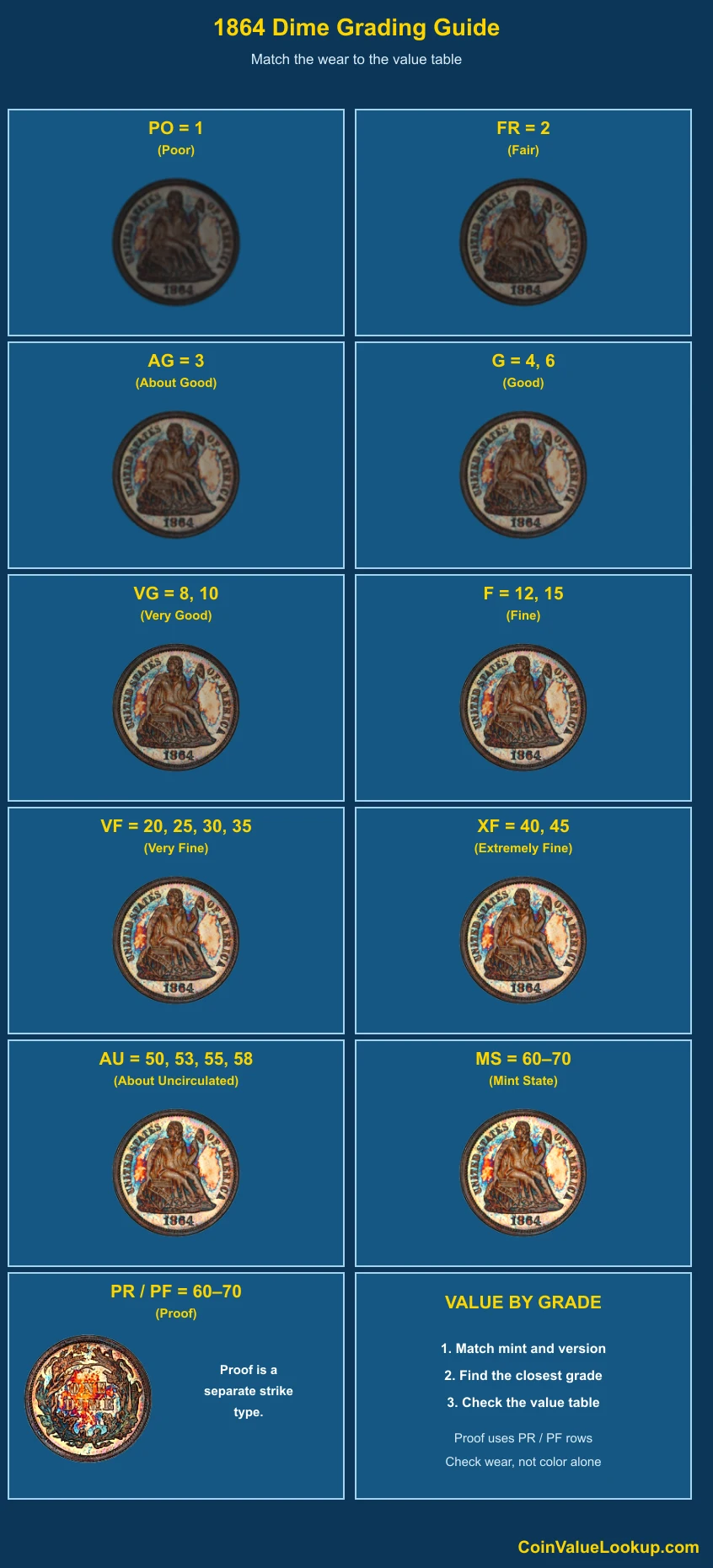
Wear on a Liberty Seated Dime shows up first on the high points of Liberty's head, her knees, and the shield on her lap. On the reverse, check the tips of the wreath leaves and the ribbon bow at the base.
Compare your coin carefully against the grading image above, matching the same subtype. A weak strike from tired dies can mimic wear, so look for remaining luster in the protected areas around the stars and lettering.
Original surfaces with natural toning are more desirable than a coin that has been cleaned or polished. Hairlines from cleaning lower the grade and the value.
Keep Proof coins in a completely separate mental category from Mint State business strikes. They are made differently and graded on a different scale.
If you are unsure whether your coin is a Proof, a third-party grading service is the safest route to confirmation.
Step 3: Check 1864 Liberty Seated Dime Value by Mint and Version
1864 Liberty Seated Dime — No Mint Mark — Regular Issue
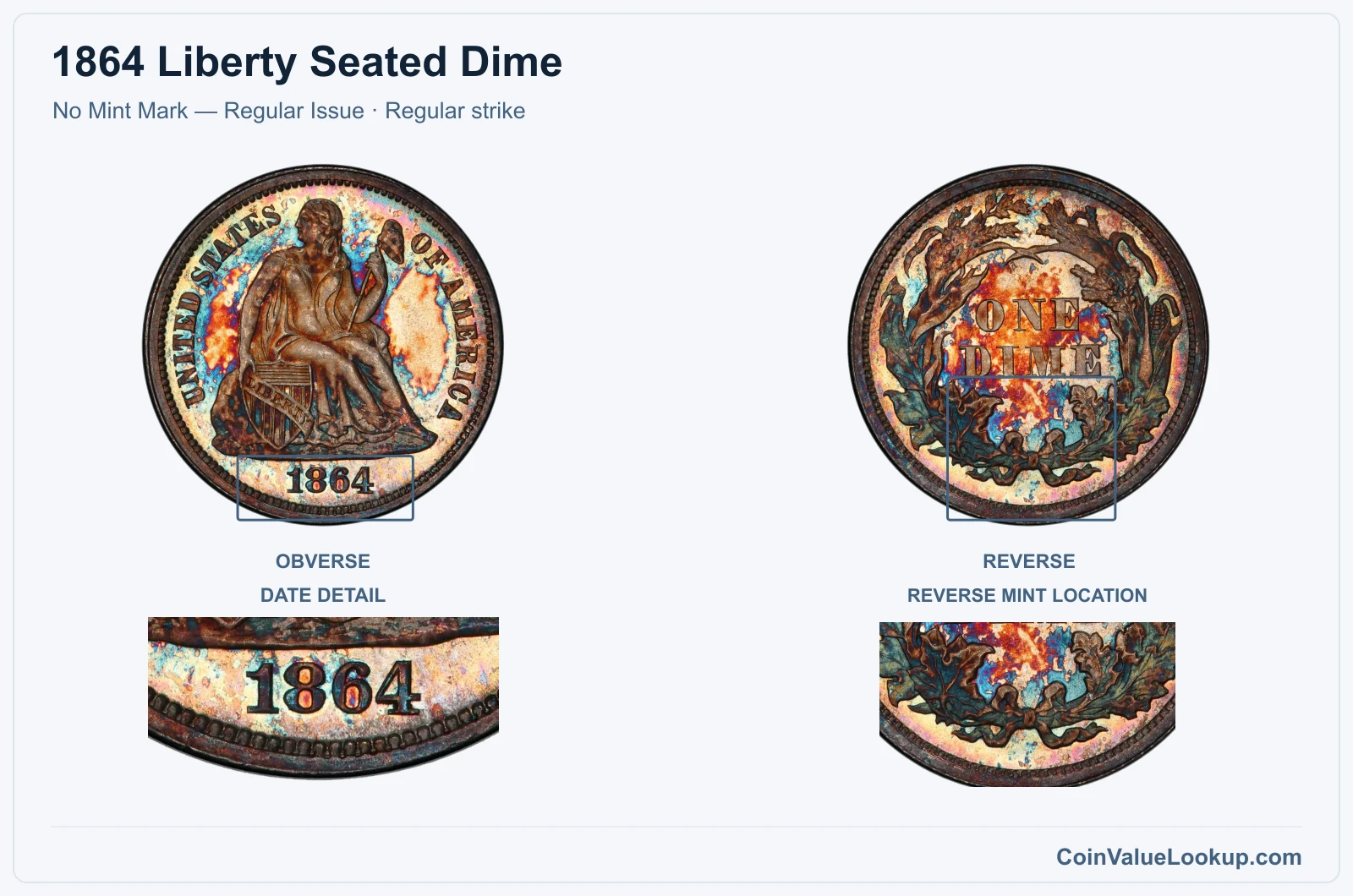
The 1864 Philadelphia dime carries no mintmark. Look at the reverse below the wreath: if that space is empty, you have the Philly issue.
This is a scarce coin by any measure. Civil War-era mintages were modest, and survivors in any grade above heavily worn are not common.
USA Coin Book lists a guide value of roughly $725 at G4 (a well-worn but readable coin) and about $3,637 at MS63 (a lightly marked uncirculated piece with good luster). These are guide estimates, not guaranteed sale prices.
The coin is 90% silver and 10% copper, weighs nominally 2.49 grams, and has a reeded edge. Before consulting the price chart, confirm both the mint and the Legend Obverse design subtype on your example.
Range Grade
Price Auction Records Appraisal PO PO 1
—
Coin Identifier FR FR 2
—
Coin Identifier AG AG 3
Coin Identifier G G 4
Coin Identifier
G 6
—
Coin Identifier VG VG 8
Coin Identifier
VG 10
—
Coin Identifier F F 12
Coin Identifier
F 15
Coin Identifier VF VF 20
Coin Identifier
VF 25
Coin Identifier
VF 30
Coin Identifier
VF 35
Coin Identifier XF XF 40
—
Coin Identifier
XF 45
Coin Identifier AU AU 50
Coin Identifier
AU 53
—
Coin Identifier
AU 55
Coin Identifier
AU 58
Coin Identifier MS MS 60
—
Coin Identifier
MS 61
—
Coin Identifier
MS 62
Coin Identifier
MS 63
Coin Identifier
MS 64
Coin Identifier
MS 65
Coin Identifier
MS 66
Coin Identifier
MS 67
Coin Identifier
MS 68
—
—
—
MS 69
—
—
—
MS 70
—
—
—
1864 Liberty Seated Dime — S — Regular Issue
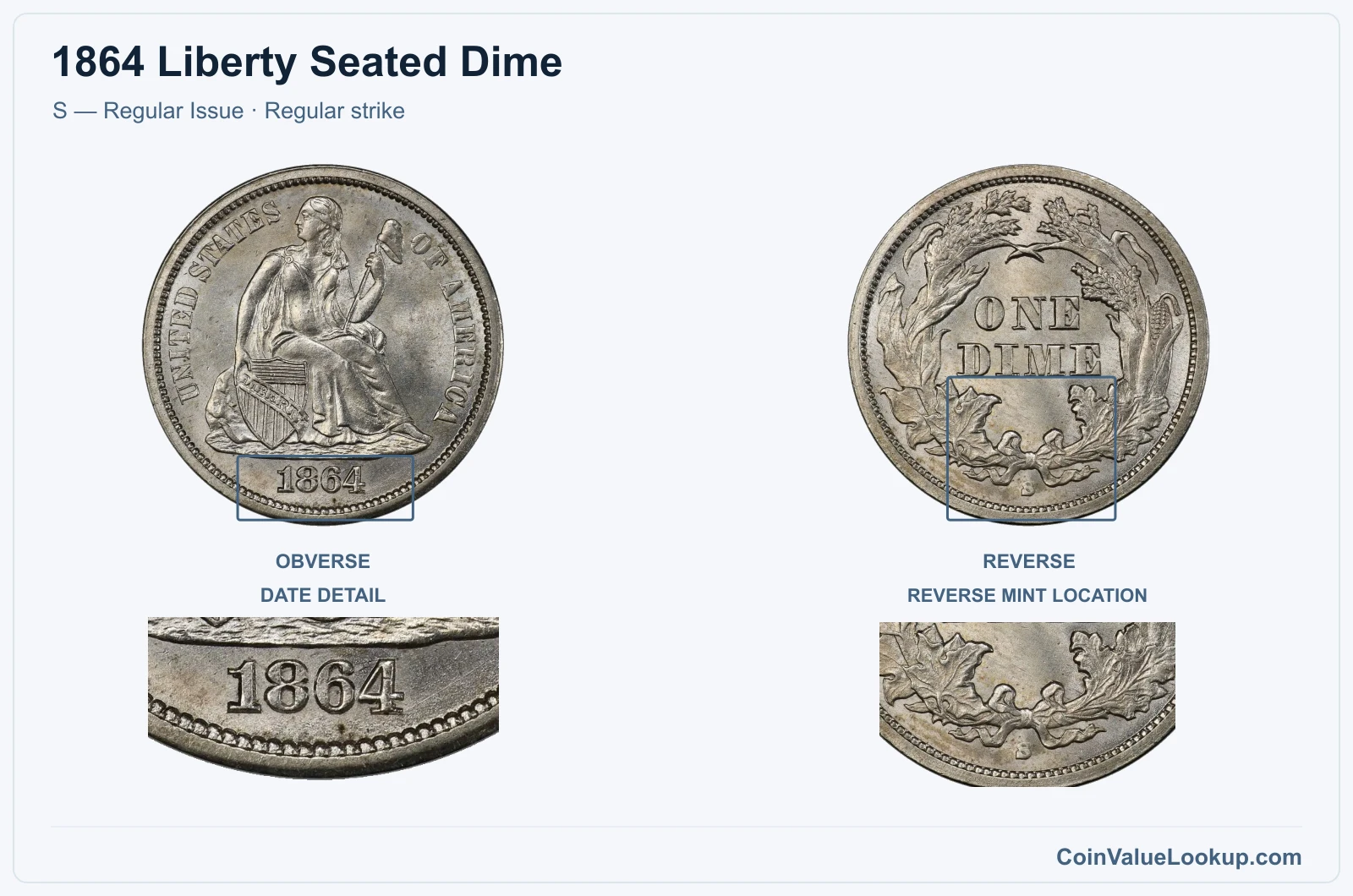
A small "S" below the wreath on the reverse identifies the San Francisco issue. This is the more frequently encountered 1864 dime, though "frequent" is relative for a Civil War date.
USA Coin Book guides this version at about $158 in G4 and around $2,501 in MS63. The spread between those grades is wide, which tells you condition matters a lot here.
Same specs as the Philadelphia coin: 90% silver, 10% copper, 2.49 grams nominal, reeded edge. When evaluating your coin, note that strike quality can vary on San Francisco issues, so compare wear patterns against the grading image rather than assuming every soft detail means heavy circulation.
Coin Value Lookup is a good place to look up other dates and denominations in this series if you are working through a collection or an inherited group of coins.
Range Grade
Price Auction Records Appraisal PO PO 1
—
Coin Identifier FR FR 2
Coin Identifier AG AG 3
—
Coin Identifier G G 4
—
Coin Identifier
G 6
Coin Identifier VG VG 8
Coin Identifier
VG 10
Coin Identifier F F 12
Coin Identifier
F 15
Coin Identifier VF VF 20
Coin Identifier
VF 25
Coin Identifier
VF 30
Coin Identifier
VF 35
Coin Identifier XF XF 40
Coin Identifier
XF 45
Coin Identifier AU AU 50
Coin Identifier
AU 53
Coin Identifier
AU 55
Coin Identifier
AU 58
Coin Identifier MS MS 60
—
Coin Identifier
MS 61
Coin Identifier
MS 62
Coin Identifier
MS 63
Coin Identifier
MS 64
Coin Identifier
MS 65
Coin Identifier
MS 66
Coin Identifier
MS 67
—
—
—
MS 68
—
—
—
MS 69
—
—
—
MS 70
—
—
—
1864 Liberty Seated Dime — No Mint Mark — Proof Regular Issue
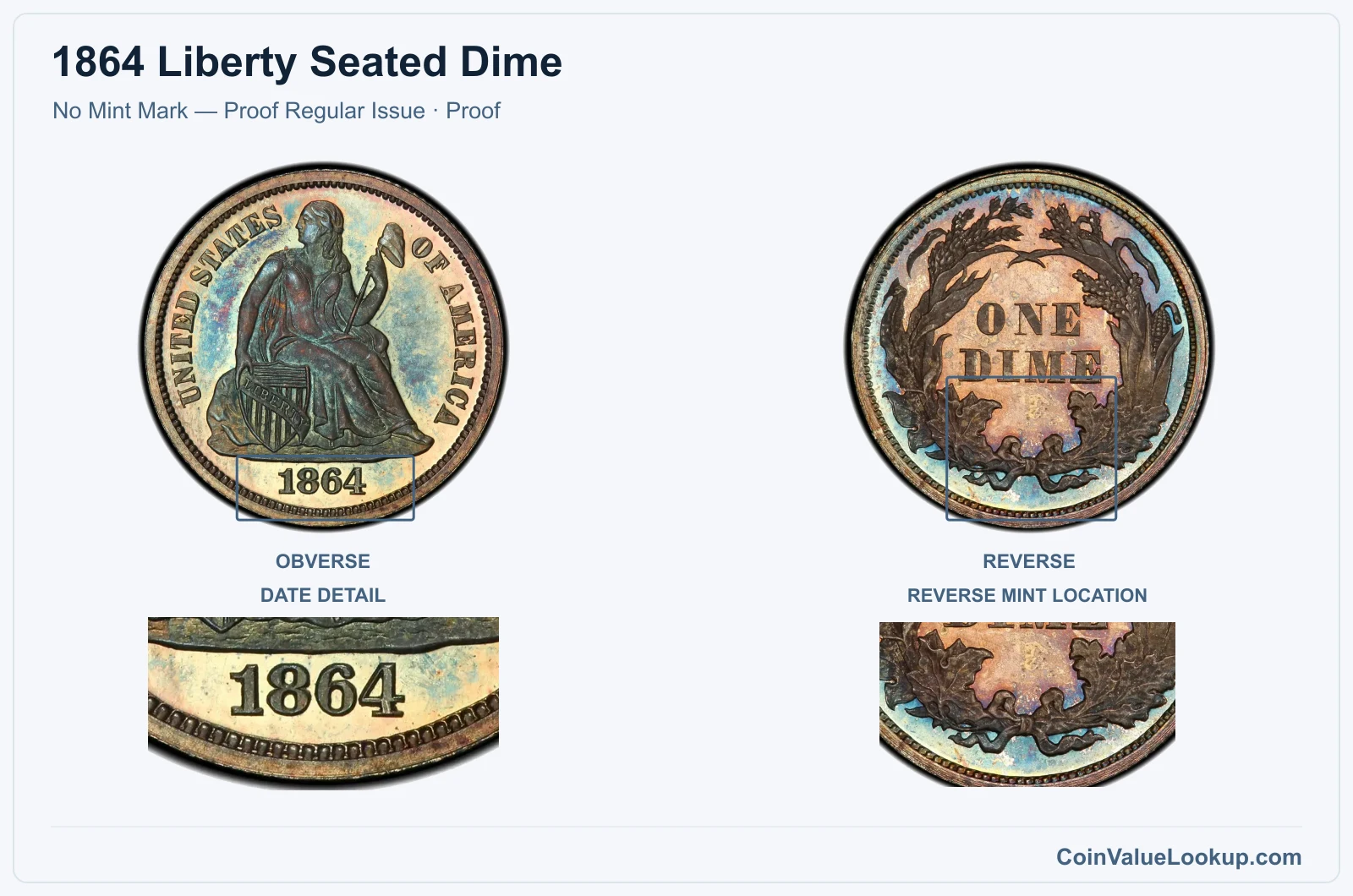
Philadelphia Proof dimes of 1864 were struck with polished dies on polished planchets, producing mirror-like fields and crisp, squared-off rims. These are not simply nice-looking business strikes; the manufacturing process is entirely different.
PCGS lists a guide value near $863 at PR63. Early-date Proofs in the Seated Dime series were produced in very small numbers and are genuinely rare, not the mass-produced collector items that later Proof programs became.
The key diagnostic is the field quality. True Proof fields reflect like a mirror and show no cartwheel luster.
Hairlines from mishandling reduce the grade quickly. A cleaned or polished circulation strike can fool a beginner, so if you suspect you have a Proof, professional attribution through a grading service is worth the cost.
Cameo contrast, where the devices appear frosty against mirrored fields, can appear on some examples but is a separate grading designation, not a different coin.
Range Grade
Price Auction Records Appraisal PR PR 1
—
Coin Identifier
PR 2
—
Coin Identifier
PR 3
—
Coin Identifier
PR 4
—
Coin Identifier
PR 6
—
Coin Identifier
PR 8
—
Coin Identifier
PR 10
—
Coin Identifier
PR 12
—
Coin Identifier
PR 15
—
Coin Identifier
PR 20
—
Coin Identifier
PR 25
—
Coin Identifier
PR 30
—
Coin Identifier
PR 35
—
Coin Identifier
PR 40
—
Coin Identifier
PR 45
—
Coin Identifier
PR 50
—
Coin Identifier
PR 53
—
Coin Identifier
PR 55
—
Coin Identifier
PR 58
Coin Identifier
PR 60
—
Coin Identifier
PR 61
Coin Identifier
PR 62
Coin Identifier
PR 63
Coin Identifier
PR 64
Coin Identifier
PR 65
Coin Identifier
PR 66
Coin Identifier
PR 67
Coin Identifier
PR 68
—
—
—
PR 69
—
—
—
PR 70
—
—
—