1998 Roosevelt Dime Coin Value: How Much Is It Worth?
Most 1998 Roosevelt dimes pulled from pocket change are worth face value — ten cents, nothing more. In uncirculated condition around MS65, a guide estimate from USA Coin Book puts the Philadelphia or Denver issue at about $2.50.
The S clad proof runs roughly $4.96 in PR65, and the S silver proof climbs to around $10.69 in the same grade. Authenticated mint errors, however, can push values into the hundreds or even thousands of dollars depending on the specific mistake and its condition.
Fast Way to Identify Your 1998 Roosevelt Dime
Snap a clear photo of your coin's front and back, then upload both images for a preliminary identification. This can help you figure out which mint produced your dime, whether it's a business strike or proof, and whether something unusual is going on with the design or planchet.
It is not a substitute for professional authentication, but it's a solid starting point.
1998 Roosevelt Dime Value
Upload both sides of your 1998 Roosevelt Dime.
Front Obverse
Upload photo
Back Reverse
Upload photo
Which 1998 Roosevelt Dime Versions Are Worth Money?
- 1998-P or 1998-D in high Mint State grades with strong torch band detail can exceed face value.
- S clad proof with pristine mirror fields and strong cameo contrast is worth checking.
- S silver proof — confirm 90% silver composition before applying silver-proof pricing.
- Struck on Cent Stock errors have sold for thousands at auction.
- Curved and Straight Double Clips, authenticated, brought over $100 at auction.
- Triple Struck Multi-Strike errors are dramatic and have sold near $1,000.
- Obverse Clad Layer Missing specimens expose bright copper and have documented sales.
- Double Strike with Full Obverse Indent is a compound error whose value depends on authentication and severity.
Step 1: Identify Your 1998 Roosevelt Dime Mint Mark and Version
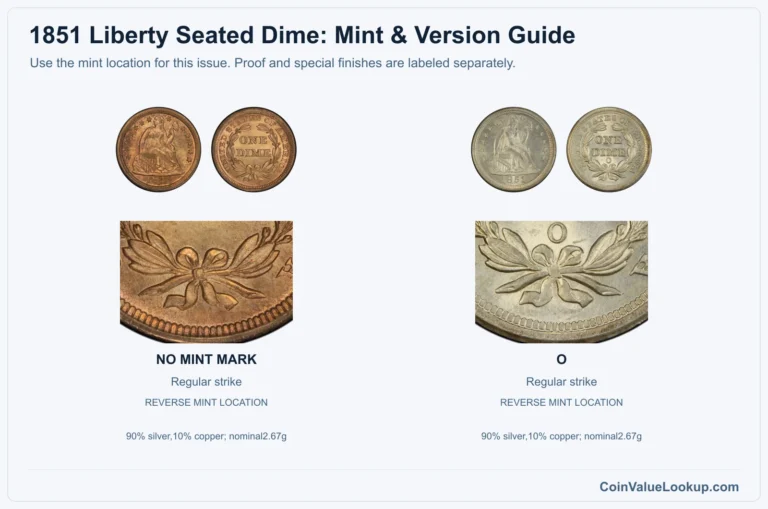
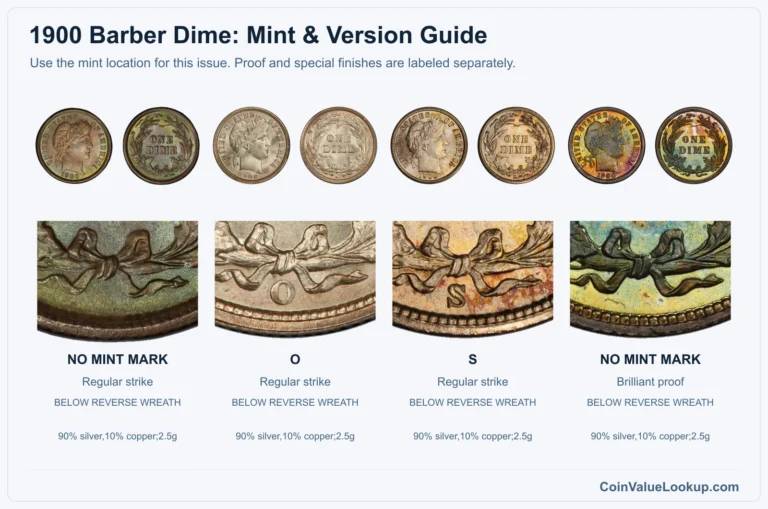
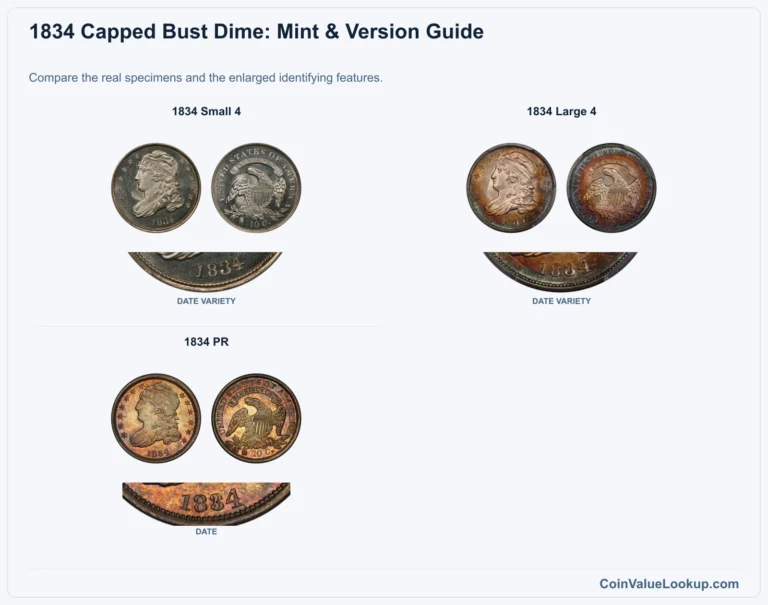
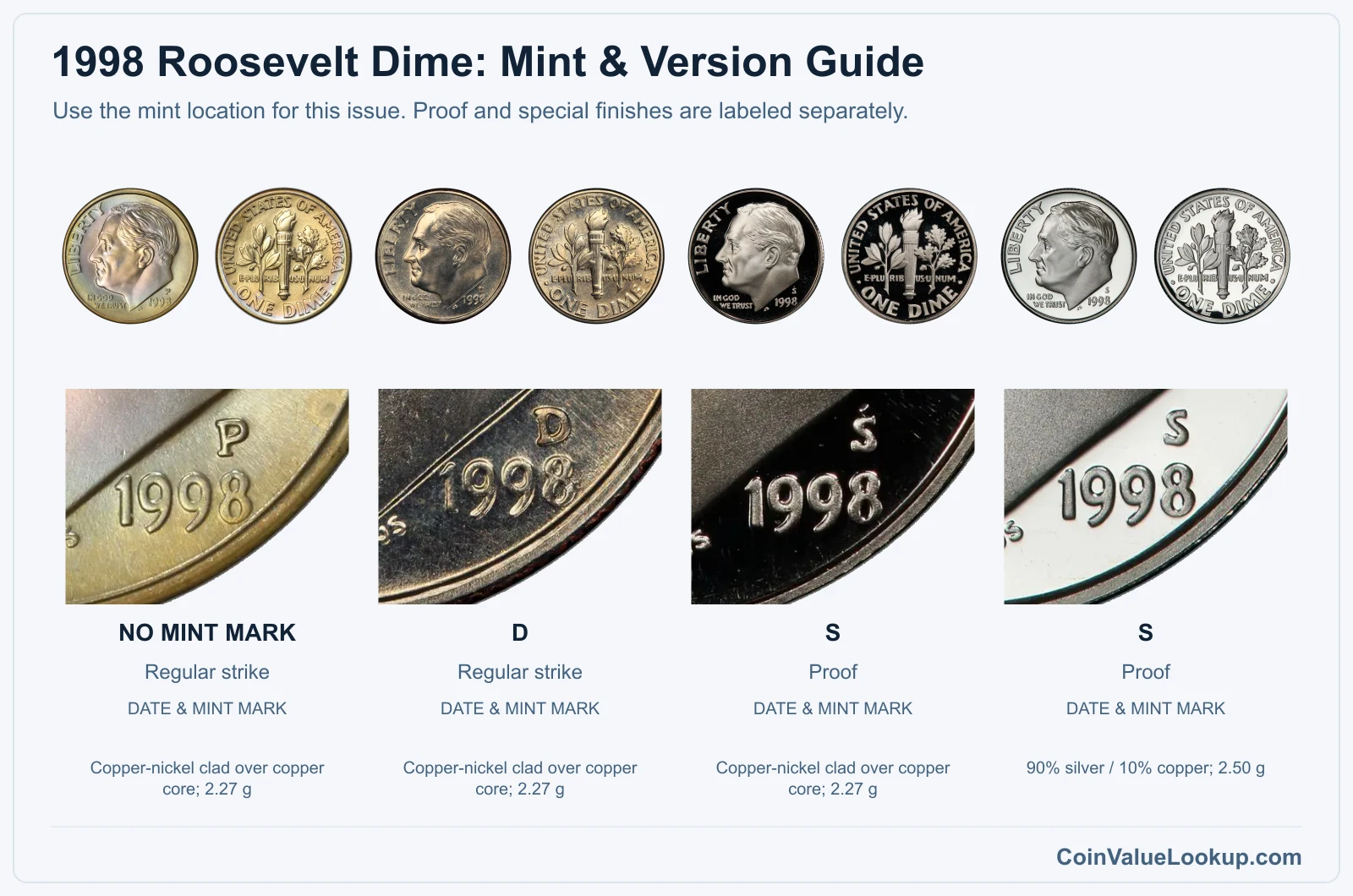
Start with the basics. Confirm your coin shows a 1998 date, the Roosevelt portrait on the obverse, and a torch flanked by branches on the reverse.
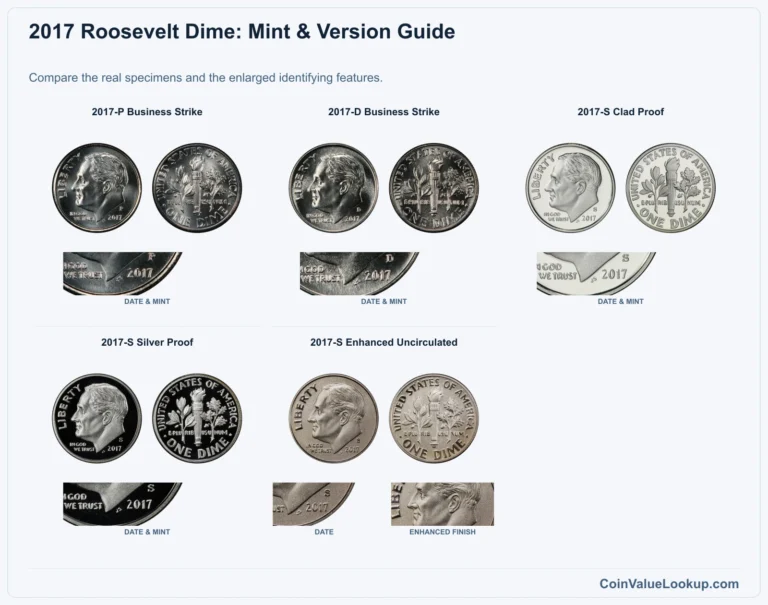
The mintmark sits on the obverse near the date: P for Philadelphia, D for Denver, S for San Francisco. If there is no mintmark at all, look more carefully — the 1998 issue should carry one.
Here is where people trip up: both the S clad proof and the S silver proof carry the same S mintmark and the same design. The mintmark alone does not tell you the metal.
A standard clad dime weighs 2.27 grams, while the silver proof weighs 2.50 grams, so a precise scale helps. Check the edge — a clad coin typically shows a copper stripe, while a 90% silver coin does not.
If your coin came from an original government-issued silver proof set, that's strong evidence. If the packaging is gone and the weight is ambiguous, professional authentication is the safest path.
Do not assume silver just because a coin looks shiny or has an S mint mark.
Step 2: Check Your 1998 Roosevelt Dime Grade
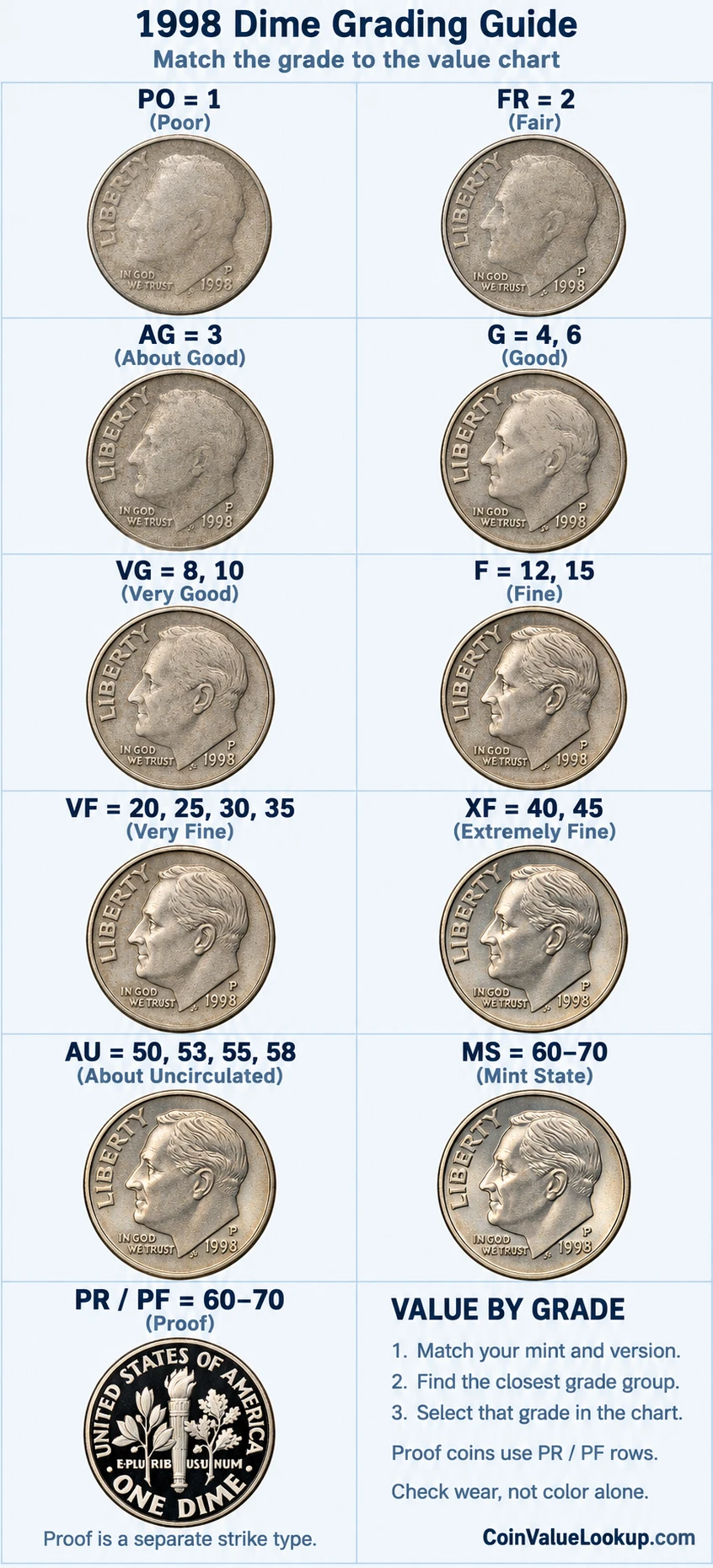
Focus on the high points first. Roosevelt's cheek, jawline, and the hair just above the ear show wear before anything else.
On the reverse, look at the horizontal bands on the torch and the leaf tips.
A coin with full original luster and no contact marks across the cheek may qualify for a higher Mint State grade. But brightness alone is not grade — a cleaned coin can look shiny yet grade poorly because of hairline scratches or stripped surfaces.
Compare your coin to the grading reference image and pay attention to light reflections on flat surfaces. Proof coins are graded separately: mirror fields and frosted devices are part of the manufacturing finish, not an indication of grade above Mint State.
For Roosevelt dimes, the Full Bands designation refers to both horizontal band pairs on the torch being clearly separated. This is a strike-quality attribute, not an error, so compare coins with like designations when checking values.
Corrosion, scratches, and environmental damage all lower a coin's appeal regardless of its technical grade.
Step 3: Check 1998 Roosevelt Dime Value by Mint and Version
1998 Roosevelt Dime — P Business Strike
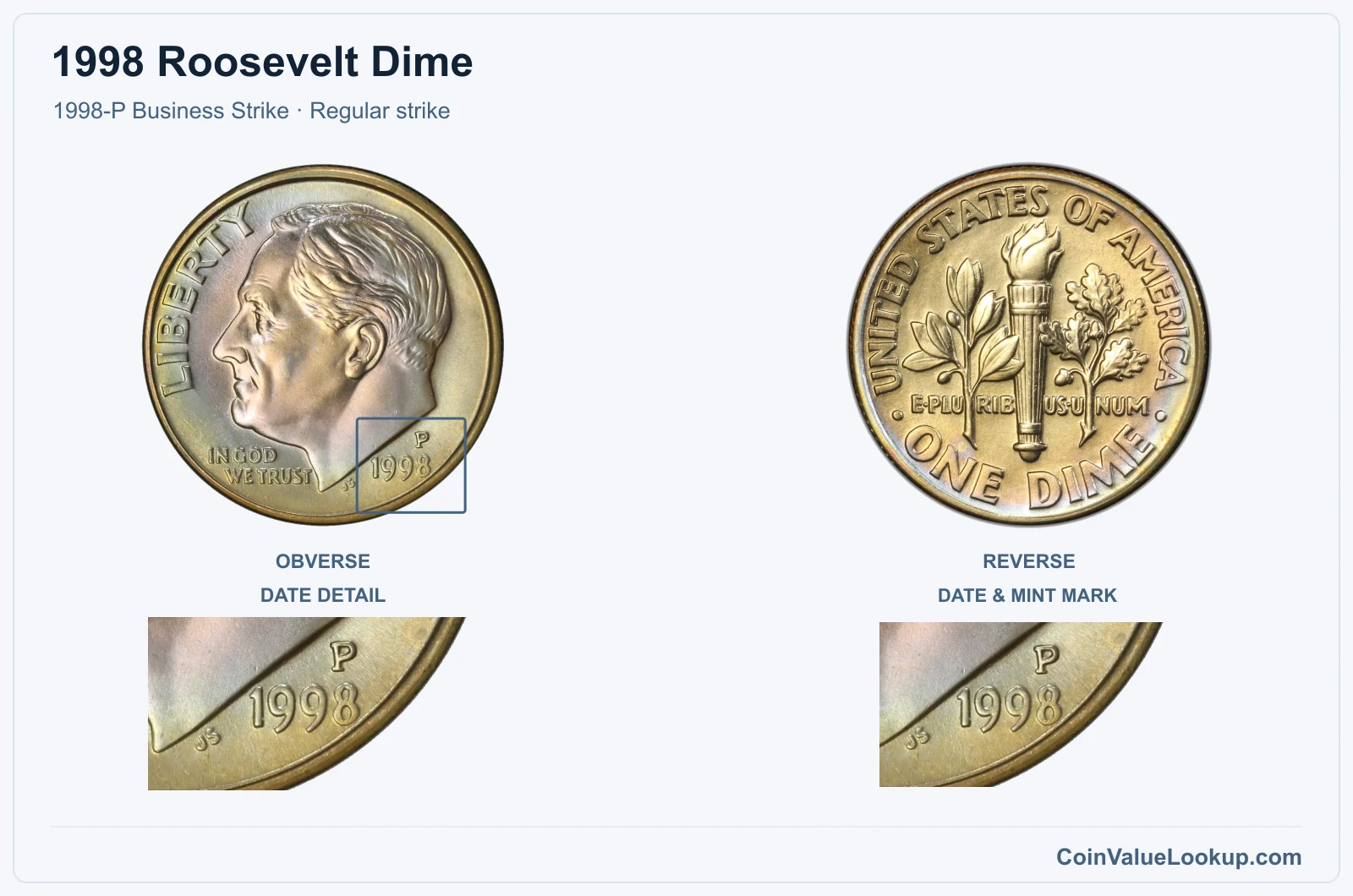
The 1998-P is a standard Philadelphia business strike on copper-nickel clad. It weighs 2.27 grams and carries a P mintmark on the obverse near the date.
In circulated grades, it's a ten-cent coin — no mystery there.
At MS65, a USA Coin Book guide estimate is about $2.50. Coins with clear Full Bands separation on the torch may attract a premium above that level, but you need to compare within the same designation.
Look for unbroken luster across the cheek and clean fields to judge condition realistically.
Range Grade
Price Auction Records Appraisal PO PO 1
—
Coin Identifier FR FR 2
—
Coin Identifier AG AG 3
—
Coin Identifier G G 4
—
Coin Identifier
G 6
—
Coin Identifier VG VG 8
—
Coin Identifier
VG 10
—
Coin Identifier F F 12
—
Coin Identifier
F 15
—
Coin Identifier VF VF 20
—
Coin Identifier
VF 25
—
Coin Identifier
VF 30
—
Coin Identifier
VF 35
—
Coin Identifier XF XF 40
—
Coin Identifier
XF 45
—
Coin Identifier AU AU 50
—
Coin Identifier
AU 53
—
Coin Identifier
AU 55
—
Coin Identifier
AU 58
—
Coin Identifier MS MS 60
Coin Identifier
MS 61
—
Coin Identifier
MS 62
—
Coin Identifier
MS 63
—
Coin Identifier
MS 64
Coin Identifier
MS 65
Coin Identifier
MS 66
Coin Identifier
MS 67
Coin Identifier
MS 68
Coin Identifier
MS 69
—
—
—
MS 70
—
—
—
1998 Roosevelt Dime — D Business Strike
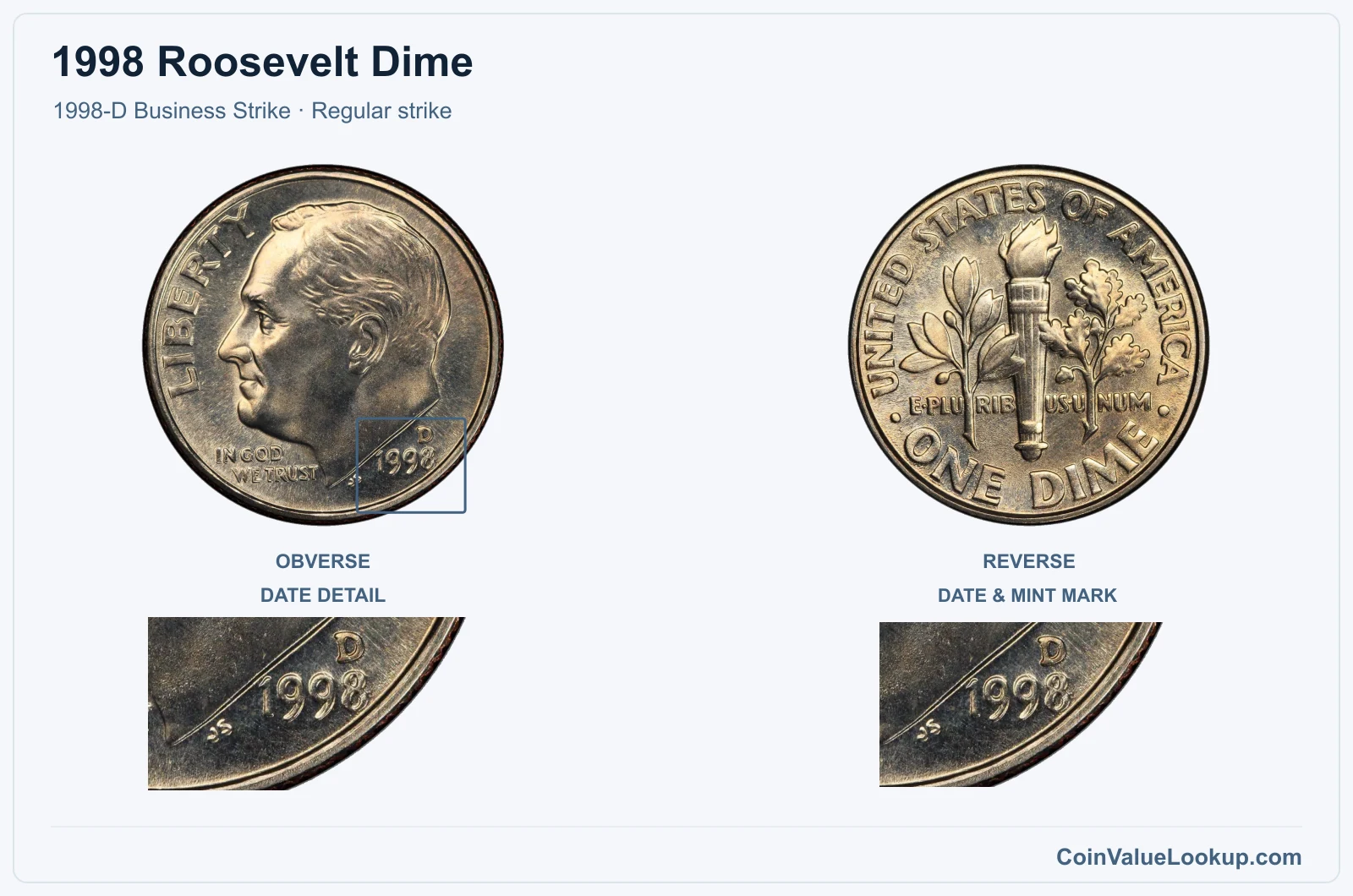
Denver's 1998-D dime shares the same clad composition and 2.27-gram weight as its Philadelphia counterpart. The D mintmark appears on the obverse near the date.
Value-wise, the story is similar: circulated pieces are face value, and the MS65 guide estimate sits at about $2.50 per USA Coin Book. Full Bands detail and original surfaces matter if you're hoping for a higher grade.
These were produced in large quantities, so condition is the main driver of any premium.
Range Grade
Price Auction Records Appraisal PO PO 1
—
Coin Identifier FR FR 2
—
Coin Identifier AG AG 3
—
Coin Identifier G G 4
—
Coin Identifier
G 6
—
Coin Identifier VG VG 8
—
Coin Identifier
VG 10
—
Coin Identifier F F 12
—
Coin Identifier
F 15
—
Coin Identifier VF VF 20
—
Coin Identifier
VF 25
—
Coin Identifier
VF 30
—
Coin Identifier
VF 35
—
Coin Identifier XF XF 40
—
Coin Identifier
XF 45
—
Coin Identifier AU AU 50
—
Coin Identifier
AU 53
—
Coin Identifier
AU 55
—
Coin Identifier
AU 58
—
Coin Identifier MS MS 60
—
Coin Identifier
MS 61
—
Coin Identifier
MS 62
—
Coin Identifier
MS 63
—
Coin Identifier
MS 64
—
Coin Identifier
MS 65
—
Coin Identifier
MS 66
Coin Identifier
MS 67
Coin Identifier
MS 68
—
Coin Identifier
MS 69
—
—
—
MS 70
—
—
—
1998 Roosevelt Dime — S Clad Proof
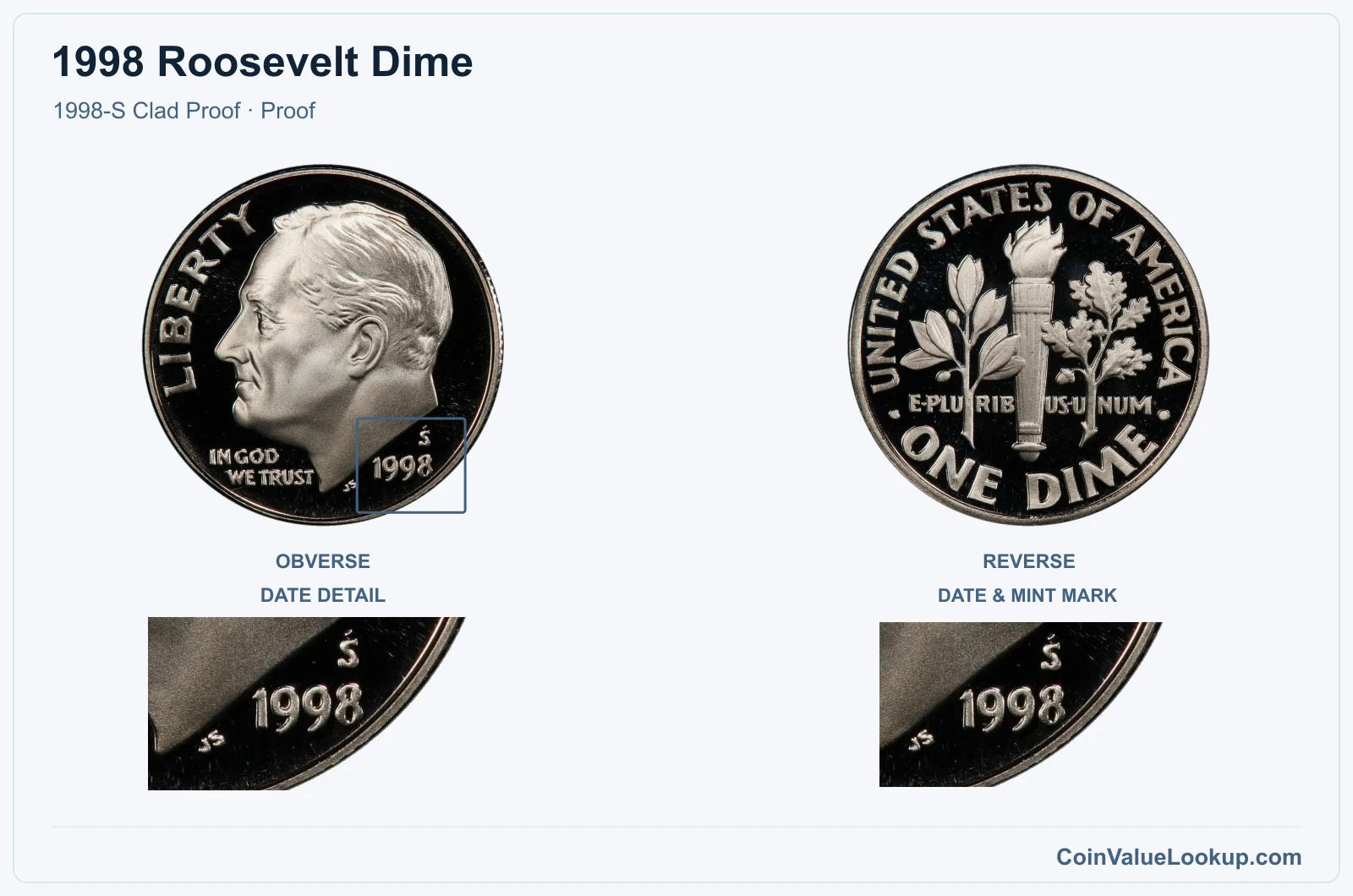
The 1998-S clad proof was made at San Francisco using polished dies and specially prepared planchets. It weighs 2.27 grams — same as the business strikes — because it uses the same copper-nickel clad composition.
The S mintmark alone does not prove silver content.
A PR65 guide estimate from USA Coin Book is roughly $4.96. Proof coins should show mirror-like fields and sharp device edges.
Cameo or deep cameo contrast, where frosted devices stand against reflective fields, can affect desirability. Check the edge for that telltale copper stripe to confirm clad rather than silver.
Coin Value Lookup is a useful place to compare guide values across different Roosevelt dime years and mints when you're trying to narrow down what you have.
Range Grade
Price Auction Records Appraisal PR PR 1
—
Coin Identifier
PR 2
—
Coin Identifier
PR 3
—
Coin Identifier
PR 4
—
Coin Identifier
PR 6
—
Coin Identifier
PR 8
—
Coin Identifier
PR 10
—
Coin Identifier
PR 12
—
Coin Identifier
PR 15
—
Coin Identifier
PR 20
—
Coin Identifier
PR 25
—
Coin Identifier
PR 30
—
Coin Identifier
PR 35
—
Coin Identifier
PR 40
—
Coin Identifier
PR 45
—
Coin Identifier
PR 50
—
Coin Identifier
PR 53
—
Coin Identifier
PR 55
—
Coin Identifier
PR 58
—
Coin Identifier
PR 60
—
Coin Identifier
PR 61
—
Coin Identifier
PR 62
—
Coin Identifier
PR 63
—
Coin Identifier
PR 64
—
Coin Identifier
PR 65
—
Coin Identifier
PR 66
—
Coin Identifier
PR 67
—
Coin Identifier
PR 68
—
Coin Identifier
PR 69
Coin Identifier
PR 70
Coin Identifier
1998 Roosevelt Dime — S Silver Proof
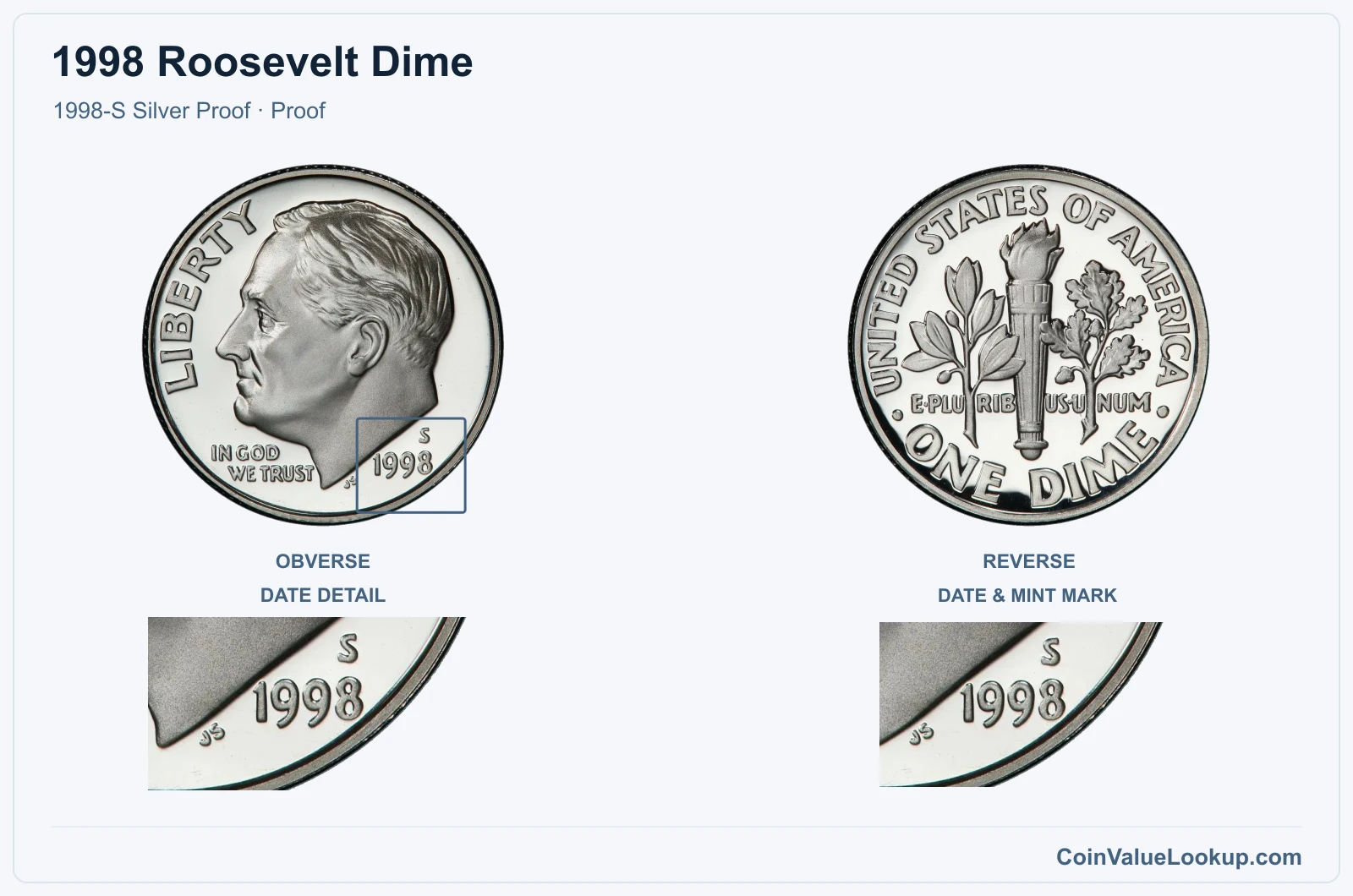
This is the 90% silver, 10% copper proof struck at San Francisco. It weighs 2.50 grams — slightly heavier than the 2.27-gram clad version.
The Silver Proof Set reintroduced in 1992 is where these originate.
At PR65, USA Coin Book estimates about $10.69. Because the coin contains actual silver, its melt value fluctuates with the silver market, which can affect the floor price.
Confirm composition before assuming the higher value: weigh the coin carefully and inspect the edge. A solid silver edge looks uniform, while clad shows a layered stripe.
If the original mint packaging is available, that makes identification much simpler.
Range Grade
Price Auction Records Appraisal PR PR 1
—
Coin Identifier
PR 2
—
Coin Identifier
PR 3
—
Coin Identifier
PR 4
—
Coin Identifier
PR 6
—
Coin Identifier
PR 8
—
Coin Identifier
PR 10
—
Coin Identifier
PR 12
—
Coin Identifier
PR 15
—
Coin Identifier
PR 20
—
Coin Identifier
PR 25
—
Coin Identifier
PR 30
—
Coin Identifier
PR 35
—
Coin Identifier
PR 40
—
Coin Identifier
PR 45
—
Coin Identifier
PR 50
—
Coin Identifier
PR 53
—
Coin Identifier
PR 55
—
Coin Identifier
PR 58
—
Coin Identifier
PR 60
—
Coin Identifier
PR 61
—
Coin Identifier
PR 62
—
Coin Identifier
PR 63
—
Coin Identifier
PR 64
—
Coin Identifier
PR 65
—
Coin Identifier
PR 66
—
Coin Identifier
PR 67
—
Coin Identifier
PR 68
—
Coin Identifier
PR 69
Coin Identifier
PR 70
Coin Identifier
1998 Roosevelt Dime Error List
1. 1998 Roosevelt Dime — Struck on Cent Stock
A 1998-P dime struck on cent-composition stock is one of the more dramatic wrong-planchet errors for this year. The coin appears orange-red rather than the usual silver tone of a clad dime, because it was struck on a planchet attributed to cent stock.
A documented PCGS MS64 specimen sold for $4,465 in January 2016.
The diagnostic to look for includes a broad, slightly dished rim and the distinctly copper-toned surface. One authenticated example also showed a small lamination above the second U in UNUM.
Color alone is not enough — a copper-plated normal dime or even an oddly toned silver proof can mimic the look. Professional authentication confirming the alloy is essential before attributing this error.
2. 1998 Roosevelt Dime — Curved and Straight Double Clips
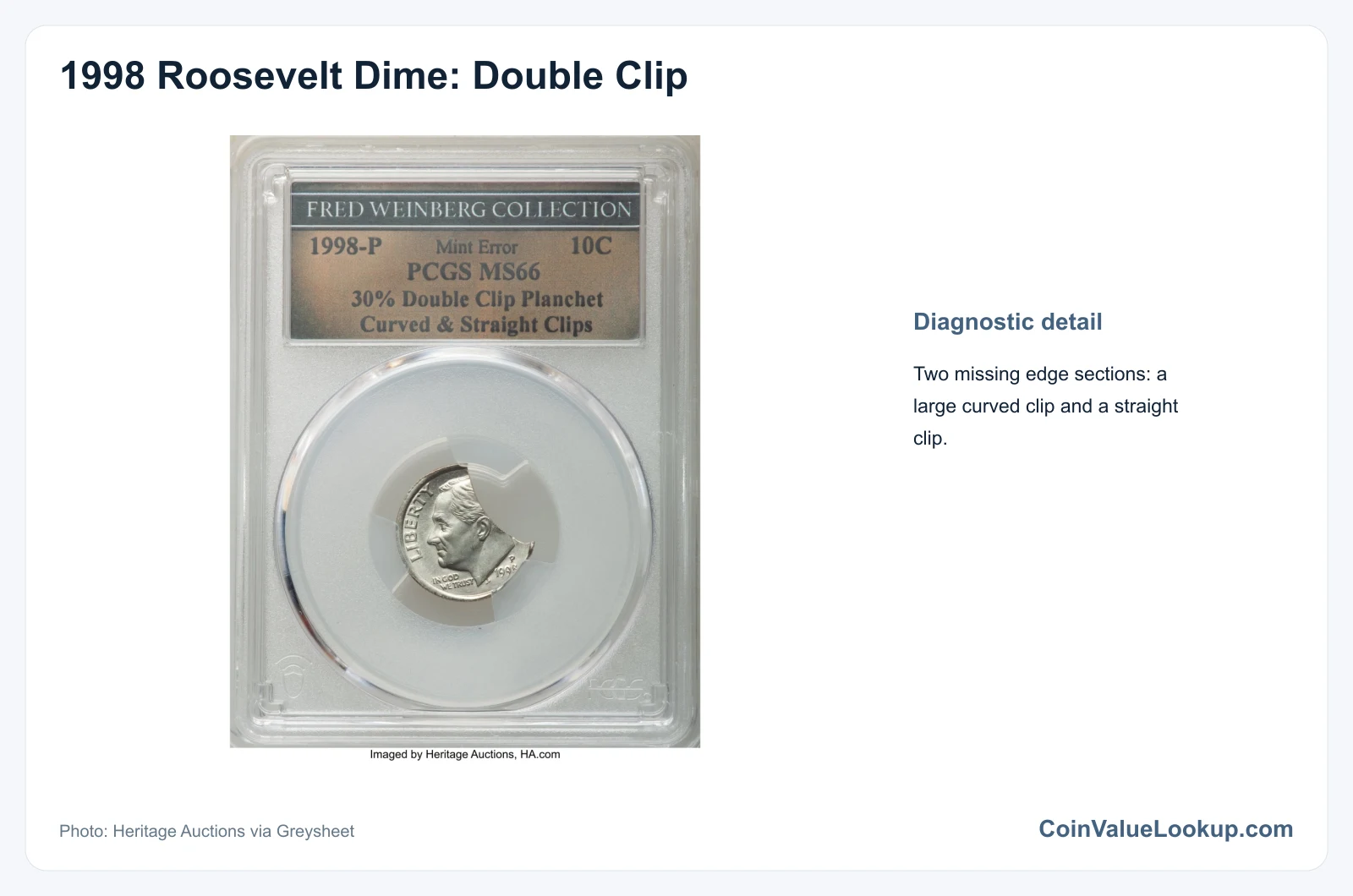
This 1998-P error shows two distinct clip shapes — one curved, one straight — that together remove roughly 30 percent of the planchet. The missing areas have natural, unfinished edges rather than clean cuts, and the full dated design remains visible on what's left of the coin.
A PCGS MS66 example sold for $114 in July 2022. When evaluating a potential clip, check for the Blakesley effect (a weak area on the rim opposite the clip) and confirm the edges are not the result of post-mint cutting or grinding.
Later cuts into a finished coin will look different from a genuine clip — the metal flow and rim behavior at the clip boundary are the giveaway.
3. 1998 Roosevelt Dime — Double Strike with Full Obverse Indent
This compound error involves a 1998-P dime that was struck a second time out of the collar while a separate blank planchet sat on top of the obverse, leaving a full indent impression. The result is a coin that shows the surviving first-strike design underneath and an expanded second strike with a round, flat depression covering the obverse.
No supported price range is available for this error. Value depends on authentication, condition, and the severity of the impression.
An NGC MS67 Full Bands example has been documented. Look for evidence of two separate strikes plus the intervening blank's outline.
Ordinary wear, grinding marks, or vise damage can superficially resemble an indent, so third-party certification is strongly recommended before drawing conclusions.
4. 1998 Roosevelt Dime — Obverse Clad Layer Missing
On this 1998-P error, the nickel clad layer on the obverse side is missing entirely, exposing bright copper underneath. The obverse looks noticeably different in color compared to the normal silvery surface, and the reverse retains its standard appearance because that clad layer is intact.
A documented MS60 specimen graded by PCGS sold for $89 in December 2011. The key diagnostic is the weight: a coin missing one clad layer will weigh less than the standard 2.27 grams.
A full-weight coin that simply looks dark or discolored is almost certainly showing environmental damage, acid exposure, or polishing — not a missing layer. Edge inspection is also helpful, as the layered structure should visibly differ from a normal clad edge.
5. 1998 Roosevelt Dime — Triple Struck Multi-Strike
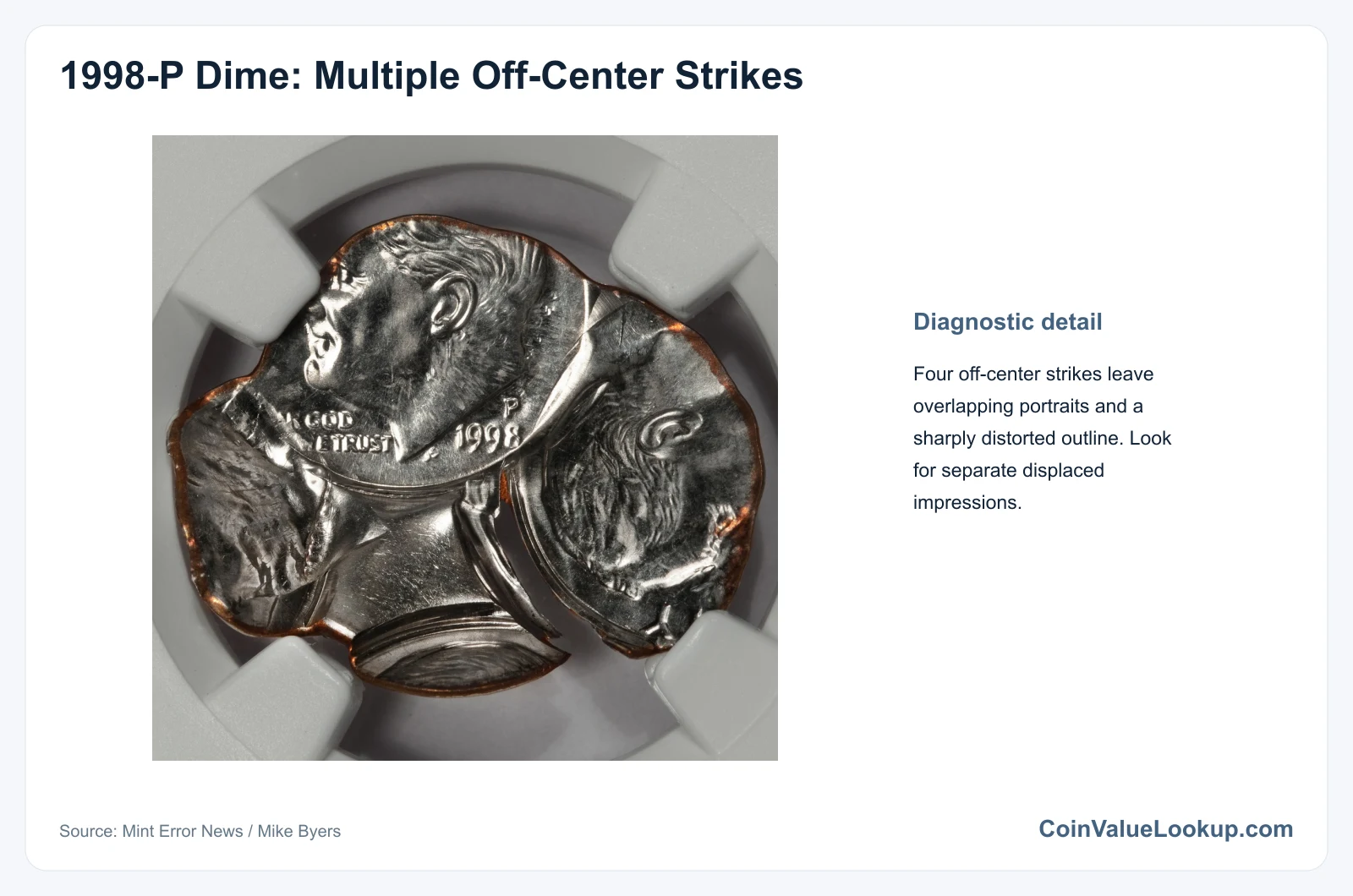
A triple-struck 1998-P dime carries three separate die impressions, each traceable through shifted or flipped design remnants on the coin's surface. The result is a visually chaotic piece with overlapping text and portraits that clearly don't belong to a single strike event.
An ANACS MS61 example sold for $990 in January 2023. When examining a potential multi-strike, look for three distinct sets of design elements — shifted dates, doubled rims, or partially inverted images.
Machine doubling produces a flat, shelf-like appearance on device edges and is far more common. A normal broadstrike or die cap will typically show only one strike event.
Require visible dated and mintmarked evidence before attempting any attribution.
6. 1998 Roosevelt Dime — Off-Center Strike
An off-center strike occurs when the planchet is not properly seated between the dies at the moment of striking. The result is a design that is displaced to one side, leaving an unstruck crescent of blank metal on the opposite edge.
For 1998 dimes, the degree of off-center displacement and whether the date remains visible are the main factors affecting desirability. No specific price range is adopted for this category, because condition, percentage of displacement, and the particular mint all play a role.
A coin with a clipped or damaged edge is not the same thing — clips involve missing planchet metal, while off-center strikes involve misalignment. Post-mint flattening can also mimic partial design loss but won't produce the characteristic blank crescent.
7. 1998 Roosevelt Dime — Doubled Die Obverse
A doubled die obverse on a 1998 dime would show consistent doubling on obverse design elements — lettering, the date, or portrait features — that results from a die-manufacturing issue rather than strike mechanics. The doubling appears as separation or notching on affected areas and should be visible under magnification with consistent lighting.
No specific price range is adopted for this category. Value depends on the strength and location of the doubling, overall condition, and authentication.
The most common lookalike is machine doubling, which leaves a flat, shelf-like distortion on one side of a letter or device. Worn die contours and reflections under certain light angles can also fool you.
Compare suspect areas carefully against a known normal 1998 dime under the same magnification.
8. 1998 Roosevelt Dime — Doubled Die Reverse
A doubled die reverse involves the same type of die-manufacturing doubling but appears on reverse design elements — the torch, ONE DIME legend, or branch details. Look for consistent separation or notching on the affected features that repeats across multiple letters or design points.
No specific price range is adopted here. As with the obverse variety, strength of the doubling, condition, and professional attribution determine value.
Machine doubling is the usual suspect — it produces flat, displaced shelves rather than the rounded separation of a true doubled die. Random nicks, corrosion spots, or surface damage can also create confusing shapes on reverse lettering.
A careful side-by-side comparison with a normal coin is the best first step.
9. 1998 Roosevelt Dime — Broadstrike
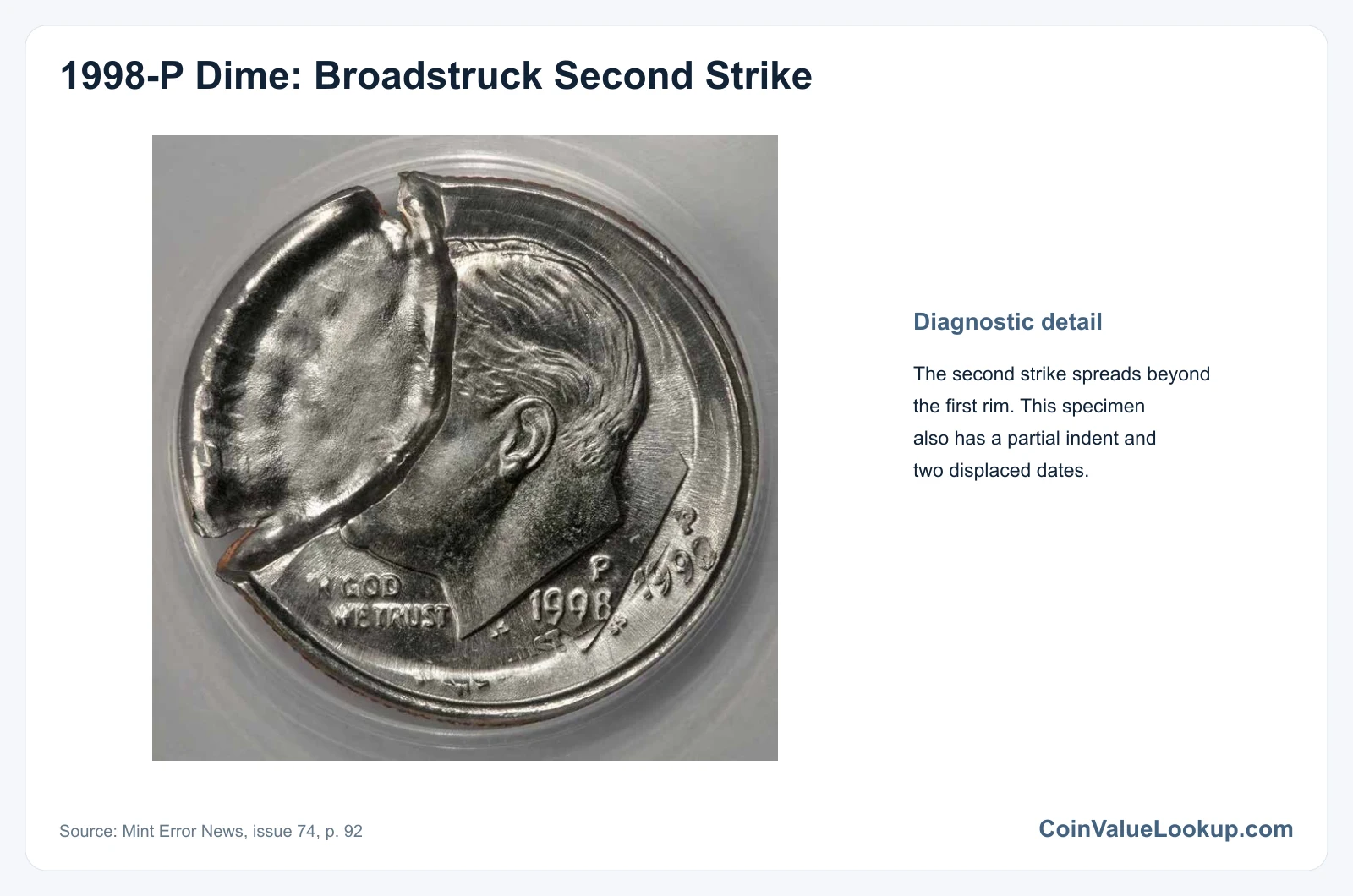
A broadstrike happens when the collar that normally confines the planchet during striking fails to engage. The coin spreads outward under the force of the dies, producing a piece that is wider than normal with a weak or missing raised rim.
The full design is still present — unlike an off-center strike, nothing is displaced.
No specific price is adopted for broadstruck 1998 dimes. The error's value depends on the degree of spread, overall condition, and whether both sides show the characteristic expansion.
A coin flattened after minting — by a train track, a hammer, or a machine shop — can look similar, but it won't show the natural metal flow and graduated rim that a genuine broadstrike exhibits. Check the edge profile carefully.
10. 1998 Roosevelt Dime — Die Cap / Capped-Die Strike
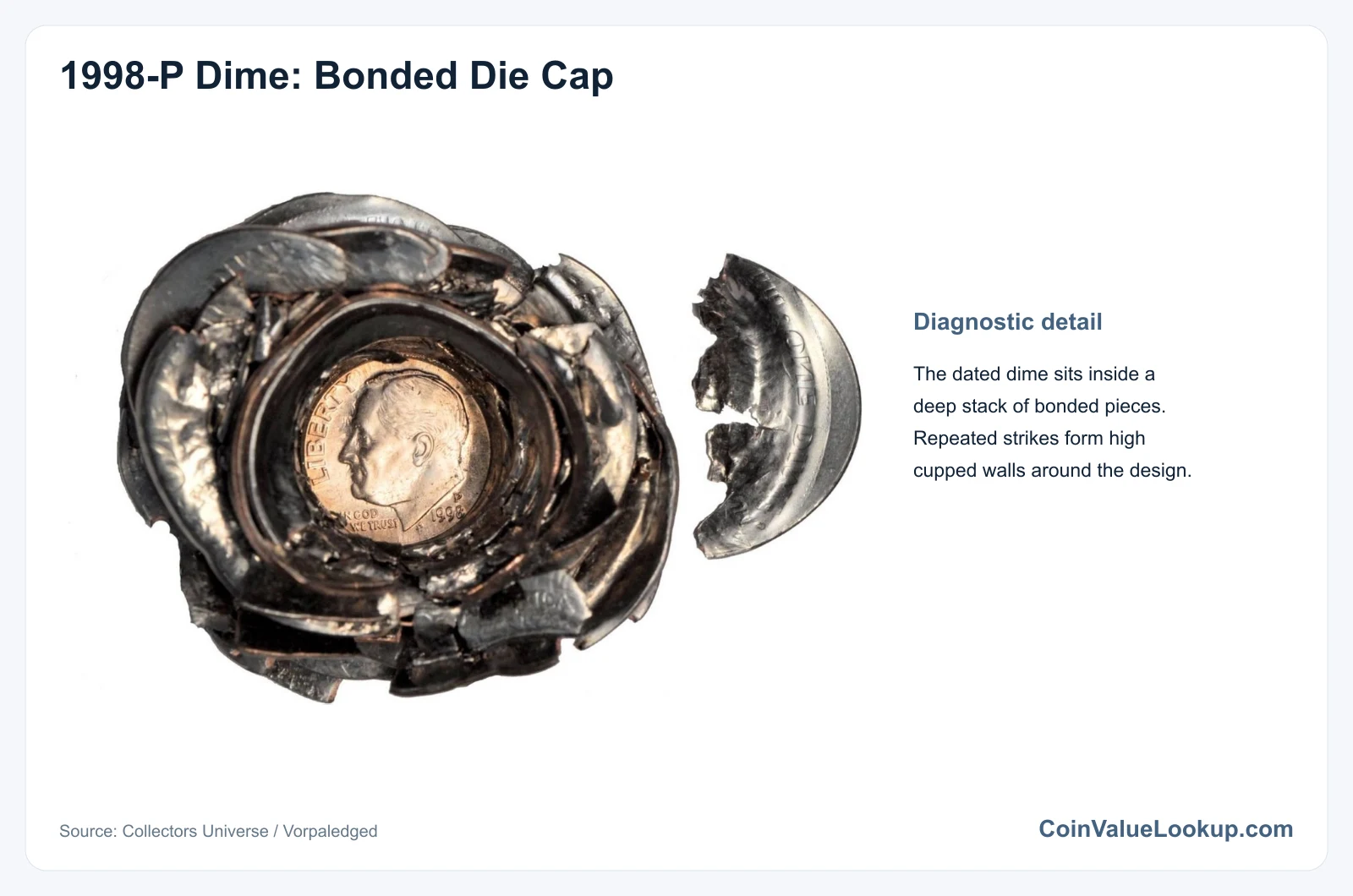
A die cap error happens when a coin sticks to one of the dies and gets struck repeatedly as new planchets feed into the press. The stuck coin gradually cups around the die like a bottle cap, and subsequent coins struck through it show a distorted, mirror-image impression.
No specific price is adopted for this error on 1998 dimes. The cap itself and the coins struck beneath it are both collectible, but they look quite different.
A cupped coin with progressively stretched edges is the cap; flat coins with a mushy, incuse ghost image were struck through it. A bent coin, vise damage, or a weak normal strike can be mistaken for die-cap involvement but won't show the progressive cupping and design transfer unique to this error.
11. 1998 Roosevelt Dime — Die Crack / Die Chip
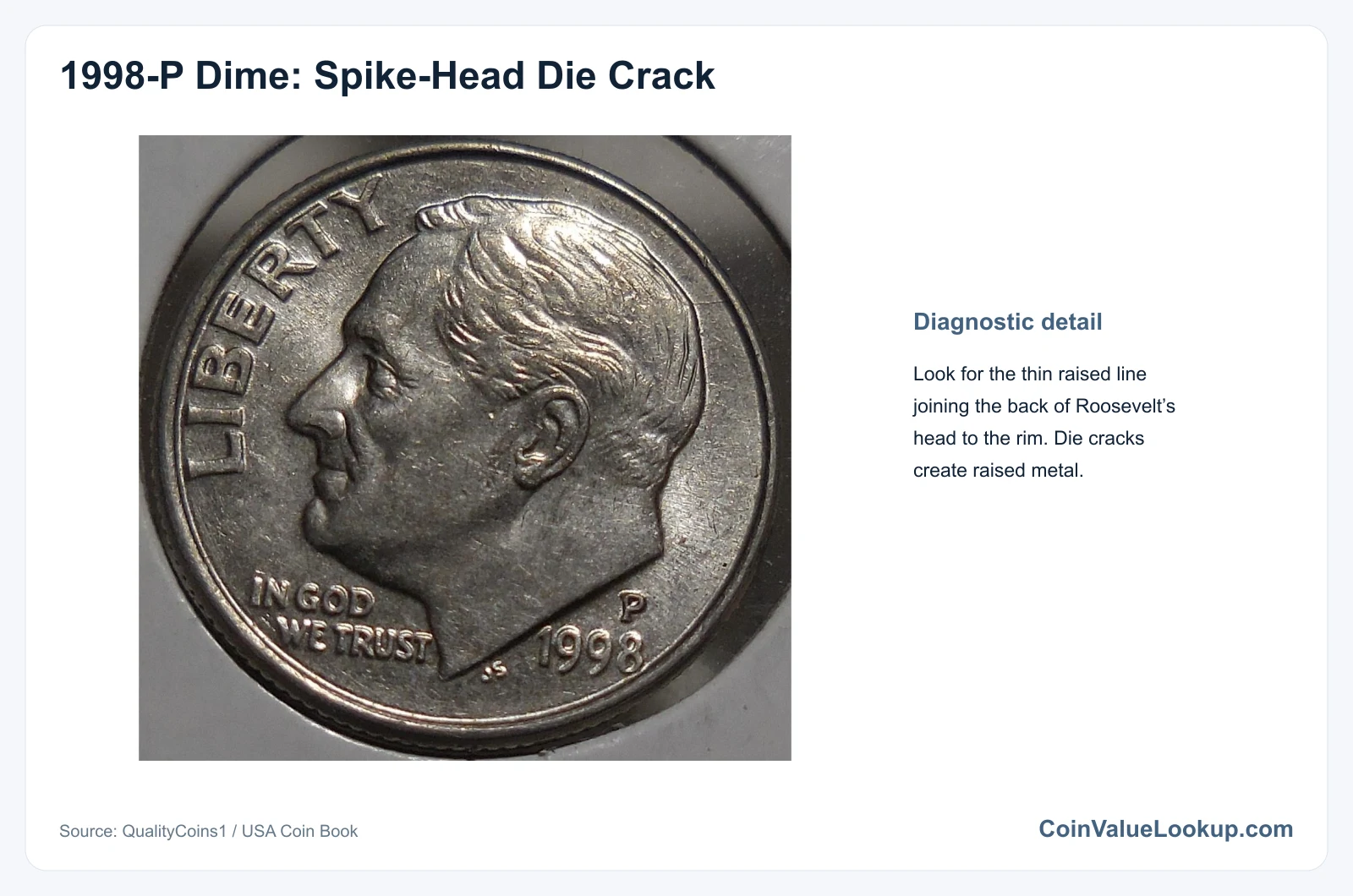
Die cracks appear as raised lines on a coin's surface, caused by fractures in the steel die transferring their shape during striking. Die chips are small raised blobs from a chunk of die metal breaking away.
A cud is a larger raised area that connects to the rim where a piece of the die has broken off entirely.
No specific price is adopted for die cracks or cuds on 1998 dimes. Severity, size, and location determine collector interest.
Interior cracks and chips are common and typically modest in value; rim-connected cuds tend to draw more attention. The key distinction from damage: die cracks and chips are raised above the field, while scratches and corrosion are incuse or pitted.
Foreign material stuck to the surface can also mimic a small die chip.