1998 Washington Quarter Coin Value: How Much Is It Worth?
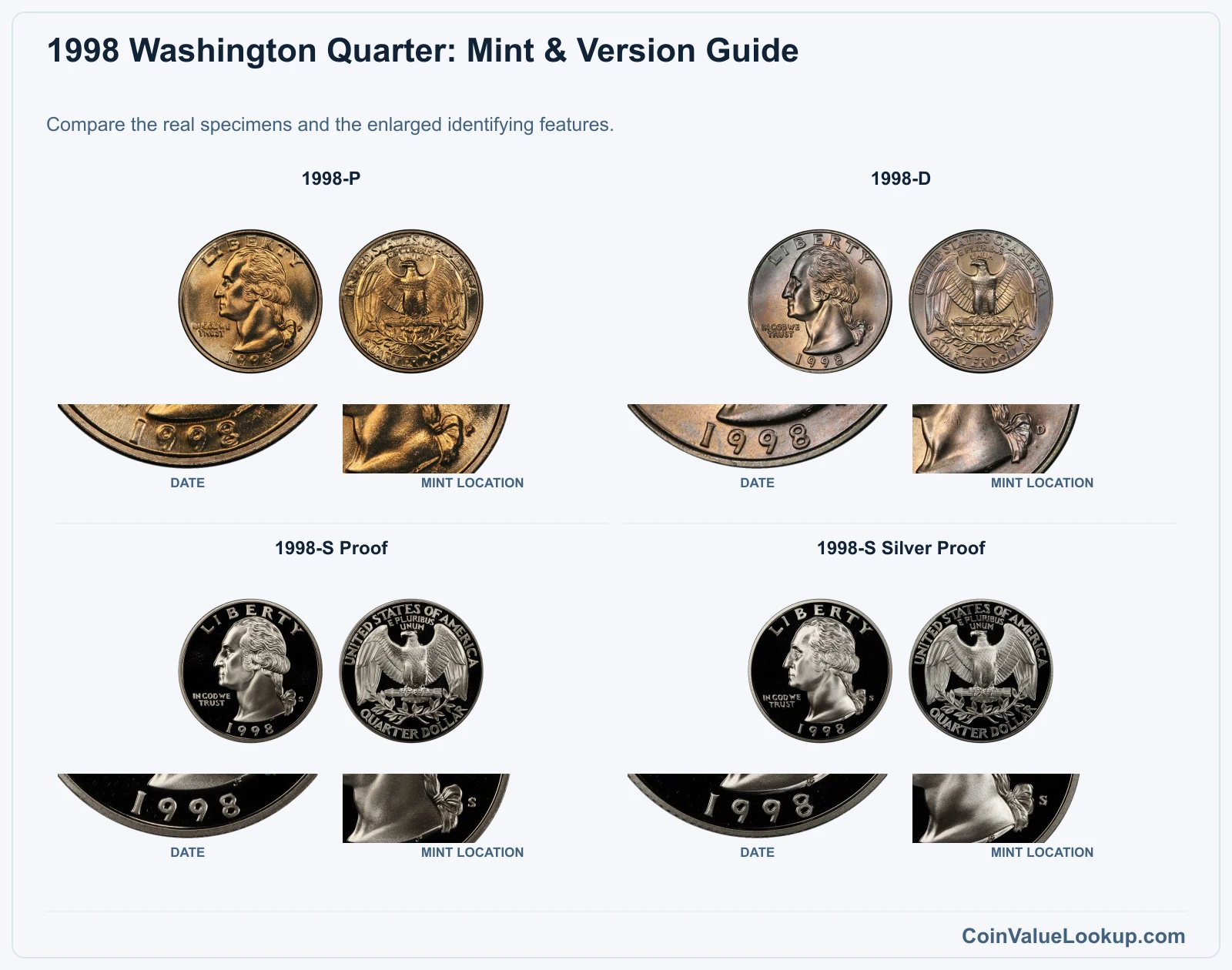
Most 1998 Washington quarters you find in pocket change are worth face value — 25 cents. In higher uncirculated grades, a USA Coin Book guide estimate places the 1998-P and 1998-D at around $8.64 in MS65.
The 1998-S silver proof carries a separate PR65 guide estimate of about $21. This was the final year of the original continuous eagle-reverse design before the State Quarters program launched in 1999, so it marks the end of an era for this long-running series.
Fast Way to Identify Your 1998 Washington Quarter
Want a quick read on what you have? Upload clear photos of both the front and back of your 1998 quarter.
Our identifier can give you a preliminary identification of the mint, version and general type. It is not a substitute for professional authentication or grading, but it is a solid starting point.
1998 Washington Quarter Value
Upload both sides of your 1998 Washington Quarter.
Front Obverse
Upload photo
Back Reverse
Upload photo
Which 1998 Washington Quarter Versions Are Worth Money?
- The 1998-S silver proof at PR65 carries a guide estimate around $21, the highest among the four standard versions at comparable grade levels.
- A 1998-P obverse die cap graded MS68 sold for $1,035 at Heritage Auctions in March 2010 — dramatic error coins like this command serious premiums.
- A 1998-P double strike with an off-center second impression graded MS63 sold for $312 at Heritage Auctions in December 2024.
- High-grade uncirculated 1998-P and 1998-D quarters in MS65 carry a USA Coin Book guide estimate of about $8.64 each, well above face value.
- Several reported error categories — including die gouges, doubled dies, clips and wrong planchets — may add value depending on visibility and condition.
Step 1: Identify Your 1998 Washington Quarter Mint Mark and Version
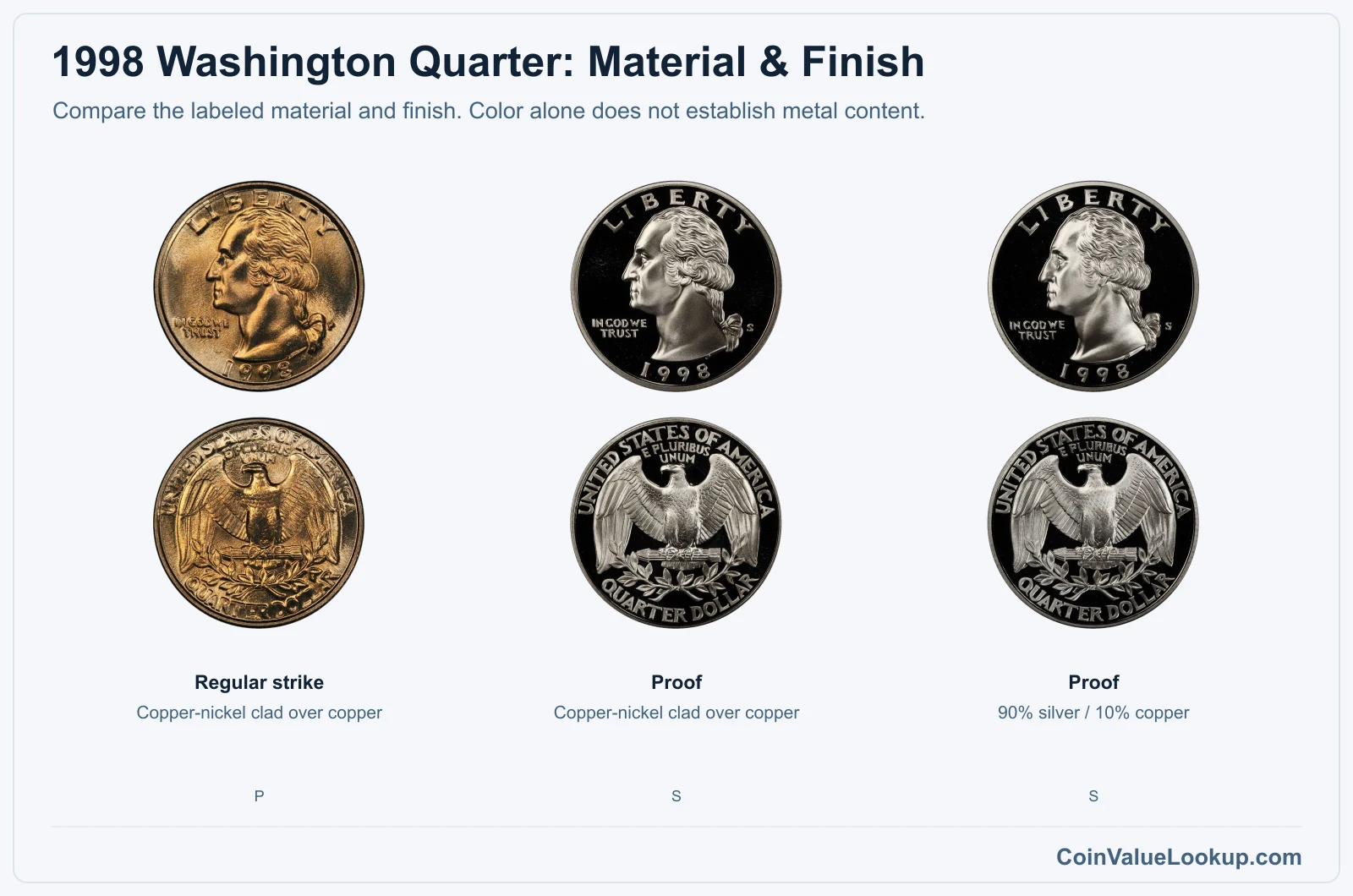
The 1998 Washington quarter comes in four distinct versions, and telling them apart is straightforward once you know where to look.
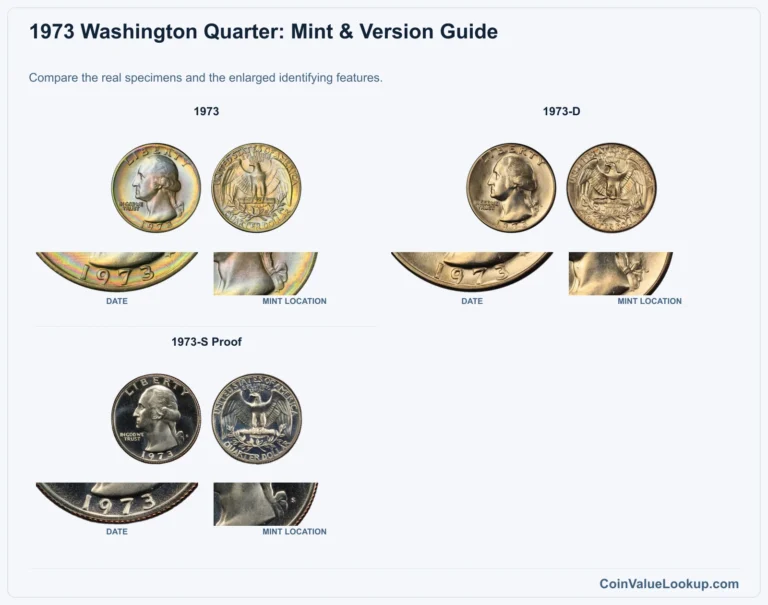
Check just to the right of Washington's ponytail ribbon for the mintmark. A "P" means Philadelphia, a "D" means Denver, and an "S" means San Francisco.
There is no blank-mintmark Philadelphia variety for this date.
P and D coins are copper-nickel clad business strikes, weighing about 5.67 grams with a diameter of roughly 24.3 mm. The S mintmark appears on two different proof types: a clad proof and a 90% silver proof.
The two S proofs look similar at first glance, but they are not the same coin. The silver proof weighs approximately 6.25 grams versus 5.67 grams for the clad proof.
Edge color helps too — a clad coin shows a visible copper-toned stripe on the edge, while a silver proof does not. Original government packaging and authenticated third-party slabs are the most reliable ways to confirm silver content.
The "S" mintmark alone does not tell you which metal you have.
Step 2: Check Your 1998 Washington Quarter Grade
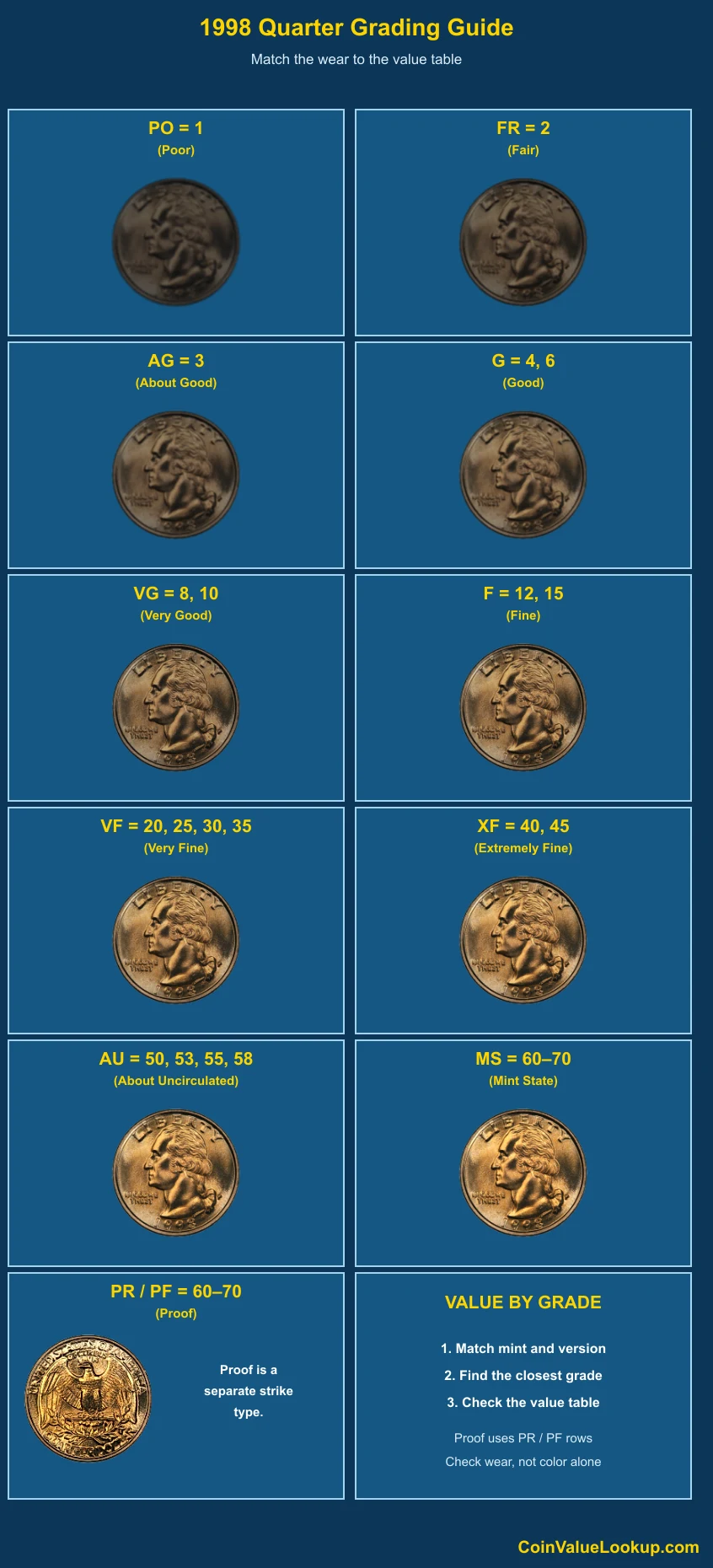
Start by examining the hair above Washington's ear. On a well-circulated coin, this area shows obvious flattening and loss of detail.
A lightly worn coin retains some hair strand separation there but loses its original mint luster.
The cheekbone and jawline are the next checkpoints. These high points pick up rub quickly, so any smoothness you see means the coin has been in circulation.
Flip the coin over and look at the eagle's breast feathers. Sharp, individually defined feathers indicate a higher grade; mushy, blended feathers signal wear.
Luster matters more than shine. A cleaned coin can look bright but will have tiny hairlines visible under a loupe, and that hurts the grade significantly.
Compare your coin to the reference image to gauge where it falls.
For proofs, remember that "proof" describes how the coin was made — mirrored fields, sharp rims — not a grade above Mint State. Deep Cameo (DCAM) refers to the contrast between frosted devices and reflective fields and is a separate designation, not an indicator of silver content.
Step 3: Check 1998 Washington Quarter Value by Mint and Version
1998 Washington Quarter — P
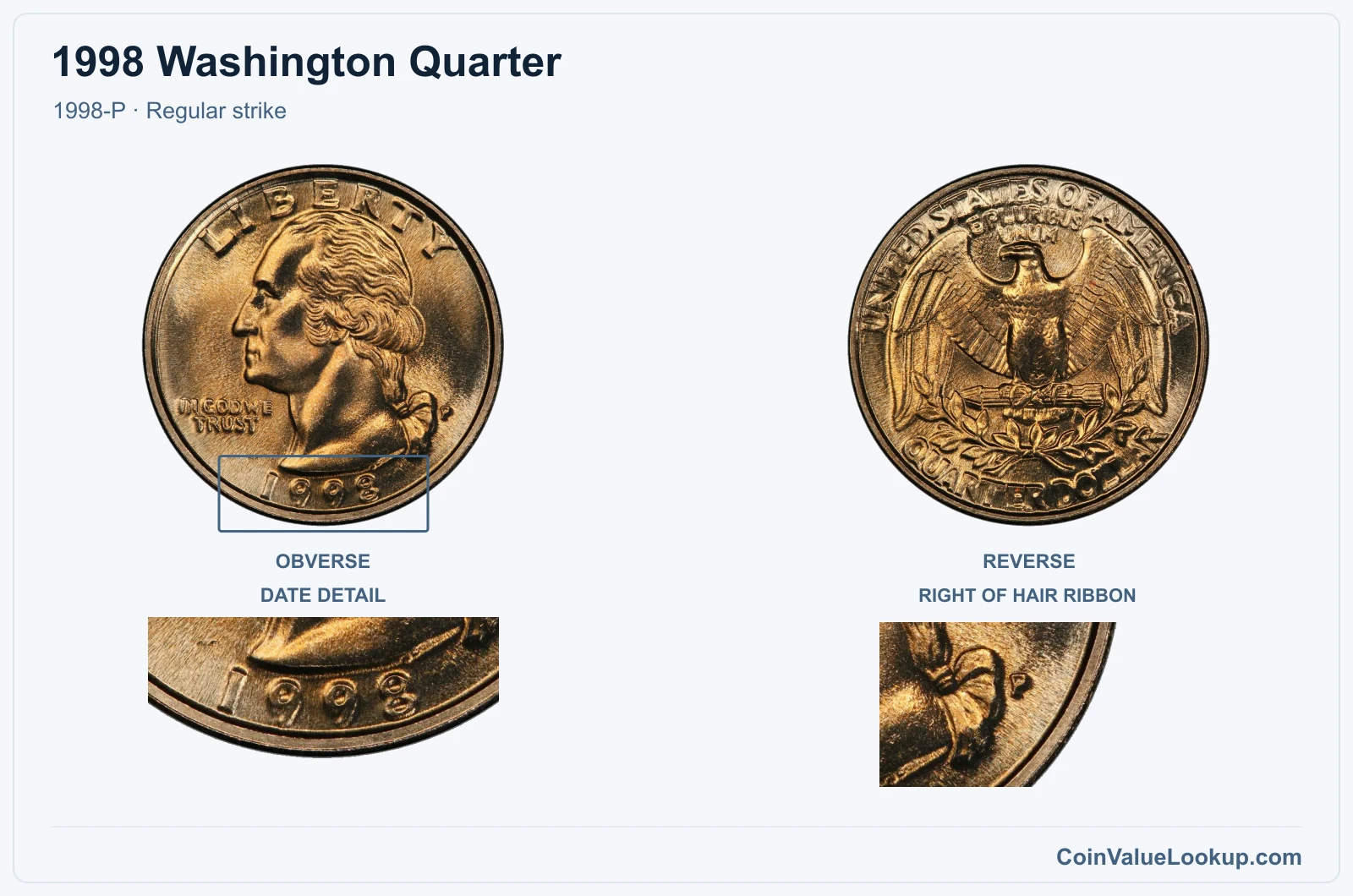
The 1998-P is a copper-nickel clad business strike from Philadelphia, weighing about 5.67 grams. It features Washington's portrait on the obverse and the heraldic eagle with arrows and olive branches on the reverse — the same design used since 1932.
In typical circulated condition, this coin is worth 25 cents. A USA Coin Book guide estimate places an MS65 example at approximately $8.64.
That is not a guaranteed sale price, but it gives you a ballpark for a well-preserved, original-luster coin. Most 1998-P quarters saw heavy use, so finding one in true gem condition takes some digging.
| Range | Grade | Price | Auction Records | Appraisal |
|---|---|---|---|---|
| PO | PO 1 | — | Coin Identifier | |
| FR | FR 2 | — | Coin Identifier | |
| AG | AG 3 | — | Coin Identifier | |
| G | G 4 | — | Coin Identifier | |
| G 6 | — | Coin Identifier | ||
| VG | VG 8 | — | Coin Identifier | |
| VG 10 | — | Coin Identifier | ||
| F | F 12 | — | Coin Identifier | |
| F 15 | — | Coin Identifier | ||
| VF | VF 20 | — | Coin Identifier | |
| VF 25 | — | Coin Identifier | ||
| VF 30 | — | Coin Identifier | ||
| VF 35 | — | Coin Identifier | ||
| XF | XF 40 | — | Coin Identifier | |
| XF 45 | — | Coin Identifier | ||
| AU | AU 50 | — | Coin Identifier | |
| AU 53 | — | Coin Identifier | ||
| AU 55 | — | Coin Identifier | ||
| AU 58 | — | Coin Identifier | ||
| MS | MS 60 | — | Coin Identifier | |
| MS 61 | — | Coin Identifier | ||
| MS 62 | — | Coin Identifier | ||
| MS 63 | — | Coin Identifier | ||
| MS 64 | Coin Identifier | |||
| MS 65 | Coin Identifier | |||
| MS 66 | Coin Identifier | |||
| MS 67 | Coin Identifier | |||
| MS 68 | Coin Identifier | |||
| MS 69 | — | — | — | |
| MS 70 | — | — | — |
1998 Washington Quarter — D
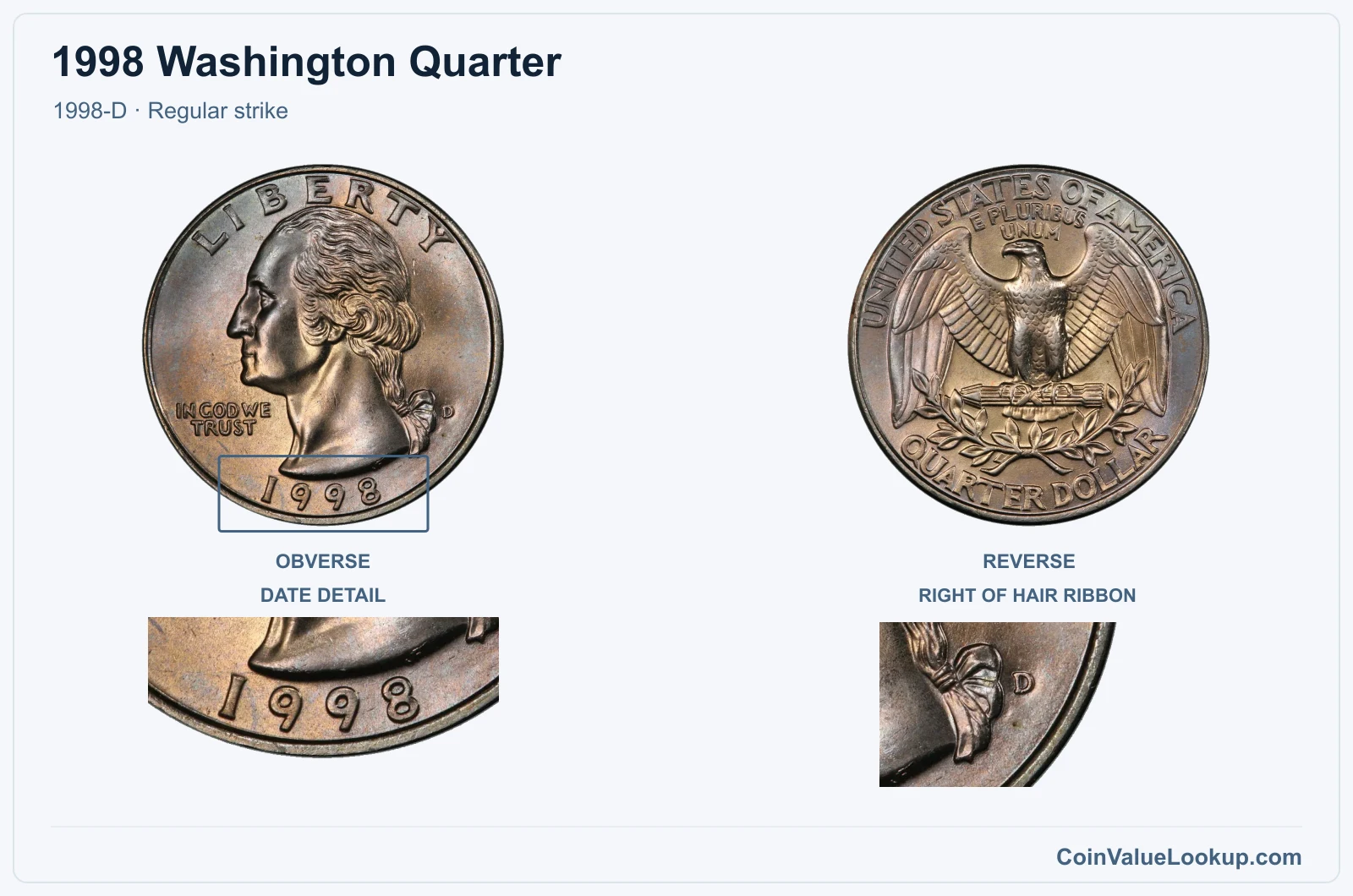
The 1998-D comes from the Denver Mint and shares the same copper-nickel clad composition and 5.67-gram weight as its Philadelphia counterpart. Look for the small "D" mintmark near Washington's ponytail.
Circulated examples spend their lives at face value. In MS65 condition, the USA Coin Book guide estimate is about $8.64 — identical to the P mint at that grade.
As the final Denver-minted eagle-reverse quarter, it closes out a production run that stretched back decades. Still, high-grade survivors are what command a premium; the historical footnote alone does not move the price.
| Range | Grade | Price | Auction Records | Appraisal |
|---|---|---|---|---|
| PO | PO 1 | — | Coin Identifier | |
| FR | FR 2 | — | Coin Identifier | |
| AG | AG 3 | — | Coin Identifier | |
| G | G 4 | — | Coin Identifier | |
| G 6 | — | Coin Identifier | ||
| VG | VG 8 | — | Coin Identifier | |
| VG 10 | — | Coin Identifier | ||
| F | F 12 | — | Coin Identifier | |
| F 15 | — | Coin Identifier | ||
| VF | VF 20 | — | Coin Identifier | |
| VF 25 | — | Coin Identifier | ||
| VF 30 | — | Coin Identifier | ||
| VF 35 | — | Coin Identifier | ||
| XF | XF 40 | — | Coin Identifier | |
| XF 45 | — | Coin Identifier | ||
| AU | AU 50 | — | Coin Identifier | |
| AU 53 | — | Coin Identifier | ||
| AU 55 | — | Coin Identifier | ||
| AU 58 | — | Coin Identifier | ||
| MS | MS 60 | — | Coin Identifier | |
| MS 61 | — | Coin Identifier | ||
| MS 62 | — | Coin Identifier | ||
| MS 63 | — | Coin Identifier | ||
| MS 64 | — | Coin Identifier | ||
| MS 65 | Coin Identifier | |||
| MS 66 | Coin Identifier | |||
| MS 67 | Coin Identifier | |||
| MS 68 | — | Coin Identifier | ||
| MS 69 | — | — | — | |
| MS 70 | — | — | — |
1998 Washington Quarter — S Proof
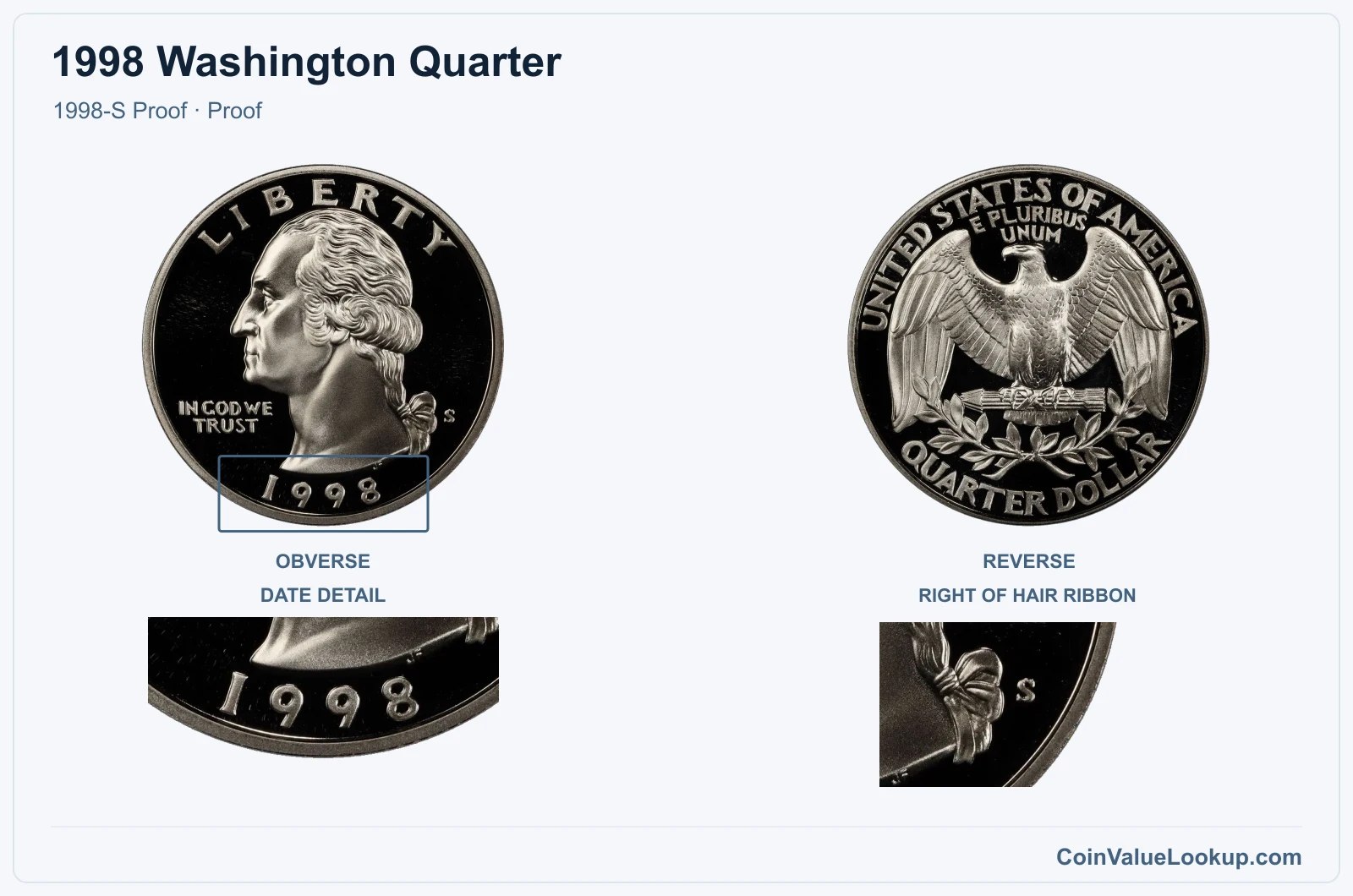
The 1998-S clad proof was struck at San Francisco on a standard copper-nickel clad planchet, the same metal as the P and D issues. Proofs feature mirror-like fields and sharply defined devices, produced using specially prepared dies and planchets.
A USA Coin Book guide estimate puts the PR65 at about $7.29. This is a generic proof estimate and does not reflect a Deep Cameo designation or higher proof grades.
Coin Value Lookup is a handy place to look up guide values for quarters and other denominations across different years and mints. If you are comparing your 1998-S clad proof against the silver version, the weight and edge differences described in the identification section above are your best tools.
Do not confuse this coin with the silver proof — both carry an "S" mintmark, but they are different products with different values.
| Range | Grade | Price | Auction Records | Appraisal |
|---|---|---|---|---|
| PR | PR 1 | — | Coin Identifier | |
| PR 2 | — | Coin Identifier | ||
| PR 3 | — | Coin Identifier | ||
| PR 4 | — | Coin Identifier | ||
| PR 6 | — | Coin Identifier | ||
| PR 8 | — | Coin Identifier | ||
| PR 10 | — | Coin Identifier | ||
| PR 12 | — | Coin Identifier | ||
| PR 15 | — | Coin Identifier | ||
| PR 20 | — | Coin Identifier | ||
| PR 25 | — | Coin Identifier | ||
| PR 30 | — | Coin Identifier | ||
| PR 35 | — | Coin Identifier | ||
| PR 40 | — | Coin Identifier | ||
| PR 45 | — | Coin Identifier | ||
| PR 50 | — | Coin Identifier | ||
| PR 53 | — | Coin Identifier | ||
| PR 55 | — | Coin Identifier | ||
| PR 58 | — | Coin Identifier | ||
| PR 60 | — | Coin Identifier | ||
| PR 61 | — | Coin Identifier | ||
| PR 62 | — | Coin Identifier | ||
| PR 63 | — | Coin Identifier | ||
| PR 64 | — | Coin Identifier | ||
| PR 65 | — | Coin Identifier | ||
| PR 66 | — | Coin Identifier | ||
| PR 67 | — | Coin Identifier | ||
| PR 68 | Coin Identifier | |||
| PR 69 | Coin Identifier | |||
| PR 70 | Coin Identifier |
1998 Washington Quarter — S Silver Proof
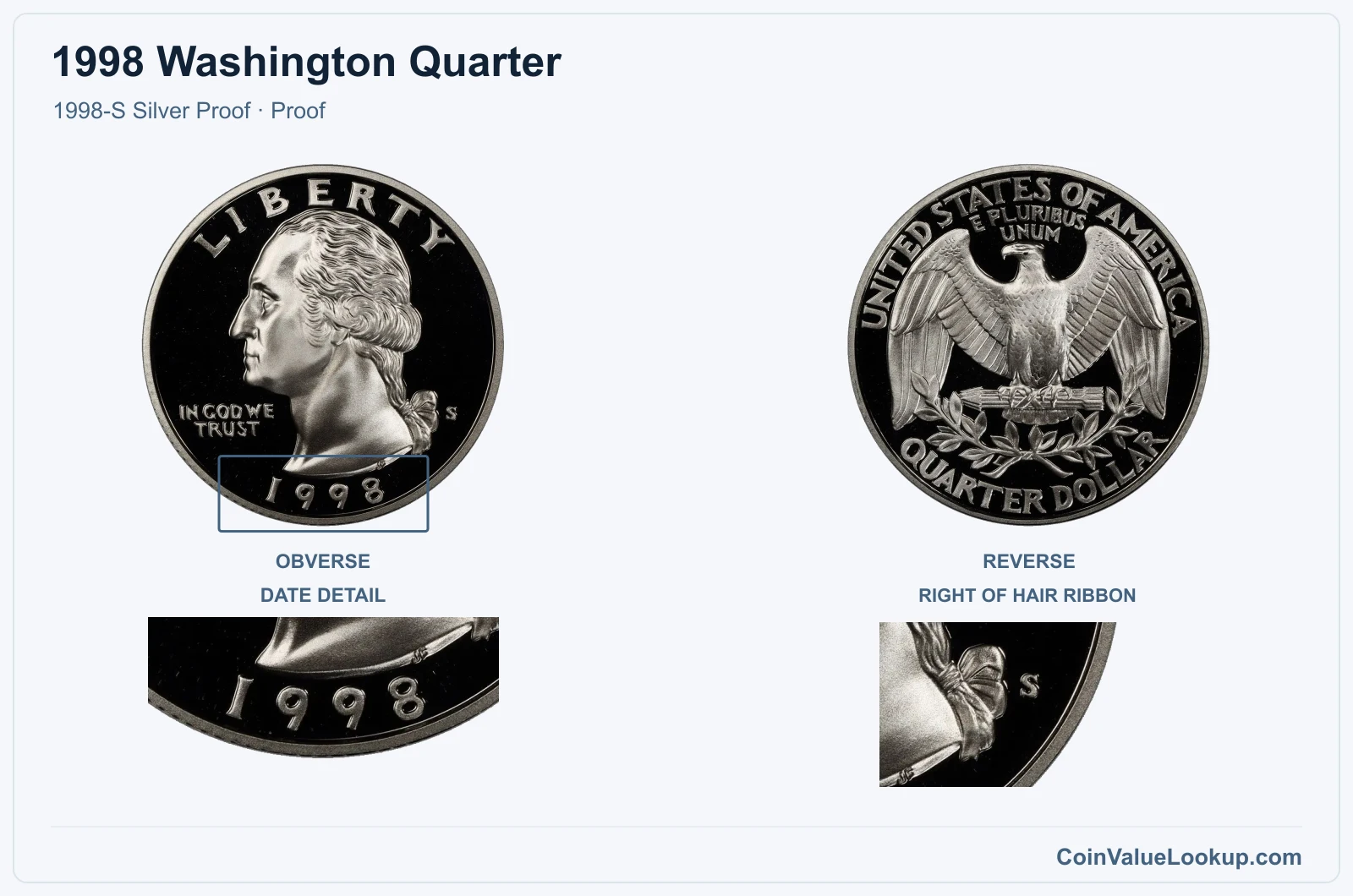
The 1998-S silver proof is struck on a 90% silver, 10% copper planchet weighing approximately 6.25 grams. PCGS rounds the catalog weight to 6.30 grams.
It carries the same "S" mintmark and proof finish as the clad version, so visual identification alone is not always enough.
The USA Coin Book guide estimate for PR65 is about $21, making it the highest-valued standard 1998 quarter version at that grade level. Silver-proof estimates are sensitive to the silver market, so the number can shift over time.
Original U.S. Mint packaging is the simplest confirmation of silver content. Without it, an accurate scale and edge inspection are your friends.
The silver proof lacks the copper-toned edge stripe visible on clad coins. Third-party certification removes guesswork entirely.
| Range | Grade | Price | Auction Records | Appraisal |
|---|---|---|---|---|
| PR | PR 1 | — | Coin Identifier | |
| PR 2 | — | Coin Identifier | ||
| PR 3 | — | Coin Identifier | ||
| PR 4 | — | Coin Identifier | ||
| PR 6 | — | Coin Identifier | ||
| PR 8 | — | Coin Identifier | ||
| PR 10 | — | Coin Identifier | ||
| PR 12 | — | Coin Identifier | ||
| PR 15 | — | Coin Identifier | ||
| PR 20 | — | Coin Identifier | ||
| PR 25 | — | Coin Identifier | ||
| PR 30 | — | Coin Identifier | ||
| PR 35 | — | Coin Identifier | ||
| PR 40 | — | Coin Identifier | ||
| PR 45 | — | Coin Identifier | ||
| PR 50 | — | Coin Identifier | ||
| PR 53 | — | Coin Identifier | ||
| PR 55 | — | Coin Identifier | ||
| PR 58 | — | Coin Identifier | ||
| PR 60 | — | Coin Identifier | ||
| PR 61 | — | Coin Identifier | ||
| PR 62 | — | Coin Identifier | ||
| PR 63 | — | Coin Identifier | ||
| PR 64 | — | Coin Identifier | ||
| PR 65 | — | Coin Identifier | ||
| PR 66 | — | Coin Identifier | ||
| PR 67 | — | Coin Identifier | ||
| PR 68 | Coin Identifier | |||
| PR 69 | Coin Identifier | |||
| PR 70 | Coin Identifier |
1998 Washington Quarter Error List
1. 1998 Washington Quarter — Obverse Die Cap
An obverse die cap occurs when a struck coin sticks to the upper die and is struck repeatedly into subsequent blanks. The result is a coin with a high, cupped rim and a sharp obverse that was pressed into the die's face while the reverse becomes progressively indistinct.
On the reported 1998-P example, the tall cap rim is most prominent near the 9 o'clock position. The obverse portrait and legends remain sharp, but the reverse shows only a faint, reversed impression of Washington's nose transferred through the struck-through cap.
A genuine die cap has a distinctive geometry — uniform metal flow creating the cup shape, plus that transferred reverse design. Coins that have been spooned, hammered into a cup shape or otherwise damaged after minting will not show the transferred die image.
One 1998-P die cap graded NGC MS68 sold for $1,035 at Heritage Auctions in March 2010.
2. 1998 Washington Quarter — Double Strike with Off-Center Second Strike
A double-struck quarter received two separate impressions from the dies, with the second strike landing off center. This creates two overlapping but distinct complete designs on one coin — very different from doubled-die doubling, which affects only specific design elements.
On the reported 1998-P example, the original strike retains a readable date and "P" mintmark, while the second impression is visibly offset, producing a dramatic overlapping outline. The exact offset percentage is not specified.
Do not confuse this with machine doubling, which produces flat, shelf-like distortion on letters, or with a doubled die, which shows consistent notching or separation. Neither of those creates a whole separate design image.
A 1998-P double strike graded NGC MS63 sold for $312 at Heritage Auctions in December 2024.
3. 1998 Washington Quarter — Die Gouge / Named Raised-Line Variety
This category is sometimes called the "Wounded Eagle" variety for the 1998 quarter. It involves a raised line or extra-metal feature on the reverse, the result of a gouge or defect in the die surface.
Because the die is incuse, damage to the die appears as a raised element on the struck coin.
To check for this, compare the reverse of your 1998 quarter to a normal example under good lighting. A genuine die gouge will appear as a raised line that is consistent across multiple coins struck from the same die.
Do not confuse this with an incuse scratch, random damage or an unrelated die crack. Post-mint scratches are cut into the surface rather than raised above it.
Condition, visibility and confirmation of the specific variety all affect value, so individual assessment matters.
4. 1998 Washington Quarter — Doubled Die Obverse
A doubled die obverse (DDO) results from a misalignment during die production, causing portions of the obverse design to show consistent doubling. On a 1998 quarter, you would look for separation, notching or thickening on obverse letters, the date or design elements.
Compare your coin's obverse lettering to a known normal example under consistent, angled lighting. Genuine doubled die doubling appears the same way on every coin struck from that die — it is not random.
Machine doubling is the most common lookalike. It produces flat, shelf-like distortion rather than the raised, rounded separation of a true doubled die.
Reflections and worn die contours can also mimic doubling to the untrained eye. The value of a DDO depends on the specific variety, its visibility and the coin's condition.
5. 1998 Washington Quarter — Doubled Die Reverse
A doubled die reverse (DDR) shows consistent doubling on reverse design elements — the eagle, lettering or denomination — caused during die manufacture. The key word is consistent: every coin from that die pair will show the same doubling in the same location.
To check, examine the reverse legends and the eagle's features closely under magnification. Compare with a normal 1998 quarter and look for separation or notching on specific letters or design contours.
Machine doubling is again the usual suspect for false positives. It creates flat, worthless shelf marks rather than the rounded, distinct separation of a genuine doubled die.
Random damage and reflections can also fool you. Value depends on the specific DDR variety, how pronounced the doubling is and the overall condition of the coin.
6. 1998 Washington Quarter — Die Crack / Die Chip
Die cracks appear as raised lines on a coin's surface, formed when a working die develops a fracture from repeated striking pressure. Die chips are small raised blobs caused by a piece of the die breaking away.
On a 1998 quarter, look for fine raised lines running across the design or small raised lumps near letters or devices. A crack that connects to the rim and creates a larger raised area is called a cud — a more dramatic and typically more valuable form of die failure.
Incuse scratches, corrosion lines or foreign material stuck to the surface can look similar at first glance. The distinction is that die cracks are raised and follow a natural fracture pattern, while post-mint scratches are grooves cut into the metal.
Value depends on size, location, visibility and overall coin condition.
7. 1998 Washington Quarter — Wrong Planchet / Off-Metal Strike
A wrong planchet error occurs when a blank intended for a different denomination or composition accidentally enters the quarter press. The result is a quarter design struck on metal that does not match normal quarter specifications.
If you suspect a wrong planchet, weigh your coin accurately and measure the diameter. Compare those numbers to the standard 5.67-gram, 24.3 mm specs for a clad quarter.
The edge and completeness of the design also provide clues — a smaller planchet will show an incomplete strike.
Lookalikes include coins with corrosion, acid damage, removed plating or deliberate alteration. These post-mint changes affect weight and appearance but are not mint errors.
Authenticated third-party certification is important for this category. Value depends on the specific planchet involved, the coin's condition and how well the design struck up.
8. 1998 Washington Quarter — Missing Clad Layer
A missing clad layer error happens when one of the outer layers fails to bond to the blank before striking. The exposed side may show a different color — typically a copper tone — and the coin will weigh less than a normal clad quarter.
Check both faces, the edge and the weight. A normal clad quarter shows a silver-toned surface on both sides with a visible copper stripe on the edge.
A missing clad layer coin will have one face that looks distinctly different in color, and the edge may appear uniform rather than layered.
Toning, corrosion, acid exposure and surface metal removed after minting are common lookalikes. These post-mint alterations can mimic the appearance of exposed copper but will not produce the correct reduced weight.
Value depends on which side is affected, how obvious the error is and the coin's overall condition.
9. 1998 Washington Quarter — Broadstrike
A broadstrike occurs when a coin is struck without the normal retaining collar that constrains the blank to its proper diameter. The result is a coin that spreads outward, appearing slightly larger than normal with a weak or absent rim.
On a 1998 quarter, look for outward metal spread beyond the standard 24.3 mm diameter. The design should be mostly complete and centered, distinguishing it from an off-center strike where the design is shifted.
The edge will lack the normal reeded pattern.
Coins that were flattened or squeezed after leaving the mint can look similar but will show damage signatures like tool marks or uneven thickness. A genuine broadstrike has uniform metal flow from the striking pressure.
Value depends on how dramatic the spread is, whether the full design is retained and the overall condition.
10. 1998 Washington Quarter — Clipped Planchet
A clipped planchet error happens when the blank is punched from strip metal that overlaps a previously punched hole or the edge of the strip. The result is a coin missing a curved, straight or irregular section from the original blank.
Look at the edge profile carefully. A genuine clip often produces a characteristic area of design weakness directly opposite the missing portion, called the Blakesley effect.
The metal at the clip boundary will show smooth, natural flow rather than sharp tool marks.
Filed notches, deliberate edge cuts and corrosion can mimic a clip. These post-mint alterations typically leave sharp edges, tool marks or irregular surfaces that differ from the smooth contours of a genuine planchet clip.
Value depends on clip size, type and the coin's condition.
11. 1998 Washington Quarter — Defective Planchet
A defective planchet error means the blank itself had a flaw — a void, lamination, crack or irregular surface — before it was struck. The struck design then conforms around or over that pre-existing defect.
Examine both faces and the edge for irregular voids, splits or rough patches in the metal that the struck design partially covers. The fact that the design elements flow into and around the flaw is key evidence that the defect existed before striking.
Post-mint gouges, corrosion and deliberate metal removal can look similar. The difference is that a genuine defective planchet shows design elements struck over and conforming to the flaw, while post-mint damage cuts through or disrupts the already-struck design.
Value depends on the type and size of the defect and the coin's overall condition.