1998 Lincoln Penny Coin Value: How Much Is It Worth?
Most 1998 Lincoln pennies are worth their face value of one cent. In average circulated condition, that is about what you should expect.
A guide estimate for a regular uncirculated example at MS65 grade is around $0.36, and a standard 1998-S proof at PR65 is listed near $11. Special varieties and errors occupy their own markets, and no single maximum applies across the board.
These are grade-specific retail estimates from a published guide, not guaranteed purchase offers.
Fast Way to Identify Your 1998 Lincoln Penny
The quickest way to figure out what you have is to upload clear photos of both the front and back of your coin. Our identifier can give you a preliminary read on your coin's mint, variety and general type from those images alone.
It does not authenticate, certify or assign an exact grade, but it narrows the field fast so you know what to research next.
1998 Penny Value
Upload both sides of your 1998 Lincoln Penny.
Front Obverse
Upload photo
Back Reverse
Upload photo
Which 1998 Lincoln Penny Versions Are Worth Money?
- A 1998 Philadelphia cent with Wide AM reverse spacing is a recognized variety; a guide lists about $30 at MS65 versus $0.36 for the normal Close AM business strike.
- The 1998-S Close AM proof, where the A and M nearly touch instead of showing the normal proof gap, carries a guide estimate around $585 at PR65.
- Standard 1998-S proofs in higher grades or with cameo and deep cameo designations can trade above the base PR65 estimate of $11.
- Clean, original-surface coins in strong uncirculated or proof condition are always worth more careful evaluation than dull or damaged examples.
Step 1: Identify Your 1998 Lincoln Penny Mint Mark and Version
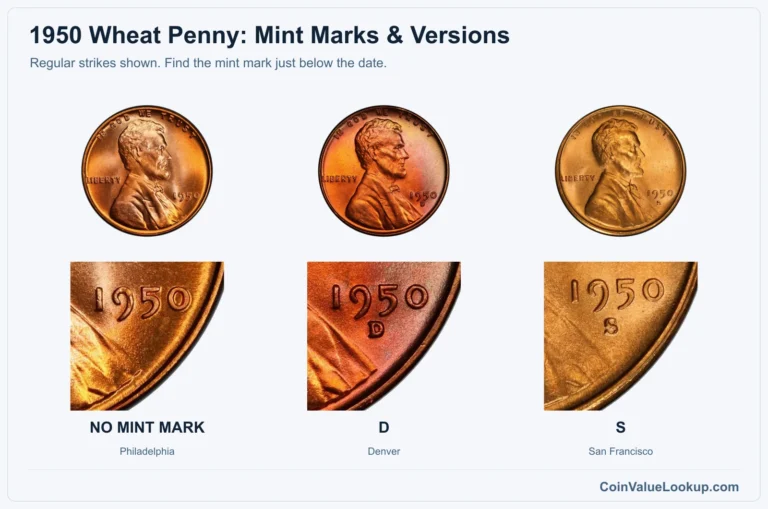
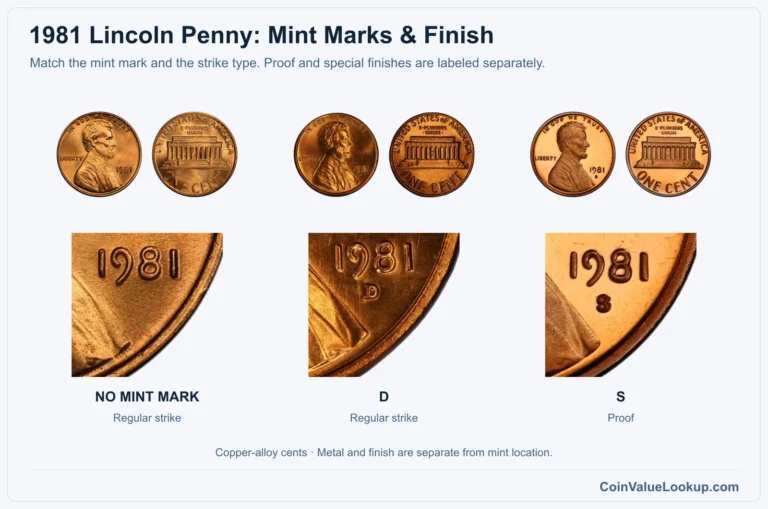
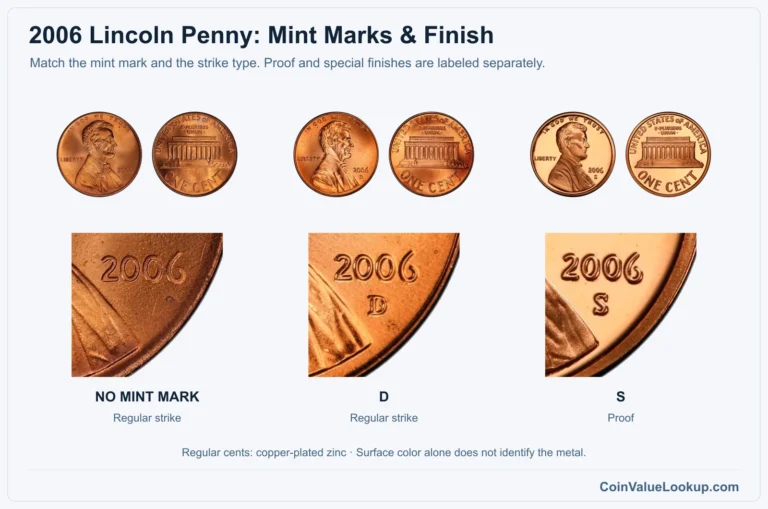
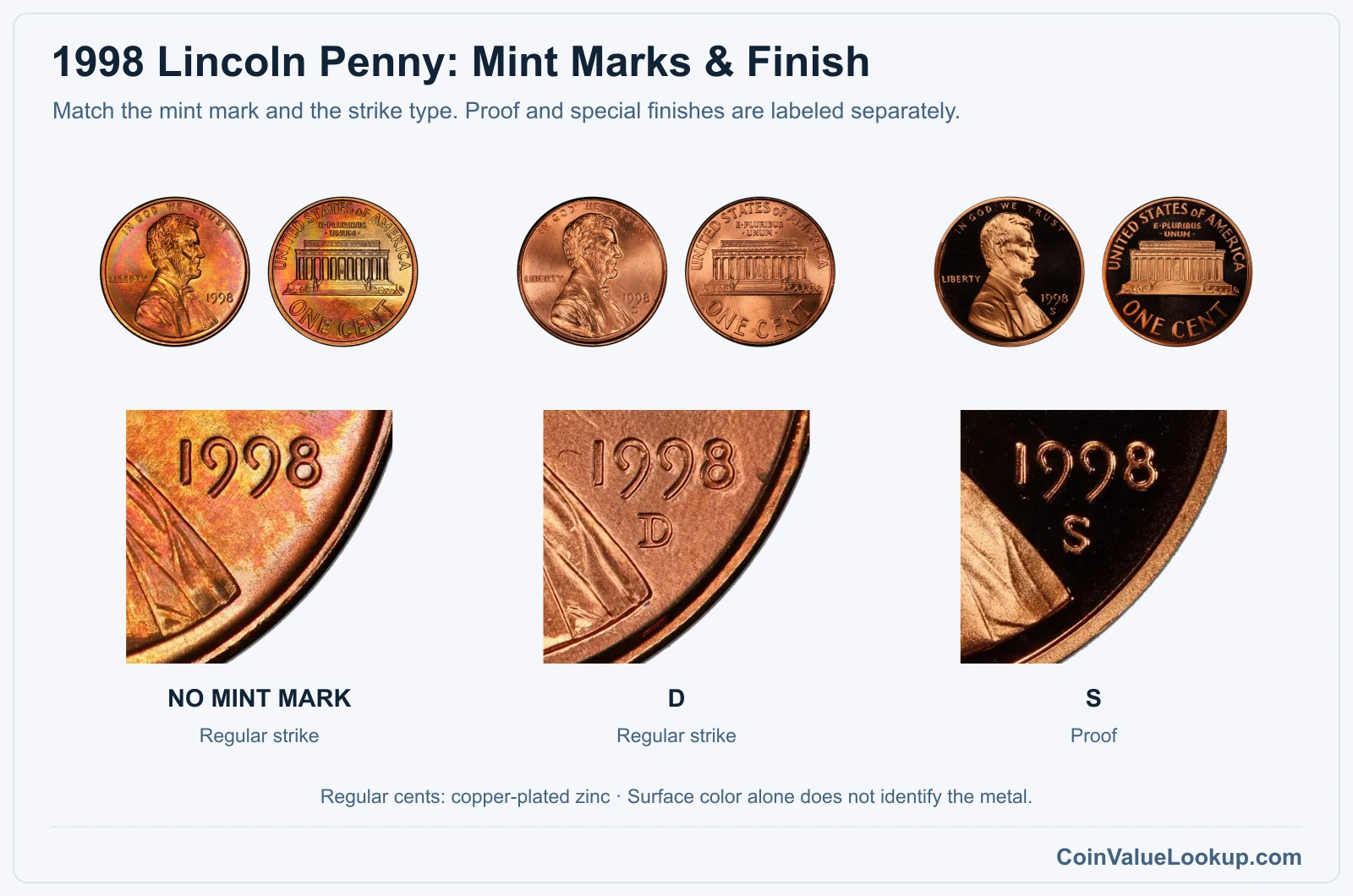
Start by looking just below the date on the front. No letter means Philadelphia.
A small D means Denver. An S means San Francisco, and on 1998 cents the S appears only on proof strikes.
All three versions share the Lincoln Memorial reverse and are struck on copper-plated zinc planchets weighing a nominal 2.50 grams with a plain edge. Color alone cannot prove a different alloy, so do not assume a silver-toned penny is anything special without checking weight and diameter.
The critical extra step for 1998 is checking the reverse lettering. Flip the coin over and look at the word AMERICA along the bottom.
On a normal 1998 business strike, the A and M nearly touch, which is the Close AM style. On a normal 1998-S proof, the A and M are clearly separated, which is Wide AM.
If you find those reversed, a business strike with Wide AM spacing or a proof with Close AM spacing, you may have a recognized variety worth considerably more than the standard version.
Step 2: Check Your 1998 Lincoln Penny Grade
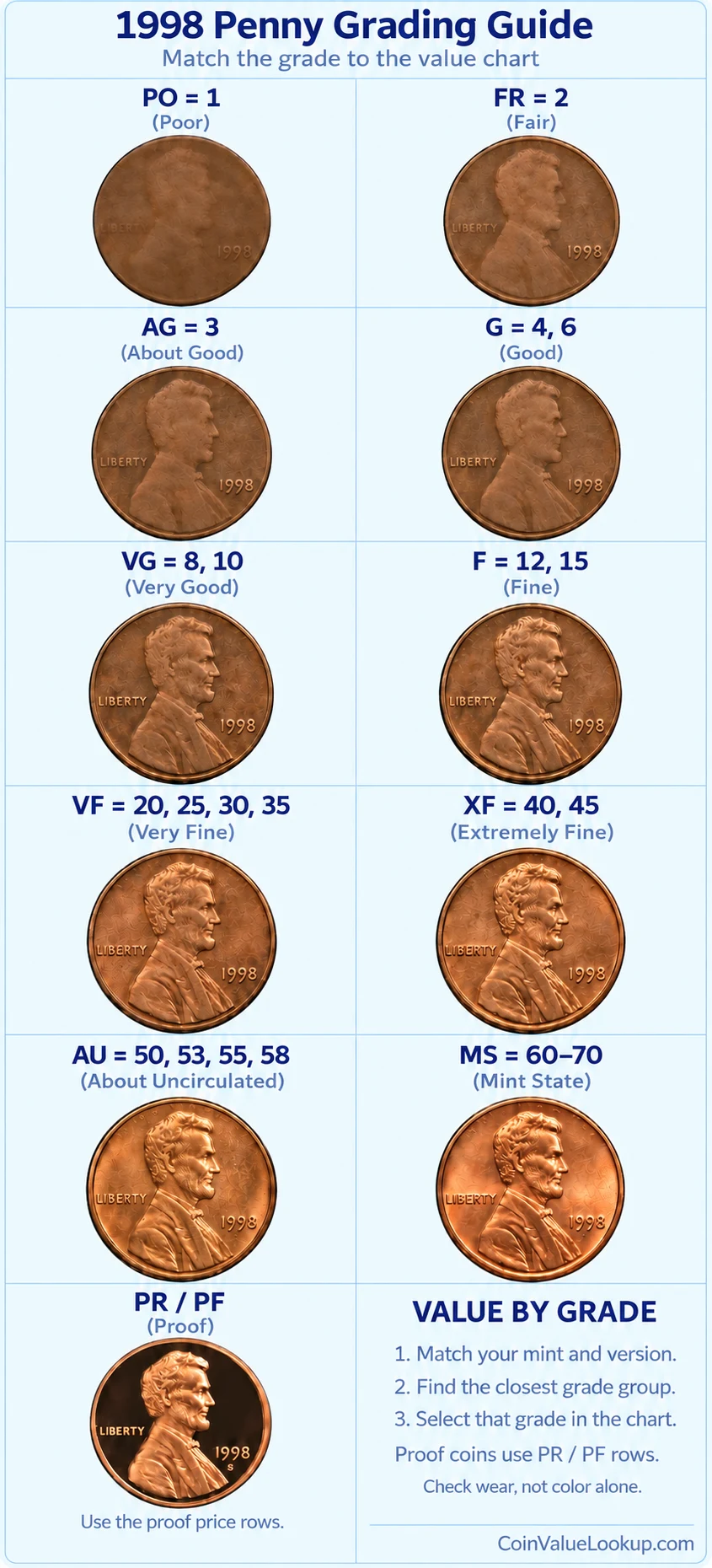
Focus first on the high points of Lincoln's portrait: the cheekbone, jawline and the hair detail just above the ear. These are the first areas to show friction.
On the reverse, check the columns and horizontal lines of the Memorial building.
A coin with full original luster and no wear is Mint State. Light rub on the cheek drops it below that threshold quickly.
Use the comparison image to match your coin's wear pattern against known grade examples.
Color grading is separate from wear. Red, Red-Brown and Brown describe how much original copper-plated surface remains bright.
A coin can be technically uncirculated but Brown from environmental exposure. Corrosion spots, cleaning marks and heavy contact marks also reduce a coin's desirability independently of the numerical grade.
For proofs, look for mirrored fields and sharply struck devices. Proof is a manufacturing finish, not a grade above Mint State.
Hairlines from mishandling or hazy surfaces lower the proof grade.
Step 3: Check 1998 Lincoln Penny Value by Mint and Version
1998 Lincoln Penny
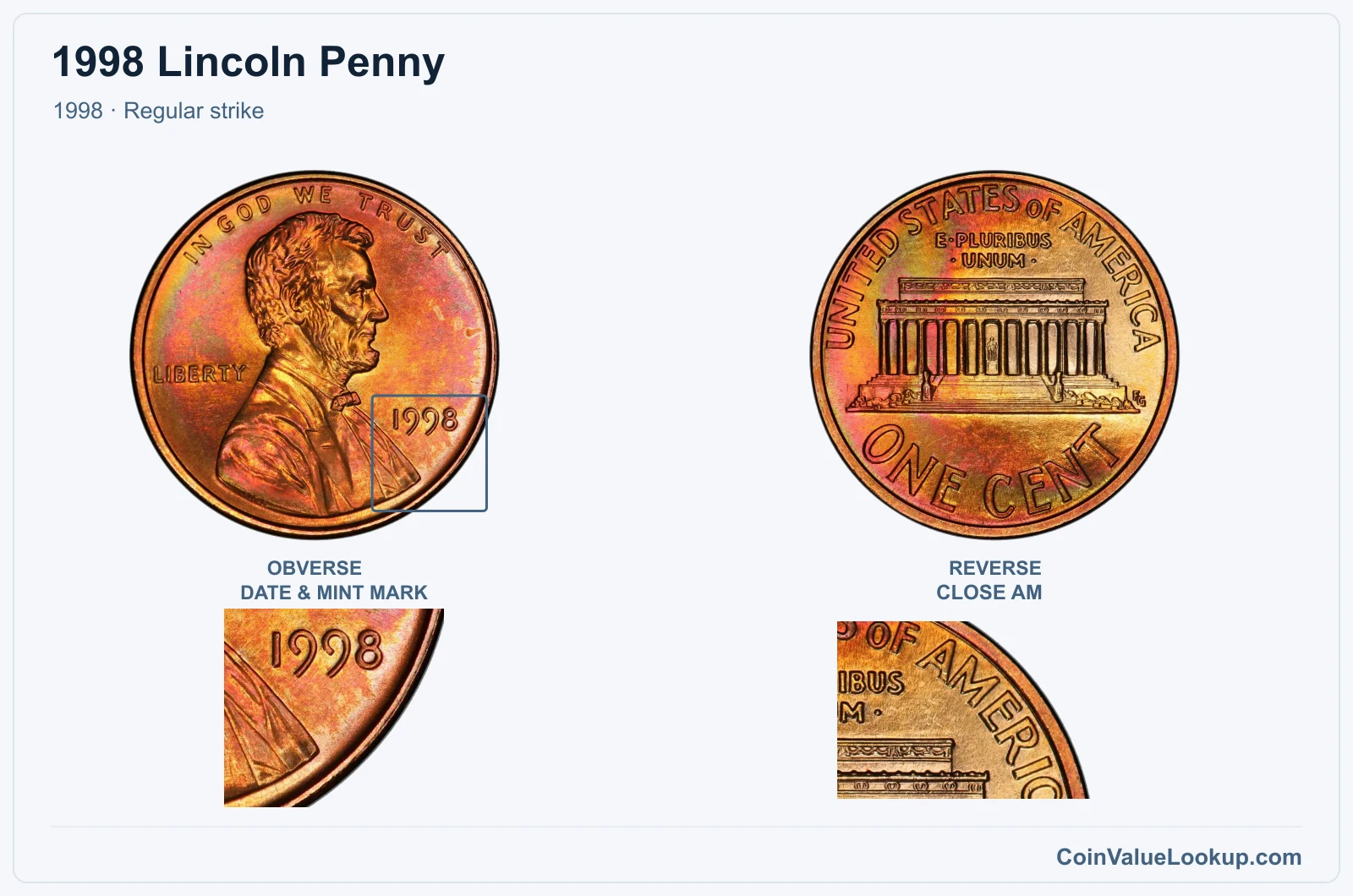
The 1998 Philadelphia cent has no mintmark below the date. It was struck for general circulation on a copper-plated zinc planchet.
Millions were made, so circulated examples are worth face value.
At MS65, a published guide estimates about $0.36. You need original luster and minimal contact marks to reach that level.
The normal reverse for this business strike uses Close AM spacing, where the A and M in AMERICA nearly touch. If you see a clear gap between those letters instead, stop and read the Wide AM variety section below.
| Range | Grade | Price | Auction Records | Appraisal |
|---|---|---|---|---|
| PO | PO 1 | — | Coin Identifier | |
| FR | FR 2 | — | Coin Identifier | |
| AG | AG 3 | — | Coin Identifier | |
| G | G 4 | — | Coin Identifier | |
| G 6 | — | Coin Identifier | ||
| VG | VG 8 | — | Coin Identifier | |
| VG 10 | — | Coin Identifier | ||
| F | F 12 | — | Coin Identifier | |
| F 15 | — | Coin Identifier | ||
| VF | VF 20 | — | Coin Identifier | |
| VF 25 | — | Coin Identifier | ||
| VF 30 | — | Coin Identifier | ||
| VF 35 | — | Coin Identifier | ||
| XF | XF 40 | — | Coin Identifier | |
| XF 45 | — | Coin Identifier | ||
| AU | AU 50 | — | Coin Identifier | |
| AU 53 | — | Coin Identifier | ||
| AU 55 | — | Coin Identifier | ||
| AU 58 | — | Coin Identifier | ||
| MS | MS 60 | — | Coin Identifier | |
| MS 61 | — | Coin Identifier | ||
| MS 62 | — | Coin Identifier | ||
| MS 63 | — | Coin Identifier | ||
| MS 64 | — | Coin Identifier | ||
| MS 65 | — | Coin Identifier | ||
| MS 66 | — | Coin Identifier | ||
| MS 67 | — | Coin Identifier | ||
| MS 68 | — | Coin Identifier | ||
| MS 69 | — | — | — | |
| MS 70 | — | — | — |
1998 Lincoln Penny — Wide AM
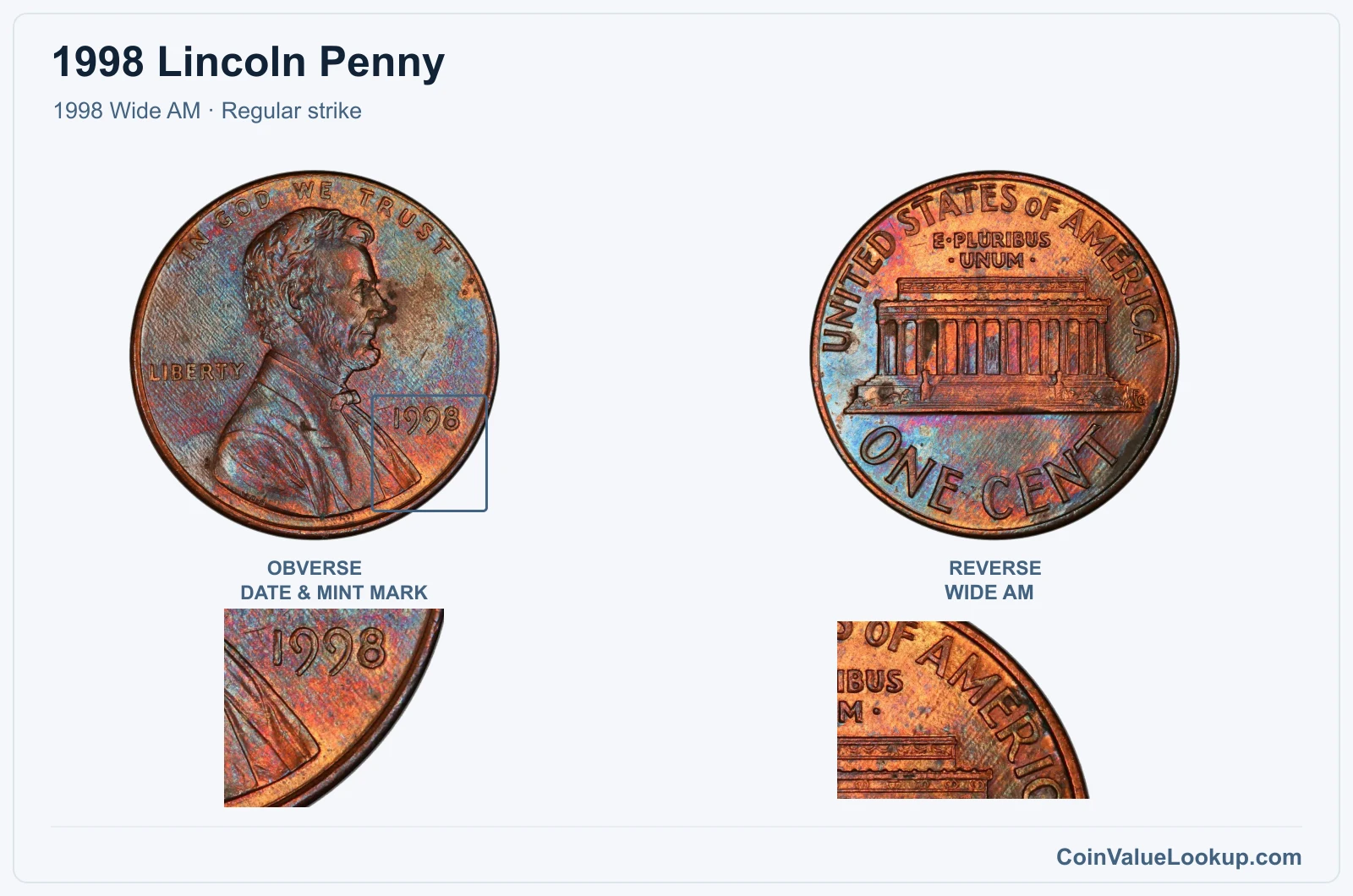
This is the 1998 Philadelphia cent with the Wide AM reverse, where a visible gap separates the A and M in AMERICA. Normal business strikes of this year use Close AM, so this variety used a die intended for proof production.
A published guide lists about $30 at MS65. That is roughly 80 times the value of a standard 1998 Philadelphia cent in the same grade.
To confirm the variety, compare the AM spacing against a known normal coin side by side. The difference is subtle in photos but clear in hand.
Also check that your coin is a business strike, not a proof; a proof with Wide AM is simply normal for 1998-S.
Coin Value Lookup can help you look up guides for this and other Lincoln cent varieties if you want to compare across years.
| Range | Grade | Price | Auction Records | Appraisal |
|---|---|---|---|---|
| PO | PO 1 | — | Coin Identifier | |
| FR | FR 2 | — | Coin Identifier | |
| AG | AG 3 | — | Coin Identifier | |
| G | G 4 | — | Coin Identifier | |
| G 6 | — | Coin Identifier | ||
| VG | VG 8 | — | Coin Identifier | |
| VG 10 | — | Coin Identifier | ||
| F | F 12 | — | Coin Identifier | |
| F 15 | — | Coin Identifier | ||
| VF | VF 20 | — | Coin Identifier | |
| VF 25 | — | Coin Identifier | ||
| VF 30 | — | Coin Identifier | ||
| VF 35 | — | Coin Identifier | ||
| XF | XF 40 | — | Coin Identifier | |
| XF 45 | — | Coin Identifier | ||
| AU | AU 50 | — | Coin Identifier | |
| AU 53 | — | Coin Identifier | ||
| AU 55 | — | Coin Identifier | ||
| AU 58 | Coin Identifier | |||
| MS | MS 60 | — | Coin Identifier | |
| MS 61 | — | Coin Identifier | ||
| MS 62 | Coin Identifier | |||
| MS 63 | — | Coin Identifier | ||
| MS 64 | — | Coin Identifier | ||
| MS 65 | — | Coin Identifier | ||
| MS 66 | — | Coin Identifier | ||
| MS 67 | — | Coin Identifier | ||
| MS 68 | — | Coin Identifier | ||
| MS 69 | — | — | — | |
| MS 70 | — | — | — |
1998 Lincoln Penny — D
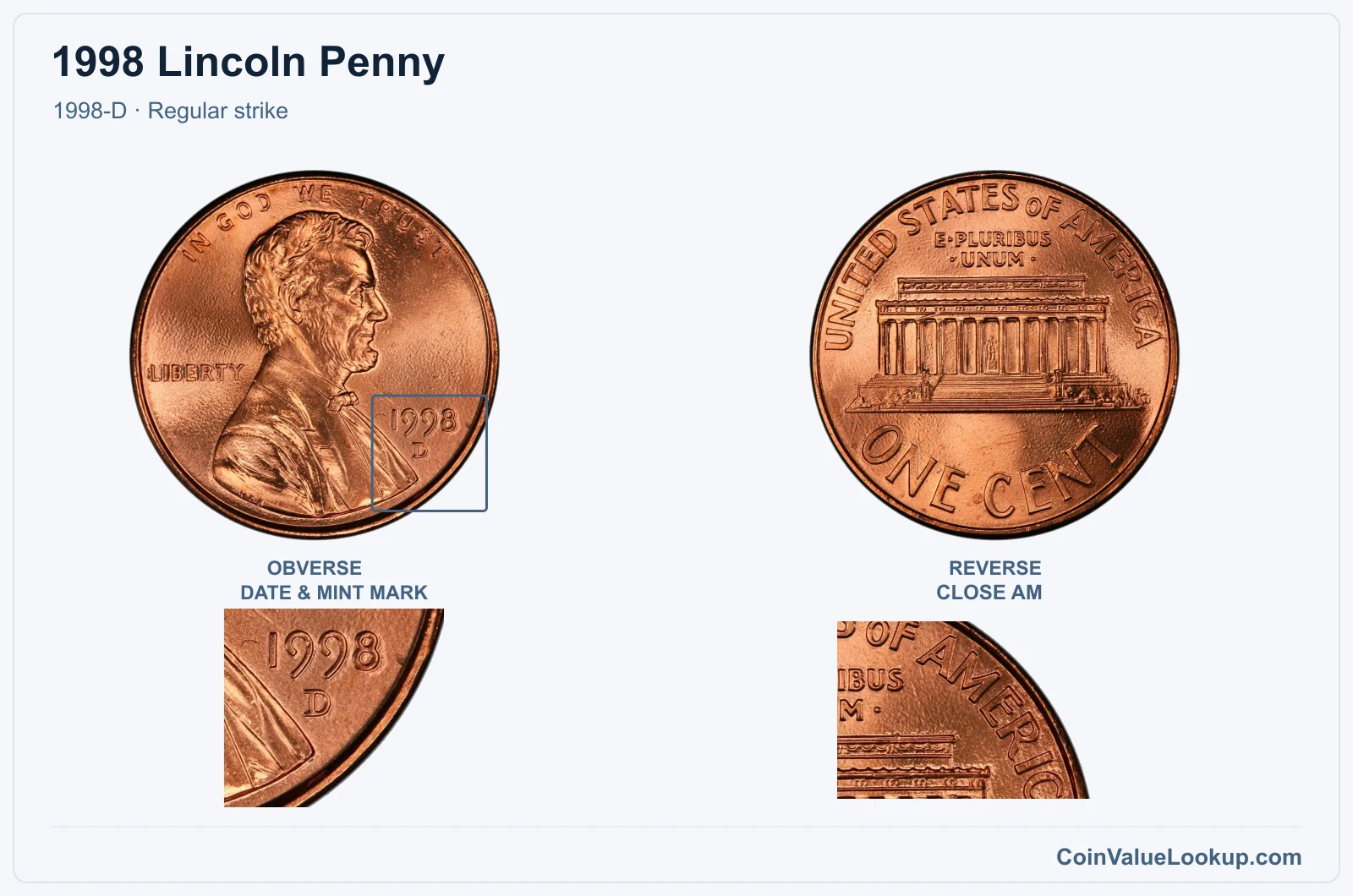
The 1998-D cent carries a small D mintmark below the date, struck at the Denver Mint for circulation. Like the Philadelphia issue, it is copper-plated zinc at a nominal 2.50 grams.
A guide estimate at MS65 is about $0.36, the same as the Philadelphia version. Circulated pieces trade at face value.
The normal reverse for Denver business strikes is Close AM. No recognized Wide AM variety exists for the 1998-D in this data, so do not assume a Denver cent with separated AM letters is automatically valuable without professional review.
| Range | Grade | Price | Auction Records | Appraisal |
|---|---|---|---|---|
| PO | PO 1 | — | Coin Identifier | |
| FR | FR 2 | — | Coin Identifier | |
| AG | AG 3 | — | Coin Identifier | |
| G | G 4 | — | Coin Identifier | |
| G 6 | — | Coin Identifier | ||
| VG | VG 8 | — | Coin Identifier | |
| VG 10 | — | Coin Identifier | ||
| F | F 12 | — | Coin Identifier | |
| F 15 | — | Coin Identifier | ||
| VF | VF 20 | — | Coin Identifier | |
| VF 25 | — | Coin Identifier | ||
| VF 30 | — | Coin Identifier | ||
| VF 35 | — | Coin Identifier | ||
| XF | XF 40 | — | Coin Identifier | |
| XF 45 | — | Coin Identifier | ||
| AU | AU 50 | — | Coin Identifier | |
| AU 53 | — | Coin Identifier | ||
| AU 55 | — | Coin Identifier | ||
| AU 58 | — | Coin Identifier | ||
| MS | MS 60 | — | Coin Identifier | |
| MS 61 | — | Coin Identifier | ||
| MS 62 | — | Coin Identifier | ||
| MS 63 | — | Coin Identifier | ||
| MS 64 | — | Coin Identifier | ||
| MS 65 | Coin Identifier | |||
| MS 66 | Coin Identifier | |||
| MS 67 | Coin Identifier | |||
| MS 68 | Coin Identifier | |||
| MS 69 | — | Coin Identifier | ||
| MS 70 | — | — | — |
1998 Lincoln Penny — S PR
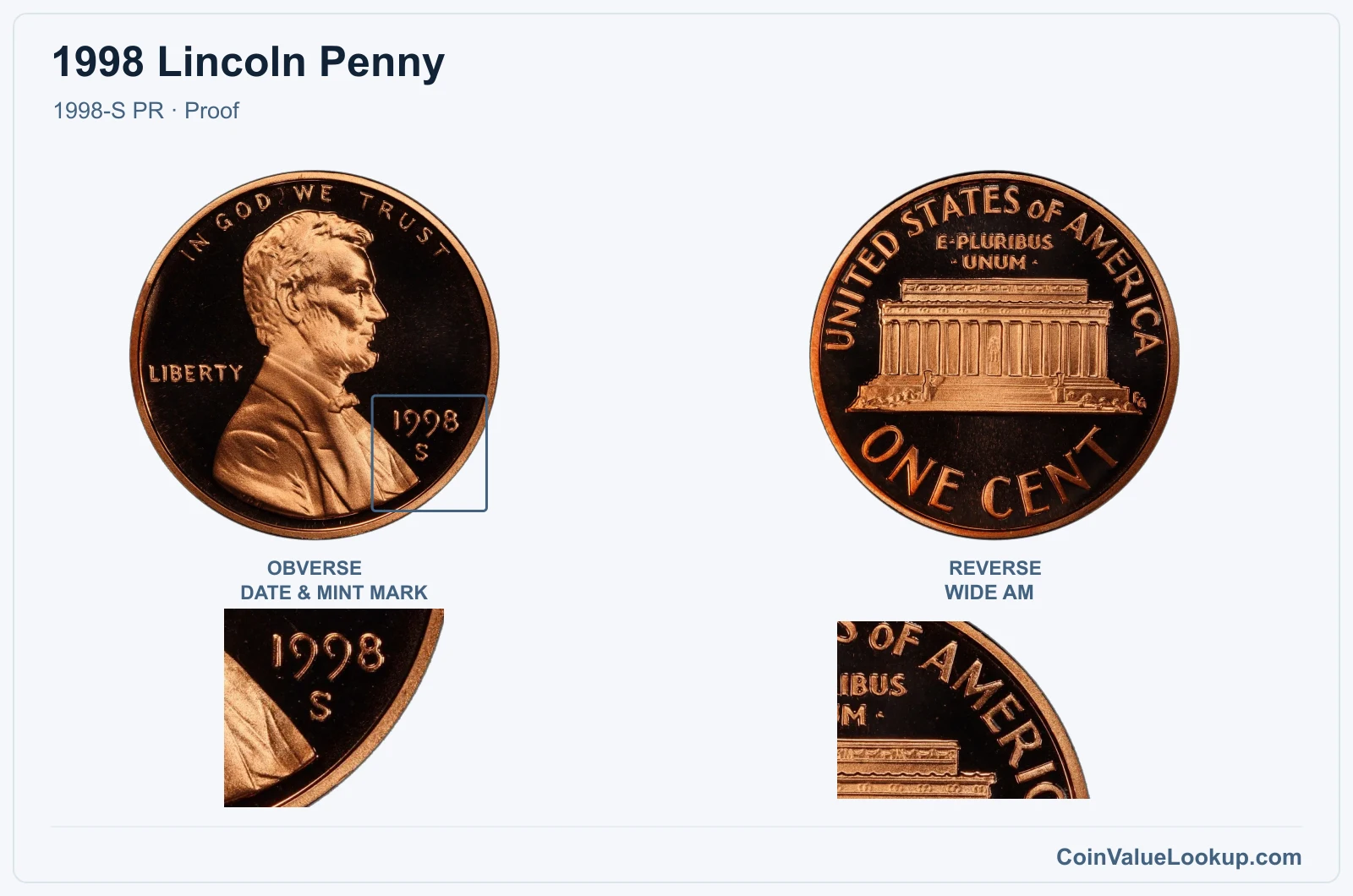
The 1998-S proof was struck at San Francisco for collector sets. It has an S mintmark below the date, mirrored fields and crisp, squared-off design details.
A guide lists about $11 at PR65.
The normal reverse for 1998-S proofs uses Wide AM spacing, with the A and M clearly separated. Cameo and Deep Cameo designations, where the raised devices appear frosty against mirror fields, are graded separately and can bring more than the base PR65 figure.
Surface quality matters a lot: hairlines, haze or fingerprints reduce the grade quickly on proof coins.
| Range | Grade | Price | Auction Records | Appraisal |
|---|---|---|---|---|
| PR | PR 1 | — | Coin Identifier | |
| PR 2 | — | Coin Identifier | ||
| PR 3 | — | Coin Identifier | ||
| PR 4 | — | Coin Identifier | ||
| PR 6 | — | Coin Identifier | ||
| PR 8 | — | Coin Identifier | ||
| PR 10 | — | Coin Identifier | ||
| PR 12 | — | Coin Identifier | ||
| PR 15 | — | Coin Identifier | ||
| PR 20 | — | Coin Identifier | ||
| PR 25 | — | Coin Identifier | ||
| PR 30 | — | Coin Identifier | ||
| PR 35 | — | Coin Identifier | ||
| PR 40 | — | Coin Identifier | ||
| PR 45 | — | Coin Identifier | ||
| PR 50 | — | Coin Identifier | ||
| PR 53 | — | Coin Identifier | ||
| PR 55 | — | Coin Identifier | ||
| PR 58 | — | Coin Identifier | ||
| PR 60 | Coin Identifier | |||
| PR 61 | — | Coin Identifier | ||
| PR 62 | — | Coin Identifier | ||
| PR 63 | — | Coin Identifier | ||
| PR 64 | — | Coin Identifier | ||
| PR 65 | — | Coin Identifier | ||
| PR 66 | — | Coin Identifier | ||
| PR 67 | Coin Identifier | |||
| PR 68 | Coin Identifier | |||
| PR 69 | Coin Identifier | |||
| PR 70 | Coin Identifier |
1998 Lincoln Penny — S Close AM PR
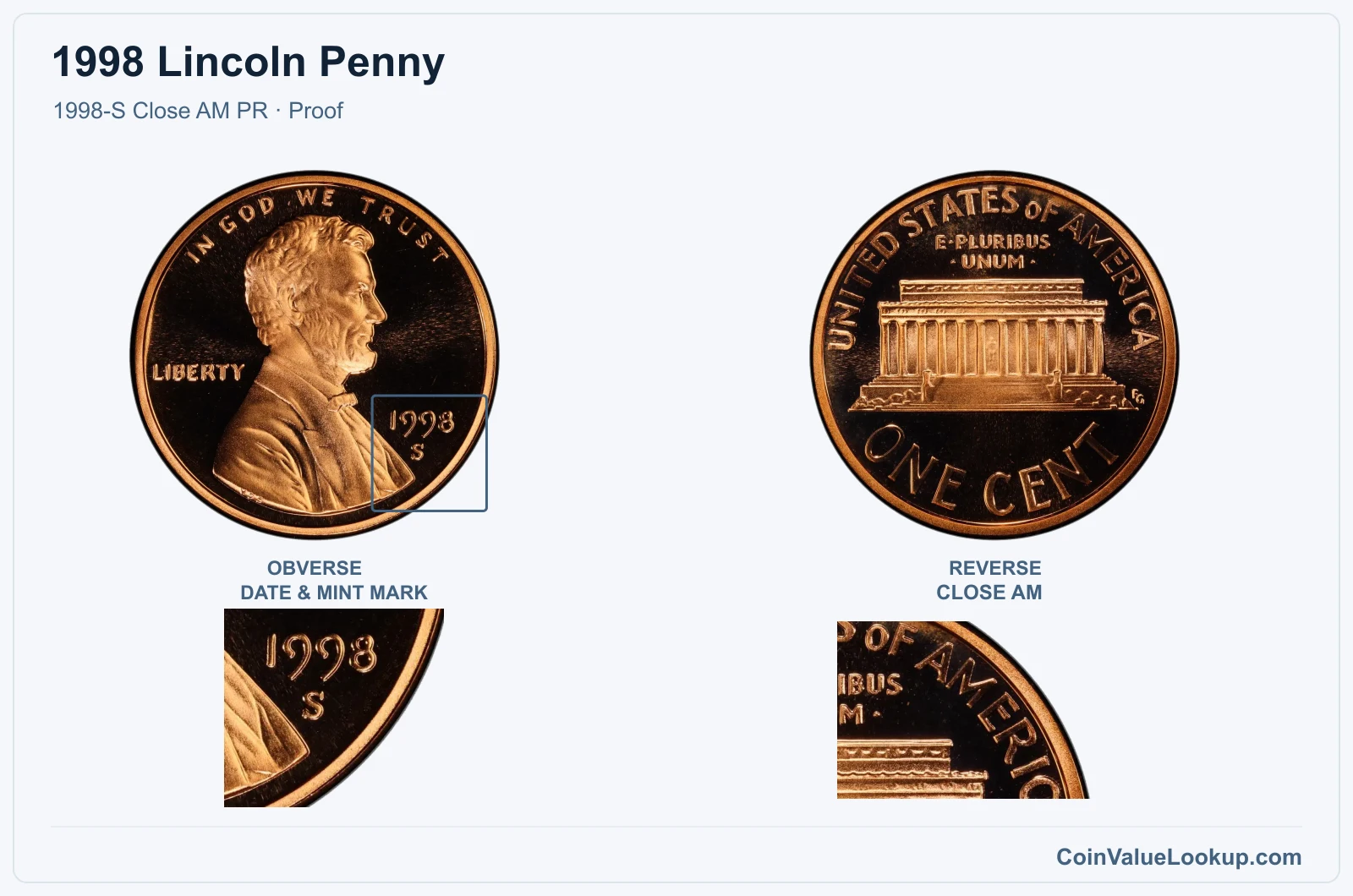
This is the 1998-S proof with the Close AM reverse, where the A and M in AMERICA nearly touch. That is the opposite of the normal Wide AM spacing used on standard 1998-S proofs, making this a recognized and scarce variety.
A published guide estimates about $585 at PR65. That figure alone tells you why it is worth checking every 1998-S proof carefully.
To confirm it, you need both the Close AM spacing and genuine proof characteristics: mirrored fields, an S mintmark and sharp device edges. A normal circulation cent already has Close AM, so simply seeing touching letters is not enough.
The coin must be a proof. Authentication by a third-party grading service is strongly recommended before buying or selling one of these.
| Range | Grade | Price | Auction Records | Appraisal |
|---|---|---|---|---|
| PR | PR 1 | — | Coin Identifier | |
| PR 2 | — | Coin Identifier | ||
| PR 3 | — | Coin Identifier | ||
| PR 4 | — | Coin Identifier | ||
| PR 6 | — | Coin Identifier | ||
| PR 8 | — | Coin Identifier | ||
| PR 10 | — | Coin Identifier | ||
| PR 12 | — | Coin Identifier | ||
| PR 15 | — | Coin Identifier | ||
| PR 20 | — | Coin Identifier | ||
| PR 25 | — | Coin Identifier | ||
| PR 30 | — | Coin Identifier | ||
| PR 35 | — | Coin Identifier | ||
| PR 40 | — | Coin Identifier | ||
| PR 45 | — | Coin Identifier | ||
| PR 50 | — | Coin Identifier | ||
| PR 53 | — | Coin Identifier | ||
| PR 55 | — | Coin Identifier | ||
| PR 58 | — | Coin Identifier | ||
| PR 60 | — | Coin Identifier | ||
| PR 61 | — | Coin Identifier | ||
| PR 62 | — | Coin Identifier | ||
| PR 63 | — | Coin Identifier | ||
| PR 64 | — | Coin Identifier | ||
| PR 65 | Coin Identifier | |||
| PR 66 | — | Coin Identifier | ||
| PR 67 | Coin Identifier | |||
| PR 68 | Coin Identifier | |||
| PR 69 | Coin Identifier | |||
| PR 70 | Coin Identifier |
1998 Lincoln Penny Error List
1. 1998 Lincoln Penny — Doubled Die
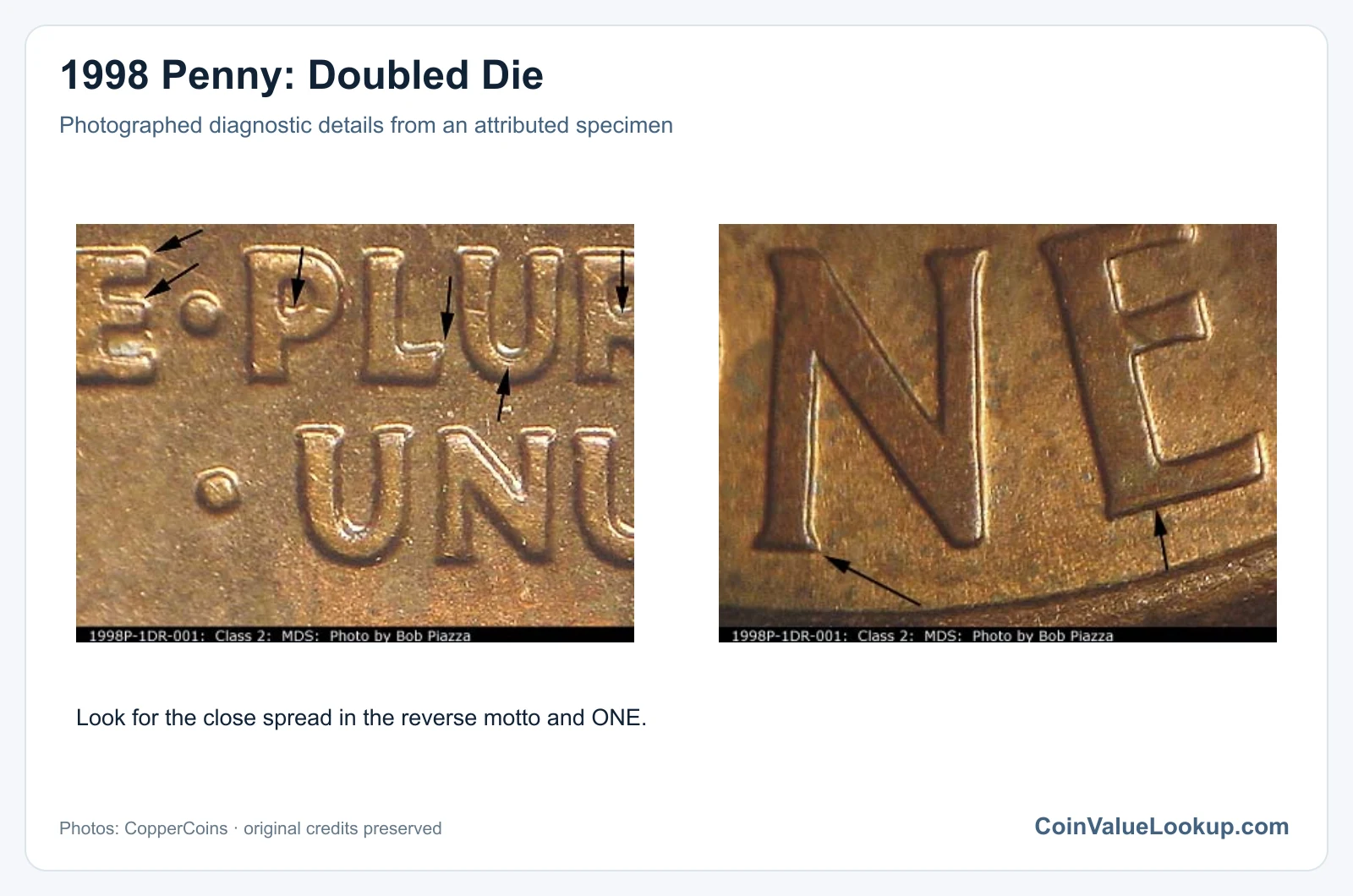
A doubled die on the 1998 Lincoln cent shows consistent doubling of design elements, typically visible as separation or notching on lettering, the date, or Lincoln's profile features. Compare the area you suspect against a normal coin under magnification.
The doubling appears identical on every coin struck from that die, so it will be uniform and directional, not random. Machine doubling, which is mechanical slide from the strike, tends to look flat and shelf-like rather than showing full secondary design separation.
Reflections or post-mint impressions can also mimic the look.
No specific price range is supported here. Value depends on the particular die involved, the strength of the doubling and the coin's authenticated grade and condition.
Professional authentication is the standard path for establishing a doubled die's identity.
2. 1998 Lincoln Penny — Off-Center Strike
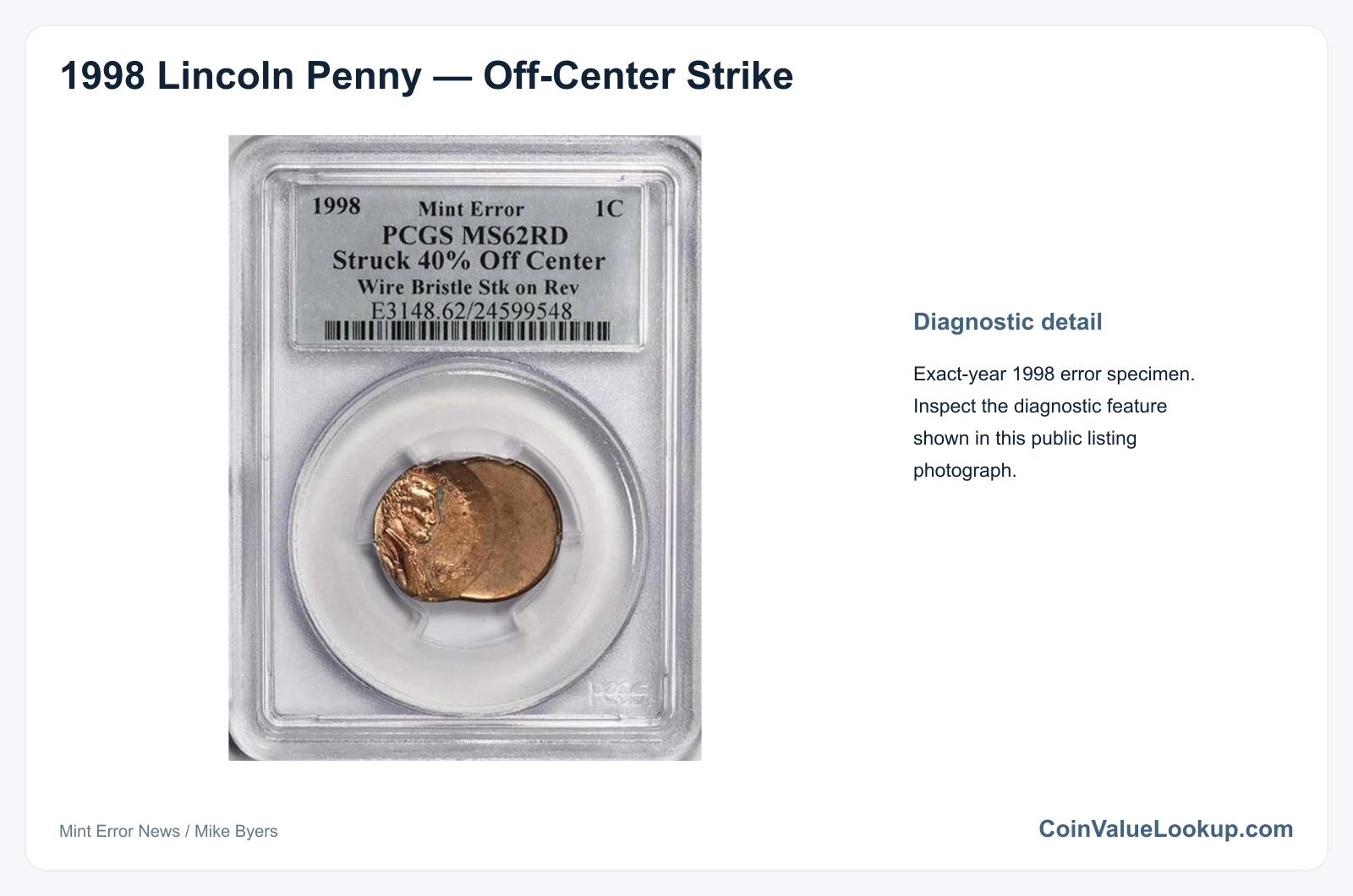
An off-center strike happens when the planchet is not properly seated in the collar during striking. The result is a design that is shifted to one side, leaving a blank crescent of unstruck metal on the opposite edge.
The key for collectibility is that the date must remain visible. Without a readable date, the coin cannot be attributed to 1998 and loses most of its premium.
Heavier off-center percentages with a full date are generally more desirable.
Do not confuse an off-center strike with a clipped planchet, which has a curved bite out of the edge, or with post-mint flattening from damage. A genuine off-center piece will show the full design displaced uniformly, not partially crushed.
Individual assessment based on authentication, percentage of displacement and condition determines value.
3. 1998 Lincoln Penny — BIE Die Break
A BIE die break shows a small raised vertical line or blob between the letters B and E in LIBERTY on the obverse. It is caused by a crack or chip in the die that fills with metal during striking.
Look at LIBERTY under magnification. The raised area should be consistent with the coin's surface, not sitting on top of it like glued debris.
Dirt, scratches and deliberately added material can mimic the look, but a genuine die break will be integral to the coin's metal and often shows a slightly irregular but natural profile.
These are minor die varieties and typically modest in value. Pricing depends on the size and prominence of the break, plus the coin's overall condition.
No specific price range is adopted for the 1998 BIE.
4. 1998 Lincoln Penny — Wrong Planchet / Off-Metal Strike
A wrong planchet error means the 1998 Lincoln cent design was struck on a blank intended for a different denomination or even a foreign coin. The result is a coin that looks like a Lincoln cent but has the wrong weight, diameter, edge or design completeness.
To check, weigh the coin. A normal 1998 cent is 2.50 grams on a 19.05 mm copper-plated zinc planchet with a plain edge.
Significant deviation in weight or diameter, combined with an incomplete strike or unusual metal appearance, suggests a wrong planchet.
Be cautious. Plating loss, corrosion, acid damage and deliberate alteration can make a normal cent look abnormal.
Authentication is essential for any wrong planchet claim. Value depends entirely on the authenticated identity and condition of the specific error.
5. 1998 Lincoln Penny — Wide AM circulation reverse
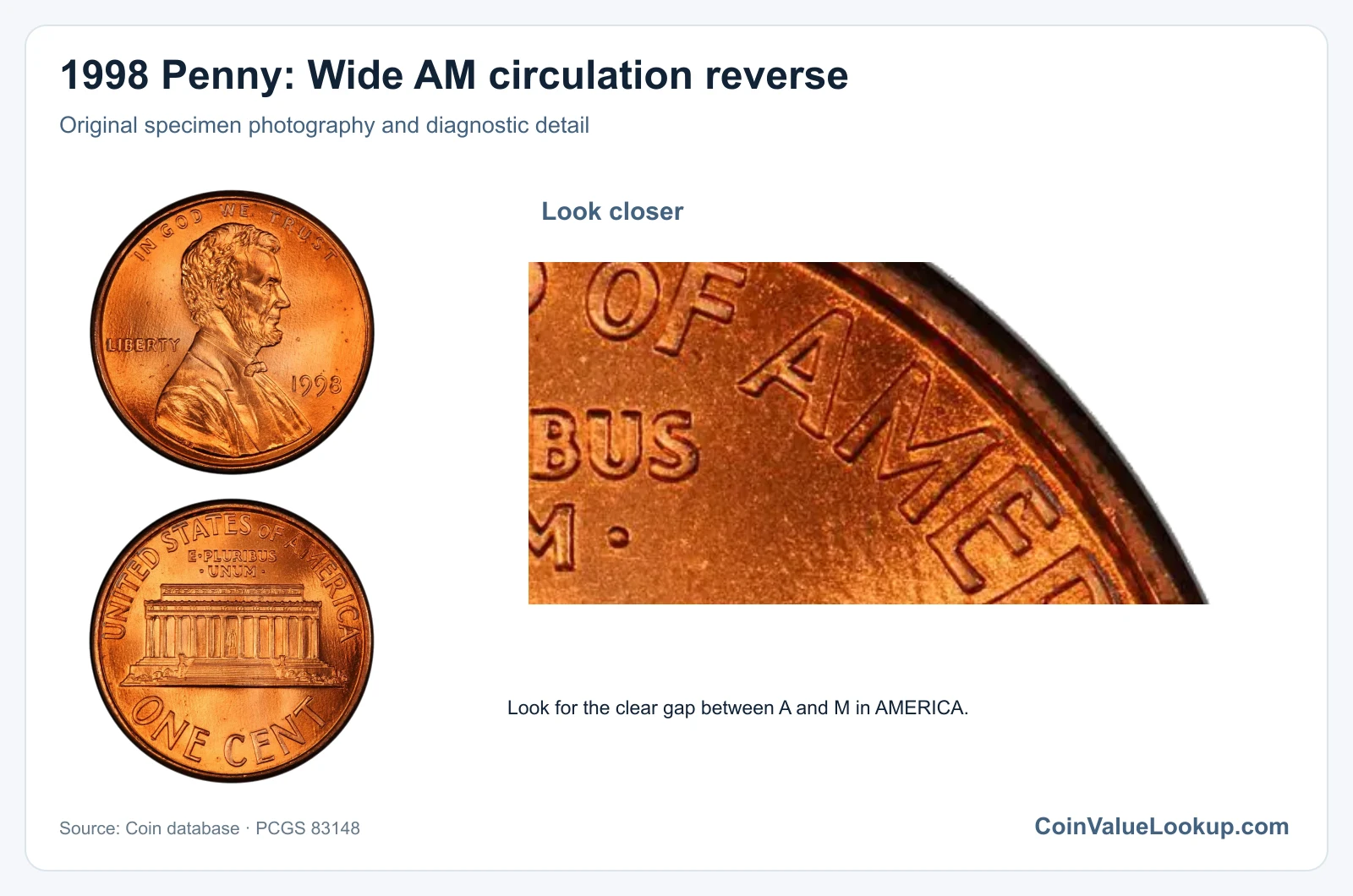
The Wide AM variety on a 1998 Philadelphia circulation cent shows a clear separation between the A and M in AMERICA on the reverse. Normal business strikes of this date use Close AM spacing, where the letters nearly touch.
The Wide AM die was normally reserved for proof production.
To verify, look at the reverse under magnification and compare directly against a known Close AM coin. The gap is most visible at the base of the two letters.
Make sure you are looking at a business strike, not a proof. A proof with Wide AM is completely normal for 1998-S and carries no variety premium.
Damage to lettering or worn dies can sometimes make Close AM spacing look wider than it is. Authentication by a recognized grading service is recommended.
Individual value depends on the coin's authenticated condition and grade.
6. 1998 Lincoln Penny — Close AM proof reverse
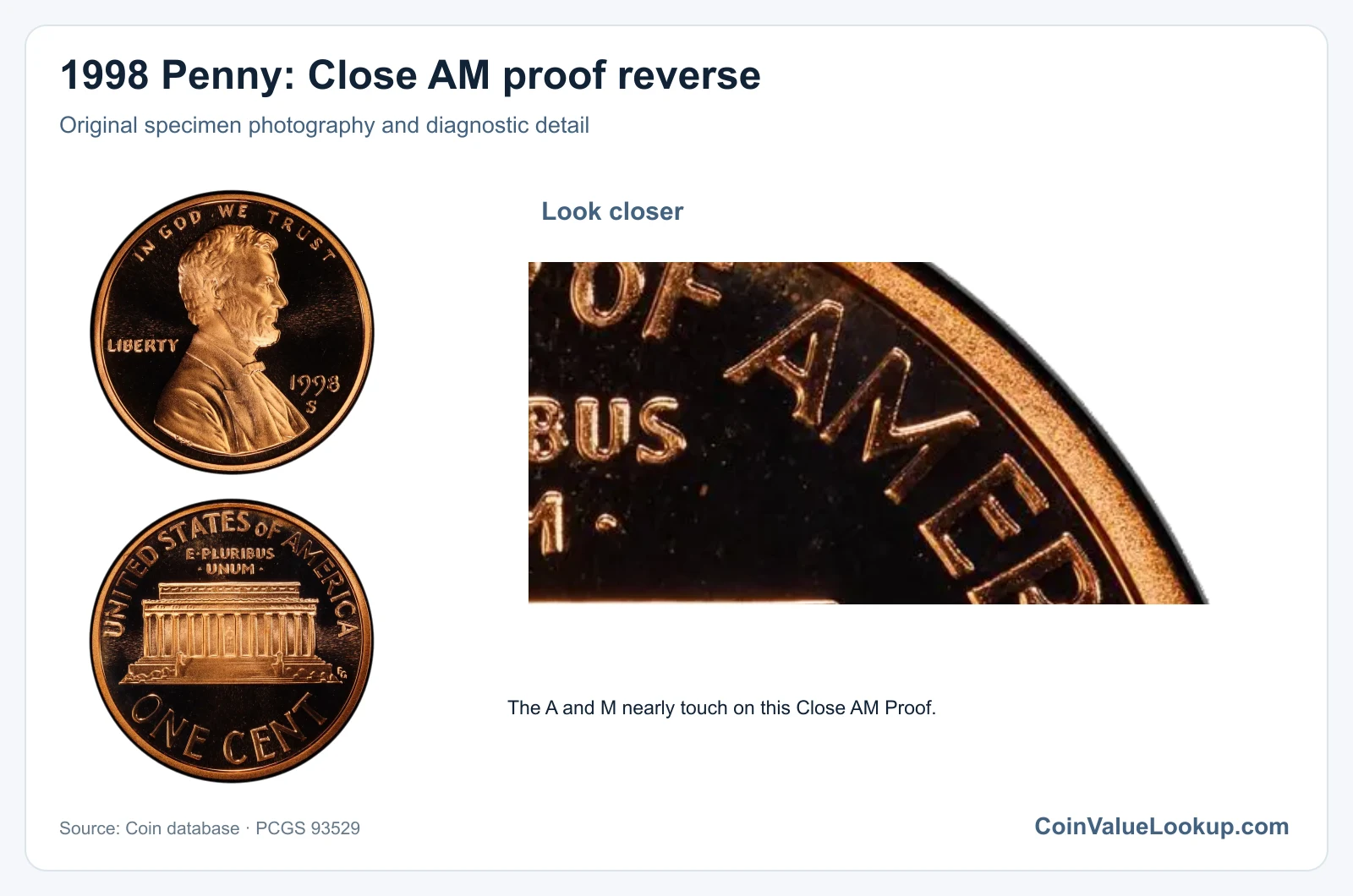
The Close AM proof variety appears on the 1998-S proof cent, where the A and M in AMERICA nearly touch instead of showing the normal Wide AM gap found on standard proofs of this year. This reversal of the expected die pairing is what makes it collectible.
Confirming this variety requires two things at once: genuine proof surfaces, meaning mirrored fields and an S mintmark, and Close AM reverse spacing. A normal circulation cent already has Close AM, so a polished business strike could fool you at first glance.
Check for the deep reflective fields, sharp device edges and the San Francisco mintmark.
No numerical price range is adopted here beyond the guide estimate listed for the version. Authentication is strongly advised, as the visual difference between a genuine Close AM proof and a doctored circulation cent can be subtle in photos.