1998 Kennedy Half Dollar Coin Value: How Much Is It Worth?
The 1998 Kennedy half dollar carries a face value of 50 cents, and most circulated clad examples are worth exactly that. Collector guide estimates for specific mint, finish and grade combinations range from about $3.62 to $40.00, according to USA Coin Book.
Before you check a price chart, you need to know whether your coin is an ordinary business strike, a clad proof, a silver proof or the special matte specimen issue from that year's Kennedy Collector's Set.
Fast Way to Identify Your 1998 Kennedy Half Dollar
Snap a clear photo of the front and back of your 1998 half dollar and upload both images. Our identifier can give you a preliminary read on the mint, finish and general condition so you know which version you are holding.
It is not a substitute for professional authentication or certified grading, but it is a solid first step.
1998 Kennedy Half Dollar Value
Upload both sides of your 1998 Kennedy Half Dollar.
Front Obverse
Upload photo
Back Reverse
Upload photo
Which 1998 Kennedy Half Dollar Versions Are Worth Money?
- Identify the mintmark and finish first; an ordinary clad P or D piece is usually a face-value coin, while silver proofs and the matte specimen carry collector premiums.
- The 1998-S silver proof is the highest-valued standard branch in guide estimates, listed at about $40.00 in PR65.
- The 1998-S silver matte specimen from the Kennedy Collector's Set is a distinct special-finish issue that requires individual assessment based on authenticated identity and condition.
- Mint-made errors such as doubled die obverse, off-center strikes and clipped planchets have been reported for specific mints and can add value depending on visibility and condition.
Step 1: Identify Your 1998 Kennedy Half Dollar Mint Mark and Version
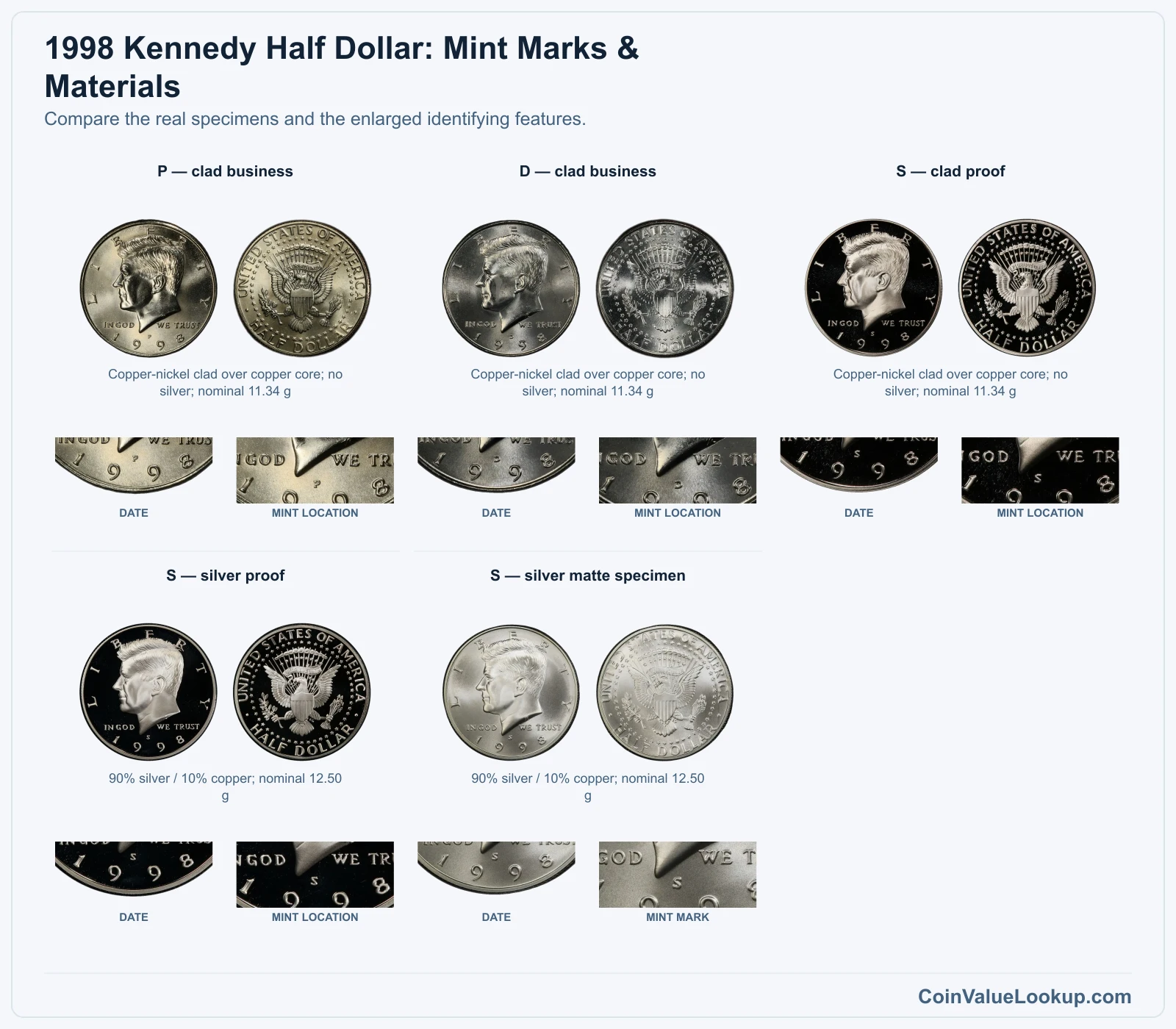
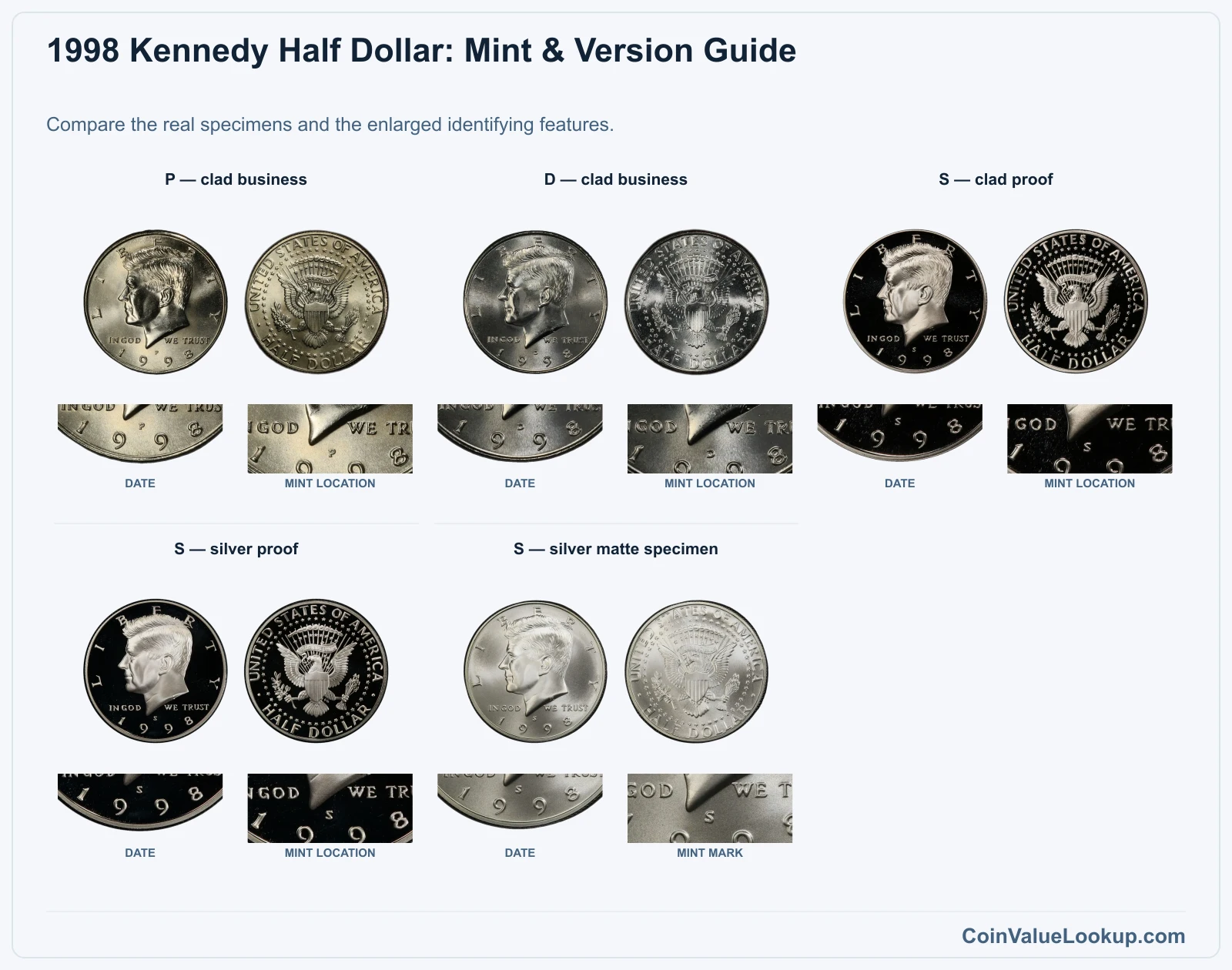
Flip the coin to the obverse and look beneath Kennedy's portrait, just above the date. A small "P" means Philadelphia, "D" means Denver, and "S" means San Francisco.
There is no W mintmark for this year's regular issues.
All P and D coins are copper-nickel clad over a copper core, weighing about 11.34 grams. The S mint made three distinct versions: a clad proof, a 90% silver proof and a 90% silver matte specimen.
Two of those share the same mintmark, so the letter alone will not settle it.
To tell a silver proof from a clad proof, compare weight and edge. Silver proofs weigh roughly 12.50 grams, and their edge shows a uniform silver-gray color rather than the visible copper stripe of a clad coin.
Lighting, toning and aftermarket plating can fool the eye, so a scale helps more than squinting.
The matte specimen has textured, satin-like surfaces instead of the mirror fields and frosted devices you see on a normal proof. It was issued in the Kennedy Collector's Set, and original packaging is the easiest confirmation.
Step 2: Check Your 1998 Kennedy Half Dollar Grade
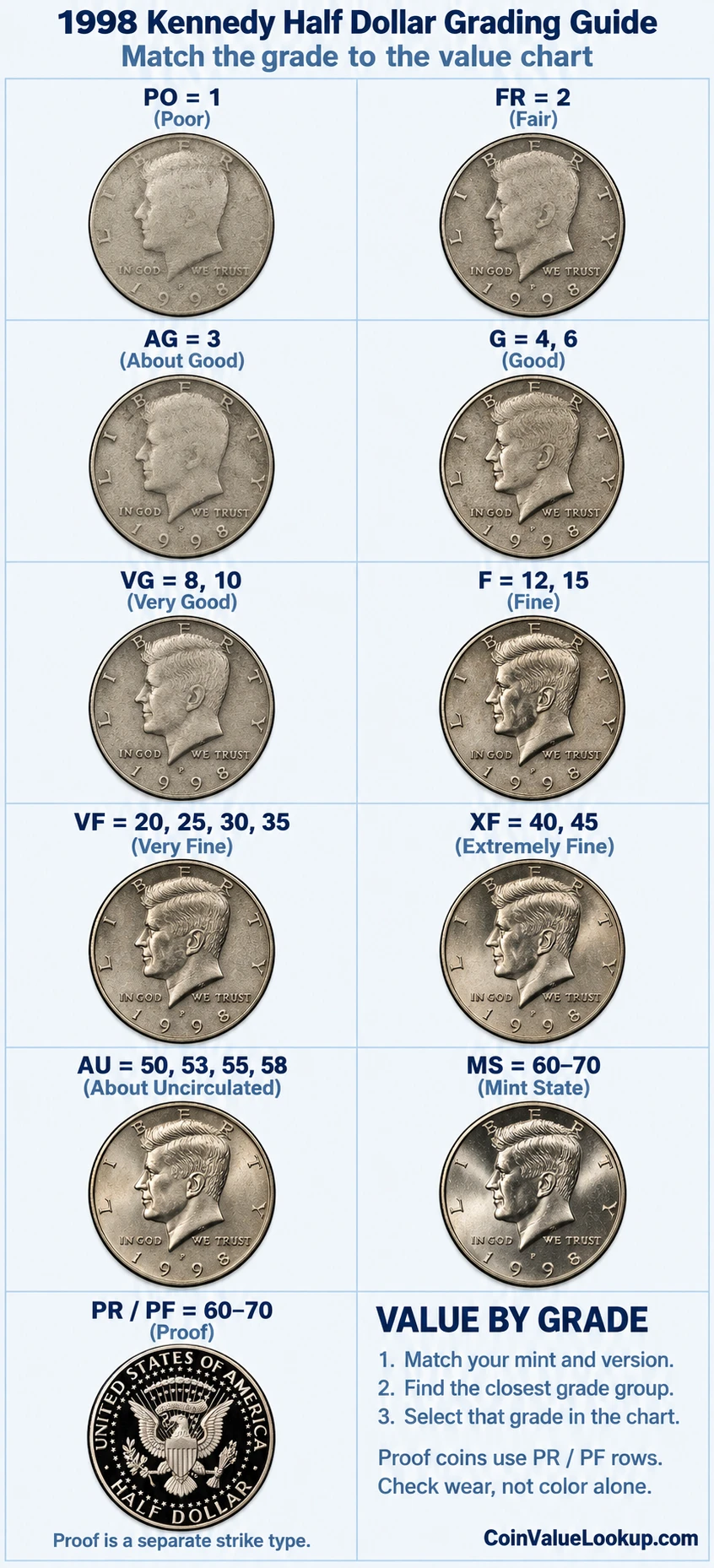
Start at Kennedy's cheekbone and jawline on the obverse. These are the highest points of the design and the first places to show smooth, flat wear from circulation.
Next check the hair detail above the ear; fine strands disappear quickly once a coin enters pocket change.
On the reverse, the eagle's breast feathers and the tops of the wings lose definition first. If those areas are fully sharp with no flattening, you are probably looking at an uncirculated coin.
Bag marks matter. A coin can be technically uncirculated yet covered in small nicks and scuffs from bouncing around in mint bags.
Those contact marks lower the grade even though the coin never circulated. Use the comparison image to see the difference between wear and bag damage.
Proofs need a separate evaluation. Look for hairlines from improper cleaning, haze on the mirror fields and any contact marks on the frosted devices.
A proof with heavy hairlines can grade lower than a clean business strike despite its sharper initial detail.
Step 3: Check 1998 Kennedy Half Dollar Value by Mint and Version
1998 Kennedy Half Dollar — P — clad business
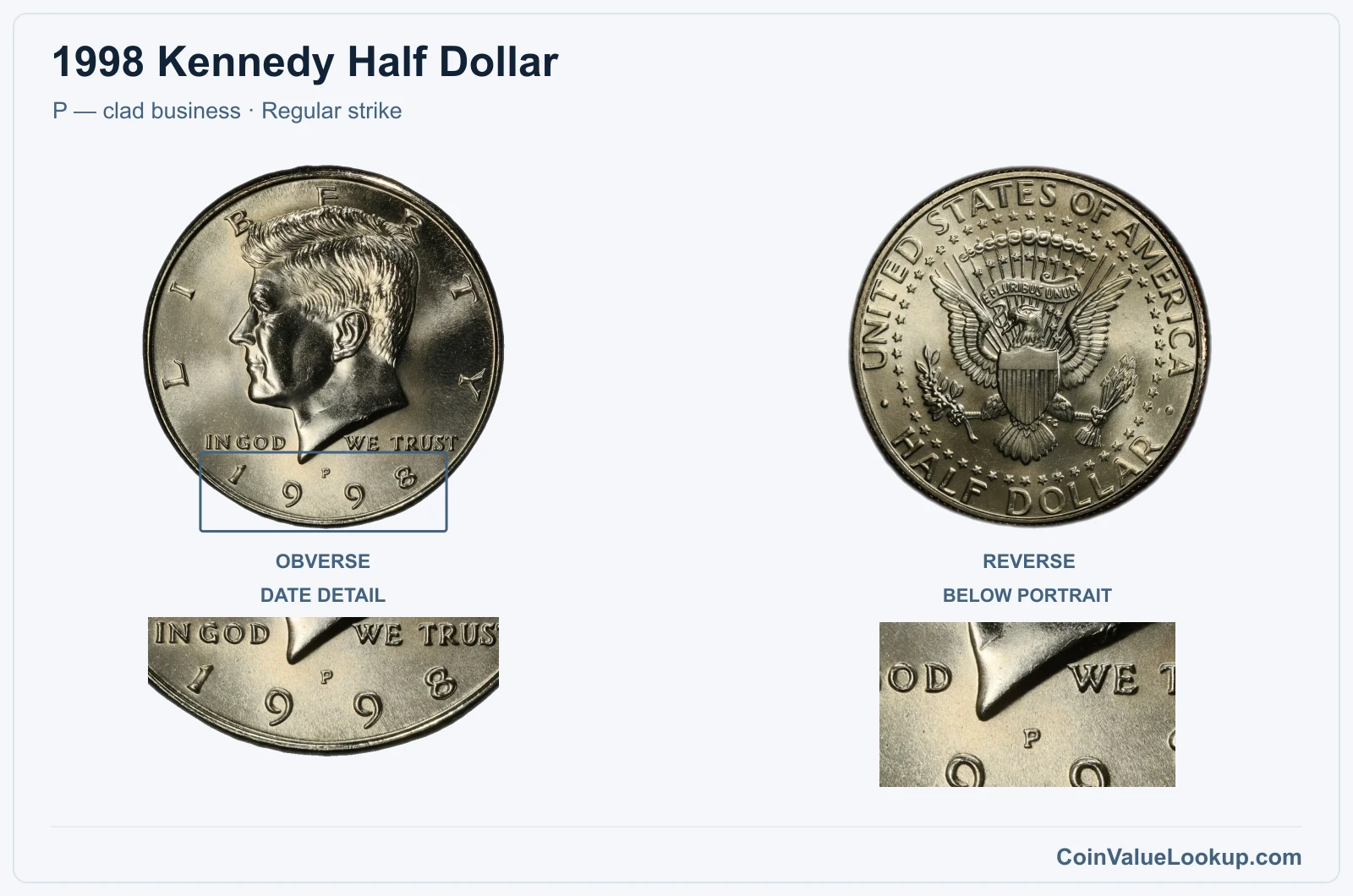
The 1998-P is the Philadelphia business strike, made on a copper-nickel clad planchet weighing about 11.34 grams. Look for the small "P" mintmark on the obverse beneath Kennedy's portrait.
Circulated examples are typically worth face value.
In higher uncirculated grades the coin begins to carry a modest premium. USA Coin Book lists an MS65 at roughly $3.62.
That is a guide estimate, not a guaranteed offer, but it gives you a baseline for a well-preserved example with minimal bag marks and strong luster.
Range Grade
Price Auction Records Appraisal PO PO 1
—
Coin Identifier FR FR 2
—
Coin Identifier AG AG 3
—
Coin Identifier G G 4
—
Coin Identifier
G 6
—
Coin Identifier VG VG 8
—
Coin Identifier
VG 10
—
Coin Identifier F F 12
—
Coin Identifier
F 15
—
Coin Identifier VF VF 20
—
Coin Identifier
VF 25
—
Coin Identifier
VF 30
—
Coin Identifier
VF 35
—
Coin Identifier XF XF 40
—
Coin Identifier
XF 45
—
Coin Identifier AU AU 50
—
Coin Identifier
AU 53
—
Coin Identifier
AU 55
—
Coin Identifier
AU 58
—
Coin Identifier MS MS 60
—
Coin Identifier
MS 61
—
Coin Identifier
MS 62
—
Coin Identifier
MS 63
—
Coin Identifier
MS 64
Coin Identifier
MS 65
Coin Identifier
MS 66
Coin Identifier
MS 67
Coin Identifier
MS 68
Coin Identifier
MS 69
—
—
—
MS 70
—
—
—
1998 Kennedy Half Dollar — D — clad business
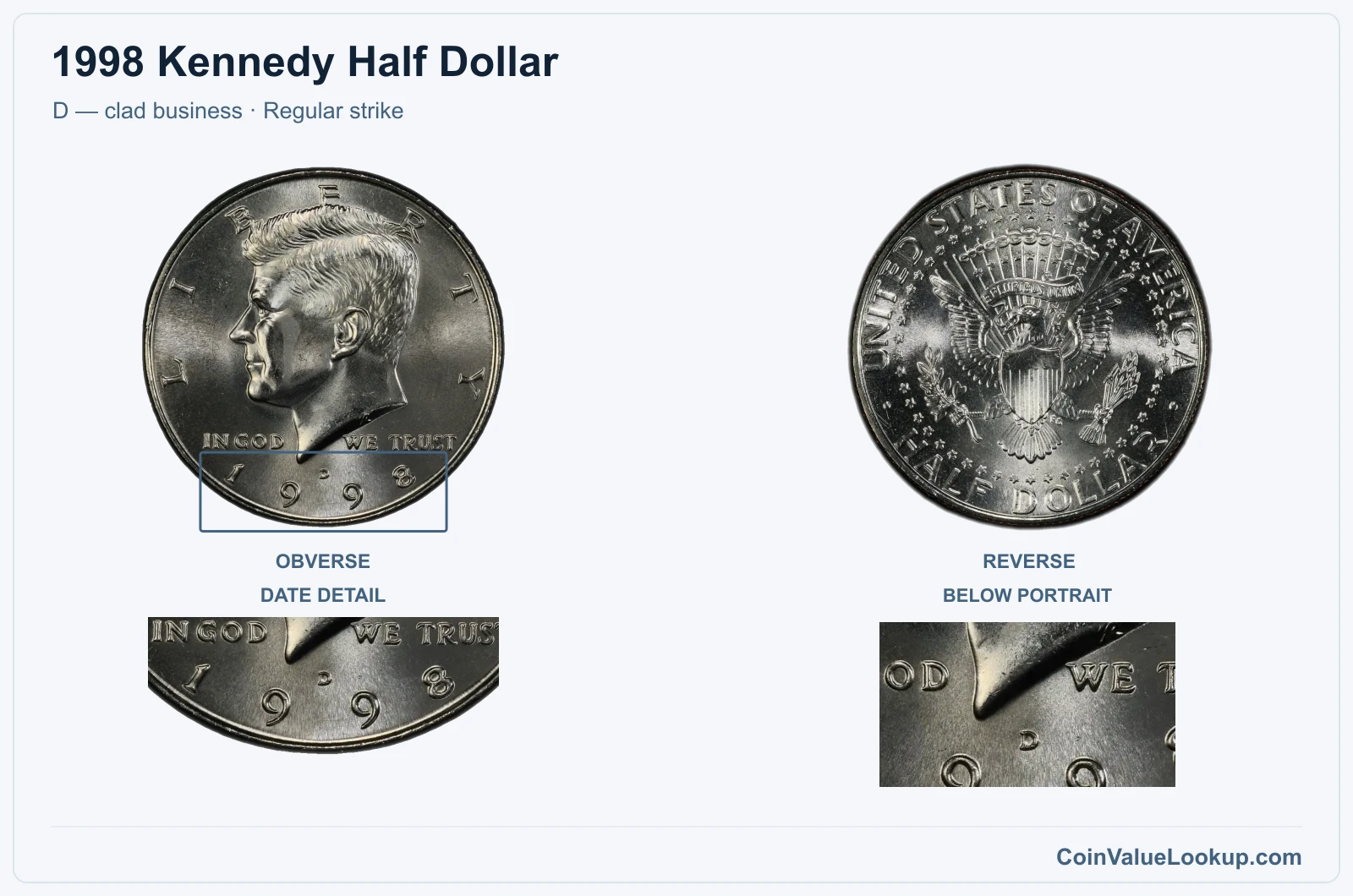
The 1998-D is Denver's clad business strike, identical in composition and weight to its Philadelphia counterpart. The distinguishing feature is a small "D" mintmark beneath Kennedy's portrait on the obverse.
Like the P, worn examples trade at face value. USA Coin Book places the MS65 at about $3.62.
If your coin still has original mint luster and only light contact marks, it falls in this collector-grade territory. Heavy bag marks or dull surfaces push the practical value back toward 50 cents.
Coin Value Lookup is a good starting point if you want to look up guides for other Kennedy half dollar years or different denominations entirely.
Range Grade
Price Auction Records Appraisal PO PO 1
—
Coin Identifier FR FR 2
—
Coin Identifier AG AG 3
—
Coin Identifier G G 4
—
Coin Identifier
G 6
—
Coin Identifier VG VG 8
—
Coin Identifier
VG 10
—
Coin Identifier F F 12
—
Coin Identifier
F 15
—
Coin Identifier VF VF 20
—
Coin Identifier
VF 25
—
Coin Identifier
VF 30
—
Coin Identifier
VF 35
—
Coin Identifier XF XF 40
—
Coin Identifier
XF 45
—
Coin Identifier AU AU 50
—
Coin Identifier
AU 53
—
Coin Identifier
AU 55
—
Coin Identifier
AU 58
—
Coin Identifier MS MS 60
—
Coin Identifier
MS 61
—
Coin Identifier
MS 62
—
Coin Identifier
MS 63
—
Coin Identifier
MS 64
Coin Identifier
MS 65
—
Coin Identifier
MS 66
Coin Identifier
MS 67
Coin Identifier
MS 68
—
Coin Identifier
MS 69
—
—
—
MS 70
—
—
—
1998 Kennedy Half Dollar — S — clad proof
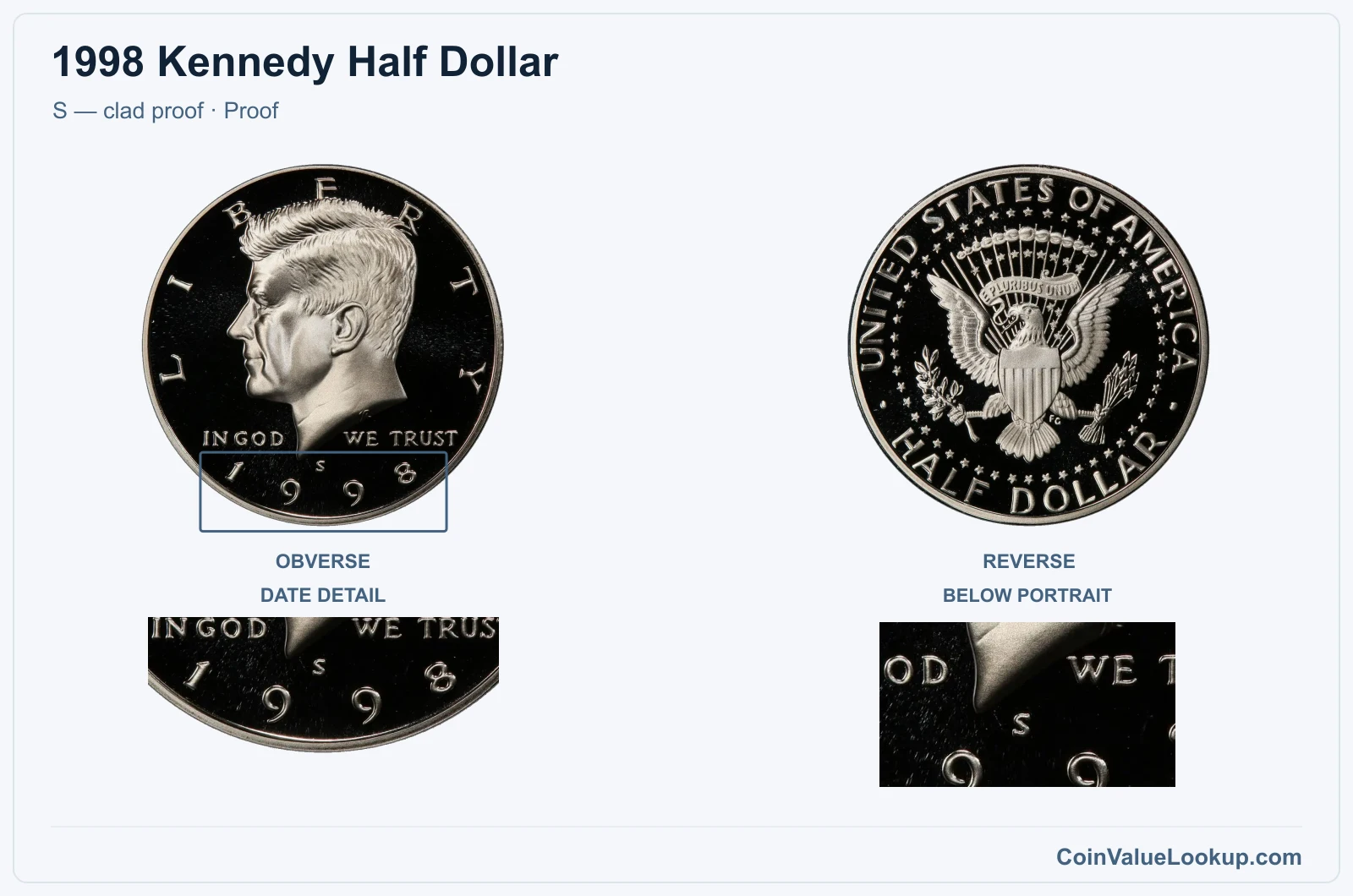
This is the San Francisco clad proof, struck on the same copper-nickel clad composition as the business strikes but with mirror-finish fields and frosted, raised devices. It weighs about 11.34 grams and shows a visible copper stripe along the edge, just like a regular clad half.
Do not confuse it with the silver proof, which also carries an S mintmark. Weigh the coin or check the edge color to distinguish them.
USA Coin Book estimates a PR65 clad proof at around $12.00. Hairlines from handling or improper storage will reduce the grade and the premium quickly.
Range Grade
Price Auction Records Appraisal PR PR 1
—
Coin Identifier
PR 2
—
Coin Identifier
PR 3
—
Coin Identifier
PR 4
—
Coin Identifier
PR 6
—
Coin Identifier
PR 8
—
Coin Identifier
PR 10
—
Coin Identifier
PR 12
—
Coin Identifier
PR 15
—
Coin Identifier
PR 20
—
Coin Identifier
PR 25
—
Coin Identifier
PR 30
—
Coin Identifier
PR 35
—
Coin Identifier
PR 40
—
Coin Identifier
PR 45
—
Coin Identifier
PR 50
—
Coin Identifier
PR 53
—
Coin Identifier
PR 55
—
Coin Identifier
PR 58
—
Coin Identifier
PR 60
—
Coin Identifier
PR 61
—
Coin Identifier
PR 62
—
Coin Identifier
PR 63
—
Coin Identifier
PR 64
—
Coin Identifier
PR 65
—
Coin Identifier
PR 66
—
Coin Identifier
PR 67
—
Coin Identifier
PR 68
Coin Identifier
PR 69
Coin Identifier
PR 70
Coin Identifier
1998 Kennedy Half Dollar — S — silver proof
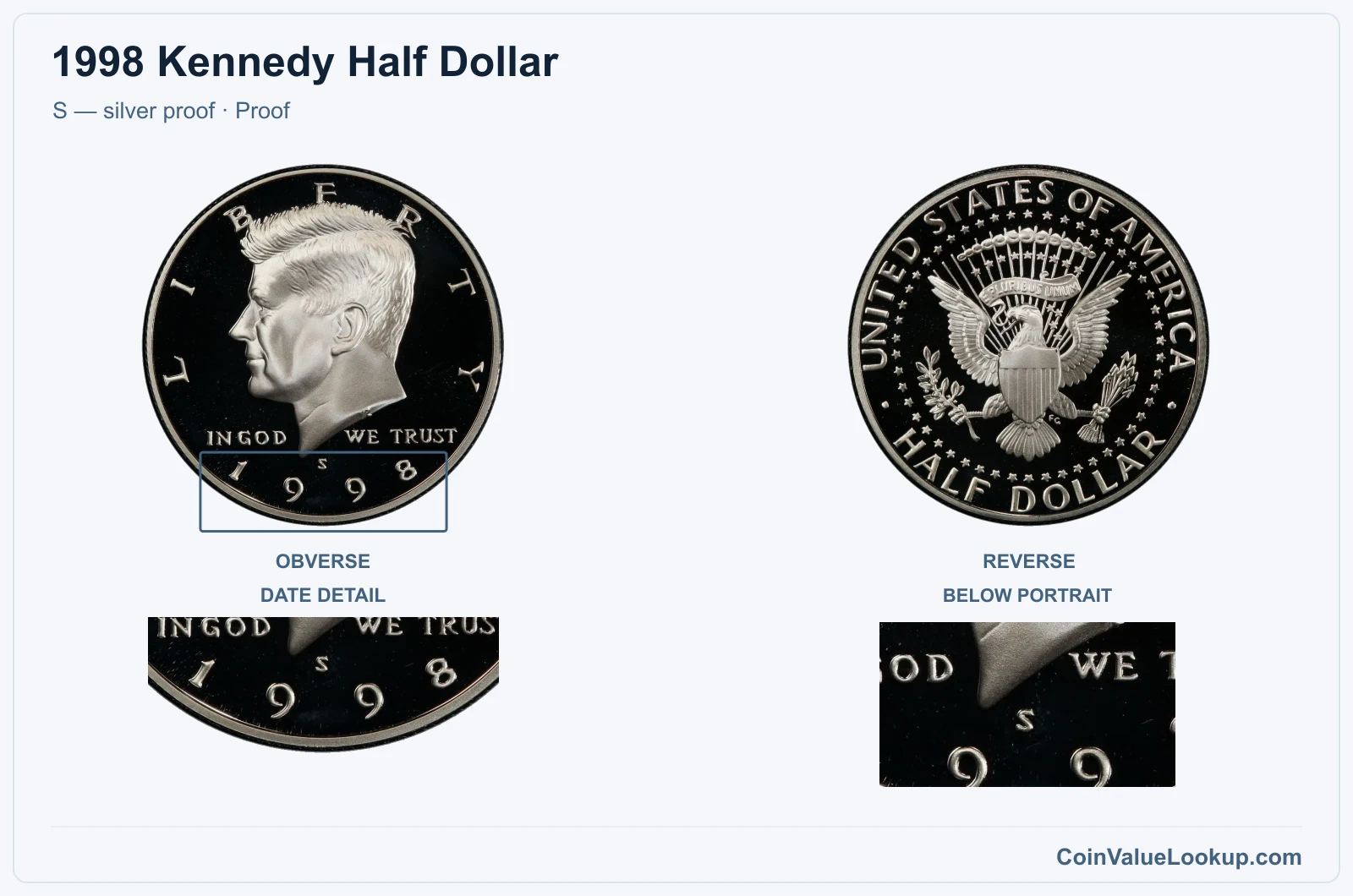
The 1998-S silver proof is struck on a 90% silver, 10% copper planchet weighing approximately 12.50 grams. Its edge is uniformly silver-gray with no copper stripe.
The fields are deeply mirrored, and the devices carry sharp frosted contrast.
This is the highest guide-valued standard branch for the year. USA Coin Book lists PR65 at about $40.00.
That premium reflects the silver content and the collector-finish quality together. Confirm composition with a scale or edge inspection rather than relying on the mintmark alone, because the clad proof also carries an S.
Silver fineness for Kennedy proofs changed to .999 starting in 2019, so this 1998 issue is the older 90% standard.
Range Grade
Price Auction Records Appraisal PR PR 1
—
Coin Identifier
PR 2
—
Coin Identifier
PR 3
—
Coin Identifier
PR 4
—
Coin Identifier
PR 6
—
Coin Identifier
PR 8
—
Coin Identifier
PR 10
—
Coin Identifier
PR 12
—
Coin Identifier
PR 15
—
Coin Identifier
PR 20
—
Coin Identifier
PR 25
—
Coin Identifier
PR 30
—
Coin Identifier
PR 35
—
Coin Identifier
PR 40
—
Coin Identifier
PR 45
—
Coin Identifier
PR 50
—
Coin Identifier
PR 53
—
Coin Identifier
PR 55
—
Coin Identifier
PR 58
—
Coin Identifier
PR 60
—
Coin Identifier
PR 61
—
Coin Identifier
PR 62
—
Coin Identifier
PR 63
—
Coin Identifier
PR 64
—
Coin Identifier
PR 65
—
Coin Identifier
PR 66
—
Coin Identifier
PR 67
—
Coin Identifier
PR 68
Coin Identifier
PR 69
Coin Identifier
PR 70
Coin Identifier
1998 Kennedy Half Dollar — S — silver matte specimen
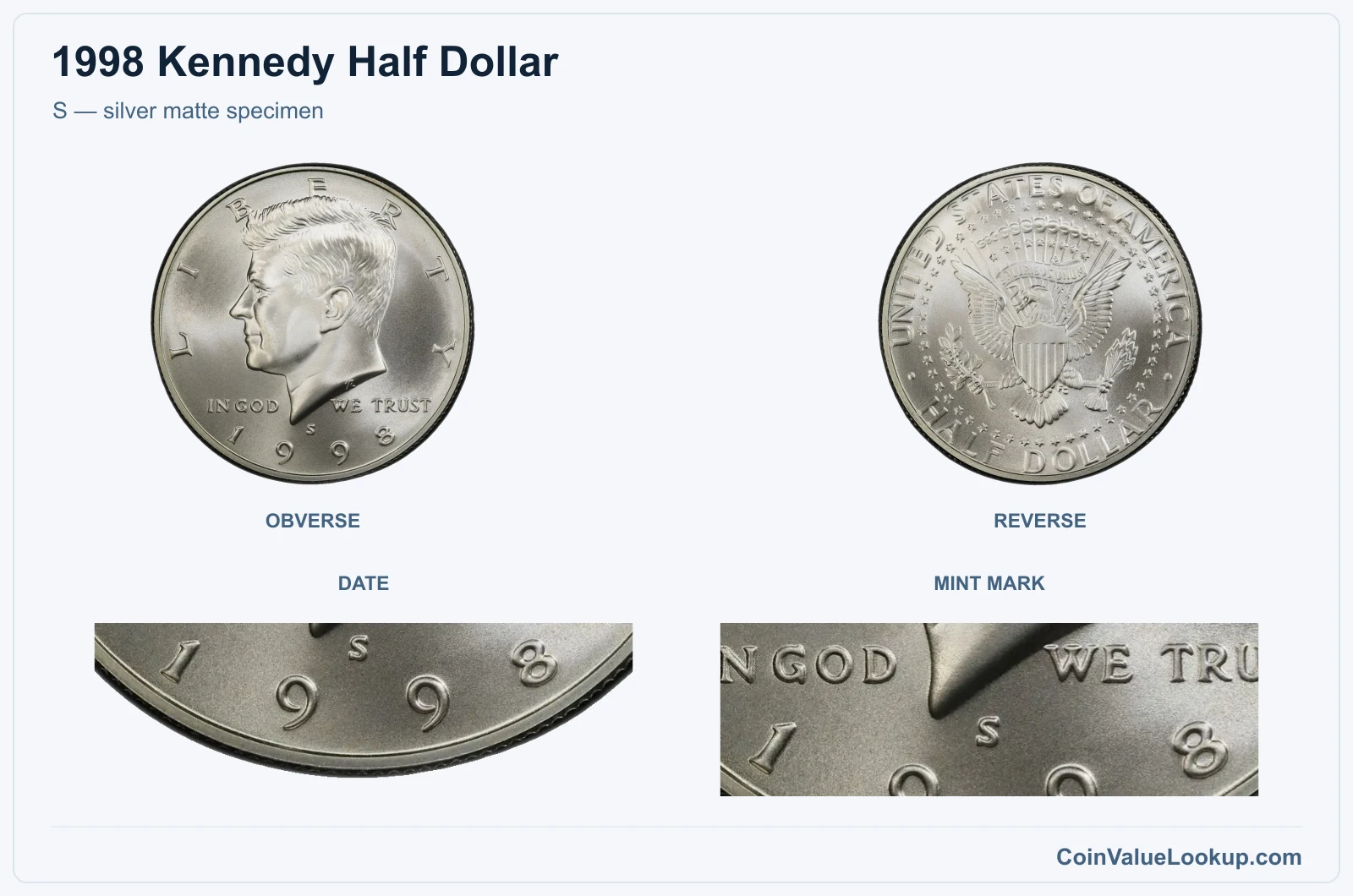
The 1998-S silver matte specimen is the odd one out. Struck on the same 90% silver planchet as the silver proof, it has a completely different surface texture: soft, granular and satin-like rather than mirrored.
It was issued as part of the Kennedy Collector's Set.
Because it shares the S mintmark and silver composition with the standard proof, surface finish is your main diagnostic. Mirror fields mean proof; uniform matte texture means specimen.
Original government packaging is the easiest confirmation.
No numerical guide value is available for this version in the supplied references. Value depends on authenticated identity, condition and any error present, so individual assessment by a grading service or knowledgeable dealer is the practical path to a price.
Range Grade
Price Auction Records Appraisal SP SP 1
—
Coin Identifier
SP 2
—
Coin Identifier
SP 3
—
Coin Identifier
SP 4
—
Coin Identifier
SP 6
—
Coin Identifier
SP 8
—
Coin Identifier
SP 10
—
Coin Identifier
SP 12
—
Coin Identifier
SP 15
—
Coin Identifier
SP 20
—
Coin Identifier
SP 25
—
Coin Identifier
SP 30
—
Coin Identifier
SP 35
—
Coin Identifier
SP 40
—
Coin Identifier
SP 45
—
Coin Identifier
SP 50
—
Coin Identifier
SP 53
—
Coin Identifier
SP 55
—
Coin Identifier
SP 58
—
Coin Identifier
SP 60
—
Coin Identifier
SP 61
—
Coin Identifier
SP 62
—
Coin Identifier
SP 63
—
Coin Identifier
SP 64
—
Coin Identifier
SP 65
—
Coin Identifier
SP 66
—
Coin Identifier
SP 67
Coin Identifier
SP 68
Coin Identifier
SP 69
Coin Identifier
SP 70
Coin Identifier
1998 Kennedy Half Dollar Error List
1. 1998 Kennedy Half Dollar — Doubled Die Obverse
A doubled die obverse error has been reported for the 1998-P Kennedy half dollar. On an affected coin, you would see consistent doubling or separation in the obverse lettering or design elements.
The key word is consistent: the doubling should appear in the same direction and magnitude across affected areas, not randomly.
Compare your coin to a normal 1998-P under the same lighting and magnification. Look for notching on letter edges or a secondary outline on design elements rather than a flat, shelf-like distortion.
Machine doubling, die wear and reflections from proof-like surfaces can all mimic a true doubled die.
No specific price range is available for this error. Value depends on the visibility of the doubling, overall coin condition and professional authentication of the variety.
2. 1998 Kennedy Half Dollar — Off-Center Strike
Off-center strikes have been reported for the 1998-D Kennedy half dollar. This happens when the planchet is not properly seated between the dies during striking, producing a displaced design with an unstruck crescent of blank metal along one edge.
The degree of off-center shift matters. A barely noticeable 2% shift adds very little; a dramatic 10% or more with the full date still visible is far more desirable.
Check that the blank crescent shows the same edge texture as the rest of the coin and that the displacement is uniform rather than one-sided.
Do not confuse an off-center strike with a clipped planchet or post-mint damage like filing or flattening. No specific price range is available.
Condition, the percentage of displacement and date visibility all factor into value, and professional assessment is recommended.
3. 1998 Kennedy Half Dollar — Clipped Planchet
Clipped planchet errors have been reported for the 1998-S Kennedy half dollar. A clip occurs when the blank is punched from strip metal that overlaps a previously punched hole, leaving a missing curved, straight or irregular section on the finished coin.
Look for a crescent-shaped absence along the rim. Genuine clips often show a characteristic area of weakness in the design directly opposite the missing section, called the Blakesley effect, where metal flow during striking was disrupted.
The edge at the clip should be smooth and natural, not rough or tooled.
Post-mint damage like filed edges, corrosion pits or deliberate cuts can look similar. A filed area typically shows scratches running in one direction, while a genuine clip has metal-flow characteristics consistent with the striking process.
No numerical price is available for this error; value depends on clip size, condition and authentication.